1 Introduction
Studies have shown that there can be considerable variation in phonation based on gender, F0, and/or position.Footnote 1 For example, females were reported to be breathier than males in several languages/dialects such as Japanese (Todaka Reference Todaka1993), American English (Klatt & Klatt Reference Klatt and Klatt1990, Hanson Reference Hanson1997, Hanson & Chuang Reference Hanson and Chuang1999), and British English (Henton & Bladon Reference Henton and Bladon1985). Some of these gender-dependent variations could be due to physiological differences; for example, direct observations of the vocal folds via fiberscopy showed that females were more likely to have incomplete glottal closure than males, which can produce a breathier voice quality (Södersten & Lindestad Reference Södersten and Lindestad1990). Gender-based phonation differences, however, do not always vary in a systematic way. For example, while results of acoustic analyses showed that on average American-English–speaking females were breathier than males, there was a great deal of gender variation and, in fact, some males were breathier than the females (Klatt & Klatt Reference Klatt and Klatt1990). Furthermore, Redi & Shattuck-Hufnagel (Reference Redi and Shattuck-Hufnagel2001) examined glottalization (a phonation similar to creaky) and found that glottalization in American English could not be predicted from gender alone.
In addition to gender, studies have suggested that phonation can be sensitive to changes in fundamental frequency (F0), whether at the lexical or utterance level. For example, a lower F0 was correlated with breathy-voiced stops in Hindi (Ohala Reference Ohala1973), while a higher F0 was correlated with a tense voice in Jingpho, Lahu and Yi (Maddieson & Hess Reference Maddieson and Hess1987). Furthermore, Hagen (Reference Hagen1997) found that in English and German, glottalization occurred more often on words produced with a low F0.
Studies have also shown that phonation can vary due to position. For example, Epstein (Reference Epstein2002) showed through inverse filtering that tense phonations were found utterance-initially regardless of F0 in American English. Other studies have shown that the ends of sentences or paragraphs in English can be associated with either (i) creakiness (or glottalization) (Lehiste Reference Lehiste, Cohen and Nooteboom1975, Kreiman Reference Kreiman1982, Henton & Bladon Reference Henton and Bladon1985) or (ii) a ‘breathy-laryngealized’ voice, a type of voice quality characterized by a simultaneous increase in the posterior glottal chink creating breathy voice and a rotation of the anterior tips of the arytenoid cartilages creating laryngealization (Klatt & Klatt Reference Klatt and Klatt1990). (This effect can likely be explained as the initiation of aryepiglottic trilling, Esling Reference Esling2005.) Several studies have reported creak phrase-initially, phrase-finally and at the boundary of smaller prosodic units from direct measuring/observation of the voicing source (Pierrehumbert & Talkin Reference Pierrehumbert, Talkin, Docherty and Ladd1992, Pierrehumbert Reference Pierrehumbert1995) or through qualitative assessment and labeling of waveforms (Dilley, Shattuck-Hufnagel & Ostendorf Reference Dilley, Shattuck-Hufnagel and Ostendorf1996, Hagen Reference Hagen1997). Additionally, the ends of sentences were associated with a lax voice quality in Swedish (Gobl Reference Gobl1988, using inverse filtering), and a creaky voice quality in Finnish (Ogden Reference Ogden2003, obtained through qualitative assessment and labeling of waveforms). With the exception of Epstein (Reference Epstein2002), however, it is difficult to tell from these studies if it is phonological pitch or position that altered phonation.
Each of the aforementioned studies (with the exception of Hindi, Ohala Reference Ohala1973) examined variation in phonation in a language with either allophonic or suprasegmental non-modal phonation. Less attention has been given to this sort of variation in languages with phonemic phonation contrasts, though some gender-dependent differences have been observed. (No study has examined or observed changes in phonation due to sentence-level F0 and/or position in languages with contrastive phonation.) In Jalapa Mazatec, a language that contrasts breathy, modal and creaky vowels, females were significantly breathier than males in their acoustic manifestation of breathiness (Blankenship Reference Blankenship1997) and in San Lucas Quiaviní Zapotec, a language that contrasts breathy, modal, creaky, and checked vowels (a vowel followed by a glottal stop with a phonation type distinct from modal and creaky, Munro & Lopez Reference Munro, Lopez, Mendez, Garcia and Galant1999), Gordon & Ladefoged (Reference Gordon and Ladefoged2001) observed spectrographic evidence that the female speaker was breathier than the male speaker. While there is some evidence that phonation will vary, at least as a function of gender, little is known about potential sources of variation in languages with contrastive phonation.
The present study sets out to investigate variation in phonation due to (i) gender, (ii) F0, and/or (iii) prosodic position in Santa Ana del Valle Zapotec, an Oto-Manguean language with phonemically breathy, modal, and creaky vowels.
Before discussing the present study in detail, there will first be a presentation of background information on Santa Ana del Valle Zapotec, then a review of the relevant acoustic measures of phonation, followed by methodology, results and discussion of the data.
2 Background
2.1 About the language
Santa Ana del Valle Zapotec (hereafter SADVZ) is an Oto-Manguean language spoken in Santa Ana del Valle, Oaxaca, Mexico. The Ethnologue (R. Gordon Reference Gordon2005) classifies SADVZ as belonging to the San Juan Guelavía Zapotec subgroup, which contains the numerous and diverse languages spoken in the Valley of Oaxaca, such as San Juan Guelavía (for which the subgroup is named), Jalieza Zapotec, Teotitlán del Valle Zapotec, and San Martín Tilcajete Zapotec, to name a few. There are approximately 28,000 speakers (1990 census) for the entire San Juan Guelavía Zapotec subgroup; it is not known what portion of this is composed of SADVZ speakers.
SADVZ has six vowels [i e i a u o], each of which can have one of three contrastive phonations: modal, breathy, or creaky. In addition, tone is contrastive on modal vowels, which can have either a high or a rising tone. There is no difference in phonation between the high and rising modal vowels. Breathy and creaky vowels both have a falling tone (Esposito Reference Esposito2003, Reference Esposito2004a). Thus, there is a strong relationship between lexical F0 and phonation in that modal phonations are only produced with high F0s. The question of whether sentence-level F0 will have the same relationship with phonation will be explored in the current study.
Santa Ana del Valle Zapotec, is a (V)erb–(S)ubject–(O)bject language. An example of a basic declarative sentence with VSO word order is given in (1).
(1)


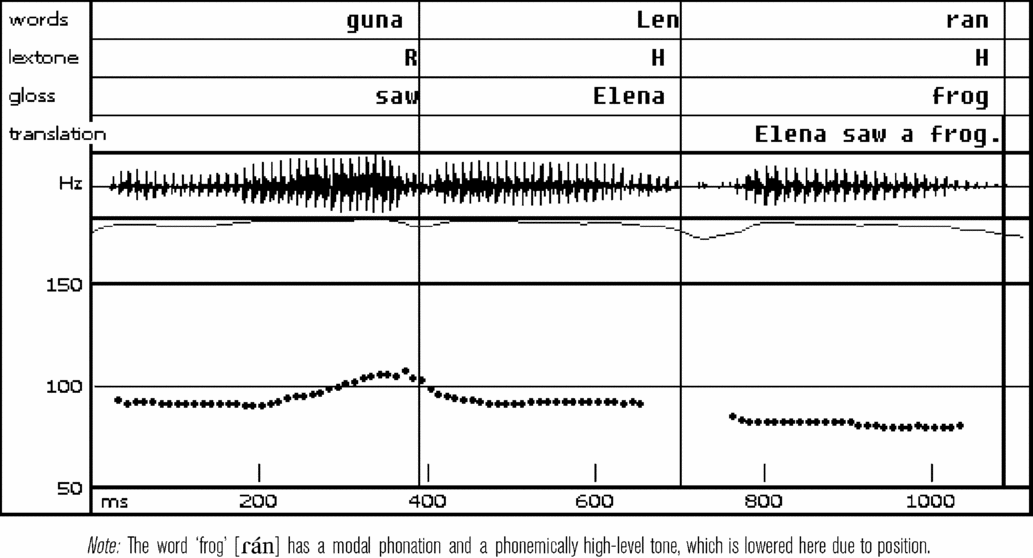
However, SADVZ also allows SVO and OVS word order (in which case the preverbal material has a focused reading). The relatively free word order of SADVZ makes it an ideal language in which to examine the effects of position on phonation because words can be elicited in a variety of positions. Furthermore, there is no utterance-final drift in sentence-level F0, making it possible to study the effects of position without a strong influence of sentence-level F0. A studyFootnote 2 of the intonation of SADVZ showed that in sentence-final position in a declarative sentence the original tonal pattern was preserved though the overall pitch value was lowered. For example, if a lexically high tone word was in sentence-final position in a basic declarative, there was a phonological lowering of lexical F0, but the level contour was preserved (i.e. it does not change to a falling F0). This is exemplified in Figure 1, a pitch track of the sentence in example (1); the end of the sentence ends with a low-level F0, and not a falling F0. In Figure 1 and throughout, the SADVZ words are written in IPA (with the exception of the 〈r〉 which represents [ɾ]) on the word tier, followed by the lexical tone (R = rising tone, H = high tone), gloss and translation.
Pitch track of [gunaˇ leˊn ɾaˊn] ‘Elena saw a frog’.

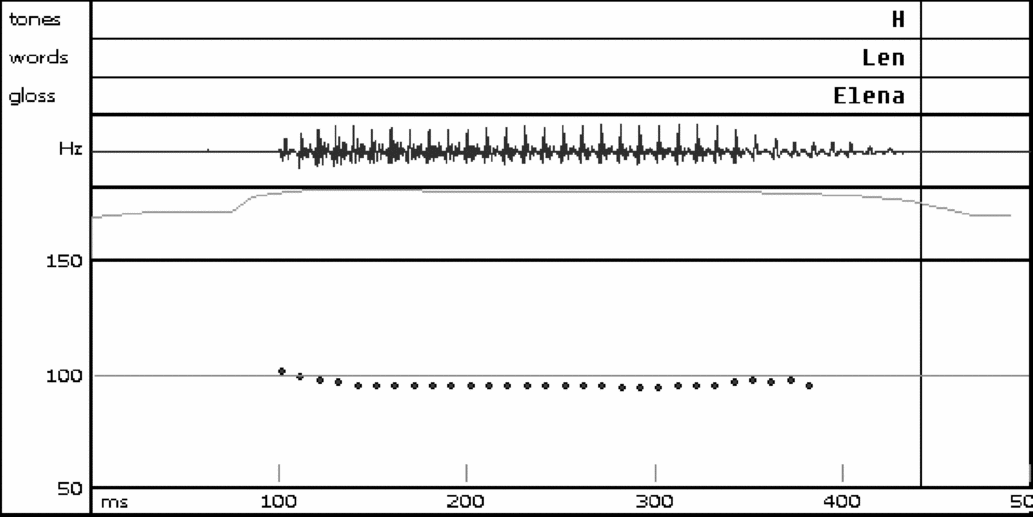
It is also possible to examine the potential influence of sentence-level F0 on phonation, independently of position, through the examination of a variety of intonational contours. For example, words in sentence-medial position have the same sentence-level F0 as words uttered in isolation without focus. Note the similarity in the F0 of ‘Elena’ [lén] as pronounced in isolation (without focus) (Figure 2) to the way in which it is pronounced in sentence-medial position (Figure 1).
Pitch track of [leˊn] ‘Elena’ produced in isolation without focus.

The independent relationship between sentence-level F0 and position, the relatively free word order, and the lack of an utterance-final drift in F0 make SADVZ an ideal language in which to study variation in phonation.
2.2 About measurements
There are numerous acoustic properties that can be useful measures of phonation, though spectral measures have been the most popular method for measuring phonation from an audio signal. Spectral measures have been a reliable measure of phonation in Hmong (Huffman Reference Huffman1987, Andruski & Ratliff Reference Andruski and Ratliff2000), Mazatec (Kirk, Ladefoged & Ladefoged Reference Kirk, Ladefoged, Ladefoged, Mattina and Montler1993, Silverman et al. Reference Silverman, Blankenship, Kirk and Ladefoged1995, Blankenship Reference Blankenship1997), and !Xóõ (Bickley Reference Bickley1982, Ladefoged Reference Ladefoged, Bless and Abbs1983, Ladefoged, Maddieson & Jackson Reference Ladefoged, Maddieson, Jackson and Fujimura1988), to name a few. Primarily, the difference between the amplitudes of the first and second harmonics (H1-H2) has been used to distinguish phonation (e.g. Fischer-Jørgensen Reference Fischer-Jørgensen1967; Bickley Reference Bickley1982). Other studies, however, have made use of the relationship between the amplitude of H1 compared to the amplitude of harmonics exciting higher formants (e.g. A1, A2, A3, and A4). These include: H1-A3 (Stevens & Hanson Reference Stevens and Hanson1995, Blankenship Reference Blankenship1997), H1-A1 or H1-A2 (Ladefoged Reference Ladefoged, Bless and Abbs1983) and the average of H1-H2 compared to A1 (Stevens Reference Stevens1988).
The majority of studies on linguistically-relevant voice qualities (e.g. Bickley Reference Bickley1982, Ladefoged Reference Ladefoged, Bless and Abbs1983, Huffman Reference Huffman1987, Ladefoged et al. Reference Ladefoged, Maddieson, Jackson and Fujimura1988, Kirk et al. Reference Kirk, Ladefoged, Ladefoged, Mattina and Montler1993, Silverman et al., Reference Silverman, Blankenship, Kirk and Ladefoged1995, Blankenship Reference Blankenship1997) have not made use of corrected or normalized measures, but instead focused on /a/, because the high first formant minimizes the effects on the first and second harmonics. (Andruski & Ratliff Reference Andruski and Ratliff2000 also used uncorrected measures, but expanded their study to /i/ and /u/ in addition to /a/.)
The various spectral measures have been associated with physiological characteristics. Holmberg et al. (Reference Holmberg, Hillman, Perkell, Guiod and Goldman1995) showed that the difference between the first harmonic (H1) and the second harmonic (H2) correlated with the proportion of the glottal cycle during which the glottis is open (the open quotient). When the vibration of the vocal folds has a large open quotient, the amplitude of H1 is greater than the amplitude of H2. For example, breathy phonation has a large open quotient and a spectrum dominated by H1.
Furthermore, Stevens (Reference Stevens1977) suggested that measures of spectral slope correlated with the abruptness of vocal fold closure. One way that vocal fold vibration can be achieved is with tightly adducted arytenoids, allowing vibration over the anterior portion of the vocal folds. As Stevens (Reference Stevens1977: 274) notes, ‘[w]ithin this region, the mechanical properties of the folds are more uniform, and an abrupt closure along the length of the vibrating portion can be expected. A more rapid rate of closure is also expected, since the inward (adducting) force on the folds is greater when the arytenoids are tightly adducted’. This configuration produces waveforms with more high-frequency energy. For this reason, in creaky phonation, which can be characterized by vocal folds that close rapidly (but also open more slowly), the amplitude of the higher harmonics of the vowel is greater than that of the fundamental.
3 Variation in phonation
Gender variation will be examined first, followed by F0 and position.
3.1 Gender variation
To determine if there is a possible gender difference in phonation in SADVZ, males’ and females’ phonations were compared and measured using two types of spectral measures, one reflecting the open quotient (H1-H2), the other reflecting the speed of vocal fold closure (H1-A3).Footnote 3
3.1.1 Methods
3.1.1.1 Speakers
Five native speakers of SADVZ (three male and two female) were selected for this study. Speakers ranged from 40 to 70 years of age. Speaker 1 is a trilingual male, speaking SADVZ and Spanish natively, in addition to English, which he learned in his late twenties. Speakers 2 and 3 are bilingual males speaking SADVZ and Spanish natively. Speaker 4 is a bilingual female speaking SADVZ and Spanish natively. Speaker 5 is a monolingual SADVZ-speaking female.
3.1.1.2 Speech materials
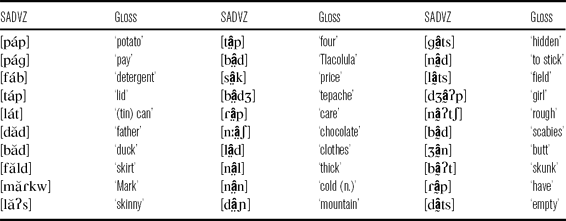
Speakers were asked to produce 10 monosyllabic [a]-vowel words per phonation type (breathy, modal, and creaky) for a total of 30 tokens per speaker (see Table 1 for the wordlist). (For modal phonation, this included five tokens with a high tone and five with a rising tone. Previous research showed that there was not a phonation difference between the high and high-rising tones; see Esposito Reference Esposito2003.) Only words with [a] were selected because the first formant of low vowels does not influence the amplitude of the first or second harmonics as much as in higher vowels. Each token was uttered in sentence-medial position in the frame [guniʔ ___ pɾimeɾ] ‘Say ___ first.’, and repeated ten times by each speaker. It was not possible to control the onset and coda consonants of the target words. However, pilot research suggested that the coda consonants did not have an effect on phonation (only coda consonants were tested because only the end of the vowels was measured). Paired t-tests indicated that the phonation of vowels produced before lenis consonants was not significantly different from the phonation before fortis consonants (df = 58, t = −.14, p = .88).
Santa Ana del Valle Zapotec (SADVZ) wordlist. The fortis/lenis obstruents are represented with the symbols for voiceless and voiced consonants, respectively. This is their typical representation in Zapotec languages. The fortis/lenis sonorants are represented by their length contrast.

3.1.1.3 Procedure
Speakers were recorded over multiple sessions in a soundproof booth at the UCLA Phonetics Lab. Tokens were digitized and analyzed in PCQuirer (Scicon R&D, Inc., Encino, CA) at a sampling rate of 22,050 Hz. Each vowel was divided into four equal parts. Two acoustic measures, H1-H2 and H1-A3, were made for each vowel over a 30 ms window in the last quarter of the vowel (approximately 50 ms). Previous research showed that the phonation contrasts were localized to the end of the vowel in SADVZ (Esposito Reference Esposito2003). Spectrograms were used to position the 30 ms window. Measurements were taken from a Fast Fourier Transform (FFT). A total of 1500 tokens were analyzed (5 speakers × 30 words × 10 repetitions each = 1500).
3.1.2 Results
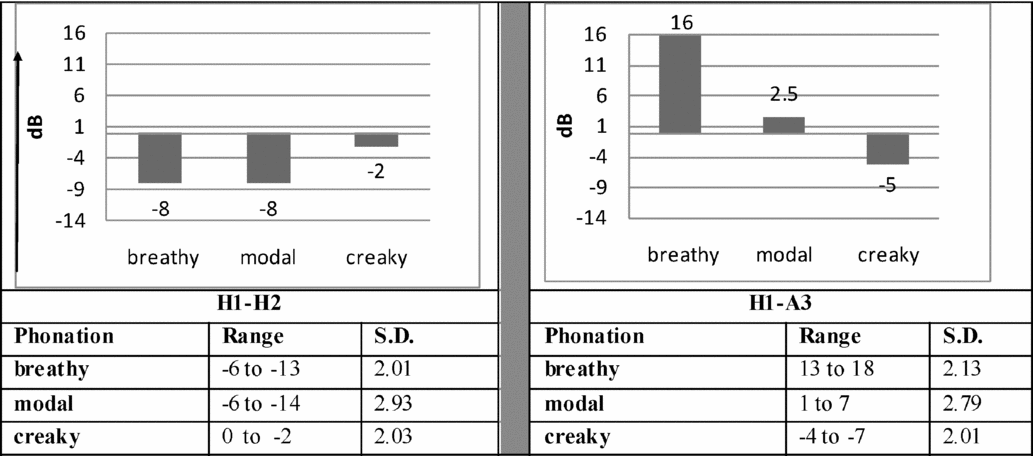
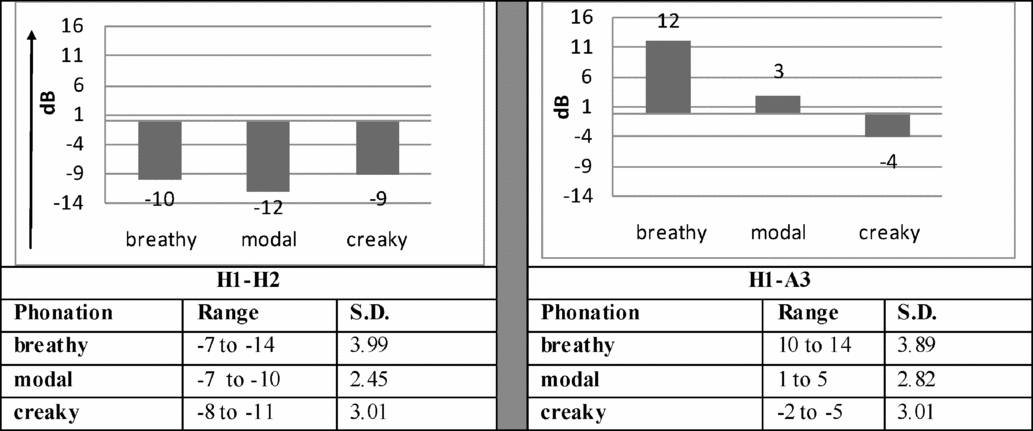
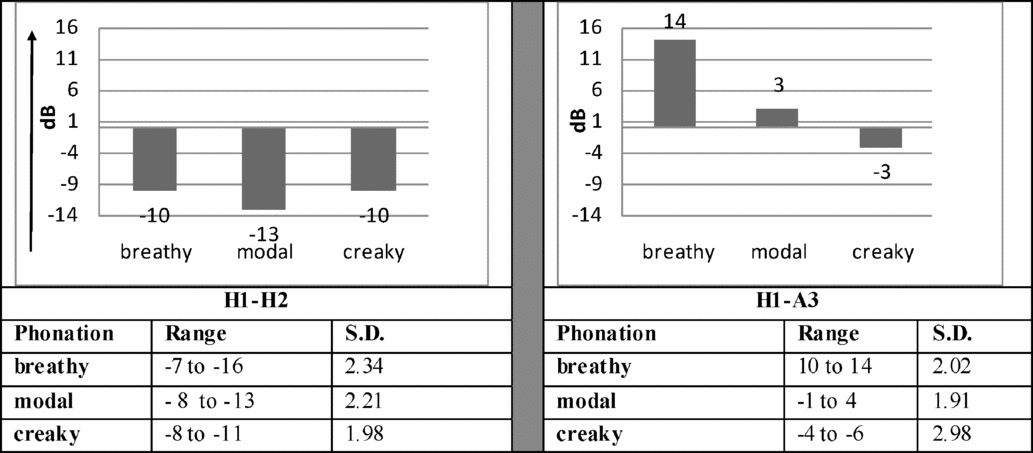
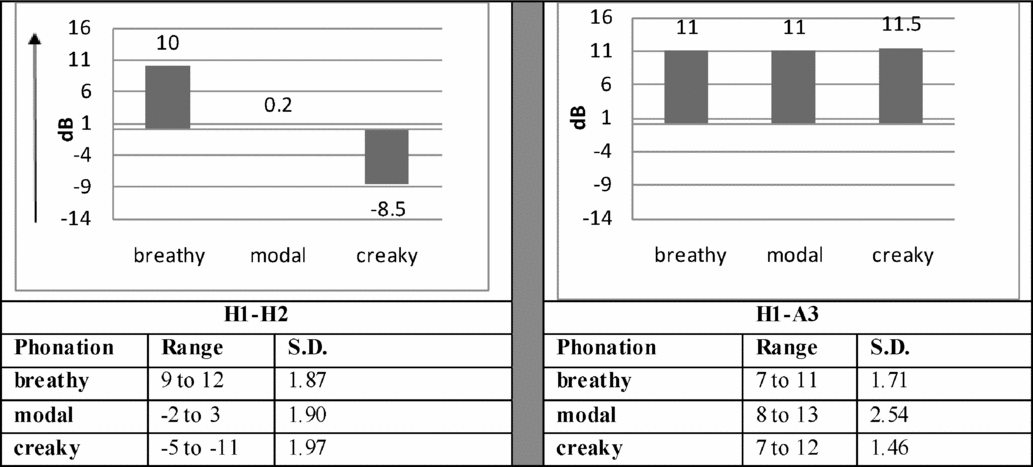
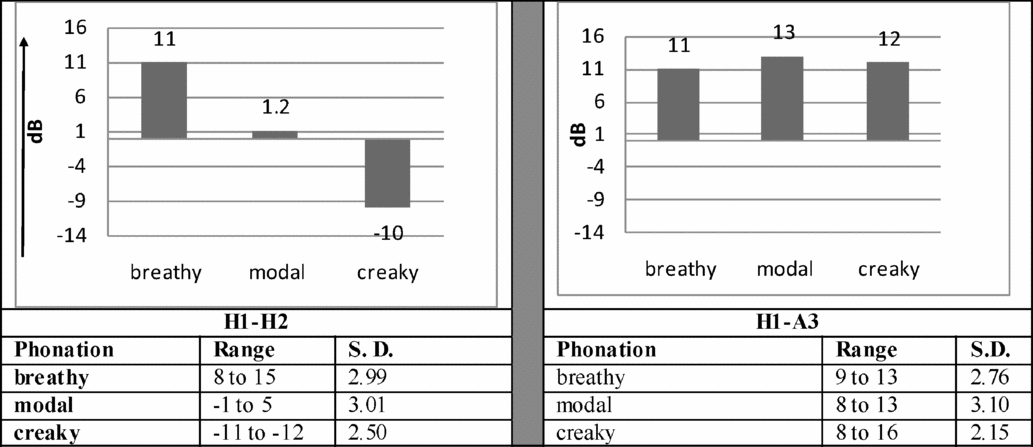
Figures 3, 4, 5, 6, and 7 are graphs of the average H1-H2 and H1-A3 values per phonation type (breathy, modal, and creaky) for Speakers 1, 2, 3, 4, and 5, respectively. The difference between the amplitudes of the harmonics is given on the y-axis in dB. Greater dB values indicate more breathiness; smaller dB values indicate more creakiness. In the figures in this section and throughout, an arrow is pointing in the direction of increased breathiness and averages are given either above (for positive values) or below (for negative values) each column. Below each figure, the range of values and standard deviation (S.D.) is presented.
Average H1-H2 and H1-A3 values (in dB) for Speaker 1 (male). The range and standard deviations are presented below the graph.

Average H1-H2 and H1-A3 values (in dB) for Speaker 2 (male). The range and standard deviations are presented below the graph.

Average H1-H2 and H1-A3 values (in dB) for Speaker 3 (male). The range and standard deviations are presented below the graph.

Average H1-H2 and H1-A3 values (in dB) for Speaker 4 (female). The range and standard deviations are presented below the graph.

Average H1-H2 and H1-A3 values (in dB) for Speaker 5 (female). The range and standard deviations are presented below the graph.

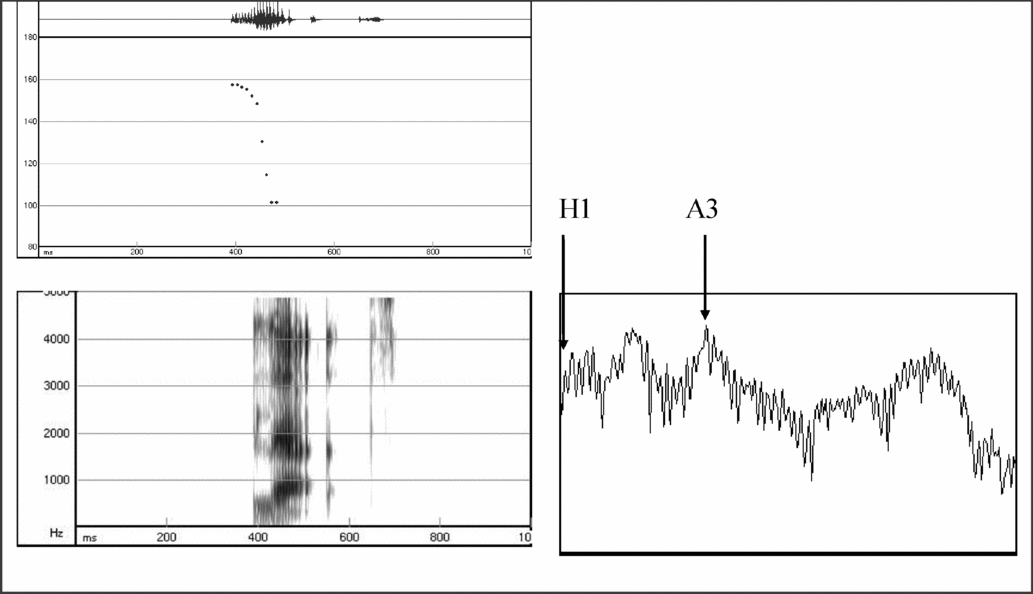
For male speakers, H1-A3 distinguished the three phonemic phonations in the expected directions (i.e. with breathy phonation having the highest dB value, followed by modal and then creaky), but H1-H2 did not. For all three male speakers, the H1-A3 values for creaky phonation were consistently negative.Footnote 4 The creaky vowels for the male speakers were remeasured using H1*-A3* (where * indicates that the measure was corrected) using VoiceSauce (Shue, Keating & Vicenik Reference Shue, Keating and Vicenik2009). Results were not significantly different (p > .05) and were still negative. Figure 8 presents a waveform, spectrogram, and FFT for [l ts] ‘field’ produced by Speaker 2. Note how the amplitude of A3 is higher than H1.
Waveform, spectrogram and FFT (calculated over a 30-ms window) of [l ˆ  ts] ‘field’ produced by Speaker 3. Pitch track fails at the end.

For female speakers, H1-H2 successfully distinguished the three phonemic phonation categories in the expected directions, while H1-A3 did not.
Unfortunately, it is difficult to determine if male SADVZ speakers are breathier/creakier than females (and vice versa) because of the success of the different measures. However, the success of H1-A3 for the male speakers and H1-H2 for the female speakers suggests that men and women are using different laryngeal settings to produce the same linguistic contrast, though direct observations of the vocal folds are needed to support this claim.
3.2 Prosodic variability
To determine if SADVZ phonation is sensitive to changes in sentence-level F0 and/or position, acoustic measures (H1-A3 for the male speakers and H1-H2 for the female speakers) were taken of the same words in five prosodic positions, each associated with an F0. The effects of sentence-level F0 and position will be teased apart in the results section.
3.2.1 Methods
3.2.1.1 Procedure
The same speakers as those used in the previous task were asked to produce ten [a]-vowel tokens per phonation (as with the previous experiment, this included five tokens with a high tone and five with a rising tone for modal phonation) in the following five prosodic positions:
(i) isolation (with focus), which has a higher F0 than sentence-medial positionFootnote 5
(ii) initial position (focused), which has a higher F0 than sentence-medial position
(iii) isolation (without focus), which has a mid-range F0
(iv) medial position, which has a mid-range F0
(v) final position (end of a declarative sentence), which has a lower F0 than sentence-medial position
Isolation (with focus) was elicited by asking the speakers a question to which the response was the target word. Isolation (without focus) was elicited by asking the speakers to simply say the word in isolation. Words uttered in isolation and not as an answer to a question were always produced without focus. H1-A3 and H1-H2 were measured from an FFT following the same procedure established above. In addition, F0 was measured at three time-points (beginning, middle, and end).
3.2.2 Results
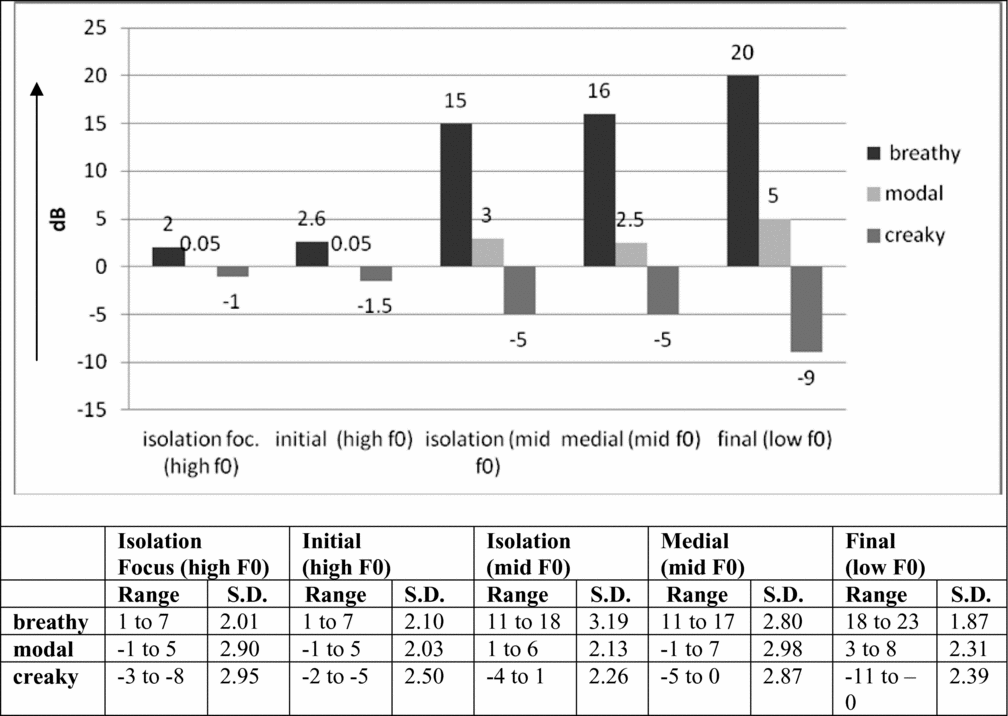
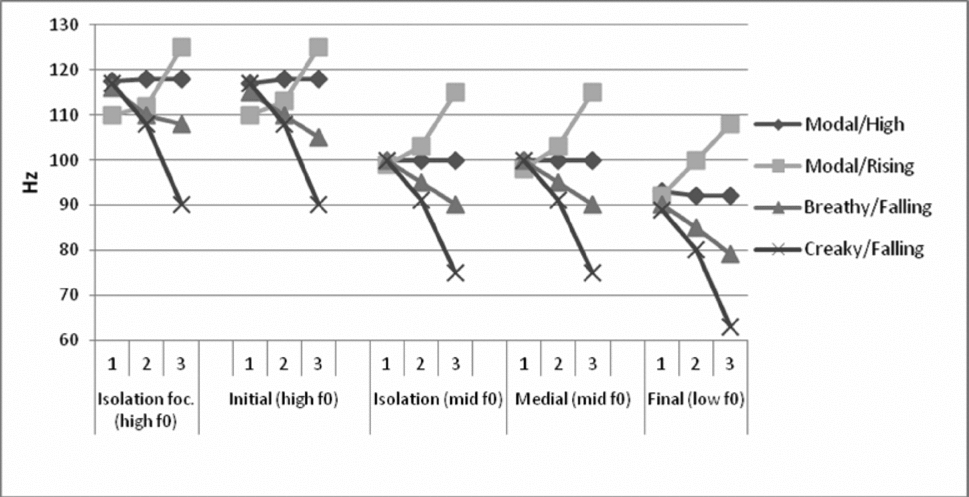
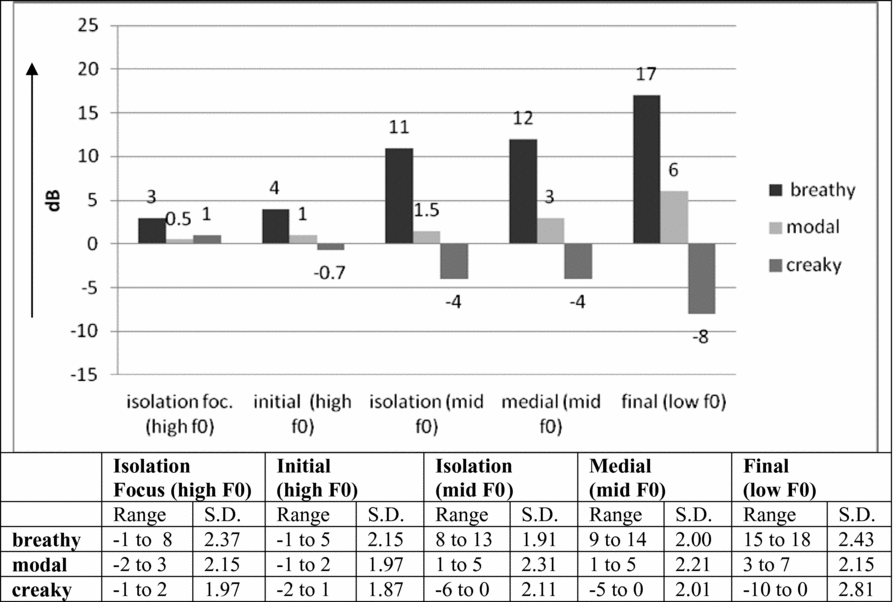
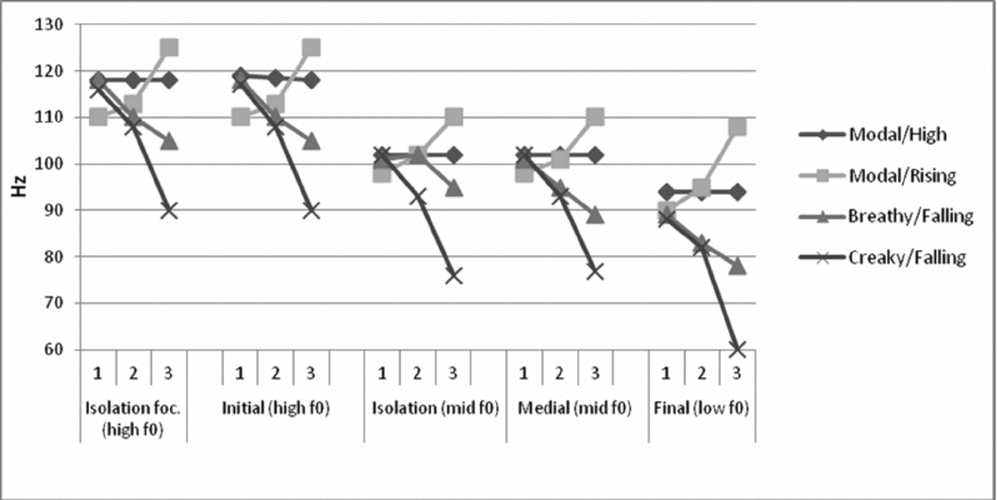
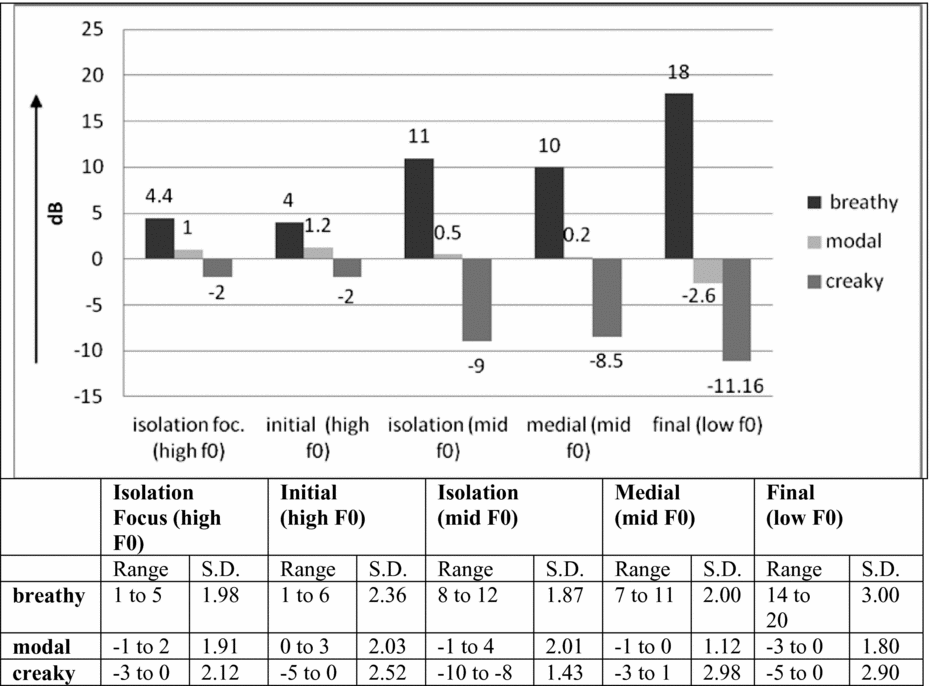
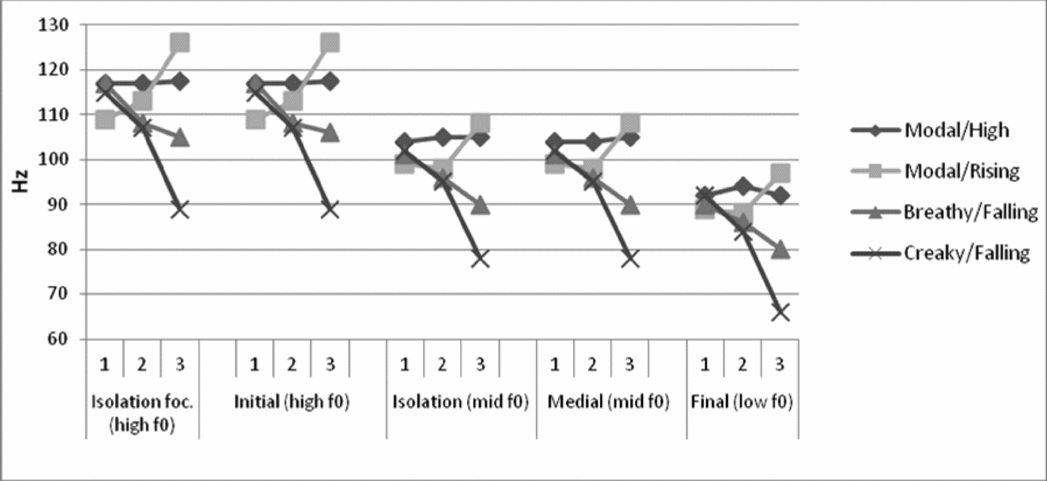
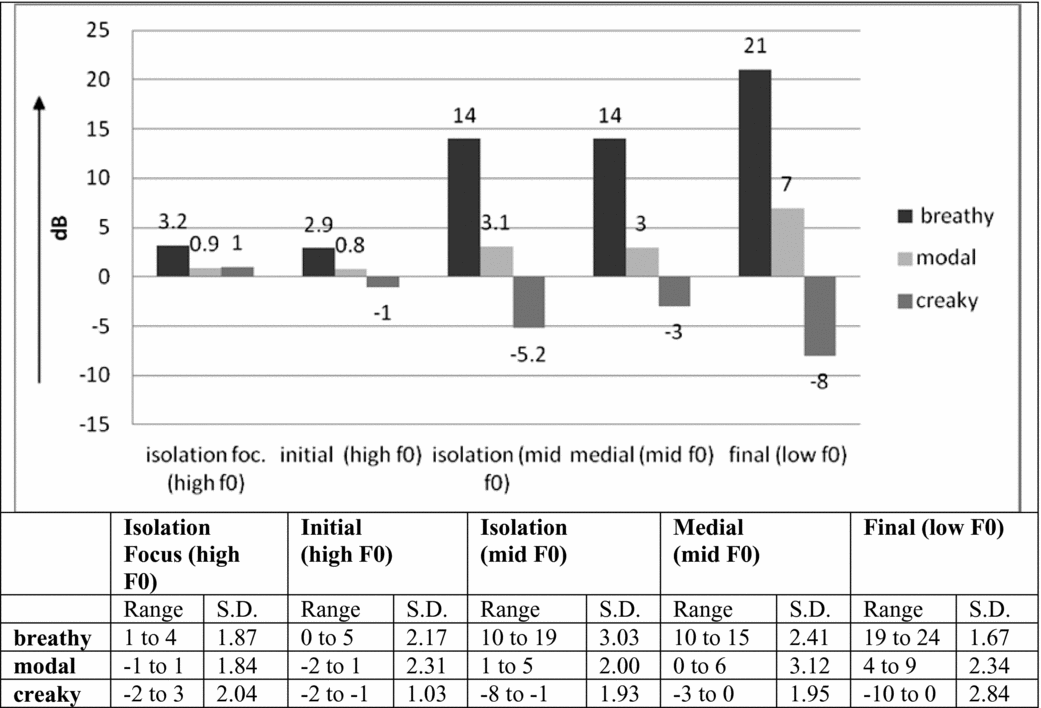
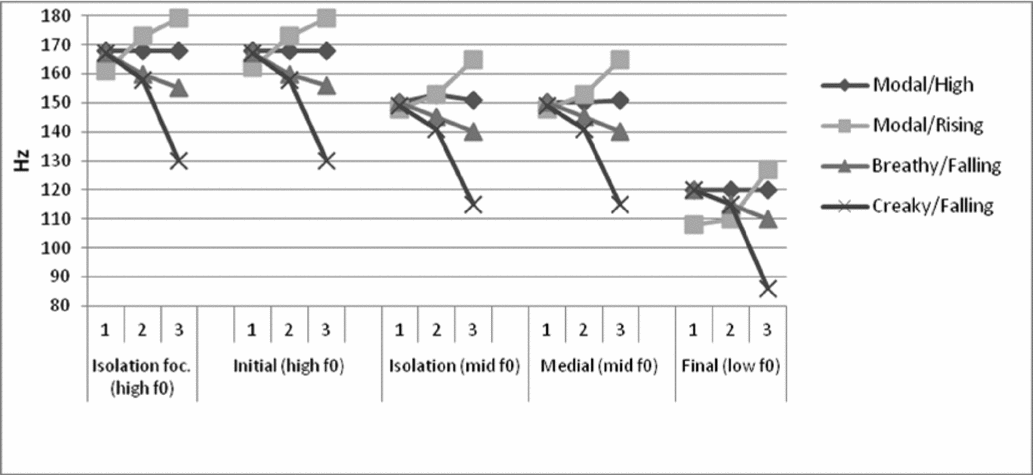
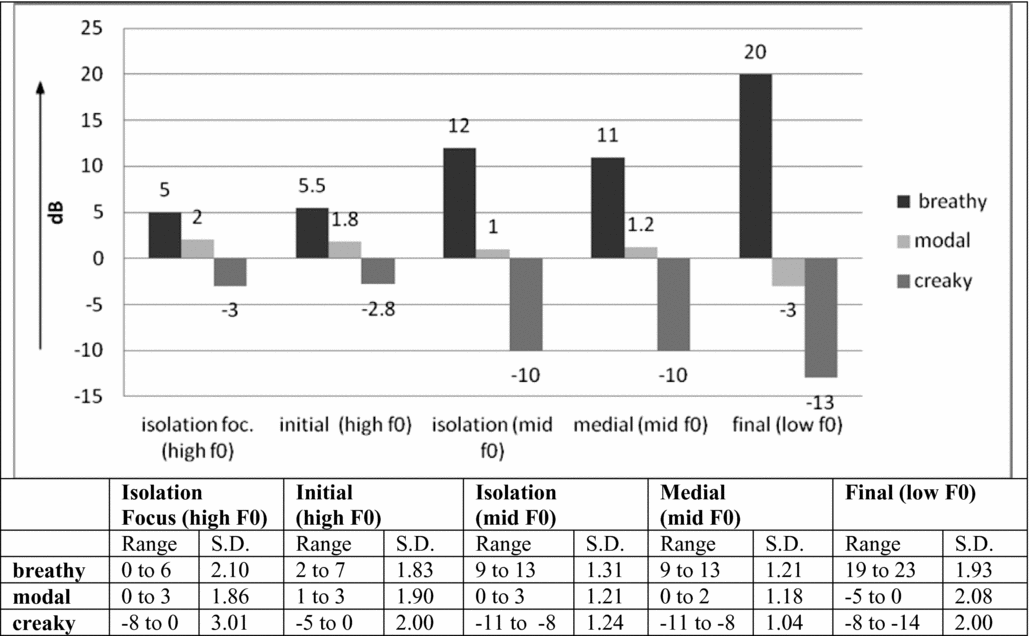
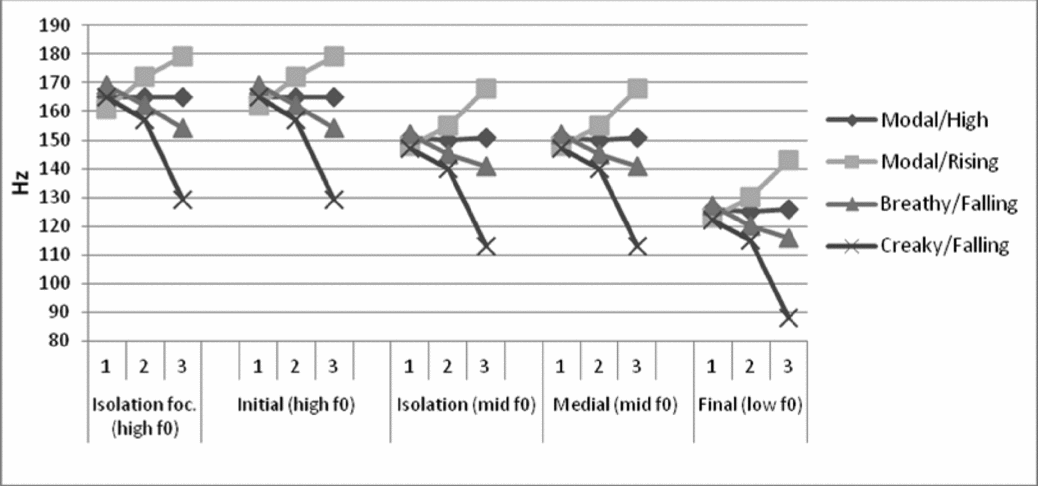
Figures 9, 11, and 13 are graphs of the average H1-A3 value for each phonation category in five prosodic positions (isolation with focus, initial, isolation (not focused), medial, and final position) for Speakers 1, 2, and 3, respectively. Figures 15 and 17 are graphs of the average H1-H2 for each phonation category in five prosodic positions (isolation with focus, initial, isolation (not focused), medial, and final position) for Speakers 4 and 5, respectively. The difference between the amplitudes of the harmonics is given on the y-axis in dB. The range and standard deviations are presented under the graphs. Figures 10, 12, 14, 16, and 18 are graphs of the average F0 (in Hz) in five prosodic positions (isolation with focus, initial, isolation (not focused), medial, and final position) for Speakers 1, 2, 3, 4, and 5, respectively. In the graphs of the F0, the high and rising tone modal vowels are separated.
Average H1-A3 values for breathy, modal, and creaky phonation in five prosodic positions for Speaker 1 (male). The range and standard deviations are presented below the graph.

Average F0 for Speaker 1 (male) in five prosodic positions (isolation with focus, initial, isolation (not focused), medial, and final position) at three timepoints (1, 2, 3) per vowel.

Average H1-A3 values for breathy, modal, and creaky phonation in five prosodic positions for Speaker 2 (male). The range and standard deviations are presented below the graph.

Average F0 for Speaker 2 (male) in five prosodic positions (isolation with focus, initial, isolation (not focused), medial, and final position) at three timepoints (1, 2, 3) per vowel.

Average H1-A3 values for breathy, modal, and creaky phonations in five prosodic positions for Speaker 3 (male). The range and standard deviations are presented below the graph.

Average F0 for Speaker 3 (male) in five prosodic positions (isolation with focus, initial, isolation (not focused), medial, and final position) at three timepoints (1, 2, 3) per vowel.

Average H1-H2 values for breathy, modal, and creaky phonations in five prosodic positions for Speaker 4 (female). The range and standard deviations are presented below the graph.

Average F0 for Speaker 4 (female) in five prosodic positions (isolation with focus, initial, isolation (not focused), medial, and final position) at three timepoints (1, 2, 3) per vowel.

Average H1-H2 values for breathy, modal, and creaky phonations in five prosodic positions for Speaker 5 (female). The range and standard deviations are presented below the graph.

Average F0 for Speaker 5 (female) in five prosodic positions (isolation with focus, initial, isolation (not focused), medial, and final position) at three timepoints (1, 2, 3) per vowel.

In all five prosodic positions, there is a three-way contrast in phonation. This contrast, however, is not always well-defined. In isolation (mid-range F0), medial position (mid-range F0) and final position (lower F0), the three-way phonation contrast is clearest for both the male and the female speakers (but with some changes for the female speakers, whose modal vowels were creakier word-finally than in medial position). The contrast was minimized in isolation with focus (high F0) and initial position (high F0). In these two positions, breathy and creaky vowels had a much more modal phonation than when produced in isolation (mid-range F0), medial position (mid-range F0) or final position (lower F0).
There is evidence that it is F0, independent of position, that is influencing phonation in SADVZ. Tokens with the same position, but different F0s, have different phonations. More specifically, tokens in isolation can be produced with either a high F0 (when focused) or a mid-range F0 (when not focused). It was only when the tokens were produced with the high F0, however, that the three-way contrast in phonation was minimized. Furthermore, tokens with the same F0 but different positions have similar phonations: in positions with mid-range F0 (i.e. isolation (non-focused) and sentence-medial position), there was a clear three-way contrast in phonation.
4 Discussion and conclusion
The current study set out to determine if phonation would vary as a function of (i) gender, (ii) F0, and/or (iii) position in Santa Ana del Valle Zapotec, a language where differences in phonation convey important linguistic information.
Results were inconclusive as to whether or not one gender was creakier or breathier than the other because of the success of different acoustic measures for the two genders. However, the success of H1-H2 for females and H1-A3 for males suggests that there is a difference in the production of phonation between the genders, though the reason for this difference remains unknown. Presumably, all healthy humans are capable of producing all possible articulations; perhaps the gender-based phonation differences in SADVZ are determined by sociolinguistic factors. However, Södersten & Lindestad (Reference Södersten and Lindestad1990) did show that female speakers (of English) were more likely to have incomplete glottal closure. Thus, another possible explanation for the gender-based differences could be a physiological one, though direct observations of the vocal folds, the larynx and the valves of the throat are needed to verify this hypothesis. Furthermore, these results raise the question of whether or not SADVZ listeners can perceive the difference between H1-H2 and H1-A3, and whether or not these differences are associated with gender differences (i.e. do H1-H2 differences sound ‘feminine’ while H1-A3 differences sound ‘masculine’?). A perception study investigating these issues would be an important follow-up to the current study.
Additional findings showed that F0, independent of position, had a strong effect on phonation. When F0 was high (i.e. isolation and initial position), the three-way contrast in phonation was minimized, with non-modal phonation having an H1-H2/A3 value typically associated with modal phonation. (While the H1-H2/A3 values at high F0 indicate a modal-like phonation, it is possible that the creaky phonation is not actually more modal, but rather a type of harsh or pressed voice.) The same pattern is also seen with lexical F0; in SADVZ modal phonation is produced with high F0s and non-modal phonations are produced with lower F0s. Cross-linguistically, high F0, which can increase vocal fold tension and length, is associated with modal phonation (though F0 is not always correlated with phonation; see Ladefoged 1973, Laver 1980). This glottal configuration (i.e. increased vocal fold tension and length) is the opposite of the typical configuration for breathy phonation, which could explain why speakers are producing phonemically breathy phonations with H1-H2/A3 values typically associated with modal phonation in environments with high F0. Furthermore, creaky phonation can also lose its characteristic creak at high F0s. Creaky phonation (with fast closure and long and slow vocal fold opening) is produced when the aryepiglottic sphincter is engaged (Esling Reference Esling2005). This shortens the length of the glottis and of the epilaryngeal structures over the glottis. When F0 is high, the larynx will lengthen longitudinally, stretching the vocal folds in the opposite dimension of the typical configuration for creaky phonation. (For more information on the relationship between phonation type and pitch, see Esling & Harris Reference Esling, Harris, Hardcastle and Beck2005.)
The results obtained in this study raise an interesting issue for fieldworkers working on Zapotec languages, and perhaps languages with phonation contrasts in general. In Santa Ana Del Valle Zapotec, when F0 is high, the phonemic three-way contrast in phonation is not well preserved. Thus, words elicited in isolation with focus, which have a higher F0 than sentence-medial position, will not show an obvious phonation contrast. In order to see a full range of phonation contrasts, it is important to elicit data that display a full range of F0s.
The current study shows that there is variation in phonation, even in languages with contrastive phonation. However, it remains to be seen how SADVZ compares with other languages with contrastive phonation. In order to truly understand the nature of the type of variation demonstrated in this study, it is necessary to replicate these results with other languages that contrast phonation and to elicit data in more natural discourse contexts.
Acknowledgements
This article derives from a larger research project guided by Matthew Gordon, Patricia Keating, and Sun-Ah Jun. I thank them for their time and guidance. Thanks also to my Zapotec consultants for providing the data used in this paper.