On April 27, 2017, the Boeing Company—the largest U.S. producer of civil aircraft and a vital defense contractor—requested government action against a proposed sale of seventy-five CS100 aircraft from Canadian firm Bombardier to U.S. carrier Delta. Boeing’s portrayal of the deal as unfair and predatory fell upon sympathetic ears within the new Trump administration, which would, within a year, point to national security concerns to justify increased tariffs on steel and aluminum imports. A subsequent antidumping investigation prompted a December Commerce Department ruling that accused Bombardier of planning to import aircraft into the US “at 79.82 percent less than fair value,” charged Canada with “providing unfair subsidies … at a rate of 212.39 percent,” and warned of targeted retaliatory tariffs. But in a unanimous decision a month later, the US International Trade Commission found that the deal did not threaten American manufacturers because a comparable domestically produced 100- to 150-person aircraft did not exist. 1 Delta took possession of its first Bombardier CS100, now rebranded the Airbus A220 after a recent merger with Boeing’s top competitor, in October of 2018. Although ultimately unsuccessful, these efforts to protect Boeing from perceived unfair trade practices arose out of a deep-seated belief in the importance of the aircraft industry to the nation’s economy and security.
The aviation industry has played a pivotal role in the development and projection of U.S. military, economic, and cultural power during the so-called American Century. 2 As seen in Charles Lindbergh’s 1928 Goodwill Tour and the State Department’s support for the subsequent southern expansion of Pan American Airways, aviation became an important tool of U.S. hegemony in Latin America. 3 Despite Congress’s continued efforts to impose traditional notions of market competition on the aircraft industry, an expansion of air carriers after the passage of the 1925 Air Mail Act and the 1926 Air Commerce Act as well as the sale of military aircraft to France and Britain in the face of increased German aggression ensured a viable industrial base between the world wars. 4 Although industry took issue with the high level of government regulation in the wartime economy, American aircraft manufacturers produced an aerial arsenal of democracy central to Allied victory in World War II. 5 In 1948 the President’s Air Policy Commission called for sustained aeronautical appropriations in peacetime, and the Berlin Airlift accentuated the airplane’s importance to the national defense in the early Cold War. 6 When President Eisenhower warned of “unwarranted influence” in 1961, he recognized that the aerospace industry constituted “the largest and most powerful component” of what he famously termed the Military-Industrial Complex. 7 By 2019, the American aerospace and defense industry employed over two million people, generated combined revenue of over $900 billion, and generated a favorable foreign trade balance of nearly $80 billion. 8 In siding with Boeing in 2017, the Trump administration acted to safeguard an industry that had become an increasingly important component of the national economy and defense over the past century.
Widely viewed as a vital sector today, the nascent American aircraft industry remained unprotected as it faced a serious threat from British surplus machines in the years immediately after World War I. Separated from lucrative wartime contracts, confronted with a postwar recession, and faced with a fiscally conservative Republican Congress, U.S. aircraft manufacturers struggled to foster a sustainable civilian market in a completely unregulated field. 9 By early 1920, efforts to dump thousands of surplus machines into the United States at prices far below the cost of production came to be seen, in the words of aviation pioneer Glenn Curtiss, as “the opening shots” in a “war” explicitly waged to entrench “British manufacturers” in the United States. 10 For Curtiss Aeroplane and Motor Corporation vice president Clement M. Keys, financial manager for the nation’s largest aircraft manufacturer, this “invasion” would bring about “the practical destruction of the aeroplane industry in the country.” 11 The loss of the nation’s aircraft manufacturers, vital hubs of expertise established at great cost during World War I, would severely hinder the United States’ ability to remain competitive in the preeminent dual-use technology of the era. 12 Manufacturers warned that diminished demand for domestic aircraft in the face of cheap imported machines would reduce the nation’s industrial base to one or two firms wholly reliant on experimental government contracts. This would, in turn, lead to further dependence on foreign manufacturers for the nation’s aeronautical needs. For Director of Military Aeronautics Brigadier General William “Billy” Mitchell, a staunch airpower advocate, foreign dominance of the domestic aircraft market would be tantamount to “turning over the key of the front door to some other nation.” 13
Although the United States possessed an intricate tariff regime buttressed by antidumping legislation, no provisions existed that expressly forbade the importation and sale of cheap foreign surplus aircraft after World War I. When faced with the importation of machines for the 1907 Gordon-Bennett International Aeronautic Cup, the Treasury Department had simply extended the provisions applicable to automobiles imported for racing purposes to balloons and aircraft. 14 The 1909 Payne-Aldrich Tariff, enacted six years after the Wright Brothers’ first flight, failed to even mention airplanes. 15 Without a “definitive rule” for the importation of aircraft, the Treasury Department instituted an ad hoc policy based on a liberal interpretation of various provisions within the 1909 tariff that allowed aircraft imported for racing purposes to enter the United States for up to three months with a promise that they would not be sold. 16 This administrative ruling on exhibition machines became official policy after its inclusion within the Underwood-Simmons Tariff of 1913, but the act remained silent on the importation of aircraft for sale. 17 Antidumping provisions in the 1916 Revenue Act that prohibited the sale of imported goods at “substantially less than the actual market value” in their home country simply did not apply to surplus equipment sold at the same incredibly low prices everywhere. 18 With no explicit mention of aeronautical equipment within the nation’s tariff laws and no provisions tying antidumping protections to the cost of production, there was no legislative basis for preventing the importation of foreign surplus aircraft.
This article analyzes the efforts of U.S. aircraft manufactures and their allies to secure emergency protections they deemed vital for both their continued existence and the national defense. Thus, it details an important yet forgotten episode situated at the nexus of industrial policy, national security, patent rights, and international trade. 19 In language similar to that of the early Cold War, Mitchell and others in the newly established Air Service recognized that the use of aircraft in modern war necessitated a sustained procurement program to ensure a suitable industrial base in peacetime. 20 They were joined by Keys, Wright Aircraft Company president George Houston, and other members of the Manufacturers Aircraft Association (MAA), an organization established in 1917 to facilitate a cross-licensing agreement among aircraft manufacturers that—under the direction of its general manager Samuel Bradley—promoted industry’s interests with the public and Congress. 21 As manufacturers sought to prevent the importation of war surplus aircraft, they confronted a rival group within the aeronautical community led by Aero Club of America governor Henry Woodhouse who believed that cheap foreign machines in the hands of ex-military aviators would jumpstart the nation’s civil aviation sector. 22 No matter how hard manufacturers and their allies sought to frame the discussion as a matter of national security, protection for the aircraft industry became embroiled in the tension between consumers and producers at the heart of the larger tariff debate, one now further complicated by the postwar disruption of global markets. 23 Despite the widespread use of aviation in World War I and a growing recognition that it would constitute a central component in future conflicts, Congress proved unwilling to erect emergency protections for the aircraft industry at the same time it did so for the chemical industry. 24 When attempts to secure emergency legislation failed, injunctions under U.S. Patent No. 821,393—the famous 1906 Wright patent—became the domestic industry’s primary defense until the inclusion of aircraft within the 1922 Fordney-McCumber Tariff.
The Wright Brothers’ first powered and controlled flight on December 17, 1903, did not predestine the American aviation industry to greatness. Between the armistice of November 1918 and the passage of the 1922 tariff act, U.S. aircraft manufacturers remained unprotected by the nation’s trade laws as they faced a serious threat from a British aircraft industry that constituted “the largest and technically one of the most capable in the world.” 25 Although the United States possessed enormous productive capacity after World War I, it remained well behind Great Britain in its ability to exert power on the global stage. 26 Had thousands of cheap British surplus machines flooded the U.S. market in these pivotal years, the history of the American aircraft industry and its role in the twentieth-century ascendency of the United States would have looked very different. The deep-seated belief that the American aircraft industry deserves protection—an element of U.S. political economy taken for granted today—emerged from efforts to prevent the importation of foreign surplus machines after World War I. By analyzing this previously unknown chapter in American aviation history, this article highlights both the precarious nature of the aircraft industry’s relationship with Congress during this crucial period and how domestic patents can protect an industry from foreign competition in the absence of official economic policy.
First Salvos: The Canadian Surplus
Charles B. Howard of Ontario could not resist the chance to visit the MAA’s first-ever Annual Aeronautical Exposition while in New York City. Over the first two weeks of March 1919, Howard and thousands of other attendees viewed a DH-4 built by the Wright-Martin Aircraft Corporation and a four-engine Handley Page O-400 bomber built by the Standard Aircraft Corporation—both derived from British designs—as well as a massive Italian Caproni bomber, a Curtiss JN-4, and numerous other aircraft and accessories from over one hundred exhibitors in booths that filled Madison Square Garden and the 69th Street Armory. 27 MAA members viewed the Exposition’s $125,000 cost as a sound investment to secure much-needed civilian sales. 28 But when Howard decided to purchase an aircraft to cut down on travel time between his family’s lumber operations in Ontario and Maine, he did not buy a new machine from an American manufacturer. Despite warnings from Curtiss representatives that he was “buying a lawsuit,” Howard elected to purchase a war surplus Canadian JN-4 from the recently organized United Aircraft Engineering Corporation (UAEC) due to its “reasonable price” and the model’s “reputation for reliability.” 29 Five months after the armistice, the Curtiss name had secured a valuable sale, but not one for the Curtiss company.
The 1919 Aeronautical Exposition publicly demonstrated the MAA’s desire to shift from a wartime expedient to address the aeronautical patent situation to a more traditional peacetime trade association. The MAA came into being on July 24, 1917, to manage a government-negotiated cross-license agreement for the aircraft industry to prevent constant litigation from interfering with war production. In exchange for submitting their respective patents to a pool and paying $200 per aircraft, subscribers gained full use of all patents within the pool and automatically became members of the MAA. Despite the fact that any “reputable manufacturer” could join the cross-license agreement, the MAA immediately came under attack as a monopoly in restraint of trade. 30 Conflicts of interest among a few wartime procurement officials, a complete lack of U.S.-built combat aircraft at the front by war’s end, and continued charges of monopoly left a specter of corruption over the MAA throughout the interwar period. 31 With the March 1919 Exposition, the MAA hoped to accentuate the wartime contributions of its members and stimulate much needed civilian sales as it entered a period of postwar uncertainty.
The loss of sales such as Howard’s to foreign surplus threatened U.S. manufacturers still reeling from the abrupt cancellation of wartime contracts. By the close of business on November 12, 1918, the Bureau of Aircraft Production had canceled eighty-nine percent of the 23,621 aircraft still on order and canceled Air Service contracts totaled $468,847,993 within four months. 32 American aircraft manufacturers were forced to radically rescale their operations. Curtiss, the nation’s largest manufacturer, laid off 6,000 employees, nearly half of its peak wartime workforce, after wartime contracts were slashed in December. 33 The only firm in any real position to foster a civilian market, Curtiss quickly established a sales office in New York City to oversee an ambitious network of seven domestic distributors and potential exports to Latin America in an effort to offset lost military contracts. 34 To prevent competition from surplus U.S. machines and protect its brand, Clement Keys negotiated with Director of Air Service Major General Charles T. Menoher for the purchase of the U.S. Army’s entire surplus stock of Curtiss aircraft and engines—1,616 JN-4s without motors, 4,608 Curtiss OX-5 motors, and 1,100 J-1s without motors—for $2,720,000, roughly thirteen percent of the $20,000,000 the U.S. government originally paid for them. At the same time, advertisements for foreign machines and attacks on U.S. manufacturers’ seeming inability to meet demand increased in the pages of Woodhouse’s aeronautical periodicals Flying and Aerial Age Weekly. After Keys and Menoher signed their agreement on May 6, Curtiss began to sell refurbished JN-4Ds for an average price of $5,000 and refurbished J-1s for $2,500, a profit of roughly 75 percent and 55 percent, respectively, even after accounting for a $500 overhaul. 35 Wartime aviators like America’s “ace of aces” Eddie Rickenbacker that “could not imagine” giving up flying increasingly looked to imported machines such as the Canadian JN-4 as an affordable alternative. 36 UAEC’s efforts to meet this demand would prompt Curtiss to initiate the first battle to protect the postwar U.S. civil aircraft market, one that, with no established protections for aircraft and Congress in recess, played out in the courts.
Curtiss’s case against UAEC rested on a particular clause nestled within one of several wartime agreements the firm made with the British Government in late 1916. 37 As the First Battle of the Somme concluded that November, the British placed a massive order with Curtiss for JN-4 aircraft, engines, and spare parts worth almost four million dollars. 38 But this sale would not take effect until both sides entered into an additional agreement “for the sale … of the property and assets of Curtiss Aeroplane and Motors, Limited, a Canadian Corporation” established in Toronto in early 1915. 39 An additional contract signed the same day as the JN-4 agreement committed Curtiss to the sale of “all the tools, machinery, drawings, patterns, jigs, etc. of the Canadian Company for use in the manufacture of … JN-4 aeroplanes” to the Imperial Munitions Board. The particulars of the sale of Curtiss’s Canadian subsidiary were finalized in a third agreement on December 6, 1916, wherein the newly created and government-owned Canadian Aeroplane Ltd. paid $80,203.97 for the physical assets of Curtiss Aeroplane and Motors Ltd., “all patents” pertaining to the JN-4, and a production license. 40 As a result of this flurry of agreements over a two week span, Curtiss secured much-needed funds and the British government acquired the means and rights to produce JN-4 aircraft in Canada.
The machinations of Early Bird aviator Frithiof G. Ericson precipitated this first battle against foreign surplus machines. A native of Sweden, Ericson became chief engineer for Curtiss Aeroplanes & Motors Ltd. in 1915. Continuing on with the Canadian Aeroplanes Ltd., Ericson made subtle changes to the JN-4 at the Royal Air Force’s request—a rounded rudder, ailerons on both the top and bottom wings, and joystick control—that resulted in what he considered “a complete re-design of the Curtiss JN-4 machine,” the Canadian JN-4, popularly known as the “Canuck.” 41 After the Armistice, Ericson began negotiations with the Imperial Munitions Board to purchase “all but fifty” of its surplus JN-4s with the full understanding that they would be sold in the United States. 42 Lacking the funds to acquire the aircraft on his own, Ericson approached fellow Society of Automotive Engineers member Frank Diffin, who initially rebuffed Ericson’s proposal. Instead, Diffin partnered with Roy U. Conger of the New York banking house Bigelow and Co. to incorporate a new aeronautical consulting firm: the United Aircraft Engineering Corporation (UAEC). 43 Potential aircraft exports to South America convinced Diffin that the Canadian surplus could be moved quickly, and he and Conger traveled with Ericson to Toronto on January 3, 1919, to negotiate with Imperial Munitions Board representatives. Diffin and his colleagues finalized the purchase of 350 Canadian JN-4 aircraft, engines, and accessories twenty days later with the “understanding” that they would only sell machines to “responsible flyers.” 44 With UAEC now in possession of these highly sought-after aircraft, Ericson joined the firm as general manager.
Curtiss declared the transfer of surplus machines to UAEC an illegal sale based on a clause in the second November 20, 1916, agreement that authorized the British Government “to manufacture such aeroplanes … within the Dominion of Canada, for sale or use by the British Government or the government of any of its possessions, but not for manufacture, use or sale otherwise.” 45 Curtiss’s charge prompted esteemed Toronto lawyer Zebulon A. Lash to evaluate all three of the 1916 agreements on behalf of the British Government. In a brief to the Imperial Munitions Board, he pointed out that the stipulation limiting the sale and use of Canadian-built JN-4s only came into effect if the British Government exercised an option to purchase Curtiss’s other Canadian patents. As this option had not been exercised—nor did it need to be because Curtiss had signed away its JN-4 patents and granted an unrestricted production license to Canadian Aeroplanes Ltd. in the December 6 agreement—the Imperial Munitions Board, and by extension UAEC, possessed full authority to dispose of these machines as they saw fit. 46
With assurances that he faced no legal liability, Diffin aggressively sold his surplus stock. Headquartered at 52 Vanderbilt Avenue in New York City—the same building as Curtiss’s new office—Diffin and his colleagues poached prospective sales. 47 Curtiss assistant sales manager Edward Ballard noted that “on several occasions, prospective customers have left my office and gone downstairs to the United Aircraft Engineering Corporation office to purchase” aircraft instead, as when Early Bird aviator James Ward purchased three Canadian machines. 48 Leroy Schantz and former wartime flight instructor Harry Crewsdon experienced the UAEC sale pitch firsthand in early April when Diffin stressed to them the similarities between his $2,275 surplus Canadian machines and the more expensive Curtiss JN-4. Convinced, the two men traveled “to Toronto to pick out the plane,” and aircraft No. C-1346 with OX-5 engine No. G-381 arrived in New York City by the end of the month. Buttressed by Lash’s report, Diffin even included a guarantee with Schantz’s bill of sale that UAEC would “accept all responsibility” and pay all monetary costs if Curtiss sued the purchaser for patent infringement. According to Diffin, UAEC had sold over one-third of its surplus machines by the time Schantz agreed to purchase his aircraft, and the firm moved “the entire lot” of its Canadian surplus “within three months.” 49 As negotiations continued between Keys and Menoher over Curtiss’s purchase of the U.S. Army surplus, Curtiss lost vital sales to a company with no manufacturing capacity or design program.
Unable to count on existing statutes to prevent the importation and sale of UAEC’s Canadian JN-4s, Curtiss turned to the courts. On May 7, one day after Keys and Menoher signed their agreement for the U.S. surplus, Curtiss vice president W. B. Stratton filed a Bill of Complaint in the U.S. District Court for the Southern District of New York that charged UAEC with infringement of thirteen Curtiss patents through the sale of machines nearly identical “in form, appearance, and mechanical details” to its JN-4. 50 Curtiss design engineer Henry Kleckler testified that the sale of foreign machines that possessed only “small differences” in “sizes and dimension of parts” amounted to an invasion of “a field which should belong exclusively to the Curtiss companies.” 51 Alluding to an argument that would become the core of industry’s lobbying efforts over the next year, Curtiss claimed that lost sales due to the actions of UAEC—a mere “selling corporation”—would undercut its ability to design and manufacture future aircraft for the national defense. Stratton petitioned for an immediate injunction to protect both his company’s profits and the nation’s security.
Curtiss received no assistance from the U.S. District Court. In dismissing Stratton’s injunction request in early July, Judge Augustus Noble Hand declared that nothing in the 1916 agreements limited the British Government’s freedom of action to dispose of their property. Since no “provision against export to this country” existed in the agreement, Hand argued that Curtiss could not now “claim infringement” after the fact, and he dismissed the case “for lack of merit.” 52 Curtiss, albeit unintentionally, had granted an unrestricted license to manufacture that carried with it the right to unrestricted sale. The Second District Court of Appeals upheld Hand’s view that “the British government obtained a full and unqualified right to use and sell the planes and engines, and that this right passed to all subsequent purchasers.” 53
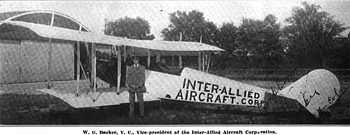
Fully protected as a result of this ruling, UAEC sold its Canadian JN-4s to both individuals and resellers during the 1919 flying season. Advertisements for used Canucks joined those of foreign manufacturers such as Farman, Vickers, and Bristol in the pages of Woodhouse’s periodicals. The James Levy Company, a dealer based in Chicago that employed roughly twenty-five people, reportedly sold nearly 150 Canadian JN-4s during the 1919 flying season. 54 The Interallied Aircraft Corporation (IAC)—a firm established in July 1919 by Canadian aces William Bishop and William Barker alongside American ace Reed Landis with the express purpose of importing foreign aircraft into the United States—made “a small fortune” selling fifty Canadian JN-4s at $2,600 to $3,000 each. 55 Eager to capitalize off a vast and unprotected market, Bristol of Great Britain and Caproni of Italy sent representatives to the United States while Britain’s Handley Page, Ltd. incorporated an American branch. 56
Canadian wartime ace William Barker with a Canadian JN-4 for sale by the Interallied Aircraft Corporation. Aerial Age Weekly 10, no. 5 (October 13–20, 1919): 160.
When Canada’s wartime supply dried up, importers turned to other types of foreign surplus to meet demand. IAC’s leadership began negotiations to purchase Avro and Sopwith machines “directly from the British Government through its Munitions Board and Aircraft Disposal Board” even prior to its incorporation, and the firm’s advertisements for Avros began to appear in the pages of Woodhouse’s aeronautical magazines by the end of October.57 Avros also began to make their way to the James Levy Company for distribution to buyers in Western states.58 An Avro exhibited at the MAA’s Chicago Aeronautical Show in January 1920 only further stimulated interest in these foreign machines.59 According to IAC’s sales manager John Inwood—a Canadian citizen who had previously served as head of the RAF’s Equipment Branch in Toronto—negotiations were underway to purchase an additional 750 British machines in the spring of 1920. By the end of April, IAC’s agents stood ready to compete with Curtiss’s distributors for sales on both coasts and in the Midwest.60 The efforts of IAC, James Levy, and other importers found support within the pages of Woodhouse’s periodicals, which increasingly branded the MAA as a group of “gloomy pessimists” who were “obstructing … progress … with their destructive attitude towards civilian aeronautics.”61 As disturbing as the activities of UAEC and IAC were for members of the MAA, they represented a minor threat compared with what was to come: a concerted effort to dump thousands of Britain surplus machines on the U.S. market.
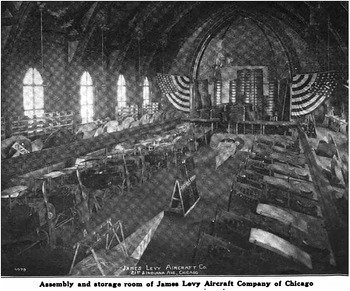
An image from Aerial Age Weekly shows that the shop floor of the James Levy Aircraft Company amounted to nothing more than a place for storage and assembly of imported machines. Aerial Age Weekly 11, no. 9 (May 10, 1920): 287.

The Threat from Handley Page
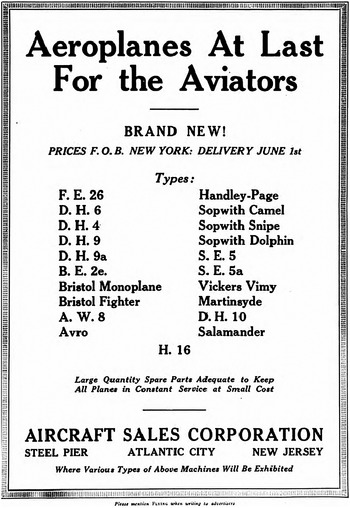
Billed in the pages of Woodhouse’s periodicals as the “greatest aeronautical event ever held,” the Third Pan-American Aeronautical Congress drew U.S. military representatives, members of various aeronautical clubs, and foreign diplomats to Atlantic City, New Jersey, when it opened on May 20, 1920. With Woodhouse as its vice chairman and importers such as UAEC’s Ericson, Inwood of IAC, and Handley Page’s American agent William H. Workman present, the event took on a decidedly anti-MAA tone. The big announcement at the opening day’s luncheon that the newly established Aerial Transport Corporation (ATC) planned to purchase around 3,000 British surplus aircraft astonished foreign representatives and deeply distressed the MAA’s members. Some of these machines would see service on the ATC’s proposed national airline, whereas the Aircraft Sales Corporation (ASC)—an affiliate firm under Workman’s direction—would sell excess machines to “people who wanted to start a jitney service between two points, or exhibition flyers.” 62
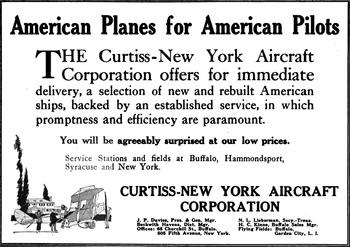
An advertisement for the Aircraft Sales Corporation from the May 1920 issue of Woodhouse’s periodical Flying. Note the use of the Atlantic City Steel Pier as the base of the firm’s operations, where according to Woodhouse an “extensive exhibit” allowed attendees to view “a Martinsyde biplane, a De Haviland No. 9, a Sopwith Snipe, and a twin motored Handley Page,” among others. “Aeroplanes and Motors Exhibited at Atlantic City,” Aerial Age Weekly 11, no. 11 (May 24, 1920): 359.

ATC planned to purchase these machines from the Aircraft Disposal Company (ADC), a syndicate under the management of Handley Page that had recently purchased the British Government’s immense stock of war surplus aircraft. By war’s end, approximately “122 airframe-manufacturing companies” with a production capacity of “4,000 airplanes each month” had left the British Government with over 22,000 aircraft, making it the owner of the largest and most advanced air force in the world. 63 With the coming of the armistice, the Ministry of Munitions ordered Handley Page Ltd. and other members of the Society of British Aircraft Constructors (SBAC) to “decrease output immediately” but, unlike in the United States, the British Government elected to taper off aircraft contracts to ensure a robust industrial base. 64 By the end of fiscal year 1919, 94 percent of the 10,184 outstanding wartime contracts worth £152 million had been settled for nearly £80 million and aircraft produced under the remaining contracts went straight into the nation’s growing surplus of Avros, De Havillands, Sopwith Camels, and other wartime models. 65
The Air Ministry projected a peacetime RAF strength of 1,800 to 2,500 aircraft, and discussions with the SBAC about what to do with the surplus began a week after the armistice. 66 In April 1919, the Air Council adopted a policy to release a limited amount of surplus material at a time so as to not “kill an infant industry” deemed vital to national defense. 67 As of mid-July, this measured approach had brought in a mere £407,000 in combined sales as surplus stocks continued to depreciate. 68 Frustrated by the slowness of this approach, Chief of Air Staff Major General Francis H. Sykes demanded rapid action to shed the projected 13,016 aircraft and 24,395 engine surplus. 69 In response, the Air Council called for “a policy of preferential disposal” that would provide Great Britain and the Dominions with access to the most up-to-date surplus material and dump the remainder on the world market to “prevent the French and Italians from capturing the trade.” 70 Even with this new policy, the Disposal Board sold only 14 percent of the 4,208 aircraft and 12 percent of the 18,192 engines in its stores by the first week of August. 71 With fifty aircraft types designated “obsolete for all purposes,” the British Government simply could not move surplus machines fast enough. 72
Although the surplus situation frustrated the Air Ministry, Frederick Handley Page sensed an opportunity. Born in 1885, the mechanically minded youth trained as an electrical engineer before becoming fascinated with the possibilities of aviation. 73 Elected into the Royal Aeronautical Society in 1907, he founded Handley Page Ltd. two years later to produce monoplanes of his own design. Handley Page’s shift to larger biplanes resulted in the HP O/100 and O/400 two-engine bombers and, toward war’s end, the four-engine V/1500. These large aircraft readily lent themselves to civilian transport, and O/400s were used on Handley Page Transport’s postwar London–Paris passenger route beginning in August 1919. 74
With its large area and cadre of ex-military pilots, the United States offered a near-perfect market for British aircraft. A full six months before the armistice, Handley Page directed William Workman, his wartime representative in the US, to open “an American office … as soon as possible” and establish “an operating Company” to carry air mail and passengers “after the war.” 75 Workman developed a strong working relationship with Woodhouse as he advertised in Aerial Age Weekly and Flying, but his efforts on behalf of Handley Page were stymied by what he deemed “piratical action” from domestic manufacturers and uncertainty over the “complicated subject of patents and rights” under the MAA’s cross-license agreement. 76 With no clear laws pertaining to the importation of foreign aircraft, Handley Page viewed the British surplus as the perfect tool with which to pry open the lucrative U.S. market. In the first months of 1920, Handley Page convinced the Imperial and Foreign Corporation to serve as “financial facilitators” on a deal to purchase the Government’s entire surplus stock—valued at one hundred million pounds—for one million pounds. 77 Confident that “energy” within the private sector could secure £500,000 more in profit than the government could on its own, Treasury provided its seal of approval contingent on the Government’s receipt of fifty percent of sales revenue. 78 The agreement that entered into force on March 4, 1920, transferred the entire British surplus stock to the newly created Aircraft Disposal Company (ADC), which became, in effect, an export syndicate for the British Government. 79 As ADC’s major shareholder, Handley Page, Ltd. served as the “sole managing and selling agents” for the company’s roughly “10,000 aeroplanes, 35,000 aeroplane engines,” and “an immense quantity of … spares, hangers and material.” 80 Handley Page had dreamed of entering the U.S. market since before war’s end, and now he had a vast stock of machines to sell at prices far below those of any American competitor.
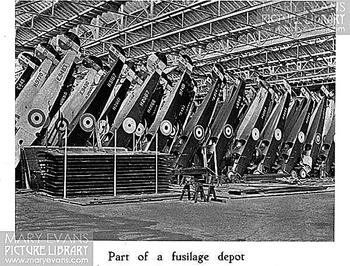
Rows upon rows of surplus British aircraft fuselages awaiting sale in one of numerous depots under the control of ADC from its 1920 brochure Wings of Commerce. (Image courtesy of National Aerospace Library, The Hub, Fowler Avenue, Farnborough Business Park, Farnborough, Hampshire, UK.)

Despite an explicit avowal that his trip was for “pleasure only,” Handley Page’s arrival in New York City on March 13, less than two weeks after the formalization of the ADC deal, shows how central the United States was to his surplus plans. That same day, Second Postmaster General Otto Praeger announced that the Post Office would seriously consider air mail proposals submitted by “any aerial transportation company established on a sound basis” at the MAA’s Second Annual Aeronautical Exposition in New York City. 81 Handley Page immediately departed for Washington to secure an air mail contract. Unsuccessful, he touted the commercial possibilities of large aircraft—the very types that the ADC now had for sale—at speaking engagements in New York City, Toronto, and Chicago. 82 By the time he left Chicago, he had secured a deal with the Chicago House Wrecking Company, a wholesale reseller, to buy half of ADC’s surplus material at a cost of £1,600,000 pounds. 83 In Cleveland Handley Page met Wiley L. Brackett and Alfred W. Harris, two businessmen attracted by the potential profits in commercial aviation, who agreed to establish an American air service company. 84 Incorporated in Delaware in late April with Brackett as Director and Harris as vice president, the Aerial Transport Corporation (ATC) would purchase ADC aircraft through the Chicago House Wrecking Company and attempt to secure an air mail contract from the Post Office as an “American” enterprise. At the same time, Workman incorporated the Aerial Sales Corporation to facilitate the further sale of ADC machines in the United States and entered into a contract with Handley Page that explicitly charged him with “the disposal of surplus aircraft and material purchased from the Government of Great Britain and acquired by the Aircraft Disposal Company, Limited.” 85 By the time ATC announced its planned air service at the Third Pan-American Aeronautical Congress, Handley Page and Workman had established a U.S. distribution network to facilitate the transfer of vast quantities of British surplus machines just in time for the 1920 flying season.
Handley Page’s efforts undoubtedly benefited from an intensifying anti-MAA stance within Woodhouse’s periodicals prior to his U.S. visit. Under vivid headlines, Woodhouse accused the organization of a “pernicious lobbying” campaign to secure federal subsidies, the proliferation of “unfounded propaganda” against nonmember companies, and “objectionable coercions” in the restraint of trade. 86 These attacks only intensified in the period between Handley Page’s arrival in the US and the Third Pan-American Aeronautical Congress. Fully aware of the advertising revenue to be gained from surplus sales, Woodhouse celebrated the “dumping of surplus military aeroplanes” as “beneficial to aviation” because it stimulated further demand. 87 Although the nature of the relationship between the two remains unclear, Handley Page noted before war’s end that Woodhouse had “done very good work for us,” and Woodhouse openly admitted in April 1920 that he was “co-operating with interests that have been planning to establish aerial transportation lines this Spring and Summer.” 88 Whether as an unwitting tool or a knowing accomplice, Woodhouse’s campaign against the MAA and support for cheap foreign aircraft clearly aided Handley Page.
Turning to Congress
In the face of this coordinated effort, MAA general manager Samuel Bradley and his members turned to congressional Republicans already concerned that European nations would dump a wave of cheap goods on an economy in the midst of a postwar recession. 89 Numerous antidumping bills were introduced in the months after the armistice that Republicans viewed as necessary protective measures and Democrats portrayed as nothing more than stealth tariff increases. In the House, staunch protectionist Joseph Fordney of Michigan shepherded a general antidumping bill through his Ways and Means Committee designed to “prevent … the dumping of foreign merchandise upon the American market at less than its fair value in the country of production.” 90 Passed by the House in December 1919, this emergency tariff bill languished in a Senate focused on America’s relationship to the proposed League of Nations. Bradley, Keys, and other MAA members lobbied extensively for the rapid consideration of Fordney’s antidumping bill in the Senate, but to no avail. 91 When the bill finally came up for debate in May, Democratic senators attacked it as an assault on American consumers and successfully worked with Progressive Republicans to send it back to the Finance Committee. 92
The news of ADC’s purchase of the British stock only increased the MAA’s sense of urgency. Aviation’s complete absence from the tariff regime coupled with the tendency to assess customs duties based on purchase price—which, in the case of ADC’s agreement with the British Government, constituted one percent of the cost of production—meant that imported aircraft would enter the country at a cost far below anything U.S. manufacturers could compete against. Boeing Aircraft General Manager Edgar Gott, famed aircraft designer Glenn L. Martin, and other MAA members expressed serious concern that a flood of surplus British machines sold at “only a few per cent of their original cost” would lead to the “complete extinction” of the American aircraft industry. 93 As the ADC initiated its first shipments of aircraft and engines to the United States in early May, Bradley frantically worked to recast the matter as a bipartisan “issue of national defense” rather than a divisive “tariff argument.” 94
With the congressional recess fast approaching, Bradley turned to Republican Harry S. New of Indiana. A member of the Senate Military Affairs Committee, New had become convinced of the importance of a strong peacetime aircraft industry. This belief had led him to sponsor a unified Department of Air bill the previous July and would guide his efforts to foster aeronautics as Postmaster General from 1923 to 1929. Convinced that a flood of cheap foreign surplus aircraft would devastate U.S. manufacturers vital to the national defense, New submitted an amendment to the Army Appropriations Bill drafted by Bradley that would explicitly extend the special duty based on the cost of production in the country of origin called for in Paragraph L, Section 3, of the 1913 Underwood Tariff to all imported aircraft over the next three years. New’s impassioned argument on the need to protect the aircraft industry convinced some Democrats and Progressive Republicans that had opposed Fordney’s general antidumping bill, but Nebraska Democrat Gilbert Hitchcock, a staunch free trader and supporter of Wilson’s League of Nations, would have none of it. Using language familiar to readers of Woodhouse’s Aerial Age, Hitchcock pointed to the industry’s vast wartime appropriations and flatly declared that “we have sacrificed enough for them; we have given them enough protections; we have put enough of the people’s money into their treasuries.” 95 Raising a point of order that the matter constituted general legislation, Hitchcock succeeded in tabling New’s amendment and Bradley “walk[ed] out of the Gallery with [his] feathers drooping.” 96
With Congress scheduled to adjourn in two weeks, Bradley succeeded in getting New’s amendment submitted as a separate bill in the House. Fordney assured Bradley it would receive prompt consideration in his Ways and Means Committee, but Woodhouse and his compatriots lobbied Republican committee members at the Third Pan-American Aeronautical Congress currently underway in Atlantic City. Claiming to represent “sixty aero clubs, associations and manufacturers, and five thousand ex-Army and Navy aviators,” they asserted that demand existed for “ten thousand aeroplanes which American manufacturers are unable to meet,” declared that the new House bill “has been framed by a few selfish members of [the] manufacturer aircraft associations,” and demanded public hearings. 97 Fordney, anxious to avoid any appearance of impropriety or favoritism, agreed to oblige them.
At the May 28 hearing, those in favor of emergency legislation centered their arguments on national security, the economic toll, and public safety concerns. Alluding to a shadowy plot by other nations to “prevent us from getting the basis of an air force in this country,” Brigadier General Mitchell warned that without a strong aircraft industry “we will find ourselves with no means for keeping up our air supremacy.” Curtiss vice president Clement Keys stressed his company’s recent decision to stop aircraft production at its Buffalo and Garden City plants due to “impending foreign competition.” 98 Columbia University-trained engineer and president of Loening Aeronautical Engineering Corporation Grover Loening argued that Americans faced a danger from “unsafe, obsolete and antiquated” British machines “rendered dangerously uncertain by age and overseas shipment.” 99 Those who testified that day all agreed on the need for the bill because those opposed to it did not appear at the hearing. In what Bradley considered a calculated attempt to delay its passage, Woodhouse, the ATC’s Brackett and Harris, and their compatriots claimed that the conclusion of festivities at the Third Pan-American Conference prevented their participation. They demanded a chance to make their case, and Fordney extended the hearings.
When the opposition finally appeared before Fordney’s committee the following Monday, their belief that the importation of “one-half of the whole British Government’s surplus” would stimulate “the most wonderful market you gentlemen can possibly conceive of” left committee members in utter disbelief. Under intense examination, Brackett and Harris were forced to admit that, although they planned to begin limited operations by July 1, the ATC did not yet exist as an operational entity. 100 They merely hoped to bid on future Post Office air mail contracts and had yet to begin experimental operations, obtain the necessary landing fields, or devise the policies and procedures necessary to ensure safe operation in the absence of government regulations. Testimony extolling the benefits of cheap imported surplus machines proved unable to convince committee members from either party, and they unanimously declared the situation “an emergency, involving the question of national defense, that calls for prompt action.” 101 The bill passed the House without objection on the last day of the session and was rushed to the Senate. There Hitchcock, still convinced that wartime appropriations had been wasted due to graft and mismanagement, delayed the second reading of the bill. 102 The Senate adjourned without considering the measure, and resentment among the pro-business and pro-flyer factions within the aeronautical community only deepened.
With no legislative restrictions on the importation of foreign surplus aircraft, Workman moved to capitalize on demand during the 1920 flying season. According to State Department reports, 251 aircraft and 325 engines arrived from England between January 1 and June 8, 1920, and industry-financed investigations revealed that nearly thirty cases marked with an ADC logo entered the Port of New York from May 25 through July 3. 103 Some of these aircraft went to the James Levy Aircraft Company, and Workman soon made arrangements with the Chicago firm to “take care of this business throughout the middle western states.” 104 Advertisements in Woodhouse’s periodicals prompted numerous inquiries. In communications signed “for and on behalf of the Aircraft Disposal Co. Ltd.,” Workman informed interested buyers that they could secure a Bristol Fighter, Avro, or DH-9 ready for “immediate delivery” for $3,500, a massive Vickers Vimy for $35,000, and a Handley Page bomber “ready to fly from Hazelhurst Field” in Mineola, Long Island, for $30,000—more than forty percent cheaper than its original production price of “over $50,000.” 105 Bradley petitioned the Treasury Department and New York customs officials to administratively apply the 1913 Tariff Act’s valuation based on cost of production to aircraft, but ADC machines continued to make their way out of customs as the Treasury Department weighed his request. 106 Without a mandatory registration system to track them, British surplus aircraft and engines began to spread across the United States. It looked as though the American industry’s worst fears would soon come to pass.
Domestic manufacturers and their agents increasingly turned to nationalistic sentiment in their fight for much-needed sales as foreign surplus arrived in the United States in greater numbers during the 1920 flying season. Aerial Age Weekly 11, no. 17 (July 5, 1920): 593.

Patents as Protection
Protection against British surplus aircraft during the pivotal period from 1920 to 1922 would come not from Congress but U.S. Patent No. 821,393—the famous 1906 Wright patent now controlled by the Wright Aeronautical Corporation (WAC). After the failure to secure emergency legislation in May 1920, WAC president George Houston turned to litigation to prevent the importation of war surplus aircraft without a license. In separate cases against the Interallied Aircraft Corporation (IAC), the Aerial Transport Corporation (ATC), and Handley Page and the Aerial Disposal Company (ADC), Houston successfully framed unlicensed importation of aircraft as patent infringement. Injunctions arising from these cases created a legal barrier against foreign surplus machines that served as an imperfect substitute in the absence of official government policy.
Houston’s strategy rested on the distinction between the British and American Wright patents. Wilbur and Orville Wright had been awarded British Patent No. 6,732 in May 1904, two years prior to securing their U.S. patent. After a licensing venture with the Short Brothers to produce Wright-type aircraft, patent agent Griffith Brewer helped to establish the British Wright Company, with Orville as chair, in February 1913. 107 To facilitate expanded wartime production, the British Government purchased full rights to Patent No. 6,732 from the British Wright Company for £15,000 in 1916. 108 However, this agreement had absolutely no bearing on WAC’s patent rights because, as Orville testified, the British Wright Company “never acquired or had any interest in … United States Patent No. 821,393.” 109 The British Wright Company may have transferred its rights to the British Government, but the WAC had not, and Houston was determined to enforce them.
Houston first moved against the Interallied Aircraft Corporation’s importation of surplus British Avros. In March 1920, IAC had paid duties on nineteen cases of aircraft and seventeen cases of parts at the Port of New York valuated at ADC’s one percent purchase rate. An additional sixty-five cases of aircraft and 604 cases of engines, the vast majority of the latter labeled “Free of Duty,” were delivered to Bush Terminal Company storage units in Brooklyn where IAC leased space for a “receiving and forwarding depot.” 110 By June 1920, IAC had imported seventy-four Avros along with six Sopwith Camels and sold twenty-eight Avros to various individuals and resellers. 111 A ruling on whether these imported Avros violated the Wright patent would not only prevent the further importation of IAC’s machines but also establish an important precedent.
Two weeks prior to the announcement that Aerial Transport Corporation planned to purchase over 3,000 British surplus aircraft, Houston submitted a complaint of patent infringement to the U.S. District Court in the Eastern District of New York that stressed IAC’s foreign ownership, called for temporary and permanent injunctions on all sales, and sought restitution for damages to WAC’s reputation. 112 Once again in the role of expert witness, Loening testified that the imported machines clearly infringed on the Wright patent, and several individuals attested to seeing Avros in the possession of IAC personnel. 113 Unable to dispute Houston’s charge of patent infringement, IAC manager John Inwood portrayed his company as a generator of much-needed jobs that had the potential to sell over one hundred aircraft in the coming months. While Judge Thomas Chatfield sided with Houston, he also recognized that the IAC had established a wide-ranging operation and already accumulated substantial stock. His temporary restraining order of May 19 prevented IAC “from selling or delivering” imported aircraft. Focused primarily on sending a message against “unfair competition” from “Government disposal material,” Houston agreed to allow the sale of already imported Avros provided that WAC received sufficient notification and IAC posted a surety bond to cover to-be-determined licensing fees. This procedure was codified in a court-mediated agreement between the two sides on June 24, one day after Chatfield officially ruled in Houston’s favor. WAC agreed to accept $8,400 for damages and an additional $300 licensing fee whenever the IAC sold one of its remaining forty-six Avros and six Sopwiths. 114 Prohibited from importing additional machines and faced with licensing fees that cut into its profits, the agreement “practically ended” Inwood’s operation. The IAC soon went into liquidation, and its remaining stock of Avros was transferred to the Lawrence Sperry Aircraft Company the next spring. 115
The case against the IAC made it clear to importers of foreign machines that the Wright patent would provide a level of protection for the U.S. market despite Congress’s inaction. Combined with Houston’s clear willingness to pursue additional litigation, this ruling compelled the British firm Bristol, Farman of France, and “importers of the Italian S.V.A. plane” to also pay a $300 licensing fee to the WAC for each aircraft sold in the United States. 116 As far as Houston, Bradley, and other MAA members were concerned, Chatfield’s opinion decisively showed that domestic patent holders retained their full rights even when an international subsidiary granted rights under an analogous foreign patent. Woodhouse characterized this interpretation as blatantly false propaganda meant to intimidate the “hundreds of dealers and users of aeroplanes who form the backbone of the American aeronautics industry.” 117
Convinced that Chatfield’s decision demonstrated that the U.S. Wright patent could be used “decisively against foreign infringement,” Houston next initiated a case in the U.S. District Court for the District of Delaware against the Aerial Transport Corporation for its planned use of ADC machines. 118 Confronted with expert testimony from Loening and affidavits from several witnesses, Harris and Brackett admitted under oath that they possessed “no airplanes and never had any.” In sworn affidavits, they claimed that when ADC’s agreement with the Chicago House Wrecking Company fell through—something the British syndicate blamed on delays in surplus aircraft transfers from the Ministry of Munitions—so too did Brackett’s personal deal with the Chicago-based distributor. 119 Judge Hugh Morris recognized the validity of the Wright patent but, with no impending threat, he dismissed Houston’s request for a temporary injunction in September 1920. He nevertheless enjoined the Aerial Transport Corporation from “directly or indirectly committing any acts” of infringement which, as a result of Chatfield’s ruling in Wright v. IAC, clearly included the importation and sale of unlicensed aircraft. 120
Armed with two legal opinions validating the power of the Wright patent to serve as a barrier against the British surplus, Houston initiated a case of patent infringement against Handley Page, the Aircraft Disposal Company, and Workman on September 15, 1920. In language that could have easily come from Woodhouse, Workman responded with an attack on the Wright patent’s validity, portrayed WAC as a mere patent “holding company,” and decried “the enormous sums of money wasted by a few of the American aircraft manufacturers” during the war. He noted that “duties amounting to 20%” were paid on all imported material, but he naturally failed to mention that these were assessed based on the price ADC paid for the machines rather than their cost of production. 121 Workman succeeded in dragging out the decision on a preliminary injunction until December, and the case finally concluded with a permanent injunction in April 1921. Although an untold number of surplus British machines had already spread throughout the United States, these three cases made it clear that WAC’s leadership “would institute legal proceedings against any firm who imported unlicensed aircraft into the United States which infringed their patents.” 122
These injunctions against unlicensed importation provided relief against the surplus threat, but only until the Wright patent expired in May 1923. Permanent protection required the passage of legislation, and Bradley and his allies again turned to Congress when it reconvened in December 1920. Perhaps because the courts had acted during the recess, they found Republicans in Congress less concerned about the matter than they had been the previous May. Pennsylvanian Republican Boies Penrose refused to make the issue a priority of his Senate Finance Committee. Fordney’s emergency tariff bill introduced in the lame duck Congress—one specifically tailored to protect the domestic chemical industry from German competition and vetoed on Wilson’s last day in office—did not include any provisions for aviation. The inclusion of a clause that would add a duty on imported goods sold “at less than the foreign home market value or foreign export value or cost of production with profit added, whichever may be the highest” in Fordney’s reintroduced bill offered a glimmer of hope. 123 But consultations with “administrative officers in the Office of the Collector of the Port of New York and in the Appraiser’s Office” made it clear that such wording would precipitate “no change” in the current assessment of imported surplus aircraft and engines because of “well established” yet “abnormally low” foreign market prices. 124 Bradley lobbied both chambers about the need for greater clarity in this emergency tariff bill, but to no avail. 125 When Senator New introduced an amendment that would grant appraising officers discretion to use the cost of production as the valuation for imported aircraft obtained from “unusual excess stocks or accumulated through artificial or abnormal conditions,” Penrose directly questioned why U.S. citizens and the Government should not be allowed to purchase cheap British surplus machines. Only ten Republicans supported New’s amendment while sixty-four of his Senate colleagues, including Progressive Republicans such as Robert M. La Follette of Wisconsin, opposed it. Bradley could “only speculate” as to why the emergency tariff of May 1921 banned imported dyes and chemicals that competed with U.S. sources but remained silent on aircraft. 126 Despite repeated calls from American aircraft manufacturers and members of the military, the votes did not exist in Congress to secure emergency protection for the struggling domestic aircraft industry.
The lobbying of Bradley, Mitchell, and others finally paid off in September 1922 with the passage of the Fordney-McCumber tariff. As chair of the House Ways and Means Committee overseeing the latest tariff revision, Fordney secured the explicit incorporation of aircraft within the nation’s tariff regime. The aircraft industry found itself protected with a sizeable thirty percent ad valorem fee on all imported aircraft and, in a marked change from prior tariff legislation, the valuation for imported goods was based on the cost of production for similar items made within the United States rather than market value in the country of origin. 127 The Fordney-McCumber tariff secured the MAA’s much sought after protection, but only after years of frustrating inaction. It was the Wright patent—blamed by both contemporaries and historians as a negative force on early American aeronautical development due to the intense litigation surrounding it—that served as the shield against foreign surplus aircraft during the pivotal twenty-eight months between the first temporary injunction against IAC in May 1920 and the passage of the 1922 tariff act. 128
Conclusion
The years immediately following World War I represented a critical juncture in the history of the U.S. aircraft industry. After a massive increase in wartime appropriations prompted an expansion of the nation’s productive capacity, aircraft manufacturers faced a rapid contraction of funding. 129 Nearly wholly reliant on government contracts for their existence, MAA members struggled to foster an entirely new civilian market without the assistance of government safety regulations. They soon found themselves confronted with a concerted effort to import thousands of surplus aircraft that threatened to overwhelm the domestic market and incentivize subsequent purchases of foreign machines through a path-dependent process. 130 Existing trade legislation proved inadequate to effectively deal with the surplus threat—current tariff laws did not explicitly address aircraft, and wartime antidumping legislation defined predatory pricing based on a presumed price differentiation between goods sold in the United States and foreign markets. Whether dealing in Canadian JN-4s, British Avros, or large bombers, importers such as Ericson and Handley Page sought to take full advantage of a U.S. trade policy that had not yet caught up to the aerial age. The efforts of Bradley, Mitchell, and their allies to portray the matter as a national security issue failed to secure emergency legislation in the face of corruption charges connected to perceived wartime production failures. In the absence of a legislative solution, MAA members Curtiss and WAC both turned to the courts for relief based on their rights as U.S. patent holders, where they experienced two very different outcomes. Whereas the all-encompassing wording of Curtiss’s wartime agreement with Great Britain precluded an injunction, WAC’s Houston transformed the Wright patent from a document that protected the rights of the individual patent holder to one that could safeguard the entire U.S. industry. Houston’s efforts provided a vital stopgap until the 1922 tariff act extended official protections to domestic manufacturers.
As Engel, Dobson, Giffard, and others have rightly noted, the U.S. aircraft industry’s focus on heavy bomber production and the transfer of jet technology during World War II provided an industrial base that allowed the United States to supplant Great Britain as the primary global aerial power in the jet age. 131 However, this required the existence of a sufficient foundation with which to build upon, one that could have looked very different had the industry’s expertise, capacity, and capital dissipated in the face of thousands of cheap foreign surplus machines after World War I. The MAA’s struggle to meet the British surplus threat serves as a stark reminder of the importance of historical contingency and a warning to policy makers about the need to proactively secure official protections for emerging technologies.