Introduction
In partisan competition, parties are constrained by their size and positions on politicized issues. Both the relative sizes and positions of parties are critical in determining the consequence of competition. More important, both factors are considered as interactive. Parties can influence the conditions for competition by attracting public attention to particular policy issues, redefining their policy orientation to capitalize on the newly politicized issues, and, if necessary, reorganizing themselves. Formal theorists analyze party competition in multi-dimensional policy spaces in abstract terms (that is, in the tradition of Downs, Reference Downs1957; McKelvey, Reference McKelvey1976) and comparative political scientists empirically distinguish the policy orientation of parties by using the ideological scaling of ‘left’ and ‘right’ so as to explore the consequence of party competition (that is, in the tradition of Duverger, Reference Duverger1954; Sartori, Reference Sartori1976). However, these approaches have fallen short of exploring the competitive dynamics of party reorganization, along with changes in their sizes and policies. This may be attributed to the absence of empirical cases that stimulate scholarly thinking based on the analyzable data.
The recent Japanese case is a quite rare example of party reorganization among stable democracies. Since 1993, the frequent alteration of governing coalitions has replaced the stable one-party dominance of the Liberal Democratic Party (LDP) that remained in power for 38 years. The LDP was ousted from power for one year but, after the non-LDP coalition government enacted electoral and political financial control reforms, it returned to office in 1994, allying with the Japan Socialist Party (JSP), which had been its major opposition rival. Since then, the LDP has been in office and, since November 1996, has dominated the premiership. Despite a conservative return to power, Japanese party politics has taken on a new look. There has been a recurrent series of mergers, splits, formations, and extinctions of parties, as well as frequent switching between parties by Diet members.
The ups and downs of the LDP vis-à-vis the major opposition party have formed a keynote of this apparently complicated transformation. The LDP was invincible, and other parties were in perennial opposition to it from 1955 to 1993. The LDP's spontaneous breakup in 1993 triggered the tilting of the balance of power among parties and underlay the transformation. The so-called 1955 system was abruptly ended, and the LDP had to face a major opposition party that had the potential to assume the reigns of government. Since 1993, the emergence of a major opposition party that is ready for the transfer of power has distinguished the politics of party coalitions from the preceding 38-year-long conservative dominance of the LDP.
The LDP has tried to remain in office, seeking new allies and changing coalition partners frequently since 1994. Observing its struggle for stable rule, one plausible explanation is: the LDP has accommodated its policy positions to changing public demands when facing the major opposition's contest for an office. Examining this possibility, the analysis will identify the major dimensions that constitute the space of policy competition among parties, focusing especially on the plural LDP and the major opposition parties – first, the JSP (later becaming the Social Democratic Party [SDP]),Footnote 1 the NFP, and, finally, the DPJ. Using expert survey data on party positions obtained after the general elections in 1996, 2000, 2003, and 2005, the results of regression and factor analyses demonstrate the following points. First, the realignment and reorganization of the existing and newly formed parties contributed to transforming and reorganizing the space of policy competition among parties. Second, parties tried to shift and change their positions so that they would be more successful in coalition formation.
Policy competition in coalition politics in Japan
Since 1993, the emergence of a major opposition party that is ready for the transfer of power has distinguished the politics of party coalitions from the preceding 38-year-long conservative dominance of the LDP. Since 1994, the LDP has remained the core party in a governing coalition and has continued to ally with the CGP since 1999. However, the LDP's rule has been far from stable. The non-LDP coalition parties merged into the New Frontier Party (NFP) in 1994, but the NFP broke up in 1997. Since then, the Democratic Party of Japan (DPJ), which was formed in 1996 as the second largest among opposition parties, has transformed itself into a major competitor for office. The DPJ survived the 1996 general election immediately after its formation, accepted switchers from the vanished NFP, and won 30–40 additional seats in the 2000 and 2003 general elections. In the 2003 general elections, the DPJ won 177 seats, whereas the LDP won 237 out of 480 seats. In the 2005 general election, the LDP won 296 seats at the expense of other parties, including the DPJ, whose seats were reduced to 113. However, this was only a brief interruption. The LDP's landslide coincidentally resulted from Prime Minister Jun'ichiro Koizumi's political maneuvering.Footnote 2 After Koisumi's retirement as a winner, the LDP suffered the loss of a large number of seats in the House of Councilors elections in 2007 that ushered in the disgraceful resignation of Shinzo Abe, an heir-apparent to Koizumi, who was replaced immediately by Yasuo Fukuda.
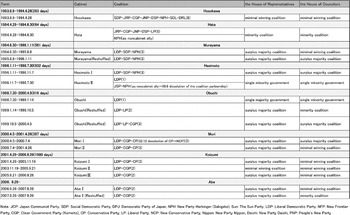
Governing coalitions have frequently changed among minimal winning, (single) minority, and surplus majority coalitions (Table 1). The LDP's minority status in the House of Councilors (HC) is one reason for instability, but the incessant reorganization of parties that accompanied the party switching of legislators has forced the LDP to seek new coalition partners. The extensive transformation of parties and party switching occurred in both the House of Representatives (HR) and HC (Kato and Yamamoto, forthcoming). A non-LDP coalition government enacted the HR electoral reform that has changed the former medium-sized district system (MDS) with a single-non-transferable-vote (SNTV) into a mixed system of a single-member district (SMD) and proportional representation (PR).
Changes of coalition government from 1996 to 2005 in Japan

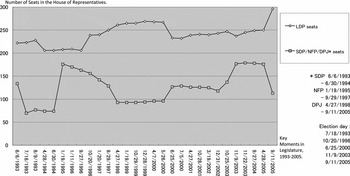
The new system, adopted after the 1996 general election, has changed electoral incentives among legislators as well as influenced the subsequent power balance among parties, but this is not the reason for all the changes. The resulting balance of power may plausibly influence the behavior of legislators as well as parties in party competition that takes place in policy space. For example, the DPJ's persistent competence, compared with the NFP's ephemeral life, has been quite unexpected. The DPJ, had ideologically distinct intraparty groups and thus faced the recurrent crisis of split while the NFP, which had been formed by the former non-LDP coalition parties, was considered as more competent vis-à-vis the LDP than the DPJ. Figure 1, representing changes in distribution of seats between the LDP and the second largest party, illustrates the process by which the NFP was abruptly disbanded three years after its formation and was replaced by the DPJ, which has been increasing in size. In addition to gains in votes and seats in all elections except the one in 2005, Kato and Yamamoto (forthcoming) explain that the DPJ benefited from office-seeking switching by legislators during most of the periods from 1998 to 2005. The middle-of-the road position in policies has made the DPJ more successful than the NFP in competing with the LDP and attracting policy-seeking switchers. Building on this prior work, we will try to explore the dynamics of policy competition by analyzing relative policy positions of competing parties.
Changes in distribution of seats among parties in Japanese House of Representatives, 1993–2005
Note: Adopted and modified from Figure 1 in Kato and Yamamoto (forthcoming).

Expert survey data
The expert survey is already an established method used to identify party positions across countries for comparison and has been used by many scholars (Castle and Mair, Reference Castle and Mair1984; Huber and Inglehart, Reference Huber and Inglehart1995; Laver and Hunt, Reference Laver and Hunt1992; Laver and Benoit, Reference Laver and Benoit2005; Benoit and Laver, Reference Benoit and Laver2006; Marks and Steenbergen, Reference Marks and Steenbergen2004). Among a variety of methods used to identify the policy positions of political actors (for example, see Laver (ed.), Reference Laver2001), the expert survey of party policy positions is certainly useful for comparative studies as well as studies of coalition politics. Political scientists as experts scale the policies and ideological positions of parties in each country to compare their positions with those in other countries. The differences in party systems are taken into account and standardized for comparison in the sense that political scientists are assumed to know the party politics of other countries and then scale the parties in a specific country.Footnote 3
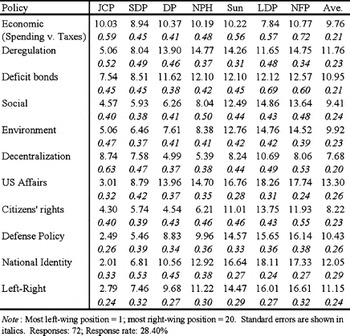
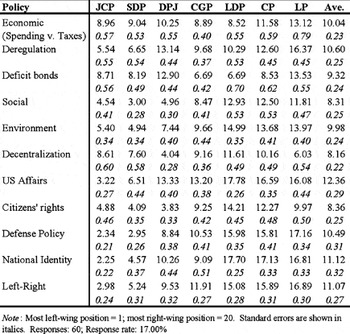
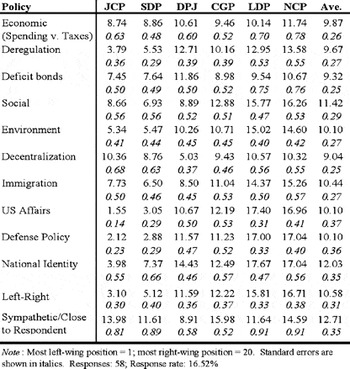
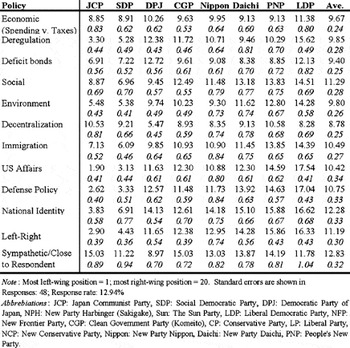
Our method is the same as the one Benoit and Laver (Reference Benoit and Laver2006) used, which was built on the one by Laver and Hunt (Reference Laver and Hunt1992). For the analysis of international data, we have obtained the data from ‘Expert Survey Results from 47 countries from 2003 to 2004’ (http://www.politics.tcd.ie/ppmd/). We have also used the Japanese data obtained from the expert surveys from 1996 to 2005 (http://www.j.u-tokyo.ac.jp/~katoj/ from which their summary statistics are available). Unlike a one-shot survey in other countries, the Japanese data consist of four rounds of surveys conducted (within three months) after the general elections of 1996, 2000, 2003, and 2005, respectively.Footnote 4 For the survey, despite the extensive party changes that are rare among industrial democracies, parties are selected by the same conditions specified by Benoit and Laver (Reference Benoit and Laver2006). All the parties that gained at least one seat or 1% of the valid votes cast in the nearest preceding election are included in the survey, in addition to the ones that experts consider important regardless of the specified conditions. For example, in the 1996 survey, Sun, a new party formed after the election by defectors from other parties, was included as important. Experts were required to answer party positions on ten policy dimensions as well as from a left−right ideological dimension. Each dimension was scaled from 1 to 20. The most leftist (scaled 1) and rightist (scaled 20) positions are conventionally distinguished so that we can examine how and to what extent party positioning in the policy dimensions corresponds with the ideological positions (see Appendix 1). An implicit assumption here is that the ideological dimension is not comprehensive enough to cover all policy differences, and thus positions are also estimated separately on policy dimensions. Here, nine policy dimensions that were consistently used in the four surveys are included in the analysis.Footnote 5
Regression analysis
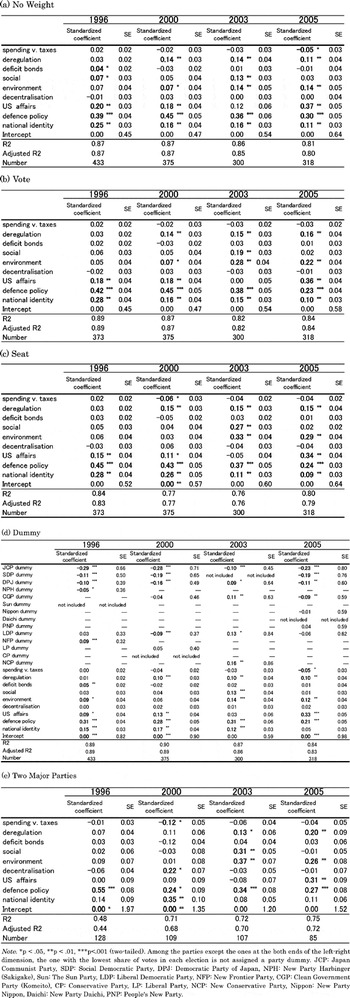
The purpose of regression analysis here is to explore the relationship between the left–right ideology and individual policies. While not all policy differences are reduced to ideological positioning, the left–right ideology is most important when judging each party's policy orientation, which constitutes the criterion for partisan competition. Alternatively, a policy difference, which is correlated with the ideological difference, more often determines the result of partisan competition. Table 2 shows the results of five OLS regression analyses in which parties’ ideological positions are explained by their policy positions using individual-level data. The data on ideological positions are standardized, whereas those on policy positions are not. Therefore, in this analysis, a regression coefficient is estimated as larger if party positioning on the policy dimension to be analyzed has a larger variance. In Tables 2(a), 2(b), and 2(c), party positioning is, respectively, not weighted, weighted by vote, and weighted by seat. Almost the same policy dimensions have statistically significant coefficients in the same year, regardless of regressions (a), (b), or (c). In other words, regardless of weighting by vote or seat, the same policy dimensions better predict parties’ ideological positions in the same year. Statistically significant coefficients are found for different policy dimensions from one election year to the next. This implies that the policy dimensions relevant for predicting parties’ ideological positions differ from year to year. However, the chronological pattern of change is almost the same, regardless of regressions (a), (b), or (c) and thus regardless of different ways of weighting. We will interpret the results of same year regressions (regardless of weighting) and then the results of regressions by weighting (regardless of the timing).
Result of regression 1996–2005

Among the economic policy dimensions, only the dimension that contrasts opposition and support for deregulation has a statistically significant coefficient in nearly all regressions since 2000. There are only two exceptions to this. One is the dimension that contrasts parties’ lenient and conservative attitudes toward deficit bonds, which has a statistically significant coefficient in the regression with no weight (a) in 1996. The other is the dimension that contrasts more or less spending and taxes, which has a statistically significant coefficient in the regressions with no weight (a) in 2005 and weighted by seat (c) in 2000.
Second, the policy dimensions that relate to international and security affairs have statistically significant coefficients across regressions in all years except the dimension for US affairs in 2003. All the regressions in all years have statistically significant coefficients for policy dimensions that contrast opposition and support for active defense policy as well as less and more respect for the emperor for national identity.
Third, in all regressions (a), (b), and (c) in 2003, both dimensions on environment and social policies have statistically significant coefficients. The environment policy dimension also has a statistically significant coefficient in all regressions since 2000 except the one weighted by seat (c) in 2000.
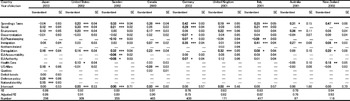
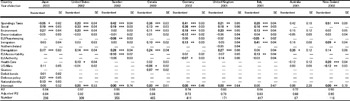
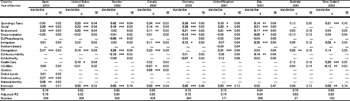
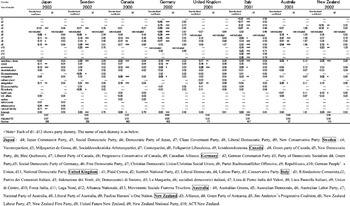
The regression results for international comparison are presented in Appendix 2(a), where all policy dimensions are included in each of nine industrial democracies. In Japan, the dimension of spending and taxes rarely has a statistically significant coefficient, which is in sharp contrast with other industrial democracies, where spending and taxes have been most important for the left–right ideological distinction.
The deficit bonds dimension was added to the Japanese survey questions, based on the above observation. In Table 2(a), the deficit bonds coefficient is statistically significant in the regression for 1996. However, since 2000, the coefficients have been statistically insignificant in predicting an ideological position.
The results of these analyses are simple and straightforward and are thus considered robust. In terms of economic policies, for example, deregulation has distinguished well the left-right positions of parties. In sharp contrast to the importance of deregulation, the issue of spending and taxes was not predicting party positions. The implications of the analyses are consistent with our observations about Japanese politics since the 1990s.
Until the early 1990s, the LDP, as the single incumbent party, often promoted tax increases to solve budget deficits and, at the same time, tried to repress the issuance of deficit bonds. The second largest party and a perennial opposition party, the DSP, supported tax cuts in spite of the party's leftist ideology. During the prolonged recession, the LDP was forced to accept the issuance of deficit bonds, which was counter to its fiscal conservatism. The DPJ became more critical of deficit finance, which was counter to its more moderate and centrist orientation toward increased public spending. In a nutshell, no party could afford to clearly state its position on the size of public sector – the left could not push high spending without reservations, but the conservative camp could advocate a small public sector only if there was fiscal solvency. This result reflects a budget stalemate, that is a stalemate in the debate over fiscal orientation among parties in the 2000s. The debt-ridden national budget and the massive, accumulated debt constituted the horns of the dilemma. In contrast, deregulation, which predicted the ideological position of parties, has been increasingly important since the early 1990s in identifying their economic policy orientation. Support for deregulation was observed among parties that gave priority to swift recovery from the economic slump and to the restructuring of the economic system. Opposition to deregulation was advocated by parties that were more concerned with increased income inequality during the prolonged recession.
Although economic policies do not necessarily predict the left–right ideological positions of parties, the foreign and security policies do. Among them, the coefficient of US affairs is smaller and its level of statistical significance is lower than those of the defense policy and national identity issues, except in 2005 when the security relationship with the United States, more specifically the Iraq issue, was politicized. This result is consistent with the fact that the conservative mainstream of the LDP has traditionally held a pro-US attitude in international security but that an anti-US orientation in international security has been observed in the leftist camp. It is harder to distinguish the left and right positions by US affairs than other foreign and security policies.
More politicized policies that discriminate party positions predict better the ideological positions of parties in both economic and foreign and security policies. This result implies that the left–right ideological difference has been an important element in distinguishing party positions and thus in understanding the dynamics of their competition.
The results of regressions weighted with no weight and by vote and seat (Tables 2(a), (b), and (c)) also have a very interesting implication if compared with those in other democracies (Appendix 2 (a), (b), and (c)). This comparison tells us to what extent and in what way the electoral systems as well as election results influence policy differences among parties in Japan. In the case of Japan, the regression model without weight has almost the same level of adjusted R2 as the one weighted by seat, but the one weighted by vote tends to have a smaller adjusted R2. This means that the model weighted by seat has a lower level of explanatory power than the ones without weight and weighted by vote. Among other countries, only the United Kingdom and Australia (that have a single-member-district system [SMD]) have a lower level of adjusted R2 in the regression weighted by seat than the one weighted by vote. This plausibly implies that a distribution of votes may not be reflected in one of the seats when considering the impact of each party's weight when defining policy differences in terms of the left–right ideology. In the Japanese case, the weight by vote tends to be more underrepresented than the weight by seat.
Observing the election systems in Japan, the United Kingdom, and Australia, the election systems do not necessarily matter. The United Kingdom adopts a system of single-non-transferable vote (SNTV), whereas Australia employs transferable votes. A significant difference in adjusted R2 is, however, absent in the US case, which has the same system as the United Kingdom, that is the SMD with SNTV. In addition, the significant difference is not observed in the case of New Zealand, which employs the same mixed system as Japan. While the election systems do not necessarily matter, the proportionality of votes in allocation of seats may explain a cross-national difference. European countries with a proportional representation (PR) system (such as Sweden, Germany, and Italy) do not observe a gap in adjusted R2 between the regressions that are weighted by seat and vote. Among the countries with the mixed system of the SMD and PR, proportionality is higher in New Zealand than in Japan and this contrast appears to be consistent with the low level of predictive power of policy positions in the regressions weighted by vote than that by seat. In Japan, the mixed system has a lower proportionality than the medium-sized district system (MSD) that preceded it. The New Zealand electoral reform has contributed to increasing proportionality (Gallagher Reference Gallagher1998).
Table 2(d) and Appendix 2(d) show the results of regressions for the Japanese chronological data as well as an international comparison that includes party dummies among independent variables. The inclusion of these dummies in the analysis makes little difference to the estimated coefficients, but it does increase the level of adjusted R2. The estimation of coefficients is influenced by the assignment of party dummies, that is by which party is excluded from the dummies. We can confirm that the party label has nothing to add to the prediction of a party's ideological position, if the coefficients of all party dummies are statistically insignificant. This condition is held true only for the UK case.
In the regression – Table 2(e) – where only two major parties are included, that is the LDP and a major opposition party (the NFP in 1996 and then the DPJ), the result is different from the regression of all parties. Most notable among the differences is that the coefficient of national identity is statistically significant only in 2000 and the one of US affairs only in 2005. These results are also consistent with the empirical observations. Neither the NFP nor the DPJ distinguished its position from the LDP's in national identity and US affairs as much as other parties, such as the Japan Communist Party (JCP) and the SDP. The low level of adjusted R2 in 1996 corresponds to the fact that the NFP included many defectors from the LDP and was as conservative as the LDP in many policy dimensions.
In conclusion, the result of regression analyses indicates that the left–right ideology represents the party positioning of some, though not necessarily all, policies during the period of party reorganization in Japan from 1996 to 2005. However, the policy positions of parties correlated with the left–right ideology are different from one election year to the other during these periods.
Factor analysis
Specific policy positions of parties usually hinge upon their fundamental policy orientations. If so, what are such fundamental policy orientations? Is the number of scaled policy positions of parties reduced to a smaller number of dimensions that correspond to the left–right scaling and/or to major policy cleavages that have been politicized? These questions are especially intriguing when parties are reorganizing themselves and the balance of power among them is changing. While the existing policy orientation of parties contributes to forming the dynamics of partisan competition, parties may shift or change their positions so as to give themselves advantages in the formation of governing coalitions as well as in gaining electoral support. Factor analysis is an appropriate statistical technique to answer these questions and enables one to plot party positions in policy space that serves to illustrate party policy competition in general. Here, we will especially focus on the relationship between the changing dynamics of policy space and bargaining among parties in coalition formation.
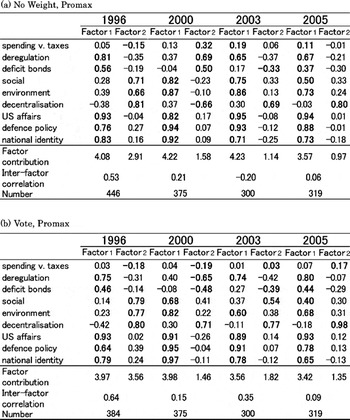
Table 3 shows the result of factor analysis by Promax rotation (oblique solution; maximum likelihood factor solution). The larger absolute value of loadings between two factors is indicated in bold. Throughout the period, Factor 1 and Factor 2 are defined, as explained below. In Table 3(a), Factor 1 principally represents a left–right ideological difference. Deregulation, deficit bonds, US affairs, defense policy, and national identity have larger (plus) loadings in Factor 1 throughout the period except in the year 2000 when deregulation and deficit bonds have larger (positive) loadings in Factor 2. Factor 2 represents a newly formed policy difference that has not been defined along a traditional ideological difference, and decentralization has apparently larger (positive) values in Factor 2 in 1996, 2003, and 2005. Again, an exception is observed in 2000 when decentralization has a larger absolute value of negative loading in Factor 2.
Result of factor analysis

The 2000 exception can be attributed to the relative party positioning over the policy space. In 2000, all economic policies, spending, taxes, deregulation, and deficit bonds, have larger (positive) loadings in Factor 2, whereas decentralization has a larger (negative) loading in Factor 2 (than in Factor 1). In other words, only in 2000, does the same factor, Factor 2, influence both economic policies and decentralization, although in a different direction. This result implies that, in 2000, Factor 2 includes an element to explain the left–right difference in economic policies as well as one that represents a conflict over decentralization. More important, a negative loading of decentralization in Factor 2 in 2000 implies that party positions on decentralization are apparently the opposite of positions assumed in the left–right difference in economic policies. The peculiar orientation of the Liberal Party (LP) that existed only in 2000 might explain this puzzling result. More specifically, according to the observation of the policy-making process in 2000, the LP was more eager (and thus was frequently scaled) to promote deregulation (defined as right) and decentralization (defined as left) than the LDP because it was frequently regarded (and thus was scaled) as a more conservative party in the ideological dimension than the LDP. In distinction, the DPJ promotes deregulation as much as the LDP but promotes decentralization more than the LDP and generally tends to be scaled in a more centrist direction than both the LDP and the LP. The twist in factor loadings is observed only in 2000 when the LP was in existence. Here, party positioning is characterized by a criterion or pattern of party competition.
The Japanese result also has an interesting parallel with the one in international comparison. The dimensions of social and environment policies have larger (positive) loadings in Factor 2 in 1996, but since 2000 they have larger positive values in Factor 1. This means that both social and environment policies distinguished party positions along with the newly formed cleavage of decentralization in 1996, but were defined by the left–right difference. As a result, only the decentralization policy is associated with the newly formed policy conflict represented by Factor 2. Laver and Benoit (Reference Laver and Benoit2006) report a parallel shift observed in the results of a factor analysis of the data from 15 democratic countriesFootnote 6 between 1989 and the 2000s. In the 1989 expert survey by Laver and Hunt (Reference Laver and Hunt1992), the analysis elicits factors that influenced decentralization and environment other than the one that relates to a left–right difference. However, in the 2003/04 survey by Benoit and Laver (Reference Benoit and Laver2006), environment policy is associated with the same factor as the economic policies defined by a left–right difference rather than the factor associated with decentralization.Footnote 7 In 15 democracies, social policy is also under the influence of the same factor as environment policy in the 2000s. The parallel change plausibly occurred in Japan between 1996 and 2000.
The factor analysis in which party positions are weighted by their seat share is presented in Table 3(b) to examine the impact of the formation and dissolution of numerous small parties during the period. Unlike the regression analysis, the results of factor analysis are almost identical regardless of whether they are weighted by vote. There is no reason to believe that larger parties influence the definition and dynamics of policy competition more than smaller parties.
Party plot over policy space
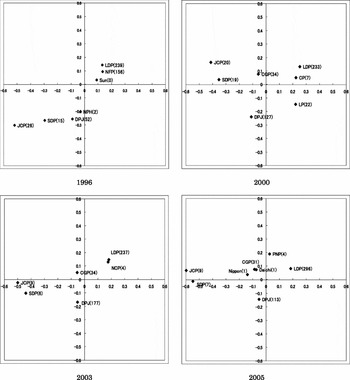
Building on the implications above, party plotting over the two-dimensional space in Figure 2 shows a dynamic change in party competition from 1996 to 2005. The coordinate axes, x and y, measure each party's average scores of Factors 1 and 2, respectively. In other words, the x-axis represents the left–right ideology distinguished by economic and foreign policies, and the y-axis represents a party's position on new issues. The results of factor analysis imply that new issues, such as environment and social policy, at the beginning of the period were assimilated with the ideological axis until 2005. Therefore, the y-axis consistently represents support for, or opposition to, policy changes in decentralization and deregulation, which we observed to have emerged from party competition, especially between the LDP and the newly formed parties in the early 1990s. In this regard, the definitions of factors are assumed to be principally the same throughout the period. Parties are plotted over rectangular coordinate axes because inter-factor correlation is generally low, although the analysis uses an oblique factor model.
Location of parties on the average of factor scores(without Citizens’ Right and Immigration)
Note. JCP: Japan Communist Party, SDP: Social Democratic Party, DPJ: Democratic Party of Japan, NPH: New Party Harbinger (Sakigake), Sun: The Sun Party, LDP: Liberal Democratic Party, NFP: New Frontier Party, CGP: Clean Government Party (Komeito), CP: Conservative Party, LP: Liberal Party, NCP: New Conservative Party, Nippon: New Party Nippon, Daichi: New Party Daichi, PNP: People's New Party.

The positions of the NFP in 1996 and those of the LP in 2000 are very close to the LDP. This is consistent with the observation that both parties that failed to distinguish themselves from the LDP vanished quickly. However, the relative positioning of the LDP and the DPJ has remained the same from 1996 to 2000: the DPJ has been consistently more left and more supportive of decentralization than the LDP. There are two interesting findings. First, despite a change in policies that contributes more to each of two factors, the parties’ relative positioning remains the same throughout period. This implies that the parties’ shifting in relative positions contributes to the change in factor loadings. Second, although the positions of the LDP and the DPJ differ enough to distinguish between then, they are moving closer together from 1996 to 2005. Because both parties are likely to ally with parties (from center to moderate conservative) other than the JCP and the SDP, they may try to shift their positions to make them more attractive to potential coalition partners. In this regard, the JCP and the SDP have been alienated from policy competition among other parties.
This consequence may be attributed to their positions on new issues rather than to their leftist ideology. The expert survey data demonstrate that both leftist parties are clearly and consistently against deregulation, promoting protection of the environment and social rights, but are more moderate in supporting decentralization (http://www.j.u-tokyo.ac.jp/~katoj/). The data are consistent with the observation that the policy-making process and plotting of parties explain the dynamics of interparty relationships during the period. In 1996, the positions of the JCP and the SDP, especially along the y-axis, were much closer to the DPJ. However, they shifted their positions upward along the y-axis to nearly the same position as the LDP in 2005. This implies that they have become less supportive of policy changes than the LDP. The result of factor analysis underscores this shift: in 2003 and 2005, the JCP and SDP party positions on deregulation, environment, and social policies were assimilated into the left–right ideological difference, and the y-axis (Factor 2) represents their attitude toward only one new issue – decentralization – for which their support is as low as the LDP's. Once deregulation, environment, and social policies have been distinguished along the left–right ideological difference and only decentralization represents the new policy cleavage, both the JCP and the SDP have ceased to support policy changes. Aside from their leftist ideology, the weakening of their apparent reformist orientation has made them less attractive coalition partners for other opposition parties.
Conclusion
According to the results of regression and factor analyses, from 1993 to 2005, party changes, including party switching, reorganization, and electoral change, influenced which policy differences constituted major conflicts or cleavages in party competition and, alternatively, the existing parties also shifted their positions adjusting to changing conditions for party competition. More important, the interaction with competitive conditions has proven to change the fortune of parties either for the better or for the worse. Both the LDP and the DPJ have tried to cope with the lack of stability throughout the period. The DPJ has been better at exploiting volatility in partisan competition than the LDP: it has made a successful transition from the third party to the second largest party, which may be able to compete with the LDP for office. Among other opposition parties, the JCP and the SDP have been pushed out of the coalition formation game. The two left parties have appeared more united than other parties: the JCP has experienced no switching to or from other parties and the SDP has been untouched by change since its major breakup in 1996. The JCP and the SDP have sought to ally with middle-of-the-road and/or conservative parties in vain. Consequently, the Japanese case carries two counter-intuitive implications on volatility in policy conflicts as well as party competition. First, a volatile situation does not necessarily bring disarray in party competition. Instead, it may often serve to consolidate a new competitive condition. Second, despite frequent changes in legislative members by switching, parties may be able to capitalize on the volatility to make them better off. On the contrary, parties with more organizational stability may well be left behind and be alienated from a coalition formation. This counter-intuitive consequence results from the interaction between parties’ policy position taking and the changing dynamics of party spatial competition.
Appendix 1

Party positions on policy scales in Japan, 1996

Party positions on policy scales in Japan, 2000

Party positions on policy scales in Japan, 2003

Party positions on policy scales in Japan, 2005

No weight

Vote

Seat

Dummy