Introduction
People with dementia usually live at home until a late stage in the disease. In Europe the percentage of admissions to long-term care of people with dementia varies from 15% in Italy to 38.5% in France (Vernooij-Dassen et al., Reference Vernooij-Dassen, Moniz-Cook, Woods, de Lepeleire, Leuschner and Zanetti2005). However, about 70% of persons with dementia are eventually placed in long-term care facilities (de Klerk, Reference de Klerk2001).
Admission into long-term care is a final option that is not preferred by the majority of people and its financial costs are very high in most countries. A long-term care facility is a place to live, but it is often difficult to feel at home. Having to start a new life at a place you have not deliberately chosen under difficult physical and social circumstances presents a major challenge to many residents.
Yet, long-term care facilities can offer services and thereby opportunities that are not available in many people's homes. Some long-term care facilities contribute to the improvement of dementia care through the development of new psychosocial interventions that try to draw on the potential of persons with dementia and compensate for disabilities. In this way, long-term care facilities are a nursery for approaches to improve the quality of care and quality of life for persons with dementia. Psychosocial interventions aim at improving quality of life and maximizing function in the context of existing deficits. Such interventions use a wide range of approaches including behavior-oriented, emotion-oriented, cognition-oriented, and stimulation-oriented approaches and are carried out by a wide range of health and social care practitioners. Most psychosocial interventions aim to improve cognitive skills, mood or behavior (APA Work Group on Alzheimer's Disease and Other Dementias, 2007).
In order to give the best care possible it is important to use best practices and available evidence on psychosocial interventions. In this paper we aim to explore the evidence and consensus on psychosocial interventions for long-term care (nursing and residential homes) through reviews of research and consensus statements.
Methods
In order to identify (i) psychosocial interventions that are effective and can be implemented in daily practice, (ii) promising interventions requiring further study, and (iii) interventions that have shown insufficient evidence, we undertook
• an appraisal of research reviews, and
• an exploration of European, U.S. and Canadian dementia guidelines
Search strategy
The PubMed database, which includes reviews from the Cochrane Library, was searched using the following search terms: Dementia (MESH) AND (psychosocial OR non-pharmacological OR nonpharmacological OR intervention). The period of search was 1999 to June 2009.
Papers (reviews and guidelines) included in this overview were selected using the following criteria: focus on dementia; focus on psychosocial interventions in long-term care; review or dementia guidelines; in English. The exclusion criteria were: interventions only focused at community care; and papers not published as a review in peer reviewed journal or as dementia guideline.
Results
Appraisal of reviews
The search identified 511 papers and resulted in 52 reviews with information on psychosocial interventions, of which 27 related to long-term care. Since training of long-term care staff in psychosocial interventions is essential to improve daily care, we also included the results of a recent review by Vasse et al. (Reference Vasse, Vernooij-Dassen, Spijker, Olde-Rikkert and Koopmans2010). Thus, 28 reviews were included. Some of these reviews focused on multiple interventions, whereas others limited themselves to the efficacy of one type of intervention, such as physical activity.
Most effective psychosocial interventions
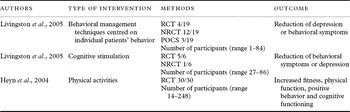
Table 1 presents the reviews of the most effective psychosocial interventions aimed at persons with dementia.
Most effective psychosocial interventions for persons with dementia in long-term care

RCT = randomized controlled trial; NRC T = non-randomized controlled trial; POCS = patients were their own comparison subject.
The psychosocial interventions sought to decrease behavioral symptoms and depression and to improve functioning. Behavioral symptoms of persons with dementia in long-term care were reduced by behavioral management techniques (Livingston et al., Reference Livingston, Johnston, Katona and Lyketsos2005), cognitive stimulation (Livingston et al., Reference Livingston, Johnston, Katona and Lyketsos2005) and physical interventions (Heyn et al., Reference Heyn, Abreu and Ottenbacher2004). Depression was decreased by behavioral management techniques and cognitive stimulation (Livingston et al., Reference Livingston, Johnston, Katona and Lyketsos2005). Physical and cognitive function were improved by physical activities (Heyn et al., Reference Heyn, Abreu and Ottenbacher2004).
Behavioral management techniques included reinforcement of quiet behavior and stimulation, individualized functional analysis based on patient's superstitions, individualized bathing based on the preferences of the person with dementia, habit training for activities of daily living tasks (dressing) and behavior therapy emphasizing pleasant events (Livingston et al., Reference Livingston, Johnston, Katona and Lyketsos2005). Cognitive stimulation has been derived from reality orientation, but uses information processing rather than factual knowledge to address problems in functioning (Livingston et al., Reference Livingston, Johnston, Katona and Lyketsos2005). Physical exercise included walking, isotonic exercises and chair exercises (Heyn et al., Reference Heyn, Abreu and Ottenbacher2004).
Table 1 indicates the number of studies, design and number of participants for each method. Behavioral management techniques were evaluated in 19 studies of which four used RCTs and 12 non-randomized controlled trials. Nearly all cognitive stimulation studies and all physical activity studies were evaluated using RCTs.
The reviews did not provide specific information on settings and also included community dwelling persons with dementia. Information on MMSE scores was only given by Heyn et al. (Reference Heyn, Abreu and Ottenbacher2004). The MMSE scores were reported in 22 studies (75% of the investigations). The scores ranged from 6 to 25 on a scale ranging from 0 to 30. The mean MMSE SD was 16.5–7.0 which was classified as a moderate cognitive impairment (Heyn et al., Reference Heyn, Abreu and Ottenbacher2004).
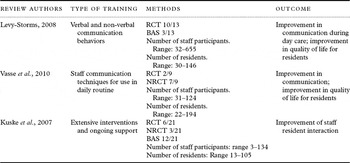
The most successful staff training programs are presented in Table 2. Improvement of staff–resident interaction behavior was demonstrated when extensive interventions, including improvement in activities of daily living, were used (Kuske et al., Reference Kuske, Hanns, Luck, Angermeyer, Behrens and Riedel-Heller2007; Levy-Storms, Reference Levy-Storms2008; Vasse et al., Reference Vasse, Vernooij-Dassen, Spijker, Olde-Rikkert and Koopmans2010). In addition, staff communication training positively affected residents' quality of life (Levy-Storms, Reference Levy-Storms2008; Vasse et al., Reference Vasse, Vernooij-Dassen, Spijker, Olde-Rikkert and Koopmans2010). Levy-Storms (Reference Levy-Storms2008) concludes that in order to sustain improvement, nursing aides need more training in therapeutic communication and also ongoing, dedicated supervision in psychosocial aspects of care.
Staff training in long-term dementia care
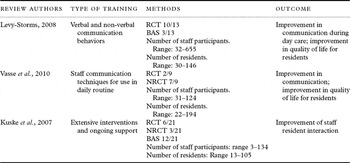
RCT = randomized controlled trial; NRC T = non-randomized controlled trial; BAS = before-and-after study.
The methodological quality of the reviewed studies was good, with a relatively high number of RCTs or controlled studies and relatively high numbers of participants.
Promising interventions requiring further study
We defined “promising” interventions as those having a positive, albeit not always significant impact. Several interventions were considered to be promising with regard to reduction of neuropsychiatric symptoms, such as structured activities (Cohen-Mansfield, Reference Cohen-Mansfield2001), massage and touch (Viggo Hansen et al., Reference Viggo Hansen, Jørgensen and Ørtenblad2006), reminiscence (Woods et al., Reference Woods, Spector, Jones, Orrell and Davies2005), unmet needs interventions (Ayalon et al., Reference Ayalon, Gum, Feliciano and Arean2006), aromatherapy (Holt et al., Reference Holt, Birks, Thorgrimsen, Spector, Wiles and Orrell2003), and music therapy (Vink et al., Reference Vink, Birks, Bruinsma and Scholten2004). In general, the most promising interventions appear to be those that are individually tailored and behavior-oriented (Ayalon et al., Reference Ayalon, Gum, Feliciano and Arean2006).
Some reviews focused on the type of behavior to be treated rather than on the type of intervention used. A review of interventions to reduce agitated behavior reported promising results, especially of stimulus control interventions (Spira and Edelstein, Reference Spira and Edelstein2006). Research on the etiology of vocal disruption is still in its infancy, but positive treatment results have been found in case studies and in one RCT (von Gunten et al., Reference von Gunten, Alnawaqil, Abderhalden, Needham and Schupbach2008). Depression was reduced by multiple component interventions in 7/11 studies (Teri et al., Reference Teri, McKenzie and LaFazia2005). Disruptive behavior has been reduced in 8/14 studies using problem-solving therapies that identify and address antecedents and consequences of disruptive behavior and increase pleasant events (Logsdon et al., Reference Logsdon, McCurry and Teri2007).
Interventions showing insufficient evidence
There is insufficient evidence from several randomized trials to allow any conclusion to be drawn about the efficacy of validation therapy for people with dementia or cognitive impairment (Neal and Barton Wright, Reference Neal and Barton Wright2003) and no robust evidence exists so far to recommend the use of any non-pharmacological intervention to reduce or prevent wandering in people with dementia (Price et al., Reference Price, Hermans and Grimley Evans2000; Robinson et al., Reference Robinson, Hutchings, Corner, Beyer, Dickinson and Vanoli2006; Reference Robinson, Hutchings, Dickinson, Corner, Beyer and Finch2007). However, wandering can be accommodated with proper design or potentially with use of technology. In addition, cognitive training and cognitive rehabilitation have not been found to be effective (Clare et al., Reference Clare, Woods, Moniz Cook, Orrell and Spector2003).
Although snoezelen was considered to be a useful treatment for neuropsychiatric symptoms (Chung et al., Reference Chung, Lai, Chung and French2002; Livingston et al., Reference Livingston, Johnston, Katona and Lyketsos2005) and was considered to be promising in reducing apathy (Verkaik et al., Reference Verkaik, van Weert and Francke2005), a recent update of the Cochrane review by Chung and Lai (Reference Chung and Lai2008) showed no significant positive effects.
Exploration of European, U.S. and Canadian dementia guidelines
The results of RCTs and reviews have been used to develop guidelines and recommendations for long-term care. Nine European guidelines, the Canadian guidelines and the American Geriatrics Society (AGS) dementia guidelines were examined. The guidelines were gathered by the Interdem network (a Pan-European research group on INTERventions in DEMentia care) and the IPA long-term care network. These networks are essential in collating guideline information, since guidelines are usually in written in the national language and not always easily accessible. Within these guidelines we searched for recommendations for long-term care. Four European guidelines had no information on long-term care. Long-term care recommendations emphasized the importance of care tailored to the needs and capabilities of persons with dementia and consideration of the individual's life context. In order to provide tailor-made care, assessment is necessary.
Assessment
Comprehensive assessment is recommended including life history, social and family circumstances, current level of functioning, physical, psychosocial, cultural and spiritual identity, physical and mental health needs, and preferences for treatment (Canadian Coalition for Seniors' Mental Health, 2006; NICE/SCIE, 2006).
Some guidelines focus on specific issues such as individual daily exercise needs (Bartholomeyczik et al., Reference Bartholomeyczik2006) or aim to identify which sensory stimuli a resident responds to positively during different caring activities (Netherlands Institute for Health Services Research, 2004). The U.S. guidelines provide detailed recommendations for assessment and treatment of depression and behavioral symptoms associated with dementia (AGS, 2003). The Canadian guidelines consider the need to develop mealtime care-giving activities to enhance nutrition and prevent behaviors that interfere with nutritional and social needs (Canadian Coalition for Seniors' Mental Health, 2006). These assessments are the basis or a prerequisite for treatment.
Treatment
The recommended treatment for people with dementia includes suggestions to deal with a variety of needs. A range of tailored interventions, such as reminiscence therapy (Bartholomeyczik et al., Reference Bartholomeyczik2006; Canadian Coalition for Seniors' Mental Health, 2006; NICE/SCIE, 2006; Ypma-Bakker et al., Reference Ypma-Bakker2008), multisensory stimulation (Netherlands Institute for Health Services Research, 2004; NICE/SCIE, 2006; Scottish Intercollegiate Guideline Network, 2006; Canadian Coalition for Seniors' Mental Health, 2006), animal-assisted therapy and exercise (Canadian Coalition for Seniors' Mental Health, 2006; NICE/SCIE, 2006) and cognitive behavioral therapy (NICE/SCIE, 2006), may be considered to be a part of treatment, especially for people with dementia who suffer from depression and/or anxiety. The active participation of their carers may be considered as part of the treatment (NICE/SCIE, 2006; Canadian Coalition for Seniors' Mental Health, 2006).
A specific recommendation has been made for dealing with crises. The suggestion is to try to find out what feelings cause the crisis and to distract the patient without correcting his/her reality. People with dementia who show challenging behavior should be treated with acceptance and respect during a psychiatric crisis (Bartholomeyczik et al., Reference Bartholomeyczik2006).
Care plans
Guidelines highly recommend care plans that address the varying needs of people with different types of dementia. Care plans should focus on (a) disabilities, (b) use of strengths while considering deficits, for instance support for people to go at their own pace and participate in activities they enjoy (NICE/SCIE, 2006), and (c) the social context, for example the use of the social context of meals (Canadian Coalition for Seniors' Mental Health, 2006).
Care plans should also focus on risk management by indicating how care staff should identify, monitor and address environmental, physical health and psychosocial factors that may increase the likelihood of challenging behavior, especially violence and aggression.
Care plans should also consider environmental factors: overcrowding, lack of privacy, lack of activities, inadequate staff attention, poor communication between the person with dementia and staff, conflicts between staff and carers, and weak clinical leadership (NICE/SCIE, 2006). Important requirements for carrying out care plans are consistent and stable staffing, retaining a familiar environment by minimizing relocations (NICE/SCIE, 2006), and staff education (Canadian Coalition for Seniors' Mental Health, 2006; Vasse et al., Reference Vasse, Vernooij-Dassen, Cantegreil, Franco, Woods, Moniz-Cook and Georges2008).
Discussion
The use of psychosocial interventions in long-term care has the potential to improve the quality of life of residents with dementia. Behavioral management techniques and cognitive stimulation have been proven to be effective in reducing behavioral symptoms and/or depression, and physical exercise has been found to improve physical and cognitive functioning and to stimulate positive behavior.
The positive results of psychosocial training programs for caregivers in long-term care indicate that these programs have the potential for improved quality of care and thereby for improved quality of life of persons with dementia.
Other interventions are promising, but they suffer from methodological weaknesses such as small numbers of participants. There is consensus described in several guidelines to recommend assessment of physical and psychosocial characteristics and needs for care, as well as on how to facilitate needs-tailored care. Care plans are highly recommended as a means of improving quality of care and quality of life.
These recommendations are consistent with those found in studies on home care in dementia which suggest that care should be tailor-made and intensive (Brodaty et al., Reference Brodaty, Green and Koschera2003). These results support the unmet needs model (Cohen-Mansfield, Reference Cohen-Mansfield2001).
Some results seem to be contradictory such as the lack of positive results on cognitive rehabilitation and cognitive training (Clare et al., Reference Clare, Woods, Moniz Cook, Orrell and Spector2003) and the positive effects of cognitive stimulation (Livingston et al., Reference Livingston, Johnston, Katona and Lyketsos2005). More research is needed to study the differential impact of these comparable approaches.
Long-term care studies suffer from specific barriers such as being small scale owing to limited funds available for non-pharmacological dementia research as well as the challenges related to recruitment. The available RCTs are of relatively low quality and the variation in outcome measures makes it too early to provide any conclusive indication of the effectiveness of these psychosocial interventions. The question is also whether the RCT is the most appropriate design to measure effects of long-term care psychosocial interventions. Unlike pharmacological studies, it can be difficult or impossible for patients and treating professionals to be blinded to the treatment intervention. The nature of the disease and personal preferences should be considered when measuring effects. Some psychosocial interventions appear to have effects that are mostly small to moderate with a short duration of action. This limited action means that treatments will work best in specific, time-limited situations tailored to individual requirements (O'Connor et al., Reference O'Connor, Ames, Gardner and King2009a), or interventions have to be programmed into care. In the few studies that addressed within-group differences, there were marked variations in response (O'Connor et al., Reference O'Connor, Ames, Gardner and King2009b). Some participants benefited greatly from a treatment, while others did not (O'Connor et al., Reference O'Connor, Ames, Gardner and King2009b). Furthermore, long-term care studies do not cover all areas relevant for psychosocial care. More research is needed on many of the understudied psychosocial interventions such as interventions including family members and end-of-life care in long-term care settings.
The conclusions reached in this paper are constrained by the limitations of research in this field and of the use of reviews and guidelines. As a consequence, recommendations heavily depend on consensus. Limitations pertaining to the use of reviews and guidelines include the following:
(1) Because different reviews utilize different methodologies, their conclusions may vary based on the methodology rather than on the strength of evidence. For example, different reviews used different search engines: Spira and Edelstein (Reference Spira and Edelstein2006) started with only Psychinfo, and references emanating from those articles; von Gunten et al. (Reference von Gunten, Alnawaqil, Abderhalden, Needham and Schupbach2008) used Pubmed, while others used multiple search engines. The populations studied varied in the different reviews; for example, some reviews also included persons who were not in long-term care. Thus, Heyn et al. (Reference Heyn, Abreu and Ottenbacher2004) reports an average MMSE score of 16.5, which may not apply to many nursing home residents. Furthermore, different reviews used different criteria for inclusion in the review. Ayalon (Reference Ayalon, Gum, Feliciano and Arean2006), for example, included single subject design, a methodology not included in many other reviews. Some reviews included only randomized controlled studies, while others graded the quality of the studies reviewed. This can lead to differing conclusions.
(2) The terminology used to characterize interventions is inconsistent across reviews. In one review, for example, the term “behavioral interventions” included person-centered care, or supportive psychotherapy (Livingston et al., Reference Livingston, Johnston, Katona and Lyketsos2005). This is different from the use of this term in other papers. Furthermore, interventions often include multiple components which may be responsible for the effect, such as social contact, or positive feedback, which may be responsible for the effects in different interventions such as music therapy, exercise or validation therapy. The examination of the active ingredient in those interventions has not yet begun (Teri et al., Reference Teri, McKenzie and LaFazia2005).
(3) Because of the weak quality of available studies and the stringent criteria used by reviewers, most reviews reach their conclusions on the basis of very few studies.
(4) Different interventions may be appropriate for different segments of the long-term care population. Matching is likely to be based on type of symptom, person characteristics, such as cognitive functioning, and setting. Interventions are only starting to examine such individualization (Cohen-Mansfield et al., Reference Cohen-Mansfield, Libin and Marx2007).
(5) Reviews and guidelines have the disadvantage of missing recent developments (Chenoweth et al., Reference Chenoweth2009), so that recent significant research studies are not represented here.
Conclusions
Recommendations based on evidence and consensus are an important means of shaping future long-term care and improving the quality of life of persons with dementia in long-term care homes. Proactive individualized care plans can support this process by including recommendations for good care that meet the needs of persons with dementia. Moreover, evidence based psychosocial interventions are not automatically used and implementation strategies should be tried and evaluated in long-term care. More well-designed research is needed on psychosocial interventions in long-term care, including research on understudied issues such as the role of family members, in order to strengthen the evidence base for long-term care.
Recommendations arising from this review
• Long-term care facilities should include psychosocial interventions in care and treatment plans. (Guidelines)
• These psychosocial interventions should be tailored to the needs of the person with dementia. (Reviews)
• A toolkit of evidence based psychosocial interventions and best practices are needed to enable the best fit between needs and support. (Guidelines)
• Activities that the resident likes or used to like and cognitive stimulation should be considered. (Reviews)
• Psychosocial interventions should preferably be embedded in daily care. (Reviews)
• Education of staff should include training on the job. The training should include both coursework as well as ongoing training addressing knowledge, skills and attitude related to dementia care and training in daily care. (Reviews)
• The individual's life context including their past and their family should be known and contact with family should be facilitated. (Guidelines)
Conflict of interest
None.
Description of authors' roles
Myrra Vernooij-Dassen designed the study and wrote the paper. Emmelyne Vasse analyzed the data and assisted with writing the paper. Sytse Zuidema assisted with writing the paper. Jiska Cohen-Mansfield checked the data and edited the paper. Wendy Moyle contributed to writing the paper.
Acknowledgments
The authors wish to acknowledge the role of David Conn and John Snowdon in forming the SIG and encouraging the writing of these guidelines.