Introduction
UK drill music has gripped the popular and penal imagination as a veritable social problem that generates noisy headlines and attracts heavy-handed criminal justice system responses (Fatsis Reference Fatsis2019b; Ilan Reference Ilan2020; Lynes et al. 2021). Described as ‘the knife crime rap’ (The Sunday Times Magazine 2019), pursued as ‘the soundtrack to London's murders’ (Knight Reference Knight2018) and charged with ‘spreading a message of hatred and violent revenge’ (Boyle Reference Boyle2021), UK drill quickly became a byword for ‘criminality’ – in ways that don't just demonise drill rap(pers), but also capitalise on its ability to titillate audiences with lurid imagery of ‘criminal’ lifestyles. Reflecting on the dual nature of this latest rap subgenre – as both a target of criminal justice policy and a source of voyeuristic pleasure – this article explores how YouTube playlists of drill-related content play on the music's violent content to attract audiences, increase viewership and generate profits through the criminalisation of drillers’ creative output. Such hyperbolic clickbait, however, doesn't just traffic in the ‘the many sensually explosive, diabolically creative, realities of crime’ (Katz Reference Katz1988, p. 314) for material gain. It also serves as a magnet for an ever-widening police dragnet by treating drill music videos as evidence of criminal wrongdoing in court proceedings (Quinn Reference Quinn2018; Nielson and Dennis Reference Nielson and Dennis2019; Owusu-Bempah Reference Owusu-Bempah2020, Reference Owusu-Bempah2022). We therefore argue that while the curation and consumption of drill-related YouTube playlists is excused as an innocent thrill-seeking pastime, the production of drill music is accused of glamourising crime and policed as such. Moral double-standards aside, the selective criminalisation of Black cultural expression serves as a reminder of stereotypical associations between ‘blackness’ and ‘criminality’ (Gilroy Reference Gilroy and Scraton1987; Young Review 2014; Lammy Review 2017; Owusu-Bempah Reference Owusu-Bempah2017; Williams and Clarke Reference Williams and Clarke2018; Phillips et al. Reference Phillips, Earle and Parmar2020; Fatsis Reference Fatsis, Gordon and Newman2021a, Reference Fatsis, Peršak and Di Roncob; Paul Reference Paul2021) – but also alerts us to how the police, prosecutors and judges translate drill music videos into incriminating evidence in ways that put an entire music genre on trial (Fischoff Reference Fischoff1999; Fried Reference Fried1999; Dennis Reference Dennis2007; Kubrin and Nielson Reference Kubrin and Nielson2014; Dunbar and Kubrin Reference Dunbar and Kubrin2018; Lerner and Kubrin Reference Lerner and Kubrin2021).
Trawling through YouTube channels that depict drill rappers as ‘dangerous criminals’, we demonstrate how such factually inaccurate and sensationalist representations contribute to a punitive public culture that targets Black music (sub)culture(s) (Fatsis Reference Fatsis, Peršak and Di Ronco2021b), ignores the artistic conventions of the genre (Kelley Reference Kelley1994; Krims Reference Krims2000; Quinn Reference Quinn2005; Stoia et al. Reference Stoia, Adams and Drakulich2018) and does violence to high standards of evidence (Ward and Fouladvand Reference Ward and Fouladvand2021; Fatsis Reference Fatsis2021c). To do so, the remainder of this article will briefly introduce UK drill music and illustrate YouTube's role as a major broadcaster of the genre – foregrounding the tension between drillers’ reliance on outlaw narratives to promote their music and the exploitation of such content by digital platforms and criminal justice professionals as sources of revenue and targets of racialised state-sanctioned violence.
UK drill music: a brief introduction
UK drill music is the latest subgenre or stylistic branch in the rap family tree. It originated in Chicago in the mid-2000s, but travelled across the Atlantic and took root in the UK rap music scene soon after. Unlike other rap music, UK drill is moodier and darker in sound and more graphic in its violent imagery, posture, lyrical and sonic qualities. Its lyrics depict fictional larger-than-life personas who tell their story in the first person and pose as violent, not unlike similar thematic formulas found in gangsta rap (Kelley Reference Kelley1994, p. 183–300; Quinn Reference Quinn2005). As such, rap lyrics are often (mis)taken for real-life descriptions of crimes committed, rather than as first-person narratives that may be partly or purely performative, fictional, hyperbolic or fabricated even, as is the case with many other music lyrics or literary works. Crucially, drill rappers consciously exploit stereotypes of violence, gangsterism and ‘ghetto life’ as a sought-after commodity to be consumed online by followers whose clicks, views, likes and shares can and do yield material rewards (Stuart Reference Stuart2020; Evans Reference Evans2020). Rather than offering a simple ‘authentic’ voice, rappers are attuned to the commercial relations of their work; deploying themes of violence and crime that they know to be very marketable (Quinn Reference Quinn2005; Stuart Reference Stuart2020). A central impetus and theme of the music is the desire to become a successful drill rapper to escape poverty and the violence in drill is part of the genre's conventions and part of its commercial appeal too. UK drill enjoys a huge popular following among young listeners, as evidenced by festival line-ups, club events, the proliferation of YouTube and Spotify playlists and chart-topping hits (Mohdin Reference Mohdin2021). As such, drill music should not and cannot be understood in ‘exclusively racial/ethnic terms’ (Gunter and Watt Reference Gunter and Watt2009, p. 520) – especially in the context of contemporary urban multiculture. The (kin)aesthetic, linguistic and musical codes that define it, however, are nevertheless informed by and borrow from Black or Afro-diasporic culture(s).Footnote 1 Were this is not so, drill music would sound radically different and would indeed be policed differently – if at all – if its aesthetics were the cultural product of ‘unpoliced populations’ (Fatsis and Lamb, Reference Fatsis and Lamb2021, p. 17) – namely, white, affluent people whose physical and cultural presence is simply not ‘the prototypical targe[t] of the panoply of police practices and the juridical infrastructure built up around them’ (Sexton Reference Sexton2010, p. 48).Footnote 2 Rather than a mere music genre that is currently in vogue, however, drill music should be understood as a cultural ecosystem, a resource for community-building among drillers and a space where the experience of social life in society's margins is articulated, negotiated and resisted through beats and rhymes (Rose Reference Rose and Perskins1996; Perry Reference Perry2004; Fatsis Reference Fatsis2019a, pp. 452–6).
‘Drillers’, ‘YouTubers’ and ‘Coppers’
In an era where digital platforms, social media and smartphone technology blur conventional distinctions between ‘online’ and ‘offline’ social life, the production, reproduction and policing of cultural activity become entangled in a complex web of considerations about what constitutes social reality and how it is mediated, interpreted and monitored; by whom and for what. Drill rappers (or ‘drillers’) upload their music to share it with a wide audience, YouTubers reorganise drillers’ output into thematic compilations to promote the music and their channels, while police officers closely monitor such activity: as ‘evidence’ of gang-affiliation and ‘bad character’ (CPS, n.d.), as confessions to already committed offences and expressions of intent, or as motive for offences to be committed. In the context of such a new (social) media ecology, YouTube functions as a digital infrastructure for staging and consuming graphic tales of gang rivalry, shootings and violent personas, but it also becomes a site for gathering intelligence (Bloch-Wehba Reference Bloch-Wehba2022). The worlds of ‘digital economy’, ‘urban poverty’ and police surveillance, therefore, do not just ‘collide’, as Stuart (Reference Stuart2020, p. 3) observes, but also merge seamlessly into each other. The same tool that allows drillers to create a scene, make a name for themselves and potentially earn a living through music, also renders them vulnerable to misrepresentation by YouTubers – who seize on drill's transgressive capital in search of profit through ad-generated revenue (Kim Reference Kim2012; Auletta Reference Auletta2018) – and police officers who browse the web looking for ‘Internet-based “threats”’ (Nielson and Dennis Reference Nielson and Dennis2019, p. 146). Such convergence of divergent interests by ‘drillers’, ‘YouTubers’ and ‘coppers’ in the same digital space doesn't just highlight the difficulty of disconnecting online life from its offline effects. It also demonstrates how digital platforms can be turned into policing and prosecutorial tools – in ways that complicate our understanding of rap music as inherently ‘criminal’ (Fatsis Reference Fatsis2019a, Reference Fatsisb, Reference Fatsis, Peršak and Di Ronco2021b), YouTube broadcasting as ‘innocent’ (Burgess and Green Reference Burgess and Green2018) and policing as ‘neutral’ (Fatsis Reference Fatsis, Gordon and Newman2021a; Fatsis and Lamb Reference Fatsis and Lamb2021).
To illustrate that, we show how video-sharing platforms like YouTube indirectly contribute to a police-heavy public culture that stigmatises UK drill music artists and audiences as violent, criminal and gang-affiliate. This ‘culture of control’ (Garland Reference Garland2002) is fuelled by sensationalising and misinforming news media representations about the alleged relationship between drill music and knife crime in cities across the UK, that feed on ‘dangerous myths’ and ‘comfortable untruths’ about drill music, knife crime and the relationship between the two (Fatsis Reference Fatsis2019b, Reference Fatsisc, Reference Fatsis2021c). Building on such a critique of the unholy alliance between amateur broadcasters and law enforcement professionals that serves to target, monitor and supress drill music, we argue that YouTube videos – which portray drill rappers as violent, gang-associated and deviant through a series of different tropes – consciously or unconsciously serve a punitive agenda that criminalises drill music through the reproduction and reinforcement of public imaginaries and stereotypes that make rappers vulnerable to criminal injustice and social marginalisation.
Our analysis focuses on a sample of YouTube channels which have – in recent years – become important platforms for shaping the public image of UK drill music. These channels are less involved in uploading original music videos by drill artists, but rather broadcast their content through curating compilation videos about drill music. Like the curator of an art exhibition who chooses to organise the exhibition around specific themes, these YouTube channels pre-determine how drill music should be viewed by YouTube users who just have to sit back in front of their computers and click on the next suggested video on drill, like walking from one painting to the next in an art gallery. The compilation videos we analysed mobilise tropes which suggest that UK drill is a music genre closely intertwined with the violent lifestyle of street gangs that exacerbates violent crime on UK's streets. Through these tropes, these compilation videos don't just shape public opinions and perspectives of drill music. They also provide further justification for the discriminatory suppression of drill by the UK criminal justice system (Quinn Reference Quinn2018; Fatsis Reference Fatsis2019b, Reference Fatsis, Peršak and Di Ronco2021b; Ilan Reference Ilan2020; Owusu-Bempah Reference Owusu-Bempah2020, Reference Owusu-Bempah2022). Such punitive silencing of drill mainly plays out through relying on drill-related material as evidence of the defendants’ involvement in violent crime. To introduce such ‘evidence’ in court, prosecutors present such material in conjunction with witness statements that are produced by relevant ‘experts’ (usually police officers, ‘gangs experts’ and forensic linguists), who may also be instructed to give evidence in court. The arguments that such cases are usually based on involve a matter-of-fact presentation of drill-related material – without adequately interrogating the artistic, literary or fictional nature of the ‘evidence’ that is brought before judges and jurors. As such, what is fictional or literary is (mis)judged as factual or literal by legal penal professionals and jurors who are rarely conversant with the music's genre norms (Fried Reference Fried1999; Dunbar and Kubrin Reference Dunbar and Kubrin2018; Stoia et al. Reference Stoia, Adams and Drakulich2018; Nielson and Dennis Reference Nielson and Dennis2019).
As a result, drillers find themselves in a highly vulnerable position within the YouTube economy – as they do not have influence over the ways in which their lyrics and videos are used by others in YouTube compilation videos. Although drill artists are responsible for the lyrics of their music, which can undoubtedly be violent, they cannot control how other YouTube users use their music videos to produce playlists that foreground criminality, violence, gang affiliation and delinquency when portraying drill music. The flow of such violent imagery, we suggest, serves three agendas. Firstly, YouTubers benefit from producing compilation videos which generate profits through paid advertising. Secondly, these videos give further authority and legitimacy to a public discourse and narrative that singles out drill music responsible for ‘the knife crime epidemic’Footnote 3 (Fatsis Reference Fatsis2019b, Reference Fatsis2021c; Fatsis et al. Reference Fatsis, Ilan, Kadiri, Owusu-Bempah, Quinn, Shiner and Squires2021). And thirdly, such narratives serve law and order agendas that turn YouTube videos into testimonies of drill rappers’ involvement in ‘criminality’ in court (Quinn Reference Quinn2018; Fatsis Reference Fatsis2019b Reference Fatsis, Peršak and Di Ronco2021b; Ilan Reference Ilan2020; Owusu-Bempah Reference Owusu-Bempah2020, Reference Owusu-Bempah2022). Thus, drill rappers’ public image is not only determined by their own lyrical content, but also influenced by the processes and structures of the YouTube economy and criminal justice policy.
This is vividly illustrated by dominant representations of the drill music scene that portray drillers and fans as being ‘more interested in crime – and specifically murder – than music. On YouTube, Instagram, Snapchat and TikTok, fans have been known to post “scoreboards” awarding points to drill rappers for their alleged involvement in attacks on opps’ (Davies Reference Davies2021). Ironically, it is this interest in violent imagery that also fuels the production of ever more creative and hyperbolic YouTube compilation videos about the alleged violent nature of drill music to which we turn in the following section. This tension between the simultaneous rejection and exploitation of the music's violent content monopolises our discussion in turn. After outlining the methodological foundations of our analysis, we delve deeper into the very violent motifs that are reproduced in YouTube compilation videos, laying the empirical ground for our critical reflections on the relationship between ‘images of deviance’ (Cohen Reference Cohen1971), (social) media and criminal (in)justice systems that stigmatise, exclude, marginalise, criminalise, prosecute and confine Black Britons by policing their artistic output.
Methodology
In his recent work on UK drill music and ‘digital street culture’, Jonathan Ilan (Reference Ilan2020) builds on Conquergood's (Reference Conquergood, Flood, Heath and Lapp2005) concept of ‘street literacy’ – renaming it ‘street illiteracy’ – to explain ‘how British authorities (police, courts and local authorities) misread drill and as a result act in a manner that is counterproductive to crime control’ (Ilan Reference Ilan2020, p. 994). Ilan conducted an extensive analysis of YouTube music videos uploaded by drillers, to show how their music is perceived and pursued as incitement to violence. Like Ilan, we also took a close look at how YouTube videos reproduce the criminalisation of the music, but ‘follow[ed] the [YouTube] algorithm’ (Airoldi et al. Reference Airoldi, Beraldo and Gandini2016) to guide our consumption of drill music.Footnote 4 Contrary to Ilan, however, we focused less on channels that host videos by drillers themselves – turning our attention instead to channels that compile existing drill music videos into thematic compilations, namely: Cheetah, DrillDon, Drillas, UK Drill Mile, Ydottyz Drill News, UK Drill Tv, BEEPEE UK and YGM. Combined, these channels have over 187,000 subscribers and over 41 million views on YouTube (22 June 2021), which makes them important (re)sources for shaping public representations and imaginaries of drill music and artists in the UK. We systematically analysed their video content, particularly focusing on how those channels depict the drill music scene. We identified themes in how drill music is represented by, firstly, looking at the titles of the compilation videos. The video titles already told us a lot about the focus of the video and how drill music is represented. For example, references to ‘gangs’, ‘crime’ or ‘violence’ in the title provided a first opportunity to categorise videos into different themes. In addition to focusing on the titles of the YouTube video compilations, we also analysed thumbnails, headings and images used in the videos to decipher how specific images and imaginaries about UK drill music are produced not only through lyrical content, but through visual choices too. This involves using graphic images of alleged crime scenes, as well as images of masked-up drill artists to (re)produce imaginaries of UK drill music and artists as intrinsically violent and ‘criminal’. Through our analysis of lyrical and visual elements, we were able to reconstruct three main themes in how drill music is represented across the YouTube channels analysed, which will be discussed below in more details: (1) drill music and gangs; (2) drill music and violence; and (3) drill music as a ‘true-crime’ subculture.
Central to our approach has been an emphasis on linking the representation of drill music in YouTube videos to the consequences of such representations for drill artists as targets of the criminal justice system. Following Cultural Criminology's invitation to ‘intellectually reorient’ and ‘radically repoliticize’ the study of crime and media (Ferrell et al. Reference Ferrell, Hayward and Young2008, p. 129), we see social media as essential in shaping public imaginaries and discourses about drill music and artists, as well as influencing the political agenda of the UK criminal justice system which relies on YouTube videos and other social media content as evidence in court proceedings – a phenomenon that Kubrin and Nielson (Reference Kubrin and Nielson2014), Nielson and Dennis (Reference Nielson and Dennis2019) and Lerner and Kubrin (Reference Lerner and Kubrin2021) have dubbed: ‘rap on trial’.Footnote 5 In surveying such material, therefore, we remained conscious of the political agendas and criminal justice practices that shape how social media content becomes surveilled to control young Black people and their forms of creative expression.
Staging the crime scene online: drill, ‘gangs’, violence and ‘criminality’ on YouTube
Having thoroughly searched a selection of drill-related playlists in eight different YouTube channels, three dominant and recurring themes, motifs and tropes towards drill music leapt out of the screen, all of which depict the music as associated with gang membership, violence and ‘criminality’. Each of these highly stereotypical and deeply problematic portrayals of drill will be discussed in turn, pointing at how such imagery leaves little room for approaching, understanding, listening to or even appreciating drill music outside the language, allure and menacing undertones of irresponsible ‘crime talk’.
Drill music and gangs
One of the most frequent tropes that saturates YouTube compilation videos on drill music facilely likens drill artists to gang members, suggesting a close link between drill music and gang membership, despite the dearth of evidence to suggest any such link (Fatsis Reference Fatsis2019b, pp. 1303–5) – if high standards of evidence are to be respected and upheld. Examples of video titles such as: ‘UK DRILL: GANGS THAT SPLIT’,Footnote 6 ‘UK DRILL: MOST HATED GANG’Footnote 7 or ‘UK DRILL: THE MOST DANGEROUS GANG IN LONDON’Footnote 8 clearly illustrate that point. As does a video entitled: ‘UK DRILL: GANGS THAT ALMOST BEEFED’,Footnote 9 where viewers learn about how different gangs in the UK – and London especially – have been involved in violent altercations with each other. Superficial information about the circumstances and origins of their conflict are blended in and out of the video, against a background of short clips from music videos produced by alleged members of those gangs the video talks about. Occasionally, screenshots of news headlines on violent incidents and CCTV footage are also included in the video – in a desperate attempt to validate the claims the video makes about the relationship between street gangs, violence and drill music. Through its combination of clips from music videos by drill artists and references to violent gang conflicts, the video unmistakably implies that UK drill music cannot be understood outside of or away from references to ‘gangs’ and that drill artists need to be considered as gang members because they are involved in this specific music genre. Furthermore, the fact that each video title starts with the words ‘UK DRILL’ reinforces the narrative that drill music and street gangs are necessarily and inevitably correlated, if not fatally linked to each other.
These videos contribute to and reproduce popular representations of drill music in mainstream news media and criminal justice rhetoric (Fatsis Reference Fatsis2019b, pp. 1301, 1304) as intrinsically associated with street gangs. Such representations give credence to prejudicial and baseless claims that treat ‘musical commodity and street life’ as ‘intertwined and indistinguishable’ (Ferrell et al. Reference Ferrell, Hayward and Young2008, p. 140). Connecting drill music with ‘gang violence’, however, is ‘street illiterate and resonates with patterns of stereotyping and criminalization’; especially ‘in the absence of excellent local context and knowledge, as well as specific evidence’ (Ilan Reference Ilan2020, p. 1005). Worse still, using the label ‘gang’ all too loosely to describe – or rather, condemn – drillers ‘leads to further stigmatisation of already disenfranchised young people and communities’ (Irwin-Rogers and Pinkney Reference Irwin-Rogers and Pinkney2017, pp. 12–13).Footnote 10 YouTube video compilations which equate drill music with gangs, therefore, erase complex and complicated socio-economic factors behind violence (Lee Reference Lee2016) in favour of over-individualistic, ‘hyperbehavioralis[tic]’ (Rose Reference Rose2008, p. 7), simplistic, oversimplified and misleading arguments about drill music's involvement and responsibility in ‘causing’ (youth) ‘crime’ and ‘gang violence’ that spills over into the streets of Britain's major conurbations.
Drill music and violence
Following the vicarious thrill that the word ‘gang’ evokes, depictions of ‘violence’ follow suit – in a bid to convince viewers about the (evil) nature, (sinister) motives and (bad) character that ostensibly pervade drill music, those who make it and those who listen to it (can this be extended – we wonder – to those, like us, who research it?). Various YouTube compilations devote their attention to drill artists who are seemingly involved in stabbings and shootings. Video titles such as ‘UK DRILL: VIDEOS THAT SHOWED GUNS’,Footnote 11 ‘UK DRILL: MOST BRUTAL DEATHS’Footnote 12 or ‘UK Drill: Why Civilians Get Killed’Footnote 13 create the impression that all that drill music does, is trade in violence. Although drill lyrics themselves are frequently (and deliberately) violent – as the artistic conventions of the genre dictate – YouTube playlists makes violence intrinsic to drillers’ lifestyles, personalities and biographies. Through such videos, ‘[c]rime and transgression are […] packaged and promoted as fashionable cultural symbols, with transgression thus emerging as a desirable consumer decision’ (Ferrell et al. Reference Ferrell, Hayward and Young2008, p. 140). Through this framing, it is not just the violent content of drill lyrics that becomes the focus of attention. Rather, it is the artists themselves who are portrayed as violent predators engaged in brutal murders, who kill innocent bystanders with knives and guns. Hyperbole is a common feature in these videos promising viewers that information about the ‘top killers in each gang’Footnote 14 is just a few clicks away. Writing on news media discourse, Bednarek (Reference Bednarek2006, p. 17) has called such exaggerations ‘superlatives’ that encourage portrayals that conform to the following pattern: ‘the bigger, the faster, the more destructive, the more violent, the more x the better’. Not unlike these YouTube playlists, newspaper headlines also traffic in such arresting imagery – littered in metaphors of ‘gang-infested’, ‘blood-drenched streets’ to discuss violence in marginalised urban communities (Schwarze Reference Schwarze2021).
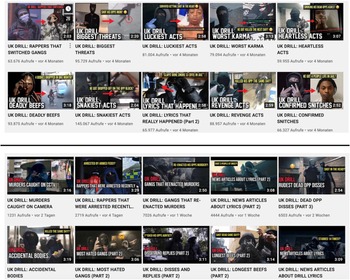
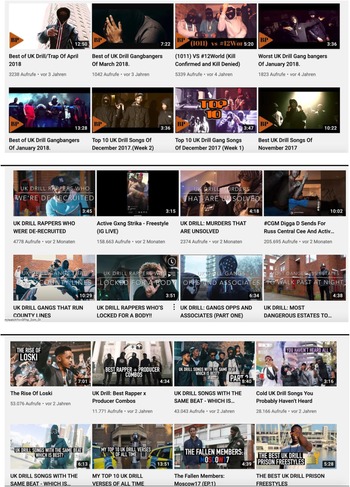
To communicate the message that UK drill music is intrinsically violent and that drill artists are also violent and ‘criminal’, the YouTube channels whose content we analysed also use design elements for their videos to further boost the violent imagery in the content that YouTubers curate. Video thumbnails for example, aim to sensationalise through letters that are displayed in bold type, provocative captions, colour choices, pictures of masked-up and hooded ‘youths’ and blurry screenshots from CCTV footage showing alleged crimes (see Figures 1 and 2). Such staging of violent content is accentuated further by images of drill collectives whose faces are hidden as they throw hand signs that could resemble gang signs or hand gestures that resemble guns or knives. Such signs of violent behaviour are also accompanied by concise and catchy phrases, such as ‘killed the same day’ in addition to other graphic depictions of violence through grainy CCTV footage and headshots of alleged shooting victims, all of which reinforce the image of UK drill as a mercilessly violent and violence-promoting music genre.
Screenshots of YouTube channels: top – channel Cheeta; bottom – channel UK Drill Mile.

Screenshots of YouTube channels: top – BEEPEE UK; middle – Ydottyz Drill News; bottom – YGM.

Such visual representations unmistakably communicate an image of drill music as ‘violent’ and ‘gang-affiliated’ regardless of the lyrical content of the music and paying scarce attention to whether consumers of this music genre are able to contextually understand the lyrical references and jargon used by drill artists when rapping about everyday life in highly deprived, marginalised and racialised communities across the UK. For the creators of these compilation videos, such graphic images alone already serve their purpose of sensationalising, and thereby misrepresenting, drill music as prone to and advancing a violent lifestyle where stabbings, gang fights and criminal activities are portrayed as ‘normal’ activities for drill artists and where rapping about these activities in music videos is considered to be the sole purpose of drill music. Other aspects of life, such as police harassment, the experience of racial oppression and the lack of employment, get lost in these visual representations, thereby providing a biased account of what drill music means to artists and how it evolved as a cultural expression and resistance strategy by people who have suffered the most under a penalising regime of racial capitalism and state strategies of social control and punishment.
Drill music as a ‘true-crime’ subculture
The third and final trope we identified in our analysis of YouTube playlists that generate drill-related content, amp the suspense by connecting drill lyrics to real-life events – implying that drill exists as a genre to record wrongdoing in rap verse – as evidence of autobiographical ‘life writing’. YouTube channel Cheetah, for example, features a video series entitled: ‘UK DRILL: LYRICS THAT REALLY HAPPENED’. In volume 6 of this series,Footnote 15 drill lyrics that mention stabbings and other violent incidents are highlighted, to show that drill music is not just a cultural expression of fictive events, but an actual reflection of drillers’ ‘criminal’ life (hi)stories. In the video, viewers ‘learn’ about several stabbings referenced in drill lyrics by different artists, including further ‘evidence’ of these events by displaying news headlines and footage that depicts the victims and police officers at the crime scene. The video explicitly seeks to ‘prove’ that drill artists are not only aware of the violence that takes place in their urban communities, expressed through the lyrical content of their music. They also participate in ‘crime’, and not just any ‘crime’ but ‘true crime’.
Such YouTube playlists don't just blur the lines between broadcasting images of violent crime and recording facts. They capitalise on selectively choosing drill lyrics that reference real-life events for dramatic effect. In so doing, they misrepresent an entire music genre by stripping it of its artistic nature to simply create the impression that drill music isn't in fact music, but a front for criminal activities. In so doing, such YouTube playlists inadvertently invite and legitimise political agendas of law and order and social control that are justified as valiant attempts to curb violent crime. Drillers, YouTubers and coppers, therefore, become participants ‘in a now decades-old dance between rap artists, record companies, local prosecutors, and moral entrepreneurs, all of whom find both problem and potential in the intermingling of “gangsta rap”, gangs, and criminal history. For the record companies and the rappers, a carefully crafted outlaw image, even a criminal record, moves product; for local prosecutors and religious conservatives, high-profile public campaigns against such images move product as well, if of a somewhat different sort’ (Ferrell et al. Reference Ferrell, Hayward and Young2008, p. 135).
The following and last section of this article, steps into this ‘decades-old dance’ – that simultaneously commodifies and criminalises rap lore – discussing how the proliferation of such ‘gang-affiliated’, ‘criminal’ and violent imagery prepares the ground for punitive criminal justice responses that puts rap(pers) behind bars. Reflecting on how the recycling of drill music by YouTube channels serves as a virtual police line-up that identifies and casts drill rappers (out) as suspects, we analyse YouTube's role as a channel for the policing against rap, in ways that set a dangerous precedent for the targeting, monitoring and manipulation of artistic expression as evidence of criminal wrongdoing.
Broadcast yourself, criminalise others: YouTube as a platform for digital policing
YouTube is typically associated with the slogan that launched this video-sharing platform – namely, ‘broadcast yourself’. However, thinking of YouTube as a neutral dissemination engine where we post, upload, circulate and consume videos in ways that aren't dictated by the algorithmic architecture of the platform would be out of touch with how digital platforms operate and ignorant of the politics that inform how they operate (Srnicek Reference Srnicek2017; Lanier Reference Lanier2018; Burgess and Green Reference Burgess and Green2018; Zuboff Reference Zuboff2019). While it is tempting to think of digital platforms like YouTube as idle tools that we can pick up and put down at will, doing so obscures their function as powerful systems what we operate within – in ways that exercise considerable influence over us, if not altogether dictate what we do and how we do it (Carrigan and Fatsis Reference Carrigan and Fatsis2021, pp. 43–54). Apart from the obvious ways in which digital platforms vie for attention – by collecting data on our online behaviour to keep us hooked on content that appeals to us – using such platforms cannot be likened to a full exercise of agency, independently of the restrictive design of such platforms. This is not to say that it is impossible to disconnect or disengage, but to stress that the addictive nature of this online ecosystem makes it difficult to step out of platforms that are predicated on an attention-grabbing economy that is designed to keep users on them for longer (Marwick Reference Marwick2013; Tufekci Reference Tufekci2013), rewarding us with enticing content for our newly acquired scrolling, clicking, liking and sharing habits. In fact, digital platforms and the technology firms that operate them are built on a technological formula and a business model that approaches their users as ‘manipulable actors’ (Carrigan and Fatsis Reference Carrigan and Fatsis2021, p. 61), operating under pressure to demonstrate growing engagement, in the absence of which significant penalties accrue – if investors lose confidence in a platform's ability to attract, mine and sell attention (Lanier Reference Lanier2018).
In such a sociotechnical context, the freedom to ‘broadcast yourself’ or create YouTube playlists is not just bought and sold. It is also subjected to patterns of online surveillance by the state's law enforcement institutions, turning acts of cultural production into targets of state regulation and social control. Unsurprisingly, the policing of such online activity is selective as it is discriminatory – creating a moral asymmetry of blame where only some activities are criminalised, while others are pardoned, in ways that mirror, ‘reproduc[e] and reinforc[e] … unequal power relations’ (Monahan Reference Monahan2010, p. 114) and make online–offline distinctions difficult to maintain. The criminalisation of UK drill music and the role of YouTube in facilitating it uniquely illustrate the dangerous liaisons between digital platforms and law enforcement institutions. YouTube's algorithmic and political architecture as a site of and a tool for (re)producing criminal injustice, and directly ‘facilitate[s] […] law enforcement priorities’, by ‘offering itself as a vital partner to police’ (Bloch-Wehba Reference Bloch-Wehba2022, pp. 110, 111) – in response to requests to remove drill music videos (Dearden Reference Dearden2018). Yet it also indirectly contributes to the policing against drill, by allowing the policing of such content, although similar demands have been resisted with impunity on other occasions (Bloch-Wehba Reference Bloch-Wehba2022, especially pp. 110–11). Rather than providing a neutral terrain where cultural performance roams freely, YouTube provides a fertile ground for punitive criminal justice interventions that target drill rappers, but not YouTubers who curate drill music playlists or YouTube itself as promoters of ‘criminality’ or purveyors of violence.
Such asymmetry of blame naturally creates disparities in law enforcement that are not only normalised or legitimised but legalised too – when digital platforms become technologies of policing and criminal justice reveals itself as a system of racial(ised) discrimination (Williams Reference Williams2014; Owusu-Bempah Reference Owusu-Bempah2017; Williams and Clarke Reference Williams and Clarke2018; Fatsis Reference Fatsis, Gordon and Newman2021a; Fatsis and Lamb Reference Fatsis and Lamb2021, especially pp. 23–34 and 79–112). While it is true that drillers stage and broadcast tales of gang rivalry and shootings by posing as violent personas that are ‘authentically’ dangerous and threatening, what is ignored is that such first-person story-telling is a performance that is consistent with the artistic motifs of drill music and other forms of Black cultural expression (Kelley Reference Kelley1994; Krims Reference Krims2000; Quinn Reference Quinn2005; Stoia et al. Reference Stoia, Adams and Drakulich2018). Indeed, much of the appeal that drill music enjoys comes from the allure of such graphic content and drill afficionados – unlike criminal justice professionals – can and do distinguish between artistic performance and factual reality, as do viewers who binge-watch the latest ‘true crime’ series as entertainment, rather than as incitement to or glamorisation of violence. However, as Nielson and Dennis (Reference Nielson and Dennis2019, p. 114) pithily put it, rap is ‘the only form of artistic expression to be mischaracterized as pure autobiography [or] real world documentary’ and uniquely policed as ‘as aesthetically “out of tune”, culturally “out of place” and politically “out of order”’ (Fatsis Reference Fatsis, Peršak and Di Ronco2021b, p. 38). Instead of interrogating what makes violence culturally admissible in some contexts but not others, or indeed critically reflecting on why we endow some audiences with the ability to distinguish between fact and fiction but not others, an important and painful realisation is eluded. Drillers consciously exploit the seductive properties of violence and the attention-getting and self-branding opportunities that digital platforms offer, by branding themselves as ‘real’, violent gun-toting and knife-wielding gangsters – in search for infamy and material reward (Stuart Reference Stuart2020, pp. 80–81). Alas, seeking celebrity comes at the expense of cynically exploiting their own stigmatisation as ‘deviant thugs’, or at the risk of exposing themselves to negative police attention. As drillers consciously capitalise on a media ecology and cultural stereotypes that rewards the commodification of their experience of social marginalisation, it is they who are accused of celebrating or promoting violence without similar claims made against curators of YouTube drill playlists or YouTube itself. This asymmetry of blame exposes the discriminating selectivity with which drill music is portrayed as trading in violence, while the secondary broadcasters (YouTubers) and hosts (YouTube) of such violence are exempt from condemnation – although they aim at making a profit from such violence. Such misplaced blame, however, also provides a window into the role of YouTube videos as an intelligence-gathering database that is relied on by the police, prosecutors and judges to bring charges against amateur and professional drill rappers.
Suspected as drillers by police officers who search for inflammatory YouTube videos to remove, they are also monitored, tracked, profiled, arrested and prosecuted for producing and disseminating music videos which are used as ‘evidence’ of criminal wrongdoing in court – without due regard for the fictive, literary or performative nature and conventions of rap music; without concern with the prejudicial impact of such ‘testimony’ on the jury; and certainly without respect for evaluating the evidential weight or inadmissibility of such material even when the law would compels them to. Legally speaking, the use of rap lyrics as evidence can be challenged on legal grounds, contending that this may have an adverse effect on the fairness of the proceedings (citing Section 78, Police and Criminal Evidence Act 1984), owing to the insubstantial probative value of rap lyrics (citing Section 101, Criminal Justice Act 2003) and concerns about freedom of expression of rappers (citing Article 10 of the Human Rights Act). Yet drill music videos feature with alarming regularity across Britain's Crown Courts as evidence of: the defendants’ ‘bad character’,Footnote 16 involvement in ‘joint enterprise’,Footnote 17 ‘serious (youth) violence’Footnote 18 and gang membership, or as confessions to an offence and expressions of intent to commit an offence. The fact that drill rappers intentionally play (up) to images of ‘criminality’, ‘gangsterism’ and violence for dramatic effect, to make money, provide entertainment, and deliberately shock mainstream society with images of ‘racial and class oppression’ (Stuart Reference Stuart2020, p. 205), is routinely treated as irrelevant in court proceedings – despite the protestations of law reform and human rights organisations (Paul Reference Paul2021), leading legal professionals (Garden Court), defence counsels, the expert witnesses they instruct, or social scientists, rap experts and legal scholars who insist that rap should be used with extreme caution in the courtroom, if at all (Fried Reference Fried1999; Dennis Reference Dennis2007; Kubrin and Nielson Reference Kubrin and Nielson2014; Nielson and Dennis Reference Nielson and Dennis2019; Fatsis Reference Fatsis2019b; Lutes et al. Reference Lutes, Purdon and Fradella2019; Ilan Reference Ilan2020; Owusu-Bempah Reference Owusu-Bempah2020; Lerner and Kubrin Reference Lerner and Kubrin2021). This is a concern that has also been voiced in an open letter endorsed by 65 signatories from human rights organisations, as well as musicians, lawyers and academics who argue that ‘all artists should be afforded the same rights to freedom of speech and creative expression’ (The Guardian 2019).
In such a public and political atmosphere that is charged with extremely negative perceptions of drill music as a (faux) enemy, whose emergence is blamed for turning city streets into cesspools of violence, it is important to pause and reconsider the logic and ideologies that inform such perceptions and the criminal justice responses that follow. The role of YouTube video playlists is crucial here, functioning as a resource that contributes to the criminalisation of drill by seizing on the music's transgressive performative pose and translating it into content that is curated to provoke public interest – at the expense of factual accuracy. In so doing, drill music is stripped of its artistic context and stylistic conventions and is repackaged as proof of ‘criminality’, in ways that have no firm basis in empirical reality and do violence to our understanding or appreciation of what drill music is, as well as who and what drillers are, (mis)taking an entire genre, its producers and audiences as ‘violent criminals’. As drillers tell exaggerated and often fabricated tales of violence to bolster their image of gangsterism and boost their online clout in search of stardom, YouTubers do much the same – but are exempt from the consequences of doing so. This realisation points to a hypocritical logic and moral calculus that selectively condemns depictions of violence as harmful when applied to drillers, but not when associated with YouTubers – or indeed YouTube itself. Without advocating for criminal justice policy that would expand its operations to also target YouTubers and digital platforms, we nevertheless highlight this asymmetry of blame and the discriminating and discriminatory treatment of some, but not all participants in ‘digital slumming’ (Stuart Reference Stuart2020, p. 153) – to call for an urgent rethinking of the language and outlook we borrow from the criminal justice system to discuss cultural and socio-political issues, be they violence, ‘crime’ or the dangers of digital platforms.
Having demonstrated how both digital platforms and criminal justice institutions are far from neutral or evidence-based in the way they broadcast ‘facts’, handle ‘evidence’ or pursue ‘suspects’, it is important to remind ourselves that our understanding of what counts as ‘crime’, who is a ‘criminal’, what ‘justice’ is and whether the criminal justice system serves the moral values we associate with it, is impaired – when we adopt criminal justice system thinking and terminology that disguise how the words we use to condemn people and their actions are the result of political processes, whose legacy has to be understood in relation to a long and disreputable history of policing against Black music genres (Fatsis Reference Fatsis, Peršak and Di Ronco2021b, pp. 35–7) and an equally long history of police racism and racial injustice (Fatsis and Lamb Reference Fatsis and Lamb2021, pp. 23–34). Instead of thinking about drill as ‘criminal’, we therefore hope that our investigation into some of the ways that it is criminalised sheds light into thinking and criminal justice processes that make crimes out of rhymes. In so doing, we concur with rappers Krept & Konan, whose track Ban Drill, concludes: ‘Feds asked who's responsible, I just kept it real I said “Whoever banned drill”’.