INTRODUCTION
Pitchers of Nepenthes plants are intricate traps that have evolved various mechanisms to lure their animal prey into the pitcher as a valuable nutritional resource in habitats with nutrient-deficient soils (Clarke Reference CLARKE2006, Gotelli & Ellison Reference GOTELLI and ELLISON2001). The jug-shaped pitcher organ, which grows as a distal extension of a leaf, usually contains digestive fluids ready to process material from animals drowned inside the pitcher. Notably, Nepenthes species produce extrafloral nectaries that lie beneath the lid or the fringe of the pitcher, the so-called peristome (Bauer et al. Reference BAUER, BOHN and FEDERLE2008, Di Giusto et al. Reference DI GIUSTO, GROSBOIS, FARGEAS, MARSHALL and GAUME2008, Moran Reference MORAN1996) and that provide arthropods and small mammals with a rewarding resource (Clarke et al. Reference CLARKE, BAUER, LEE, REMBOLD and MORAN2009, Joel Reference JOEL1988).
The first step, however, is to attract suitable prey to the pitcher. Most of the carnivorous plant species studied to date promote their detection by ants and other arthropods through olfactory and visual cues (Bauer et al. Reference BAUER, BOHN and FEDERLE2008, Bennett & Ellison Reference BENNETT and ELLISON2009, Di Giusto et al. Reference DI GIUSTO, GROSBOIS, FARGEAS, MARSHALL and GAUME2008, Reference DI GIUSTO, BESSIERE, GUEROULT, LIM, MARSHALL, HOSSAERT-MCKEY and GAUME2010; Joel Reference JOEL1988, Jürgens et al. Reference JÜRGENS, EL-SAYED and SUCKLING2009, Merbach et al. Reference MERBACH, MERBACH, MASCHWITZ, BOOTH, FIALA and ZIZKA2002, Moran Reference MORAN1996, Schaefer & Ruxton Reference SCHAEFER and RUXTON2008). Whereas such mechanisms of prey attraction and capture through visual and olfactory cues and occasional rewards have long been examined in arthropod-capturing plants, only recent studies have explored previously anecdotal records of small-mammal interactions with pitcher plants. The montane tree shrew, Tupaia montana, has frequently been found to approach pitchers of the three large montane species Nepenthes lowii, N. rajah and N. macrophylla from Borneo and defecate into the pitcher while licking its lid (Chin et al. Reference CHIN, MORAN and CLARKE2010, Clarke et al. Reference CLARKE, BAUER, LEE, REMBOLD and MORAN2009) and the bat Kerivoula hardwickii roosts and defecates into aerial pitcher of N. rafflesiana var. elongata (Grafe et al. Reference GRAFE, SCHÖNER, KERTH, JUNAIDI and SCHÖNER2011). Nepenthes rajah is one of the most spectacular species because of its large pitchers, which can hold up to 2 L of fluid, and because of the occasional observations of drowned vertebrates therein (Clarke Reference CLARKE2006, Phillipps & Lamb Reference PHILLIPPS and LAMB1987). Since features such as intense pitcher colouration and extrafloral nectaries have evolved in congeneric species for arthropod attraction but are not reduced in N. rajah and other large species, some functionality in either attracting arthropods or even vertebrates can be hypothesized.
In this study, we investigated the interactions of N. rajah with small mammals and explored whether pitchers were visited by small-mammal species others than T. montana. For diurnal mammals and birds with well-developed colour vision, colour has been identified as the major signal to the consumer in plant advertisement (Dominy et al. Reference DOMINY, SVENNING and LI2003, Schaefer et al. Reference SCHAEFER, SCHAEFER and VOROBYEV2007). However, pitchers are often hidden within dense grassy vegetation. Moreover, if pitchers are visited by both diurnal and nocturnal mammals for which olfaction is a major sensory modality (Acharya et al. Reference ACHARYA, ROY and KRISHNA1998, Hodgkison et al. Reference HODGKISON, AYASSE, KALKO, HÄBERLEIN, SCHULZ, MUSTAPHA, ZUBAID and KUNZ2007, Rieger & Jakob Reference RIEGER and JAKOB1988), olfactory cues may serve as a general mechanism for attracting both diurnal and nocturnal visitors. Emission of fruit and flower scent by the closely related arthropod-capturing N. rafflesiana, as recently reported by Di Giusto et al. (Reference DI GIUSTO, BESSIERE, GUEROULT, LIM, MARSHALL, HOSSAERT-MCKEY and GAUME2010), leads to the question if such kind of odours are also emitted from N. rajah. Tree shrews, squirrels and rats are likely to share some resources such as various fruits as known from nearby rain-forest localities (Emmons Reference EMMONS2000, Nor Reference NOR2001, Wells et al. Reference WELLS, CORLETT, LAKIM, KALKO, and PFEIFFER2009). Therefore, we have analysed volatile compounds emitted from the pitcher lid of plants frequently visited by small mammals as a first step to exploring potential general signals attracting small mammals to the pitcher.
METHODS
Study site, field observations and sample collection
Field work was conducted at Mesilau (06°02′52″N, 116°35′57″E, c. 2000 m asl) near Mount Kinabalu in Sabah, Borneo, between 2 December 2009 and 24 January 2010. The study area comprised a natural landslip of loose ultrabasic soil on a slope surrounded by pristine montane forest within the Kinabalu National Park area. Although Nepenthes rajah occurs naturally in such habitat and is endemic to the Kinabalu Park area, some of the population in our study area have been planted along a trail to make this spectacular species accessible to tourists. For all field experiments, we therefore selected pitchers away from the trail in order to avoid disturbance by tourists. We recorded visits of small mammals to four lower pitchers of different plant individuals of mature Nepenthes rajah plants. The glands beneath the lids of these pitchers produced a visible liquid film and were assumed to provide exudates to potential visitors. Digital camera traps with infrared sensors (Cuddeback Capture IR 3.0, USA) were set to a picture interval of 30 s. We considered all pictures taken 5 min after the previous one as a new visit. Recordings were made for 77 to 96 observational hours per pitcher (mean = 87 ± 10), resulting in a total recording time of 348 h. We further recorded small-mammal visits to four other pitchers with a video camera (Sony, DCR-SR-45E, Japan) with an additional recording time of 55 h. We conducted equal amounts of recording during daytime and night-time. For results, means are given with 1 SD. We recorded the frequency of faecal droppings in pitchers by a daily survey of seven pitchers of different plant individuals in which we placed a plastic sheet above the fluid in order to collect fresh droppings for a total of 61 observation days. Species identification of small mammals from digital records and the assignment of faecal droppings to its originator were facilitated by live trapping in the nearby forest environment as part of our small-mammal monitoring efforts (Wells et al. Reference WELLS, KALKO, LAKIM and PFEIFFER2007).
We extracted the compounds of lids in pentane or acetone for later gas chromatography (GC) and GC/mass spectrometry in the laboratory. For this, lids were cut off during the day and wrapped in aluminium foil to avoid contamination. On returning to the field laboratory 30–60 min later, lids were extracted in vials containing 20–30 ml of pentane (R & M Marketing, Essex, UK, 99%) or acetone (Fisher Scientific, UK, 99.8+%) for c. 30 min. Extracts were stored in airtight glass vials closed with Teflon-coated lids. For chemical analysis, we used one acetone and one pentane sample, which revealed similar results and we therefore present the overall list of compounds without further differentiation.
Gas chromatography/mass spectrometry
Analyses of the lid extracts was performed with a HP 6890 gas chromatograph (Hewlett Packard, Series, Palo Alto, CA, USA) connected to a mass selective detector (GC/MS, Agilent Quadrupol 5972) equipped with a polar DB-Wax column (J & W Folsom, USA) with an inner diameter of 0.25 mm, a length of 30 m, and a film thickness of 0.25 μm. The flow rate of the carrier gas (nitrogen) was 1.5 ml min−1 constant flow. One microlitre of each sample was injected in full at 50 °C. After 1 min, the splitter was opened, and the oven temperature increased at a rate of 10 °C min−1 to 240 °C. Structure elucidation of individual compounds was carried out by a comparison of mass spectra and retention times of natural products with corresponding data of synthetic reference samples, with the NIST database, and with a database of the Institute of Experimental Ecology.
RESULTS
Pitcher visits by rats and tree shrews
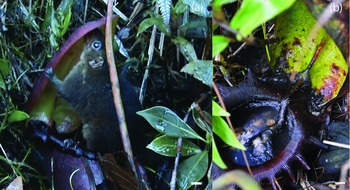
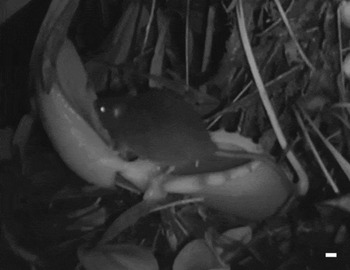
Field observations revealed that small mammals frequently visited pitchers of Nepenthes rajah. We recorded a total of 56 visits of the tree shrew Tupaia montana and 42 visits of the rat Rattus baluensis within 413.5 h of observation (average of one visit per 4.2 h). In most interactions, individuals of both T. montana and R. baluensis positioned themselves with all four feet on the peristome of the pitchers in order to lick parts of the inner surface of the pitcher lid (Figures 1 and 2). Several individuals of both species appeared to be involved in the interactions; although we were not able to fully distinguish individuals, encountered rats differed in the size of testes and tree shrews in body size. From this position, faecal pellets produced by the tree shrew or rat could easily fall directly down into the pitcher. Occasionally, the animal moved its front feet further upward to lick the upper part of lids that were up to 210 mm long. Interactions lasted for only 2–39 s for the tree shrew (mean = 19 ± 12 s, n = 18 video recordings) and 11–20 s in the rat (mean = 18 ± 7 s, n = 17).
Interactions of Tupaia montana with Nepenthes rajah. Individuals of T. montana usually sit on the pitcher rim while licking the lid of a pitcher (a). We found one individual of T. montana drowned inside a pitcher of N. rajah (b). Faecal droppings from small mammals can be seen at the bottom of the lid, fresh droppings were also observed 14 d after the tree shrew was found drowned. Scale bars (bottom left) represent c. 1 cm.

Rattus baluensis licking the lid of a Nepenthes rajah pitcher while sitting on the pitcher rim. Note the faecal pellet at the anus of the rat; this pellet is ready to drop inside the pitcher during the feeding event. The scale bar (bottom left) represents c. 1 cm.

Tree shrews visited pitchers throughout the day between 06h00 and 17h45 with an average observed time interval of 133 ± 111 min (n = 37) between consecutive visits of the same pitcher. Similarly, rats visited pitchers throughout the night and late afternoon between 17h00 and 05h30 with an average observed time interval of 166 ± 99 min (n = 29) between consecutive visits.
We observed fresh faecal droppings from both tree shrews and rats inside the surveyed pitchers with an overall frequency of new faecal droppings every 3.4 d. The pitcher that received most faecal droppings contained new droppings on seven out of nine observation days, suggesting that attractive pitchers can expect a relatively continuous intake of faeces.
We found only one drowned Tupaia montana inside a large pitcher (inner diameter of pitcher rim: 110 × 85 mm, Figure 1b) in the 42 mature pitchers that we surveyed repeatedly during field work. Various dipteran flies and midges were frequently observed in pitchers containing faeces and the decaying tree shrew, whereas they appeared to be absent from pitchers with clear liquid and no animal content. Fresh faecal droppings on the bottom of the lid with the drowned animal were observed 14 d after observing the drowned tree shrew, suggesting that this pitcher was still attractive to small mammals.
Analysis of volatile compounds
In the samples from pitcher lids of plants frequently visited by small mammals, we detected a total of 44 volatile compounds (Appendix 1). Hydrocarbons, alcohols, esters and ketones were among the most commonly found compounds in terms of numbers and the relative amount in samples. Further, we identified six sulphur-containing compounds. The odour of N. rajah which is perceptible by human nose is only slight fruity and but appears to have a component resembling the odour of cabbage from the genus Brassica.
DISCUSSION
Interactions of carnivorous plants with vertebrates are rare and remain little investigated. An important factor in understanding the strength and mechanism of such interactions is the number of species involved, since multispecies interactions largely influence the strength and coevolution of pairwise interactions (Palmer et al. Reference PALMER, STANTON and YOUNG2003, Strauss & Irwin 2004) and, hence, the way that carnivorous strategies of the attraction and capture of resources evolve. Our study shows that not only the tree shrew Tupaia montana, but also the rat Rattus baluensis, frequently interacts with pitchers of Nepenthes rajah. Small mammals appear to be attracted to the pitchers, and, while licking-off exudates produced by the pitcher lid, they repeatedly drop faeces inside the pitcher. The major interaction between N. rajah and small mammals appears therefore to be a resource exchange on a mutualistic basis – extrafloral nectar for faecal droppings. This mutualistic interaction and the function of the pitcher as a collecting tank for faecal droppings is in accordance with studies by Chin et al. (Reference CHIN, MORAN and CLARKE2010) and Clarke et al. (Reference CLARKE, BAUER, LEE, REMBOLD and MORAN2009), except that we found N. rajah also to be visited by nocturnal rats and not to be specialized to tree shrews as suggested by these studies. Moreover, the occasional capture of visiting small mammals together with the relatively large opening of the pitcher suggest that N. rajah is not as a whole specialized for coprophagy. Indeed, this large pitcher with a relatively unspecified wide opening not only seems to be advantageous for collecting faeces from various small-mammal species that differ in size and behaviour, but also might favour a cascade of effects in collecting and processing additional animal material, once faecal droppings influence the milieu inside the pitcher liquid; pitchers that contained collected faeces or the drowned tree shrew appeared to be more frequently visited by various species of dipteran flies and midges, some of which were also found to have drowned in the liquid (pers. obs.).
Although cost–benefit models in carnivorous plant interactions generally remain poorly understood (Gotelli & Ellison Reference GOTELLI and ELLISON2001), the exploration of systems in which vertebrates are involved awaits substantial future research, since even basic knowledge of the ecology and life history of small tropical mammals is sparse. Whereas rat and tree shrew species in tropical rain forests are known to overlap in their use of resources and habitats (Emmons Reference EMMONS2000, Nor Reference NOR2001, Wells et al. Reference WELLS, CORLETT, LAKIM, KALKO, and PFEIFFER2009), tree shrews, for example, have weaker teeth and relatively simple intestines with short retention times (Emmons Reference EMMONS1991); this might impact the interaction with N. rajah with respect to the likelihood of defecating or the amount of faeces dropped into the pitcher during a visit to the plant. In turn, the various needs and limits of small-mammal species in the montane environment might affect the relative attraction of visits to the pitcher plants in relation to foraging time allocated to alternative resources. Small mammals are probably not only attracted, but also gain rewards by consuming extrafloral nectars from the pitcher lid. Given the relatively large number of daily visits to pitchers compared with the few animal ranges likely to occur in the study area of approximately 1 ha (Emmons Reference EMMONS2000), only a limited number of animals probably are repeatedly visiting the pitchers, an undertaking that they should perform only if previous visits have been beneficial to them (Wright & Schiestl Reference WRIGHT and SCHIESTL2009). Certainly, N. rajah needs to be efficient at attracting small mammals that can be expected to feed on variable animal and plant resources in the surrounding environment. Frequent pitcher visits are thus unlikely to occur by chance or if the pitchers are difficult to detect by animals. Small mammals might be attracted by both the visual and olfactory cues of pitcher plants. Our odour analysis has revealed that a diverse odour of not less than 44 different compounds is emitted by the lids of N. rajah. Initial behavioural tests in the field revealed only weak evidence that small mammals are solely attracted by scent (i.e. bioassay with covered and dislocated lids versus controls), but more research is needed to disentangle the strength of olfactory and visual cues and the possible role of particular compounds. In particular, a more detailed sampling procedure including so-called headspace samples may reveal a larger spectra of volatile odours not captured with our sampling protocol and additional compounds may be emitted from the peristome such as in N. rafflesiana (Di Giusto et al. Reference DI GIUSTO, BESSIERE, GUEROULT, LIM, MARSHALL, HOSSAERT-MCKEY and GAUME2010). Some of the compounds, such as nonanal, 2-methylpropyl acetate, benzyl alcohol, or acetophenone emitted by N. rajah, occur in various fruit and flowers of unrelated plant species (Hui Reference HUI2010, Knudsen et al. Reference KNUDSEN, ERIKSSON, GERSHENZON and STÅHL2006). These results are in accordance with the recent finding that N. rafflesiana emits flower and fruit odour in order to attract various arthropod species (Di Giusto et al. Reference DI GIUSTO, BESSIERE, GUEROULT, LIM, MARSHALL, HOSSAERT-MCKEY and GAUME2010). The overlap in volatile compounds of the two Nepenthes species, viz. N. rajah and N. rafflesiana investigated to date, included nonanal and acetophenone beside the ubiquitous compounds hexadecane and benzyl alcohol. Notably, we have identified six sulphur-containing compounds in the bouquet of N. rajah, whereas no such compounds have been detected in N. rafflesiana (Di Giusto et al. Reference DI GIUSTO, BESSIERE, GUEROULT, LIM, MARSHALL, HOSSAERT-MCKEY and GAUME2010). Sulphur-containing compounds have also been found to be associated with the attraction of flower-visiting bats (Bestmann et al. Reference BESTMANN, WINKLER and VON HELVERSEN1997, von Helversen et al. Reference VON HELVERSEN, WINKLER and BESTMANN2000). Dimethyl disulphide present in mouse urine might also play a role in mammalian social behaviour (Lin et al. Reference LIN, ZHANG, BLOCK and KATZ2005) and attracts flies to flowers of the dead-horse arum Helicodiceros muscivorus (Stensmyr et al. Reference STENSMYR, URRU, COLLU, CELANDER, HANSSON and ANGIOY2002). To the best of our knowledge, however, none of the sulphur-containing compounds that we have determined in our study has been reported, to date, as a key substance in social behaviour or as flower content (Knudsen et al. Reference KNUDSEN, ERIKSSON, GERSHENZON and STÅHL2006). Only 3-hydroxy-2-butanone found in the scent of Tupaia belangeri (von Stralendorff Reference VON STRALENDORFF1982) and 2-furanmethanol found in laboratory mouse scent (Röck et al. Reference RÖCK, MUELLER, WEIMAR, RAMMENSEE and OVERATH2006) are among the volatiles in our sample, also recorded from mammals. However, both volatiles are also present in flowers (Knudsen et al. Reference KNUDSEN, ERIKSSON, GERSHENZON and STÅHL2006). As shown for dimethyl disulphide, which occurs in both rotten flesh and flowers and attracts glossophagine bats, the effects of substances in odours are largely context-dependent. Another interesting aspect for future research is the occurrence of fatty acid derivatives such as the isobutyl esters, which might eventually have a role as a lipid complement in the diet of small-mammal visitors. The role of scent signals of flowers and fruits remains surprisingly poorly investigated for terrestrial small mammals compared with those for bats or arthropods (Corlett Reference CORLETT2004, Raguso Reference RAGUSO2008) despite the well-developed olfactory senses in small mammals (Tirindelli et al. Reference TIRINDELLI, DIBATTISTA, PIFFERI and MENINI2009). The rich odour of N. rajah lids with many volatiles that are also found in flowers and fruits and that attract animal partners is however a first preliminary indication that olfactory cues may play a role in attracting both tree shrews and rats to the pitcher.
In summary, the pitcher plant Nepenthes rajah is frequently visited by diurnal tree shrews and nocturnal rats that drop faeces into the pitcher while licking the lid that produces extrafloral nectaries. Although our results add to the little information available concerning the interaction of vertebrates with carnivorous plants, much more research is needed to establish the response of small-mammal species to particular volatiles and to determine whether species from different taxa respond to the same visual and olfactory cues. Laboratory studies suggest that nocturnal mice rely much more on olfactory cues than diurnal tree shrews, which in turn rely more on visual cues (Bartolomucci et al. Reference BARTOLOMUCCI, DE and FUCHS2001). Plasticity in volatile emission during the day and night or among various stages of life would be of great interest given the various life histories of the small-mammal species involved. Moreover, on the basis that a faecal drop into the pitcher not only adds to the bouquet surrounding the pitcher, but also provides a saprobic milieu for other species to join, species interactions and trophic cascades at pitchers need to be explored from various perspectives.
ACKNOWLEDGEMENTS
We are delighted to thank the staff of Sabah Parks, particularly Fred Tuh Yit Yuh, Alim Biun, and Ansou Gunsalam, for their varied support during field work and for their amicable hospitality. K. Eduard Linsenmair, Brigitte Fiala, Jorimia Molubi, and Martin Pfeiffer are acknowledged for logistic support during field work. We thank Andrea Weis for assisting with laboratory analysis. We thank the anonymous reviewers for providing helpful comments on an earlier draft of the manuscript.
Appendix 1.
Volatile compounds emitted from the pitcher lids of Nepenthes rajah frequently visited by tree shrews and rats. The following compounds were found (retention times for a: acetone and p: pentane are given in parentheses; note that there were unknown positions of double bonds for the three esters at retention times of 2529, 2643, 2713). Out of these compounds, at least 16 have been recorded in fruits or flowers according to Knudsen et al. (Reference KNUDSEN, ERIKSSON, GERSHENZON and STÅHL2006) and the pherobase (database of insect pheromones and semiochemicals, http://www.pherobase.com) and at least 14 are also recorded as semiochemicals in arthropod interactions according to the pherobase.
Hydrocarbons: hexadecane (1597, p), heptadecane (1698, p), octadecane (1798, p), pentacosane (2500, p), heptacosane (2700, a, p), octacosane (2800, p), nonacosane (2900, a, p), triacontane (3000, p), hentriacontane (3090, p).
Diols and their derivatives: 3-hydroxy-2-butanone (1297, a), 4-hydroxy-2-pentanone (1466, a), 2,3-butanediol (1542, a), 2,3-dihydro-3,5-dihydroxy-6-methyl-4H-pyran-4-one (2274, a).
Esters: isobutyl acetate (1024, a), isobutyl decanoate (1755, p), ethyl dodecanoate (1844, p), bis-isobutyl butanedioate (1906, p), isobutyl dodecanoate (1960, p), 3-methylbutyl dodecanoate (2068, p), 2-butyl butanedioate (2009, p), ethyl tetradecanoate (2048, p), bis-isobutyl hexanedioate (2130, p), isobutyl tetradecanoate (21.645, p), 3-methylbutyl tetradecanoate (22.726, p), isobutyl hexadecanoate (23.683, p), 2-butyl tetradecanoate (2166, a), ethyl hexadecanoate (2254, p), ethyl octadecanoate (2481, a, p), ethyl octadecadienoate (2529, p), isobutyl octadecanoate (2594, p), isobutyl octadecadienoate (2643, p), isobutyl octadecatrienoate (2713, p), octadecenoic acid ester (2974, p).
Acids: acetic acid (1468, p).
Aldehydes: nonanal (1395, p), octacosanal (3396, p), triacontanal (> 3600, p).
Aromatic compounds: acetophenone (1655, p), N-ethyl-benzamine (1730, p), benzyl alcohol (1879, p).
Sulphur-containing compounds: diethyl disulphide (1214, p), ethyl 1-methyl ethyl disulphide (1259, p), bis-1-methylethyl sulphide (1261, p), diethyl trisulphide (1514, p), ethyl 1-methylethyl trisulphide (1527, p), bis-1-methylethyl trisulphide (1535, p); others: furan (1611, p), 2-furanmethanol (1661, a).