INTRODUCTION
Meta-analytic research into outcome following mild traumatic brain injury (mTBI) has confirmed that measures of attention, working memory, and speed of processing are the most frequent mTBI-related cognitive impairments. It has also shown that mTBI-associated neuropsychological impairment decreases with time since injury. Binder et al.'s (1997) meta-analysis addressed post-acute neuropsychological outcome and found that comparison of individuals with uncomplicated mTBI and controls yielded a small but significant effect size on neuropsychological measures indicating subtle persisting neuropsychological deficits for the mTBI group. Subsequent investigation addressing the issue of time since injury confirmed that the neuropsychological deficits associated with mTBI diminish over time (Frencham et al., 2005). Attention and working memory, speed of processing, and general memory were most likely to demonstrate subtle impairment after mTBI. With regard to assessing attention span/working memory functioning after mTBI, it has been reported that a task of memory span for sequences of hand postures (the hand movement task) is sensitive to neuropsychological sequelae following mTBI. Fox and Fox (2001) demonstrated that individuals referred for neuropsychological assessment after mTBI recalled significantly fewer hand movement sequences than controls.
The current study addressed the sensitivity of the hand movement task to recovery from mTBI by assessing prospectively recruited participants within a month of injury (Session 1) and 3–12 months post-injury (Session 2). The time frame for initial testing was chosen because neuropsychological deficits are more likely to be evident within the first month after mTBI (Dikmen et al., 1986). The flexible nine-month follow-up time frame was chosen to minimize attrition rates, which is crucial in maximizing the generalizability of longitudinal mTBI research results (Carroll et al., 2004; Levin et al., 1987).
Another research aim was to explore whether there were differential practice effects across groups with retesting. A practice effect occurs when task-related material is learnt implicitly or explicitly in the initial testing session and retained over time, leading to comparatively better performance on subsequent re-testing (Spikman et al., 1999). In mTBI research, whereas patient and control groups may demonstrate practice effects with repeated testing, the magnitude of the effect observed for the control group is often smaller than that observed for the mTBI group (Bernstein, 1999). Such results could be misinterpreted as indicating recovery of function for the mTBI group, but they actually reflect a ceiling effect for the control group at time 1, reducing their potential for improvement at time 2. However, in longitudinal mTBI research spanning both acute and post-acute phases, practice effects are more likely to be relatively small for both groups (Dikmen et al., 1995).
This study involved group comparison of immediate recall for sequences of verbal, spatial and movement stimuli, performed with and without articulatory suppression. We hypothesized that the mTBI group would obtain poorer baseline hand movement span scores than controls in the acute phase, but that this difference would resolve over time. With regard to the effect of articulatory suppression on hand movement span, it was predicted that this form of interference should remove the advantage that controls have when using an auxiliary labeling strategy under baseline conditions and render mTBI and control group performance comparable. Research has shown that recall of hand posture stimuli in a university population likely depends on using verbal recoding and labeling strategies (Frencham et al., 2004). Tasks of higher complexity are more sensitive to mTBI-related cognitive deficits (Raskin et al., 1998), and owing to its reliance on verbal recoding for successful performance, the hand movement task is potentially more complex and demanding than tasks of letter and Corsi span. The prediction that hand movement span, but not letter and Corsi span tasks, would be poorer for the mTBI group than controls was because of the potentially higher level of complexity in hand movement task performance. Group performance was predicted to be comparable on the simpler letter span and Corsi span tasks at both assessments, with any practice effects being constant across groups. Such findings would demonstrate the sensitivity of the hand movement task to acute neuropsychological deficits after mTBI and to resolution of impairment by the post-acute phase.
METHOD
Participants
Twenty-two individuals who had experienced an mTBI and 22 of their same-sex similar-aged friends (controls) were tested together in the two sessions (which were approximately 45 minutes each), the first conducted within a month of the injury and the second held 3–12 months post-injury. The majority (77%) of individuals in the mTBI group were recruited at presentation to Emergency Departments of Perth teaching hospitals and the remainder responded to community advertisements for individuals who had been concussed within the last month. To verify details pertaining to mTBI, hospital medical records were obtained for individuals who presented at Emergency Departments, and corroborative details were gathered from medical professionals who had contact with the individual after the incident for non-hospitalized cases.
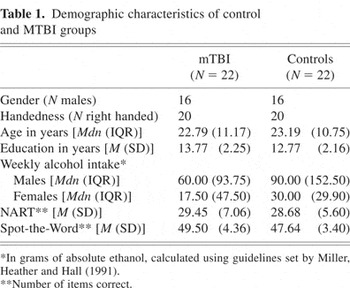
Using the mTBI definition suggested by the Mild Traumatic Brain Injury Committee of the American Congress of Rehabilitation Medicine (1993), mTBI participants were required to have experienced a period of loss of consciousness (LOC) or loss of memory for the details immediately preceding and following the incident, an alteration in mental state such as feeling dazed and confused after the incident, or any focal neurological deficit(s) that may or may not have been transient. Participants were excluded if their LOC exceeded 30 minutes, post-traumatic amnesia (PTA) exceeded 24 hours, or their Glasgow Coma Scale (GCS) score was lower than 13. Participants were naïve to study hypotheses, but were aware that the focus of the study was on mild head injury. There were no significant group differences in terms of gender, handedness, age, years of education, weekly alcohol consumption, or premorbid intelligence as assessed using the National Adult Reading Test (NART, Nelson & Willison, 1991), and the Spot-the-Word test from the Speed and Capacity of Language Processing battery (SCOLP; Baddeley, Emslie, & Nimmo-Smith, 1992). The mTBI group had a median of 30 s LOC (range = 0–7 min) and 16.5 min PTA (range = 0–18 hr). For cases presenting to hospitals, GCS scores were either 15 (N = 13) or 14 (N = 4). Fourteen of the mTBI were incurred through sporting accidents, five via motor vehicle accidents and three via assault or fall. Eight participants reported sustaining other minor physical injuries at the time of their mTBI. Individuals (and their friend controls) were assessed on average 17 days post-injury initially (range 2–30 days) whereas Session 2 took place at a mean of 6.41 months post injury (range 3–12 months). Summary statistics for the demographic variables are presented in Table 1.
Demographic characteristics of control and MTBI groups

Measures
Three computerized tasks of immediate memory span were administered: the hand movement, letter, and Corsi span tasks. Tasks were completed both without additional interference and with concurrent articulatory suppression. For further task details, see Frencham et al. (2003).
Procedure
At Session 1, the SCOLP and NART were administered prior to the memory tasks. The order of presentation of the memory tasks was counterbalanced across participants in each group during both sessions.
RESULTS
Hand Movement Task
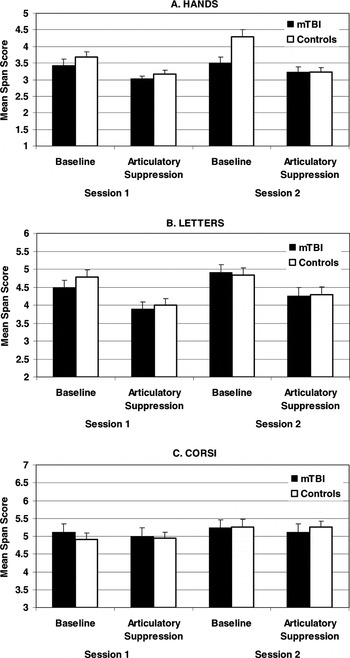
A time (Session 1, Session 2) × interference (none, articulatory suppression) × group (mTBI, control) ANOVA yielded main effects of time, F(1,42) = 13.37, p < .005, and interference, F(1,42) = 44.52, p < .001. There were also significant interactions for interference and group, F(1,42) = 7.02, p < .05, time and interference, F(1,42) = 4.21, p < .05, and interference, time and group, F(1,42) = 9.62, p < .005. As can be seen in Figure 1, no effects of group or time were present in the data for the articulatory suppression condition. However, for the no interference condition there was a significant effect of time, F(1,42) = 15.32, p < .001, and a significant time by group interaction, F(1,42) = 9.89, p < .005. This reflects comparable span scores for the two groups at Session 1, but superior span scores for the control group relative to the mTBI group at Session 2, t(42) = 2.89, p < 0.01 (see Figure 1). Thus, span improved across sessions for the control group, t(21) = 4.65, p < 0.01, but not for the mTBI group in the no interference condition.

Mean group scores for hand movement (Panel A), letter (Panel B) and Corsi (Panel C) span tasks under articulatory suppression and baseline conditions at Sessions 1 and 2 (SEs as error bars).
Letter and Corsi Span Tasks
Mean levels of performance are presented in Figure 1. Letter span scores improved across sessions, F(1,42) = 12.58, p < .005, and they were higher during no interference than during articulatory suppression, F(1,42) = 57.10, p < .001 but no effects involving group approached significance. No effects were significant in the analysis of Corsi span scores.
DISCUSSION
Because span scores were comparable for the two groups in the acute phase, a difference emerged in the post-acute phase, such that the control group obtained significantly higher hand movement span scores than the mTBI group, and mTBI performance was relatively less affected by articulatory suppression than was the performance of the controls. The finding that hand movement span was improved at Session 2 for controls but not for the mTBI group suggests differential effects of practice on task performance.
This finding is consistent with Dikmen and colleagues' (1995) suggestion that practice effects for mTBI individuals are likely to be smaller than those for the control group in longitudinal studies across the first year post-injury. Studies addressing acute effects of sports-related mTBI also have found smaller practice effects for the mTBI group compared to controls over much briefer test–retest intervals. Echemendia et al. (2001) assessed individuals four times during the first month after sports-related mTBI. On a verbal learning task, when tested together at the equivalent of two hours and two days post-mTBI, the control group demonstrated improved retest performance compared to baseline, but there was no practice effect evident for the mTBI group. The authors hypothesized that this pattern reflected the neuropathological changes that ensue in the first hours after injury. Subsequently, Bruce and Echemendia (2003) predicted that this failure to benefit from practice evident in the subacute phase post-injury reflected decreased efficiency in encoding novel material. They explained that “failure to learn” might relate to reduced working memory or attention, whereby mTBI individuals had difficulty identifying relationships between novel unrelated stimuli, or lacked the attentional resources that facilitate task execution, despite being able to register stimulus relationships. Because the present finding of the mTBI group demonstrating a smaller practice effect than controls is in keeping with the findings of these sports-related mTBI studies, the time frames for initial testing and re-testing are incongruent—participants in the present study were tested within a month post-injury, whereas those in the sports-mTBI studies were tested 48 hours post-injury.
Despite these differences, it is useful to consider possible explanations for reduced practice effects in the sports-related mTBI and other mTBI literature. As mentioned, Bruce and Echemendia (2003) argued that reduced working memory and attentional resources at initial testing could underlie smaller practice effects in mTBI individuals during the acute phase. The relative novelty of the hand movement task compared to letter span might be the key in explaining the lack of hand movement task practice effects for the mTBI group in the current study. Meta-analysis has indicated memory and learning to be compromised after mTBI, especially acutely (Frencham et al., 2005). It is possible that the effectiveness with which hand posture stimuli and any associated verbal labels were encoded and retained from Session 1 was poorer for the mTBI group because of difficulty with the learning and retention of novel material. The finding of reduced learning and delayed recall ability in the context of intact working memory has been previously reported for a group of individuals assessed more than three months post mTBI (Fisher et al., 2000). The present findings may therefore indicate that controls learnt the relationships between verbal labels and hand postures and retained this information between testing sessions better than the mTBI group. Future research could address the hypothesis that memory/learning impairment underpins the failure of the mTBI group to benefit from practice in terms of hand movement span by administering direct measures of memory and learning ability at both sessions. Another avenue for future studies would be to investigate the effect of test–retest length on group practice effects.
Addressing the cognitive processes involved in the hand movement task, the manner in which group performance was affected by articulatory suppression across sessions supports the proposition that the hand movement task involves verbal labeling. For the control group, despite across-session improvement in hand movement task performance under no interference, Session-2 span scores were rendered comparable with those obtained at Session 1 when subvocal rehearsal was prevented. Findings are consistent with the idea that hand movement task performance involves subvocal rehearsal of stimulus-related verbal labels and indicate that the improvement over time for the control group may have been due to the retention of verbal labels.
There was no effect of mTBI on letter or Corsi span scores, in line with previous research that has shown simple tasks of verbal and visual span to be insensitive to the neuropsychological sequelae of mTBI (Potter & Barrett, 1999). The detrimental effect of articulatory suppression on immediate recall of visually presented letters and hand posture stimuli demonstrates that both the hand movement and letter span tasks engage verbal working memory. This result replicates previous studies incorporating university populations (Frencham et al., 2003).
The issue of participant attrition is important in longitudinal research due to its potential impact on the generalizability of results. Because the present rate of attrition was low (12.5%), the chance that the mTBI sample was biased towards over-representing individuals with more complex recoveries was minimized. However, it is acknowledged that the relatively small sample sizes employed pose some limitations to the generalizability of results, and replication is required. Also, because eight mTBI participants in the present sample reported having sustained other minor physical injuries at the time of their mTBI, it is possible that their cognitive and psychosocial presentation may have related in part to their physical injury rather than their mTBI. If a control group with non-head injuries had been used, it would be possible to rule out the effects of minor physical injury. Future research using orthopedic controls could address this issue.
In conclusion, this study demonstrated that performance on a task of memory for hand movements by a group of individuals with mTBI was comparable to control performance within a month of head injury. However, mTBI individuals failed to benefit from practice when re-administered the task 3–12 months later. This “failure to learn” for the mTBI group may relate to poorer encoding of information within a month of injury, compromising their ability to improve performance over time.
ACKNOWLEDGMENTS
The authors thank Matt Huitson and Herb Jurkiewicz for their assistance with task development. This work was supported by an Australian Postgraduate Award provided to K. Frencham and by an Australian Research Council grant (DP045312) awarded to M. Maybery, D. Jones and F. Parmentier.