


The use of puberty blockers has been thrust into a contentious spotlight in recent debates about transgender youth healthcare. Puberty blocking medications (gonadotropin-releasing hormone (GnRH) analogues) have been used for decades to pause precocious puberty in children, and in the treatment of endometriosis and some cancers. In this context they have not been the subject of much debate or disagreement. But they are also a reversible intervention that has been prescribed for many years to alleviate gender dysphoria by halting unwanted pubertal changes, and it is their use for this specific purpose that has received considerable attention and has proven extremely divisive in recent years. The discourse surrounding this treatment continues to be fraught with narrative battles, both publicly and within the research community. Competing narratives alternately emplot these medications as life-saving and benign (Guss and Gordon Reference Guss and Gordon2022, Parshall Reference Parshall2023) or as unproven and dangerous (Laidlow et al. Reference Laidlaw, Van Meter, Hruz, Van Mol and Malone2019; Richards et al. Reference Richards, Maxwell and McCune2019; Latham Reference Latham2022) in the treatment of transgender adolescents, reflecting deeper value conflicts about youth gender diversity and medical uncertainty.
This chapter examines how these narratives are constructed and contested in both privileged and non-privileged sites of narration, focusing on a prominent case study: the 2022–2024 Cass Review of gender identity services in England and its aftermath. The Review raised the alarm about the quality of evidence for puberty blockers and recommended restricting their use for transgender children under the age of 18 to formal research settings. Together with the counter-critiques the Review sparked from various sources, it offers valuable insight into how accounts of scientific findings are constructed and how they are transformed by a variety of stakeholders into conflicting and ethically charged narratives.
4.1 The Cass Review: Independent Review of Gender Identity Services for Children and Young People
The Cass Review is named after Hilary Cass, the retired consultant pediatrician and former president of the Royal College of Pediatrics and Child Health who led the study. Its remit was to provide recommendations on the treatment of trans children and young people. Commissioned in 2020 by NHS England in the context of what the Final Report described as an ‘increasingly toxic, ideological and polarized public debate’ (Cass Review 2024:20), it issued an Interim Report in February 2022 (Cass Review 2022) and a Final Report on 10 April 2024 (Cass Review 2024). Its stated aim is ‘to make recommendations that ensure that children and young people who are questioning their gender identity or experiencing gender dysphoria receive a high standard of care’ (Cass Review 2024:20).
Although endorsed by the main political parties in the UK, the Royal College of General Practitioners, and the Royal College of Psychiatrists, the Review has been mired in controversy from the start and has received considerable criticism from a wide range of stakeholders, especially as its recommendations on the use of puberty blockers for gender dysphoria deviated from the current international Standards of Care published by the World Professional Association for Transgender Health (WPATH; Coleman et al. Reference Coleman, Radix and Bouman2022) and from the position of the European Professional Association for Transgender Health,Footnote 1 the US Endocrine Society,Footnote 2 and the US Pediatric Endocrine Society,Footnote 3 among others. More than 200 educational psychologists signed an open letter expressing concerns about its findings,Footnote 4 the Feminist Gender Equality Network criticised its ‘unsound methodology, unacceptable bias, and unsupported conclusions’,Footnote 5 and the trans community group TransActual described it as ‘fundamentally flawed’ (TransActual 2024a). Nevertheless, it has also received widespread support from clinicians, including the editor of The British Medical Journal (Abbasi Reference Abbasi2024) as well as 900 members of the British Medical Association (BMA), who signed an open letterFootnote 6 protesting the BMA Council’s initial vote in July 2024 to oppose the Review and call for the implementation of its recommendations to be paused while the Association conducted its own assessment of its evidence base and findings (Clinical Advisory Network on Sex and Gender (CAN-SG) 2024). The BMA reversed its position in September 2024 under pressure, stressing that it will undertake an evaluation of the Cass Review from ‘a position of neutrality’.Footnote 7
Most criticism directed at the Review focused on what has been referred to by several scholars as the ‘substandard’ quality of the evidence cited to support its findings (Grijseels Reference Grijseels2024; Noone et al. Reference Noone, Southgate and Ashman2025, among others). Others have defended the Review from the same perspective, arguing that accusations of unreliable evidence ‘misrepresent the Cass Review’s role and process (specifically by mistakenly comparing the Review to clinical practice guideline development)’ and that ‘many of the methodological criticisms directed at the Cass Review, including its use of evidence appraisal and systematic reviews conducted by University of York (UK), are unfounded’ (Cheung et al. Reference Cheung, Abbruzzese and Lockhart2025:251). While questioning some of the evidence it draws on, some critiques were more wide ranging, pointing to inherent weaknesses in the assumptions underpinning the Review and its very structure. For example, Horton (Reference Horton2024) argues that the Review fails to take into account and challenge anti-trans prejudice among healthcare professionals while claiming to accept all views as equally valuable. At the same time, Horton claims, the Review repeatedly equates non-affirmative views with ‘neutrality’ and refers to affirmative views as ‘ideological’. Horton also critiques the Review for ‘failure to understand the purpose of trans healthcare, framing it as diagnosis, prevention and treatment of a disease, rather than supporting well-being in a minority population’ (Horton Reference Horton2024:13).
There has also been both widespread criticism of the Review as well as endorsements of it from grassroots organisations. The National Survivor User Network (NSUN) argued that the Review weaponised mental healthcare ‘to gaslight trans people and discourage them from transitioning’ and rejected the attempt to use mental healthcare ‘as a replacement for gender-affirming medical support’ (NSUN 2024). Likewise, TransActual (2024a) suggested that the Review is underpinned by ‘the idea that being trans is an undesirable outcome rather than a natural facet of human diversity’. But the LGB Alliance, which represents ‘lesbians, gay men, and bisexuals’ rather than the transgender community, argued that there is a ‘large body of evidence that suggests … there is no such thing as a “trans child”’ and vehemently supported the Review and its findings (LGB Alliance 2025). Given that the Review was published following four years of research, ‘including seven peer-reviewed systematic reviews – the largest study of its kind’, and that its conclusion ‘that there is substantial evidence of harm and very low evidence of any benefit arising from the administration of GnRH agonists (puberty blockers) to children’ is therefore evidence-based, the Alliance does not see how it can be questioned (LGB Alliance 2025). Similarly, Transgender Trend (2024) described the Review as ‘a wake up call for a society that has failed to safeguard the health and welfare of children’, not only in clinical settings but also in schools and other contexts, where various groups have encouraged children and their parents to pursue a medical pathway unsupported by evidence.
In a recent parallel development that demonstrates the wider impact of the Cass Review and extends the scope of the controversy, the US Department of Health and Human Services (HHS) issued a similar but more wide-ranging Review of the treatment of pediatric gender dysphoria in response to an Executive Order signed by President Trump in January 2025. The HHS Review builds on the findings of the Cass Review and references it extensively, describing it as having had ‘a profound influence on international debates’ (HHS 2025:63). Unlike the Cass Review, the 409-page HHS Review, published in May 2025, did not issue recommendations. Instead, it conducted an ‘umbrella review’, understood as an overview of all relevant systematic reviews – including those analysed and commissioned by the Cass Review – in order ‘to provide the most accurate and current information available regarding the evidence base for the treatment of gender dysphoria’ in the US and ‘the ethical considerations associated with the treatments offered’ (HHS 2025:10–11). It was enthusiastically welcomed by groups such as the UK-based Transgender Trend because it went ‘much further’ than the Cass Review and ‘leads us to the inevitable serious medical consequences for children of an ideology and an approach based on the “affirmation” of a “gender identity”’ (Transgender Trend 2025). But, like the Cass Review before it, the HHS Review also received much criticism from various sources, including the American Academy of Pediatrics (AAP), which claims that the report ‘misrepresents the current medical consensus and fails to reflect the realities of pediatric care’.Footnote 8
In what follows we focus on the Cass Review, its aftermath (including the HHS Review, where relevant), and positions both for and against it as important sites of narration and re-narration that are just as consequential and worthy of critical analysis as personal narratives of illness. In doing so we seek neither to support nor to undermine the Review and its findings, but rather to unpack the complexity of arguments and narrative positions on both sides, to demonstrate the inevitable entanglement of medicine and politics that is particularly visible in this case but is not restricted to it, and to support our main argument, namely, that narrative medicine must widen its remit beyond illness narratives in order to enhance its relevance within the field and in society as a whole. Throughout this discussion, it is important to bear in mind that there is a difference between the Cass Review and its recommendations on the one hand, and the way it has been interpreted and implemented by different stakeholders such as politicians, the media, and schools on the other. As the activist group Stonewall emphasised in its initial response to the Review (Stonewall Reference Stonewall2024),
Dr Cass has not called for adolescents to have their right to their identity or autonomy removed. Nor did Dr Cass recommend a blanket ban on social transitioning for children of any age. Most significantly, Dr Cass did not support unilateral ‘outing’ of trans young people by schools. There are clear gaps between recommendations and practical policy, and we’re already hearing early reports of Dr Cass’ analysis of – and recommendations about – social transition being used to challenge trans young people’s right to identity.
Amnesty International similarly found it ‘concerning’ that the Review ‘was being “weaponised” by anti trans people’, including ‘sections of the media and many politicians’,Footnote 9 and the activist group Mermaids was alarmed that ‘Dr Cass’ own calls for compassion and respect have been completely disregarded’.Footnote 10 Like all narratives, the Cass Report has the potential to be interpreted in (sometimes wildly) different ways by different groups located within different narrative environments, and can be used to promote agendas that the narrators themselves may never have anticipated or desired. Importantly, these different interpretations and re-narrations have consequences not only for those being narrated in the Review – primarily transgender children and young people – but also at times for the narrators themselves. In this case, The Times newspaper quoted Dr Cass saying that she could no longer travel on public transportFootnote 11 following the publication of the report, suggesting that the Review – or rather some of the ways in which it has been interpreted and re-narrated – put her own life in danger.
4.2 Conflicting Narratives of Scientific Evidence: RCTs, Systematic Reviews, and Guidelines
Systematic reviews, as discussed at length in Chapter 3, are an essential component of all models of knowledge translation. They treat individual studies as modular data points that can be rendered commensurable and combined to yield objective effect estimates. Their claim to neutrality rests on a hierarchy of evidence that privileges randomised controlled trials (RCTs) and quantitative outcomes, foregrounding internal validity while bracketing contextual nuance. Consequently, systematic reviews serve both as practical tools for knowledge translation and as epistemic artefacts that encode specific assumptions about what constitutes reliable evidence and how truth is best produced in biomedical science.
The Cass Review is steeped in the mainstream narrative of systematic reviews as the most trustworthy site of narration in medicine – indeed, a site where bias is not just ‘reduced’ but ‘eliminated’ altogether (Figure 4.1).
Highlighted boxed statement on systematic reviews (Cass Final Report 2024:56)
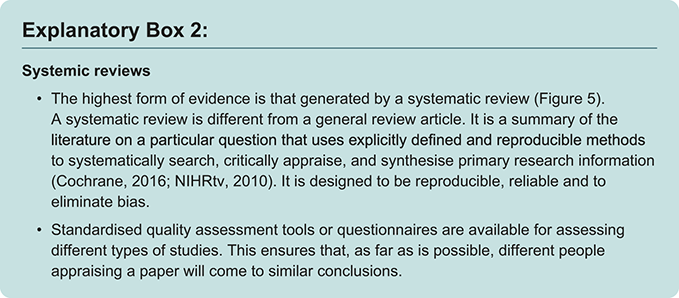
Figure 4.1 Long description
The textbox reads: Explanatory box 2. Systematic reviews. The highest form of evidence is that generated by a systematic review (Figure 5). A systematic review is different from a general review article. It is a summary of the literature on a particular question that uses explicitly defined and reproducible methods to systematically search, critically appraise, and synthesise primary research information (Cochrane, 2016: NIHRtv, 2010). It is designed to be reproducible, reliable and to eliminate bias. Standardised quality assessment tools or questionnaires are available for assessing different types of studies. This ensures that, as far as is possible, different people appraising a paper will come to similar conclusions.
Consistent with this narrative stance, the Cass Review entrusted the task of appraising the published evidence and guidelines on puberty blockers and other hormone treatments, and later of undertaking additional systematic reviews, to the University of York. The University of York ‘is the home of the Centre for Reviews and Dissemination, one of three bodies funded by the National Institute for Health and Care Research (NIHR) to provide a systematic review service to the NHS’ (Cass Final Report 2024:56). Based on the research undertaken by the University, the Review concluded not only that there is insufficient evidence from RCTs and systematic reviews to support the use of puberty blockers for gender dysphoria, but also that most existing guidelines ‘have not followed the international standards for guideline development’ (Cass Review 2024:27) and are therefore similarly unreliable.
There is tension in this narrative between the privileging of a methodology that consists of population-level studies on the one hand and, on the other, the Review’s repeated emphasis on the uniqueness of each child and the heterogeneity of the group under study:
The research study plans to use existing data held by the NHS – including data from GIDS [Gender Identity Development Service], hospital wards, outpatient clinics, emergency departments and adult Gender Dysphoria Clinics (GDCs) to track the journeys of all young people (approximately 9,000) referred to the GIDS service through the system to provide a population-level evidence base of the different pathways people take and different outcomes people experience.
When conducting an assessment, it will be important that clinicians are mindful that presentations, pathways and outcomes for this cohort are very individual.
The individual presentations of many of the children and young people seeking support are diverse and complex.
Awareness of the diversity of profiles of this cohort was also acknowledged by Dr Cass in an interview with On Point in May 2024: ‘Many of the studies didn’t take account of the fact that this is a really, what we call heterogeneous, so a mixed population of young people who were very different from each other.’Footnote 12 This tension aside, Horton (Reference Horton2024) claims that the Cass Review fixates from the outset on the volume and quality of existing evidence. Unlike other critiques of the Review, such as the claim that it incorporates evidence from RCTs selectively, this claim can be easily tested on the basis of empirical evidence.
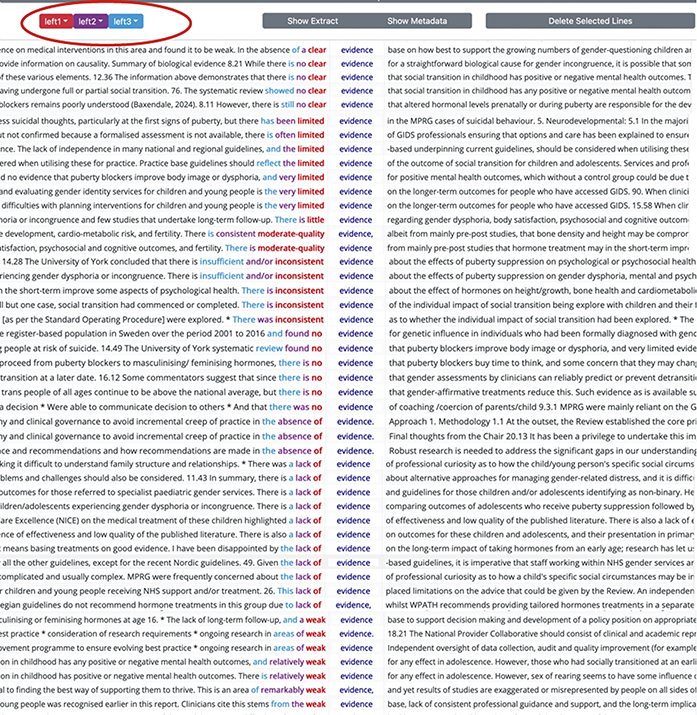
The Cass Review (2024) is included in a large electronic corpus held at the Faculty of Medicine, University Oslo: the Sustainability and Health (SHE) Corpus.Footnote 13 The SHE Corpus is accompanied by a software interface designed to assist in the identification of repeated patterns. To establish whether the Cass Review does focus on uncertainties and methodological weaknesses, as Horton claims, we ran a concordance of evidence in the Review. This returned a total of 270 instances/lines. We then ordered the lines alphabetically by first, second, and third position to the left of the keyword evidence. As a screenshot of selected lines of the concordance shows, the Review repeatedly employs descriptors like weak, limited, and inconsistent, as well as patterns such as there is no clear evidence and there is no evidence, to question the reliability of available research (Figure 4.2).
Focus on volume and quality of ‘evidence’ in the Cass Review (SHE Corpus, University of Oslo)
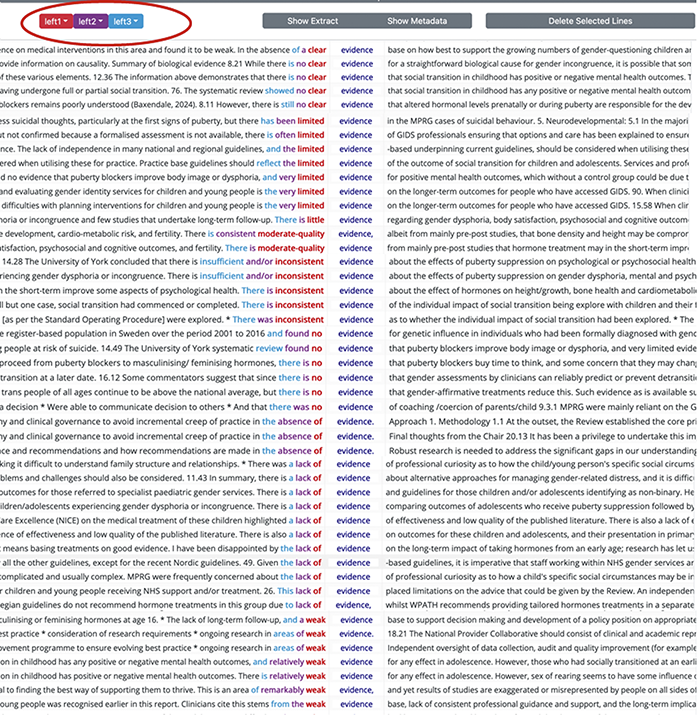
Figure 4.2 Long description
A screenshot of 47 lines of text from the Cass review with the word evidence centralised in each line. The 3 words preceding evidence in each line are highlighted to show repeating patterns and descriptors.
Empirical evidence from the SHE Corpus reveals many more variations on this pattern in the Review, citing ‘concerns about the weakness of the evidence’, suggesting that ‘WPATH 8 overstates the strength of the evidence’, and claiming that ‘there is not a reliable evidence base upon which to base clinical decisions’.
This particular framing of evidence constitutes a critical narrative battleground. Some critics have argued that the Review’s heavy emphasis on the volume and quality of evidence from RCTs and systematic reviews neglects other key factors that clinical guidelines typically weigh, such as the balance of harms and benefits and patient preferences (Noone et al. Reference Noone, Southgate and Ashman2025). It further disregards ‘the consensus of positive impacts of affirmative healthcare found in a large body of non-RCT evidence’ (Horton Reference Horton2024:15). The Review consistently narrates the evidence supporting gender-affirming care as weak and uncertain, its critics argue, and strategically deploys this uncertainty to justify caution and deferral of interventions. Noone and colleagues (Reference Noone, Southgate and Ashman2025), among others, challenge these representational choices, arguing that they skew perceptions, obscure supportive evidence, and disproportionately amplify alleged risks like detransition. Such critics call for narratives that represent the existing evidence less selectively and that emplots uncertainty not as grounds for paralysis but as a prompt for compassionate, informed care. Horton (Reference Horton2024:15) takes particular issue with the negative framing of evidence ‘in a report expected to be widely read by audiences who are not medical professionals’.
Grijseels (Reference Grijseels2024) and Noone and colleagues (Reference Noone, Southgate and Ashman2025) offer the most detailed critique of the Cass Review from the perspective of its methodology, its analysis of the RCTs and systematic reviews it drew on initially, and the research that was commissioned to inform it. Among other criticisms, Grijseels (Reference Grijseels2024:2) calls out the Review for its ‘substandard level of scientific rigor’, and Noone and colleagues (Reference Noone, Southgate and Ashman2025:6) suggest that the Review at times even downplays the implications of its own data in order to further its preset narrative:
In the synthesis section in the review on HRT [hormone replacement therapy], the authors conclude that low, or even moderate, quality evidence indicates that there is insufficient evidence for recommending GAC [gender-affirming care] practices. For example, the authors argue that no conclusions can be drawn regarding any relationships between HRT and psychological health. However, this minimizes their own data. One study showed an improvement in gender dysphoria, one showed an improvement in body satisfaction, four studies showed an improvement in depression-related outcomes, three studies showed an improvement in anxiety-related outcomes and three studies showed a decrease in suicidality/self-harm related outcomes. So, five distinct studies on 415 trans youth show positive psychological outcomes, and no study demonstrated ‘consistent’ evidence for harm.
The repeated highlighting of gaps in available evidence reflects a pattern of selective appropriation that foregrounds certain elements of a narrative and downplays others in order to assign specific roles to particular protagonists and build up to a morally justified outcome – as all narratives do. In this case, the persistent focus on a lack of sufficient evidence of a particular type (evidence from RCTs and systematic reviews) feeds into a pattern of emplotment that implicitly undermines confidence in gender-affirming interventions and casts current providers of puberty blockers as irresponsible and/or insufficiently qualified to provide care for young people with gender dysphoria. The then specialist provider of this service to young transgender youth and their main port of call was the Gender Identity Development Service (GIDS) at the Tavistock and Portman NHS Foundation Trust.Footnote 14 NHS England swiftly responded to the Interim Cass Review (2022) by ‘carefully bringing about the managed closure’ of GIDS in March 2024,Footnote 15 two years before the publication of the final report on 10 April 2024 and while the Cass team was still examining the evidence. The Times newspaper further reported that the NHS and other public bodies were reviewing their long-standing association with the activist charity Stonewall, which was being closely scrutinised ‘for its stance on trans rights’ following the publication of the Review. Most importantly, NHS England’s current policy, based on the recommendations of the Cass Review, impacts transgender children and young people suffering from gender dysphoria by restricting their access to gender-affirming medication while continuing to provide it for other groups (emphasis added):Footnote 16
Puberty blockers are a type of medication called gonadotropin-releasing hormone (GnRH) analogues. They are licensed only for use in young children (for precocious puberty) or older adults (for certain cancers).
They are not licensed for use in adolescents and they are not licensed for gender incongruence or dysphoria.
Questioning the pattern of selective appropriation favoured by the Review, much of the criticism directed against it argues that puberty blockers have been used safely for decades in other pediatric contexts, also based on evidence from RCTs and systematic reviews, and there is no suggestion that they will be discontinued in these contexts. In particular, they are routinely used to treat precocious puberty in non-trans/cis children (Horton Reference Horton2024:16). There is, according to Horton, a sufficient evidence base confirming their safety and effectiveness in this case, but this evidence base is excluded from the Cass Review analysis of the literature. This selective attention, which is an inherent aspect of the process of narrativisation, asymmetrically emphasises potential harms and potential benefits of treatment in some contexts and downplays them in others, leading the activist group Stonewall to wonder in its initial response to the Review ‘whether healthcare for trans children and young people is being designed to different standards than those for other children and young people’.Footnote 17 The Gender Identity Research & Education Society similarly argues that ‘many other paediatric medications that are routinely used in paediatric care do not and cannot have the level of evidence that Cass and NHS England demand: medicines for ADHD, for example, anti-psychotic medications, and many others have comparable if not lower levels of evidence’.Footnote 18 The Cass narrative pattern of selective appropriation thus implicitly places transgender children and young people in a special category and narrates them as victims not of genuine gender dysphoria but of mental illness, other illnesses such as autism, or alternatively what the HHS Review on Gender Dysphoria refers to as social influence or pressure (HHS 2025:67).
Narratives rarely remain within the confines of one community or society. They often travel to other spaces and can be pressed into the service of slightly or significantly different agendas; the original narrator has little or no control over this process. In this case, the idea of ‘social pressure’ was unsurprisingly amplified in the HHS Review – which draws heavily on the Cass Review but was undertaken as a direct response to a Presidential Order issued within a highly divisive political environment – as a pervasive and threatening conspiracy. This conspiracy extends beyond social media and peer pressure to the scientific community itself and seeks to silence ‘dissenting voices’ that warn of the lack of scientific evidence and the potential harms of puberty blockers and other gender-affirming medication (HHS Review 2025:206):
The absence of professional consensus is often obscured, as dissenting voices are seldom included on specialty committees responsible for policy development. Researchers who study detransition, investigate social influences underlying epidemiologic changes in GD [gender dysphoria] presentations, express concerns about PMT [premenstrual tension], or advocate for a more cautious approach to pediatric GD frequently encounter hostility and a lack of support from major publishers, medical societies, and academic institutions. Organizations advocating for higher evidentiary standards, journalists reporting on the controversies, and academics writing about issues related to sex and gender have also faced hostility and attempts at public shaming. Activist organizations have contributed significantly to this dynamic, often targeting individuals and groups that question or critically examine prevailing practices in gender medicine.
Each new narrative thus draws selectively on existing narratives, re-emploting the evidence and arguments it favours differently within the wider social and political context. As it does so, it assigns different roles and traits to different protagonists in pursuit of its own pragmatic and moral goals. Science is not immune to this process of narrative accrual, nor can it fully control its consequences, which are often the result of its inevitable entanglement with politics.
One question that features in much of the critique directed at the Cass Review, and indeed even precedes the publication of the Review, concerns whether RCTs are feasible, meaningful, and ethical as a methodology at all in the context of gender dysphoria (Ashley et al. Reference Ashley, Tordoff, Olson-Kennedy and Restar2024; Noone et al. Reference Noone, Southgate and Ashman2025). Giordano and Holm (Reference Giordano and Holm2020), among others, suggest that they are not – for several reasons. First, young people suffering from gender dysphoria are unlikely to agree to taking part in a clinical trial, especially one in which they may be placed in a control group and given a placebo. They need medication as soon as possible to alleviate their symptoms. Second, blinding, a key element in RCT design, cannot be maintained in this context. Because the medication being tested is ‘effective in delaying puberty’, its effects cannot be masked for long: ‘it would soon become evident to participants, researchers and outcome assessors who was in the active treatment arm and who was not’ (Giordano and Holm Reference Giordano and Holm2020:115), leading participants in the non-treatment arm to withdraw or ‘more likely not to adhere to the trial but seek puberty delaying treatment outside of the trial thereby adding a confounder’ (Giordano and Holm Reference Giordano and Holm2020:115). And third, some of the most urgent outstanding questions about puberty blockers, such as their effect on bone density, require follow-up over a much longer period of time than a typical RCT is designed to accommodate. Even in an RCT that is designed as a longitudinal study, ‘the effects of puberty delay will become entangled with the effects of later treatments’ and will therefore be difficult to assess reliably (Giordano and Holm Reference Giordano and Holm2020:116). In terms of the Cass Review’s specific recommendation that puberty blockers should only be offered for gender dysphoria as part of a research protocol, Noone and colleagues (Reference Noone, Southgate and Ashman2025:9) express concern about ‘the unethical and coercive nature of access to puberty blockers being contingent on consenting to participation in research’.
4.3 Narrating Transgender Youths: Competence and Gender Identity
For both critics and supporters of the Cass Review, the issues it raises extend beyond the veracity and relevance of the scientific evidence it draws on. Among other things, they concern how the central characters in this evolving story are characterised: as competent and deserving beneficiaries of a necessary treatment for genuine gender incongruence or as potential victims of unsafe medication and a substandard system of healthcare. For some, they even concern whether there is such a thing as transgender identity that warrants support from clinical evidence in the first place.
The Cass Review, like all narratives, was not undertaken and did not land in a narrative-free environment. It took shape within a world already populated by narratives; in this case, these narratives were highly toxic, which goes some way towards explaining the intense reaction it received. The Review was commissioned and undertaken in the context of a high-profile legal case (Bell v. Tavistock) brought to the Court of Appeal for England and Wales on the question of whether patients under 16 are sufficiently competent to give informed consent for treatment by puberty blockers. The case was originally initiated in 2019 by Sue Evans, a former therapist at GIDS who had resigned 10 years earlier. Evans’s husband, Dr David Evans, was former staff governor of Tavistock who wrote a ‘highly critical report of GIDS that was leaked to the press’ (Osserman Reference Osserman, Frosh, Vrygioti and Walsh2024:594). The two consequently published a book in which they stressed that they were neither pro- nor anti-transition. Saketopoulou (Reference Saketopoulou2022:179), however, cites stretches from the book that suggest otherwise, as when Evans and Evans refer to a trans female child by her pre-transition male name and state, ‘Paul, by requesting castration, will do permanent damage to his capacity to have children, while also assaulting the sexuality his parents bestowed upon him in conception.’ The case initiated by Sue Evans against GIDS was later taken up by the mother of a 15-year-old patient with autism on the GIDS waiting list and a 24-year-old detransitioned patient (Keira Quincy Bell) who claimed that she was not fully competent to make an informed decision when she was given puberty blockers at the age of 15 and did not receive appropriate advice from GIDS (de Vries et al. Reference de Vries, Richards, Tishelman, Motmans, Hannema, Green and Rosenthal2021). Keira Bell won her case against GIDS in 2020, but a Court of Appeal later overturned it on the basis that the issue was not for the courts but for clinicians to decide on.
In the initial case, the Court concluded that irrespective of the amount of information provided, it ‘is highly unlikely that a child aged 13 or under would ever be Gillick competentFootnote 19 to give consent to being treated with PBs [puberty blockers]’ and that it was also ‘very doubtful’ that children aged 14 or 15 ‘could understand the long-term risks and consequences of treatment in such a way as to have sufficient understanding to give consent’ (Bell v. Tavistock 2020, 145). Hence it ruled that children below the age of 16 must apply to the Court if they wish to access puberty blockers, and it would then be for the Court to decide whether this treatment is in their best interests. The Court also suggested that ‘it would be appropriate’ for clinicians to apply the same rule to 16- and 17-year-olds in cases where there is any doubt about the wisdom of interventions (Bell v. Tavistock 2020, 147). Commenting on the Court’s ruling in the University of Bristol Law School Blog, Duffy argues that it imposes stricter standards on trans children than on other children seeking health treatment. Specifically, it overrides the Gillick competence framework ‘as it relates to trans children as a class’ since decisions on capacity are normally made on a case-by-case basis (Duffy Reference Duffy2021). It is thanks to Gillick that young people can access contraceptives and mental health services ‘on their own initiative’ (Baars Reference Baars2021). ‘To put this in perspective’, moreover, the age of criminal responsibility in England and Wales is 10 years old: ‘a 13-year-old can seek paid employment, and at 15 and 7 months a young person can sign up to join the army at 16’ (Baars Reference Baars2021).
The Cass Review references the Bell v. Tavistock case extensively and states that ‘in developing its vision for the new service’, it took into account ‘the issue of consent, the challenges of which were starkly brought to light by the Bell vs Tavistock case’ (Cass Review 2024:34). It acknowledges that the Court of Appeal later rejected the High Court’s ruling on whether specific age groups are able to make informed decisions on puberty blocking drugs, but stresses that such decisions would nevertheless ‘be uniquely difficult for children to be able to make for themselves’ (Cass Review 2024:195). Moreover, ‘the large number of unknowns regarding the risk/benefits in any one individual and the lack of robust information to help them [children and young people] make decisions present a major problem in obtaining informed consent’ (Cass Review 2024:196). The Review thus adopts a similar approach to the Court’s in Bell v. Tavistock, arguably requiring higher levels of caution in providing treatment to trans children and revising the standard understanding of Gillick competence to justify this approach.
Commenting on the first Court ruling, de Vries et al. (Reference de Vries, Richards, Tishelman, Motmans, Hannema, Green and Rosenthal2021:221) argue that ‘many minors possess the cognitive and emotional abilities to understand the consequences of their decisions’ and cite research that supports this statement, including a then-recent study that ‘determined that 90% of the transgender adolescents about to receive puberty suppression are assessed to be competent to consent’. Moreover, as is noted by several critics, it is customary in various areas of pediatric care for parents to give or withhold informed consent on behalf of a young person when there is doubt about a minor’s competence to assess the implications of a medical treatment (de Vries et al. Reference de Vries, Richards, Tishelman, Motmans, Hannema, Green and Rosenthal2021). But the Court’s initial ruling makes an exception in the case of transgender youths and their parents, and the Cass Review implicitly follows suit. This ruling occurred despite the Court acknowledging that two consent forms, not one, were required by GIDS for treatment by puberty blockers: once before referral and again ‘once the child is under endocrinology’ (Cass Review 2024, Appendix 1c). In its comment on the Review, the Endocrine Society (2024) thus highlights what it considers to be a case of discriminatory practice: ‘Cisgender teenagers, together with their parents or guardians, are deemed competent to give consent to various medical treatments. Teenagers who have gender incongruence and their parents and guardians should not be discriminated against.’
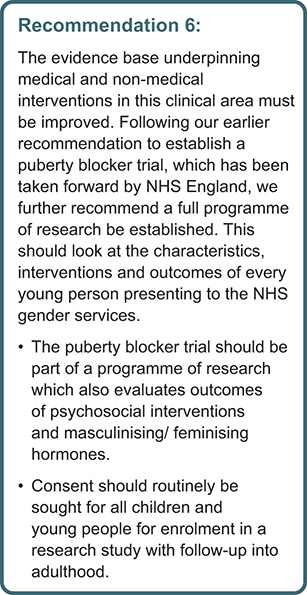
In terms of narrative coherence, the characterisation of transgender children and young people as less competent than others of their age group who are receiving different medical treatments attracted further scrutiny in the context of the research trial recommended by the Review. The 2022 Interim Review had advised that puberty blockers should only be made available as part of a research protocol, and the UK government had already moved forward with the advice by the time the final report was published, in 2024. Transactual (2024) considers this a form of coercion since it forces transgender youths to participate in an ‘undefined study’. Although the details of the study were not made available, Giordano (Reference Giordano2025) notes that the wording of the recommendation (Figure 4.3) suggests that the research is meant to be therapeutic. The Review thus simultaneously claims that treatment by puberty blockers is not necessary and recommends a trial in which this unnecessary treatment is provided. Moreover, the recommendation states that consent must be sought for (not from) all children participating in the trial. Giordano considers this problematic because young people over the age of 16 can and may wish to participate in the trial, although puberty blockers are ‘maximally effective at Tanner Stage 2 or 3, and therefore usually will be considered in people younger than 16 years’ (Reference Giordano2025:2). Consent should therefore be sought from not for patients over 16, but the Review still implicitly casts this group as minors with no capacity to give informed consent. At the same time, the UK Clinical Trial Regulations require the consent of parents for younger minors but state that ‘the wish of a minor who is capable of forming an opinion must be considered by the investigator’ (Giordano Reference Giordano2025:2):
We are thus in a peculiar situation: in all likelihood, a young person will be only considered eligible for PBs [puberty blockers] if they are capable of consenting to treatment, in line with accepted clinical practice, and the assessment of their competence will be part of the decision to consider the young person as a suitable candidate for PBs. The convoluted and somewhat paradoxical situation will be that capacity to consent to treatment will almost certainly be required in order to consider young people eligible for PBs, but their consent to participation in research (which is the only way to obtain medical treatment, for which their capacity to consent will be typically expected) will not be required.
Recommended research trial (Cass Review 2024:197)
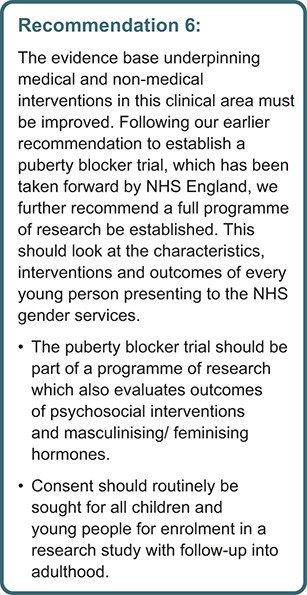
Figure 4.3 Long description
The screenshot reads: Recommendation 6: The evidence base underpinning medical and non-medical interventions in this clinical area must be improved. Following our earlier recommendation to establish a puberty blocker trial, which has been taken forward by N H S England, we further recommend a full programme of research be established. This should look at the characteristics, interventions and outcomes of every young person presenting to the NHS gender services. The puberty blocker trial should be part of a programme of research which also evaluates outcomes of psychosocial interventions and masculinising/feminising hormones. Consent should routinely be sought for all children and young people for enrolment in a research study with follow-up into adulthood.
Other critics have drawn attention to further concerns in the emplotment of transgender youths within the wider narrative of puberty blockers emerging prior to the publication of the Review and potentially feeding into it. De Vries and colleagues (Reference de Vries, Richards, Tishelman, Motmans, Hannema, Green and Rosenthal2021) note that in the Bell v. Tavistock case, the Court ‘inferred from the low detransition rates not that the young people were being appropriately selected through the stringent clinical assessment process employed’ but that suppressing puberty was the initial stage of a course of treatment that was inevitably followed by gender-affirming hormones and surgeries, with lasting physical and mental consequences. This inference – that puberty blockers locked them into a fixed course of treatment – informed its view that young transgender people cannot make an informed decision in this context. De Vries et al. (Reference de Vries, Richards, Tishelman, Motmans, Hannema, Green and Rosenthal2021:220) favour a different pattern of emplotment that casts these youths in a very different light: ‘The fact that they continue with hormonal care when they are older validates a stability of gender identity experienced over time’ and confirms that ‘these youth were able to make informed choices at an earlier age without regrets in later adolescence and early adulthood’.
The casting of transgender youths and transgender identity in the narratives elaborated in such influential texts can have serious consequences for their protagonists, often extending well beyond the intentions of the narrators. In particular, the recommendations of the Review raised considerable alarm in relation to conversion therapy, despite the fact that the Review itself states that ‘strong safeguards must be built into any potential legislation on conversion practices’ and that ‘any ambiguity could serve to further disadvantage these children and young people rather than support them’ (Cass Review 2024:202). Nevertheless, the Review was explicitly referenced by the British government ‘to justify plans to exclude trans people from legislation to ban conversion therapy’ (Horton Reference Horton2024:2, citing the British Psychological Society). Pink News, which describes itself as ‘the world’s largest and most influential LGBTQ+ led media brand’, also drew attention to a statement given to Sky News by the then Health Secretary Sajid Javid following the publication of the Interim Report in 2022, in which he referenced Dr Cass in justifying the exclusion of transgender children from a ban on conversion therapy for LGB groups:Footnote 20
The health secretary said Cass ‘talked about how the children and young people, when they say they have gender dysphoria, it is right for medical experts to be able to question that and to determine what the cause might be.’
‘So I think it is right to take the approach that we have, which is to ban conversion therapy for LGB, but to take a much more sort of sensitive approach when it comes to trans,’ Javid added.
Following the publication of the final Cass Review, Transactual (2024) warned that ‘the ongoing political effort to normalise conversion therapy practices as part of trans healthcare will only serve to drive more trans people to take their treatment into their own hands’. It is not clear how they can do this, however, given that the government quickly imposed a ban on the sale or supply of puberty blockers ‘prescribed by private UK registered prescribers for gender incongruence and/or gender dysphoria to under 18s who are not already taking them’ and ‘against prescriptions from prescribers registered in the European Economic Area (EEA) or Switzerland for any purpose to those under 18’.Footnote 21
4.4 Narratives of Lived Experience: Amplified and Silenced Protagonists
When attention is narrowly focused on methodological checklists, the human realities and practical insights embedded in the research risk being sidelined or dismissed. The Cass Review has been accused of sidelining the expertise and experience of a number of important stakeholders in the debate, especially young transgender people’s own lived experiences of well-being and improvement. This is an area in which the limitations of narrative medicine become apparent: it fails to engage adequately with core discourses in medicine and chooses to focus almost exclusively on the doctor patient encounter, ignoring the fact that patient voices and experiences are not just suppressed in clinical encounters but may also be dismissed or inadequately represented in mainstream medical discourse, with potentially serious consequences.
Commenting in the King’s Fund Blog on the Cass Review and the government’s subsequent ban on puberty blockers, Rigby (Reference Rigby2025) stresses that pointing gaps in research evidence is not sufficient to address the issue of gender dysphoria. There is a need to incorporate patient stories into the narrative in order to ensure that trans people are treated ‘with the dignity and respect [they] deserve’. Although the Review did convene focus groups with trans youths, these sessions primarily highlighted young people’s desires for improved access to affirming care and knowledgeable clinicians. At the same time, patient narratives were sidelined in the Review’s final recommendations, where the focus on adult expert concerns about uncertainty and safety dominate the narrative and arguably marginalise trans youths’ self-reported needs and experiences. Critics such as Noone and colleagues (Reference Noone, Southgate and Ashman2025) thus call for redirecting attention to trans youths’ lived realities and broader socio-political contexts. They call out the Cass Review for emphasising the distress of minors as a psychiatric issue rather than affirming their agency and competence. In highlighting the need to recognise and support transgender youths’ narratives as a central dimension of the debate, they hope to shift attention from the narrow question of methodological certainty toward broader ethical considerations of patient autonomy, well-being, and risk balance.
At the same time, Noone and colleagues’ counter-analysis of the data in turn oversimplifies the narrative and sidelines the voices and diversity of transgender youths. It presents aggregated outcomes from five studies involving 415 trans youths that show overall improvements in mental health, gender dysphoria, and body satisfaction in order to prove that many benefit from gender-affirming interventions. While this framing supports the authors’ alternative narrative, it obscures the specific contexts from which the findings emerged. By collapsing diverse study designs, methodologies, and epistemic framings into a single collective storyline, the critique inadvertently treats the data as self-representing – as though the aggregated figures directly reflect the voices and lived realities of trans youths themselves. This elides the crucial fact that each study involved researchers and protocols that mediated, interpreted, and represented those experiences in particular ways. The refrain of ‘415 trans youths’ showing improvement is turned into a compelling story, but one that risks effacing the narrative processes through which improvement was constructed and communicated, and the diverse voices involved in the narration. A more nuanced narrative attention of the type Charon calls for would preserve both the interpretive contexts and the methodological heterogeneity shaping the evidence, recognising that positive, gender-affirming stories – like all stories – emerge through structured and partial frames in which a range of voices are foregrounded, downplayed, or totally suppressed, depending on the narrative stance of the storytellers.
Oesthoeck and colleagues (Reference Oesthoek, Stanwich and Gerritse2024) warn of the dangers of adopting a ‘logic of improvement’ in the case of transgender youth because this standard approach to justifying the provision of Gender Affirmative Medical Care ‘comes at the cost of obscuring and rendering invisible more diverse and nuanced experiences of GAMT [gender-affirming medical treatment] and risks discrediting this care practice’. It implicitly promotes normative representations of young people with gender dysphoria as ‘good’ clients who are receptive to treatment or as ‘unstable’ and ‘less credible’. The temporal emplotting of the improvement narrative, which assumes a linear progression from ‘doing bad’ to ‘doing better’, further assumes that gender identity ‘is potentially malleable during adolescence but tends toward a stable endpoint, solidifying into a static identity in young adulthood’ (Oesthoeck et al. Reference Oesthoek, Stanwich and Gerritse2024). This temporal pattern casts gender transition as ‘a chronological process with a clear beginning and endpoint’ and hence promotes a binary understanding of gender that is not supported by transgender organisations such as WPATH. Importantly, the logic and temporal emplotment of the improvement narrative also risk straining the relationship between health providers and transgender youths seeking treatment for gender dysphoria, who may fear that ‘not showing enough distress will impact their eligibility for care’ (Oesthoeck et al. Reference Oesthoek, Stanwich and Gerritse2024; emphasis in original). By limiting itself to the clinical encounter and failing to engage with these wider narratives, narrative medicine undermines the efficacy of its core framework of attention, representation, and affiliation. The first step of this triad may be undercut in this instance by the wider politics of GAMT deficiency, which lead transgender youths to see their clinicians as gatekeepers, potentially leading to unreliable representation and failure in ‘bonding’ with the patient in the final stage of affiliation.
Apart from the transgender children and young people at the centre of the Cass narrative, some critics of the Review have focused on the composition of the research team. Among the most influential critics, the Yale Integrity Project raises this issue from the perspective of mainstream medical research practice:
Most of the Review’s known contributors have neither research nor clinical experience in transgender healthcare. The Review incorrectly assumes that clinicians who provide and conduct research in transgender healthcare are biased. Expertise is not considered bias in any other realm of science or medicine, and it should not be here. Further, many of the Review’s authors’ identities are unknown. Transparency and trustworthiness go hand-in-hand, but many of the Review’s authors cannot be vetted for ideological and intellectual conflicts of interest.Footnote 22
Transcultural (2024) likewise accused the Review of assuming from the start that being trans is ‘an undesirable outcome rather than a natural facet of human diversity’, suggesting that this is evident ‘not only from the recommendations but also from the exclusion of trans researchers from the design of the review process and the links individual members of the research team have to anti-trans groups’. Another trans activist group, ‘What the Trans’, makes a similar point when it accuses the Review of excluding ‘a huge swathe of … relevant experience that exists in the field of trans healthcare’.Footnote 23 Noone and colleagues (Reference Noone, Southgate and Ashman2025) similarly criticise the Review more generally for excluding ‘content experts’ from the research team but mention that Cass later recruited Dr Tilly Langton. Noone and colleagues do not comment on this choice, but the appointment gives some credence to Transactual’s narrative. Tilly, formerly Clinical Psychologist at GIDS, is accused by several transgender activist groups of being anti-trans and is the originator of an approach that many believe to be suspiciously close to conversion therapy – Gender Exploratory Therapy (Moore Reference Moore2023; see also Ashley Reference Ashley2023). And, finally, Noone and colleagues also stress that given the wide-ranging implications of the Review, what was needed is ‘community involvement at every stage, not just superficially, as is common in NHS England initiatives’ (Reference Noone, Southgate and Ashman2025:14).
There is also the more specific question of which of the voices that eventually featured in the Review are challenged and which are accepted at face value. Horton (Reference Horton2024:3) critiques the Review for presenting the views of all professionals involved in its surveys, ‘including those demonstrating ignorance, dismissiveness or hostility to trans children … as valid and valuable’, even though, for instance, one survey concluded that a third of those interviewed ‘identified with the view that “there is no such thing as a trans child”’. The Cass Review does not challenge this opinion but accepts it as ‘a valid professional viewpoint’. Horton finds it alarming that ‘the view that “there is no such thing as a trans child” is not deemed disqualifying from a professional seat at the table in designing healthcare for trans children’.
Those who adopt a gender-affirming approach will argue that neutrality is a narrative position that supports the powerful and mainstream rather than a value to be appreciated in the presentation of scientific and other types of evidence. Ultimately, a narrative approach recognises that the translation of empirical data into clinical practice is profoundly non-neutral, deeply enmeshed within powerful narrative structures dictating whose experiences count as legitimate knowledge and whose perspectives remain marginalised. Adopting a richer, narrative-conscious approach, as advocated but not fully developed by Charon, compels healthcare discourse to engage transparently with the ethical and political dimensions of representation – explicitly recognising who speaks, from which positions of authority, and towards what moral horizons.
4.5 Narratives of Equality and Justice
For some, there is an issue of whether trans children and adolescents are treated fairly, irrespective of the quality and volume of available evidence from clinical trials. Even where clinical trials are concerned, some have argued, the Review treats this group unfairly by ‘applying impossible evidence standards which, if applied to other medicines would invalidate more than three quarters of the existing treatments used in paediatric care … [and] currently being prescribed off-label’ (TransActual 2024b).
The Cass Review situates itself firmly within the dominant biomedical model, stating that even though ‘some think the clinical approach should be based on a social justice model, the NHS works in an evidence-based way’ (2024:20). It thus unsurprisingly tends to represent gender dysphoric youth through a medicalised and problem-focused lens, whereas affirmative perspectives strive to represent trans youth in terms of agency, identity, and rights. Horton, who adopts an affirmative approach, accuses the Review of being committed throughout to ‘trans as disease paradigm’ and of ‘failure to understand the purpose of trans healthcare, framing it as diagnosis, prevention and treatment of a disease, rather than supporting well-being in a minority population’ (2024:13). Given the tension between the two approaches, the same empirical findings may be narrated either as alarming uncertainties or, alternatively, as evidence of effectiveness, depending on the narrator’s stance.
For Rigby (Reference Rigby2025), the Cass recommendations and subsequent ban on puberty blockers point to a larger issue of inequality in healthcare: ‘where there is a lack of evidence, there is caution, but rarely an increase in research.’ This issue affects marginalised groups in general, including trans people, refugees, asylum seekers, and Roma: ‘the issues each group experience may differ, but the fundamental issue remains the same: a lack of data leads to poorer health outcomes.’ Writing on X (formerly Twitter) in June 2023,Footnote 24 Jo Maugham, Director of the Good Law Project and King’s Counsel, likened the ban on puberty blockers to anti-abortion laws which ‘drive poorer women to unregulated backstreet abortionists, whilst the wealthy travel abroad’.
Ultimately, the struggle over puberty blockers in transgender youth healthcare is not only a scientific and policy debate – it is fundamentally a narrative contest about how we understand and respond to gender diversity in young people. Examining the Cass Review and its critics through a narrative lens suggests that facts alone do not drive effective knowledge translation; rather, facts are woven into stories that carry moral and emotional weight. Adapting Charon’s model, we might say that the Cass Review directed attention to uncertainty and risk, represented trans youth in clinical terms of distress, and implicitly affiliated with protective scepticism – a combination that yielded a cautious, arguably paternalistic narrative. Opposing voices have sought to redirect attention to lived experiences and the harm of non-treatment, to represent trans youths as agents deserving of care, and to affiliate with communities advocating for affirmation and rights. These dueling narratives have real-world consequences: they influence legislation, clinical practice, and the well-being of transgender youths and their families.
From a narrative perspective, this chapter underlines the importance of narrative reflexivity – the need to critically reflect on who gets to tell the story, whose voices are amplified or silenced, and what values are being advanced between the lines. In the case at hand, a more ethically robust approach would not be to choose one narrative extreme over another, but to strive for a narrative that is inclusive. Such a narrative would pay deep attention to both empirical evidence and patient testimony, represent the full complexity of benefits and risks (including the risks of not intervening), and build affiliation by honouring the perspectives of those most affected. As transgender healthcare continues to evolve amid cultural controversies, narrative framing will continue to shape public understanding and policy. Scholars and practitioners in the medical humanities have a vital role to play in illuminating these narratives and advocating for those that promote compassion, justice, and truth.
While this chapter focuses on how the Cass Review is interpreted, contested, and mobilised by both critics and supporters – revealing how codified evidence gives rise to competing narrative framings and calls for action across clinical, political, and public arenas – Chapter 5 turns to the field of in vitro fertilisation (IVF), examining two contrasting clinical guidelines and analysing how they narratively reconfigure the same body of evidence into divergent normative commitments and practical recommendations.

 Open access