Introduction
Have land redistribution programs undermined property rights in Latin America? This is the question raised – and answered affirmatively – by Michael Albertus in his most recent book Property Without Rights (PWR)Footnote 1. The importance of the question – analytically and policy-wise – can hardly be disputed. Analytically: PWR takes us back to the old issue of the plausibility of the view according to which private property over land is no more, and no less, than an efficient institutional device. PWR, though, introduces a new perspective: it asserts that it can be shown that when the state allots lands (that is, ‘chooses winners’) in Latin America, it actually prevents the peasants’ access to full-fledged rights over it. How do we understand then the relationship between property rights, land struggles and inequality? Policy-wise: Given that Latin America is by far the most unequal continent in the world in terms of access to land,Footnote 2 the answer will necessarily inform the policies adopted to react (or fail to do so) to such a reality.
Albertus's case is relatively straightforward and, as always, is backed by serious theoretical arguments and impressive empirical evidence. The first claim made by PWR is that the countries involved in an agrarian reform in Latin America exhibit a significant ‘property gap’: peasants that received land amid reforms never received full-fledged property rights (frequently, not even a title). This is the book's central puzzle, because standard economic theory establishes that clear and stable property rights are a key variable for growth.Footnote 3 PWR asks: Why should a government refrain from taking a step that has such fundamentally benevolent effects for its citizens and possibly for its own chances of building a stable constituency?Footnote 4
The answer given by Albertus, to which he devotes most of his data analysis methodology, is that independently of the reasons for implementing the redistribution programs that create property gaps, the regimes understand the political potential of maintaining the gap, and even expanding it, to ensure that those who received land will continue to depend on the state: ‘The strategy of widely distributing property without rights activates a set of additional political mechanisms that provide an opportunity to enmesh land reform beneficiaries in relations of dependence on the state. This paves the way to creating a politically pliable and dispersed support base’.Footnote 5
For this hypothesis to hold, it is necessary to understand what has happened in countries without property gaps. According to PWR, this is the case of countries like Colombia where small-scale redistribution programs were implemented that guaranteed partial or full property rights.Footnote 6 According to the author, Colombia is similar to countries that have not engaged in any type of redistribution reforms, such as Argentina between 1960 and 2010. In Argentina there is no gap because no land distribution has taken place, and consequently property rights have been transferred through market mechanisms or civil law rules that grant full rights to the subsequent acquirers.
There is a third possibility, which is that the regimes that initiate massive reforms without delivering property rights will eventually be replaced by other administrations that no longer perceive the political usefulness of maintaining the gap, and subsequently decide to grant the property rights. According to Albertus, this usually occurs during transitions from authoritarian regimes to democracies. This case reinforces the author's hypothesis on the strategic use of the property gaps, because the change in administration is what creates the possibility of closing them.
As explained earlier, Albertus believes that Colombia is an example of ‘Path A’, a country that implemented land redistribution programs and guaranteed partial or total property rights. However, based on evidence from Colombia, we will argue in this paper that this claim is fundamentally wrong. Since our case of choice is Colombia, we show from different points of view that, contrary to such a claim, property rights over land in Colombia have been massively informal and precarious as well as open to violent contestation. The yawning property rights gaps in Colombia are among the largest, and certainly bloodiest, in the world. Albertus does not see them because of his legalistic approach to the measurement of property gaps. Notwithstanding the precautions taken by PWR in framing the concept of property rights, in the author's proposed methodology, information about land titling and the rights granted by law are the key aspects used to measure the gap.Footnote 7 It is because of this legalistic approach that Albertus, in gathering the data, defines property rights as formally titled land that can be legally transferred and that incorporates the enforceable right to exclude others from using the land. These few elements pin down the gap at the crux of Albertus's thesis and enable him to assert a rationalistic interpretation of the ways in which governments made use of these gaps. As we mentioned, PWR asserts that Latin American governments have refrained from delivering property rights to peasants in order to control them.Footnote 8 While the proposition sounds prima facie plausible, it misses completely the real, empirically observable politics of property rights, and its cast of characters (governments, large landowners, armed groups) that have developed different tools (such as coercion, clientelistic networks and other forms of intermediation) to establish such control.
The book neglects social (and violent) conflicts around property rights. In effect, if inequality is too large, it may also weaken the property rights of vulnerable sectors, as it opens windows of opportunity for the powerful to override their rights through different mechanisms (of which we will discuss plenty below). It also treats the state as unitary: as a rule-setting entity that does not meddle with rights as long as populist elites do not push it to do so. These departure points do not work in Colombia and are likely to not work elsewhere. In competitive political regimes, as in the Colombian case, the capture of state agencies by actors that accumulate land violently and politically is generally patchy and unstable, and thus the understanding of the relationship between the state and the violation of the rights of the peasants must be considered at a higher level of granularity.Footnote 9
Certainly, our case could be made stronger if we departed from PWR's conceptualisations, which preclude the discussion of the full range of problems related to land property rights in Colombia and elsewhere. However, for the sake of clarity, we have decided to play the game, as it were, according to PWR's rules. Thus, we show that Colombia suffers from major gaps in the sense explicitly specified by the book.
This article strives to demonstrate a political economy of property rights grounded on social and political dynamics.Footnote 10 We proceed in the following way. First, we flesh out PWR's concept of property gaps, in the context of the relevant literature on land property rights. Gaps can be ‘broad’ (affect all lands) or ‘narrow’ (affect only agrarian reform lands). Then, we go on to sketch the key aspects of the Colombian context. The third section takes a close look at Colombian gaps in the broad sense, and the fourth section discusses gaps in the narrow sense. These sections focus on enforcement issues and their relative impacts on the other types of gaps, but the next section is dedicated to the informality and ambiguity of land property rights in Colombia. Next we move on to the discussion, where we highlight some patterns underlying Colombian property rights gaps and show how they can have an accumulative character. In conclusion, we recapitulate and highlight some fundamental limitations of Albertus's theory of land property, especially its rationalistic, narrow view of the processes related to the access, transfer, specification and contestation of land rights.
Private Property over Land and Agrarian Conflict
Property rights are a bundle of rights,Footnote 11 and thus – acknowledges PWR – they are difficult to define.Footnote 12 However, they do have an operational core, constituted by the following dimensions:
(a) Enforceability, or the enforcement of rights by the state.
(b) Transferability, or the capacity to sell or otherwise voluntarily surrender the asset.
(c) Formality, or the formal, legally driven assignment of property.
(d) Exclusion, or the capacity to exclude others from access to the land.
Gaps are thus defined by PWR as shortcomings in any of these four dimensions. For example, if there is no land market, then transferability is in question. Note, however, that not all these dimensions were made equal. In particular, the failure of the state to uphold rights undermines not only enforceability, but also transferability, formality and exclusion.
Now, there are two possible ways of analysing these gaps. The first one is narrow: do agrarian reform programs create persisting gaps? This is the focus of Albertus's thesis. The second one is broad: do gaps regarding land property exist in general? Though PWR does not directly answer this question, it seems necessary to deal with it, even within its own framework. Indeed, Albertus's argument seems to work because lands not affected by agrarian reform do not show any significant gaps, especially considering that even relatively radical reforms affect only a relatively low percentage of usable land.Footnote 13 This is so because if most of the population is deprived of full rights over the land, then the government's bargaining chip for maintaining the support of the peasants who have gained access to land does not carry as much weight in comparison with the general population. Furthermore, there is no Chinese wallFootnote 14 between reform and non-reform lands, so the gaps that affect the latter can end up undermining rights in the former. Thus, both narrow and broad understandings of property rights gaps are relevant for a discussion of PWR's propositions.
The idea of property as a bundle of entitlements is a starting point, from which two types of ‘property rights dramas’ can be staged. In the first one, individual property rights appeared because they promoted efficiency and also alleviated collective action problems.Footnote 15 This is precisely the perspective adopted by Albertus (which we label here as the liberal vision of rights).Footnote 16 If, however, other agents are introduced into the narrative – as they must be – then we face another, quite different, script. In this second story – with social structures, classes and groups of people aspiring to define or to change institutions – politics, by definition, creeps in.Footnote 17
As soon as the strictly liberal perspective is dropped, then human agency and distributional conflicts around the definition of property rights come to the fore, which has two relevant implications for our discussion. First, it calls into question predictions about individual rights taking priority independently of the context, as Elinor Ostrom has shown so clearly.Footnote 18 Thus, as both Ostrom and Cristobal Kay remind us, individual rights are not necessarily synonymous with clarity or efficiency.Footnote 19 In many contexts, the individualisation of rights can be highly counterproductive and have negative distributive effects.Footnote 20 Actually, the informality and ambiguity of peasant properties – that Albertus describes as an anomaly which ought to result from a deliberate choice by reformist elites – may be more the norm than the exception for peasant properties, at least in non-capitalistic environments. Both Alexander Chayanov and Teodor Shanin, for example, highlighted that peasant properties combine collective and individual rights and that they have generally been informal and contested.Footnote 21 Last but not least, due to distributive issues, the frailty and undermining of clearly established rights can be a social good for subordinate sectors and actually for society as a whole, as the examples of the prohibition of slavery and of child labour in the 19th century so powerfully show.Footnote 22 This calls into question PWR's core assumptions. In view of the above discussion, where is the (informality) puzzle?
Second, property rights are frequently politically defined, specified and contested. Political settlements over property rights can be sticky and durable, as Mariano Sánchez-Talanquer showed so well for the Colombian context.Footnote 23 In fact, Catherine Boone concludes that in rural African societies land tenure IS the political system.Footnote 24 In many countries, rights are defined through complex, highly adversarial political processes, frequently associated with violence.Footnote 25 This kind of analysis sits well with the massive literature on Colombia, a country that has been in the midst of a civil war for decades, a fundamental fact that Albertus's theory simply disregards. Violent conflict has frequently been associated with politically assigned rights over land,Footnote 26 and it has been shown that for decades many forms of violent and non-violent mobilisation from below and above were grounded on rural conflict.Footnote 27
Does this have any bearing over the generation of broadly and narrowly conceived land property gaps? The next sections show that the simple answer is ‘yes’.
The Context
The assertion that, regarding rural land property rights, Colombia is in some way better off or more stable than its Latin American peers – or than anybody else, for that matter – seems rather surprising. Why? First, let us consider the context.
The territorial occupation of the country unfolded through the permanent expansion of the agrarian frontier,Footnote 28 governed by push (for example, violence affecting rural economies within this frontier) and pull (global markets) factors.Footnote 29 Settlers seldom legalised their properties, because of the barriers to entry to doing so, typical of the Colombian juridical process, which made them highly vulnerable to dispossession.Footnote 30 Rural elites, who had the support of local authorities, state security agencies and astute lawyers, regularly dispossessed settlers, who then pushed the agrarian frontier out even further. The cycle has had many iterations, which in turn have been linked in many ways to Colombia's different waves of political violence.Footnote 31
In 1926, the country's Supreme Court ruled that land property had been in essence illegally assigned throughout the country's history.Footnote 32 This decision, plus the launching of an agrarian reform in 1936, created the conditions for renewed clashes between settlers and large landowners.Footnote 33 After the country fell into a ‘non-declared civil war’ between the two main political parties – christened by contemporaries and analysts as ‘La Violencia’, which took place approximately between the late 1940s and the early 1960s – rural land distribution disputes in many regions were decided by coercion. Furthermore, La Violencia opened windows of opportunity for enterprising party leaders to accumulate land through a combination of the use of law, force and political connections.Footnote 34
The Frente Nacional (National Front, FN, 1958–74) established a pact between the two warring parties. It recognised explicitly that La Violencia had prompted the land dispossession of peasants on a massive scale. To counter the outcome, the FN took two types of measures. On the one hand, it promoted early processes of land restitution.Footnote 35 On the other, it launched two agrarian reforms (in 1961, and more vigorously in 1968).Footnote 36 Even though they triggered major political changes and impressive peasant mobilisations,Footnote 37 the reforms did not significantly transform the country's land tenure, and eventually stalled. In the meantime, though, land dispossession continued. Politically well-connected large landowners had direct access to the army, to the police, to local authorities and to notaries (who were, and still largely are, named through party connections),Footnote 38 so in moments of acute conflict they could define and specify property rights over land.Footnote 39
As in the rest of Latin America, new Marxist-inspired guerrillas were being created in 1960s Colombia. Initially marginal, some of them had the skills and the cadres – formed by the tough experience of La Violencia – to do better than their other South American peers.Footnote 40 Thus, they survived and eventually thrived. To combat subversion, the Colombian state created institutions that allowed the arming of civilians, that is, the creation of self-defensive forces or paramilitaries. The formation of paramilitaries was funnelled through party networks and territorial notables (mainly, cattle ranchers and other rural elites.Footnote 41 By the early 1980s, the country was already in a new spiral of violence, whose protagonists were the guerrillas, the paramilitaries and the state.
This scaled land dispossession to a wholly new level. Though estimates of the magnitude of the phenomenon vary wildly, the most conservative establish that at least one million hectares were taken from peasants and transferred to other actors.Footnote 42 This was not a classless operation, where a non-state armed group decided to pick on civilians, as in the standard rendering of the civil war literature; it was more often than not planned, prompted and operationalised by agrarian elites,Footnote 43 who additionally played leading roles in the main paramilitary undertakings.Footnote 44 This redistribution, mainly from the peasants to the rural rich, spiked an already extreme land polarisation. In terms of forced displacement, which is primarily rural,Footnote 45 Colombia in 2006 was the second-worst country in the world after Somalia,Footnote 46 and its present land Gini index is well above 0.8 (where 1 means that all the land belongs to a single person).
In the meantime, the country became a major player in the coca and marihuana global markets. Two consequences of this are particularly relevant to our discussion. First, a new sector of illicit peasants emerged.Footnote 47 Since at least the late 1970s, tens of thousands of cultivators have been part of this demographic, and hardly any of them have formal rights over their lands.Footnote 48 The majority of cultivators have no title,Footnote 49 and a substantial number could not have formal rights anyway, as they grew their crops in national parks and environmental reserves.Footnote 50 Actually, according to Colombian legislation, any land with illicit crops can be taken over by the state.Footnote 51
Second, narcotraffickers have been investing in land for decades.Footnote 52 The rationale underlying the phenomenon is easy to understand. Due to the type of land tenure that characterised the country, and the enormous power of rural elites within its political system, Colombia never developed a strong cadastre and did not significantly tax rural land.Footnote 53 It also has not carried out an agrarian census since 1962.Footnote 54 Rural land was typically off-limits for state regulation. Although the Colombian state developed, in collaboration with the United Nations system and the United States, ways of combatting narcotraffickers and expropriating their properties,Footnote 55 this tendency was partially stymied by narco-paramilitary influence within the country's political system, and in any case rendered rural property rights even more blurry.Footnote 56
The next section shows that, when we consider social and political issues with a broader lens, PWR's four key dimensions, and especially enforceability, do not sit well with this type of context.
Property Gaps in the Broad Sense
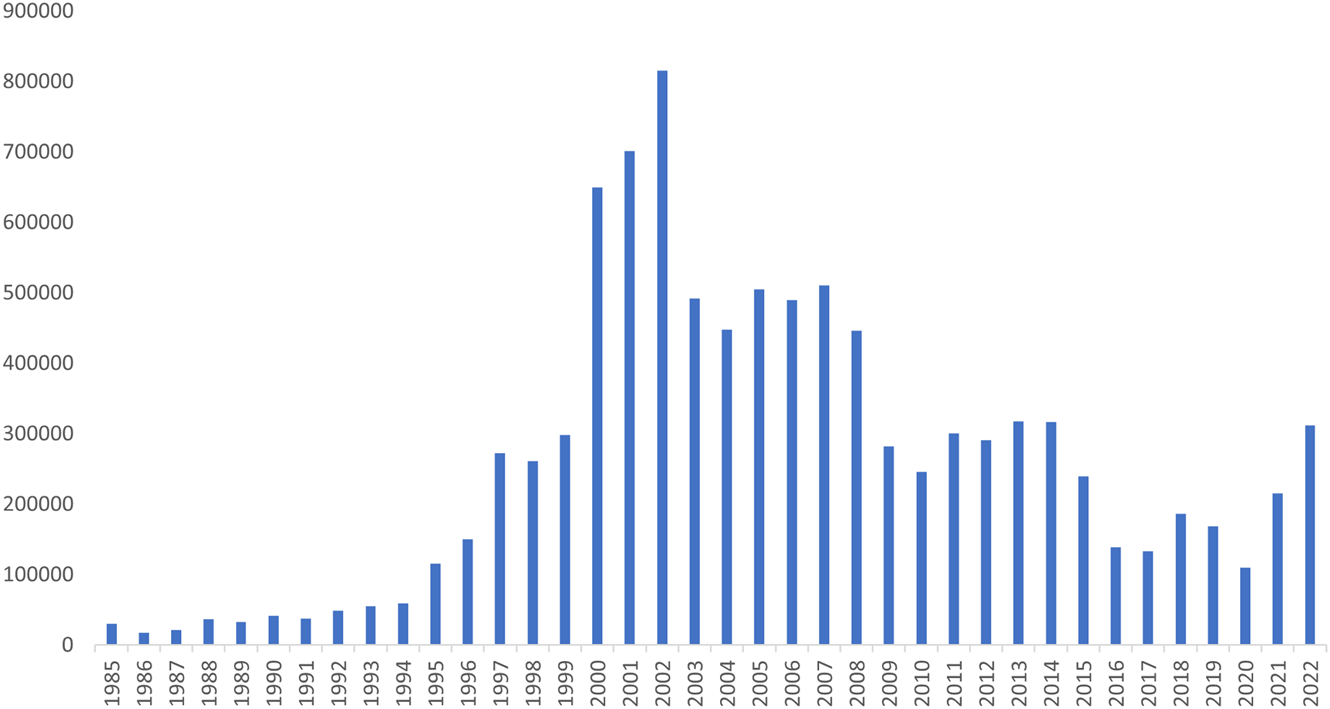
Colombia suffered massive displacements between the mid-1980s and 2010.Footnote 57 According to the main official database in the country, the Registro Único de Víctimas (Unified Victims Registry, RUV), the country presently has nearly 9 million internally displaced people (IDPs) out of a population of more than 40 million. This made the country one of the global epicentres of this phenomenon, second only to Somalia or Syria depending on the period.Footnote 58 Figure 1 shows the way displacement evolved.
Displaced persons in Colombia, 1985–2022
Source: Authors’ elaboration based on data from Unidad para las Víctimas, ‘Víctimas desplazamiento anualizado ocurrencia y llegada’: https://www.unidadvictimas.gov.co/publicacion-de-datos-abiertos/.

Displacement went hand in hand with land dispossession.Footnote 59 Symptomatically of such a context, there are no reliable figures regarding the latter. For example, Francisco Gutiérrez-Sanín et al. studied five municipalities on the Caribbean Coast and found that dispossession in that region might be underestimated by as much as one case in twenty.Footnote 60 Even so, many standing estimations also suggest that dispossession was enormous. For instance, researchers investigating on behalf of the Constitutional Court found in 2011 that more than 40 per cent of IDPs had lost their land in the context of the armed conflict.Footnote 61 This would mean, according to the RUV tally, more than 3 million dispossessed people.
In reality, the dismal performance of the Colombian state regarding rights enforcement began much earlier. As seen above, the gradual occupation of the Colombian territory took place through successive iterations of dispossession and displacement. During La Violencia, as eventually recognised by the state, rural land was also coercively transferred on a massive scale.Footnote 62 Even though the FN period produced a partial realignment of the state in certain territories, due to peasant pressures and agrarian reform programs, the dispossession of peasants by large landowners and/or well-connected politicians (which in the Colombian case are often one and the same)Footnote 63 continued to be a major factor underlying the extreme land concentration in the country.Footnote 64
Even then, what happened after the 1980s was in a wholly different league. The mix of change and continuity regarding the inability of the Colombian state to enforce the property rights of a broad sector of rural dwellers can only be understood if the institutionalisation of property rights over land and its relationship with political and other power structures in different territories is taken into account. In particular, unlike its neighbours and peers, Colombia maintained competitive electoral politics almost uninterruptedly throughout the twentieth century. And unlike many other Latin American countries, notaries never became public officials. They were private agents taking care of a public good (defined as ‘public faith’).Footnote 65 Many notary appointments came with very large perks and income.Footnote 66 Due in part to political pressure and in part to lack of capacity, the state never developed a working cadastre nor tools to observe, regulate and measure rural land, particularly large properties.
Whenever rural conflict appeared, large landowners had thus a good chance of summoning the support of both the very actors in charge of the assignment of property rights (notaries) and of local authorities and key coercive agencies (army; police) with which they were intimately linked. However, there was always a host of local and national actors whose relationship with large landowners was not so friendly. In particular, the national government may have had reasons to periodically push forward redistributive policies, thus straining the relationship between at least some national agencies and large landowners.Footnote 67 The possibility and level of dispossession depended on this constellation of actors and their alignment, or lack thereof, through the decades. Once again: to understand enforcement in the Colombian context, the state cannot be seen as a unitary actor.
As the guerrillas increased their firepower, becoming a real threat, and agrarian elite-led paramilitaries developed, large landowners and key state agencies at all territorial levels gradually fell into alignment. Not only the army and the police but also a substantial proportion of agrarian and other civilian bureaucracies converged around the struggle against subversion and its purported social base, which was mainly peasants (Bautista et al., 2022).Footnote 68 ‘Taking the water from the fish’, a standard counterinsurgent strategy, meant in the Colombian context linking the operation of the state with different rural elites, which in many regions were intimately related to the paramilitaries. The army wanted to defeat the guerrillas, and many large landowners were involved in bitter struggles over land with peasants (largely assumed both by security agencies and landowners to be pro-guerrilla) that had lasted decades.Footnote 69 The main target of this convergence was the figure of the subversive peasant.
The strategic alignment between key state agencies and large landowners in many territories was fully operational, in the sense that it trickled down to the very logistics of dispossession. In the midst of war, land properties, especially large ones, took on different uses. They became ideal sites for training, stashing weapons and goods, torturing and killing – and also for arranging political meetings, where paramilitaries, actors of land dispossession and state agents could gather, establish objectives and agree on specific activities without any type of hindrance. This was not a marginal phenomenon; it took place on a massive scale.Footnote 70 Furthermore, the lack of regulation over land opened the door ever more widely to narcotraffickers wanting to purchase land, which was a practically ideal cover operation for money laundering. An additional effect was that rural elites had increasingly stronger incentives to call the paramilitaries into their territories, as their presence provided security and increased the value of land, a point that the paramilitaries themselves were well aware of.Footnote 71
Until now, we have shown that the non-enforcement of property rights was extraordinarily widespread and associated with longstanding institutional designs. But it is also the case that a variety of different rural power structures had access to those institutions which promoted dispossession. We illustrate the point with two examples (from among many) of the construction of dispossession coalitions that included rural and political elites as well as state agents.
First, notaries continued to be central figures in the cast of characters of dispossession. The following was a typical process: a peasant was threatened by a paramilitary to abandon his property or else; the victim was then ordered to sign a blank sheet of paper, which was later filled in at the notary's office.Footnote 72 The role of the notaries as helpers of dispossession was also reinforced at the highest levels of political power. The 1991 Constitution had ordered that notaries should be appointed through a technical competition (article 31 of the Código Penal). However, this did not happen.
Notaries kept on being named through political influence. Because of this, the Supreme Court declared a ‘non-constitutional state of affairs’ in 1998.Footnote 73 And during the peak of the conflict and of dispossession (the administrations of Andrés Pastrana, 1998–2002, and of Álvaro Uribe, 2002–10), several representatives of rural elites were named as Superintendents of Notaries and Registries: José E. Barrios and Manuel Cuello Baute, cattle ranchers, José Félix Lafaurie, who would become president of the association of cattle ranchers in 2004 and Orlando García Herreros, president of the association of cotton producers.
Second, many entrepreneurs involved in dispossession, displacement, or taking over land from victims were awarded generous incentives.Footnote 74 The basic sequence linking dispossession with opportunistic entrepreneurs was as follows: First, some actors (paramilitaries, ranchers, state agents) contributed to the eviction of people from their lands. Second, due to the massive scale and widespread nature of dispossession, the Colombian state placed large tracts of land under protection, for example, by limiting land sales. Third, another set of people (not necessarily the same as the evictors) tried to take over those lands once the violence had subsided and the paramilitaries demobilised. However, this operation was only possible through the weakening of the protection established by the Colombian state over the affected lands. As always, this was done through a combination of political influence, violence and legal action.Footnote 75 In Urabá, paramilitary private firms and NGOs interacted with local and departmental authorities to take over lands, with the strong backing of the Colombian national state and the United States Agency for International Development (USAID).Footnote 76 Something similar happened in the department of Chocó and the Catatumbo region, where palm agro-industrialists sought to take over collective lands that had been delivered by the Constitution to Afro-Colombian communities.Footnote 77 In many of these cases, the entrepreneurs involved in the operation were showered with incentives, like subsidies, credit and friendly institutional designs.Footnote 78
In summary: during the counterinsurgent war, large landowners, national agencies, local actors and the institutions in charge of defining and assigning property rights converged as they had never done in the past. This produced the conditions for the dispossession of peasants on a massive scale. The undermining of the enforcement criterion was not just a state failure but was frequently promoted directly by state agencies.Footnote 79 Only by taking this into account can the magnitude of this form of victimisation be explained.
Property Gaps in the Narrow Sense
Now let us consider property gaps understood in the narrow sense, that is, gaps that arise in the context of land redistribution. Colombia exhibits extreme land inequality in spite of its more or less regular engagement in redistributive programs.Footnote 80 The effects of these programs were limited, and/or were eventually reversed through a combination of extreme violence, clientelistic politics and market mechanisms. But all of them exhibited flagrant property gaps, something that PWR failed to recognise. This is a consequence of the methodology used for spotting the gaps. One of the sources Albertus used is the official data provided by the Ministry of Agriculture or land reform agencies. However, granting a title does not necessarily mean that it was registered in the private property registry. This has created a situation of informal tenancy over the land that has been addressed by major formalisation programs.Footnote 81 And even when the property was registered, there were huge limitations on the transferability and usage of the land.
A good example of this is the market agrarian reform (MAR) that took place during the Samper administration (1994–8). The MAR picked up all the themes that were being promoted at the time by multilateral agencies, especially the World Bank.Footnote 82 MAR's basic working mechanism was the following: large landowners could sell lands to smaller ones or to landless peasants. The state – through its agrarian reform agency, Instituto Colombiano de la Reforma Agraria (Colombian Institute of Agrarian Reform, INCORA) – would bring both parties together and partially subsidise the purchase of the land by peasants. Given Colombia's extreme inequality, though, and the longstanding tradition of enabling different types of economic and political elites to gain access to land through the astute use of the law,Footnote 83 the reform established a set of specific conditions and constraints that tried to focus subsidies and purchase opportunities to people who were genuine peasants. For example, MAR beneficiaries could not abandon the purchased land for more than 30 days, or else they would lose their rights over it.Footnote 84 They could also not sell the land for 12 years (art. 39. Law 160/1994).Footnote 85
So here we already find major gaps (limits to transferability, conditionality of rights, etc.). However, the real problems only appeared later. At the end of the 1990s, the paramilitary Bloque Norte de las Autodefensas Unidas de Colombia (Northern Bloc of the United Self-Defence Forces of Colombia) arrived in several territories of the Caribbean coast and began a wave of dispossession and displacement. At some point, the Bloc leaders decided to tone down the killings due to the political costs involved. They discovered in MAR's institutional designs an ideal mechanism to expropriate peasants while minimising the costs of the operation. For example, in Magdalena they used threats to force their victims to abandon their plots during the mandatory 30-day period, and then took care of documenting that the victims had in effect breached their commitments to the state. In theory, the victim had the right to a legal defence, but the leader of the Northern Bloc had coordinated his actions with the regional director of INCORA (later transformed into the Instituto Colombiano de Desarrollo Rural (National Institute of Agrarian Development, INCODER)Footnote 86 who vigorously enforced the victim's documented fault. The committee in charge of such certification, headed by the regional INCORA director, seems also to have been under the thumb of the paramilitaries.Footnote 87 Simultaneously, state and private credit agencies put pressure on victims,Footnote 88 demanding repayment of overdue loans, even after the dispossession had taken place.Footnote 89 Then, lands were reassigned (generally to large cattle ranchers, paramilitary leaders and politicians – the area of intersection between the three being relatively large). It was not uncommon for the perpetrator to receive credits from the state to develop palm or timber projects.
The MAR experience is grounded on a long tradition of limitation of property rights to agrarian reform beneficiaries, albeit with different purposes. The regimen parcelario (small-holding regime), created by Colombia's 1961 agrarian reform and in place ever since, severely restricts transferability (selling or leasing) of land for a period between seven and fifteen years. The allotment of lands to beneficiaries could also be reversed if they did not comply with certain conditions, like remaining on their lands. Once again, this was instrumental for dispossession by paramilitaries. Land thus lost by peasants was then transferred through different types of networks to elite members and well-connected people.Footnote 90 Contrary to Albertus's claim, the institutional restrictions on property rights do not arise only from the lack of title, as was the case in Colombia during the agrarian reform of the 1960s and as described by the author in the case of Venezuela.Footnote 91 Furthermore, the author does not take into consideration additional gaps in the Colombian case, such as conditions and restrictions placed on sales, leases and other aspects that are part of the bundle of property rights.
It is thus clear that the state enforced in many cases the claims of well-connected violent expropriators, not of legal owners. But the massive expropriation of peasants that took place, especially during the 1990s and 2000s, was also related, at least loosely, to different distributional programs, to the point that several authors have claimed that the Colombian dispossession movement constitutes a counter-agrarian reform.Footnote 92 While it is important to clarify the specific content of this conclusion, two of its meanings can hardly be called into question: First, the dispossession resulted in the concentration of massive swathes of dispossessed land all over the country.Footnote 93 Second, a substantial number of beneficiaries of the different waves of reform were dispossessed by paramilitaries and large landowners. In fact, some of the latter were quite candid concerning their anti-reform motivation.Footnote 94
The paramilitaries indeed had ample latitude to meddle with property rights. The same can be said of the guerrillas. For example, exclusion and transferability were severely limited in the fiefdoms of non-state armed groups, as proprietors had to allow the permanent transit of armed people. However, guerrillas were extra-systemic actors, something that cannot be said of the paramilitaries, who also probably carried out dispossession on a more massive scale than the insurgents did, as evidenced by the cases adjudicated by land restitution judges: paramilitary groups were responsible for 53 per cent of judicial cases of dispossession, while guerrillas were responsible for 19 per cent.Footnote 95
Interestingly, the paramilitaries launched their own (regional) agrarian reform in the early 1990s, which makes a nearly ideal vantage point for observing the Colombian version of property rights gaps and the constellation of forces that generated them. In effect, from the early 1990s the Castaño brothers (heavyweight paramilitary leaders) started to buy land in the department of Córdoba, as a tool to expand their influence and armed project. However, after the Ejército Popular de Liberación (Popular Liberation Army, EPL) was disbanded, they allotted the land to the former combatants of this guerilla army and their purported social bases, whom they wanted to win over in order to combat another guerrilla group that remained active, the Fuerzas Armadas Revolucionarias de Colombia – Ejército del Pueblo (Revolutionary Armed Forces of Colombia – the People's Army, FARC-EP or FARC). More or less in parallel, they created an NGO, Fundación para la Paz de Córdoba (Foundation for the Promotion of Peace in the Department of Cordoba, FUNPAZCOR), as an interface between themselves and their reform ‘beneficiaries’. The entity was headed by government officials at the departmental level and was supported by ranchers and other private sector actors.Footnote 96 From beginning to end, FUNPAZCOR acted in broad daylight, with the active participation of different officials, as well as with subsidies and loans provided by the central state.Footnote 97
As could be expected, the paramilitary rural reform project was full of property gaps. The peasants could not sell or mortgage their land (these constraints were not only coercive; they were established legally). They also had to follow FUNPAZCOR's lead regarding the use of land.Footnote 98 Eventually, though, FUNPAZCOR forced and intimidated the peasants into selling their land at derisory prices, a blatant violation of enforceability, which did not prompt any reaction from the central state. All in all, the conclusion is clear: there is overwhelming evidence against Albertus's claim about the situation in Colombia. The country has not, in any reasonable appraisal, been spared from yawning property gaps, in the narrow nor the broad sense. As we have shown, this flaw is due to the shortsightedness of the PWR methodology in terms of tracing the property gaps. The legalistic approach that focuses on the issuance of titles and the rights bestowed by law to the owners fails to take into consideration the social and political context in which these rights are disputed and rehashed by multiple actors. In these disputes, the state does not appear as a unitary actor.
Informality and Ambiguity
In the previous sections we considered property gaps, in the narrow and broad senses, mainly in terms of the enforcement criterion. Now we take a close look at another major gap, according to PWR: informality.
The informality of property rights over rural land in Colombia is pervasive. According to the Unidad de Planificación Rural Agropecuaria (Agricultural Rural Planning Unit, UPRA), in their 2020 appraisal, 52.7 per cent of rural lands in Colombia are informal. But this could well be a substantial underestimation.Footnote 99 To begin with, given the weakness of the Colombian cadastre, there are many unregistered properties. The complexities of land tenure also play a role. For example, there could be a large number of land occupants and holders who do not have formal property rights but could eventually aspire to obtain them, given how long they have been cultivating the land.Footnote 100 Additionally, the inventory of wastelands is severely outdated. This informality is concentrated in ten very rural departments, precisely where the lack of a registry and other forms of underestimation are more likely to occur.Footnote 101
On the other hand, formalisation programs have been the source of numerous hazards for the property rights of peasants.Footnote 102 For example, there are many barriers and risks to formalisation in the context of illicit crop substitution. As mentioned earlier, many peasants cultivate either in national parks or in otherwise protected areas, which prevents the state from assigning them rights to land.Footnote 103 Since hosting illicit crops is a cause for expropriation according to Colombian law, many cultivators are wary of joining formalisation programs.Footnote 104 Such programs have been limited, unstable and marked by frequent failure by the state to fulfil its commitments.Footnote 105 Many material barriers to entry also remain for peasants who want to formalise their land rights: the distance from registry offices, the duration and cost of the process, etc.Footnote 106
Furthermore, some of the legal designs adopted in Colombia to distribute land create practical obstacles for the use of the land that cannot be understood through the legalistic lens used by PWR. For example, since 1970, land authorities have assigned lands to comuneros (co-owners) using the legal form común y proindiviso (joint ownership).Footnote 107 This land distribution program may not be particularly large (based on National Land Agency sources, we have identified more than 2,000 beneficiaries between 1970 and 2015)Footnote 108 but decisions by the assembly of comuneros in this type of ownership model must be passed by unanimous agreement in some cases and the rules applying to this type of property are not clear, which exacerbates collective action problems. These issues, plus the lack of public goods and exposure to violence, have induced many comuneros to abandon their lands.Footnote 109
Predictably, informality and ambiguity are interrelated in the Colombian context with poor enforcement of rights. Paramilitaries, politicians, cattle ranchers and agro-industrialists, as well as those at the intersections of these groups, took great advantage of institutional design problems around property rights in order to dispossess ethnic communities and peasants without land deeds. The main mechanism of dispossession has been to co-opt members of the community to contribute to the lifting of limitations on the transfer of land and other property rights, while exercising threats or actual violence against opponents of the operation.Footnote 110 These pressures, by the way, have not disappeared.Footnote 111
Discussion
We saw in the last four sections that Colombia indeed is endowed with major, egregious property gaps. We have focused mainly on enforceability and informality, but have also seen how they affected transferability and exclusion. The state fails to enforce property rights, both in the narrow sense (that is, in the context of redistributive programs) and in the broad sense. Redistributive programs have tended to bestow limited rights, in order to protect victims of dispossession, among other reasons, but to add insult to injury, those limitations have played into the hands of land predators. Informality is widespread. As mentioned above, some forms of property in Colombia incorporate, by institutional design, ambiguities that are difficult to solve for the owners. Informality and ambiguity have opened the doors to ever-new modalities of non-enforcement and limited transferability and exclusion, as well as to other forms of land dispossession and the illegal and violent bypassing of the limits to transferability.
Nor can anybody reasonably claim that these phenomena are marginal. As we have shown, in Colombia they actually constitute more often the rule than the exception. The majority of rural land in Colombia is in a state of informality. The number of dispossessed people can be counted by the hundreds of thousands, in the most optimistic scenario, but more probably by the millions. There is good evidence that suggests that the purchase of land by narcotraffickers has been taking place on a massive scale, despite the intrinsic difficulty of quantifying the problem. And so on.
A possible counterargument to all this could be the following. Yes, PWR got everything wrong in the Colombian case because of the methodology used to trace the gaps. Maybe the country simply belongs to the other category, that of the disorderly reformers who have not granted full rights over the land (Path B).Footnote 112 Thus, Colombia would be misclassified, but Albertus's narrative would stand. However, this counterargument would fail to realise that the gap exists in a broader sense, in other words, that it is a structural problem of rural land in Colombia, even for lands that were not redistributed. Why? Firstly, because non-enforcement in Colombia is largely rooted in extreme agrarian inequality. In standard economic or political science jargon, there is a fair amount of endogeneity in the relationship between the instability of rights in Colombia and extreme inequality. Since the latter has run amok, different actors had both the incentives and the means to attack and undermine the rights of vulnerable people. In the context of war, the situation became even worse – which is not idiosyncratic or exceptional.Footnote 113 In other words, beyond a certain threshold, it is likely that inequality in access to land – which in turn can imply extreme asymmetries in access to decision-making and security – undermines the rights of vulnerable sectors.
How and why did this happen? In the empirical section, we looked at three ways in which inequality could produce gaps. First, some rural elites could have strong motivations to dispossess peasants of their land; either because land was fundamental for them as economic actors,Footnote 114 or they had been involved in longstanding disputes over land with peasants (further poisoned by the presence of guerrillas, paramilitaries, etc.), or both. This was occurring on an absolutely massive scale, but it also triggered a second-order mechanism: in order to protect victims, the state developed instruments that limit their property rights. This might seem counterintuitive, given the involvement of the state in the dispossession processes analysed above, but it is easily explainable. The Colombian state is not a unitary entity. In particular, and in parallel with other medium-income countries, it was and is constrained by the need to respond to international constituencies, but also to internal actors and public opinion. Thus, the restrictions on the property rights of victims are not necessarily absurd or malicious. For example, to guarantee that land went to needy peasants, and not third parties, the state developed focalisation instruments, and also established different forms of conditionality. To prevent victims – and/or ethnic communities – from being forced into selling, it restricted transferability. However, these instruments in turn gave rise to a third-order mechanism: old and new agents of dispossession began tinkering with these limitations, triggering yet further cycles of accumulation under duress.
Colombia is rife with the three types of gap-generating mechanisms. The preconditions for their development are extreme differentials in power and land tenure between perpetrators and victims, and the gradual alignment of key dispossession actors in the context of armed conflict. Indeed, the undermining of property rights in Colombia seems to have affected mainly small and medium landholders.Footnote 115
In sum, the attempts by successive Colombian governments to distribute and clarify property rights might have been more or less genuine and well-intended, at least in some circumstances, but once set in motion they did not operate in a social and political vacuum. Redistribution efforts in Colombia did in effect take place, but frequently as a response to violence, or at least to legally foul accumulation of land. The limits to property rights established by legislators and decision-makers in this context were prompted by the need to focalise (redress wrongs and give due recompense to victims). It is not redistribution, but rather the constellation of forces that operated in rural areas, and the power structures that processed their initiatives and claims, that are at the root of the Colombian property rights gaps.
Something similar can be said regarding informality and ambiguity. Colombia's widespread informality is related to its historical trajectory of weak regulatory instruments and the incessant expansion of its agrarian frontier driven by global markets, which explain its failure to redistribute land within densely populated areas. This opened the door to the occupation of territories without state regulation. Whether deliberately or not (this would merit a separate discussion), the presence of informality and ambiguity, and their interaction with non-enforcement, have contributed to the concentration of land in the hands of paramilitaries and rural elites. Additionally, as we have seen, formalisation programs generally produce distributive effects and trigger distributive conflicts that cannot be disregarded. Once again, there are potentially strong forms of endogeneity here, as territorial occupation without state regulation might have contributed to the origin and/or duration of the Colombian armed conflict, which in turn substantially undermined rural property rights, though in a differential fashion.
All this takes us to the politics of rural property in Colombia. PWR's story is devoid of social agency – save when political populist elites start to meddle with individual property rights. However, property rights are, predictably, continually rehashed through conflict, influence and negotiation – especially in conflict-prone settings and situations. The state plays a much more complex role than Albertus's narrative would allow for.Footnote 116 On the one hand, over the years, different agencies aligned with actors of dispossession, and this crystallised in different institutional designs that favoured them. Concrete dispossession took place through coalitions and networks of cattle ranchers, paramilitaries, notaries and functionaries, who in turn had the connections to operate at different territorial levels. But on the other hand, the Colombian state was far from being a unitary agentFootnote 117 – even at the worst moments, it had to respond to different audiences, so it also had strong incentives to push forward at least remedial policies to address displacement and dispossession. The combination of first, second and third-order gap-producing mechanisms can only be understood through the tensions that determined the concrete position of the state at specific moments and on specific territories.
Last but not least: how could Albertus not have noted the presence of the property gaps we have been describing? The answer is relatively straightforward. PWR's research design is extremely narrow. The book is based on the (careful and laborious) analysis of databases of lands purchased by the state over a long period.Footnote 118 Thus, phenomena like massive dispossession are simply not taken into account. Nor does the book seriously discuss the institutions that regulate property rights in the country. It also ignores the fact that Colombia has suffered intense civil strife throughout almost the entire period under consideration. PWR's conclusions on the Colombian case are based on a one-sided quantification, without taking into account the relevant context, potential counterarguments or contradictory evidence, of which the author could have found plenty.
Conclusion
Concerning land property and other rights, in recent decades, Colombia has been much more a liberal Gulag than a liberal paradise. Despite having almost uninterrupted competitive politics and checks and balances, and being at best tame in terms of its redistributive proclivities, the country has witnessed massive property gaps in the terms defined by PWR. This is a consequence of shortsightedness in the identification of the gaps. The number of titles issued and the rights granted by law fail to show the full picture of rural property rights conflicts and institutionalisation. We have shown that the gap not only exists in the redistributed lands (matching the Path B proposed by PWR) but that it is a structural problem affecting rural property rights as a whole. Property rights have been the focus of multiple forms of conflict and contestation, and the state's role therein is dependent on alignments, convergences and divergences of different constellations of social forces (local, national and global) but also of the differential behaviour of agencies that respond to separate constituencies and demands.
Our analysis has fleshed out, thus, the inconsistencies and problems of a strictly liberal perspective on property rights in Colombia. But the more general issue is that the landscape of property rights and their complex relationship with redistribution, inequality and force requires a different conceptualisation and methodology. James Ferguson famously characterised the liberal vision of property rights, as applied to Africa, as an ‘antipolitics machine’.Footnote 119 By design, it fails to consider political variables. We have tried to show how in the Colombian case there are key mechanisms and forces that inevitably bring politics and conflict back into the analysis.
This, of course, is not only relevant for the Colombian case. Other countries considered in PWR, like Peru, would merit an equally meticulous, and political, reconsideration. For example, Latin American property rights in general have been marked historically by tough disputes around the hacienda, whose rights were enforced largely by a combination of coercion and access to decision-making leverage. The typical large hacienda, says Eric Hobsbawm, was not based on legal property, but rather on the fact that the large landowner had more power than the state – at least in cases when these two were not one and the same person.Footnote 120 This is distinctively not a relic from the past, but a complex standing reality for many Latin American countries.Footnote 121 In this continent, those that fell into conflict dealt with ferocious disputes around property rights, patterns of tenancy, political dynamics and the use of coercion, all of which were in continuous interaction.Footnote 122 This is true also in Colombia for periods not covered in this article.Footnote 123
What happens if we go beyond Latin America? We find very different conflicts, certainly, but the same problems related to the concepts, methodology and evidence used in PWR. Actually, bracketing out other continents may have reinforced PWR's biases. For example: how are redistributive policies and clear property rights associated elsewhere? How would the Philippines, which was unable to execute a full-fledged agrarian reform, fare in comparison with South Korea or Taiwan, which did have periods of energetic redistribution at different points in time? And even more to the point: in these countries, the specification, transfer and clarification of property rights were an eminently political process, taking place at the heart of different power structures.Footnote 124 As reported above, Boone also found that in Africa land tenure had been intimately associated with the political system and the structure of the state.Footnote 125 From the point of view of several theories, this is to be expected: property rights are at the heart of social order.
All this actually highlights the importance of PWR. Even if it fails to adequately answer them, it raises and/or rehashes key questions that deserve to be taken up for a comparative research agenda on the politics of agrarian property rights. What forces and mechanisms contribute to their configuration? How do they interact in shaping (and being shaped by) patterns of inequality and different types of rights? What processes of inclusion and exclusion are triggered by different types of property rights policies? How do the latter relate to coercion and war? For all the many excellent pieces already written on this topic, a unified, systematic and comparative perspective, beyond the very limited and limiting liberal lens, could likely boost our understanding of these issues.
Acknowledgements
This article is the result of the projects ‘Indiviso y conflicto armado: análisis de incidencia de la forma de tenencia de la tierra en el despojo y desplazamiento en Santa Marta y Dibulla’, funded by Universidad del Rosario and ‘Diseños institucionales: campesinado, conflicto y paz’, funded by Universidad Nacional de Colombia.