The cinema of Stanley Kubrick was deeply influenced by the history and culture of central Europe in the modern era. His favorite author was Franz Kafka, and he admired German filmmakers such as Fritz Lang and, especially, Max Ophüls. His film The Shining (1980) can be read as a central European imaginary that presents historical comprehension as the product not just of knowledge, but of experience, memory, and artistic representation/reception. This approach has the advantage that “in fiction, the echoes of deep memory are transformed and altered, engaging the existing conventions and genres as well as historical knowledge in a dialogue.”Footnote 1 The film also defines and examines central European culture within and across national and ethnic boundaries, including both Jewish and non-Jewish diaspora occasioned by imperialism and war. Kubrick adapts the many works by central European artists and scholars inhabiting The Shining to construct a dark meditation on the human condition in general and the horrors of that historical period, which shadowed these works and also reached abroad to Kubrick as child, adolescent, and adult. Nathan Abrams has recently established the centrality of being Jewish to Kubrick's career as a filmmaker.Footnote 2 Kubrick brought this Jewish identity to a lifelong study of history, particularly that of central Europe during the era of the world wars. It is this historical focus—especially by means of its concentration on German central Europe—that dominates the layered historical discourse in The Shining. The reason, after all, that Kubrick in 1928 was born in New York City was that his grandfather, tailor Elias Kubrik, had emigrated with his Romanian wife Rosa (née Spiegelblatt) from Austrian Galicia in 1902.Footnote 3
All of Kubrick's films display attitudes toward the world characteristic of contemporary, critical, and cosmopolitan central European culture in the twentieth century: existential dread, a mix of weary and outraged irony, alertness to the absurd, wary fascination with the uncanny, an eye for the surreal, and recourse to black humor. The cohabitation of realism and surrealism—as well as that of humor and horror—is a consistent feature of Kubrick's cinema as well as central to the works of Prague's German Jewish Kafka. Kubrick was especially attracted to what he called Kafka's “almost journalistic” accounts of the grotesque inherence of horror in the everyday.Footnote 4 All of these elements are present in Krzysztof Kieslowski's cycle of short films for Polish television, Decalogue (1989), for which published screenplay Kubrick wrote a foreword.Footnote 5 Decalogue, each episode based on one of the Ten Commandments, comprises ten moody and melancholic metaphysical films on problems of contemporary Polish society. Its final episode is a black comedy that echoes the farcical satire of one of Kubrick's favorite films, Czech Miloš Forman's The Firemen's Ball (1967). Kubrick was familiar with the ironic and antiauthoritarian Jewish humor that had come to America from central and eastern Europe. For Kubrick, as for his American and European Jewish cultural kin in particular, humor was sword and shield against a world of unpredictability, indifference, and hostility in which all his characters—good, bad, and indifferent—are victims of powerful circumstances and institutions. Such general resignation regarding the human condition preempted any recourse on Kubrick's part to contemporaneous critical gender, class, or race theory.Footnote 6 Kubrick's early films feature antiheroes presented with sympathy and pity as well as some amusement. These men and women include the unhinged and most memorable characters played by Timothy Carey in The Killing (1956) and Paths of Glory (1957) and by Peter Sellers in Lolita (1962), whose mix of mummery and meanness anticipates later classic Kubrick antiheroes. Dr. Strangelove (1964) rolls out black humor, satire, and—following Kafka in particular—slapstick comedy to render those with great power—even Nazis—ridiculous. The archetypal Kubrickian antiheroes of A Clockwork Orange (1971) and The Shining too combine the cruel and the comic in ways that make them realistically human and even problematically likable. Such ambiguities reflect the sober and suspicious view of humanity characteristic of Kubrick's films and much of the central European culture that informed them.
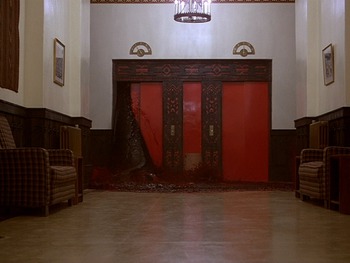
Kubrick also shared with central European film and literature a fascination with simulacra, automatons, and mannequins as uncanny inhabitants of the blurry boundary between human and machine, between living and nonliving. Frequent menacing juxtapositions of animals and machines in his films take two forms. One is physical confrontation between animal and machine, such as dog and tractor in The Killing, horse and motorcycle in Paths of Glory, and in The Shining a torrent of blood from an elevator. The other is characterization of human beings as machines—in The Shining man/typewriter—and vice versa. In Killer's Kiss (1955) mechanical dolls in Times Square shop windows and a warehouse full of mannequins serve as social commentary on working men and women as commodities for the pleasure and profit of powerful and ruthless men. The eponymous Dr. Strangelove moves via wheelchair and has a mechanical right arm. The commercial space hostess in 2001: A Space Odyssey (1968)—stiff as a mannequin with her slow, robotic stagger in grip shoes under microgravity—embodies that film's exploration of the interface between human and machine. As does computer HAL who recalls the Golem of Prague, an android that destroys its creator.Footnote 7 A Clockwork Orange in title and theme addresses such existential ambiguity. And the entire conception of Kubrick's posthumous production of Steven Spielberg's Artificial Intelligence: A.I. (2001) is a commercially produced artificial child who, like Pinocchio, wants to be a real boy.
The subject of simulacra, automatons, and mannequins animates, as it were, The Shining's theme of the relationship between human beings and ghosts. Sigmund Freud defined spirits, shadows, and mirrors in the literature of the fantastic as uncanny in that their strangeness is familiar: they represent for every individual the desire for immortality in the face of death. The Polish “post-traumatic theater” of Jerzy Grotowski and Tadeusz Kantor wrestled with such fraught themes. Kantor's play Dead Class (1975) features ghosts, mannequins, and—for Kubrick an abiding concern—the loss of childhood. Such relationships are prominent in the work of one central European writer referenced in the production files from The Shining. A business card to be carried by a ghost reads:
There is no death;
Lifelessness is only a disguise,
Behind which hide,
Unknown forms of life.Footnote 8
The words are from The Street of Crocodiles (1934), a collection of stories marked by Kafkaesque surrealistic humor and realistic detail by Polish writer Bruno Schulz. The first line in the original is the less sanguine “There is no dead matter” and is taken from a lecture on mannequins by Schulz's father, Jacob. The stories are told from the point of view of Schulz as a boy he names Joseph after the son of Jacob in the Book of Genesis and Mann's tetralogy, Joseph and His Brothers (1933–1943). Jacob, a cloth merchant, wishes to re-create man in the form of a tailor's dummy. He believes he will capture the nature of matter as infinitely plastic and transitory in the forms it assumes. Adult reality for Schulz was a matter of suspension between animate and inanimate, an evanescent mélange of mannequins, automatons, and simulacra. For Schulz with his streets crowded with “puppets” and “cut-out paper figures”—as for Freud and for Kubrick—the uncanniness of simulacra, automatons, and mannequins lies in the truth that “man was only a transit station, a temporary junction, of mesmeric currents, wandering hither and thither within the lap of eternal matter.”Footnote 9
Kubrick's Magic Mountain
In 1980, François Truffaut's film about Paris under Nazi occupation, The Last Metro, posed an unanswered question: What would a Jewish theater manager in hiding have to say in the 1940s about Thomas Mann's The Magic Mountain (1924)? Coincidentally, that same year of 1980 Kubrick's The Shining in effect provided an answer to that question, for this film was Kubrick's own gloomy post-1945 challenge to Mann's novel. In composing his answer, Kubrick out of both personal and historical necessity filled The Shining with voices from central Europe in its grimmest century.
The Shining's executive producer Jan Harlan says that Kubrick was originally reluctant to adapt Stephen King's 1977 horror novel about a family isolated by winter in a mountaintop hotel. This was because he did not regard it as a vehicle for the ideas that had always inhabited his films. Then Kubrick decided that a film about ghosts that makes no sense and is filled with mystery and incongruity would be interesting.Footnote 10 But it was also the case that the horror genre had its roots in the German Expressionist cinema of the early twentieth century Kubrick so admired. And it was a genre attuned by nature and effect to the horrors of the world war era. Its Urfilm, Robert Wiene's The Cabinet of Dr. Caligari (1920), originated as a screenplay by two young disillusioned German veterans of the First World War.Footnote 11 Both similar in setting to The Shining, Caligari and Magic Mountain use asylum and sanatorium, respectively, to address institutional confinement as a sign of “dissolution of the old bourgeois order and the pathologies of the emerging society.”Footnote 12 As early as 1981, Fredric Jameson recognized that The Shining is a ghost story in which history is the ghost. Jameson's point of departure was Theodor Adorno's argument that the bourgeois culture of late capitalism had eliminated reverence for ancestors and the family past in favor of the commodified needs of the individual in an atomized suburban culture.Footnote 13 Jameson overlooked the rest—and the bulk—of the film's prolix and indirect visual and aural discourse on the human condition in the wake of the Second World War. Kubrick was always reluctant to discuss his intentions, development of which went beyond adaptation, drew from multiple sources, and extended throughout filming and into post-production. He even deployed playful and provocative indirection or misdirection when speaking about his work. This was one means to engage audience interest in meanings below the surface of his films. Kubrick's open narrative style too spoke to his genre-bending postmodern emphasis on the importance and inevitability of audience reception and interpretation. In sum, as D. H. Lawrence advised, trust the tale, not the teller. Given all this, Harlan's apparent refusal to entertain the idea that there are deep meanings in The Shining is consistent with, even if not collaborative in, Kubrick's insistence on leaving exploration and explanation to the viewer.
Kubrick found Freud's emphasis on fundamental conflict between individual desires and social demands a compelling explanation for the unhappiness and violence in the world. One of the reasons Kubrick hired Diane Johnson to help write the screenplay for The Shining was her novel The Shadow Knows (1974), which concerns the paranoia induced in women by the history of husbands murdering wives. In writing the script for The Shining, Kubrick and Johnson drew upon two psychoanalytic works: Freud's essay “The Uncanny” (1919) and Bruno Bettelheim's The Uses of Enchantment: The Meaning and Importance of Fairy Tales (1976). For Freud, the uncanny encompasses those strange but also familiar experiences that result from repression of sexual and aggressive drives. The English word canny means “cozy” but also “uncanny,” “occult,” “supernatural,” and “(of a house) haunted.” Kubrick's reliance on the etymology of uncanny is evident in Jack's unsettling sentimentality during a tour of their living quarters in the older part of the Overlook Hotel. On Danny's bedroom: “Perfect for a child”; their bedroom: “Cozy”; and the bathroom in which he will attempt to murder his wife: “Well, it's very homey.” There is a cozy Kubrickian fit here between Freud's uncanny, Kafka's grotesque, and the form and content of the genre of horror in a film whose story is structured as a dream.
Bettelheim's book explores the ways in which fairy tales can help the child come to terms with feelings of anger and anxiety. This approach reflects his neo-Freudian view that society can nurture as well as frustrate the individual. Also neo-Freudian was psychoanalyst Karen Horney, who is referred to in notes for The Shining.Footnote 14 The film displays a darker view much more in keeping with Freud's view of family and society than with that of Bettelheim or Horney. There is, for example, Kubrick's highlighting of a passage in Bettelheim about how the oedipal boy sees the father as a monster who threatens him because of the boy's unconscious desire for the mother.Footnote 15 Oedipal conflict between father and son is evoked by Jack's liquor of choice, Jack Daniel's, which fuels his physical abuse of son Danny. Along these same oedipal lines, Kubrick was influenced by Arthur Schnitzler's novella Dream Story (1926), which was the source in Kubrick's copy of King's novel of annotations about hotels and sexual adventures. This same connection was central to Kubrick's early interest in another Austrian Jewish writer, Stefan Zweig, who was a friend of Freud's. In 1956, Kubrick wrote a script from Zweig's novella Burning Secret (1913), which concerns a young baron's attempted seduction of a Jewish woman at a mountain spa. The baron befriends the woman's young son, who is prevailed upon by his mother to keep the incident secret from his father. Kubrick drew similar inspiration from German writer Hermann Hesse. Psychoanalysis opened up for Hesse, in novels such as Steppenwolf (1927), a world of deep introspection into the perils and potentials of the human personality. In another annotation to King, Kubrick jotted that Jack's lonely pacing of the Overlook's corridors is “Jack's Steppenwolf sequence, intriguing but almost always a trap”; a note to King's words “time has ceased to matter” reads “very Steppenwolfish.” And in a separate note to himself: “There should be some kind of sensual thing—reread Steppenwolf.”Footnote 16
Autobiographical elements in The Shining reflect the central oedipal theme in a film Johnson describes as being about “family hate.”Footnote 17 Jack, a self-described writer, represents both Kubrick and Kubrick's father, Jacob, who went by Jacques or Jack. Danny—for whom, alongside mother Wendy, Johnson says, Kubrick had a “soft spot”Footnote 18—is, like Kubrick, a first-born and only son, close to his mother. As Wendy—whom Danny will later kiss on the mouth upon escaping his murderous father—describes Jack once injuring him, visible next to her is The Wish Child (1930) by German poet and novelist Ina Seidel about a Prussian war widow and her young son during the Napoleonic Wars. Later, on television, Wendy and Danny watch the likewise oedipal Summer of ’42 (Robert Mulligan, 1971) about a teenager and a war widow during the Second World War. Kubrick then moves King's August 1945 Overlook masked ball—inspired by Edgar Allan Poe's short story “The Masque of the Red Death” (1845[1842])—to the decades of his own interwar childhood. He does this by means of a chronological blur of Independence Day 1921 (in an early treatment New Year's Eve 1919) and 1930s dance music.Footnote 19 And he surrounds Danny with artifacts of fairy tale and cartoon menace and violence drawn from his 1930s childhood, such as the witch in Jacob and Wilhelm Grimm's Hansel and Gretel (1812) and the Big Bad Wolf from Walt Disney's Three Little Pigs (1933). Emphasis on predation coincides of course with the genre of horror within which Kubrick is working, as does his use of the gothic horror convention of the double (Danny's imaginary friend Tony, the Grady sisters, Charles and Delbert Grady) as the dark side of the human personality. Tony also represents (following Freud) Danny's wish for immortality in view of the deadly threat from his father. And in alerting Danny to past, present, and future danger, Tony unmasks the history of the violent patriarchy of the Overlook and by extension that of the menacing modern world into which Kubrick was born in 1928.
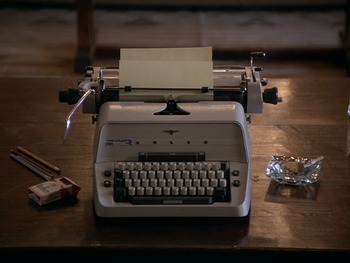
This Freudian marriage of familial and historical dynamics sets up the drinks of Jack Daniel's for which, following Goethe's Faust (1808), Jack (“I'd give my goddamned soul for just a glass of beer”) sells his soul to the Overlook.Footnote 20 The Overlook in this way connects with Kafka's unfinished novel The Castle (1926), which concerns K., who has been called in winter to the hilltop castle to be appointed a land surveyor. Like The Shining's Jack, the schoolteacher who longs to be a writer but becomes only a caretaker, K. ends up a school janitor. But Jack also embodies K.'s twin assistants, who represent Kafka's own sense of himself as divided between poet and bureaucrat. J., unlike K., consequently, becomes an agent of the murderous designs of “the impersonal and Kafkaesque corporate state” that is the Overlook Hotel.Footnote 21 While Kafka stresses the mystery and inaccessibility of worldly authority, Kubrick's post-Holocaust perspective is that of collaboration with powerful evil. Both works use the eagle as a symbol of official power. Kafka emphasizes the lofty imperviousness of the castle through the image of bureaucrat Klamm as an eagle: his “remoteness . . . his silence . . . his downward-pressing gaze . . . his wheelings . . . which far above followed incomprehensible laws.”Footnote 22 The film evokes this perspective in the opening credits through a high aerial shot stalking Jack's car on his way up to the Overlook for his job interview. But the eagle in The Shining is most associated with Jack as a minion of the hotel, appearing first on his T-shirt before a dissolve centered on the eagle logo of his Adler (German for “eagle”) typewriter and accompanied by a horrific diegetic booming on the soundtrack (“Does he have a typewriter—”, Kubrick wrote, “What kind?”).Footnote 23 Also in line with Kafka, Kubrick eliminated the supernatural elements in King's novel, leaving Danny's and others’ visions (King's “shining”)—those of past, present, and future worldly horrors—at the Overlook. There is only parody of horror genre conventions in Kubrick's film, intentional incongruities of form and content for purposes of audience reflection, not continuity errors.Footnote 24
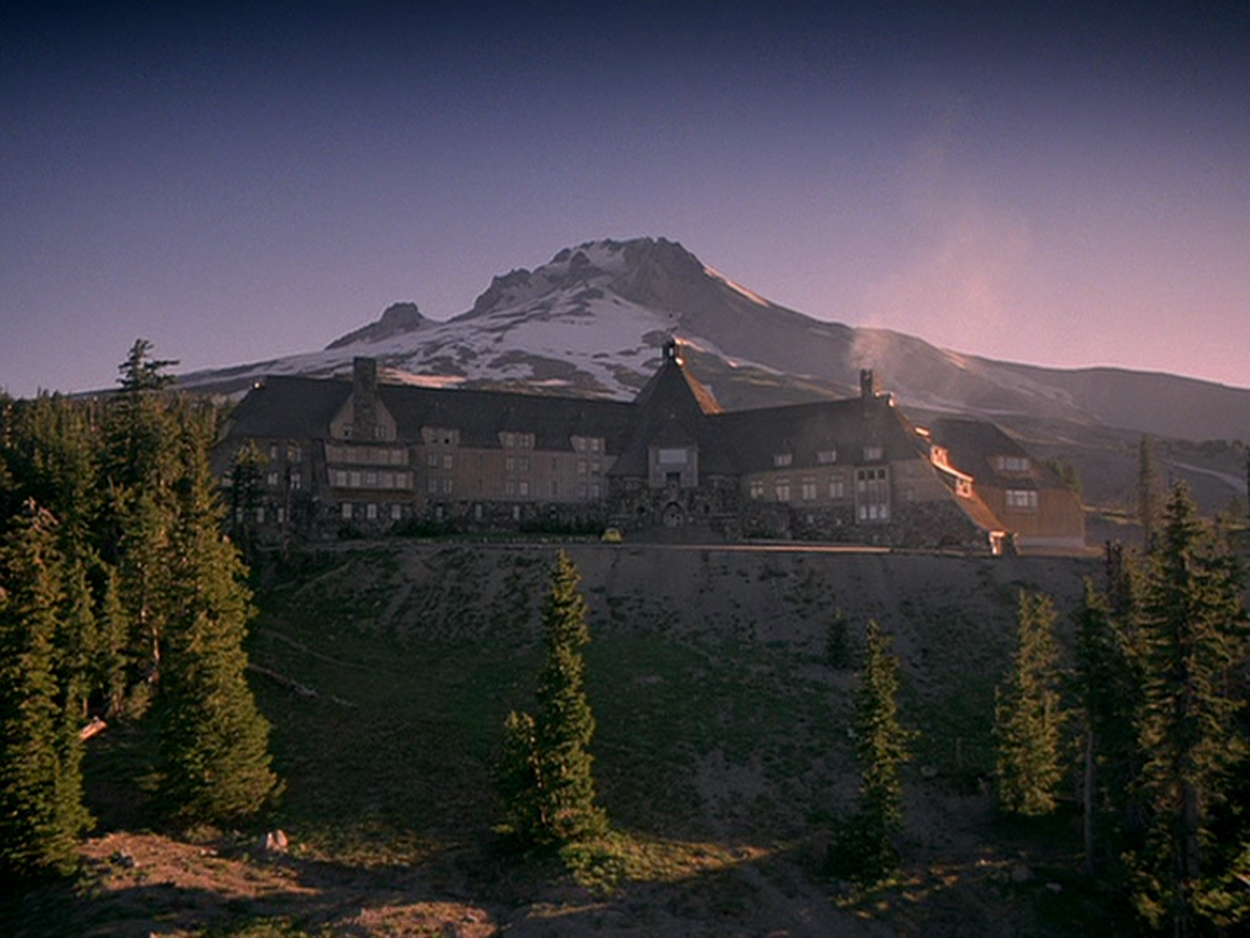
Screenwriter Johnson does not remember discussing The Magic Mountain with Kubrick, but said that, given “the implicit resemblance” between it and The Shining it probably did come up.Footnote 25 Unlike the shared writing of the film narrative from King's novel, however, Kubrick's ongoing construction of broader meanings was his alone. Construction begins on King's Overlook Hotel in 1907, the same year Mann's story begins and Kubrick, following Mann,Footnote 26 makes symbolic use of the number seven. There is also the striking resemblance in syllable, sound, and cadence in the names of Mann's protagonist Hans (Johannes = John, Jack) Castorp and King's Jack Torrance. The Shining opens with its protagonist's journey up to his mountaintop destination. Jack's old yellow Volkswagen (Hitler's “people's car”)—changed from King's red VW—is a déclassé version of the conveyance of Mann's Castorp, a marine engineer who arrives at the International Sanatorium Berghof in a fashionable yellow cabriolet. Because the Volkswagen was also known as the Beetle, or Bug, it recalls Kafka's story “The Metamorphosis” (1915) about a (Jewish) man alienated at work and at home who wakes up one morning as a “monstrous vermin” (ungeheures Ungeziefer),Footnote 27 living but not human, while simultaneously conveying the same subordinate status (Figure 1) that The Castle's K. occupies. Jack's ascent also engages Hans's experience of the impoverished alpine environment, the film's light blue titles scrolling up over cold blue skies and slate gray mountains. Mann uses blue in The Magic Mountain to signify the pallor of the tuberculosis patients at the Berghof, the lack of oxygen at altitude, transcendence, and death. In constructing his horror film, Kubrick drew from filmmaker Sergei Eisenstein's observation in “Color and Meaning” (1942) that in the theater blue was the color of villains, ghosts, and fiends. This accorded with Kubrick's customary use of blue to signify cold, cruel temporal power and authority. It was to these ends that Kubrick directed Jack's typewriter be painted blue after its initial appearance in the film as a symbol of Jack's growing subservience to the Overlook.Footnote 28
Overlook and Volkswagen.
So while King's novel calls to mind The Magic Mountain, Kubrick's film more generally refashions the horror genre along the lines of what Adorno in the modernist work of Mann and others identifies as pastiche, “the recourse . . . to dead styles and artistic languages of the past as vehicles for new works.”Footnote 29 Kubrick, like King, re-creates “Snow,” the crucial seventh chapter of the sixth section of Mann's novel. Castorp is caught in a blizzard, “a chaos of white darkness, a beast,” but he survives, newly committed to the conviction that for “the sake of goodness and love, man shall grant death no dominion over his thoughts.”Footnote 30 The Magic Mountain concerns psychological and moral growth (symbolized by the number seven), its sanatorium filled with people and just a few ghosts. Mann was offering qualified hope for recovery from the decline of European civilization into the death and destructiveness of the First World War. Both King and Kubrick—writing in the wake of an even more gruesome Second World War—emphasize entrapment, terror, and horror in a hotel vacant for the winter and peopled mostly by ghosts. Outside the Overlook (“Thursday”) Wendy and Danny Torrance play and laugh—Mann's “goodness and love”—in the falling snow. Then the scene cuts to a baleful Jack, a flaming fireplace; Overlook (“Saturday”) engulfed in snow; Jack grimly typing, fireplace filled with fire. All this recalls Castorp's vision during the blizzard of witches slaughtering children that is in line with Kubrick's allusions to Hansel and Gretel, Mann's references to Grimm fairy tales, and the youthful Castorp's death in the First World War. There is also a striking similarity between Mann's blizzard and one Kubrick representation of murderous entrapment. Castorp perceives in the “equilateral, equiangular hexagon” of each snowflake an “absolute symmetry and icy regularity” that is “anti-organic [and] hostile to life itself.” In the contemporary sections of Kubrick's labyrinthine hotel, the hallway carpets are composed of interlocked brown, orange, and red hexagons that suggest deadly isolation. The similarities between Mann and Kubrick on the geometry of snow continue to the very end of the film. In the penultimate shot, Jack is shown frozen to death in the hotel's labyrinth, a space of monstrous alienation, terror, and loss. This recalls the fear Hans has of being “covered beneath hexagonal symmetry . . . with eyes turned to glass, a snowy cap cocked to one side.”Footnote 31 And because Kubrick has transported King's ghost manifestations of 1945 to the interwar era, the last shot tracks toward a photograph on a hotel wall of Jack in a tuxedo at a ball on July 4, 1921. Here Jack, fully lodged in the dreadful history of the Overlook elite,Footnote 32 is frozen in time inside the hotel, his smiling omniscient gaze in the present, though, in full eye contact with the audience.
The film's claustrophobic compression of time at the Overlook from months to days to hours—and the distortions of time and space intrinsic to its dreamlike storytelling—also reflects the chronological structure of The Magic Mountain central to Mann's interest—shared with Hesse—in the relativity of time and space. Mann derived from Einstein's theory of relativity that human perception of time is dependent on one's experience in space.Footnote 33 So the novel is a space in which neither the characters nor the reader can determine any “real” passage of time. The Magic Mountain is a Bildungsroman, but one marked by modernist irony. Mann's final irony is that Hans leaves the timelessness of the mountain in 1914 to return to the “flatland” below only to find the mysteries of life and death mired in the mud of the trenches. The Magic Mountain foreshadowed even worse horrors to come. Leo Naptha, a parody of Hungarian philosopher György Lukàcs, reflects Mann's growing fear of radicalism and terrorism on the political left and right. Mynheer Peeperkorn, based on Gerhart Hauptmann, is a grotesque augury of Dionysian charismatic tyranny.Footnote 34 Mann had in the 1920s departed from prewar enthusiasm for Friedrich Nietzsche's celebration of Dionysian impulse. But he would introduce the truly demonic into the Dionysian only when he began writing Doctor Faustus (1947) in 1943. Kubrick was a Jewish child of the 1930s, and so The Shining is not about its protagonist being enlightened but about becoming enslaved by evil. At the Overlook time and space alternately contract and dilate as forebodings of deadly isolation and exposure, while intertitles chronicle the film's progressive compression of time. The act of shining itself erases the boundaries of time and space. Past and present are collapsed in the coincident interactions of the Torrance family with the Overlook's ghosts and in the ceaseless narrowing of Jack's concentration on murder. This compression and cohabitation represent history as doleful repetition and regression rather than potential progress, the fateful years in and around the film's narrative (1907/1970, 1921/1942) mirrors or multiples of each other. Thus, while Danny, like Hans, escapes the mountain, he has learned only of the ongoing evil in the world.
The only other Kubrick film that ends with direct eye contact is 2001, in which the Star Child gazes blankly out from the screen and into the audience's space. 2001 represents Nietzsche's conception of humanity's evolutionary ascent from ape to man to overman, the film beginning and ending to the Nietzschean Thus Spake Zarathustra (1896) by German composer Richard Strauss. Kubrick's affectless astronauts are Nietzsche's Apollonian men of cool logic and science who evolve into the overman, the Star Child, with intelligence freed by will, power, creativity, and Dionysian vitality from limits imposed by the past.Footnote 35 But Kubrick's century—and Mann's—was darker than Nietzsche's. The Jack who stares at us at the end of Kubrick's horror film—like thug Alex whose twisted stare back at the Star Child opens A Clockwork Orange—has been conditioned into enslavement of his instinct and intellect to murderous modern power. His grunting and howling in the hotel labyrinth represent descent back to the Earth's apes at the beginning of 2001, while his placement into the Overlook's violent past speaks of history as recurrence and not ascent. In this way the title of the previously diegetic song that closes The Shining, “Midnight, the Stars, and You” (1934)—performed, ironically, by a British vocalist killed in a nighttime German air raid on London in 1941Footnote 36—is a sardonic counterpoint to the conclusion of 2001. Even 2001 bears traces of the material existential dread that resides in Schulz's The Street of Crocodiles, about a second Genesis and translated into English in 1963, whose own conclusion anticipates a dark reading of the final scene of Kubrick's 1968 film:
Sometimes [Father] put his head in the chimney shaft . . . cozy as in the very center of nothingness. . . . [H]e opened the door of the flue and looked grinning into its dark abyss, where a smiling homunculus slept forever in its luminous sleep, bathed in fluorescent light, already adjudged, erased, filed away, another record card in the immense archives of the sky.Footnote 37
Contrast those three trapped, lonely stares with the ending to Eyes Wide Shut (1999), based on Schnitzler's Dream Story. Here Kubrick allows himself rare recourse to conventional over-the-shoulder shot/reverse-shots in the concluding conversation between Bill and Alice so as to highlight the domesticity they share in their relationship with each other.Footnote 38 Though even here, with the last word in his last film—“Fuck”—Kubrick underlines the uncanny material reality that mates sex with death: only an organism that dies—Schulz's “transit station . . . within the lap of eternal matter”—needs to reproduce.
Mitteleuropa, Movies, and Murder
The Shining not only draws widely and deeply from central European culture and history, but it concerns central Europe itself as a subject matter, as a specific space at a specific time. Among the competing definitions of “central Europe,” Kubrick is interested in the effects of that associated powerfully, problematically, and in the end horrifically with Germany. In the late nineteenth century, the new German Empire saw Mitteleuropa as an area over which Germany should exercise economic and political dominion. In the twentieth century, this hegemonic vision was expanded and radicalized by the Nazis into racist imperial Neuordnung and Lebensraum in both central and eastern Europe.Footnote 39 In this way, not only did people move—or were moved—across national borders, the political and cultural borders of central Europe itself moved across and around the populations of central and eastern Europe. This had of course been true in the past. For example, Kubrick's family had emigrated from Austrian Galicia, but the family name Kubrik had its origins in Ukrainian and Polish. Therefore, reference in The Shining to twentieth-century central European artists and scholars—most of them German and half of them Jewish—includes for a knowledgeable and attentive audience not only the works but the fateful lives that influenced Kubrick's selection and treatment. Mann was not Jewish but would move to Switzerland in 1933 with the help of Hesse, who was a Swiss citizen; in 1939, he went to the United States. (Mann indulged in some literary antisemitism, though in The Magic Mountain he describes how Jewish Jesuit Naphta's father died horribly in a pogrom in Poland.) Freud left Vienna in 1938, the Nazis forcing his largely Jewish psychoanalytic movement out of Germany and Austria to new centers in London and New York. The Jewish Bettelheim, imprisoned in Dachau and Buchenwald, emigrated from Austria in 1939 to the United States; Horney had left Germany in 1932. Zweig fled Vienna in 1934, and he and his wife committed suicide in Brazil in 1942. Zweig's last work, Chess Novella (1942), was a Kubrick favorite, using Kubrick's favorite game as metaphor for the struggle against Hitler and the Gestapo.Footnote 40 The Jewish Schulz was murdered by the Nazis in 1942 in his hometown of Drohobycz in eastern Galicia, which in August 1941 had become Distrikt Galizien in the German Generalgouvernement für die besetzten polnischen Gebiete.
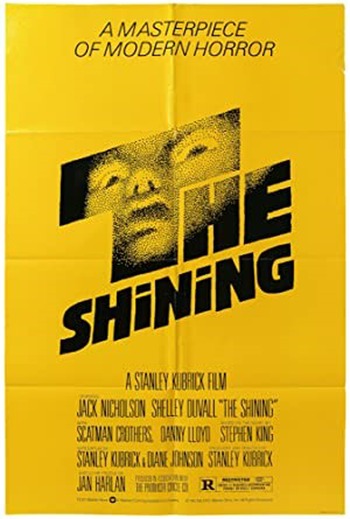
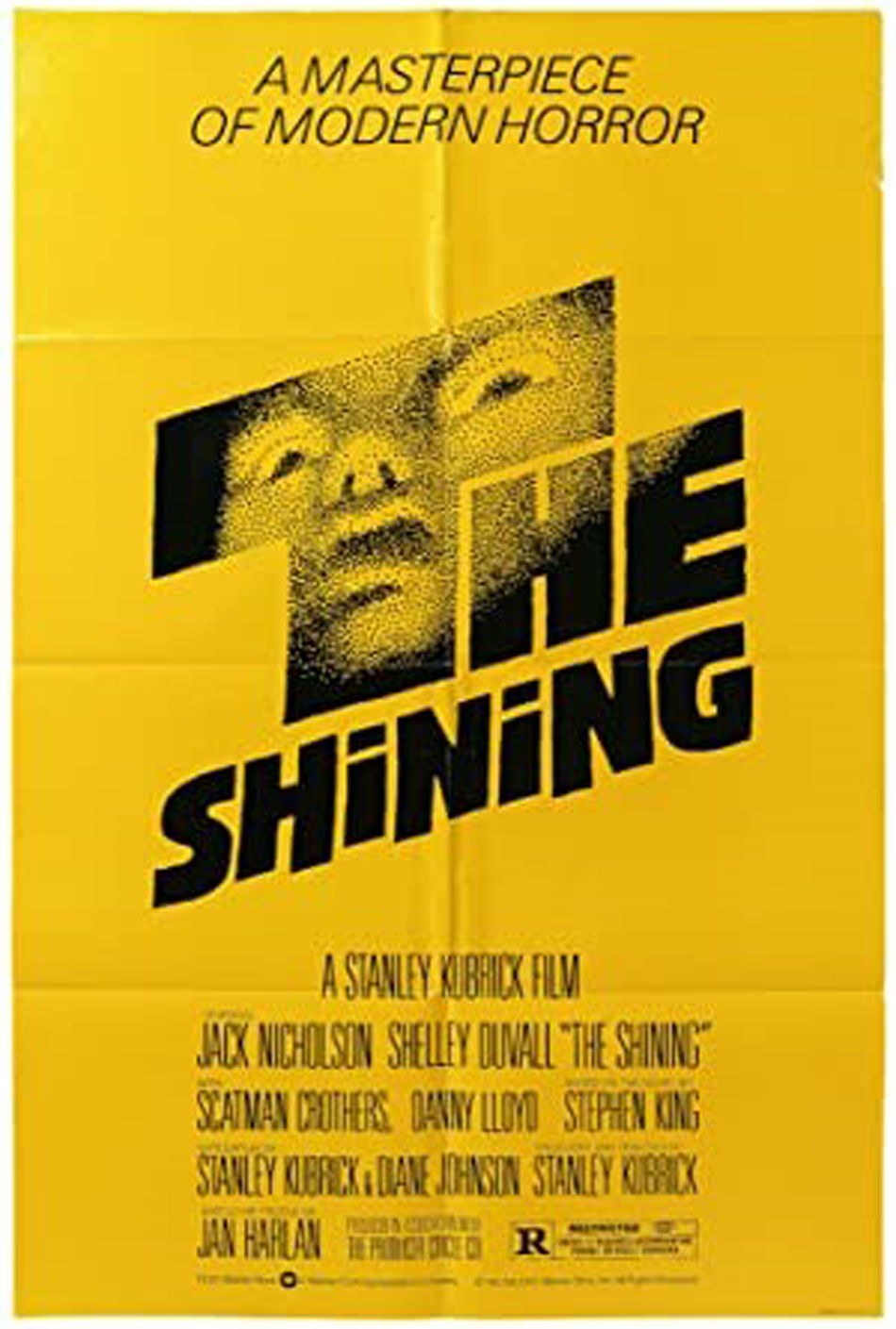
This historical background joins with The Shining's genre, its retelling of Mann, and recurrent patterns—sustained by Kubrick's habitual deep focus and long takes—of visual and aural symbolization through quotidian objects to create subtextual discourse on the Holocaust.Footnote 41 Most pervasive and significant in The Shining are, as we shall see, repeated allusions to the Nazi killing apparatus: trains, typewriters, gas chambers, crematoria, and—à la Kafka's “The Penal Colony” (1919)—the marking of doomed Jews with yellow, the dominant color in the film. Apropos of the genre and also following The Magic Mountain, yellowish hues inside the Overlook suggest decay and death. Abrams argues that yellow is part of Kubrick's self-reflexive portrait of Jack as Jewish.Footnote 42 This allegory goes beyond the autobiographical to the historical. Eisenstein, born of Jewish ancestry in Riga, Latvia, focuses on yellow evolving into a sign of treachery and ignominy associated with Jews, citing Goethe's Theory of Colors (1810) on sunny yellow becoming foul when applied to cloth.Footnote 43 Thus The Shining's original poster (Figure 2) was black on a bilious yellow (changed by Kubrick from the designer's bright red),Footnote 44 just like Nazi cloth markings on Jews. Jack's enlistment as murderer is “legalized” when Delbert Grady spills a yellow drink on him in the Gold Room, saying “I'm afraid it's Advocaat [Dutch for “lawyer”], sir. It tends to stain.” As with Kubrick's change of King's red VW to yellow, this represents a nightmarishly oneiric convergence of perpetrator and victim. This one is doubled because Jack in turn marks Delbert's jacket with a yellowed hand.
Kubrick's Yellow Movie Poster.
Such indirection mitigated Kubrick's strong reservations (expressed in Jack's severe case of writer's block) as artist, individual, and Jew about putting the Holocaust on film. Kubrick was also thereby employing Bertolt Brecht's “alienation effect.” Brecht, a German communist playwright and poet who too fled Nazi Germany in 1933 with Hesse's assistance, used this device to break the surface and spell of performance so as to prompt audience thought and reflection in and about the real world. This strategy fitted well with Kubrick's postmodern style of indirection, which in a much less—and certainly different—politically ideological way sought to have viewers consider things as they are for themselves. Moreover, indirection in The Shining allowed Kubrick to avoid the danger of trivialization ensuing from direct discourse on the Holocaust in a horror film. At the same time, indirection on this subject in a horror film was particularly well suited to the evaluative parody of genre that all Kubrick films have in common. The real horrors of history buried here lay bare the cheap thrills that are the formal and commercial aim of scary movies. This historical perspective also unmasks the very foundation of horror as entertainment in the human capacity for violence and destruction.
Once Kubrick mated the horror genre with numerous and specific twentieth-century central European sources the creative logic and momentum of his conscious, subconscious, and unconscious feelings and intentions could not help but over time develop the historical subtext that resides in The Shining. As a result, there is in the film convincing consistency in patterns of reference to the Holocaust that is also in line with Freud's insight that dreams—and nightmares—are filled with meaningful contradiction and obscurity. Audiences then bring their own shared experiences and perceptions to the film that aid in finding what is already there as a result of the filmmaker's working through of his own established and evolving perceptions and purposes regarding a recent event of besetting cultural cognizance. Dominick LaCapra argues that such analytical “working through”—as opposed to repetitive and unreflective “acting out”—is central to meaningful artistic portrayals of the social trauma of the Holocaust.Footnote 45 For example, some viewers have seen the young Grady sisters as Mengele twins. Kubrick, in contrast to King, features them, perhaps prompted by the memory of a photograph he took for Look magazine in 1948 of two similarly posed girls rescued from carbon monoxide poisoning.Footnote 46 Given the film's dreamlike historical discourse, Kubrick creates around them a mise en scène that can be read as an allusion to Auschwitz. The girls, played by twins wearing identical light blue dresses, are hacked to death in a claustrophobic hallway featuring a dark blue runner and painted (or lit) pale yellow woodwork enclosing old-fashioned blue floral wallpaper—blue again the color of coldness, darkness, death, villains, ghosts, and fiends. This murderous thread is picked up in the dark blue runner, light blue painted walls, and pale yellow woodwork of an adjoining hallway where hotel manager Ullman breezily calls “Goodbye, girls!” to two employees leaving for the winter. Germane to this is that the hydrogen cyanide pesticide (“prussic acid”)Footnote 47 used in Nazi gas chambers was derived from the pigment known as Prussian blue—the shade, consistent with Kubrick's habit of thematic self-reference—identical to the dark blue Prussian uniforms from the Seven Years War in Barry Lyndon (1975).
Kubrick's first confrontation with the reality of Nazi extermination of the Jews of Europe had come during his adolescence. Even before that time, however, Kubrick's childhood was surrounded by a rise in domestic as well as foreign antisemitism. The West Bronx Jewish community where the Kubrick family lived was one of those whose consciousness of anti-Jewish feeling—and, increasingly, action—was heightened during the first decade of Stanley's life. There had already been resurgence in early twentieth-century America of longstanding nativism and racism. In the 1930s, New York City became a center of pro-fascist and pro-Nazi sentiment. In the Bronx, Jewish businesses were picketed. Kubrick himself spent a great deal of time at the movies, principally at Loew's Paradise Theater or the RKO Fordham. By the end of the decade, in addition to newsreel coverage of fascist violence in Europe, there began to be movies about the Nazi threat to and in America. Confessions of a Nazi Spy (1939), directed by Ukrainian Jewish emigrant Anatole Litvak, showed at the RKO Fordham in July. After the outbreak of war in Europe that year and the Japanese attack on Pearl Harbor at the end of 1941, war films were increasingly common. The subject of the Nazi persecution of Jews was much less common both before and during the war, in part due to studios’ fear of American antisemitic backlash against alleged special pleading on behalf of Jews by “Jewish” Hollywood.Footnote 48 But the issue was a real one for many filmmakers and audiences. German emigrant William Dieterle's The Hunchback of Notre Dame (1939) fashions “Gypsies” in late medieval Paris to dramatize the plight of European Jews as refugees and victims of racial prejudice (“You come from an evil race,” says black-robed Frollo to Esmeralda). Many of the films Kubrick saw during the war were directed, written, and acted by emigrants from central Europe. German emigrant filmmakers were largely responsible for the dark film noir style in 1930s and 1940s Hollywood movies. Kubrick's first three films—Fear and Desire (1953), Killer's Kiss, and The Killing—are significant examples of the enduring influence of film noir across the Atlantic from its central European origins. Hitler of course occasioned the largest wave of intellectual and artistic transfer between Europe and North America beginning in the early 1930s. Many of these immigrants were Jews, and in the cinema their work gave greater expression to the realities of Nazi racism and antisemitism.
One example of this is a film that played at Loew's Paradise Theater in the West Bronx in July 1943, Five Graves to Cairo, directed by Billy Wilder, who would become one of Kubrick's favorite directors. Wilder was born in Sucha, western Galicia, in 1906 to German Jewish parents, who named their son Samuel. He left Germany for France in 1933 and went to America the next year. Five Graves to Cairo is notable for darkly elliptical references to the Holocaust that were the sort of indirect discourse that Kubrick often used, and especially for references to the Holocaust in The Shining. The film combined the cinematography of German Expressionism with the realism and social criticism of Neue Sachlichkeit from the late Weimar Republic. Erich von Stroheim's portrayal of Field Marshal Erwin Rommel, commander of the German Afrika Korps, recalls the actor's past portrayals of stiff-necked Prussian martinets. But Wilder uses Rommel as a means of indirect reference to Nazi antisemitism and the wartime extermination of the Jews. At one point a swaggering Rommel observes that there is no Moses to part the Red Sea for the British Eighth Army. In raging against a German officer's dalliance with a hotel maid, Rommel storms, in German: “Ist das die deutsche Reichswehr [sic] oder ist das eine Judenschule? Ganz gemeine Schwindelfälschungen. . . . In diesen Dingen kenne ich kein Mitleid.”Footnote 49 The use of German gives the words a certain savage power, even to a viewer—like Kubrick—who doesn't know German, particularly since “Juden” in “Judenschule” (synagogue) sounds similar to the English word and was often heard then in newsreels around the world. There is also haunting indirect reference to the Schutzstaffel (SS) extermination bureaucracy, which had been greatly expanded in the course of 1942 and 1943. This occurs when Rommel observes ominously in a discussion about concentration camps that “we can use paper in Germany, a great deal of paper.”
The Kubrick family in the Bronx would have been aware of Nazi mass murder in eastern Europe. Jews in New York City were socially, religiously, and culturally diverse: “Jews of German origin versus Ostjuden, and, among the latter, a somewhat attenuated split between Litvaks and Galitzianer.”Footnote 50 But while more recent Jewish immigrants on the Lower East Side of Manhattan (where two previous generations of Kubriks had lived) and in the Williamsburg section of Brooklyn were more likely to read the more extensive Yiddish press coverage of the Holocaust, “most Jewish-Americans” Matthew Baigell recalled “knew what was happening. I certainly knew in 1943, although I was barely ten years old.”Footnote 51 The Jewish Telegraphic Agency reported the mass shootings of Jews in Russia during the summer of 1941. In October the Jewish-owned New York Times—having generally been reluctant to print “Jewish-sounding bylines on its front page”Footnote 52—printed a story on page six titled “Slaying of Jews in Galicia Depicted.” On June 30, 1942, on an inside page, the paper for the first time used a seven-figure number on the subject: “1,000,000 Jews Slain by Nazis, Report Says”; the figure of 2 million appeared in articles in September, November, and December. In July 1942, the Times—again on page six—used the word “extermination” concerning Jews in eastern Galicia. Two years later, on October 14, 1944, a national magazine, Collier's, published Jan Karski's eyewitness account of exterminations at Bełżec in eastern Galicia under the title “Polish Death Camp.” Christiane Kubrick has said that Stanley knew of relatives who had died in the Holocaust.Footnote 53 Certainly the Kubrick household in the Bronx during the war years was a place of worry over a world beset by horrors that was both faraway and ever present.
Family was a central fact of Kubrick's life and career. His Austrian mother (née Sadie Gertrude Perveler) regularly took her first-born and only son to the movies, and his father introduced him to photography—Kubrick's first profession—and to chess. It was an uncle, Martin Perveler, who helped finance Kubrick's first feature film, Fear and Desire. From 1965 on, when Kubrick moved to England, he worked almost exclusively at home, surrounded by his wife and children. This is reflected in the only film made about Kubrick at work, daughter Vivian's short documentary Making The Shining (1980) in which Kubrick's parents, both of whom would die in 1985, are shown visiting the set. Vivian's film also documents her father's quarrelsome relationship with actress Shelley Duvall, likely due in part to feelings of oedipal guilt. The intersection of Kubrick's family life and consciousness of the Holocaust is evident in The Shining itself. It comes in the form of a film reference that connects the year the Nazis held the Wannsee Conference on January 20 to organize the Final SolutionFootnote 54 with one of Kubrick's movie-going years in the Bronx. When Wendy and Danny watch Summer of ’42 in the Colorado Lounge, a blizzard rages outside the large windows of this, Jack's “office.” Kubrick, following Mann's symbolic use of multiples of the number seven, renders 42—a numeral evident in several forms throughout The Shining (see Figure 6)—part of a chain of dark historical signifiers of destruction. There is in this as well grim caricature of 42 in Jewish Kabbalah numerology—which numerology Kubrick had incorporated into 2001 Footnote 55—wherein the 42-Letter Name of God represents the power of creation. The screenplay and novel (1971) of Summer of ’42 were by Herman Raucher, a Jewish New Yorker born, like Kubrick, in 1928. Raucher adapted for screen and page his vacation experience with a war widow in 1942. Herman's summer of 1942 was like Stanley's summer of 1942: warm and sweet but touched by death as Europe's Jews began dying by the millions due to one winter day that same year in Berlin. This was forty-three years after Kubrick's great-grandfather, tailor Hersh Kubrik, had immigrated to North America from Probużna (today Probizhna in Ukraine), thirty miles west of Buczacz in eastern Galicia. There were Kubriks living in towns and villages throughout eastern Galicia, a number of them east of Lwόw, which also included Brody, Podkamień, Michalowka, Zalacżce, Murawica, and Popowce. As of 1932, there were no Kubriks registered as members of the Jewish community in Probużna.Footnote 56 But the fate of Probużna's Jews a decade later is of course representative of the larger reality faced by all Jews in occupied Poland during the war. On Sunday, October 4, 1942, units of the SS Security Police, Gestapo, Reserve Police Battalion 133, as well as local gendarmes and police descended upon Probużna. Eight hundred Jews were driven into the market square and deported to the extermination camp at Bełżec and a labor camp at Lemberg-Janowska. Soon after, the remaining Jews in Probużna were sent five miles northwest to a new ghetto in Kopyczynce.Footnote 57
As a result of these early influences and experiences, Kubrick all his life maintained a special, scholarly, and fearful interest in German literature, German film, and German history. By the 1950s, he was collaborating on a screenplay about German soldiers at the end of the Second World War.Footnote 58 In 1970, he was apparently considering a film—possibly based on a work by Hans Hellmut Kirst, Rolf Hochhuth, Peter Weiss, or Günter Grass—that would “follow a group of characters from the time of Hitler's rise to power, through the period of the war, to the advent of Neo-Nazi-ism [sic] and present-day Germany.”Footnote 59 Soon thereafter, he decided that as a Jew he could not make a contemplated film about Hitler's architect, Albert Speer: “It's fascinating stuff. But, you know, the thing is—how can I do it when I'm Jewish? I would love to make it, but how can I as a Jew?”Footnote 60 Germany had also become personal for Kubrick when he married Susanne Christiane Harlan in 1958. Her uncle Veit was the notorious Nazi filmmaker who at Joseph Goebbels's behest directed Jud Süss (1940), the vile big-budget antisemitic melodrama that demonized Jews in the minds of tens of millions. Kubrick wanted to make a film about this artist's pact with the devil. But he never did, due not for the last time to ambivalence about his own desire and ability as an artist and a Jew to portray the evil of Nazism and the Holocaust. When he met Harlan, as he later characterized it, “I'm standing here like Woody Allen looking like ten Jews.”Footnote 61
Through Christiane's parents the interplay between art and Nazi evil was brought even closer to home. Christiane's father, Fritz Moritz Harlan (1901–1970), was a Kammersänger. In August 1942, he was, as he put it in 1948, “obliged” to join the Deutsches Theater in the German-occupied Netherlands, where he and wife Ingeborg lived in apartments they knew had been occupied by Jews. They originally moved into a small apartment at 51 Van der Aastraat in the wealthy Benoordenhout district northeast of The Hague city center. Its likely former occupant, Fanny Judith Henriëtte Oppenheim Josephus-Jitta, had been deported to Auschwitz the month before. The Harlans subsequently moved into a larger apartment on the Van der Bosstraat in the central Bezuidhenhout district.Footnote 62 In 1936, Fritz had prudently reported paramilitary service against the Poles after the First World War as his only political affiliation. That same year he joined the Nazi Party social welfare organization. On his 1947 denazification questionnaire, he declared he never became a member of the Nazi Party. However, party membership rolls list him enrolled as of January 1, 1942, having applied for admission to the party on November 6, 1941. On November 22, the Propaganda Ministry arranged Fritz's deferment—though he had been judged fully fit for duty—from military service. His deferment was extended on June 16, 1942, when he agreed to go to the Netherlands, Christiane has said, to avoid being drafted. In 1944, his letters sprinkled with the customary “Heil Hitler,” Fritz successfully petitioned to leave the failing Deutsches Theatre, after being reminded to leave the furnishings in their “Judenwohnung” for disposition by occupation authorities. By this time he and Ingeborg had been spending most of their time singing for German troops through the German Labor Front's Kraft durch Freude program. After returning to Germany, Fritz was drafted, captured by the French, and spent a year as a prisoner of war. He later won a job teaching music in Freiburg, again stating he had never been a Nazi Party member. By 1948, denazification was yielding to Cold War anticommunism and French and German authorities, with no mention of party membership, ruled Harlan “not affected by the law” concerning “political purification.”Footnote 63
Christiane and younger brother Jan (middle name Veit), who lived safe from air attacks in the German countryside,Footnote 64 spent holidays with their parents in The Hague. For Christiane, who in 1941 had to join the girls’ Hitler Youth, “I was the little girl who moved in where Anne Frank had been pushed out.” Stanley, of course, “took a great interest in my catastrophic family background. We spoke about it a great deal.”Footnote 65 Soon after their marriage, Kubrick began writing a treatment based on Christiane's experiences in The Hague during the war about a German girl in Amsterdam who in February–March 1943 is witness to Jewish suffering. Anna is ten years old, the same age as Christiane that winter, and has moved to the Netherlands from her boarding school in Germany.Footnote 66 The girl's name recalls both Christiane and murdered German Jew Anne Frank. And it resonates powerfully in the name of the Kubricks’ first child, German Jewish Anya, born in 1959.
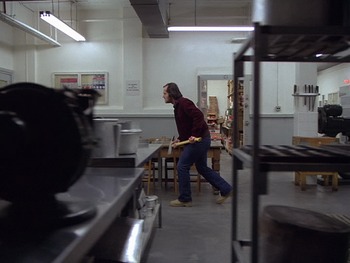
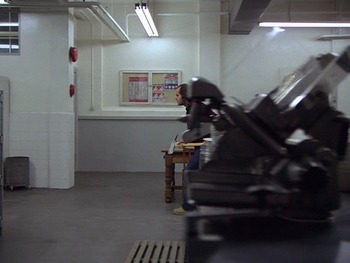
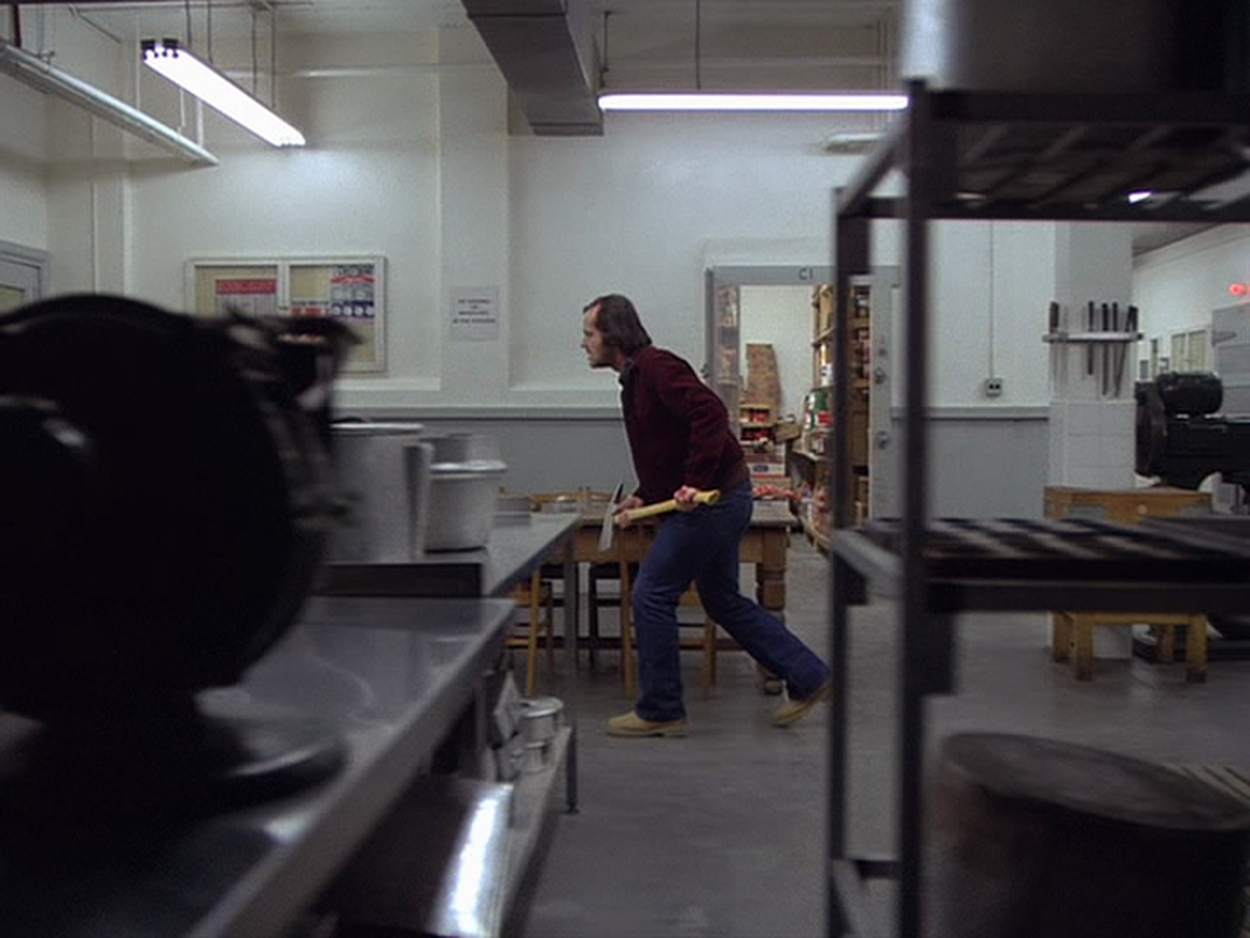
That in The Shining Kubrick's rampaging Jack injures and drags his right foot (Figure 3) reflects this family history, recalling not only Oedipus (“swollen foot” in Greek) and medieval demonization of Jews but also Mann's allegory of the rise of Hitler, Doctor Faustus. Mann devotes an entire chapter to “a scrawny man of less than average height” who teaches Christian demonology at the University of Halle. His name, Eberhard Schleppfuss (“Drag-foot”), suggests the Devil/Mephistopheles in the form of Nazi Propaganda Minister Goebbels, a small man who dragged his deformed right foot.Footnote 67 The identical Goebbels reference appears in Fritz Lang's The 1,000 Eyes of Dr. Mabuse (1960), the last in a series of thrillers Kubrick liked.Footnote 68 Kubrick's in-laws had made a Faustian bargain with Goebbels that resembles the demonic deal for artistic greatness made by Mann's Faustus as well as self-described “writer” Jack's own deal with the Devil. Jack, told that a former Overlook caretaker in 1970 slaughtered his family with an axe, is ordered by the hotel's ghosts to murder his family. The foot-dragging sequence of scenes that introduces the axe begins with a shot of Jack in the larder crawling past two large cans labelled HEINZ Fresh Pack Thick KOSHER DILL Pickle SLICES (Figure 4). The ominous, surrealistic, and even grotesquely comic juxtaposition of “KOSHER” and the German name “HEINZ” takes on even greater historical menace when—in an especially gruesome blurring of human and machine—a later scene foregrounds a large mechanical meat slicer in the kitchen that updates Jack's axe to genocidal industrial scale (Figure 5).
Jack as Schleppfuss.
Heinz Kosher Dill Slices.

Man and Machine.

In 1961, the trial of Adolf Eichmann in Israel for his leading role in the Nazi extermination of the Jews was televised worldwide. Kubrick, who confessed to sharing “the fairly widespread fascination with the horror of the Nazi period,”Footnote 69 became very familiar with scholarly literature on the Holocaust that included works by Bettelheim, Hannah Arendt, and Raul Hilberg. All of these works heavily influenced Dr. Strangelove in its blackly comic “grappling with the issue of mass death in the post-Holocaust era.”Footnote 70 In his planning for the film, Kubrick adopted the perspective of Arendt and Hilberg in their criticism of Jews for alleged passivity in the face of Nazi persecution:
WALT DISNEY SHOT OF LEMMINGS
JUMPING OFF CLIFF BY TENS OF THOUSANDS
6,000,000 JEWS TO GAS
6 millions [sic] Jews cooperated in their destruction.
400–600 millions—USA Europe Russia—do the same thing.Footnote 71
Arendt, a Jewish refugee from Nazi Germany in 1933, also controversially characterized Eichmann as representative of the soulless “banality of evil” of obedient SS bureaucrats within the machinery of Nazi mass murder. Hilberg, born in Vienna to a family of Jews from Poland and Romania, fled Austria in 1939. In 1961, he published The Destruction of the European Jews (paperback 1967), a meticulous history of the operation of the Final Solution. In 1975, Kubrick had Jan Harlan read Hilberg's book and sent him to ask Isaac Bashevis Singer, the Polish American writer in Yiddish on Poland's prewar Jewish communities, to help write a Holocaust screenplay. Singer declined. Following the release of The Shining, Kubrick approached Hilberg himself on more than one occasion seeking suggestions for a book on which to base a film about the subject. By the early 1980s, he was sending copies of Hilberg's book to people, including Michael Herr and Harold Pinter.Footnote 72
This brooding over history fitted the apprehensively iconoclastic culture of the 1970s, as in Gravity's Rainbow (1973), a dark comic novel erected around the Nazi V-2 rocket program by Thomas Pynchon, an American writer Kubrick admired.Footnote 73 At this time there was as well a “Hitler wave” in the United States and United Kingdom of popular and scholarly interest in Nazi Germany and the Holocaust. In choosing King's story, Kubrick himself tapped into a contemporaneous trend of Holocaust fiction and film set in hotels, such as Aharon Appelfeld's Badenheim 1939 (1978). There were even horror films that—as part of a postmodern pastiche retake of early postwar cinematic struggles with the subjectFootnote 74—addressed the Holocaust. Kubrick admired Holocaust survivor Roman Polanski's Rosemary's Baby (1968), which anticipated films by other Jewish directors on familial demonic possession such as The Exorcist (1973) and The Omen (1976)—both referenced in The Shining—films that evoked the banality of Nazi evil. Kubrick portrays Jack in this way through his obsessive typing of the proverb, “All work and no play makes Jack a dull boy.” Genre and performance add the element of passionate and disfiguring hatred later documented among Nazi perpetrators.Footnote 75 But Kubrick's much more historically intentional film mostly dispenses with the subject of supernatural intervention. Instead, by constructing a systematic discourse on the Holocaust and not just reflecting its elements, it addresses the grotesque world of human mind and murder whose dead as ghosts inhabit the supernatural. In this, Kubrick followed Alfred Hitchcock's Psycho (1960)—which has its own indelible echoes of the HolocaustFootnote 76—in presenting horror as a product of the natural world and not of a supernatural one. In The Shining, death pervades life, ghosts are of flesh and blood and bone, and the propinquities of human and machine serve as metaphor for modern mechanized mass murder. The extradiegetic music in The Shining too is chillingly attuned to the film's indirect cinematic discourse on the Holocaust. The film opens with the Dies irae, a Gregorian chant about the Last Judgment whose first line reads: “The day of wrath/which will reduce the world to ashes.” This opening recalls Carl Theodor Dreyer's Day of Wrath (1943), a wartime Danish film about seventeenth-century religious persecution of witches that opens with a ferocious orchestral rendering of the Dies irae and has been read as an allegory of the Nazi occupation of Denmark. Kubrick opts for an electronic rendering of the Dies irae from Hector Berlioz's “Dream of a Witches Sabbath” (Symphonie fantastique, 1830). From 1968 on, Kubrick almost exclusively used preexisting music in his films to provoke contemplation in the audience rather than just emotional engagement. As in 2001, A Clockwork Orange, Barry Lyndon, and Eyes Wide Shut—each also featuring music from central Europe—such pieces in The Shining lend thematic, philosophical, and historical authenticity and depth to the film narrative. Choosing found music also allowed Kubrick to have unmediated control over the sampling and selection of works. Those for The Shining not only were appropriate in mood and texture for the horror genre, but they carried with them substantive elements of central European culture and history in the twentieth century, a century in which Kubrick lived his entire life. As such, they also echo Adorno's insistence that modern music—while functioning in accord with its own elements and parameters—had the task of reflecting the real conditions of the society in which it is conceived. Adorno argued that Arnold Schoenberg's atonal music of the 1920s alone expressed the reality of a bourgeois society driven by alienation and corruption. Beyond this, Adorno's “negative eschatology,” based on a combination of critical theory and Jewish gnosticism, posited that the issue for humanity in the twentieth century is not the promise of a better world but recognition of a present, “enlightened” world defined by Auschwitz. Kubrick certainly shared the Germanocentric pessimism of Adorno, a German Jew forced into exile in 1933. In 1947, Adorno, Mann, and German Jewish emigrant Schoenberg had all published works using music to portray “the process by which culture had collapsed into barbarism.”Footnote 77
It is exclusively music from central Europe—and its twentieth-century agony—that accompanies the story itself of The Shining. The foreboding early scenes at the Overlook Hotel are dominated by the “night music” movement from a single composition, Hungarian Béla Bartόk's ghostly Music for Strings, Percussion and Celesta (1936). Although the subject of the Adagio is the sounds of the countryside at night, Kubrick certainly chose it for the quietly eerie effects that breathe mystery and whisper menace. Bartόk was an anti-Nazi who refused to perform in Germany after Hitler came to power and fled to the United States in 1940. Reprising the juxtaposition of Beethoven's Ninth Symphony with Nazi propaganda films in A Clockwork Orange, Kubrick selected a 1966 German recording of Bartόk by the Berlin Philharmonic under Herbert von Karajan, who as a rising young Austrian conductor in the 1930s joined the Nazi Party. The same historical and aesthetic tension earlier attends the novel by Seidel, whose romanticizing of motherhood, race, and heredity made her popular with the Nazis.Footnote 78 Kubrick also makes atmospheric use of György Ligeti's micropolyphonic composition Lontano (1967), in which Ligeti, born in Hungary in 1923 and after 1945 a composer in the “catastrophe style,” apparently employs “the timbres of air-raid sirens.”Footnote 79 In 1944, the Jewish Ligeti was sent to a forced labor camp, his brother to Mauthausen, and his parents to Auschwitz.Footnote 80
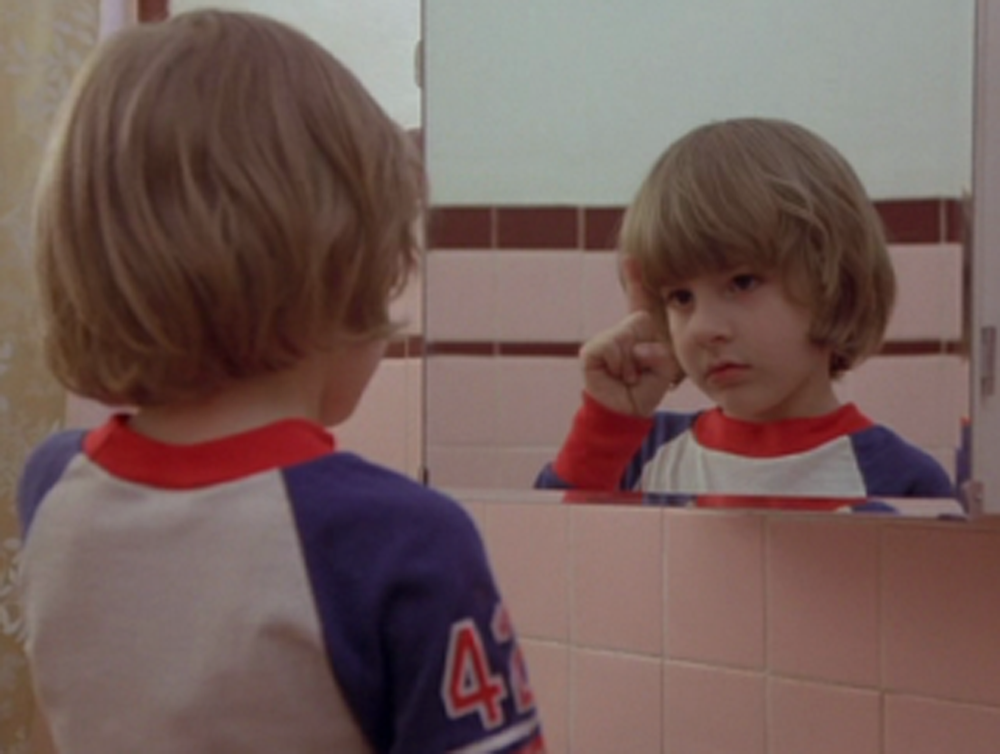
Most of the film's music is by a single composer and dominates the second half of the film when the horrors of the Overlook are manifested. Kubrick excerpts six compositions by Polish composer Krzysztof Penderecki, whom he had asked to compose music for The Shining.Footnote 81 Kubrick's use of Penderecki's avant-garde electronic and acoustic music in such an indirect discourse on the Holocaust arguably meets Adorno's standard for post-Auschwitz artistic expression. The Catholic Penderecki was born in Dębica in western Galicia. As a child, he had witnessed the destruction of the Jewish ghetto in Dębica, an experience that deeply influenced his life and art. Kubrick makes forbidding use of several Penderecki compositions from Christian liturgy. The Awakening of Jacob (1974) recounts the dream of Jacob from the Old Testament in which he experiences the horror, dread, and uncanniness of confrontation with the fearsome powers of life and death invested in the divine. It accompanies Danny's first vision of the Overlook elevator disgorging an ocean of blood (Figures 6 and 7)—at Auschwitz-Birkenau, Hilberg details, elevators carried bodies up from gas chambers to crematoriaFootnote 82—as well as Jack's dream of murdering his family.
Danny Shining.
The Overlook Elevator.

“The horror! The horror!”
In King's novel Jack's discovery of a scrapbook—glimpsed in the film—becomes the basis for his projected novel. The clippings constitute a chronicle of American greed, power, and violence. Although King focuses on the corruptions of such individuals in the Overlook's past, Kubrick symbolically as well as narratively expresses the sufferings of victim groups—Native Americans, Africans, and women—at the hands of white male imperial elites. Johnson says that she and Kubrick planned references to the massacre of Native Americans and “violence in American history: Western frontier elements, photographs of railroads,” and so forth; Kubrick's Overlook represents a European colonial outpost built, unlike King's, on “an Indian burial ground,” the other source for the blood flowing from the hotel elevator.Footnote 83 Like Kubrick's first film, Fear and Desire, The Shining courses from Joseph Conrad's Heart of Darkness (1902), a novella about European atrocities (“The horror! The horror!”) in the Belgian Congo. The opening shot and title sequence were influenced by the journey upriver in Apocalypse Now (1979), Francis Ford Coppola's Vietnam variation on Heart of Darkness. Conrad was born Jόzef Teodor Konrad Korzeniowski in 1857 in Berdychiv, Ukraine. As a Pole, Conrad like Kubrick admired German culture but feared Prussian militarism. That was one reason he gave the murderous head of the trading station in the Congo the German name Kurtz. Two years after the publication of Heart of Darkness, in 1904, German colonial troops exterminated 80 percent of the Herero and Nama peoples in German Southwest Africa.Footnote 84 This horror was largely overlooked in the West until 1963, when Thomas Pynchon highlighted it in his novel V. Ten years later, Pynchon reprised these same African victims of German genocide in Gravity's Rainbow. In between, Kubrick—certainly making the historical connection—had desert location photography for 2001 shot in Namibia, the former German Southwest Africa then part of apartheid South Africa.
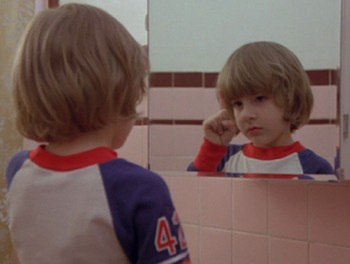
The Shining, bridging historical time and space, early on links the same horrors of imperialism in North America with the horrors of Nazism. The latter especially resemble in their allusiveness the deeply buried allegory of the Holocaust in German emigrant Lang's 1952 Western melodrama, Rancho Notorious.Footnote 85 For Lang and for Kubrick, the story set in the West—more distant in time and closer in space—comprises the manifest content of a dream that the dreamer experiences but which is made up of latent unconscious feelings and thoughts. Although visual references to Native Americans in The Shining are conspicuous, the Holocaust is latent content—closer in time and more distant in space—requiring greater effort to see and to analyze. Kubrick, in one more instance of ominous juxtaposition of animal and machine, establishes this linkage through imagery of the trains that had spread European settlers and migrants west and—with the implementation of the Final Solution in 1942—transported European Jews east.Footnote 86 The film's opening sequence at the Torrance apartment in Boulder is built around Danny's first “shining” and the “42” on his Bugs Bunny jersey (Figure 6). The sounds of a steam locomotive from a television of the Road Runner cartoon “Stop! Look! And Hasten!” (1954) signal a Kafkaesque composition of nightmare, comic violence, and dual historical reference set in the American Southwest. The unseen segment ends with Wile E. Coyote—in the path of the train emerging from a mountain railroad tunnel—holding a sign that reads: STOP IN THE NAME OF HUMANITY. Soon after, a scene on the television from 1939 Hungarian emigrant Andre de Toth's Western, Carson City (1952), shows two men discussing the tunneling of a railroad track through a mountain in Nevada.Footnote 87 Late in this associative sequence, there appears a painting of a horse galloping down a railroad track at twilight toward a long oncoming train pulled by a steam locomotive.
The Boulder sequence ends with several shots of Wendy holding a cigarette upon which teeters a distractingly long ash while behind her in the kitchen—out of focus—is a gas stove. Kubrick similarly evokes the witch's oven in Hansel and Gretel and the murdered Grady sisters by means of four shadowy glimpses of After the Bath (Paul Peel, 1890), a painting of two naked little girls warming themselves before a large fireplace.Footnote 88 The opening historical discourse intensifies early on at the Overlook. The horrific booming heard during the close-up and pull back from Jack's German typewriter is the sound of Jack throwing a yellow tennis ball violently against a wall decorated with reproductions of Navajo sand paintings. The Adler typewriter (Figure 8)—smoking ashtray alongside and yellowish paper in the machine—recalls Nazi state power and the machine-like SS bureaucracy of Schreibtischtäter detailed by Hilberg.Footnote 89 All this is prefigured in the morning scene previous when the eagle on Jack's T-shirt is juxtaposed with an insectile figuration on the bed's headboard that both suggests Kafka's “The Metamorphosis” and anticipates the human forms in the sand paintings. A lap dissolve slowly fades Jack and the figuration into the typewriter and its eagle logo while Jack's playful parody of scary horror movie music gives way to the booming.
Jack's Typewriter.

The Holocaust subtext constitutes a third dimension of the film's autobiographical portrait of Danny as both oedipal child and American child: Kubrick as a Jewish child of the 1930s confronting the angry, dangerous world of Nazism, antisemitism, and mass extermination in central Europe. Danny, like Stanley, suspects—to paraphrase Mann's “Disorder and Early Sorrow” (1925)—that beneath the happy chatter of family life something is dreadfully wrong somewhere. In line with the film's concern with relativity of time and space, moreover, Danny's visions of past and future horrors at the Overlook reproduce the traumatic time discontinuities experienced by survivors of the Holocaust.Footnote 90 Geographically telling in this regard are fourteen sequential shots of Wendy (oedipally) centering the signature on Danny's baseball bat, which in the manner of a nightmarishly fragmented Freudian dreamscape is that of Polish American baseball star Carl Yastrzemski. And just as historically telling, in the initial tracking shot toward Danny just before his first vision of the bloody elevator. conspicuous on his bedroom door is a cheerful Dopey from Snow White and the Seven Dwarfs (1937) but robed in Eisenstein/Hilberg/Kubrick yellow, not Disney's green. Following Danny's shining—and more glimpses of 42—yellow prewar Dopey is gone from the door. Like Kubrick, Danny has lost his childhood innocence, when his double in the mirror shows him the terrifying adult face of family and history that is the Overlook Hotel.
The motif of a Jewish child in deadly danger—it is Danny's face on the original yellow poster—preoccupied Kubrick, but was a subject too fraught personally as well as artistically for him ever to address directly. Kubrick's reluctance to confront extermination itself is evident in the properties he considered, all of which involve Jewish children threatened by the Nazis who nevertheless survive, albeit at the cost of childhood. A decade earlier, he had been interested in filming Polish Jew Jerzy Kosinski's novel The Painted Bird (1965), the phantasmagoric tale—based partly on the experiences of Roman Polanski—of a young boy homeless and alone somewhere in Nazi-occupied central Europe. Much later, Kubrick wrote the draft of a screenplay, “Aryan Papers,” from Wartime Lies (1991), a semi-autobiographical novel by Louis Begley—born Ludwig Begleiter and also from eastern Galicia—about a young Jewish boy in Poland hidden as a Catholic. Kubrick assembled a huge library of books on the Holocaust and had extensive production and location work done in the South Moravian city of Brno. But he was overwhelmed by work on multiple projects and ever more depressed by the subject.Footnote 91
In fairy tales, Bettelheim observes, children emerge safe and victorious into adulthood. In The Shining, Danny does as well, riding away in oedipal triumph with his mother. But while King's Overlook burns down, Kubrick's Overlook, Mann's howling chaos of freezing white darkness, remains. This represents—as noted, at some considerable personal as well as artistic remove—the most awful twentieth-century world of violence, hatred, and horror during which Kubrick himself grew toward adulthood.
Acknowledgments
For their assistance, I am grateful to Jennifer Bass, William Blakemore, Diane Johnson, Pat Kirkham, Thomas Kohut, Peter Loewenberg, Catriona McAvoy, Gordon Stainforth, Jeremii Szaniawski, Filippo Ulivieri, and to the readers of the submitted manuscript.