On 15 October 1955, Mao Zedong informed a group of Japanese visitors in Beijing that they could finally stop apologizing for their country's past aggression against China. “There is no point in calling you guys to account for past debts,” he told an unofficial delegation of leftist politicians and performers. “You have already apologized. You can't apologize every day now, can you? It isn't good for a nation to keep whining all the time. This is something we [Chinese] understand quite well.”Footnote 1 The startled recipients of Mao's unexpected admonition were in Beijing as part of a much larger cultural delegation from Japan. This delegation, headlined by world famous kabuki celebrity Ichikawa Ennosuke, was the first act of a two-part theatre exchange that would see Beijing opera (jingju 京劇) luminaries Mei Lanfang 梅蘭芳 and Ouyang Yuqian 歐陽予倩 perform in Japan the following year. The arrival of Ichikawa's 57-member troupe, whisked to Beijing just in time to celebrate National Day on 1 October, was intended to inaugurate “a new beginning for Sino-Japanese cultural exchanges.”Footnote 2
The timing was not a coincidence. Looming on the horizon were the long-awaited courtroom proceedings for 1,062 Japanese war criminals that the PRC authorities had been waiting nearly six years to bring to trial. Consisting originally of 969 prisoners apprehended by the Soviets in Siberia (but whose crimes were deemed to have been perpetrated on Chinese soil) as well as 140 postwar hangers-on who opted to join the Nationalists and Yan Xishan 閻錫山 in resisting the Communists instead of returning to Japan, these self-confessed war criminals were finally arraigned in June and July 1956 in two separate proceedings held in Shenyang 瀋陽 and Taiyuan 太原.Footnote 3 Yet the verdicts handed down by the special military tribunal (tebie junshi fating 特別軍事法庭) in charge of their fates appear baffling at first glance. Only 45 of the “most heinous offenders” were actually saddled with a formal suit of prosecution, and of these none was handed a life or death sentence. Prison sentences ranged from eight to 20 years (only four received the latter), yet, following a retroactive application for the 11 years that had already passed since the end of the war, most prisoners were free within a few years, and none later than 1964. A staggering 1,017 self-confessed Japanese war criminals were released without ever having set foot inside the courtroom. These numbers stand in stark contrast to the war crimes trials carried out by the Nationalist government in the immediate postwar period. Though often still seen as “lenient” when contrasted to Allied war crimes trials in Europe and Japan, the Nationalist trials resulted in 145 death sentences and more than 500 total convictions prior to 1949.Footnote 4
Previous treatments of the 1956 PRC war crimes trials have attempted to account for what can only be seen as an unprecedentedly lenient show of justice. German and Japanese scholars have led the way. Osawa Takeshi, taking advantage of recently available access to Zhou Enlai's diplomatic papers, emphasizes the geostrategic Cold War calculus that informed top PRC leaders as they sought to use these war criminals both as bargaining chips to ensure Japan's political neutrality in the aftermath of the American occupation and to encourage the early normalization of official ties between the two countries. Less ambitiously, Zhou hoped to create an amicable economic environment in which Sino-Japanese trade could flourish. These overarching geopolitical and economic factors merged with a longstanding Party faith in labour and thought-reform. Though such corporeally lenient platforms date their theoretical origins to CCP writings from as early as 1927, it was only with Mao's concrete application during the war against Japan that the full potential of “lenient” reform through thought and labour programmes was actually realized.Footnote 5
Petra Buchholz has examined the actual implementation of Zhou and Mao's platform of leniency during the early PRC in far more detail. By analysing a slew of “guilt narratives” that were published in Japan after the prisoners returned home, Buchholz concludes that the thought-reform programme carried out in the prisons in Fushun 撫順 and Taiyuan was a very real success. Like a Trojan horse, these newly converted pacifists and repentants returned home to Japan and promptly began to spread the word about a benevolent and progressive Chinese Communist government in Beijing. The intangible propaganda spoils of this humane treatment of the Japanese war criminals stand in marked contrast to the severe mistreatment of American POWS in North Korea, who became so resentful and embittered by their experiences that only a tiny percentage ultimately proved receptive to ideological remoulding efforts.Footnote 6 And indeed, there is little evidence of recidivism among the Japanese prisoners. Buchholz claims that “not a single prisoner revoked their confession or claimed that they had made it under duress,” and contemporary newspaper accounts appear to provide confirmation.Footnote 7
There is thus little doubt that a host of internationally motivated geostrategic and ideological concerns helped to shape the unprecedentedly generous war criminals policy that the PRC undertook in 1956. Up until now the extant scholarship on this issue has stressed the proactive agency exhibited by top PRC leaders as they managed an apparently polished campaign designed to enhance the political stature and progressive reputation of the PRC in the international arena. What remains to be examined more fully, however, are the domestic considerations that surely must have weighed just as heavily, if not more so, in the minds of Zhou and Mao. Emphasis on the apparent success of thought-reform and the improvement of relations with Japan during the Cold War obscures the great discordance of domestic opinion concerning the proper way to handle the Japanese war criminals. Japanese and German scholars have, in their revelations of popular dissatisfaction with the government's policy of leniency, moved far beyond the intellectually constricted agendas of scholars in the PRC, who have mostly confirmed and extolled the essential wisdom of the line adopted and advertised by PRC leaders.Footnote 8 Yet there is still an acute need to examine the concrete measures that Zhou adopted in his attempt to transform popular displeasure into support for government policies.
Approached from the perspective of domestic politics, the PRC policy of “leniency” turns out to be fraught with a great deal of uncertainty and tension. Consider the constrained position that the hardening of ideological Cold War camps in 1948–49 foisted upon the nascent PRC state. In the immediate aftermath of the Second World War, “victor's justice” was the order of the day, and, despite widespread dissatisfaction at the often arbitrary and uneven sentences meted out to captured Axis “perpetrators,” it was nevertheless quite common to see large numbers of convicted war criminals sent to the gallows, slapped with life sentences or otherwise deprived of civil liberties. In the so-called “Dachau trials” of 1945–48, for instance, in which 1,672 lower-level Nazi functionaries were prosecuted for war crimes – the exact counterparts of the 1,062 prisoners in PRC custody – nearly 85 per cent were convicted and imprisoned, and over 200 executions carried out. Yet by 1955, in preparation for the United States' alliance with a sovereign West German state, the vast majority of the Dachau convicts had been quietly released, and those not yet executed were granted parole.Footnote 9 There was clearly a time when war criminals could be dealt with harshly, and clearly a time when it had become a political liability to adhere to the original sentences.
With this in mind, Zhou Enlai's decision to adopt a policy of leniency towards the Japanese war criminals in PRC custody suddenly appears more multifaceted. For the major Cold War players enmeshed in geopolitical jockeying, harsh justice was out of the question by the early 1950s. After the Korean War, with the US military firmly entrenched along Chinese borders in a crescent arc from Japan to Taiwan to South-East Asia, and the PRC very much in need of allies and industrial material, Zhou would have been foolish not to have parlayed his Japanese prisoners into political and economic capital aimed squarely back at their suddenly and unexpectedly prosperous home country. After the conclusion of the Korean War in 1953, the Japanese war criminals quartered at Fushun and Taiyuan simply could not be tried in direct equivalence to the severity of their crimes. And yet, as the following examination of the newly declassified Japanese confessions themselves will show, their crimes were indeed monstrous almost beyond belief. Not only that, these stomach-churning crimes were all inflicted upon the oft glorified ideological constituents and military backbone of Chinese Communist legitimacy and power: north China peasants living in occupied territory during the war and Eighth Route Army soldiers.
The question that remains, then, is this. How could the PRC safely dispose of 1,062 prominent political liabilities without inciting a potentially destabilizing and internationally embarrassing backlash from its own citizenry? In order to answer this question, we must turn to the history of published confessions in the early PRC, the cultural exchange initiatives undertaken in the immediate run-up to the trials, and the press coverage of the trials themselves. Whatever constructive actions that penitent and “born again” Japanese may have undertaken to further PRC interests towards trade and normalization of ties after their return to Japan could never have been anything more than an unknown quantity while they remained in China. In the event, they provided an unexpectedly forceful and most welcome reinforcement for the burgeoning peace movement and leftist camp in Japan. Nevertheless, it is the contention of this study that it was more what happened in China during the process of getting rid of them that kept Zhou Enlai up at night.
Japanese Confessions and Early PRC Discourse on Japanese War Crimes
On 18 July 1950, the Soviet Union transferred custody of 969 Japanese prisoners to the PRC, thus fulfilling one of the stipulations of the Sino-Soviet Treaty of Friendship signed earlier the same year in Moscow. Zhou Enlai's initial reaction to his new charges fixated simultaneously on both the liabilities and opportunities that lay ahead. “We must make sure not a single one of them escapes, and not a single one of them dies,” he said. “Maybe in the future we can also consider the possibility of not killing any of them.”Footnote 10 In the meantime, just getting the prisoners settled into their cells in Fushun and Taiyuan was a sufficiently onerous task. The windows on the train carriages that transported them south from the Manchurian border had to be papered over so that curious onlookers would be unable to divine their identities. As Buchholz observes, “the policy of clemency was from the government, not the people,” and those overseeing the transfer had good reason to fear a public outcry at the sight of their former Japanese overlords enjoying the amenities of a first-class cabin experience.Footnote 11
Once safely settled in Fushun and Taiyuan, the prisoners quickly locked horns with their jailors, refusing to write confessions, insisting they were “prisoners of war,” and hatching several successful plots to incite riots among their cellmates. Their jailors were scarcely less combative, and the assignment of prison guard duty was considered a punishment. Within only a few months a whopping 89 per cent of the prison staff had lodged a request to be transferred to a less taxing work unit. The seemingly counterintuitive orders from on high to treat their former oppressors with lavish leniency were resented, and, when implemented, generated deep antipathy in well-informed nearby communities. A decade later these same reluctant prison warders were denounced during the Cultural Revolution as “Japanese spies” and ruthlessly struggled against for “exhibiting leniency towards the Japanese.”Footnote 12
With such a turbulent atmosphere inside the prisons, resentment was sure to be rife outside. Having been informed that the central government was determined not to hand down any death or life sentences and that less than 5 per cent of the prisoners would even be formally prosecuted, both lower-level Party officials and inhabitants across the formerly occupied territories of north China expressed their extreme dissatisfaction. Within the Party, several consultative groups organized by Zhou in late 1955 drafted documents recommending the handing out of death sentences. Eventually the representatives of lower Party organs were persuaded to compromise and agree to downgrade the harshest penalty from a death to a life sentence. Yet even this recommendation was unacceptable to Zhou, who continued to insist on “limited imprisonment” for only a small select group of heinous offenders. As for the general public, reports were sent back to Zhou in late 1955 by his own hastily assembled Sentencing Research Small Group (liangxing yanjiu xiaozu 量刑研究小組) indicating that the “righteous indignation of the people” (renmin de yifen 人民的義憤) was widespread, and that it might therefore be prudent to retain a certain number of life sentences within the final verdicts.
This resistance to central government orders, emphatically expressed on two fronts, prompted Zhou to instigate “explanatory work” (jieshi gongzuo 解釋工作) teams and public forums intended to bring both public opinion and Party sentiment in line with what was fast becoming an unyielding central directive.Footnote 13 Yet if the language of the indictments produced by actual victims during the trials the following year is any indication – they continued to insist on the death penalty with “intense resentment” – then Zhou's efforts were something less than a rousing success, at least among the public.Footnote 14 Party documents thus instructed central leadership to be attuned to the inevitable fact that “dealing with the war criminals [leniently] may upset some people, who will think that we are treating them too lightly. It may also embolden the reactionaries.”Footnote 15
In order to comprehend the so-called “righteous indignation of the people” (and Party), fully, it is essential to examine just what exactly these war criminals had confessed to. The original confessions, most of which were penned during 1954–55, were published for the first time in 2005.Footnote 16 This occurred during a particularly low point in Sino-Japanese relations, and the publication of first-hand admissions of guilt by Japanese prisoners was expected to embarrass conservative patrons of the Yasukuni Shrine. The confessions, none of which was repudiated upon its author's return to Japan, offer a glimpse into the popular resentment that seems to have circulated widely among the Chinese public a full decade after the end of the war. This is what Zhou Enlai was up against in his determination to navigate a minefield of 1,062 potent political liabilities that could neither be released en masse without some show of risky public accounting nor brought to harsh justice in accordance with the unconscionable severity of their crimes.
Iwaya Isamu, the former commander of a small garrison in Shanxi 山西 province, subjected two Eighth Route Army prisoners to fatal maulings. Four attack dogs were deliberately set upon the first prisoner. “After tearing open his pants, they sunk their teeth into his thighs and dragged his body around the premise.” As the canine incisors dug deeper, “chunks of flesh were ripped from his body and blood began to spurt everywhere.” Before long a pair of jaws locked on to the man's shoulders and pulled him violently to the ground. “Then [the dog] latched onto his throat, and after one or two jerks tore out [his trachea].”Footnote 17 Major Nagai Satoru confessed to rounding up a tatterdemalion throng of approximately 40 villagers under the heat of a flamethrower. After bludgeoning one young man to the point of unconsciousness, sanctioning the crushing of another old lady's skull with a rock and overseeing the fatal bayoneting of a teenage girl, Nagai “took the stick I was holding in my hand and shoved it up the vagina of one of the women.” He then selected two men and women at random and forced them to engage in intercourse, one of them doing so only after “I tore her child from her grasp and threw it to the ground.” Finally, Nagai told the men under his command that “anyone who wishes to rape these women may do so,” and he proceeded to lead by example.Footnote 18
Not all the confessions were written by military personnel. Yoshizawa Yukio, a Japanese surgeon, admitted to puncturing the windpipes of a live Chinese prisoner with tubes until the distracting crimson spray of ruptured blood vessels forced him to “discard” his subject with a swift scalpel thrust to the heart.Footnote 19 By far the most inhuman acts, however, were attested to by Arai Masayo, a former brigade leader. After raping a shackled female “plaything,” Arai confessed to “chopping her up with a kitchen knife and then slicing her into pieces, which, like fresh animal meat, were divided into several parts and distributed to the soldiers.” The soldiers, lately deprived of protein, “were happy to have meat distributed to them. Some of the small teams fried the meat with oil, some baked it with fire, but everyone ate it all up.”Footnote 20
If any act of violence can legitimately constitute a “crime against humanity,” then the horrors described in these confessions more than fit the bill. And yet for nearly 50 years after the Shenyang and Taiyuan trials, these chilling documents gathered dust in the inner recesses of the Number Two Historical Archives in Nanjing 南京, inaccessible to both Chinese and foreign researchers. It is not enough just to invoke vague “geostrategic interests” as sufficient explanation for why the PRC consistently chose to suppress public dialogue about inflammatory historical issues all the way up to the 1980s.Footnote 21 In fact, prior to the collection of the first stream of sobering confessions in mid-1954 and the discovery of widespread antipathy among the general public towards Zhou's policy of leniency in 1955, righteous exposés of Japanese war criminals and the US-led so-called “policy of leniency” towards them in Tokyo were the order of the day. Only when the decision had been taken to deal with the Japanese prisoners in the PRC in a fashion eerily reminiscent of American actions in occupied Japan did the sudden shift in PRC media discourse become evident.
An introduction to the early heady days of the PRC, in which seemingly every opportunity was taken to vilify both past Japanese aggression in China and contemporary American conspiracies in postwar Japan, is provided by a little-known Soviet trial of 12 Japanese war criminals held in December 1949 in the industrial Manchurian border town of Khabarovsk. Dismissed as “communist propaganda” and largely ignored outside the Soviet bloc, the trial was intended to illustrate the scope and methods of Japanese biological and chemical warfare programmes during the Second World War, thereby drawing attention to the many culpable leaders deceptively ensconced in Japan's postwar political scene under American countenance.Footnote 22 The Soviet newspaper Pravda accused the American occupation authorities in Japan of having placed into power “people who belong to the same camp as the war criminals now being tried in Khabarovsk.”Footnote 23 Most provocatively, the Khabarovsk trial directly linked Emperor Hirohito to Japanese biological warfare programmes, calling for his arraignment as a war criminal – something the US-led Tokyo War Crimes trials had pointedly shied away from.
It is of less interest that the Soviet press made such a big deal of the Khabarovsk trial than that the PRC press also enthusiastically jumped on board. The full indictment of the 12 defendants was immediately translated in the People's Daily (Renmin ribao 人民日報), and the motion to try Hirohito as a war criminal was featured prominently in numerous headlines. Though a handful of horrible confessions were highlighted in these reports, the most inflammatory material came out with the November 1950 publication of a 583-page abridged Chinese translation of the transcript for the entire Khabarovsk trial.Footnote 24 For the first time the Chinese public had access to detailed first-person descriptions of human frostbite experiments, intentional infection with plague fleas, and the lethally laced melons that were given to Chinese prisoners. Yet PRC censors did not simply settle for mechanical translations from the Russian-language originals. Two books published in the aftermath of the Khabarovsk trial, with excerpts from Materials on the Trial interspersed with additional Chinese commentary and testaments, show just how few qualms PRC authorities had regarding the lusty exposé of Japanese atrocities.
A Just Trial: An Account of the Soviet Interrogation of Japanese Germ Warfare Criminals, published in March 1950, provided a compact summary of the trial and subsequent Chinese media commentary. Li Kenong 李克農, assistant director of the Foreign Affairs Bureau, described the Japanese emperor unsparingly as a war criminal who had committed “the most heinous, utterly despicable, and treacherous murder of humankind.” Journalist Xiao Fan 蕭凡 supplemented the Japanese confessions with his own eyewitness accounts from the war, concluding on a shrill note: “These thuggish Japanese war criminals must be punished without any mercy. Any talk of ‘leniency’ (kuanrong 寬容) would be the biggest crime of all.” According to Xiao, Chiang Kai-shek's most unforgivable outrage came when he treated the postwar Japanese prisoners in his custody with a policy of “magnanimous and lenient treatment” (kuanda weihuai 寬大為懷). As a result, the people who died in the war were still “rolling in their graves, unable to rest peacefully.”Footnote 25
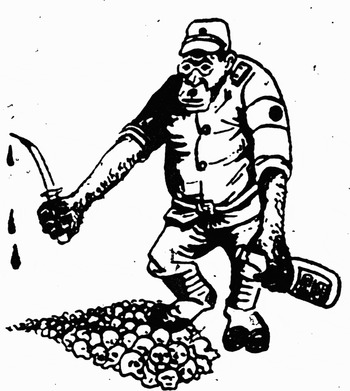
Exactly one year later, in March 1951, Chu Hua 儲華 published his Monstrous Crimes of the Japanese Dwarves: Cruel and Inhumane Germ Warfare. Relying on Soviet-mediated trial records, Chu aimed to publicize “concrete examples of the vicious brutality of the Japanese invaders.” On the cover was a shamelessly racist depiction of a Japanese soldier, portrayed as a slouched-over bespectacled gorilla groggy on liquor, standing atop a grisly mound of human skulls and brandishing a dagger dripping with blood (Figure 1). The “sea of blood and grievances” that the “bestial” Japanese left in their wake, Chu declared in his preface, “can never in all eternity be forgotten.”Footnote 26 Included in the appendix were facsimiles of the hand-written documents attesting to the various ways in which Chinese human experimental subjects were slaughtered.
Japanese Soldier Portrayed as Drunk Homicidal Gorilla

It is inconceivable that Zhou Enlai had already formulated a master plan for handling the Japanese war criminals in his custody while uncompromising polemics such as these were still in the public sphere. Indignant accusations of unpunished war criminals under American auspices in post-occupation Japan continued to feature in the People's Daily and other newspapers up until early 1954, when they suddenly ceased. The general shift in timing coincides with several larger international developments. In March 1954 the detonation of the United States' first thermonuclear bomb in the Bikini atolls irradiated Japanese fisherman on board the Lucky Dragon No. 5, touching off an international brouhaha that led to “the most serious strain on Japanese–American relations since 1945.”Footnote 27 In June 1954, Zhou Enlai and Jawaharlal Nehru signed the Sino-Indian communiqué, which outlined five principles for peaceful coexistence. With serious cracks appearing in the US–Japan alliance and tangible prospects for peace with its South Asian neighbours, the PRC for the first time since the Korean War seems to have spotted an opening for a Cold War power play towards Japan. Thus it is only after mid-1954 that “geostrategic interests” seem to have finally convinced top PRC leaders to make a dramatic break with their own past precedent concerning the concrete handling and public discourse surrounding Japanese war crimes.
But after five years of sanctioning state-sponsored anti-Japanese diatribes that had effectively fanned the flames of popular hostility towards Japan, Zhou Enlai had his work cut out. The Chinese people would now have to be carefully conditioned and meticulously prepared for what was soon to become, against all non-governmental wishes, a manifestly counterintuitive show of mass clemency.
Ichikawa Ennosuke, Mei Lanfang and Sino-Japanese Theatre Exchanges
In October 1955, when Mao Zedong informed a visiting delegation of Japanese leftist politicians and performers that they should stop apologizing for their country's history of aggression against China, he was merely bestowing his substantial prestige and playful rhetoric upon the dictates of the new official line on Japanese war criminals as laid down by Zhou Enlai. The new Party line, clearly delineated in contemporaneous documents, was that “a lenient policy towards these Japanese war criminals will help us win over Japan and isolate American imperialism.”Footnote 28 Pragmatically speaking, in order to accomplish these goals, Zhou believed it necessary to “criticize the most reactionary, pro-American” figures in Japan, while “encouraging and supporting those among the people and government who are willing to have dealings with us.”Footnote 29 One example of those willing to have dealings with the PRC was Ichikawa Ennosuke and his 57-member kabuki troupe, which arrived in Beijing just in time for National Day and stayed on to enjoy rave reviews for several weeks thereafter. The on-stage spectacles, one of which was attended by Mao himself, were, according to Ichikawa, “certain to assist [Sino-Japanese relations]. Anyone who says otherwise is lying.”Footnote 30
The PRC press coverage of the kabuki troupe was intended to persuade a domestic audience that China and Japan were natural allies whose cultural and racial ties far outweighed the unpleasant immediate past. If there was an implacable foe of the Chinese people in East Asia, it was the United States, not Japan. Thus explanatory commentary on the history of kabuki in Japan suggested that the appeal of this theatre art form lies chiefly in its long tradition of expressing resistance to oppressive, occupying authorities such as the United States.Footnote 31 Yin Falu 殷法路, writing for the Tianjin da gongbao 天津大公報, believed that the “brilliant performances of the [kabuki] troupe … deepened mutual understanding between [our] two peoples,” helped to “shatter any and all man-made obstacles,” and “accelerated efforts to normalize Sino-Japanese relations at an early date.”Footnote 32 Wu Xuewen's 吳學問 three-part series in the Guangming Daily (Guangming ribao 光明日報) excoriated the evils of jazz music on Japan's radiowaves and said that the importation of American movies was part of a plot by the US–Japan “reactionary clique” to keep the masses ignorant.Footnote 33
In December 1955, two months after Ichikawa's troupe had returned to Japan, Hu Qiaomu 胡喬木, Mao's political secretary and deputy director of the Party's Propaganda Department, decided to organize a pen pal exchange between Chinese and Japanese youth, and then published the resulting missives in the People's Daily over a three-month period.Footnote 34 A 16-year-old Japanese schoolgirl expressed her desire to “learn about China's current situation and to have direct contact with the good people of China.”Footnote 35 One week later she received a response from an engineering student coached by Hu. The “student's” response commiserated with the current situation in Japan. “The American imperialists once constructed military bases in China, too, forcing the Chinese peasants to leave their fields, inflicting savage beatings on the Chinese people, and even raping Chinese women.”Footnote 36 This in turn elicited a passionate response, as the Japanese side insisted that they could no longer “look upon those who use the same script as us and have the same blood flowing in their veins as foreigners from a far-off country.” Another respondent also invoked the race card, wondering why Japan and China, whose people share “the same eyes, same hair, same skin, and same race … cannot engage in mutual exchange at present?”Footnote 37
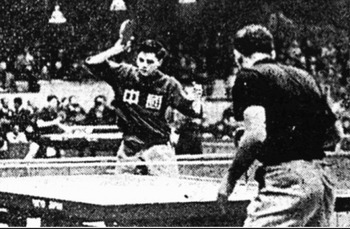
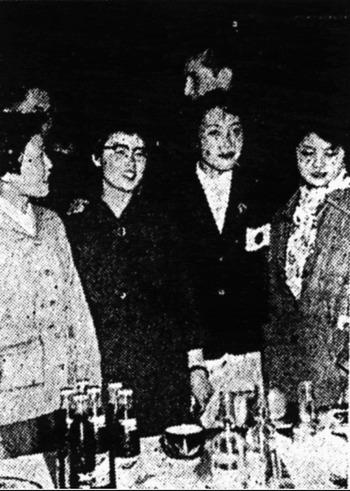
By early 1956, reports of numerous campaigns on multiple fronts were beginning to saturate the PRC press. The media coverage was designed to prepare the Chinese people to accept as natural and inevitable the forthcoming mass clemency of Japanese war criminals. A delegation from Japan's Protect the Constitution Association was fêted across China's entire eastern seaboard, a Dunhuang 敦煌 exhibition was held in Tokyo, there were trade exhibitions in Tokyo and Beijing, and, in cities across China, “Japan Movie Week” (Riben dianying zhou 日本電影周) became a regular occurrence, with extended press coverage introducing leftist films in an invariably anti-American light. On 14 April a none-too-subtle montage in several major daily newspapers juxtaposed a live-action shot of a Chinese ping pong player beating his American opponent (Figure 2), side-by-side with a congenial group photograph of smiling members of the Chinese and Japanese women's teams (Figure 3). Yet even with so many simultaneous cultural exchange projects in motion, Zhou Enlai was still not ready to proceed with the trial of the Japanese war criminals. “Because Japan has still yet to recognize China and has independently signed a peace treaty with Taiwan,” Zhou reasoned in March 1956, “China and Japan are still situated in a state of war.” As a result, “dealing with these war criminals at too early a date would appear improper in both form and substance. … Only after we have had further contacts with the Japanese people will the time be ripe for us to take care of this matter.”Footnote 38
Chinese Ping Pong Beats US Team

Japanese Player (wearing Japanese Flag Lapel) Poses with PRC Women's Team

What Zhou seems to have been patiently waiting for was the 16 May departure of the 86-member Beijing opera troupe on its long-awaited whirlwind tour of Japan. In personally selecting Mei Lanfang to lead this troupe, Zhou was strategically leveraging the historical symbolism of his refusal to perform for eight years during the Japanese invasion of China (1937–45). Mei was at first wary of the assignment, but acquiesced after Zhou called on him in person and outlined what was at stake. “Culture and the economy are like a pair of wings,” Zhou explained to Mei. “Right now we are using culture as the vanguard to open up a path. After [you] succeed, then we will send in the economic teams.”Footnote 39 Though he once gave up the stage in the face of Japanese aggression, Mei had made two earlier tours of Japan, in 1919 and 1924. It was to these two previous visits that constant reference was made in the press, in the hope that readers would indulge in a bit of historical amnesia and cast their minds back to a time, some 30 years ago, when Japan and China had not yet become enemies.
From the outset, Ouyang Yuqian attempted to place his troupe's visit within this revisionist historical perspective. Observing that friendly Sino-Japanese exchanges had existed for over 2,000 years, while “Japanese militarists” had only interrupted this relationship for a mere 50 years, he posed the following question: “In the final analysis, which is longer? Fifty to 60 years or 2,000 years?”Footnote 40 Troupe member Ma Shaobo 馬少波 made a similar calculation. Friendly relations dated back 2,000, he declared in verse, while the “regrettable moment” (yihan shike 遗憾时刻) totalled no more than a few decades. “Let the unhappiness disperse like so many clouds; hereafter our friendship will be everlasting.”Footnote 41 The sudden willingness to forget the past is striking. Gone were those early 1950s adamantine invocations of a vast “sea of blood and grievances” that the “Japanese imperialists” had left in their wake, grievances that were still as “fresh as yesterday.” The passing of a few years had managed to downgrade the slaughter into a mere “regrettable moment.” Gone too were the uncompromising invectives against Emperor Hirohito, who only a few years earlier had been besmirched in China as a war criminal guilty of “the most heinous, utterly despicable, and treacherous murder of humankind.” Now Hirohito's younger brother Prince Takahito was a distinguished guest at one of the performances, and rumours that the Emperor himself had watched a performance on television were interpreted as an honour.Footnote 42
Instead, constant attention was drawn to China and Japan's new common enemy: the United States, which had just detonated another nuclear bomb in the Bikini atolls, prompting a fresh rehash of commentary on the Lucky Dragon incident two years earlier. During a welcoming party in Tokyo, the troupe's Japanese host belittled the significance of this nuclear test. “Sino-Japanese cultural exchanges are a form of diplomacy through art. They produce results that bombs dropped from a plane cannot.” The Beijing opera troupe was quick to capitalize on the apparent effect of the nuclear tests on the Japanese. In early June the troupe made a special trip to Hiroshima and visited a group of mutilated survivors from the 1945 explosion. Ouyang Yuqian proposed a special benefit performance for the victims of radiation, and, with the support of the Asahi Shinbun and Sino-Japanese Friendship Association (Zhong Ri youhao xiehui 中日友好協會), the troupe's sponsors in Japan, they managed to gather substantial publicity.Footnote 43
The same rhetorical technique that was used in the visit of the kabuki troupe to China was again employed during the Beijing troupe's trip to Japan. Chinese journalists attached to the troupe portrayed the Chinese presence in Japan as a zero-sum game with the United States. An illustrative example comes from the troupe's visit in early July to Nagoya, where a public hall had just been returned to the local community after being occupied by the US military for more than ten years. “The first thing the people of Nagoya did after getting their hall back was to use it to host a performance from the Beijing opera troupe,” People's Daily reporter Pei Da 裴達 wrote. “The beauty of the artistic dance of our opera performers and the pleasing sound of our songs restored lustre to the hall,” which, during the US occupation, had suffered only the indignity of broken windows and graffiti on the walls.Footnote 44 The Japanese people, the article seemed to suggest, were fast waking up to the realization that China – and not the United States – was Japan's historically rightful bosom buddy.
Marginalizing Japanese War Crimes in Shenyang and Taiyuan
There is ample reason to suspect that Zhou Enlai purposely postponed the Japanese war crimes trials by a full three months precisely because he was waiting for Mei's troupe to start making headlines about China's newfound friendship with Japan. After six months of intense conditioning in the media, the Chinese people were apparently still not yet ready to digest the sudden and probably unwelcome news of pardoned Japanese war criminals. By early June 1956, however, it would have appeared to any casual reader of PRC newspapers that prominent Japanese citizens had already been lining up for weeks to offer ostentatious praise and admiration for the living symbols of China's national cultural traditions. The Japanese, it seemed, were practically begging for China's morally superior government and intoxicating cultural luminaries to dislodge the United States from its undeserved pre-eminence in Japan.
It was amidst just such a self-congratulatory and flattering public discourse that coverage of the first Japanese war crimes trial in Shenyang and Taiyuan suddenly and without warning appeared in the newspapers. Colourful features on Mei Lanfang's performances in Japan continued to maintain a high profile throughout the course of both trials. Indeed, it was surely no coincidence that interested readers of trial coverage could find their eyes subtly drawn towards adjacent articles and images on Beijing opera performances in Tokyo. It is important to note, however, that the trials were not reported on while the court was still in session. Public mention of the first series of trials, held in three separate sessions in Shenyang and Taiyuan from 9 to 20 June, did not appear in the newspapers until 22 June. Seventeen of the worst offenders were given prison sentences of between eight and 20 years, while 335 other prisoners were exempted from prosecution. The second, held in Shenyang from 1 to 20 July, resulted in 28 guilty pleas, sentences of between 12 and 20 years, and the further exemption of 328 prisoners from prosecution. On 21 August the remaining 354 prisoners were granted clemency without trial.Footnote 45
One look at the official court transcript, published for the first time in 1990, reveals immediately why none of the court proceedings could be openly and faithfully publicized in the domestic clime of the mid-1950s.Footnote 46 Court records describe how Suzuki Keikyo, a former lieutenant general in the Japanese Army sentenced to the maximum of 20 years, ordered his men to murder and violate an untold number of women in a particular village. When one of the villagers' wives resisted rape, she was “taken to the river bank and hacked to death.” The victim was pregnant, so a Japanese soldier “slit open her stomach, took out the foetus, and cut it up.”Footnote 47 Considering that the surviving family members of victims such as these continued to insist on the death penalty while testifying in the courtroom, and that Zhou Enlai was keenly aware of the vast chasm standing between government and popular preferences for harsh sentences, it is little wonder that a different account of Suzuki's crimes would have to appear in the papers.
Suzuki Keikyo was charged with the murders of 1,280 north China villagers. The paperwork for his indictment consisted of 181 pages of accusations, 45 pages of testimony similar to that just described, 89 pages of direct questioning and 38 photographs. The summary of his crimes in the People's Daily, however, totalled three short paragraphs. It would be wrong to say that the PRC press completely glossed over Suzuki's crimes. The statistics of his criminal record were duly recorded, including his number of murders. Yet much like Carlyle's portrait of Louis XV, who “avoided the sight of churchyards, funereal monuments, and whatsoever could bring [death] to mind,” any allusion to the human dimension of mass slaughter was kept at arm's length, and sterilized when unavoidably referenced.Footnote 48 Though Suzuki's “crimes against humanity” – severe enough to receive only one of four 20-year sentences – were allotted a mere three sterile paragraphs, multiple lengthy feature articles were simultaneously devoted to Suzuki and his fellow convicts' praise for the lenient sufferance supposedly exhibited by “the Chinese people.” Uno Shintaro, sentenced to 12 years, declared that “the Chinese people have saved me.” Pictures of prostrate, teary-eyed Japanese filled the newspapers.Footnote 49
For any newspaper readers still unsure as to how to judge the lenient punishment being meted out to the Japanese war criminals – and who may have raised an eyebrow at the nonchalant reference to Suzuki's 1,280 murders – legal experts were summoned in to buttress the government's position. Mei Ru'ao 梅汝璈, an expert on international law, reassured readers that “these Japanese war criminals do not bear chief responsibility for the prosecution of the Japanese imperialist invasion.” In fact, their crimes were now characterized as being of “lesser importance” (ciyao 次要).Footnote 50 Furthermore, in a complete reversal of earlier accusations against American and Nationalist Chinese postwar collaboration with Japanese war criminals (whose lack of scruples, wrote Xiao Fan in 1950, caused victims to “roll in their graves, unable to rest peacefully”), Zhang Dingcheng 張鼎丞, a state prosecutor, now decided that the United States deserved some credit after all. “After Japan's surrender,” Zhang remarked, “the Far Eastern Military Tribunal [in Tokyo] and the Chinese government [in Nanjing] attended to the disposal of the chief offenders.”Footnote 51 Therefore, to apply harsh punishments out of all proportion to the insignificant offenders in their midst would be out of line; after all, “the Chinese people do not believe in revenge” (fuchou zhuyi 復仇主義).Footnote 52 Sentiments concerning the “bestial Japanese” who had supposedly left a “sea of blood and grievances” in China, which “can never in all eternity be forgotten” were now banished to out-of-print bookshelves and enterprising academic libraries overseas.
Another justification offered by these legal experts for the PRC's unprecedented leniency was, in the phrasing of prosecutor Zhang, the fact that these war criminals had been “forced by Japanese imperialists to participate in the war, and that their superior officers had ordered them to commit crimes.”Footnote 53 This may have been true in a certain number of cases, but even so, it did not constitute legitimate grounds for clemency in the international law of the day. In light of the insistence of PRC authorities during the Shenyang and Taiyuan trials that they were adhering to – indeed, exceeding – rigorous international standards of justice, these trials should once more be compared to their functionary European counterparts, the Dachau trials of 1945–48. Frequent recourse by the Dachau defendants to mitigating pleas of “acting on superior orders” were coldly and repeatedly overturned by the American judges. One defendant, hanged in January 1949 for the killings of five Polish inmates, attempted to justify his conduct in this way but the Dachau court would have none of it. “Compliance with superior orders does not constitute a defense to the charge of having committed a war crime,” the court determined.Footnote 54 Countless court records from the 489 Dachau trials reveal a standard two-paragraph citation of international legal precedent denying the efficacy of such a plea.
Whereas Eugen Ziehmer was executed seven years earlier in Dachau for the murder of 0.004 per cent the number of victims as Suzuki, the latter had only to endure an additional eight years of comfortable incarceration before obtaining his unconditional freedom. Interestingly, however, Suzuki himself was far more forthcoming. “[My] brutal, inhumane murder of the Chinese people is something the Chinese will never be able to forget,” he admitted.Footnote 55 Indeed, the Chinese people had not forgotten it in 1956, nor, as the 2005 riots suggest, have they forgotten it today. Their government, on the other hand, simply could not forgive and forget fast enough. “For the sake of peace and the friendship of the peoples of our two countries,” opined the Guangming Daily, “we are willing to let the unhappy interlude of the past 60 years dissipate like a cloudy mist.”Footnote 56
The Legacy of the 1956 War Crimes Trials
The 1,062 Japanese war criminals in PRC custody during the early 1950s constituted a delicate political liability for China's top leaders. In his pragmatic determination to treat them leniently, Zhou Enlai faced considerable opposition and dissatisfaction both from the general public and members of the Party. Once it became apparent, in late 1955, that his efforts in organizing government-run “explanatory workteams” were failing to influence popular and Party sentiment, he moved quickly to supplement these with a multifaceted mass media campaign designed to persuade the public at large that the central government's seemingly counterintuitive treatment of Japanese criminals did, in fact, make perfect sense. In order to accomplish this feat, Zhou was forced, among other things, to coax opera star Mei Lanfang out of a decades-long, self-imposed retirement from performing in front of Japanese audiences; delegate the organization of both Japanese “movie weeks” and Sino-Japanese pen pal exchanges across China; encourage subtle coverage of an early form of “ping pong diplomacy”; and, perhaps most importantly, suppress public knowledge of the hundreds of blood-curdling Japanese confessions that Fushun and Taiyuan jailors had spent years collecting. All these initiatives were accomplished as part of an abrupt volte-face from the conventional treatment afforded Japanese war crimes during the first five years of the PRC.
By 21 August 1956, the third and final batch of the 1,017 Japanese war criminals who had been given a wholesale pardon returned to Japan aboard the Koan Maru. Their beaming faces and joyously waving arms, gesticulating wildly over the double-decker banisters of the ship, followed in the wake of two previous shiploads of Japanese convicts that summer. In line with the dictates of Zhou's year-long media campaign, the entire scene was captured for posterity in a full-page photograph published in the People's Pictorial (Renmin huabao 人民畫報) and disseminated throughout the nation.Footnote 57 For those Chinese who still insisted on a measure of justice and were not beguiled by the government's rhetoric, this final insult must have been particularly painful.
The normalization of Sino-Japanese diplomatic relations in 1972, a goal for which Zhou Enlai had long laboured, signalled the death knell for victims' compensation. The legal precedents of the 1956 trials, combined with the signing, 16 years later, of a joint communiqué and a treaty of peace and friendship with Japan, “would later be used by Japanese court rulings as proof that China had given up its claims for compensation for wartime atrocities.”Footnote 58 The governments of both China and Japan have tried their best over the years to marginalize mainstream discussion of Japanese war crimes. The permissible media coverage of the trials during the Mao years did not even remotely resemble that of the European war crimes trials. The Nuremberg, Eichmann and Auschwitz trials, according to a recent study, received “considerable press coverage” both in Germany and in Israel, thus making it “possible for the general public to be exposed to the horrible stories” for the first time.Footnote 59 Painful though they may be, such stories can ultimately be cathartic when shared and acknowledged in visibly public forums. An era of “new remembering” was indeed sanctioned in the Deng Xiaoping reform period, but by this point over 40 years had passed since the war, and “time was running out” for most veterans and victims to write their memoirs.Footnote 60
The recent declassification of the original Japanese confessions from the 1956 trials certainly fills a void of historical authenticity. Though some may question the veracity of the confessions, it is instructive to recall that none of the authors recanted or modified them after returning to Japan. Indeed, many of the Fushun and Taiyuan prisoners worked tirelessly for decades to spread word of their own past atrocities in China to anyone who would listen.Footnote 61 Though derisively marginalized by local conservatives as well as overseas journalists as having been “brainwashed,” they have gained widespread transnational legitimacy in recent decades, as is clear from the numerous translations of their post-1956 Japanese-language war crimes narratives back into the mainland Chinese-language press.
The belated publication of these gruesome narratives in China in 2005, however, has not been undertaken, as it has for decades on the Japanese side, in the humanistic interest of exposing wartime atrocities and preventing their recurrence. Instead, these documents have been published only in tandem with a vast supplementary literature that extols the rousing success of early PRC thought-reform efforts. The Japanese confessions and expressions of repentance are held up as shining examples of the “miracles” worked on recalcitrant war criminals by early PRC government initiatives.Footnote 62 The real victims of the atrocities have thus once again become the silenced chess pieces of a government bid for nationalist legitimacy.