Congenital heart disease (chd) is the most common birth defect causing infant mortality, affecting approximately 40,000 newborns in the United States of America each year. In the first 12 months, one in four infants with CHD requires medical, therapeutic, palliative, or reparative invasive interventions.Reference Mahle, Spray, Wernovsky, Gaynor and Clark 1 , Reference Jacobs, Quintessenza and Burke 2 Infants with complex CHD present significant medical and emotional challenges for their caregivers and parents, as well as in the paediatric cardiac ICU. Postoperatively, infants with CHD are at a high risk for haemodynamic instability, haemorrhage, arrhythmia, multi-organ dysfunction, infection, and malnutrition. Many infants undergoing surgical or interventional treatment for CHD require extended periods of sedation and pain management that involve careful weaning of medications and control of withdrawal symptoms.Reference Tweddell and Hoffman 3 Postsurgically, infants with CHD are hypersensitive, easily overwhelmed in terms of self-regulation and state management, and show difficulties in growth and feeding.Reference Butler, Sadhwani and Stopp 4 Although mortality rates in children with CHD have significantly declined, the incidence of neurological abnormalities and neurodevelopmental impairment has increased. Neurodevelopmental deficits are noted in preschool and school-aged children, including developmental delays, learning disabilities, and behavioural problems. Children with CHD often require special education and social and emotional services. In addition, they exhibit challenges in mental health and executive processing as young adults.Reference Marino, Lipkin and Newburger 5 – Reference Snookes, Gunn and Eldridge 9
The aetiology of the neurodevelopmental delay seen in children with CHD is multifactorial. Cardiopulmonary bypass, extracorporeal membrane oxygenation, and the use of ventricular assist devices may predispose infants to an increased risk for neurological injury and subsequent sequelae. Neurological injuries that occur in the pre-, peri-, or postoperative periods in children with CHD are associated with a higher risk for long-term cognitive, motor, and language delays, as well as with emotional or behavioural problems, social difficulties, and inattention.Reference Limperopoulos, Majnemer and Shevell 10 , Reference Clouchoux, Du Plessis and Bouyssi-Kobar 11 Infants with CHD suffer from impaired cerebral oxygen delivery both before and after birth, leading to a difference or possibly a decrease in brain maturation at birth. Infants with CHD are often likened to premature infants.Reference Limperopoulos, Tworetzky and McElhinney 12 – Reference Miller, McQuillen and Hamrick 14 Hospital and environmental challenges such as noxious stimuli, painful procedures, sleep deprivation, and invasive lines and tubes additionally produce infant and parental stress, which affects parent–infant interactions and lead to less-than-optimal infant brain development.Reference Anand and Scalzo 15
In the growing population of children with CHD, research has generally focussed on outcomes, with only a limited, more recent focus on prevention and intervention. Given the known long-term challenges for children with CHD, the American Heart Association and American Academy of Pediatrics recently released guidelines for developmental screening, surveillance, and evaluation of children with CHD. These guidelines suggest that biological risk factors are modifiable by environmental and protective factors and that all high-risk patients with CHD should receive formal developmental evaluations. Although many children are now referred for neurodevelopmental assessment after discharge, few are evaluated while inpatient, when prevention and amelioration is likely to be more effective.Reference Butler, Sadhwani and Stopp 4 , Reference Massaro, Glass and Brown 16 , Reference Sood, Berends and Butcher 17
Understanding developmental care
Environmental factors such as high sound and light levels elicit physiological changes in newborns, including increases in heart rate, respiratory rate, and blood pressure, as well as decreases in oxygen saturation. All of these adversely affect growth and development. High sound and light levels are correlated with hearing loss, sleep disturbances, hypoxaemia, decrease in expected endocrine and cardiovascular function, and other stress responses.Reference Peng, Chen and Bachman 18 – Reference Perlman 20 In the cardiac ICU, extensive sleep interruptions have been recorded, along with high levels of environmental stimulation. Current research advocates adjustment of medical practice to reduce the detrimental developmental effects of noxious environmental stimuli such as excessive light, sound, and sleep disruption in the cardiac ICU.Reference Daniels and Harrison 21
It has been proven repeatedly that individualised developmental care in the newborn ICU improves neurodevelopment and psychosocial outcomes in preterm infants and their families, and it is widely agreed to be best practice for vulnerable high-risk infants.Reference Als, Lawhon, Duffy, McAnulty, Gibes-Grossman and Blickman 25 – Reference Westrup, Böhm, Lagercrantz and Stjernqvist 31 The intervention of developmental care is designed to minimise the mismatch between the fragile brain’s expectations and the experiences of stress and pain inherent in an ICU environment. An ICU that provides individualised, developmentally supportive, and family-integrated care includes a soothing environment, which encourages sleep and healing, supports parents as their child’s primary caregiver, and provides continual adjustment of caregiving in support of the child’s well-being, strengths, and healing.Reference Winnicott 22 – Reference Als, Lawhon, Duffy, McAnulty, Gibes-Grossman and Blickman 25 Parent involvement and education are important aspects of individualised developmental care. In individualised developmental care, parents are recognised as the infant’s stable, familiar, predictable providers, who are involved in all aspects of caregiving.
Developmental and family-integrated care strategies have been combined to form comprehensive programmes, such as the Newborn Individualized Developmental Care and Assessment Program (NIDCAP).Reference Als 23 , Reference Silberstein and Litmanovitz 24 NIDCAP is the only evidence-based, comprehensive, internationally recognised programme of individualised developmental care. The therapeutic method of individualised developmental care in the NIDCAP model provides early support and preventive intervention based on each child’s behavioural signals of stress, comfort, and strength. The individualised adaptation and planning of care is based on careful, detailed, repeated observation of behavioural cues and communication. NIDCAP has been shown to improve outcomes in premature infants with enhanced brain structure and function, along with improved behavioural outcomes that endure beyond infancy and into school age. In addition, many NIDCAP studies report benefits for medical variables such as decreased length of ICU and hospital stay, earlier oral feeding, and increased weight gain.Reference Als, Lawhon, Duffy, McAnulty, Gibes-Grossman and Blickman 25 – Reference Moody, Callahan, Aldrich, Gance-Cleveland and Sables-Baus 32 NIDCAP increases parental engagement at the bedside, attachment to their infant, and confidence in caregiving.Reference Als, Duffy and McAnulty 33 – Reference Nelson and Bedford 36 There is overwhelming evidence for the positive effects of NIDCAP on families and children in the ICU. There is also documented variability in the implementation of developmental care across ICUs and thus variabililty in the impact of care on long-term development.Reference Ohlsson and Jacobs 37
Challenges to developmental care in the cardiac ICU
Although individualised developmental care is of upmost importance, the extreme nature of the medical needs of the cardiac ICU population provides an extra layer of challenge, with extremely unstable patients, life-threatening procedures, precarious lines and tubes, postsurgical obstacles, medical complications, long hospital stays, comorbid medical conditions, wide age ranges of patients, and traumatised families. Although developmental care practices are implemented to varying degrees in many North American cardiac ICUs, recent research indicates that developmental care practices fluctuate within and across cardiac ICUs and that there are no established guidelines of developmental care for the cardiac patient. The ability to regulate sound and television use, reduce the use of sedation and restraints, engage in infant holding, and fully integrating families into the care of the infant have been noted as challenging in the cardiac ICU. Further, most units identified being ill-equipped to provide developmental care without additional education and allocation of resources, a formal developmental task force or committee, and regularly scheduled developmental rounds.Reference Butler, Sadhwani and Stopp 4 , Reference Sood, Berends and Butcher 17
An example of developmental care introduction and implementation in the cardiac ICU
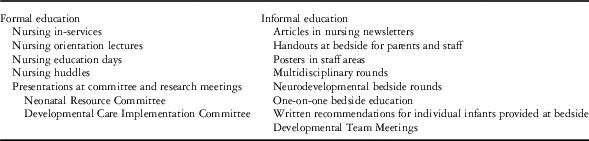
This paper describes the successful introduction and practice of individualised developmental care in the cardiac ICU of a large urban tertiary care children’s hospital. The cardiac inpatient setting includes a 31-bed cardiac ICU and a 42-bed medical and surgical cardiovascular unit. Approximately 1400 heart surgeries are performed each year. Developmental care was introduced into the inpatient cardiac service in 2013 by a NIDCAP-trained professional. Implementing developmental care practices in a cardiac ICU requires a thoughtful and well-planned approach to ensure successful adoption of sustainable practice changes. Research has shown that staff coordination, among others, is a large obstacle to developmental care.Reference Mosqueda, Castilla, Perapoch, Lora, López-Maestro and Pallás 38 Focus was placed on multidisciplinary collaboration in the cardiac ICU. First steps included obtaining support of nursing leadership and nursing education. Initially the professional specialities of psychology, child life, and nursing incorporated the developmental intervention responsibilities into their daily patient care regimens. It became clear very quickly that the collaboration of all medical professionals, therapists, and mental health clinicians was of critical importance. Thus, the model of bringing developmental care to the cardiac ICU was expanded to include staff education (Table 1), child neurodevelopment assessment and intervention, clinician support, parent support, and research initiatives in order to test the effectiveness of the approach.
Opportunities for staff education.

Staff education
Staff education was provided across multiple modalities on an ongoing basis. Specific developmental care components and strategies were targeted serially (Table 2). Before implementation of developmental care strategies, staff in both the cardiac ICU and the adjacent Cardiac Ward – that is, the acute-care inpatient unit – were provided instructions on individualised developmental care interventions across varying aspects of cardiac ICU care, brain development, observation and understanding of infant cues, typical infant and child development, long-term outcomes for children with CHD, and parental stress in the cardiac ICU. Developmental education was provided for cardiologists, surgeons, neurologists, and anaesthesiologists during monthly research meetings. Nursing huddles, small meetings of mostly nursing staff during regular work shifts, provided opportunities for a quick review of new and old developmental aspects. Education for all staff was also provided during developmental care committee meetings, which is further described below. Posters and handouts, including a pocket guide containing developmental care guidelines and typical developmental expectations, were provided to nursing and other therapy staff. Developmental care reminders were included in the nursing newsletter, sent by e-mail to staff, and posted in the nursing break rooms and nursing stations. To individualise further, education included bedside guidance for nursing provided by the collaborating psychologist and child-life specialist. This often occurred during bedside neurodevelopmental rounds, which is also discussed further below.
Targeted components of individualised developmental care adapted from the NIDCAP developmental care guidelines.Reference Als and McAnulty 46

Child neurodevelopment assessment and intervention
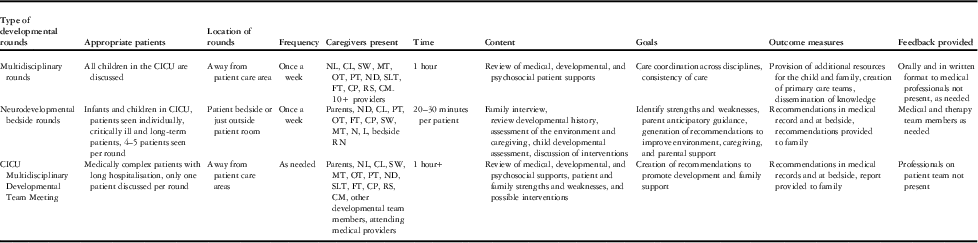
Neurodevelopmental assessment and intervention occurred in three different mediums and served to provide child assessment, patient and family support, education to staff, and clinician support with the overall goal of system change (Table 3).
Variability in developmental rounds in cardiac ICU (CICU).

CL=child life; CM=case managers; CP=chaplaincy; FT=feeding therapy; L=lactation; MT=music therapy; N=nutrition; ND=psychology/neurodevelopment; NL=nursing leadership; OT=occupational therapy; PT=physical therapy; RS=resource specialists; SLT=speech and language therapy; SW=social work
First, multidisciplinary rounds were carried out once a week, away from patient care areas, with multiple therapeutic specialists and medical staff. These rounds included a discussion on all children in the cardiac ICU with a review of current medical status, social challenges, parent needs, patient developmental or educational concerns, and other pertinent information. Information from the rounds was distributed to any absent medical staff, and to the supervising senior attending medical providers. The goal of the multidisciplinary rounds was to integrate the information of multiple providers on a single child into one comprehensive and succinct narrative, and to develop a mutually agreed upon and binding plan of best care. This exchange of information allowed for planning of co-treatment across disciplines, coordination of care including scheduling therapies on different days, consistency of care which involved organising a primary nursing team with a primary physician, identification of challenging situations requiring special clinican support, and overall system-wide coordination for the improvement in care delivery.
Second, neurodevelopmental bedside rounds were a more individualised method of child neurodevelopmental assessment via individual bedside developmental rounds. Young children were seen at their bedside in the presence of their parents, bedside nurse, and multiple therapists. The team members varied for each child and were chosen carefully by the child’s developmental rounding team so that each member of the team brought unique expertise in support of the child’s individual development. The goal of these rounds was to provide detailed infant assessment and parental guidance, along with an opportunity to enhance the child’s overall quality of care, with discussion at the bedside by multiple providers in the child’s care. Education regarding the specific developmental expectations and challenges of the patient, with recommendations for interventions, occurred in real time with the nurse(s) and other available medical team members at the bedside. Nurses and other team members were directly involved in the rounds, both learning about and practising key individualised developmental tools and contributing pertinent information on the clinical status. As the cardiac ICU comprised mostly individual infant–family rooms, adjustments individualised to the child and family were often possible. As not all patients in the unit were seen on these intensive bedside rounds, given time constraints, the psychologist and child-life specialist screened patients twice a week for inclusion. Children selected for this intense support, with some exceptions, met the following criteria: referred by the medical team; under a year of age; were either post open heart surgery or in consideration for surgery, required a cardiac ICU stay of longer than 2 weeks; and/or were receiving extracorporeal membrane oxygen, ventricular assist devices, or heart transplant.
Neurodevelopmental bedside rounds began with introduction of the team to the parent(s) or legal guardian(s) and to the bedside nurse, followed by explanation of the nature and purpose of the neurodevelopmental bedside rounds. Every attempt was made to perform rounds while the patients’ family was at the bedside. A short psychodynamic interview was completed, which included a discussion of family dynamics and how best to support the family, siblings, and extended family members. Parents were also asked to describe their child, his or her likes and dislikes, strengths and weaknesses, and any developmental concerns before or during hospitalisation. Parents were asked about their anticipated availability at the bedside, expectations for care and their relationship with the child. This information was often collected over several sessions. Parents were typically proud to share information which showed the child’s personality and skill development rather than just his or her medical state and diagnoses.
In addition, an assessment of the environment and care delivered was made using the NIDCAP Assessment of the Nursery Environment and Care Components (Templates),Reference Als, Buehler, Gilkerson and Smith 39 which records the amount of light, sound, and activity in the room as well as at the specific bedside, and the type and quality of care techniques employed. These were used as a guide to ensure assessment and discussion of the environment and also for the evaluation of developmental care techniques during caregiving (Table 3).
Neurodevelopmental bedside rounding also included hands-on developmental assessment of the child in the cardiac ICU, when appropriate for the child and the family. Assessment was tailored to the child and the family and depended on the child’s medical status, which might range from intubated and/or fully sedated to awake and interactive. The psychologist provided the assessment following the NIDCAP model of detailed behavioural observation.Reference Als 23 , Reference Als 40 For newborns, parent support and anticipatory guidance was provided using segments of the Assessment of Preterm Infants’ Behavior,Reference Als, Butler, Kosta and McAnulty 41 which is an infant assessment tool of mutually interacting behavioural subsystems in simultaneous interaction with the environment, and the Newborn Behavioral Observation,Reference Nugent 42 which used infant assessment as an intervention with the family.Reference Butler, Sadhwani and Stopp 4 For older infants and children, the Bayley Scales of Infant and Toddler Development Screening Test®,Reference Bayley 43 was used when appropriate. Often the Bayley Screener was completed in the step-down unit closer to discharge. The psychologist was certified in these measures. The child’s assessment included a discussion of the organisation of the autonomic, state, regulatory, and motor systems, along with the child’s communication, social, attention, cognitive, feeding, and sleeping abilities. Major focus was placed on the child’s comfort and pleasure, attachment with family, and documentation of specific developmental skills. On the basis of the assessment, appropriate resources and further steps required for the child’s best developmental progression were identified. Depending on the child and family recommendations, steps ranged from supporting the family in holding their child regularly to enhancing the child’s own understanding of his or her situation. Recommendations were discussed with the family and the team, documented in the medical records, and hung at the bedside. These were decorated with a consistent developmental care logo developed in collaboration with staff. When there were unusually significant concerns, developmental feedback and recommendations were also discussed away from the bedside with the primary medical team and sent by e-mail to providers not readily available on the unit, after informing the family of the steps that would be taken.
Third, the Individualized Cardiac ICU Multidisciplinary Developmental Team Meeting was developed. This format proved helpful for complex, long-stay patients with a large medical and therapeutic provider team. Unlike the bedside rounds, this meeting included as many providers as possible who cared for the child, including all therapists, medical attendants from different disciplines, and the parent(s) or legal guardian(s). These meetings often contained more than 10 providers in the discussion of one child. The attending medical providers added, among other important considerations, information on the possible or known effects of medical treatments and medications on the child’s development. These meetings generated a summary of content and recommendations for the child’s medical record and for the family. As extended-stay patients were considered to be at a high risk for neurodevelopmental complications due to a prolonged critical illness and inpatient stay, children who remained inpatients for longer than 3 months were determined as qualifying for a Multidisciplinary Developmental Team Meeting. Those infants might have been listed for a transplant, required multiple surgeries during one hospitalisation, or had received a ventricular assist device. Individualised cardiac ICU Multidisciplinary Developmental Team Meeting Rounds were always carried out away from the patient’s bedside and provided an excellent opportunity to impart education for the entire team about the importance of individualised developmental care and each provider’s opportunity to contribute.
Clinician support
Developmental Care Committees were developed as the primary means of Clinician Support. Developmental care groups and committees provide both an arena for brainstorming new developmental initiatives as well as an opportunity for education and clinician support. Research has documented the effectiveness of formalised developmental care committees.Reference Sood, Berends and Butcher 17
The Developmental Care Implementation Committee was developed as a large working group of multidisciplinary specialists, focussed on providing support across disciplines regarding system change and integration of developmental care and family-centred care across the hospital. The goal of the group is to work together as a team to provide the best practice for all children in the hospital. Clinicians who participate are from varying departments, and all work with newborns and young infants with an interest in supporting development. This hospital-wide committee was initiated in the CICU and includes NICU, PICU, and cardiac step-down unit specialists. The current cardiac ICU effort acknowledged that the other units have a greater and longer-standing expertise in implementing developmental care and are likely to have knowledge and creative solutions to challenges encountered in the cardiac ICU as well. The hospital-wide developmental care committee currently includes physical therapy, speech therapy, child life, social work, nursing – that is, NP, RN, and CNS – music therapy, feeding therapy, chaplaincy, and neurodevelopment.
A Multidisciplinary Neonatal Resource Committee was established newly to aid in identification of knowledge gaps among staff related to preterm and neonatal care and provide additional education and training related to both physiological and developmentally focussed topics. This multidisciplinary group composed of nurses, child-life specialist, feeding therapist, nutritionist, psychology, and a cardiac ICU intensivist has focussed on the education of staff around topics such as infant growth and nutrition, positioning, and consulting on individualised care related to both preterm and full-term newborns with a special focus on infants with complex needs. This group purchased developmental care-products and provided unit education on the benefits of their use during formal in-services, as well as specialised posters. Further, monthly educational topics have been initiated that focus on neonatal care, including nutritional needs, thermoregulation, and breast-feeding. The cardiac ICU developmental care initiative formally joined the Multidisciplinary Neonatal Resource Committee’s efforts for the benefit of newborns with cardiac issues and their families.
Parent support
It is clinically important to support families and provide interventions that reduce separation of families and children. Supporting parents in parenting at the bedside and as respected members of the care team may prevent stress and anxiety often seen in parents during a hospitalisation and thus promote positive child outcomes.Reference Gooding, Cooper, Blaine, Franck, Howse and Berns 44 In this developmental care model, parents were conceptualised as an integral part of caregiving. Parents were considered collaborators in all medical discussions and decisions. Parent support included involving the family in every aspect of care, partnering with the family in caregiving and decision making, engaging with the family in discussion of infant and child observations, and reading the child’s cues along with making recommendations to support development. Parents report enjoying engagement in what they identify as basic parental tasks, such as putting on diapers, holding, feeding, practising breast-feeding by holding in breast-feeding position, reading and singing to their child, cleaning, and gently touching their child. Parents provide the most comfortable environment, with familiar sights, smells, and sounds.
Often the medical team determined that a child was too fragile to be held, or thought the parent’s voice to be overstimulating. These situations can be extremely disappointing for the parents and a challenge for the developmentally minded caregiver. Along with continuing to question whether it was safe to hold and interact with the child, other modes of providing family presence at the bedside were considered imperative. In the case of sicker patients, parents were advised to provide comfort by cradling their child in their hands while the child remained in the crib by, applying light pressure with their hands placed on the child’s head and feet this provided a, soothing touch, assuring parent–child contact. It was also recommended that parents place cloths on their skin for a while and then leave them near their child’s nose to provide their familiar smell to the child. As the most appropriate supportive measures for development of the child’s attention and interaction, parents were also encouraged to use their face and voice along with familiar objects at the bedside for times when the child opens his or her eyes. Parent support including lactation, social work, and developmental rounds were provided to enhance the parent–child connection and protection of the child’s brain development. For parents, remaining at the bedside may be challenging because of obligations at home and work, having to care for their other children, and transportation and lodging issues during their infant’s hospitalisation. Utilising social work, psychology, resource coordinators, and other hospital-based resources to help families with the stress of an acute or prolonged hospitalisation of their child was considered important to optimise parental participation in their child’s life. When parents could not be present, specially trained volunteers were called upon for support. Parents and the patient’s developmental team educate the volunteer about the child’s developmental goals with recommendations listed at the bedside.
Research initiatives
In the model of developmental care described here, all children under the age of 1 year of age receive neurodevelopmental assessment before discharge from the hospital and are entered into a data registry with parental consent. These children are asked to return for follow-up throughout their period of development after discharge. The registry documents medical and developmental variables in order to define this population of children with CHD. Future research initiatives must include investigating the rate and specific causes of parental stress in the cardiac ICU, whether developmental care initiatives such as NIDCAP have a long-term effect on development for children with CHD, and whether staff education has an impact on developmental care practice in the cardiac ICU.
Further considerations
Several additional points warrant exploration, including continued developmental support after hospital discharge and the exploration of opportunities for change.
Continued developmental support
After discharge from the cardiac ICU and hospital, there is a need for ongoing developmental follow-up and support. Most children discharging from the CICU are referred for outpatient developmental support. In a number of states in the United States of America, children less than 3 years of age who meet state-established criteria are typically referred for early-intervention services. Early intervention is a preventive and rehabilitative method of therapy to provide developmental supports in the home and track a child’s development over time. The American Academy of Pediatrics and the American Heart Association recommend that children with CHD receive long-term follow-up and developmental support. Our program follows children from discharge through adolescence with neurodevelopmental, psychological, and paediatric neurological care. The discussion on the value of these outpatient resources should begin early in the child’s and family’s hospitalisation period in order to prepare and encourage the family to avail themselves of the services offered.
Opportunities for change
The establishment of written policies that address reduced lighting and sound levels, increase infant holding, documentation and monitoring of sedation use, encouragement of early breast-feeding practices, and facilitation of physiologically advantageous infant positions will be a positive step for developmentally appropriate care and will offer helpful practice guidelines for staff, families, and patients. Research into these aspects of developmental care has been discussed in the literature in relation to the NICU and the growth and development of preterm and ill newborns. Results from this research may be extrapolated to the paediatric cardiac population; however, more specific research into the nuances of the neurological development of preterm and full-term newborns with CHD is also called for. As an example, although acknowledging the challenges of feeding a child with CHD, the American Heart Association promotes pumping of breast milk within hours after birth and breast-feeding when oral feeding is introduced, as breast-fed newborns with CHD tend to have better weight gain than bottle-fed babies.Reference Gidding, Dennison and Birch 45 This said, enteral feeding in the newborn with complex CHD remains challenging because of pre- and/or postsurgical haemodynamic instability and the potential for reduced gut perfusion. Promotion of kangaroo care and non-nutritive sucking at the breast for more clinically stable patients, who cannot feed yet, may assist the advancement of breast-feeding in these infants.
Conclusion
In summary, given the established developmental risks for children with CHD, consistent implementation of individualised developmental care in both the cardiac ICU and the cardiac acute-care unit is imperative. The early experiences of a child with CHD pose many challenges for development, which consequently delays development. It is necessary to implement a developmental care model within the cardiac ICU in order to protect brain development in the youngest patients and appropriately care for each child and family. As this paper attempts to demonstrate, employing a comprehensive, collaborative, multidisciplinary, family-integrative, consistently practised standard of individualised developmental care for cardiac patients in the paediatric cardiac ICU and acute care unit is not only feasible but also rewarding, and enhances infant and family outcome as well as furthers professional growth and satisfaction, collaboration, communication, and participation.
Acknowledgements
None.
Financial Support
This research received no specific grant from any funding agency, commercial, or not-for-profit sectors.
Conflicts of Interest
None.