





Introduction
In 2018, I accompanied Amang Baoy, a member of the Panay Bukidnon Indigenous cultural community, on a trek to Central Panay via a newly established route that allowed us to see the ongoing construction of the Jalaur River Multipurpose “Mega-Dam” Project in Brgy. Agcalaga, Calinog, Iloilo. As we witnessed truckloads of gravel and rock being carried to and from the construction site, Amang Baoy cleared his throat and set his limug (voice) to an ambahan, a song-chant of welcome, which he had recently performed before top legislators in the country’s capital, Manila. He opened his chant with a hoarse, guttural hum, setting his voice to a particular tonal placement, which he subsequently strung with the message he wanted to convey:
Hmmm…
Hmmm…
Nga may inmilig
There is a stream of water
Dulang gani sa Handog
In a place called Handog
May tubig sa Halawod
There is water in the Halawod
Sa suba na Taub-taub
In the river called Taub-Taub
Nga ginalukuban ka Bukay na Isda
Where rests the Bukay na Isda
His song, set to a traditional tune and in the local Kinaray-a language, narrates the social, cultural, and ethnohistorical significance of the Bukay Isda, a rock formation found on a stretch of the river that will soon be submerged once the dam becomes fully operational. While Amang Baoy was immersed in the song, other elders who accompanied us began an informal conversation that included retelling their experiences and stories associated with the rock, as well as its spiritual significance, through related genres such as the sugidanon (epic) and hinun-anon (folk story).
In this scenario, the placement of the “voice” to a particular tone contour is significant, if not central, in the recognition of song genre and the expression of narratives appropriate to such a context. Among the Panay Bukidnon of Central Panay in Western Visayas, this practice is called mangalimog, sometimes glossed as pagpangalimug. Muyco (Reference Muyco and Revel2013a) defines mangalimog as a process of intoning the voice to specific melodic scales and a means of preparing the body for performance. This act is a deportment of the limug, or sometimes referred to as limog, the “voice” or a kind of “sound” (Kaufmann Reference Kaufmann1934:272), through a vocal body. It is a particular way of “tuning in,” an act that largely assists the chanter in achieving tonal stability and musical sensitivity through finding the right “voice quality, range, and tune” (60). Similarly, mangalimog functions as an introduction that shapes the structure and defines the appropriate aesthetic elements of the entire performance. Muyco articulates the importance of the vocal body in performing mangalimog, where, in addition to tone, mastery of words, appropriate tone quality, and affective characterisation are indispensable facets of the performance. Mangalimog thus fine-tunes the weaving of lexical, speech, and emotive catalogues that define Panay Bukidnon musical aesthetics, central to the chanting of the sugidanon (epic) (Muyco Reference Muyco and Revel2013a) and to the singing of other vocal musical repartee.
In the ambahan sung by Amang Baoy, the act of intoning, however, is more than just the internalisation of musical structures and aesthetics; it is also a crucial catalyst that engages both performer and listener in recalling and (re)experiencing embodied narratives from memory after the song-chant. For this paper, I look at the manner of intoning which I call pagpangalimug Footnote 1 (vocality or voicing) as a process integral to vocal music performance and the evocation of narratives. I frame the process in two ways: (1) a “tuning in,” where the vocal-narrative frame is prepared and (2) a “tuning out,” where contextual narratives are recalled from personal and collective memory. While Muyco (Reference Muyco and Revel2013a) stresses the importance of intoning as “tuning in” in relation to the preparation of the vocal body, here, I argue that pagpangalimug is a type of proto-narrative (Nattiez Reference Nattiez and Ellis1990) that serves as a precursor to the unfolding of narrative expectations and semantic structures that mediate, if not interweave, sonic and narrative experiences among humans. The Panay Bukidnon has a number of these voice-narrative frames associated with spirits and metaphysical occurrences. In this paper, I look at three vocal genres—the ambahan (welcome joust; songs of salutation), the duruyanon (lullaby), and the haya (dirges; songs for the dead)—to explore how pagpangalimug (intoning) sifts from memory narratives about spirits and the metaphysical, grounds these stories in performance spaces, and imprints their affective value back in memory again. Thus, through singing style-specific limug (tone; melodic contour), spiritual and spatial (hi)stories are creatively articulated and are explicitly heard, experienced, and evaluated.
While the concept of voice is not new and is replete in Philippine scholarship, this essay aims to enrich and expand the scope of existing literature, many of which touch on themes related to prosody and tune formulae, characterisation, extemporaneity, textuality, affect, and experience (Prudente Reference Prudente1984, Reference Prudente2020; Revel Reference Revel1996; Santos Reference Santos2005; Buenconsejo Reference Buenconsejo2006, Reference Buenconsejo2026; Muyco Reference Muyco and Revel2013a; del Rosario Reference Del Rosario and Revel2013). In her work on the Buwaya Kalingga gasumbi (epic), Prudente (Reference Prudente1984) examined specific galoy (tunes) as operational “constraints” in shaping “pitch, contour, rhythm and duration of a given melody and in the verse length, rhyme, metrical scheme and plot” (104). In the chant, they function as melodic formulae, the singing of which matches a particular scene in the narrative. In another article, Prudente (Reference Prudente2020) asserts that ayug is also instrumental in conveying affect based on how it is strategically applied to the narrative. Revel (Reference Revel1996), in her study of the tultul chant tradition of the Palawan people, observes that the performance, particularly with the chanter’s vocal gestures and techniques, is tied to the “voices” of the characters in the epic repertoire (121). This mastery of the voice extends to embodying heroic and mythical references as the narrative unfolds across “natural, celestial, atmospheric, cosmogonic, visible, and invisible events” (111). On affect and the nature of experience, Buenconsejo (Reference Buenconsejo2026) relates the expression of ajenged (weeping sound) as an important facet of the Agusan Manobo tud-om chanting. He asserts that evoking this characteristic quality of the tingug (voice), spirit guides take control of the singing voice, conjuring a narrative journey in ritual with deep associated meanings. Meanwhile, Revel and Tourny (Reference Revel, Tourny and Buenconsejo2003), in describing Ifugao hudhud chanters in action, highlight the “split and complementary relationship” between the leading voice that drives the plot and the chorus that chants the setting, time, and character’s relationships using music phrases with formulas. Other works that explore the intersection of voice, textual poetics, extemporaneity, and narrative include Ramon Santos’s analysis on the formulaic delivery of the Maranao bayok (Reference Santos2005) and the poetics of the Ibaloi ba’diw (Reference Santos2017), as well as Revel and Tourny’s (Reference Revel, Tourny and Buenconsejo2003) comparative approach to the structural and stylistic musical and textual devices employed in the Ifugao hudhud and Sama kata-kata traditions.
In this study, I expand the literature on voice from the context of the Panay Bukidnon Indigenous community, whose musical expressions and experiences have informed my thoughts on “vocality” as praxis and my conjectures about “narrativity.” Since my initial fieldwork in 2014 in various Panay Bukidnon communities, I have witnessed several ambahan, duruyanon, and haya performances delivered by various chanters in the villages of Garangan and Masaroy in Calinog, Iloilo Province, and in the villages of Taft and Salong in Tapaz, Capiz Province, most of which were documented through audio and video formats. These experiences developed my linguistic competence and acuity in understanding the nuances of the Kinaray-a language used in these music-narrative genres. To describe the process of pagpangalimug, I have employed textual, musical, and contextual analyses to explicate the ensuing narrativity such a process entails. In specific, I draw my analysis for the ambahan on performances done during various drinking sprees as well as community rehearsals observed in 2016 and 2019; for the duruyanon, during social visits in 2015 and 2017; and for the haya, from the following situations: du-aw (cemetery visits) during All Souls’ Day in November 2015, 2016, and 2017; wake and the funeral of an army officer in March 2017; wakes through the funeral of a respected woman in June 2017 and of a community leader in 2023 and 2024.
This essay is organised into four sections. I start with an introduction to the Panay Bukidnon community and its repertoire of vocal music expressions. Next, I discuss the concept of limug and its link to narrativity, followed by examples of stories that link voice and voicing with metaphysical realities. I recapitulate my thoughts and reposition the study within the broader field of voice studies.
The Panay Bukidnon community and its music expressions
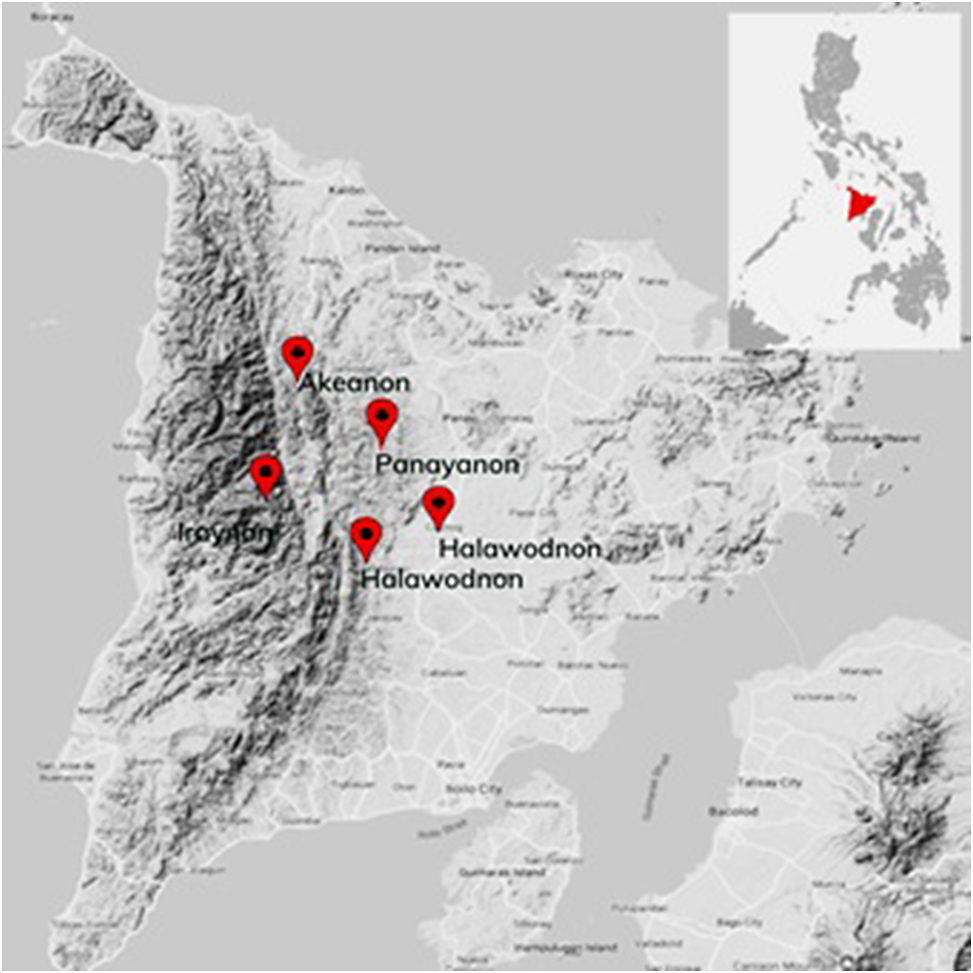
The Panay Bukidnon is a collectively large group of Indigenous mountain-dwelling communities located along the headwaters of major river systems in Central Panay, Western Visayas, Philippines (see Figure 1).Footnote 2 While a majority of specialists maintain that their ancestors were once seafaring and slave-raiding people, some communities have moved to the interior and more remote areas over time and have adapted to swidden agriculture (Jocano Reference Jocano2008; Magos Reference Magosn.d.).Footnote 3 Given their close affinity to the environment, they continuously enact cultural practices that match ecological specificities with cosmological and spiritual affordances.
The Panay Bukidnon community in Panay Island, Philippines. From Google Maps: https://commons.wikimedia.org/wiki/File:Panay_Island_Red.png and https://commons.wikimedia.org/wiki/File:Ph_fil_iloilo.png

In this regard, community life is replete with rituals and dance performances that reference the sound link between society and the environment, between human and more-than-human spaces. In several villages, the babaylan (spirit intermediaries) and other folk medicine practitioners continually perform their social and civic duties, which include officiating simple to complex rituals like the pahimalay, a rite during house building; the panimo, an agricultural rite before the first intake of newly harvested rice to appease spirits (Austria Reference Austria2015); and the pahampangon, a healing rite for a person who experiences coughing up or defecating blood (see Taton and Tambirao Reference Taton and Tambirao2025). All of these rites involve varying degrees of supplication and complexity of offerings to and for visible and unseen spirits. In large social gatherings such as weddings, binanog dance performances imitate the flight of the hawk-eagle (Tolentino Reference Tolentino2005; Muyco Reference Muyco2016). Moreover, its performance also alludes to the performer’s connections with heavenly and earthly entities (Muyco Reference Muyco2013b). In many ways, this parallel between society and environment is shaped culturally (Sahlins Reference Sahlins1976), which is constitutive of how the Panay Bukidnon situate themselves as a distinct cultural community and as a means of cultural identification.
Such a relational connection between humans and spirits is also exemplified in the expansive taxonomy of Panay Bukidnon vocal music forms and genres. The music-narrative renditions of the long, chanted epic stories collectively called sugidanon had foregrounded crucial cultural ideologues, making it a rich reference for social relations and customary law (Caballero et al Reference Caballero, Caballero-Castor and Magos2014), as a multilayered framework of and for reality, expressing themes on gender and power (Gowey Reference Gowey2019; Rebong Reference Rebong2019), and an explicative resource to reify beliefs on magico-spiritual and metaphysical phenomena. Meanwhile, other vocal music categories such as the ambahan (welcome joust), the duruyanon (lullaby), and the haya (dirge; songs for the dead) are context and function specific. The ambahan, for instance, has a twofold purpose: (1) to deliver inaugural salutations which contain narratives of exemplary and praiseworthy acts, if not as a rebuke to certain individuals; and (2) to deliver a joust against someone during formal events, such as in the hungaw (wedding), or in informal drinking gatherings, all of which involve the intake of pangasi (rice wine). On the one hand, the duruyanon helps lull children to sleep. The haya, on the other hand, are songs spontaneously performed for the deceased at wakes, funerals, or cemetery visits (Jocano Reference Jocano2008; Muyco Reference Muyco2016). It is commonly performed as a personal homage to the dead or as a form of emotional relief, in which denial and anger are publicly expressed (Taton Reference Taton2019). Like the sugidanon, many song-chant examples categorised within these genres are replete with narratives and stories related to the supernatural.
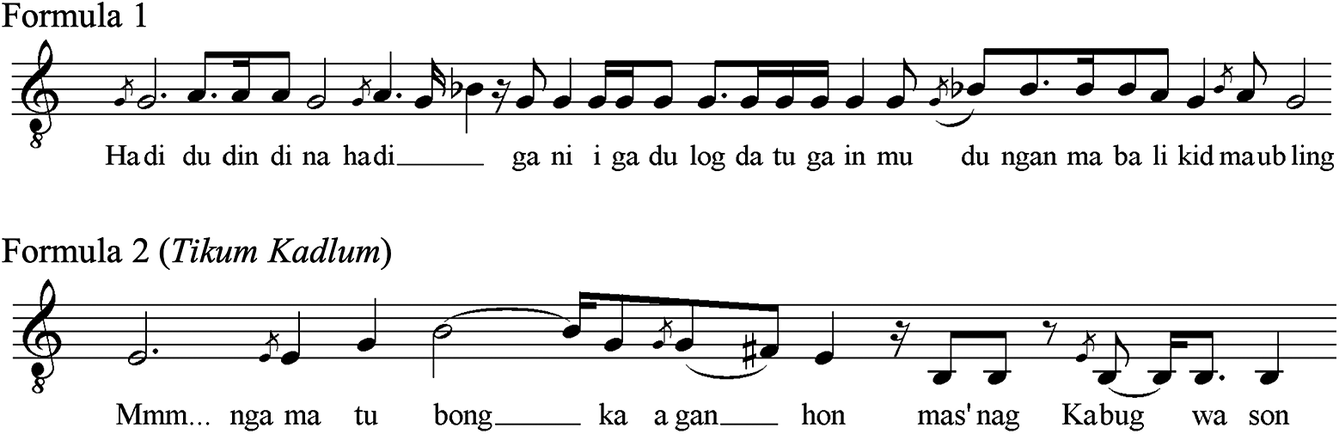
Musically, these vocal forms are categorically distinct in the way their limug are characterised. The limug often follows a particular melodic contour that is set to formula-driven texts, some of which are semantically meaningless. These specific markers, both the tune and the text, serve as preparatory or closing elements that help indicate the narrative’s genre. In the sugidanon, for example, the vocable “Mmmm…” and the phrases, “Hadi di dindina…” (Muyco Reference Muyco and Revel2013a) and “Naoy balawganday…” (Taton Reference Taton2015) are typically set to several limug that performers utilise as a preparatory exercise before evoking the narrative. Among practitioners in Calinog, Iloilo, these are characterised by an establishing pitch that ascends shortly, which is followed by a recto tono or undulating melodies, the phrasing and rhythm of which may be temporally extended and tonally expanded as desired depending on the chanter’s breathing. Three examples of formula texts are found below:
Formula
1
Hadi du dindina…
Hadi gani iga-dulog
Datu gainmudungan
Mabalikid maubling
I will start [the tale]
Where I last stopped
Where I last ended
That is where we’ll revisit
2
Mmm…
Mmm…
3
Naoy balawganday daliun
datu dugay-dugayun
pira-pira gid sugid sang anoy
sugidanon madali toltolanon
si inmanoy ponoon
si insay pohawaon
gasinmala sinmaylo
kaspan gatinmaliwan
Oh…everyone I’ll be quick
I will not prolong this anymore
I can tell this story with ease
For the tale is easy to situate
There from the start
At the beginning
For there is no other part
No other story there is
In Muyco’s (Reference Muyco and Revel2013a) study, this act of intoning, specifically in Formula 1, establishes the basis of the melody which ushers in the narrative of the chant in a diachronic fashion. The mangalimog, as she words it, opens with the phrase “I’ll start where I last stopped” that indicates the continuation of the plot described much earlier on another performance occasion. Formula 2, meanwhile, is more straightforward in that the melodic contour is chanted with a nasal or guttural hum using the particle “Mmm…” without the use of phrases. In other instances, for example in the epic Tikum Kadlum, this humming only establishes the starting pitch, followed by the early section of the narrative, set in an ascending and undulating contour (see Figure 2). Formula 3, however, differs in melodic contour that opens with a high-pitched tone that gradually descends to the chanter’s desired comfortable pitch centre. The text, though, parallels the propositional content of Formula 1 but is expanded to include the chanter’s wit, command, and mastery of the story. The closing melodic particle, often the last syllable of a word that the chanter chooses, is often protracted marking the end of a segment in the narrative. Meanwhile, in Lambunao, Iloilo, and Tapaz, Capiz, other means of pagpangalimug exist, for instance, “Odoy…,” which other practitioners perceive as more rhythmically paced and continuous.Footnote 4
Various limug used for sugidanon (epic), often chanted in free rhythm, with approximate pitches (+ or −). Transcription by Author.

Figure 2. Long description
The transcription consists of two horizontal musical staves.
Formula 1 is the top staff. It begins with a treble clef and an 8 below it. The melody consists of a dense sequence of eighth and sixteenth notes. Several notes feature an ‘x’ symbol instead of a standard notehead, indicating approximate pitch. Lyrics below the staff read: Ha di du din di na hadi ga ni i ga du log da tu ga in mu du ngan ma ba li kid ma ubling.
Formula 2 Tikum Kadlum is the bottom staff. It also begins with a treble clef and an 8. This melody uses longer note values, including dotted half notes and quarter notes, interspersed with sixteenth note runs. It includes a flat symbol, a sharp symbol, and several ‘x’ noteheads. Slurs connect several notes, indicating melismatic singing. Lyrics below the staff read: Mmm... nga ma tu bong ka a gan hon mas’nag Kabug wa son.
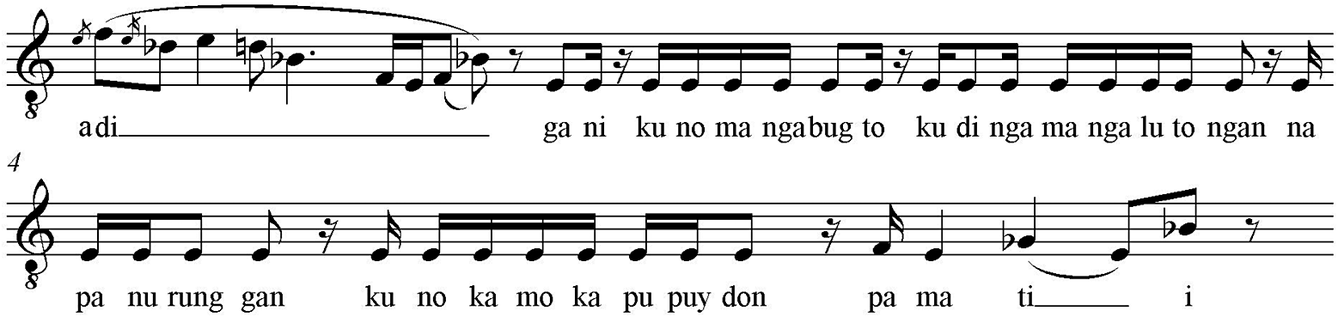
Like the sugidanon, the vocalising of a genre-specific limug is also present in other musical forms. Chanters commonly use tune sets or melodic formulae as a point of entry for the articulation of texts and, subsequently, the contextualisation of the narrative, thereby informing the listeners of the nature of performance. For example, in the ambahan, the opening cue word “Hadi,” the genre’s identity marker, is set to a distinctly high-pitched, undulating limug (see Figure 3), which signals to listeners that a welcome joust is about to begin. Roughly translated as “in this,” the cue is followed by a short acknowledgement to attending family and guests with the phrase, “gani kuno mga bugto, uduy mga lutungan” (that you my fellow brothers and sisters), which is chanted in a drone that freely follows the rhythm of speech syllables. For the Panay Bukidnon, this recognisable vocal-text frame instantaneously prepares everyone, with attention given to the salutations and pleasantries, if not indirect threats hidden in metaphor, conveyed in the repartee. This exchange of messages happens during informal socialisation, which is typically addressed to one’s kin as well as those outside of family lineage whom the chanters merge under the general label bugto (brother/sister). In cases of ambahan sung in a marriage ceremony, the limug acquaints and reminds both the couple and their kin of the newly forged social relations that entail the enactment of marital duties and social responsibilities for the married couple, respectively.
Limug of an ambahan (welcome joust). Transcription by Author.

Figure 3. Long description
The musical notation consists of two staves for a solo voice, indicated by a treble clef with an 8 below it, signifying a tenor or octave-shifted vocal range.
Staff 1:
- The first measure begins with a melismatic passage on the word ‘adi’, featuring a series of eighth and sixteenth notes with accidentals including sharps, flats, and naturals. A long horizontal line extends from the word ‘adi’ to indicate the held syllable.
- The following measures transition into a syllabic, rhythmic pattern primarily using eighth and sixteenth notes on a single pitch.
- Lyrics: ‘adi... ga ni ku no ma ngabug to ku di nga ma nga lu to ngan na’.
Staff 2:
- The second line continues the rhythmic, monotone style with occasional eighth rests.
- The final two measures of the staff feature a melodic rise and fall with a slur over the notes for the word ‘ti’.
- Lyrics: ‘pa nu rung gan ku no ka mo ka pu puy don pa ma ti... i’.
The duruyanon (lullaby), meanwhile, is sung in different sets of limug suited to individual preferences, with the tune sets being equally recognised by both the singer and the community members. Lullabies are initially hummed and, later, a song-text about the child’s qualities could be added. For example, in a well-known duruyanon, the chanter likens the fair child to a makopa tree (Syzygium malaccense) lush with pinkish fruit.Footnote 5 Other lullabies, however, do not possess this characteristic and are categorised based on the occasions where these songs are sung. For this essay, I utilise one common tune sung by a family of chanters in Calinog, Iloilo (Figure 4). In this particular limug, the chanter executes an undulating pentatonic tune in the minor mode that is repeated throughout the song verse.
Limug of a duruyanon (lullaby). Transcription by Author.

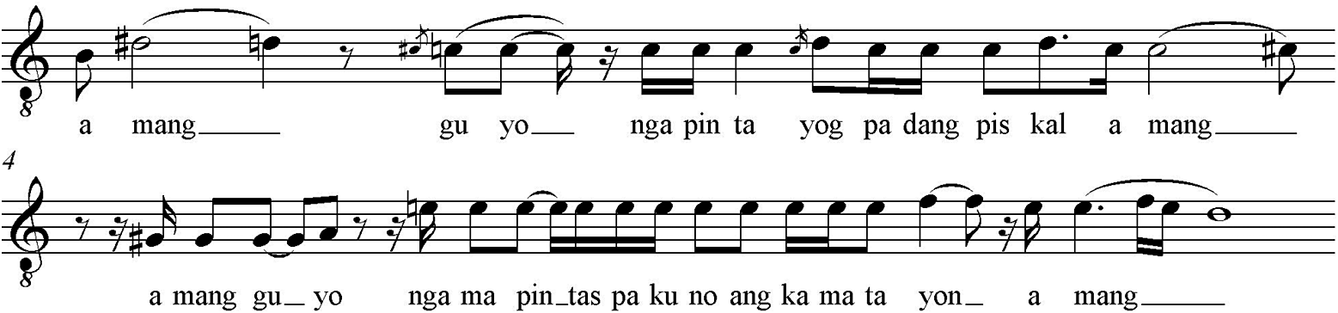
In the performance of a haya, chanters often intone the opening section of the music with phrasals like amang guyo or inang guyo and utilise the terms amang or inang to close the vocal segment (Figure 5). Referring to a deceased male or female ancestor within one’s lineage, these lexical injections are sung in a high-pitched, wail-like manner, often infused with guttural pauses as singers gasp for breath, shifting between singing and crying.
Limug of a haya (dirge or lamentation). Transcription by Author.

Figure 5. Long description
The musical score consists of two horizontal staves. Each staff begins with a treble clef containing a small number 8 at the bottom.
Top Staff:
The melody begins with an eighth note on ‘a’, followed by a half note with a sharp symbol on ‘mang’. A slur connects the sharped note to a natural note. The phrase continues with eighth and sixteenth notes over the lyrics ‘gu yo nga pin ta yog pa dang pis kal a mang’. Accidental symbols including sharps and naturals appear frequently above specific notes.
Bottom Staff:
Labeled with a small number 4 at the start. The melody continues with a series of eighth and sixteenth notes, some connected by beams and slurs. The lyrics read ‘a mang gu yo nga ma pin tas pa ku no ang ka ma ta yon a mang’. The final note is a whole note held over the word ‘mang’.
Throughout the piece, the vocal line is characterized by melismatic passages where multiple notes are sung to a single syllable, indicated by horizontal lines following the words.
In general, this process of opening and closing the segments of the narratives with phrasals induces greater tonal stability, structuring the entire musical performance as it progresses.
Besides the breath, specific timbral placement of a chanter’s limug also contributes to the voicing of characters in the narrative. For example, in the sugidanon, the character Taghoy, a whimsical spirit messenger, is often demonstrated with a constricted, high-pitched, child-like voice (Muyco Reference Muyco and Revel2013a). This vocal characterisation, however, is not evident in other genres, as these are more personal expressions and thus employ a timbre of the singer’s speaking voice, rather than using the voice to characterise a character within a narrative. What is common among these three vocal genres, though, is the spontaneous delivery of texts, a process glossed as gina-gato, that are commonly laced with highly metaphorical and figurative language. These words are strung in a tune formula that facilitates moments of pause where the chanter recuperates one’s ginhawa (breath), ensuring the flow and continuity of the narrative and the song. Ginhawa, for the chanters, is vital to the performance as it entails opening spaces where action can take place. In a study on instrumental music, such as the tulali (bamboo flute) playing and the binanog (hawk-eagle) music-making, Muyco (Reference Muyco2019) asserts that ginhawa, as a force, occupies sonic spaces which “becomes operational or effective when it is cycled back to the person who exhaled it” (42).
What this means is that music, as a concept and as a practice, flows with circularity. In the context of performance, music is thought to emanate from the mind, as a limug nga gina-isip, a thought-of sound concept that is manifested into audible sound through the breath (Muyco Reference Muyco and Revel2013a). In flute playing, that breath carries the voice concept along the instrument column, or, in the context of singing, within the respiratory cavities. Once the breath makes the voice concept perceptible as a sonic phenomenon, it re-enters the performer’s awareness as a sound concept, now evaluated according to the parameters of Panay Bukidnon aesthetics. This circularity of breath only happens when it establishes a flow within and across cognitive, physical, and temporal spaces during performance. Muyco (Reference Muyco2019) carefully explains that
Sound becomes sound when from the wellspring of one’s inner being there is a connecting respondent. Panay Bukidnons refer to this response and the continuity that the breath establishes a tayuyon (flow). This concept is part of sibod, a Panay ideology that is embodied in the pursuit of mastering structure and play in music-making as well as in dance. (42)
In vocal music, Taton (Reference Taton2019) observes a similar process in the performance of the talda, a musical repartee, in which the use of breath stops in the structuring of the limug (tune) that “gives a surge of energy back to the chanter linking and directing the flow of prior music-text material with the succeeding sections” (49–50).Footnote 6 In this sense, if applied to vocal music, ginhawa entails a demonstration of expressive and receptive sonic energy that establishes the limug’s melodic character, structural configuration, and narrative flow and continuity. In Muyco’s (Reference Muyco2019) words, “ginhawa is not a singular essence – it is coupled by another, and linked to another complementary energy, motion, or force” (42). This idea may be extended to how the performers operationalise the limug as an expressive force to tap into the awareness of the listening audience. In the performance of vocal music, the recognition of a genre-specific limug evokes an affective response, often harnessed from social and cultural memory, in the form of multiple, usually consonant, and sometimes conflicting narratives.
The limug and the narrativity of experience
In the earlier discussion, I have emphasised the importance of genre-specific limug in establishing the genre and in foregrounding subsequent musical texts. However, a music genre’s limug is more than a functional facet of performance: it is crucial in contextualising the narrative being rendered, which is subsequently recognised and responded to by the audience. These narrations carry inherent elements that performers and listeners recognise, perceive, and interpret, a process of “re-cognization of a text as narrative,” and what Monika Fludernik (Reference Fludernik1996) terms as “narrativity” (313). For Fludernik, narratives emerge from embodied social experiences intentionally portrayed through expressive media, such as text, speech, music, and others, in dynamic event sequences. Central to narrativity is the role of experience, which, for Caracciolo (Reference Caracciolo2012), “accounts for the representational dimension of narrative experientiality.” Embodied experiences, specifically those with high emotional and affective impact, are intentionally evaluated, foregrounded, and projected in the performance (Fludernik Reference Fludernik and Herman2003) against a shared background of perceptions, emotions, and values (Caracciolo Reference Caracciolo2012). Together, these determine the “narrativizing of the text” (Fludernik Reference Fludernik and Herman2003:244; emphasis in the original). The artistic (re)constructions embedded in a narrative are thus traces of real-life experiences brought by prior socialisation and interaction with the world (Caracciolo Reference Caracciolo2014). Narratives, in this sense, may foreground social, cultural, political, and spiritual contexts that are espoused by the text and beyond it.
In line with this thought, two sets of narratives in the performance of the Panay Bukidnon musical texts are demonstrated. The first one is the textual narrative, “the quasi-mimetic” elicitation of real-life experience (Fludernik Reference Fludernik1996). Here, quasi-mimetic means that the textual narrative does not directly produce lived experience but approximates it through the conventions of the genre. The qualifying term “quasi” here matters for musical texts; unlike prose narratives, limug only structures when and how propositional content becomes legible in text, so its mimesis of lived experience is mediated—through structural cueing, genre recognition, and affective priming rather than depiction. Because intoning serves as an identity marker and a tonal formulaic structure, the pagpangalimug, as a process, facilitates the performer in “tuning in” to prepare and direct the flow of song-texts.
The second is the contextual narrative, which is attributed to how the performer or listener constructs meaning by reading and interpreting it against social and cultural frames drawn from shared and collective histories. This reading beyond the song-text, for me, is a process of “tuning out,” where other narratives outside of the immediate narrative are invoked from personal experiences and from collective, if not ancestral, memory.
In the epics, limug serves as a musical precedent that firmly establishes rich narratives juxtaposed with everyday reality (Muyco Reference Muyco and Revel2013a; Caballero et al. Reference Caballero, Caballero-Castor and Magos2014). However, unlike the highly descriptive and expository nature of the epics, where lives and characterisation of prominent protagonists like Humadapnon are captured through the evocative execution of the limug, the narrative contexts of other Panay Bukidnon vocal music forms are bereft of description, or, if explicit, are highly metaphorical, if not undisclosed. Thus, the limug facilitates the layering of logical and patterned threads of “texts,” both visual and rhythmic, into “multiple drafts” (Dennett Reference Dennett1991),Footnote 7 whose references are drawn from the performer’s experiences. Intoning may simultaneously serve as a sieve where specific narratives are omitted within the text, while recalling narratives beyond it may enrich the text’s narrativity.
Metaphysical narratives in Panay Bukidnon music-texts
Many, if not most, Panay Bukidnon musical narratives are performed to evoke a sense of wonder, with stories closely tied and related to nature and the metaphysical. In the sugidanon (epic) alone, the narrative is replete with scenes in which characters engage in brute, martial altercations across layers of cosmological zones, transform into feral animals or inanimate objects, and demonstrate magical prowess and abilities set in a lucid maritime environment. In other vocal forms, the natural world is often thought to intersect with, if not conflate with, the spiritual realm. Several narratives describe and allude to deities, enchanted beings, spirit messengers, and supernatural creatures that inhabit agricultural lands, riverine systems or waterways, and natural landmarks, as well as other spiritual phenomena.
For instance, in the ambahan titled Bukay Isda (literally, “White Fish”), a rock formation locally known as Bukay Isda is referenced in a song-text as palhi or mari-it (spiritual zones; dangerous areas), where supernatural entities reside and where metaphysical occurrences take place. The rock is found in the deeper parts of the Jalaur River (also referred to as Halawod), located between Mount Patawan and Mount Dila-Dila (see Figure 6), whose peaks were reshaped into a pataw (a piece of chicken meat) and a dila (tongue), respectively, by the great flood, Anaw (Pumaren Reference Pumaren2022). Below is a chanted narration of Amang Baoy (2015, 29 March):
Hmmm…
Hmmm…
Nga may inmilig
There is a stream of water
Dulang gani sa Handog
In a place called Handog
May tubig sa Halawod
There is water in the Halawod
Sa suba na Taub-taub
In the river called Taub-Taub
Nga ginalukuban ka Bukay na Isda
Where rests the Bukay na Isda
Sapat na rumba-rumba
A huge fish, a rumba-rumba
Nga ginaanunaw kuno day bukid
There, a fair mountain overlooks it
Nalungay ka buntukon
Where the foothills dawn upon it
Buntukon kuno sa Patawan
Patawan, the mountain is called
Bukid ka Sinandigan
Oh, the Sinandigan Mountain
Nga inaglihi kunong bukid
Such is a dangerous peak
Mari-it na buntukon
A mountain where spirits lie
Nagpakaikod kuno say tigda
Counsel is told by the elders
Nagbilin kuno say magurang
And disclosed by the wise
Na hugiwan gid namu pagpabay-an
One must neither leave it
Indi pagpaturasan
Nor one forsake it
Irugal nga harimuyngan
In this place of refuge
Inandaan balawda dayon
Here in this abode
Bukay Isda (left) and the Alawihaw River (right). Photo still from Sine Panayanon (Reference Panayanon2012).

Here, the limug’s function as a textual narrative is thin as the song-text carries most of the propositional content. However, the contextual narrative that follows the intoning, stories drawn from the people’s collective memory, is richer as the ambahan about the rock formation is understood not only as a singular narrative but as an intersection of multiple narratives. Among the residents of Agcalaga, the area’s reputation as a mari-it (sacred/dangerous zone) stems from a legend about Alawihaw, a maiden who once lived there (Norio “Mirasol” Lozada, pers. comm., 27 August 2017). Insilada (Reference Insilada2019) writes that the god Burulakaw punished the maiden for her infidelity to her husband, Sarwagan. After learning of Alawihaw’s illicit deed, Sarwagan implored the god to intercede, cursing his wife to turn into water; hence, the name of the current river. The other man who escaped by swimming upstream after the affair was caught, was struck by lightning, and subsequently turned to stone, forming the Bukay Isda. Today, the dangerous churning waters and strong current of the Alawihaw in the Jalaur River are believed by locals to claim lives regularly.
For the older generation, the Bukay Isda is a testament to the phenomenon commonly known as baliw (literally “to change,” “to transform,” or “to transfigure”).Footnote
8 This event, as retold in the hinun-anon (folk story) titled Tibang-Tibang, ensued out of the jealousy of the female deity Tibang-Tibang, who conjured down a fiery chasm onto the world. In the tale, Tibang-Tibang was made a dapli (additional wife) of the protagonist Labaw Donggon (or Abaw) on the condition that Matan-ayon, his first wife, had set. In the agreement, Labaw Donggon should sound the budyong (a shell trumpet) upon his arrival in their abode with his new wife. Tibang-Tibang, however, requested Abaw to do the opposite as a provision for their marriage, thus contradicting Matan-ayon’s wish. Upon returning to the heavens, Abaw did not heed Tibang-Tibang’s request in favour of his first wife’s bid. Because of this, the angered Tibang-Tibang conjured and hurled fire on earth, causing chasmic devastation, and inflicted a curse—the baliw or tigbaliw—that petrified all living creatures to stone. Those who escaped the rain of fire were either those who had ascended to the heavens and became future deities or those who had swum into and submerged themselves under bodies of water. In this account, two survivors named Lampunaya and Agtang Layun-on, with their heads exposed to the scorching heat of the fire, curling their hair and darkening their skin as they waded underwater, became the first Ati, the Negrito-type inhabitants of the island, distinct for their dark brown skin and curly hair. Subsequently, they retold the story to the next generation of Ati, who also shared it with migrants from the Island of Borneo, led by Datu Puti, who settled on the Island in the 13th century. Romulo “Amang Baoy” Caballero (pers. comm., 29 March 2015), a Panay Bukidnon chanter and elder, recounts this in a sugidanon (epic) performance:
Tibang-tibanga’y banwa
Shudder the recesses of the earth
Balikida’y dinun-an
Look back at the earth
Baliwa’y kalibutan
Rain fire will be cast on the world
Hatagan lang si Kulabo Kulambaw
And be given to Labaw Donggon
Similarly, in community lore, a huge fish, or sometimes alluded to as a balyena (whale), coursing upstream in the riverine depths of the Jalaur River had turned to rock, a stone feature the community refers to as the Bukay Isda.
In this sample, intoning acts as a trigger for narrativisation. This, however, is contingent upon the listener’s degree of enculturation to various narratives from the community’s knowledge archive. This contrasts with the case of Amang Baoy’s ambahan before the legislators in which the level of engagement among his audience is cursory, if not merely a spectacle, as the chant is framed within as just performance in 2018. With heavy infrastructure development programs and the ongoing construction of a mega dam (Balani and Mangilog Reference Balani and Mangilog2016) (see Figure 7),Footnote 9 flooding of agricultural lands, the diversion of waterways, and the destruction of natural landmarks, such as the Bukay Isda, constitute “a loss of the intangible” as well as “memories and stories that give meaning to indigenous lifeways and identity” (Gowey Reference Gowey2016:6). Thus, the ambahan performed in various state-sponsored events, masked as an opening welcome address or, in some instances, as a cultural presentation, did not reach its intended audience as politicians, legislators, and other government officials do not have a native’s shared cultural understanding and proper valuation of the said landmark. However, for Panay Bukidnon locals, the performance evokes strong criticism, whether intentionally embedded in the chant or not, that prompts recall of parallel contemporary narratives, for example, geography-altering infrastructure projects, which resonate deeply with their experience as Indigenous peoples. Through performance, local Panay Bukidnon elders utilise the limug and the narrativity of the ambahan as a form of covert resistance, if not as an explicit response to the silencing, amidst the threats and possible destruction of important geological formations and natural landscapes which “hold deep cultural significance as markers of their settlement in the area, both spatially and temporally” (Gowey Reference Gowey2016). In this sense, narratives fulfil a metacognitive function and link the narrative performance, including its sonic medium, the conventions that frame the text, and the contexts in which these are told. As such, pagpangalimug, as an aid to narrativisation, provides avenues for locals to surface a multitude of stories whose contexts are dependent on the interpretation of their lived realities.

The pagpangalimug in other vocal genres also elicits narrativisation which contains explicit and implicit themes related to the physical and the non-material worlds. In a duruyanon chant (see Figure 8), Tuohan,Footnote
10 a respected elder and chanter in the community, narrates the story of San Pedro Binagro, a male tumawo (enchanted being), who also goes by the name San Jose, and is believed to inhabit a section of a forest that was intended for clearing for kaingin (swidden farming). In the song-text, San Pedro can miraculously prepare a feast of specially grown rice grains complemented by a unique type of fish. This celebration is for his successful capture of the woman named Inggay, also known as Otayan, who was at that time afflicted with panutok (curse). The tumawo had grown fond of the woman whom he described as possessing beauty similar to his mother, Kenugma, also known as LampunayaFootnote
11 (Federico “Tuohan” Caballero, pers. comm., 14 February 2015).Footnote
12
Si San Pedro Binagro
San Jose Binagro
Si San Jose Pigado
San Jose Pigado
Humay nga tinduganon
The natindugon rice grains
Isda nga budlunganon
And the budlonganon fish
Sa rumboy anang himbis
With large scales
Suli it palik palik
And inverted fins
Madaligan tay Inggay
Inggay, oh what a beauty
Madawgan tay Otayan
Otayan, oh, such a fair maiden
Olambit kay Kenugma
You and Kenugma are alike
Ogot kay Lampunaya
A splendour similar to Lampunaya
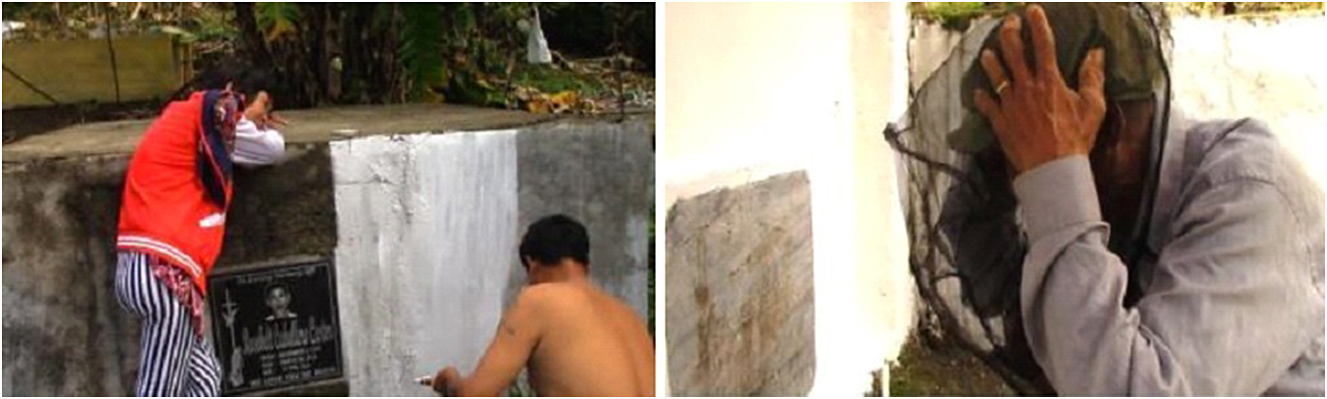
Abyaran rendering a haya (left) and Paino lamenting for his parents during All Souls’ Day at Garangan, Calinog (1 November 2018). Photos by Author.

Years later, in one of my fieldwork immersions in 2016, Sandigan shares through chant another duruyanon in the same intoned tune frame after hearing me sing the former to entertain myself. Titled “Nabalatik Si Ga-ay,” the lullaby narrates the unfortunate death of Ga-ay, the daughter of the tumawo Mateo, who was left trapped in a balatik, a traditional ballista-type trap commonly used for wild pigs (Rodolfo “Sandigan” Caballero, pers. comm., Garangan, Calinog, 10 August 2016). In the story, locals had set up the device in a forest cover, aspiring to capture a pig for its prized game meat. Without realising that the area they encroached upon was the territory of some enchanted beings, the hunters had accidentally ensnared Ga-ay instead, causing her death. Mateo was deeply infuriated by the transgression and immediately desired retribution. However, his anger was appeased when the culprits paid their respects to the deceased by dressing Ga-ay in expensive garments and adorning her body with jewels in a stately burial (Teresita “Abyaran” Caballero-Castor, pers. comm., Mandurriao, Iloilo City, 1 September 2016).
Aydan tatun sa Mabkad
In a place known as Mabkad
Aydan sa Maburak
In the locale called Maburak
Na balatik duy Ga-ay
Ga-ay was ensnared in a pig’s trap
Nabkas aman Mateo
She was caught, Mateo said.
Baubaon ta si Ga-ay
Let us revenge Ga-ay
Baslon aman Mateo
All should be settled, said Mateo
Tatay ka tumawo
Father of the enchanted being
Inmano lamay baslon
But what is it to redress for?
Ano may baubaon
Is there something to avenge for?
Sirado may dayaw na
For her clothes are the best in quality
Husto may hirabong na
She was dressed lavishly
In this particular narrative, the Panay Bukidnon recognises the demarcations of particular territorial borders between humans and spirits. Sandigan recounts that zones considered mari-it or palhi (dangerous areas) are often avoided as a courtesy and out of respect for the unseen in a shared kalibutan (space).Footnote 13 The narrative also illustrates how proactive and affirmative actions can redress grievances and transgressions. In local customary law, Sandigan explains that deceased individuals are usually outfitted with lavish and proper sangkap (adornments) as a tribute to a beloved and as an expression of respect, if not a redress agreed by both parties, to the departed. Such practice, as the narrative suggests, is extended to the spiritual world.Footnote 14
This account of Sandigan is interesting because when the duruyanon vocal-narrative frame is finished, the sonic experience evoked a unique recollection of stories from memory. In this case, intoning facilitated the “opening” of cultural memory, foregrounding other narratives and customary contexts which, through performance, become reinforced and re-embedded in contemporary life practice.
The haya (dirges; lamentations; songs for the dead), meanwhile, is another important performance that conveys contextual narratives beyond the mere performance of the actual song-text. During All Souls’ Day in November 2018, I accompanied Abyaran, now in her 60s, to a local cemetery at Garangan, Calinog, where her deceased son was interred. Upon reaching the niche, she lit a candle and, with intense emotion, chanted a haya, expressing a yearning and a desire to accompany her son’s soul to Madya-as,Footnote 15 a sacred mountain considered by locals to be the haven of the souls. The swelling of the emotional atmosphere also affected, through social contagion, those who could hear the chanting. Abyaran’s brother Paino,Footnote 16 who at that time was sitting beside the niche of their deceased parents, immediately donned the black veil he brought, joined the cacophony of wails, and lamented death’s grip on a good life that is yet to wither.
Besides the thoughtful, mournful, and invariably imploring messages delivered by the performers, the limug of the music opens up spaces where metaphysical-spiritual narratives about the dead are openly discussed. According to stories, souls traverse a riverine area called Moroboro,Footnote
17 where souls are purified. It is on this site that the perfumes and other aromatics placed on the body of the deceased will be washed off. After this, several inquiries from various spirit guardians are made before the soul is allowed to continue its journey, and once the souls reach the mountain, they take a liquefied form and are stored in individual bowls. The souls remain in this fragile state, subject to imminent harm coming from supernatural beings in the spirit world.
Amang guyo…
Amang guyo…
Hugalida kami pa-Madyaw
Bring us to Madyaw
Ubusa kami pa-Madya-as
Take us all along to Madya-as
Amang guyo…
Amang guyo…
Kun may kalbangan pa lang pa-Madyaw
If there is just a path to the mountain
Amang guyo…
Amang guyo…
Kung may dalan pa lang pa-Madya-as
If such a path exists to the slopes
Buyuboy kita mambos
Together, we go down
Buylog kita mana-og
Hand in hand, to that pass
Gasanonton koy agi
There, I follow your lead
Gasondon koy bagena man
I will go after your call
Here, Abyaran’s haya informally elicited, through conversation, the idea of a possible recovery of the soul from the land of the dead if only she had the capacity to do so. In Panay Bukidnon lore, there is general fear that, without the post-funerary ritual called hamwat, Mulang, a human-like monster, would sip the contents of the bowl and completely devour the soul and, therefore, the spirit essence of the deceased. Through propitiation, wherein the soul is sculpted back to its human-like shape in the process called pabilog (moulding), souls can achieve their final etheric form, which can subsequently traverse to their final abode in Madya-as, assuaging fears that these spirits may wander back into the community and bring misfortune. The ritual is performed by a spirit medium (babaylan), who, in a very elaborate process that spans days, commands Sabug, a spirit messenger, to fully redeem the soul from the custody of Mulang, and to give the water of life, which imbues the soul with ginhawa (breath).
What the pagpangalimug evoked is an aggregate of stories that, in the Panay Bukidnon experience, are often personal and lived realities. Evoking narratives on customary practices was particularly deliberate; it contextually informs the audience that her course of action, that is, to go to Madya-as, parallels local beliefs about soul journeys. The vocal-narrative of the haya, thus, is not just expressive as a song-text on its own; it also contributes to the foregrounding of other metaphysical narratives—narratives that inform reality, reify native customary practices, and shape contemporary Indigenous life.
Conclusion
In this essay, I have stressed that the process of pagpangalimug is central to the foregrounding of experience in narrative. This process operates in two directions: a “tuning in,” where musical structure, aesthetics, and the vocal body are prepared, and a “tuning out,” where narratives are sieved from personal and shared memory which are then grounded to a specific limug. In these processes, the performer enters a state of narrativisation, in which particular stories are evoked in memory through sonic prompts. Here, the music becomes a proto-narrative and pagpangalimug, as a process, facilitates narrative foregrounding, “tuning in” both the chanter’s and the listener’s experiences, expectations, and embodied knowledge within the narrative frame. At the same time, receivers and the general audience, upon recognition of the narrative, weave their own embodied narratives with the one being performed—narratives that contextually ground what was sung while “tuning out” those that are unrelated to the vocal-narrative frame; for example, intoning in sugidanon (epic) ushers the narration of exploits of heroes, while intoning the haya (dirge) leads to narratives about the travel of the soul in the afterlife. Thus, the limug, as a musical component, mediates the possibilities of revealing consonant and, sometimes, diverging narratives that could enrich the primary narrative material.
The few accounts of the ambahan, the duruyanon, and the haya represent a larger body of metaphysical, spiritual, and mythical stories that demonstrate the Panay Bukidnon community’s inner flow of consciousness, shared memory archive, and Indigenous psyche. These narratives become textually meaningful, grounded by context, and sustained as a value-laden experience. Thus, the creation of metaphysical (hi)stories and narratives closely linked with a particular limug imprints as a “‘special memory,’ of a shared experience between participants who, during the co-creation imbue the memory with ‘meaning’” (Revel Reference Revel1996:9). Meaning, therefore, is not only generated by the presentation of the primary narrative; it diverges with other narratives constructed not solely by the performer but also by the audience. In this sense, pagpangalimug has become important in this process. It provides moments where narrative experiences can be elicited in the foreground. Intoning, thus, provides opportunities to voice multiplicitous, embodied narratives in musical performance.
Glossary
- ambahan
-
welcome joust; salutatory songs during drinking
- babaylan
-
spirit intermediaries
- balatik
-
a ballista-type trap, ideally for wild pigs
- baliw
-
to change, to transform, to transfigure
- binanog
-
hawk-eagle dance performed during weddings, among others
- bugto
-
brother/sister
- dapli
-
additional wife
- duruyanon
-
lullaby
- gina-gato
-
spontaneous delivery of text
- ginhawa
-
breath (Panay Bukidnon)
- goynawa
-
breath (Manobo)
- haya
-
dirge; lamentation; songs for the dead
- hamwat
-
post-funerary rite intended to reshape the soul from its watery state
- hungaw
-
wedding
- kaingin
-
swidden farming
- kalibutan
-
space; world
- limug
-
voice
- mari-it
-
sacred zone
- pabilog
-
process of moulding the soul back into shape
- pagpangalimug
-
vocality or voicing; the act of intoning
- pahampangon
-
a healing rite for a person who experiences coughing up or defecating blood
- pahimalay
-
a rite during house building
- palhi
-
sacred zone
- pangasi
-
rice wine
- panimo
-
an agricultural rite before the first intake of newly harvested rice to appease spirits
- panutok
-
curse
- sangkap
-
body adornments
- sibod
-
a Panay ideology that is embodied in the pursuit of mastering structure and play in music-making as well as in dance
- talda
-
musical repartee
- tayuyon
-
flow
- tulali
-
bamboo flute
- tumawo
-
an enchanted being
Acknowledgements
This essay is an updated and expanded paper read during the 45th World Conference of the International Council of Traditional Music (now, the International Council for Traditions of Music and Dance) in Bangkok, Thailand, in July 2019.
I am indebted to the comments of Dr Ricardo Trimillos, Dr Felicidad Prudente, Dr Masaya Shishikura, and Dr Alicia Magos, as well as the suggestions of Rennel Lavilla, Christian Jeo Talaguit, and Dr David Gowey. I am thankful to the Caballero family for their hospitality throughout my research.




 Open access



