

The existing literature has, in general, demonstrated that a lack of financial literacy is found to be associated with poor financial decisions or lower financial wellbeing; individuals with low financial literacy are less likely to invest in the stock market (van Rooij et al., Reference van Rooij, Lusardi and Alessie2011), to save for post-retirement (Lusardi and Mitchell, Reference Lusardi and Mitchell2007), to accumulate wealth (Lusardi and Mitchell, Reference Lusardi and Mitchell2008), are more likely to take out high-cost mortgages (Moore, Reference Moore2003), to have debt problems (Lusardi and Tufano, Reference Lusardi and Tufano2009), and to have incurred a loss from sub-prime mortgages during the 2008 financial crisis (Gerardi et al., Reference Gerardi, Goette and Meier2010). However, the mechanisms by which financial literacy leads to the reported outcomes have not been fully explored – Why or how do financially literate people prepare for future such as retirement? Planning for retirement is an important long-term financial decision that matters a great deal for life post-retirement when one is usually no longer earning. Under-saving for retirement will result in a dramatic drop in income, consumption, and life quality. The mechanism in which financial literacy is associated with preparing for retirement is a research topic of both theoretical and practical importance.
This study explores the possible channels through which financial literacy can play relevantly positive roles in the three phases of a financial decision-making process in a financially dominated life situation, using the taxonomy suggested by Daxhammer and Facsar (Reference Daxhammer and Facsar2012) – information perception, information search and evaluation, and decision-making and implementation. This study hypothesizes the phase-by-phase roles of financial literacy, that is, an increase in one's awareness of post-retirement living needs, the ability to compare alternative financial products, and the ability to prepare for retirement.
Existing literature also suggests that the reason people are not saving enough is primarily behavioral biases or heuristics, such as self-control and procrastination (Thaler and Shefrin, Reference Thaler and Shefrin1981), status quo bias (Samuelson and Zeckhauser, Reference Samuelson and Zeckhauser1988) and peer effect (Duflo and Saez, Reference Duflo and Saez2002). It is plausible that individuals succumb to behavioral biases because they lack financial literacy. For instance, if people do not understand their financial choices or cannot grasp general concepts, they can easily make mistakes and fall back on simple heuristics (Agnew, Reference Agnew, Baker and Nofsinger2011). This study explores the indirect or mediation effects of financial literacy – financial literacy may contribute via a reduction in behavioral biases.
The empirical tests provide evidence as to the effect of financial literacy on the financial behaviors or biases related to saving for retirement, by utilizing a dataset generated by a survey conducted by Japan's central bank (Bank of Japan), conducted during 2015 on 25,000 Japanese respondents for a total of 51 questions. The richness of data and information enables more rigorous empirical tests which shed new light on the relationship between financial literacy and behaviors. The survey questions range across a wide range of financial literacy questions, financial behaviors including retirement saving and investment in financial products, as well as behavioral tendencies or heuristics. The survey comprised 30 financial literacy questions ranging from inflation, interest, spending, risks, pension, and insurance. As more than general financial literacy is required for the decision of saving for the future, I use the respondent's answers to these 30 questions to compile a comprehensive financial index using factor analysis. The primary analyses are based on non-student respondents aged 20–60.
The empirical results can be summarized as follows. First, similar to studies conducted in the USA and some European countries, Japanese respondents are not uniformly distributed in their understanding of financial information. For instance, 43% of respondents fail to understand the relationship between inflation and purchasing power, and 45% fail to understand compound interest rates correctly. Second, financial literacy is associated with a comparison of alternatives when investing in financial products such as stocks, mutual funds, mortgages, or life insurances. Such prudent behaviors help respondents make choices that are less costly or better fit one's needs or investment goals, achieving the saving/investing goals more efficiently and effectively. Third, the lack of financial literacy predisposed an individual to biases relevant to financial decisions. Respondents with lower financial literacy manifest a greater degree of the present time or loss aversion bias. Such biases may have influenced respondents to the effect that they refrain from saving at all or fail to follow through with rational investment strategies. Lastly, financial literacy helps one be better able to perceive post-retirement lifestyle, and to implement a saving/investment plan, after controlling for the effects of other possible factors. This is conducive to a higher chance of successfully securing funds necessary for post-retirement life. Additional tests also find that financial literacy not only contributes directly to saving for retirement but also indirectly via a reduction of behavioral biases, although the indirect effect is only modest compared with direct effect.
This study makes several contributions. While previous studies have documented the positive effects of financial literacy on financial decisions, the mechanisms in which financial literacy plays a role have not been fully explored. The empirical results establish that financial literacy is associated with those behaviors or biases relevant in the different phases of saving decision for retirement – it increases one's awareness of post-retirement living needs and the ability to compare alternative financial options, and reduces behavioral biases, which eventually, directly and indirectly, enhances one's ability to save for retirement. The results complement the findings of previous studies that people with higher financial literacy are more likely to invest in the stock market and accumulate greater net wealth (Lusardi and Mitchell, Reference Lusardi and Mitchell2008; Behrman et al., Reference Behrman, Mitchell, Soo and Bravo2012; Gustman et al., Reference Gustman, Steinmeier and Tabatabai2012; van Rooij et al., Reference van Rooij, Lusardi and Alessie2012; Jappelli and Padula, Reference Jappelli and Padula2013). This connection can be explained by the results of this study that more financially literate people are less subject to biases, allowing them to generate greater wealth from investments. Previous research finds that more financially literate people tend to choose mutual funds or take loans with lower costs or fees (Moore, Reference Moore2003; Disney and Gathergood, Reference Disney and Gathergood2013; Klapper et al., Reference Klapper, Lusardi and Panos2013), which can also be attributed to making use of financial knowledge to search for information and compare alternative products.
In addition, while most previous studies use only three or four questions primarily related to inflation and interest to measure financial literacy, this study develops a comprehensive measure. An important decision such as saving for retirement required more than general financial literacy. Both theoretical and empirical results illustrate that multiple dimensions of financial knowledge are relevant in assisting or guiding one's prudent financial behaviors. Some common knowledge of spending, financial products, markets, and the associated risks is necessary for an informed decision-making process, at least in the decision to save for the future.
Furthermore, the results in this study can have implications for the question of whether financial education can be effective in promoting prudent financial behaviors. There is little consensus in the literature on the efficacy of financial education (Hastings, et al., Reference Hastings, Madrian and Skimmyhorn2013), even though positive effects of financial literacy have been reported. For instance, Clark and d'Ambrosio (Reference Clark, d'Ambrosio and Lusardi2008) show that while individuals attending employer-sponsored seminars have intentions to improve savings behavior after attendance, they do not necessarily follow through. Choi et al. (Reference Choi, Laibson and Metrick2002) find similar tendencies. The results in this study can provide supporting evidence for financial education aiming to increase financial knowledge regarding interest, inflation, risk-and-return, spending, insurance, and pensions. Greater financial literacy via focused education may have the potential to mitigate biases and prompt prudent financial decision-making, increasing one's financial welfare. Such questions await further research in the future.
1. Literature review and hypotheses
1.1 Literature review
Behrman et al. (Reference Behrman, Mitchell, Soo and Bravo2012) define financial literacy as ‘the ability to process economic information and make informed decisions about household finances.’ In practice, questionnaires are used to quantify an individual's financial literacy. In most studies, an individual is asked to answer three or four questions regarding inflation and interest rates (Lusardi and Mitchell, Reference Lusardi and Mitchell2008; Choi et al., Reference Choi, Laibson and Brigitte2010; Disney and Gathergood, Reference Disney and Gathergood2013; Jappelli and Padula, Reference Jappelli and Padula2013; Klapper et al., Reference Klapper, Lusardi and Panos2013; Von Gaudecker, Reference Von Gaudecker2015; Gathergood and Weber, Reference Gathergood and Weber2017). Exceptions are Behrman et al. (Reference Behrman, Mitchell, Soo and Bravo2012), which asked 12 questions, and van Rooij et al. (Reference van Rooij, Lusardi and Alessie2012), which asked a total of 16 questions. The justification for using only a limited number of questions to measure financial literacy is that knowledge pertaining to interest rates can be a good predictor of one's financial literacy. While some studies simply use the percentage of correctly answered questions to proxy one's financial literacy, some studies, e.g., Von Gaudecker (Reference Von Gaudecker2015), Klapper et al. (Reference Klapper, Lusardi and Panos2013), van Rooij et al. (Reference van Rooij, Lusardi and Alessie2012), use factor analysis or principal component analysis to compute a composite index to be suited to empirical tests. The current study uses an index based on a larger set of questions related to financial knowledge in a variety of dimensions.
Previous studies have documented systematic variations in financial literacy that can be explained by demographic and cognitive factors. In general, those with lower financial literacy are more likely to be elderly, female, unemployed, less healthy individuals or households (Agarwal et al., Reference Agarwal, Driscoll, Gabaix and Laibson2009; Calvet et al., Reference Calvet, Campbell and Sodini2009; Jappelli and Padula, Reference Jappelli and Padula2013). Higher cognitive ability, manifested in higher mathematical performance during the teens or higher education attainment, is also associated with higher financial literacy (Jappelli, Reference Jappelli2010; Jappelli and Padula, Reference Jappelli and Padula2013; Gathergood and Weber, Reference Gathergood and Weber2017). In addition, people with home-ownership, or higher income, higher property value, or less consumer debt are found to be more financially literate (Disney and Gathergood, Reference Disney and Gathergood2013; Gathergood and Weber, Reference Gathergood and Weber2017). In this current study, the empirical studies account for these demographic and socioeconomic factors as control variables in explaining an individual's financial literacy.
One of the most important questions in the literature involves the implications of financial literacy. Previous studies conducted in different countries have consistently reported positive effects of financial literacy on prudent financial behaviors. For instance, more financially literate people are more likely to avoid the disposition effect (Dhar and Zhu, Reference Dhar and Zhu2006), plan for retirement (Lusardi and Mitchell, Reference Lusardi and Mitchell2008), shun mutual funds with expensive fees (Choi et al., Reference Choi, Laibson and Brigitte2010), use loans or other financing sources with lower interest cost (Moore, Reference Moore2003; Disney and Gathergood, Reference Disney and Gathergood2013; Klapper et al., Reference Klapper, Lusardi and Panos2013), are less likely to experience debt problems (Lusardi and Tufano, Reference Lusardi and Tufano2009), and diversify stock portfolios (Von Gaudecker, Reference Von Gaudecker2015). Von Gaudecker (Reference Von Gaudecker2015) also concludes that financial literacy may supplement professional advice. These results are also consistent with the finding that people who are more financially literate accumulate greater wealth (Lusardi and Mitchell, Reference Lusardi and Mitchell2008; Behrman et al., Reference Behrman, Mitchell, Soo and Bravo2012; Gustman et al., Reference Gustman, Steinmeier and Tabatabai2012; van Rooij et al., Reference van Rooij, Lusardi and Alessie2012; Jappelli and Padula, Reference Jappelli and Padula2013). However, the mechanism through which financial literacy contributes to financial behaviors or outcomes is not clear. This current study aims to fill the gap by advancing some possible channels through which financial literacy can contribute to an individual's saving behavior for the future.
1.2 Hypotheses of the effects of financial literacy
This study focuses on an individual's preparation for post-retirement life, which is a substantive decision in one's financial life and has been the subject of previous research. How can financial literacy have an impact on the process of saving for retirement? Daxhammer and Facsar (Reference Daxhammer and Facsar2012) suggest that there are three phases of a decision-making process in a financially significant life situation (Loerwald and Stemmann, Reference Loerwald, Stemmann, Aprea, Wuttke, Breuer, Koh, Davies, Greimel-Fuhrmann and Lopus2016). Financial literacy, ‘the ability to process economic information and make informed decisions about household finances’ (Behrman et al., Reference Behrman, Mitchell, Soo and Bravo2012), can play an important role in the process, resulting in decisions with varying degrees of quality.
During the first phase of information perception, investors create a picture of their environment to reduce the uncertainty in the process. The intensity of information perception influences to what extent existing information can be used, or what additional information from external sources is required and acquired via active searching. In the context of saving/investing for retirement, investors need to be able to imagine their post-retirement life, estimating the amount of living expenses needed to maintain a certain desired living standard. Financial literacy, including knowledge of spending behaviors, can help investors grasp their post-retirement living expenditures. Financial literacy can also increase efficiency and reduce costs associated with information searching and acquisition. Based on the aforementioned, the following hypothesis can be formulated:
H1: People with greater financial literacy are more able to be aware of their post-retirement needs and know their estimated living expenditures for post-retirement life.
In the second phase of information processing and evaluation, investors consider the relevant information to prepare for the decision. In order to make an informed decision, investors need to compare alternative options in terms of return and cost. Decisions in these matters can be considered substantial enough to merit one's time and effort being spent on information search and comparison. Therefore, a broad range of knowledge is necessary when investors are making financial decisions in purchasing stocks or funds, taking out a mortgage or buying long-term insurance policies. Comparing alternatives can be beneficial by saving costs such as fees or finding a more suitable product to fit one's needs.
H2: People with greater financial literacy are more likely to compare alternatives when making financial investments.
The final phase of decision making and its implementation then completes the process of decision making. In the context of saving for retirement, this is the stage in which an individual formulates and implements the plan to meet the financial needs post-retirement. Financial knowledge related to markets, risk, investment products, and so on helps one in implementing his or her saving plan.
However, it has been reported that attitude toward money influences behaviors regarding saving for life post-retirement (MacFarland et al., Reference MacFarland, Marconi, Utkus, Mitchell and Utkus2004). Thaler and Shefrin (Reference Thaler and Shefrin1981) suggest that under-saving for retirement can be blamed on limited self-control and procrastination. Self-control bias occurs when investors are not always consistently or persistently pursuing a particular investment or saving goal. Self-control bias is related to the present time bias. People often act as if they are using a hyperbolic discount function (Laibson, Reference Laibson1997), hence preferring spending in the present and may not make sufficient saving for retirement and are thus more likely to suffer post-retirement or due to an unexpected situation. There is evidence to show that present-time bias induces higher levels of credit card debt and lower savings (Laibson, Reference Laibson1997; Meier and Sprenger, Reference Meier and Sprenger2010).
Another widely reported behavioral bias that may be relevant for saving for retirement is loss aversion bias. Considering the context of stock investment, loss aversion arises when losses are felt more than comparable gains. Based on insights from prospect theory (Kahneman and Tversky, Reference Kahneman and Tversky1979), loss-aversive investors with stock gains behave in a risk-averse manner and are concerned about losing their gains, but their risk attitude changes as soon as they make losses. They tend to hold onto falling shares and the respective loss while making profits by prematurely selling their rising shares. Such investors are vulnerable to increased risk-seeking in situations where losses have already been incurred, possibly leading to greater losses (Loerwald and Stemmann, Reference Loerwald, Stemmann, Aprea, Wuttke, Breuer, Koh, Davies, Greimel-Fuhrmann and Lopus2016). Loss aversion bias can also lead to status quo bias, referring to the tendency to do nothing, and thus influence one's under-preparing for retirement (Samuelson and Zeckhauser, Reference Samuelson and Zeckhauser1988).
In light of the research suggesting such biases as one reason behind poor savings, this current study explores the possibility that financial literacy can reduce such bias. For example, financially literate individuals can anticipate their future life from the perspective of a life cycle and comprehend the importance of disciplined savings and investment behavior; thus, they are less subject to present-time bias. If financially literate investors are more capable of recognizing the vulnerability of prioritizing losses over gains in financial decisions (less subject to loss aversion bias), they are more likely to succeed in their preparation for post-retirement life. In fact, a laboratory experiment by Agnew and Szykman (Reference Agnew and Szykman2005) suggests that a lack of financial literacy may make individuals susceptible to biases.
In summary, it can be hypothesized that financial literacy may directly contribute to saving for retirement and that it may also contribute indirectly by reducing behavioral biases, which has been suggested as a reason for the phenomenon of poor savings.
H3: Individuals with greater financial literacy are more likely to prepare for post-retirement life (direct effect).
H4: People with greater financial literacy are less likely to display behavioral biases and are therefore more likely to prepare for post-retirement life (indirect effect).
2. Sample and data
The empirical study investigates the hypotheses by tapping into the datasets obtained from a national survey, conducted by Japan's central bank (Bank of Japan) in 2015, on 25,000 Japanese regarding their financial literacy and financial behaviors. For the purpose of this study, the empirical tests exclude respondents who are under the age of 20 or those who are students, as they are less likely to be required to make significant independent financial decisions.
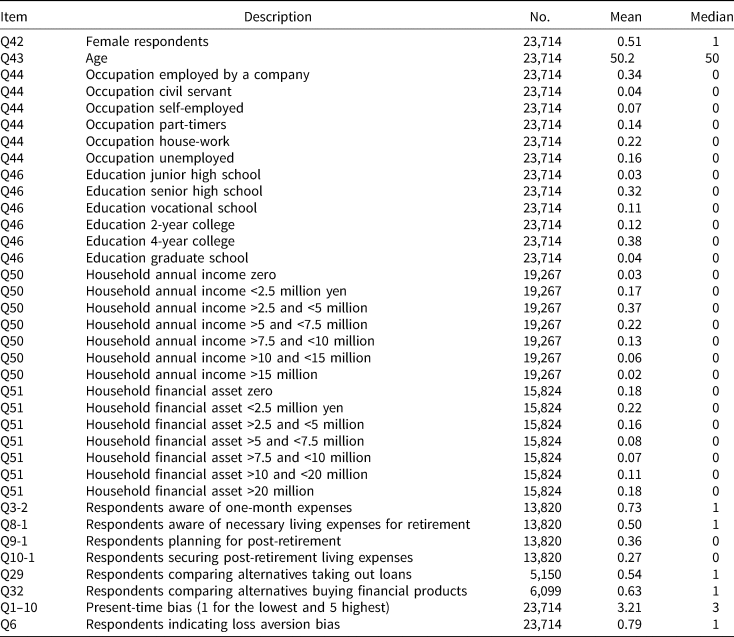
Table 1 summarizes the socioeconomic characteristics for the sample. The respondents are evenly distributed between genders. The average age of respondents is aged 50, with 11.6% in their 20s, 19.2% in their 30s%, 18.0% in their 40s, 17.6% in their 50s, 20.4% in their 60s, and 13.3% in their 70s. In terms of occupation, the largest group is respondents employed by companies (34%), followed by the housewife or househusband (22%), unemployed (16%), employed part-time (14%), self-employed (7%), civil servant (4%), and others. With regard to final educational attainment, 50% of respondents had graduated from 2-year or 4-year colleges and 43% had graduated from a senior high school or vocational school. The remaining 7% are those with only a degree of junior high school (mandatory education) or graduate school.
The socioeconomic characteristics and financial behaviors of the respondents to the financial literacy survey conducted by the Bank of Japan in 2015

Respondents are non-student adults over 20 years of age. The column titled ‘item’ refers to the corresponding question number in the original survey. Mean and median are reported for the items, most of which pertain to binary information with the exception of Q43 (age) and Q1–10 (present-time bias).
The survey also obtained information on the respondent's annual household income and financial wealth (including deposits, stocks, and financial assets). Thirty-seven percent reported annual income between 2.5 and 5 million yen, followed by 22% between 5 and 7. 5 million yen, 20% below 2.5 million yen, and 13% between 7. 5 and 10 million yen. Those earning an income higher than 10 million yen account for only 8% of the sample. On the other hand, household financial wealth is relatively more evenly distributed. The proportion of each wealth category ranges from 7% to 22%. The lowest wealth (zero) and the highest wealth category (>20 million yen) are both 18%.
2.1 Financial Behaviors and biases
The remaining items in Table 1 show the financial behaviors to be investigated in this study. This first set of variables pertaining to whether the respondent is aware of the amount necessary for the present and post-retirement. While 88% and 73% of respondents are aware of their current 1-month incomes and expenses, respectively, only half of the respondents indicated awareness of their post-retirement living expenditures. Among the respondents who are aware of their post-retirement living estimates, 36% indicated that they had a saving plan and only 27% have secured the necessary funds.
The second set of variables is about whether one searches for information to compare with alternative products when buying investment products such as stocks, mutual funds, or foreign exchange products, or when taking out a loan with an amount greater than one's 3-month living expenses. Only 63% of respondents make comparisons when purchasing investment products, and 54% when taking out loans.
The third set of variables is related to behavioral biases. For present-time bias, the survey question (Q1_10) asks ‘How much do you agree or disagree that the following statement applies to you personally? If I had the choice of (1) receiving 100,000 yen now or (2) receiving 110,000 yen in 1 year, I would choose (1), provided that I can definitely receive the money.’ The original question asks the respondent to choose from a scale of 1 (agree) to 5 (disagree). I recoded this variable by reversing the order of the scale so that a higher value now indicates greater present-time bias. The average and median are 3.21 and 3, respectively. On average, Japanese respondents display no considerable biases.
For loss aversion bias, Q6 asks ‘Suppose that, if you invested 100,000 yen, you would either get a capital gain of 20,000 yen or a capital loss of 10,000 yen at 50% probability. What would you do? Choose (1) I would invest, or (2) I would not invest.’ The variable was recoded into a dummy, with the value of 1 if the respondent chose (2) to indicate loss aversion bias, which is the tendency to place greater weights on losses rather than on an equivalent amount of gains. On average, 79% of respondents display loss-aversion bias.
2.2 Financial literacy index
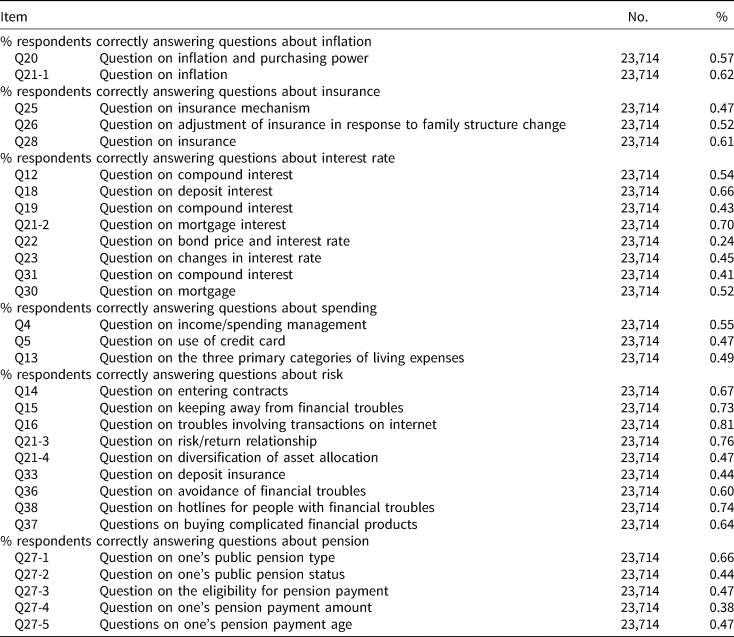
Survey questions relating to financial literacy can be divided into six categories, with each associated with knowledge relating to ‘inflation,’ ‘interest,’ ‘pension,’ ‘insurance,’ ‘spending,’ and ‘risk.’ The original questions are presented in the Appendix at the end of this paper. Table 2 summarizes the performance of the respondents in terms of their financial literacy for respondents over the age of 20. Table 2 reports the percentage of respondents correctly answering the questions, ranging from 24% to 81%. The question with the lowest correct answer rate, 24%, concerns the relationship between bond price and interest rate. Questions about compound interest calculation also have low correct answer rates, around 41% to 54%.
Distributions of the respondents' financial literacy for all non-student respondents over 20 years of age

The survey questions, presented in the Appendix at the end of this paper, are divided into six categories: ‘inflation,’ ‘interest,’ ‘pension,’ ‘insurance,’ ‘spending,’ and ‘risk.’ The rightmost column reports the percentage of respondents correctly answering the questions. The item column refers to the corresponding question number in the original survey.
An index of the financial literacy level is constructed as follows. First, for each of the six categories, I tabulated the number of questions that a respondent correctly answered, which is then standardized (with an average of zero and a variance of one) to obtain a score that represents the respondent's financial literacy relating to that category. Take, for example, the category of interest rate knowledge, which includes eight questions. The number of questions that a respondent correctly answers can range from zero to eight. The mean and standard deviation for all 25,000 respondents are 3.89 and 2.5, respectively. Thus, a respondent who correctly answers four questions obtains a standardized score of 0.042 = (4−3.89)/2.5, which serves as a measure of this respondent's financial literacy regarding the interest rate. Similarly, I calculated the standardized scores for the respondents' financial literacy regarding pension, inflation, insurance, spending, and risk, respectively.
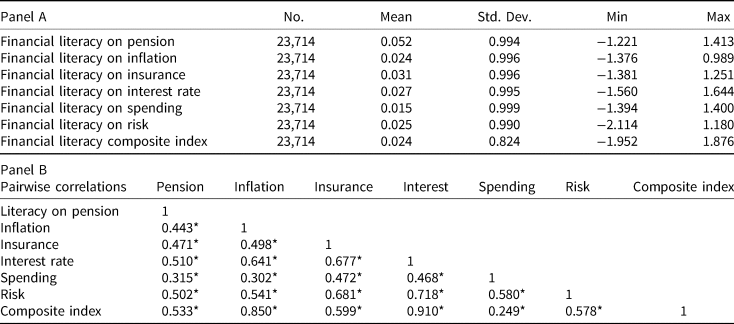
Next, the financial literacy scores of the six categories are then combined by a factor analysis using the iterative principal factor method, following van Rooij et al. (Reference van Rooij, Lusardi and Alessie2011, Reference van Rooij, Lusardi and Alessie2012). The advantage of factor analysis is that it accounts for correlation among the questions (as well as the respondent's performances) in different categories. The factor analysis computes a composite index that is used as a measure of one's financial literacy for subsequent analyses. In Table 3, Panel A reports the financial literacy scores for each of the six categories, as well as the composite index, for the 23,714 non-student adults (over the age of 20). Also reported in Panel B are their pairwise correlation coefficients. The indices are all positively and statistically correlated with one another at the 1% level.
Financial literacy indices and pairwise correlations. Panel A reports the performance measures for a respondent's financial literacy

Financial literacy for each category is measured by the standardized number of questions correctly answered by the respondent in that given category. The financial literacy composite index is obtained by performing a factor analysis on the six standardized measures using the iterative principal factor method. Panel B reports the pairwise correlation coefficients for these financial literacy measures, with * indicating significance at 1%.
3. Empirical tests and results
Empirical tests are conducted to test the hypotheses regarding the relationship between financial literacy and the aforementioned outcome variables. The main part of the analysis uses the sample set excluding students, underaged respondents, and those above 60 years, as the primary interest of this research is one's preparation for retirement. However, additional robustness tests will utilize other sample sets, for example, those who are not full-time employees of companies or government agencies (and may be eligible for employer-provided retirement pensions).
When explaining the causal effect of financial literacy on the individual's outcome variable, the possibility of unobservable factors exists. Some measures are taken to address the issue of endogeneity of financial literacy to the extent possible within the data sets. First, the estimation accounts for control variables used and reported in previous studies that may also affect the outcome variables, such as demographic characteristics. Second, the instrument for financial literacy, which is not correlated to the outcome variable, is used in the analyses. Commonly used instruments include education attainments (van Rooij et al., Reference van Rooij, Lusardi and Alessie2012; Klapper et al., Reference Klapper, Lusardi and Panos2013), the mathematical ability during the teens (Jappelli and Padula, Reference Jappelli and Padula2013; Gathergood and Weber, Reference Gathergood and Weber2017), the experience of family members (van Rooij et al., Reference van Rooij, Lusardi and Alessie2011; Behrman et al., Reference Behrman, Mitchell, Soo and Bravo2012), or the number of universities or newspaper circulating in the neighborhood (Klapper et al., Reference Klapper, Lusardi and Panos2013).
Due to data constraints, the empirical study uses as the IV an indicator variable for those who responded in the survey that their ‘parents or guardians teach them how to manage finances.’ The understanding of financial knowledge during childhood is significant for financial literacy. Those who have received financial education at home may better understand the importance of finance and might be more motivated to acquire financial knowledge as they grow up. Tang and Peter (Reference Tang and Peter2015) report that financial education and parents' financial experience exert a positive impact on young adults' financial knowledge. Moreno-Herrero et al. (Reference Moreno-Herrero, Salas-Velasco and Sanchez-Campillo2018) also assert that students' financial literacy is associated with discussions on money matters with parents. Meanwhile, financial education at home is an exogenous experience, since it is provided to the respondents (the children) exogenously. However, it is also influenced by a responder's demographic background such as parents' wealth and education, which may affect their children's education and income. Therefore, by controlling for a family's socioeconomic factors, financial education at home can be a plausible instrument for financial literacy. IV regressions in the empirical analyses will control for the respondents' demographic characteristics such as education, occupation, and income level.
In this study, I present both results with and without using the instrumental variable estimating method. Furthermore, the propensity score matching method is also employed to match those with high financial literacy with comparable peers with low financial literacy, based on a set of relevant covariates. Statistical tests are performed to test whether there are differences in the financial outcomes between the high- and low-literacy groups.
3.1 The factors determining financial literacy level
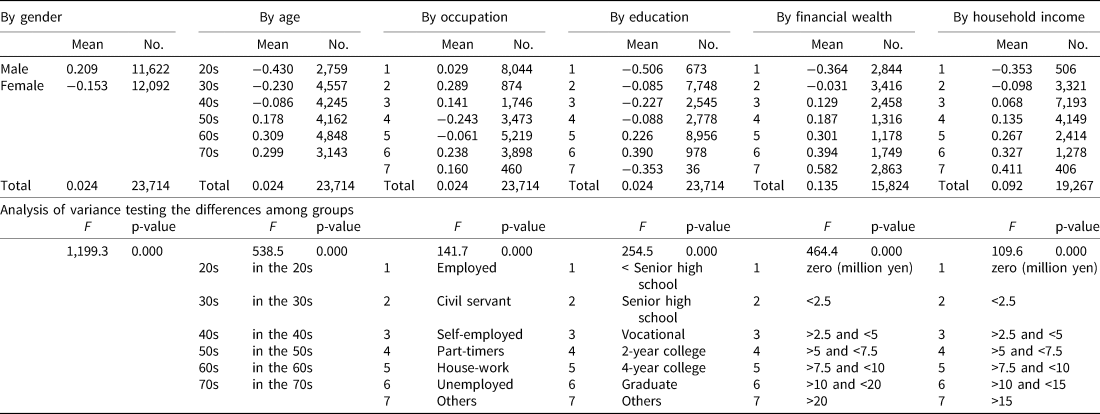
Table 4 summarizes the financial literacy composite index stratified by the respondent's socioeconomic characteristics. Female respondents have statistically lower financial literacy than males, consistent with previous findings based on different countries. Financial literacy also increases with age, a result somewhat different from previous studies which show older people are less financially literate (Agarwal et al., Reference Agarwal, Driscoll, Gabaix and Laibson2009; Calvet et al., Reference Calvet, Campbell and Sodini2009; Jappelli and Padula, Reference Jappelli and Padula2013). The cohort with the highest literacy is those in their 60s, followed by those in their 70s, 50s, 40s, 30s, and 20s. This tendency is similar when comparing the sub-indices. One possible explanation is that the literacy index used in this study is based on a wider range of financial knowledge, which may increase with age and life experiences.
The descriptive statistics of financial literacy for all non-student respondents over 20 years of age

The average financial literacy composite index is reported and stratified by the respondent's gender, age, occupation, educational attainment, household financial wealth, and household income. The lower part reports the results for the analysis of variance testing and whether there are no differences among the stratified groups.
In terms of occupation, civil servants and unemployed respondents report higher financial literacy index of 0.29 and 0.24, respectively. Civil servants probably perform better because they possess a wider range of knowledge gained from their civil servant examination preparations. Approximately three-quarters of the unemployed respondents are in their 60s and above, who, as previously indicated, are also more literate than cohorts of other ages. Education also matters in that respondents with higher education attainments are more financially literate. The last two columns show that financial literacy is higher for those with greater household financial wealth or annual income. In general, analysis of variance indicates significant differences in financial literacy among groups defined by the aforementioned demographic and socioeconomic factors.
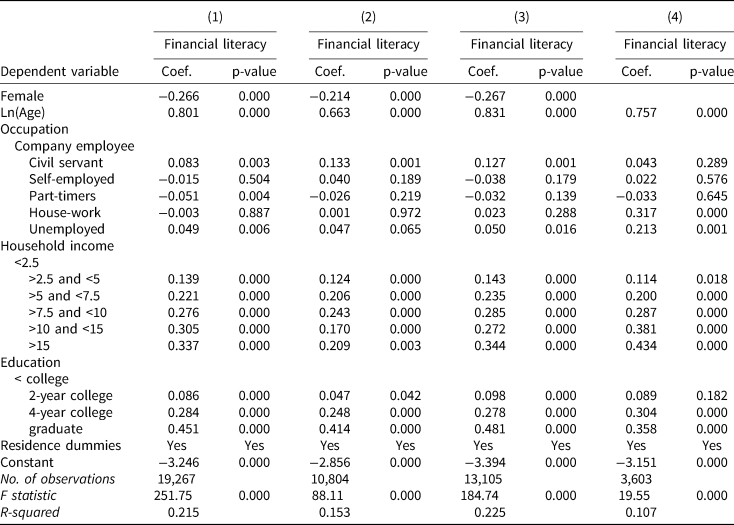
Table 5 presents the results of the regression of a respondent's composite financial literacy index on his or her socioeconomic characteristics, including age, gender, household annual income (or financial asset wealth), occupations, education attainments, and areas of residence (broadly divided into nine areas).Footnote 1 Coefficients are estimated based on robust standard errors. The results can also serve as references for the exogeneity tests for financial literacy to be performed in the subsequent analyses.
Ordinary least squares regressions of a respondent's composite financial literacy index on the socioeconomic characteristics, including age, gender, household annual income, occupation, educational attainment, and areas of residence

Column (1) reports results for all non-student respondents aged over 20 years; column (2) reports results for a smaller subset for those without experience in investing in financial assets such as stocks, funds, or foreign exchanges; column (3) for those without loans in their household; and column (4) for male respondents in their 40s and 50s. The coefficients are estimated based on robust standard errors.
The first column shows that financial literacy is significantly associated with one's socioeconomic characteristics, consistent with univariate results. Female respondents have significantly lower financial literacy. Financial literacy also increases with age. Civil servants and the unemployed group are more financially literate compared to the reference group of company employees, while other categories are either significantly less financially literate (e.g. part-timers) or do not differ from company employees. Furthermore, people with higher education degrees or greater household income (or financial asset wealth) have significantly higher financial literacy than those in the lowest income (wealth) cohort.
In column 2, the estimation is performed using respondents without experiences of investing in financial assets such as stocks, funds, or foreign exchanges. The exclusion is meant to account for the possibility that respondents with investment experiences may acquire more financial knowledge. The results remain similar to the first two columns. Similarly, column 3 is estimated on respondents without mortgages in their household, as those with a mortgage may also develop financial literacy, particularly interest-related knowledge. The results remain similar. To compare with previous studies that focus on household heads, column 4 only includes male respondents in their 40s and 50s. People in these categories are more likely to be the breadwinners in Japanese households. This reduces the sample size to only 3603 respondents. However, the results are basically similar to other regressions.
In general, the results indicate that higher financial literacy is displayed by the male, senior, highly educated, and wealthier respondents. The results are primarily consistent with previous studies, with the exception of age, which previous studies report as having an adverse relationship with financial literacy, while this current study finds a positive relationship for Japanese people.
3.2 The effects of financial literacy on awareness of financial needs
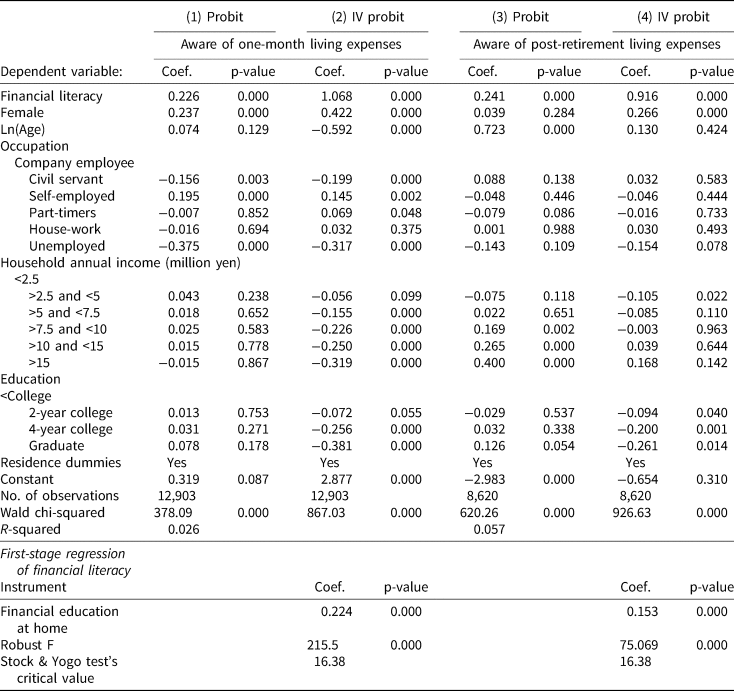
In this subsection, probit regressions are employed to test the first hypothesis by estimating the effect of financial literacy on the dependent variables, which indicate if the respondent is aware of his or her living expenses, in the present or for the future. Exogenous control variables include the respondent's socioeconomic characteristics. I report the results with and without using the instrumental variable estimating method. As described in the preceding section, the instrument is an indicator variable for those who answered in the survey that their ‘parents or guardians teach them how to manage finances’. Table 6 reports the results for both probit and IV probit regressions with the maximum likelihood estimates based on robust standard errors.
The effects of financial literacy on awareness of living expenses for non-student respondents aged between 20 and 60 years

Probit and IV probit regressions are utilized to estimate the effect of financial literacy on the dependent variables, which take the value of 1 if the respondent is aware of his or her one-month living expenses (columns 1, 2), or post-retirement living expenses (columns 3, 4). The instrumental variable for financial literacy is a dummy indicating receiving financial education at home. Exogenous control variables include the respondent's demographic and socioeconomic characteristics. The coefficients are maximum likelihood estimates with robust standard errors. In the bottom of the table, the estimate of the instrument from the first stage regression is reported, as well as the test of weak instruments, where the critical value is the 2SLS estimator for the Wald test size of 10%, based on Stock and Yogo (Reference Stock, Yogo, Stock and Andrews2005).
Columns 1 and 2 of Table 6 show the results for the dependent variable of being aware of 1-month expenses. The estimates in both columns show that people with higher financial literacy are more aware of their short-term financial needs. The IV probit estimates highlight a downward bias in the probit estimates. Also reported in the bottom of the table is the estimate of a financial education instrument variable from the first-stage regression, which indicates a positive and statistically significant impact on financial literacy. The robust F-statistic is larger than the critical value of 16.38 for an actual Wald test size of 10% suggested by Stock and Yogo (Reference Stock, Yogo, Stock and Andrews2005), rejecting the null hypothesis of weak instruments. Conditional on the validity of the instruments, the second-stage estimate implies that a one standard-deviation increase in the financial literacy index increases the probability of being aware of short-term financial needs by 5.5%.
Columns 3 and 4 of Table 6 present the results for the dependent variable of being aware of post-retirement living expenses. The results are similar to those in the first two columns in that the IV probit estimate for financial literacy remains positive, statistically significant, and larger than the probit estimate. The IV probit estimate for financial literacy implies that a one standard-deviation increase in the financial literacy index increases the probability of awareness of post-retirement financial needs by 7.1%.
As for other control variables, women seem more aware of financial needs than men. The effects of other control variables are inconclusive since the coefficients are somewhat different between probit and IV probit regressions.
3.3 The effects of financial literacy on financial prudence
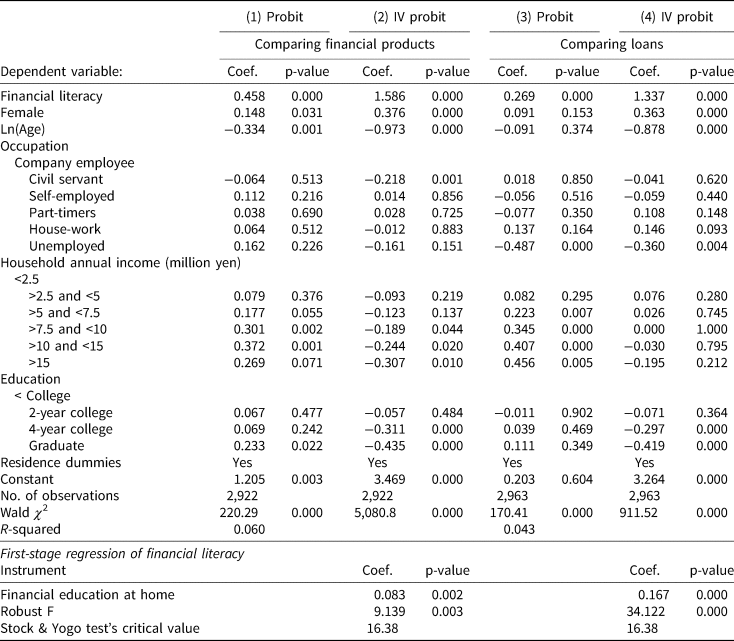
In this subsection, probit regressions are employed to test the second hypothesis – whether financially literate people behave more wisely in their financial behaviors, i.e., search for information and comparing alternatives when making financial investments. Two dependent variables are examined – the dummy variable for comparing financial investment products and for comparing loans. Table 7 reports the results for both probit and IV probit regressions, with the maximum likelihood estimates based on robust standard errors.
The effects of financial literacy on the comparing behaviors of non-student respondents aged between 20 and 60 years

Probit and IV probit regressions are employed to test whether financial literacy leads to comparing alternatives when purchasing financial products (columns 1, 2) or when taking out a mortgage (columns 3, 4). The instrumental variable for financial literacy is a dummy indicating receiving financial education at home. Exogenous control variables include the respondent's geographical characteristics. The coefficients are maximum likelihood estimates with robust standard errors. In the bottom of the table, the estimate of the instrument from the first stage regression is reported, as well as the test of weak instruments, where the critical value is the 2SLS estimator for the Wald test size of 10%, based on Stock and Yogo (Reference Stock, Yogo, Stock and Andrews2005).
Both probit and IV probit regressions indicate that people with higher financial literacy are more likely to compare financial products (Column 1 and 2) or loans (Column 3 and 4). In both models, the IV probit estimate for financial literacy is larger than the probit estimate. The first-stage regression shows that the IV is relevant in both IV regressions (Column 2 and 4). Although in Column 2, the robust F ( = 9.14) fails the Stock and Yogo test for a Wald test size of 10%, the null hypothesis of weak instrument can still be rejected if we tolerate a test size of 15% at most, for which the critical value is 8.96. The marginal effects of financial literacy suggest that a one standard deviation increase in financial literacy index increases the probability of comparing financial products (loans) by 12.7% (7.8%).
On control variables, women also behave with more rationality than males, and, surprisingly, older people are less likely to compare investment and insurance alternatives. One possible explanation is the decline in cognitive ability as people get older. The effects of other control variables are inconclusive since the coefficients are somewhat different between probit and IV probit regressions.
3.4 The effects of financial literacy on financial biases
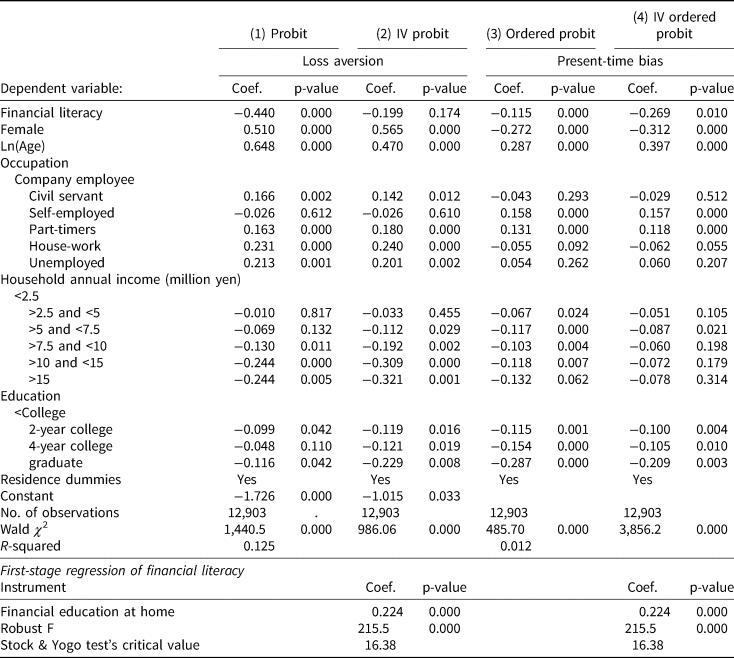
This subsection investigates whether financial literacy can alleviate finance-related biases in relation to Hypothesis 4. Probit and IV probit methods are performed when loss aversion bias is used as the dependent variable, while the ordered probit and IV-ordered probit methods are performed for present-time bias (which is based on a 5-point Likert scale). Table 8 reports the maximum likelihood estimates based on robust standard errors.
The effects of financial literacy on behavioral biases for non-student respondents aged between 20 and 60 years

(Ordered) probit and IV (ordered) probit regressions are employed to test whether financial literacy reduces behavioral biases. In columns (1) and (2), the dependent variable is the dummy for loss aversion, while in columns (3) and (4), the dependent variable is the degree of present-time bias (from 1 to 5). The instrumental variable for financial literacy is a dummy indicating receiving financial education at home. Exogenous control variables include the respondent's geographical characteristics. The coefficients are maximum likelihood estimates with robust standard errors. In the bottom of the table, the estimate of the instrument from the first stage regression is reported, as well as the test of weak instruments, where the critical value is the 2SLS estimator for the Wald test size of 10%, based on Stock and Yogo (Reference Stock, Yogo, Stock and Andrews2005).
The results regarding loss aversion are inconclusive. In column 1, the probit regression shows that financial literacy has a negative and significant association with loss aversion bias, while in column 2, the IV probit regression shows that the negative coefficient is not statistically significant at the 10% level. Still, in both models, the negative coefficients of financial literacy are consistent with the hypothesis.
The results in column 3 and 4 suggest a statistically significant mitigating effect of financial literacy on the present-time bias. The IV-ordered probit estimate of financial literacy is stronger than the ordered probit estimate bias.Footnote 2 The first-stage regression shows that the IV is relevant and that the null hypothesis of weak instrument is rejected. Conditional on the validity of the instruments, a one standard deviation increase in the financial literacy index reduces the probability of belonging to the highest present-time bias category by 7.5%.
Regarding control variables, the estimates show that women are more loss averse than men but are less biased toward present consumption, while older people are more loss averse than younger ones and are also more biased toward present consumption. Occupation appears to be associated with biases, but the coefficients are difficult to interpret. Finally, individuals with a higher household income and education present lower behavioral biases.
3.5 The effects of financial literacy on preparation for post-retirement life
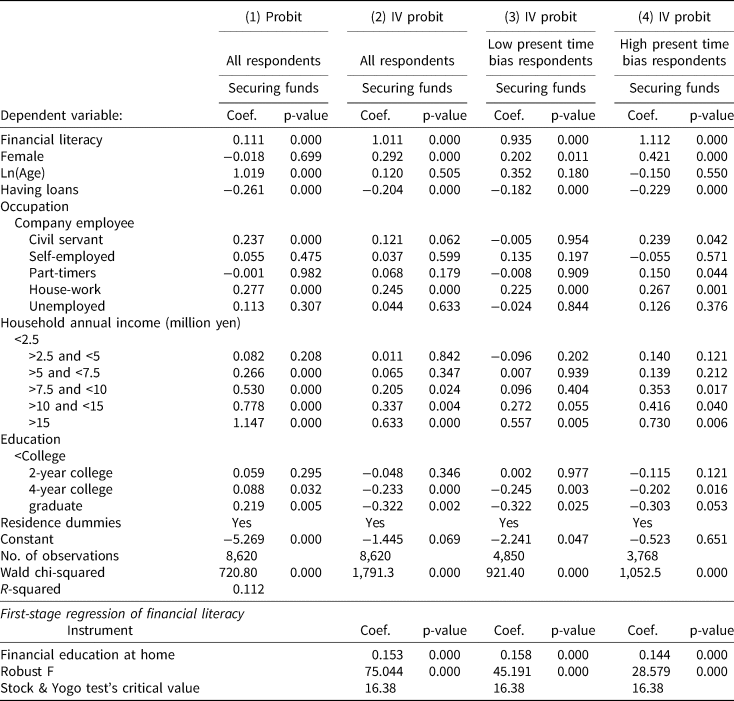
This subsection tests the effects of financial literacy in relation to Hypothesis 3. Reported here are results for using ‘securing funds for retirement’ as the dependent variable, while the results for using ‘having a plan’ remains qualitatively the same. The regressions include an additional explanatory variable regarding whether one has a mortgage, as the ability to save for post-retirement life may be hindered by the obligation of the mortgage payment. Table 9 reports the probit and IV probit estimation results, with maximum likelihood estimates based on robust standard errors. In the first two columns, the estimates show that people with higher financial literacy are more likely to secure retirement funds. The IV probit estimate for financial literacy is larger than the probit estimate. The first-stage regression shows that the IV is relevant and that the null hypothesis of weak instrument is rejected. The marginal effect of a one standard deviation increase in financial literacy has a higher probability of securing funds for retirement by 1.8%. Additionally, both columns suggest that people with higher income are more likely to secure funds for retirement, while people with mortgages are less prepared. For the educational attainment variable, the coefficients change signs in different regressions and are difficult to interpret.
The effect of financial literacy on preparation for retirement for non-student respondents aged between 20 and 60 years

Probit (IV probit) regressions are employed to estimate the effect of financial literacy on the dependent variable of having secured funds for retirement. The instrumental variable for financial literacy is a dummy indicating receiving financial education at home. Exogenous control variables include the respondent's geographical characteristics. The coefficients are maximum likelihood estimates with robust standard errors. In the bottom of the table, the estimate of the instrument from the first stage regression is reported, as well as the test of weak instruments, where the critical value is the 2SLS estimator for the Wald test size of 10%, based on Stock and Yogo (Reference Stock, Yogo, Stock and Andrews2005).
Furthermore, to test if financial literacy affects preparation for retirement through mitigating behavioral biases, the same regressions are performed again on a smaller set of sample with low-bias and high-bias respondents, separately. Since Table 8 indicates that financial literacy reduces present-time bias, I divide respondents into the high-bias group (those with above-median bias scores) and low-bias group (below-median). If financial literacy affects preparation for retirement through mitigating bias, then the effect of financial literacy on preparation for retirement should be more pronounced for the high-bias group. Columns 3 and 4 of Table 9 report the IV probit regression results for low-bias and high-bias respondents, respectively, to account for potential endogeneity of financial literacy. In both columns, financial literacy has a significantly positive effect on preparation for retirement, while it has a greater magnitude for high-bias individuals ( = 1.112) than for low-bias individuals ( = 0.935). The estimates imply that a one standard deviation increase in financial literacy raises the probability of securing funds for retirement by 2.70% for high-bias individuals and by 1.14% for low-bias individuals.
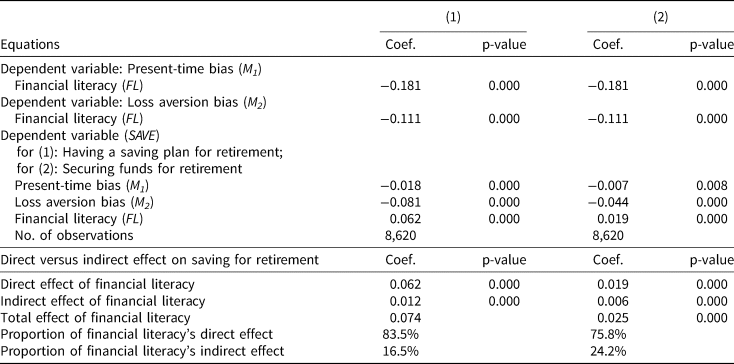
Furthermore, structural equation modeling (SEM) can be employed to test the magnitude and significance of the direct and indirect effect of financial literacy. SEM has the advantage of using full information even in the absence of missing values, as well as of being able to treat mediation models with multiple mediation factors (which applies to this current study). SEM is performed to estimate the following equations, where M1 and M2 denote present-time bias and loss aversion bias, respectively, FL financial literacy, SAVE the dummy for those who have a plan (or secured funds) for retirement, and controls are a set of covariates including gender, age, having a loan, educational attainment, occupation, annual income, and areas. Bootstrapped standard errors are obtained by performing 200 replications.


In Table 10, the first column reports the results by using ‘having a retirement’ for the dependent variable SAVE. The table only presents results for the variables of interest, due to limitations of space. Financial literacy is associated with lower present-time bias and loss aversion and at a significant level, with coefficients of −0.181 and −0.111, respectively. At the same time, present-time bias and loss aversion bias have a significantly negative effect on having a plan, with coefficients of −0.018 and −0.081, respectively. The indirect effect of financial literacy accounts for 16.48% of the total effect, while the direct effect is 83.52%. The second column reports the results by using ‘securing funds’ for the dependent variable SAVE. The results remain similar; however, the magnitudes of the coefficients all become lower than in the first column, suggesting the more challenging task of securing funds for retirement than having a plan. The indirect effect of financial literacy through mitigating behavioral biases now accounts for a larger proportion (75.77%) of the total effect. This suggests that restraining behavioral biases may play a more important role in order to implement the retirement and achieve the goal. Finally, it should be noted that the present-time bias is measured using a Likert scale from 1 to 5, which do not have a cardinal meaning.
Mediation Analysis of the direct and indirect effect of financial literacy using structural equation modeling (SEM)

Sample contains non-student respondents aged between 20 and 60. SEM is performed to estimate three equations, where the dependent variables are present-time bias, loss aversion bias, and preparation for retirement, respectively. Unreported here due to space limitation is a set of control variables including gender, age, having a loan, educational attainment, occupation, annual income, and areas of residence. The dependent variable for preparation for retirement in column (1) is having a retirement plan, while in column (2) having secured the funds. Tests of significance are based on bootstrapped standard errors.
3.6 Additional robust tests
As those working for companies or government agencies in Japan are statutorily subject to defined benefit pension plans provided by their employers, they can expect to receive pension payments after retirement. Therefore, they may plan to save for their post-retirement lifeless proactively, regardless of their financial literacy level. The first additional test repeats analyses similar to those in Table 9 by further investigating a subset of samples by excluding company employees and civil servants. The results are qualitatively similar. SEM analysis is also performed for this sample subset, with the results similar to those reported in Table 10.
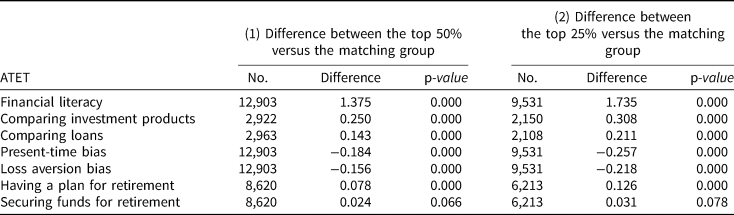
The second set of additional tests employ the propensity score matching method to compare respondents with high financial literacy and those with low financial literacy. In the first test, respondents are divided into a high (low) financial literacy group if their literacy index is larger (smaller) than the median. Then, using a propensity score matching method (with replacement), each individual in the high literacy group is matched with a nearest-neighbor peer from the low literacy group, based on a set of covariates, such as gender, age group, education attainments, occupation, income level, and residing areas. Multiple matches are allowed when they have the same propensity score and are tied with the nearest-neighbor. Comparison is then made between the high and low literacy groups regarding their financial behaviors. In Table 11, the first column reports the average treatment effect on the treated (ATET). The standard error is computed by taking into account the fact that the propensity score is estimated, relying on the work of Abadie and Imbens (Reference Abadie and Imbens2016).
Comparison of high versus low financial literacy respondents

Using a propensity score matching method, each individual in the high literacy group is matched with a nearest-neighbor peer from the low literacy group, based on a set of covariates, gender, age group, educational attainment, occupation, income level, and area of residence. In Column (1), the high literacy group contains those with higher than median financial literacy index, with the matching peers selected from the below-median group. In Column (2), the high literacy respondents are in the top 25th of the distribution of financial literacy, with matching peers selected from the below-median group. Multiple matches are allowed when they have the same propensity score and tied for nearest-neighbor. Comparison is then made between the high literacy and the matching by computing the average treatment effect on the treated (ATET).
The difference in financial literacy is statistically significant. The high financial literacy group is more likely to compare financial products or loans than the low literacy group, at significant levels. The former group is also less subject to behavioral biases than the low literacy group at significant levels. Finally, the high financial literacy group is more likely to be prepared for retirement.
In column (2), a high literacy group only contains those individuals in the top 25% of financial literacy. Each individual in the high literacy group is then matched with a nearest-neighbor peer from the low literacy group (below the median) in the same manner as previously described. The ATET results for this pair comparison provide the same conclusion as those reported in the first column; however, the differences (i.e., ATETs) are becoming larger than those in the first column. Since the high financial literacy group in column 2 contains only the top 25% individuals with high financial literacy, the more pronounced ATETs further confirm the effects of financial literacy.
4. Conclusion
While the existing literature has extensively reported positive effects of financial literacy on substantive household financial matters such as saving for retirement, the mechanisms through which financial literacy plays a role are yet fully explored. This study fills the gap by investigating the effects of financial literacy on the three phases of decision-making processes: information perception, information search and evaluation, and decision making and implementation. The primary financial setting is saving/investing for retirement, for which the majority of people have failed to prepare sufficiently, as reported in previous studies conducted in different countries. Analyzing a large sample of Japanese adults, the empirical results indicate that, even after accounting for various control variables, financial literacy has significantly positive effects on one's awareness of necessary post-retirement living expenditures, the ability to compare alternative products when making significant financial decisions, displaying fewer behavioral biases relating to financial decisions, and successfully preparing for retirement. The results also indicate that financial literacy cannot only directly contribute to saving for retirement, but also indirectly by reducing behavioral biases. The results are consistent with the findings of previous studies that people with higher financial literacy are better off in their financial outcomes, such as accumulating greater net wealth (Lusardi and Mitchell, Reference Lusardi and Mitchell2008; Behrman et al., Reference Behrman, Mitchell, Soo and Bravo2012; Gustman et al., Reference Gustman, Steinmeier and Tabatabai2012; van Rooij et al., Reference van Rooij, Lusardi and Alessie2012; Jappelli and Padula, Reference Jappelli and Padula2013).
The results of this study may have implications for the importance of financial education. Even though there is little consensus as to the efficacy of financial education (Hastings et al., Reference Hastings, Madrian and Skimmyhorn2013), the results of this study suggest that it can be effective in terms of mitigating behavioral biases commonly observed in financial decisions or guiding one to make an informed decision via more information acquisition and appropriate evaluation. Whether financial education programs designed to that effect can change one's saving behaviors awaits further research in the future.
Acknowledgement
The author is grateful for comments and suggestions by the referees and the editor, as well as participants at the 26th Conference on the Theories and Practices of Securities and Financial Markets, the 31st Australasian Finance and Banking Conference, the Asian Growth Research Institute, the Economic Engineering Research Workshop at Kyushu University, and the 2019 International Conference of Taiwan Finance Association. The author also acknowledges financial support from JSPS KAKENHI (JP17K03807); Nomura School of Advanced Management; and Education and Research Center for Mathematical and Data Science, Kyushu University.
Appendix
Survey questions used to construct an individual's financial literacy.
1. Financial Literacy on Inflation
-
Q20. Imagine that the interest rate on your savings account was 1% per year and inflation was 2% per year. After 1 year, how much would you be able to buy with the money in this account? Choose only one answer. (1) More than today. (2) Exactly the same. (3) Less than today. (4) Don't know.
-
Q21_1. Please indicate whether you think the following statements are true or false. ‘High inflation means that the cost of living is increasing rapidly.’ Choose one answer for each item. (1) True. (2) False. (3) Don't Know.
-
2. Financial Literacy on Insurance
-
Q25. Which of the following statements on the basic function of insurance is appropriate? Choose only one answer. (1) Insurance is effective when a risk occurs with high frequency, causing a large loss. (2) Insurance is effective when a risk occurs with low frequency, causing a large loss. (3) Insurance is effective when a risk occurs with high frequency, causing a small loss. (4) Insurance is effective when a risk occurs with low frequency, causing a small loss. (5) Don't know.
-
Q26. When a 50-year-old man reviews his life insurance policy (whole life insurance) after his children have become financially independent, which of the following statements is appropriate? Suppose that other circumstances have not changed. Choose only one answer. (1) He should consider increasing the death benefit. (2) He should consider decreasing the death benefit. (3) There is no need to review the policy in particular. (4) Don't know.
-
Q28. Which of the following statements on insurance is inappropriate? Choose only one answer. (1) You need to pay national pension contributions if you are aged 20 or over, even if you are a student. (2) The damage caused by an automobile accident will be fully covered by automobile liability insurance. (3) You should review the necessity of life insurance and the amount of coverage of insurance according to changes in circumstances of family members and yourself. (4) Health insurance may not cover pre-existing medical conditions that you had before purchasing the insurance policy. (5) Don't know.
-
3. Financial Literacy on Interest Rate
-
Q12. Taro and Hanako are the same age. At age 25 Hanako began saving 100,000 yen per year and continued to save the same amount annually thereafter. Meanwhile, Taro did not save money at age 25 but began saving 200,000 yen per year at age 50. When they are aged 75, which of them will have more money saved? Choose only one answer. (1) They would each have the same amount because they put away exactly the same amount. (2) Taro, because he saved more each year. (3) Hanako, because she has put away more money. (4) Hanako, because her money has grown for a longer time at compound interest. (5) Don't know.
-
Q18. Suppose you put 1 million yen into a savings account with a guaranteed interest rate of 2% per year. If no further deposits or withdrawals are made, how much would be in the account after 1 year, once the interest payment is made? Disregard tax deductions. Answer with a whole number.
-
Q19. Then, how much would be in the account after 5 years? Disregard tax deductions. Choose only one answer. (1) More than 1.1 million yen. (2) Exactly 1.1 million yen. (3) Less than 1.1 million yen. (4) Impossible to tell from the information given. (5) Don't know.
-
Q21_2. Please indicate whether you think the following statements are true or false. ‘When compared, a 15-year mortgage typically requires higher monthly payments than a 30-year loan, but the total interest paid over the life of the loan will be less.’ Choose one answer for each item. (1) True. (2) False. (3) Don't Know.
-
Q22. If interest rates rise, what will typically happen to bond prices? Choose only one answer. (1) They will rise. (2) They will fall. (3) They will stay the same. (4) There is no relationship between bond prices and the interest rate. (5) Don't know.
-
Q23. Which of the following is appropriate as an action to take when investing (making deposits, etc.) or borrowing funds at a time of interest rate rise? Choose only one answer. (1) Investing and borrowing at fixed interest rates. (2) Investing at a fixed interest rate and borrowing at a floating interest rate. (3) Investing at a floating interest rate and borrowing at a fixed interest rate. (4) Investing and borrowing at floating interest rates. (5) Don't know.
-
Q30. Which of the following statements on mortgages is appropriate? Choose only one answer. (1) It is far less costly to continue living in a rented house for your whole life than buying a house with a loan. (2) Mortgages can be repaid by either the equal payment method or the equal principal payment method, but the total repayment is the same for both methods. (3) Mortgages are offered with either a floating interest rate or a fixed interest rate, and those with a fixed interest rate are always more advantageous than those with a floating interest rate. (4) In order to decrease the total mortgage repayment, it is effective to prepare as much down payment as possible and make advanced repayments to the extent possible. (5) Don't know.
-
Q31. Suppose you owe 100,000 yen on a loan and the interest rate you are charged is 20% per year compounded annually. If you didn't pay anything off, at this interest rate, how many years would it take for the amount you owe to double? Choose only one answer. (1) Less than 2 years. (2) At least 2 years but less than 5 years. (3) At least 5 years but less than 10 years. (4) At least 10 years. (5) Don't know.
-
4. Financial Literacy on Pension
-
Q27_1. About public pensions you are qualified to receive, are you aware of the type of public pension that covers you? Choose (1) Yes. (2) No.
-
Q27_2. About public pensions you are qualified to receive, are you aware of the category of insured person you fall into? Choose (1) Yes. (2) No.
-
Q27_3. About public pensions you are qualified to receive, are you aware of the required number of years of paying contributions in order to qualify for pension benefits.? Choose (1) Yes. (2) No.
-
Q27_4. About public pensions you are qualified to receive, are you aware of the amounts of pension you are qualified to receive.? Choose (1) Yes. (2) No.
-
Q27_5. About public pensions you are qualified to receive, are you aware of the age at which you will start receiving the pension? Choose (1) Yes. (2) No.
-
5. Financial Literacy on Risk
-
Q14. Which of the following is inappropriate as an action to take when concluding a contract? Choose only one answer. (1) Reconsidering whether the contract is truly necessary. (2) Checking whether the cancellation of the contract is possible and whether a penalty is charged for doing so. (3) Concluding a contract based on a detailed explanation from the service provider, and carefully reading the contract document later. (4) Seeking advice from a third party as needed when concluding a contract. (5) Don't know.
-
Q15. Which of the following is inappropriate as a behavior to avoid being involved in financial trouble? Choose only one answer. (1) Avoiding disclosing your personal information as much as possible. (2) Making an effort to acquire financial and economic knowledge. (3) Trusting and leaving the entire matter to the service provider when it is difficult to make a decision. (4) Checking the user reviews of the product you are planning to purchase. (5) Don't know.
-
Q16. Which of the following is inappropriate as an action related to Internet transactions? Choose only one answer. (1) I updated the security software to the latest version. (2) I received an e-mail, but I did not open it since it was sent from an unknown address. (3) I made a bank transfer by using a computer at an Internet café. (4) I checked many times to make sure that the information I entered had no errors. (5) Don't know.
-
Q21_3. Please indicate whether you think the following statements are true or false. ‘An investment with a high return is likely to be high risk’. Choose one answer for each item. (1) True. (2) False. (3) Don't Know.
-
Q21_4. Please indicate whether you think the following statements are true or false. ‘Buying a single company's stock usually provides a safer return than a stock mutual fund.’ Choose one answer for each item. (1) True. (2) False. (3) Don't Know.
-
Q33. Which of the following statements on the types of deposits protected up to 10 million yen under Japan's deposit insurance system is appropriate? Choose only one answer. (1) Only ordinary deposits are protected. (2) Ordinary deposits and time deposits are protected. (3) All types of deposits including ordinary deposits, time deposits, and foreign currency deposits are protected. (4) No deposit is protected due to the principle of self-responsibility. (5) Don't know.
-
Q36. Which of the following is inappropriate as behavior or attitude when determining whether to purchase an unfamiliar financial product? Choose only one answer. (1) Collecting information to make sure that the product is not frequently causing trouble and no warning has been issued by a public institution. (2) Collecting information from the Internet, books, and several sellers and comparing the product with other products. (3) Consulting with an institution, agency, etc., that provides information from a neutral standpoint and receiving advice. (4) Purchasing the product if the seller tells you that you can expect a high return. (5) Don't know.
-
Q37. Which of the following is appropriate as an action to take when considering the purchase of a financial product with a complicated structure? Choose only one answer. (1) Purchasing the product if it is selling well, even if you do not understand its structure clearly. (2) Purchasing the product if you can trust the financial institution providing the product, even if you do not understand its structure clearly. (3) Purchasing the product if you can expect a high return, even if you do not understand its structure clearly. (4) Purchasing the product if you understand its structure and find no problem. (5) Don't know.
-
Q38. Which of the following is inappropriate as a consultant office or a system to be used when trouble occurs in relation to a contract for a financial product? Choose only one answer. (1) Consumer center. (2) Financial alternative dispute resolution (ADR) system. (3) Rating company. (4) Attorney at law.
-
6. Financial Literacy on Spending
-
Q4. Which of the following statements on household behavior is inappropriate? Choose only one answer. (1) Managing income and expenditure by keeping a household account book or the like. (2) Deciding on expenditure after considering whether it is truly necessary and whether there is enough income. (3) Saving some money out of income by transferring a fixed amount of income into a savings account or the like. (4) Frequently using installment payment plans of credit cards in order to defer payment. (5) Don't know.
-
Q5. Which of the following statements on family budget management and credit cards is inappropriate? Choose only one answer. (1) Using credit cards in a well-planned manner according to income. (2) Any unsettled credit card payment is practically a debt. (3) A credit card fee (interest) is charged for revolving payments but not for installment payments. (4) Failure to pay the credit card charge may cause credit card transactions to be declined. (5) Don't know.
-
Q13. What are the so-called three major expenses in life? Choose only one answer. (1) Living expenses for your lifetime, children's educational expenses, and your medical expenses. (2) Children's educational expenses, costs of buying a house, and living expenses for your retirement. (3) Costs of buying a house, your medical expenses, and costs of nursing care for your parents. (4) Don't know.
-