Proponents of the liberal peace theory have long argued that membership in intergovernmental organizations (IGOs) promotes and reinforces democracy.Footnote 1 Evidence suggests that regional IGOs play a particularly important role. Members of “densely democratic” regional organizations—IGOs whose member states are democracies—are more likely to experience a democratic transition, and democracy, once established, is more likely to endure.Footnote 2 The proposed explanation for this association rests on the idea that member states of densely democratic organizations are more likely to enforce violations of democratic norms because they are likely to share similar ideas about what constitutes a violation and how to respond.Footnote 3
However, the empirical record reveals that enforcement of democratic norms—defined here as the imposition of material, political, or reputational costs on a norm-violating government—by regional IGOs is quite rare, even within the most democratic regions. While densely democratic IGOs may be, on average, more likely than others to enforce commitments to democracy, they are still selective, and sometimes inconsistent, in their responses across cases. The Organization of American States (OAS), for example, took a more active role in responding to Haiti's coup (1991) and subsequent flawed elections (1995, 2000) than it did in response to Alberto Fujimori's self-coup in Peru (1992) or to a series of flawed elections in Mexico under the long-ruling Institutional Revolutionary Party (PRI). Moreover, different tools of enforcement are used at different times. Sometimes regional IGOs impose sanctions, but more often they rely on tools—such as shaming or mediation missions—that impose reputational or political costs, rather than material costs, on governments.
What explains this variation? Why do regional IGOs punish some norm-violating countries but not others? What explains their choice of tools? This article presents a theoretical framework for understanding the politics of norm enforcement within multilateral institutions. It proposes two reasons why seemingly like-minded member states are sometimes unable to enforce their normative commitments. First, the presence of competing geopolitical interests may trump member states' interest in defending the norm. Second, if an IGO's member states lack reliable information on the occurrence and extent of a norm violation, it is difficult for them to agree on what the appropriate response should be. I argue that monitoring helps mitigate these barriers to enforcement in two ways: by publicizing and revealing information about norm violations. Publicity from monitors' reports can help pressure reluctant member states into prioritizing defense of the norm over other competing interests, while information revelation helps member states coordinate on the appropriate collective response.
This article focuses on one type of monitoring, international election observation, that provides and publicizes information about one of the most common violations of democratic norms: electoral misconduct. Using an original data set of regional IGO enforcement in response to electoral misconduct, I find that the presence of election observers increases the probability of regional IGO enforcement in response to electoral misconduct, and the content of the observers' reports influences the type of enforcement that is imposed. Sanctions or threats to punish the sitting government are only more likely if observers report that misconduct was intentional and severe. Otherwise, less punitive tools—such as shaming, diplomacy, and mediation—are preferred. The geopolitical importance of the target state also matters. As a country's economic size, military expenditures, and fuel exports increase, enforcement becomes less likely, but the magnitude of this effect decreases if election observers are present.
By examining the causes of variation in the timing and tools of enforcement, this article improves our understanding of the conditions under which IGOs matter for democracy. It also suggests two broader implications about the credibility of international commitments. First, if variation in enforcement follows a discernible logic, the costs of commitment likely vary systematically across different member states depending on whether they expect to be punished for noncompliance.Footnote 4 Second, monitoring is an aspect of international regime design that can increase the credibility of commitments, but it does so in a way more complex than is usually assumed. Most research has focused on how monitoring affects the behavior of the state being monitored.Footnote 5 But the question of how monitoring influences other states—specifically, those in a position to potentially punish the state being monitored—has not been sufficiently explored. This study shows that monitoring also has an important effect on non-norm violating states, by pressuring them to enforce their commitments. Counterintuitively, this effect is larger for geopolitically important countries, which are otherwise less likely to be punished.
The article proceeds as follows. The first section reviews existing research on IGOs, enforcement, and credible commitments. The second section explains how geopolitical considerations and information influence IGO member states' decisions about enforcement, and derives testable hypotheses about both the probability and the type of enforcement in response to electoral misconduct. The third section introduces the data set, which covers all Latin American and postcommunist countries that held multiparty elections between 1990 and 2005. The fourth section tests the hypotheses and rules out alternative explanations. The last section concludes.
IGOs, Enforcement, and Credible Commitments
Enforcement—or the threat of enforcement—is an important mechanism through which membership in international organizations can help bolster democracy and human rights. But some IGOs matter more than others, and scholars have pointed to different institutional attributes that are associated with enforcement. For example, in a comparison of the OAS and Council of Europe (COE), Hawkins shows that the degree to which IGOs are accessible to nongovernmental organizations' (NGOs) influence affects the strength of their democracy protection regimes.Footnote 6 Pevehouse instead focuses on attributes of the IGO's member states, arguing that densely democratic IGOs are more likely than others to supply enforcement because their members, being democracies themselves, are more likely to support it.Footnote 7 In the realm of human rights, Hafner-Burton finds that membership in preferential trade agreements with “hard,” binding human rights clauses are more effective at changing states' human rights behavior than agreements with “soft,” declarative language, because the “hard” agreements create the possibility that trade benefits will be suspended if norms are violated.Footnote 8
Though these accounts highlight different characteristics of IGOs that create an expectation of enforcement, they share the idea that IGO membership can increase the costs of violating norms, and therefore may help states make a credible commitment to abide by them. As Pevehouse explains:
IOs signal a commitment to reform by setting in place mechanisms to increase the cost of anti-regime behavior. This increased cost arises from conditionality imposed by the organization on members. Any reversal of reform can bring sanctions, even expulsion, from the organization.Footnote 9
This credible-commitment logic has also been used to explain states' decisions about what kinds of IGOs to join and create. In keeping with the hypothesis that new democracies in particular need to find ways to make credible commitments to political reform, Mansfield and Pevehouse find that democratizing countries are more likely than others to join IGOs.Footnote 10 In a similar vein, Moravcsik's study of the formation of the European Court of Human Rights, finds that new democracies were the most avid supporters of a powerful supranational court that could help them lock-in their political transitions.Footnote 11
All these arguments rest on the claim that IGO membership influences domestic outcomes through the expectation of enforcement. Empirically, however, enforcement is selective and relatively rare. Case studies of democracy protection by the European Union (EU) and OAS, for example, have pointed to inconsistencies in how these actors respond in different countries.Footnote 12 Such country-specific variation is potentially highly consequential. Studies of the International Monetary Fund (IMF), for example, argue that inconsistencies in the implementation of conditionality can undermine the credibility and effectiveness of IMF programs.Footnote 13 If patterns of enforcement follow a predictable logic, certain governments will anticipate a high probability of being punished if they violate commitments, while others will anticipate little to no cost. This casts doubt on the idea that IGO membership has a uniform average effect on domestic outcomes, suggesting instead that membership should be theorized and tested as a conditional effect, which depends at least in part on country- and case-specific variation in the likelihood of enforcement.
Understanding patterns of enforcement is therefore essential for assessing the effects of IGOs on democracy, but scholars have not developed a theory that can account for country-level variation. While it may be true that IGO-level attributes, such as democratic density or legalization, make an IGO more likely to enforce democratic norms on average, this does not tell us whether enforcement is likely in a given case. This is the primary theoretical problem resolved in this article.
Hypotheses derived from the theory are tested using an original cross-national data set on regional IGO enforcement of democratic norms. The data record enforcement in response to one type of norm violation: electoral misconduct, understood as the presence of a ruling-party bias during the campaign period, restrictions on party or voter freedom, or irregularities in the casting and counting of ballots.Footnote 14 While international enforcement is often understood as synonymous with sanctions, this study conceives of democracy enforcement broadly as the imposition of material, political, or reputational costs on a norm-violating government. In addition to sanctions, this includes tools such as diplomatic and mediation missions, and shaming, which impose reputational or political costs.Footnote 15
To provide a first look at enforcement patterns, Figure 1 shows the percent of elections between 1990 and 2005 that exhibited misconduct in Latin America/Caribbean and postcommunist Europe.Footnote 16 I refer to these as “flawed elections.” It also shows the percent of elections in each region that were the targets of three tools of regional IGO enforcement: negative conditionality (that is, sanctions or the threat of sanctions), diplomatic or mediation missions, or shaming.Footnote 17
Flawed elections and regional IGO enforcement

If regional IGOs were perfectly consistent in enforcing their democratic commitments, the percent of flawed elections and those targeted by some kind of enforcement would be equal. Instead, Figure 1 shows that flawed elections occur far more frequently than enforcement. It is worth noting, however, that enforcement rates by IGOs in these regions are still well above the global average, as the track record of regional IGOs in Africa and Asia in responding to electoral misconduct is weak.Footnote 18 This supports the idea that democratic density does indeed increase the average probability of enforcement, though much case-specific variation remains unexplained. In addition to understanding why enforcement occurs in some cases but not others, it is also important to understand variation in the particular tools of enforcement that are chosen. When responding to violations of democratic norms, regional IGOs employ shaming, diplomatic pressure, and mediation far more frequently than they employ (or threaten) sanctions. Why are some norm violations met by sanctions and others by less punitive measures?
Punishing Electoral Misconduct
The norm of free and fair elections is enshrined in the Universal Declaration of Human Rights, the International Covenant on Civil and Political Rights, and numerous regional commitments. Electoral misconduct can be understood as a violation of any of the fundamental principles of free and fair elections, specifically, the presence of one or more of the following patterns: restrictions on the freedom of opposition parties or voters; a biased campaign environment that favors the ruling party; or flaws in the casting, counting, or tabulation of ballots.Footnote 19 In the post–Cold War era, leaders across the globe have made increasing use of these tools in an attempt to limit political competition while still maintaining the appearance of electoral democracy.Footnote 20 Sometimes misconduct is blatant, but often, leaders mask their actions, making misconduct appear as if it is due to disorganization and technical incapacity.
While electoral misconduct clearly constitutes a violation of democratic norms, the question of whether (and how) international actors should respond is often a contested one. Even within densely democratic regional IGOs whose member states have created formal commitments to protect democracy, enforcement is by no means guaranteed. As Simmons notes in her study of human rights treaties, when an international commitment does not produce mutual gains that are contingent on cooperation, “states face tremendous collective action problems in organizing potential enforcement efforts.”Footnote 21
Two factors stand out as potential obstacles to enforcement: first, member states may have competing geopolitical priorities that trump their commitment to defending democracy in a given neighboring country. Second, uncertainty about the source, scope, and effects of electoral misconduct can hinder member states' ability to agree on what type of response is most appropriate in a given case. The remainder of this section discusses these two obstacles in greater detail and explains how international monitoring can help mitigate them, identifying two ways that international election observers influence regional IGO enforcement. First, by publicizing electoral misconduct, observers mitigate the problem of competing geopolitical priorities by helping to place the election on the regional IGO's agenda, and creating public pressure for member states to take action. I argue that the size of this “publicity effect” is greatest in geopolitically important countries in which enforcement is otherwise less likely. Second, by revealing information about the source, scope, and effects of electoral misconduct, election observers reduce uncertainty and help member states coordinate on which tools of enforcement are most appropriate in a given case.
It should be noted that the theory and hypotheses presented in this article only apply to credible international election observation missions—corresponding to Carothers's description of “professional” observers—which obtain high-quality information and are not obviously biased.Footnote 22 Of course, no observer group is immune to political pressure, but some agencies are widely understood to be better than others, in part because of a proven willingness to criticize flawed elections.Footnote 23 The third section of this article explains which agencies are included in the data as credible observers.
Competing Geopolitical Interests
The first source of disagreement over enforcement of democratic norms stems from the existence of competing geopolitical priorities. Research on enforcement in other issue areas highlights these considerations. For example, Stone shows that the IMF is less likely to punish strategically important countries (for example, Russia) than smaller, weaker countries (for example, Poland) for deviating from the terms of their agreements.Footnote 24 Similarly, Lebovic and Voeten find that militarily powerful states are less likely to be targeted for criticism by the UN Commission on Human Rights, and Simmons argues that the incentives for enforcing human rights treaties are especially weak in “strategically, politically or economically important countries.”Footnote 25
The intuition behind these patterns is simple. For the potential enforcer states, the costs of upsetting relations with economically and militarily powerful countries are much greater than the costs of offending weaker countries with few sources of international leverage.Footnote 26 Oil and natural gas exporters should also be less likely to be the targets of democracy enforcement, for similar reasons: member states' strategic concerns about the supply of energy can easily trump concerns about democracy. This is particularly true if the country's leader threatens to disrupt supply in response to international meddling in its domestic affairs or in its perceived sphere of influence. Russia has notoriously used such tactics to stave off Western pressure for democratic reform.Footnote 27 Moreover, if energy deals are in place—or pending—with a country's sitting government, neighboring countries may be less likely to push for potentially destabilizing democratic change. For example, following a fraudulent election in energy-exporting Azerbaijan in November 2005, the responses of Western actors were widely perceived as soft. In postelection protests, Azeri opposition supporters expressed frustration at the lack of international support; one protest sign read: “Stand true to your values. Do not exchange democracy for oil.”Footnote 28
H1: Regional IGO enforcement in response to flawed elections is less likely as a country's geopolitical size and importance increase.
Uncertainty
The second potential obstacle to member-state agreement on enforcement stems from uncertainty. While some violations of democratic norms—such as military coups—are public, clearly observable events, electoral misconduct is an activity shrouded in ambiguity. Cheating incumbents often conceal their actions, and it may be difficult to tell whether irregularities in election administration are the result of intentional government choices or weak administrative capacity.Footnote 29 Three issues in particular are often unclear: Was misconduct intentional? How widespread were the problems? Did misconduct potentially alter the outcome of the election?
Uncertainty about any of these issues—intentionality, scope, and effect—can hamstring the ability of a regional IGO to respond to flawed elections. Most regional IGOs require consensus among their member states to approve policies, creating a tendency toward lowest-common-denominator outcomes that adhere to the preferences of those that least favor enforcement.Footnote 30 Even if member states can forge a consensus that some kind of enforcement is necessary, uncertainty is likely to create disagreement about how to respond, since the effectiveness of different tools depends on the sources and extent of electoral misconduct. Sanctions or other tools that aim to coerce a change in government behavior may be deemed appropriate in response to cases of widespread, intentional fraud. However, as international lawyers have long pointed out, sanctions are inappropriate when noncompliance is unintentional.Footnote 31 Therefore, less punitive tools are likely to be considered more fitting when misconduct is due primarily to disorganization and weak institutional capacity.
International Election Observation
Since the end of the Cold War, international election observation has become a widely accepted tool for exposing electoral misconduct.Footnote 32 International observers are not the only source of information about electoral conduct; many elections around the world are now also monitored by domestic observer groups. But international observers do make an important contribution, particularly in new or fragile democracies where domestic sources of information are limited or unreliable.Footnote 33 In such contexts, journalists and domestic NGOs may be unable to gather and disseminate information, and opposition parties may have little to lose from leveling spurious accusations of fraud.Footnote 34
International election observation is particularly well developed in Latin America and Europe, where, in addition to NGOs, regional IGOs themselves have developed credible monitoring agencies.Footnote 35 This is likely due to the high-democratic density of these regions, relative to other parts of the world. As Kelley shows, observation missions sent by IGOs with more democratic member states are significantly less likely to endorse flawed elections than missions from other IGOs.Footnote 36 An important attribute of the election observation agencies associated with regional IGOs, such as the OSCE and OAS, is their autonomy, meaning that they draft and issue their reports independently of decisions about enforcement taken within the IGO's intergovernmental bodies. For this reason, the presence of an election observation mission sent by a regional IGO does not in any way guarantee (though, as I show, it does increase the chances) that the IGO will impose enforcement in response to misconduct.Footnote 37
By gathering and revealing information about electoral misconduct, international observers help mitigate both of the obstacles to enforcement outlined above. First, they publicize misconduct by holding press conferences and issuing reports that are circulated in the international media.Footnote 38 Such publicity, in turn, can help place an election on the regional IGO's agenda. This is no small task: multiple member states hold elections in any given year, and the ability of an IGO to deliberate and respond to every flawed election is limited. In the European Union, for example, matters must be perceived as both urgent and highly consequential to make it onto the Council agenda, where decisive foreign policy action can be taken.Footnote 39
H2a: Regional IGO enforcement following flawed elections is more likely when an international election observation mission is present.
Once a flawed election finds a place on the IGO's agenda, the publicity created by election observation missions can further generate pressure for a response. This pressure is likely to have a particularly important effect when the presence of competing geopolitical interests creates conflict among member states about enforcement. In such cases, the publicity generated by international observers can be leveraged by supportive member states to pressure or shame member states that are reluctant to support enforcement for geopolitical reasons.
Ukraine's controversial 2004 election illustrates this dynamic. The election exacerbated tensions between the EU and Russia, which viewed Ukraine as part of its sphere of influence. This in turn highlighted differences within the EU itself between the new postcommunist member states that favored a more adversarial policy toward Russia, and the “old” member states that favored a more conciliatory approach.Footnote 40 Injected into this tense situation was a highly critical report issued by the OSCE's election observation mission. In addition to denouncing media bias, misuse of state resources, and other practices that created an unequal campaign environment, the report documented suspiciously high turnout figures and ballot irregularities in regions known to favor the pro-government candidate.Footnote 41 Seizing on this information, Poland took the lead in pushing for a strong EU response, joined by Lithuania and Estonia.Footnote 42 As one Polish legislator stated, “the main task facing Polish diplomacy is to speed up and clarify the EU's policy. We must convince Europe that Ukraine cannot be sacrificed on the altar of relations with Russia.”Footnote 43 The new member states ultimately succeeded when EU officials deemed Ukraine's election unacceptable and called for a repeat second round as the only possible solution to the crisis.Footnote 44
As Ukraine's experience suggests, the publicity generated by election observers helps expose hypocrisy when certain member states are reluctant to back up their commitment to defend democracy. This publicity effect should therefore be most potent in cases where geopolitical interests would otherwise prevent member states from agreeing on a collective response. In smaller, weaker countries of lesser geopolitical importance, the publicity generated by international observers is relatively less important, simply because intervention in such countries is less controversial. In such cases, there is likely to be far less conflict between member states' commitment to promote democracy and other economic or foreign policy interests, and there may already be a history of international intervention in the country. Thus, domestic sources of information about electoral misconduct—from NGOs, opposition parties, or the media—may be sufficient to provoke a regional IGO response. All else equal, then, the magnitude of the effect of election observation should depend on the target country's size and geopolitical importance.
H2b. International election observation has a greater effect on the probability of regional IGO enforcement as the target country's geopolitical importance increases.
The second way that international election observers can influence regional IGO enforcement patterns is through an information effect, whereby the information gleaned by observers influences what types of enforcement member states are willing to support. Observer reports determine whether the election can be considered essentially clean or whether systematic misconduct was present.Footnote 45 If evidence of misconduct is found, observer reports shed further light on the issues of intentionality and effect. The election can be considered irregular if misconduct cannot be clearly linked to the government and did not appear to alter the election's outcome; conversely, observers can be considered to reject an election if they find evidence that misconduct was intentionally orchestrated by the government and/or that it did, in all likelihood, lead to a stolen victory.
Agreement on the need to punish a sitting government with sanctions is likely to be forthcoming only when member states can be quite certain that manipulation was both intentional and severe, that is, when observers reject the election. Again, Ukraine's 2004 election is illustrative: as an EU official explained, the OSCE observation mission's report—which suggested in no uncertain terms that fraud had likely affected the outcome of the election—was essential in inciting the EU's unprecedented decision to withhold recognition of an election in a nonmember state.Footnote 46 The implementation of less punitive tools—namely, diplomatic or mediation missions, or shaming—is less controversial than conditionality, because these tools do not threaten or impose tangible punishments on the government. Such tools are likely to be considered appropriate not only in response to intentional misconduct, but also to cases in which flaws were not clearly intentional and did not alter the outcome of the election. In such cases, diplomacy, mediation, and shaming can be used to push for institutional reforms—such as increasing the independence of the electoral commission, or cleaning up voter registration lists—which help improve electoral conduct in the future.
H3a: Regional IGOs are more likely to impose conditionality when international election observers reject the election, compared to elections deemed irregular or clean.
H3b: Regional IGOs are more likely to implement diplomatic/mediation missions and shaming when international election observers deem an election irregular or reject the election, compared to elections deemed clean.
Data
I test the hypotheses using an original data set of election observation and regional IGO enforcement in the postcommunist and Latin American/Caribbean countries, in the post–Cold War era.Footnote 47 I focus on these two regions because they are the most densely democratic in the post–Cold War world—meaning that the IGOs' member states likely share a general preference for democracy in their neighborhood—and because IGOs in these regions have a track record of (at least sometimes) responding to flawed elections.Footnote 48 The data therefore allows one to answer the question: Given that regional IGO enforcement is possible, when does it occur, and what form does it take?
Because the hypotheses relate to how IGOs respond to elections, the units of analysis in the data are national elections (including presidential, parliamentary, and constitutional referenda) taken from all countries that held multiparty elections between 1990 and 2005.Footnote 49 This necessarily includes many elections held in countries classified as “partly free” or “partial democracies” or even as electoral authoritarian regimes. Because the phenomena of interest—electoral misconduct and regional IGO enforcement—occur in many different political contexts, I do not limit my sample to countries that meet a certain threshold, choosing instead to control for the level of democracy as a factor that may influence the decisions of regional IGOs.
Dependent Variable
Enforcement is defined broadly as the imposition of material, political, or reputational costs on a norm-violating government. This encompasses a range of tools, including sanctions, but also less punitive measures, such as diplomatic or mediation missions, or resolutions criticizing the government's conduct. While enforcement plays an important role in theories of how IGOs influence domestic politics, to date, there has not been any comprehensive cross-national data on democracy enforcement by regional IGOs. This article therefore features original data on the implementation of three tools of democracy enforcement. These tools are not mutually exclusive; IGOs may choose to implement one or more in any given case:Footnote 50
• Conditionality: the threat or application of punishments (political or economic) in response to electoral misconduct and conditional on improvement in conduct.
• Mediation and Diplomatic Missions: missions composed of IGO officials sent to the target country to exert pressure for democracy or resolve postelectoral conflicts between political parties.
• Shaming: official declarations, resolutions, or statements that criticize electoral misconduct.
Conditionality imposes either material (for example, economic sanctions) or political (for example, suspension of IGO membership) costs on the government to punish it and attempt to coerce it to change its behavior in the future. Diplomatic/mediation missions and shaming impose political or reputational costs (both domestic and international) but are less overtly punitive than conditionality. The costs they impose also tend to be more indirect. For example, by setting up forums for dialogue between the government and opposition actors, mediation missions can empower opposition voices and increase domestic political pressure for governments to introduce electoral reforms or hold repeat elections. Shaming, even though not backed by material punishment, can nevertheless impose reputational costs on governments, particularly in today's world, in which democratic credentials are important for both international and domestic legitimacy. Diplomacy, mediation, and shaming all differ from conditionality in that they are “one-shot” events, and the costs they impose are not conditional on future changes in behavior.
Each of these three tools is coded as a dummy variable, taking the value of 1 if it was implemented and 0 otherwise. In order for a policy to be coded, it must have occurred within a four-month window after the last round of the election, and it must be clearly targeted toward the country and the election in question.Footnote 51 Data on implementation of these policy tools was collected for seven regional IGOs in Latin America and the postcommunist region: the OAS, Caribbean Community and Common Market (CARICOM), Common Market of the South (Mercosur), EU, Organization for Security and Cooperation in Europe (OSCE), COE, and North Atlantic Treaty Organization (NATO). These IGOs were chosen based on two criteria: (1) they possess formal commitments to democracy within their constitutive documents, and (2) they exhibit a level of institutionalization (that is, they possess a permanent secretariat and representative bodies, constitutive treaties, and formal decision-making procedures) that distinguish them from “lifeless” non-institutionalized organizations.Footnote 52
Independent Variables
Because geopolitical importance can stem from multiple sources, I use three variables to operationalize this concept, each of which is included in a separate model. First, a country's gross domestic product (gdp) captures economic size.Footnote 53 Second, as a measure of military power, I employ data on annual military expenditures.Footnote 54 Third, to capture the potential importance of energy wealth as a shield against international intervention, I use the World Bank's data on fuel exports, measured in millions of current-year U.S. dollars. Because the distribution of these variables is highly right-skewed, I take the natural log of each of the three measures.
To code for the presence of election observation missions, as well as their verdicts, I used election observers' reports from the OSCE's Office for Democratic Institutions and Human Rights (ODIHR) (for the postcommunist countries), the OAS and the Carter Center (for Latin American and Caribbean countries), and the National Democratic Institute (NDI) (for both regions).Footnote 55 These organizations are the most active observation agencies in the regions under study; they are widely considered to field credible and professional missions; and they have demonstrated a willingness to criticize misconduct.Footnote 56 An election is coded as having hosted international observers if one or more of these organizations sent a mission.
Using their postelection statements and the information contained in their reports, the observers' verdict is coded as clean if the election was deemed to be without misconduct or, at most, isolated cases of procedural flaws were found in some districts or polling stations.Footnote 57 The verdict is coded as irregular if systematic misconduct was found, but was attributed to weak administrative capacity or disorganization, or could not be definitely linked to intentional government manipulation. The observers' verdict is coded as reject if they reported clear evidence that misconduct was intentionally perpetrated by the government, or if misconduct altered the outcome of the election. If observers from both an IGO and one or more NGOs were present in an election, I coded for the verdict of the IGO (that is, the OAS or ODIHR).
It is worth emphasizing again that the observer groups considered in this study exhibit autonomy and above-average credibility when issuing their reports, meaning that it is unlikely that the information published in the reports is systematically influenced by the international community's willingness to intervene in the host country. Empirically, it is far more common for observers to criticize an election than for an IGO to impose enforcement. In the OSCE, for example, the ODIHR regularly releases critical reports of elections in the former Soviet Republics despite Russia's disapproval of its activities.Footnote 58
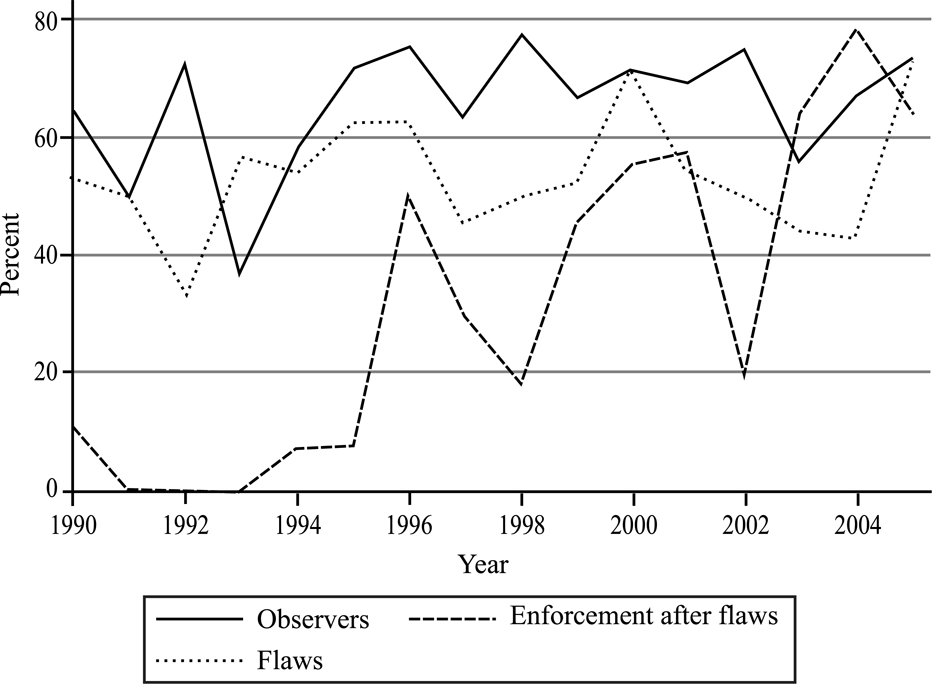
To illustrate trends in observation and enforcement over time, Figure 2 shows the percentage of elections, by year, that host observation missions, experience misconduct, and are the targets of regional IGO enforcement.
Presence of observers, flaws, and enforcement over time
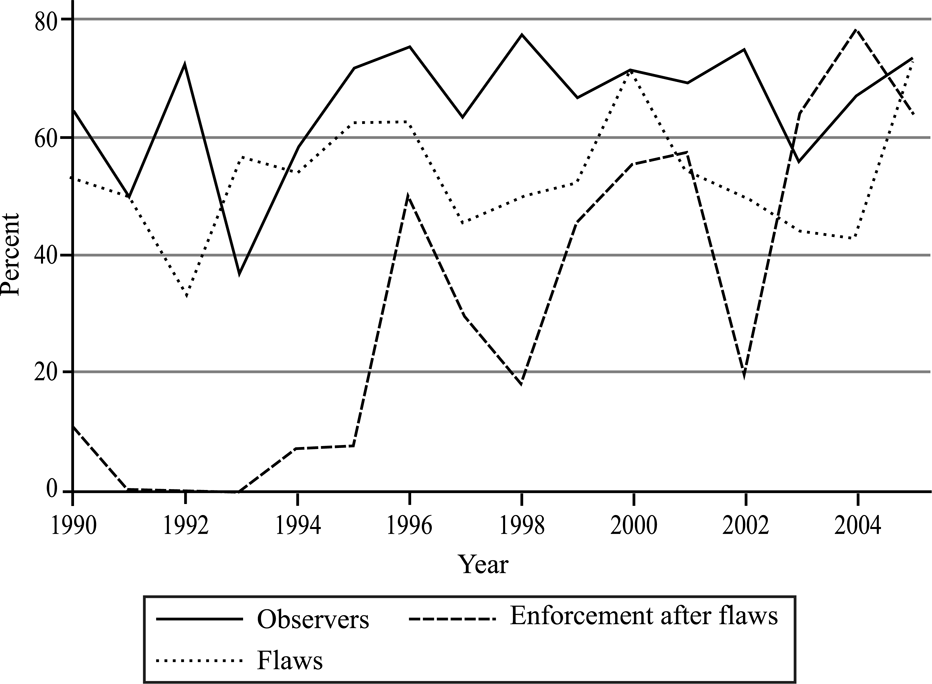
On average, international election observers are present in 60 to 70 percent of elections in any given year. The rate of electoral misconduct varies by year around an average of 50 percent. In contrast, regional IGO enforcement in response to electoral misconduct increases over time, though there is substantial year-by-year fluctuation around this trend. This rise is likely due to an increase over time in organizational capacity and expertise. Many regional IGOs, such as the OAS, began enforcing their democratic commitments in the early 1990s and became more active over time as they learned from previous efforts and developed more effective procedures for responding to flawed elections.Footnote 59
Analysis
When Does Regional IGO Enforcement Occur?
H1 predicts that, all else equal, regional IGO enforcement in response to a flawed election is less likely in countries that are of high geopolitical importance. In such cases, member states are more likely to privilege other goals above the goal of protecting democracy. H2a and H2b predict, however, that international election observers can mitigate this barrier to enforcement by publicizing electoral misconduct. The size of this effect is conditional on the target state's geopolitical importance.Footnote 60
To test these predictions, I estimate logistic models with regional IGO enforcement as the dependent variable. This is a dummy variable that captures whether one or more of the three tools of enforcement are implemented by one or more regional IGO. It allows me to assess—from the perspective of the target country—the factors that influence the chances that a regional IGO will respond in some way to violations of democratic norms. The next section presents more nuanced evidence about the implementation of different tools.
Because the hypotheses relate to how IGOs respond to violations of democratic norms, and because there is no reason for IGOs to impose enforcement following obviously clean elections, I limit the sample to flawed elections that represent the universe of potential targets of enforcement.Footnote 61 This sample was constructed via a two-step process. For elections with international observers, I exclude those in which observers' final reports cited no evidence of irregularities.Footnote 62 For elections without observers, news reports,Footnote 63 and Keesings Record of World EventsFootnote 64 were used to identify cases in which allegations of electoral misconduct were widely reported by the media or by civil society groups.Footnote 65 While these sources may lead me to code some false positives (that is, elections with questionable allegations of fraud), it is worth noting that, in the absence of election observers, this is the same information available to regional IGOs when determining whether to respond. This yields a sample of 167 flawed elections in thirty-seven countries.
Six additional variables capture relevant features of the domestic and international context that may influence the supply of regional IGO enforcement. First, it is possible that countries at a higher or lower level of democracy are more likely to be the targets of enforcement. This would be the case if regional IGOs tend to select themselves into cases that are either easier (more democratic) or harder (more authoritarian) in terms of the perceived probability that enforcement will be successful. In addition, enforcement may be viewed as most effective and therefore most needed in hybrid regimes—in the middle ranges of the Polity scale—that are neither established liberal democracies nor closed dictatorships. To control for both possibilities, I include a variable for the country's polity score and polity2, both lagged one year.Footnote 66
International enforcement may also be less likely in elections that are flawed but nevertheless represent an improvement over previous contests, or elections that usher in democratization. Indeed, analysts have noted that founding elections, elections that lead to alternation in power or that establish peace after civil wars generally receive less international criticism.Footnote 67 To control for this possibility, a variable capturing the change in polity score in the year of the election is included. If democratizing elections are less likely to be punished, this variable's coefficient should be negative.
The international community may be more invested in the domestic political trajectories of some countries than others. To capture the pre-existing level of international interest in a country, I include a variable for foreign aid (log), lagged one year.Footnote 68 Elections in foreign aid recipients may also be more likely to be targets of regional IGO enforcement due to a precedent of international involvement.
Variation in IGO membership profiles across countries is also a potentially significant factor affecting the supply of enforcement, as studies of the domestic effects of IGOs have shown.Footnote 69 For example, it is plausible that Poland, which became an EU member in 2004, is more likely to be sanctioned for electoral misconduct than is Uzbekistan, which is not a member of the EU or COE. Accordingly, I include a variable, labeled democratic density, measured as the average Polity score of the member states of the most densely democratic IGO of which country i is a member in the year of the election in question.Footnote 70
Finally, a year count variable is included to capture any increase in the average probability of enforcement as IGOs deepen their expertise and capacity to respond to flawed elections over time.
Table 1 presents the results of specifications with the three measures of geopolitical importance entered separately.Footnote 71 To test for a conditional effect of election observation (H2b), Models 4 to 6 include interaction terms between observers and each of the three measures of geopolitical importance in turn. All models are estimated with robust standard errors, clustered by country.
Determinants of regional IGO enforcement following flawed elections

Notes: Parameters estimated using logistic regression. Standard errors clustered on country. Robust p values in parentheses. Two-tailed significance tests:
* significant at 10%;
** significant at 5%;
*** significant at 1%.
The results lend support to the argument. In the noninteractive models, the coefficients on all measures of geopolitical importance are negative and statistically significant, and the coefficients on election observation are positive and significant. When an interaction term is included (Models 4 to 6), the coefficients on geopolitical importance represent the effect of these variables when election observers are not present. The coefficients for election observers in the interactive models are negative, indicating that observers are negatively associated with enforcement when geopolitical importance is held at zero, though as Figure 3 shows, this is not a substantively meaningful scenario.
Predicted probability of regional IGO enforcement, with and without election observers

In support of H2b, the interaction terms are positive in all three models, indicating that the effect of election observers on enforcement does indeed increase with the target country's geopolitical importance. To provide a meaningful interpretation of the interactive relationship, simulations were run to calculate the marginal effect of election observation over different values of geopolitical importance.Footnote 72 All other control variables are held at their median values.
The graphs in Figure 3 show the average predicted probability of regional IGO enforcement following flawed elections, both with and without election observers. The x-axes map how this probability changes as the target country's GDP (graph A), military expenditures (graph B), and fuel exports (graph C) increase. While the probability of enforcement declines as a target country's geopolitical importance increases, this decline is less steep when elections are monitored by international observers. Absent observers, the probability of enforcement essentially reduces to zero in the upper ranges of geopolitical importance. Election observers are only associated with a significantly higher probability of enforcement at these higher ranges. This conditional effect is moderate in size, yet significant for GDP and military expenditures (graphs A and B), where the 95 percent confidence intervals of the estimates diverge. The effect conditional on fuel exports is less significant, though still higher for countries with high fuel exports.
Results for the control variables, displayed in Table 1, generally correspond to expectations. Regional IGOs are less likely to impose enforcement in more democratic countries and following elections that lead to an increase in Polity score. But they are more likely to impose enforcement in hybrid regimes at middle ranges of the Polity scale. Members of more densely democratic IGOs were somewhat more likely to be the targets of regional IGO enforcement, though this variable was only marginally significant in two of the six models.Footnote 73 As suggested in Figure 2, there is also clear evidence that regional IGOs became better at responding to electoral misconduct over time.
Which Tools of Enforcement are Chosen?
If election observers do in fact reveal information that helps guide an IGO's member states in choosing how to respond to flawed elections (H3a and H3b), their verdicts should matter. Conditionality should be more likely following a verdict of reject (relative to clean or irregular), and noncoercive tools should be more likely following verdicts of irregular or reject (relative to clean).
Figure 4 provides an initial look at how the choice of different tools of enforcement varies by verdict, showing the percentage of elections in which each tool was implemented. A different sample is appropriate here than that used in the previous set of tests: because I am interested in gauging the impact of observers' verdicts given that a mission is present, the sample includes all elections that hosted observers. Of these 206 elections, 33 percent were deemed clean, 27 percent irregular, and 32 percent were rejected.Footnote 74
Tools of enforcement by election observer verdict

In support of the hypotheses, Figure 4 shows that conditionality is only substantially more likely following a verdict of reject. There are no cases of conditionality following clean elections and very few (2 percent) following verdicts of irregular. In contrast, the use of diplomatic/mediation missions, as well as shaming, increases substantially following irregular elections (vis-à-vis clean) and increases further following verdicts of reject.Footnote 75
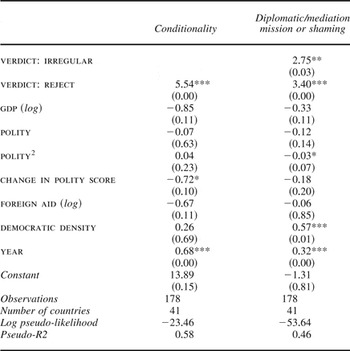
To assess whether these associations hold up after controlling for other factors that influence enforcement, I estimate two logistic models, the first predicting the implementation of conditionality and the second predicting the implementation of the other two tools of enforcement.Footnote 76 The dependent variables are dichotomous, capturing whether one or more regional IGOs implemented the tool(s) in question. There are two key independent variables: dummy variables for elections deemed irregular and reject. The baseline (omitted) category is therefore elections deemed clean. The variable for gdp (log) captures geopolitical importance. Six additional control variables—identical to those in Table 1—are included.
Table 2 presents the results. Due to colinearity, the variable for verdict: irregular must be omitted from Model 1.Footnote 77 The evidence is clear: when international observers reject the election, this significantly increases the probability that a regional IGO will punish the country by imposing conditionality. When all control variables are held at their median values, the predicted probability of conditionality given a verdict of clean or irregular is zero, but this increases to 0.08 given a verdict of reject.Footnote 78 Results in Model 2 also conform to expectations, supporting the idea that tools of mediation, diplomacy, and shaming will be perceived by an IGO's member states as useful and appropriate not only when misconduct is severe and intentionally perpetrated by the government, but also when it is primarily technical or administrative in nature. The predicted probability of shaming or diplomacy/mediation following a verdict of clean (holding all other variables at their medians) is 0.02; following an irregular verdict, 0.15; and following a verdict of reject, 0.25.
The effect of election observers' verdicts on tools of enforcement

Notes: Parameters estimated using logistic regression. Standard errors clustered on country. Robust p values in parentheses. Two-tailed significance tests:
* significant at 10%;
** significant at 5%;
*** significant at 1%.
Alternative Explanations
One potential problem with testing for the effects of international election observers is that missions are not randomly assigned. There may be factors correlated with the presence of observers that also influence the probability of regional IGO enforcement. This would be problematic if IGOs avoid sending observation missions to countries where they are unwilling or unable to enforce their commitment to democracy. If this were the case, rather than exerting a real effect on enforcement, the presence of observers might simply reflect a precommitment to enforcement.Footnote 79 An investigation of the association between observation missions and geopolitical importance yields little evidence that observers tend to systematically avoid more powerful countries.Footnote 80 Moreover, controlling for geopolitical importance, level of democracy, and other variables that influence the probability of enforcement in Tables 1 and 2 should greatly mitigate this potential problem.Footnote 81
Nevertheless, to assess whether unobserved factors are simultaneously driving both observation and enforcement, I estimate a bivariate probit model with enforcement and election observation as the two outcome variables.Footnote 82 Bivariate probit is a flexible method that allows for the inclusion of one dependent variable (election observation) as a potentially endogenous explanatory variable predicting the other dependent variable (enforcement). I estimate the following model:Footnote 83

Here, Φ2 represents the cumulative distribution function of the bivariate normal distribution, y 1 represents enforcement, y 2 represents the presence of an international election observation mission, x1 and x2 are the covariates, β1 and β2 are their coefficients, γ is the coefficient on y 2 in equation (1), and ρ (rho) measures the correlation between the error terms of the two equations. In other words, ρ captures the association between the two outcomes after controlling for the influence of the included covariates.Footnote 84 Only a positive ρ would be problematic for this study, because it would indicate that observers are more likely to be sent to elections with a high probability of enforcement.
As in Table 1, the sample is limited to flawed elections. The specification of the model predicting y 1 enforcement is identical to Table 1. Control variables in the model predicting y 2 are based on the factors that Kelley finds to be significant predictors of international election observation:Footnote 85 an indicator for the presence of observers in the previous election (international election observers), an indicator for whether the previous election was flawed (previous election flawed), polity score (lagged one year), polity2 (lagged one year), log of foreign aid (lagged one year), and year, which indicates the year in which the election occurred.
The results, shown in Table 3, do not support the idea that the relationship between election observation and enforcement is endogenous. The coefficient estimates in the equation predicting enforcement are similar in direction and significance to those presented in Table 1. Tellingly, the correlation between the errors of the two equations is negative (ρ = −0.75) but not significant.Footnote 86 In short, election observation appears to be more likely in cases with a lower probability of enforcement, after controlling for the other covariates. This would, if anything, bias against finding a positive, significant relationship between observers and enforcement in the original models.
Bivariate probit model estimating probability of enforcement and election observation

Notes : Standard errors clustered on country. Robust p values in parentheses. Two-tailed significance tests:
* significant at 10%;
** significant at 5%;
*** significant at 1%.
Finally, because regional effects may be potentially correlated with both election observation and enforcement, I re-estimate the models in Tables 1 and 2 with regional dummy variables for Latin America and the former Soviet Republics.Footnote 87 The variable for Latin America is negative and marginally significant in two of eight specifications, but the results are otherwise not substantively changed.Footnote 88
A second alternative explanation for the finding that observers are positively associated with enforcement after flawed elections stems from the possibility of sample selection bias. If observers deter leaders from engaging in electoral misconduct, this may mean that the presence of observers is negatively associated with entrance into the sample of flawed elections. It is unlikely that this would pose problems for this study, since deterrence should, if anything, create a negative rather than a positive association between observers and enforcement. It is also doubtful that the costs associated with inviting election observers are high enough to outweigh the benefits of misconduct—which can make the difference between winning and losing the election—in most cases. However, it is possible that if deterrence is at work, only the most intransigent incumbents persist in electoral misconduct despite the presence of observers, and these may represent the most blatant cases of misconduct that are more likely to experience enforcement. Or, misconduct may be more likely in geopolitically important countries, in which election observers have a larger effect on enforcement. I investigate these issues further using a Heckman probit model with sample selection. Results (available by request) indicate that after controlling for factors—including observers and economic size—that may influence whether an election is flawed, the effect of observers on enforcement remains positive and significant. Moreover, the lack of any significant correlation in the error terms of the two equations (ρ) indicates that sample selection is not biasing the results.
Robustness
Tables 1 and 2 presented models predicting whether enforcement is implemented by at least one of the IGOs considered in this study. But are the results driven by a single IGO? It is often argued, for example, that the EU is the most effective actor in its region. To ensure that findings about the effect of geopolitical importance and election observers are generalizable across more than one IGO, I reran the main models in Tables 1 and 2 omitting each IGO in turn from the dependent variable.Footnote 89 Results are shown in Table 4.
Sensitivity of results to dropping IGOs

Notes: Parameters estimated using logistic regression. Standard errors clustered on country. Robust p values in parentheses. COE = Council of Europe; EU = European Union; OAS = Organization of American States; OSCE = Organization for Security and Cooperation in Europe. Two-tailed significance tests:
* significant at 10%;
** significant at 5%;
*** significant at 1%
1. Not applicable. The variable dropped due to colinearity: no cases of conditionality when reject = 0.
The first “baseline” column shows the coefficient and p-values for geopolitical importance, election observers, and verdicts from the original models presented in Tables 1 and 2. Columns (2) to (5) show the coefficients when a particular IGO is dropped from inclusion in the dependent variable.Footnote 90 Thus, column (2) shows coefficient estimates from models predicting enforcement implemented by any regional IGO except the EU. A reduction in significance compared to the baseline can be interpreted as showing that the IGO that was dropped is more sensitive to the independent variable in question than the other IGOs included in the analysis.
Overall, results lend strong support to the robustness of the findings across multiple IGOs. Importantly, in all four models that drop IGOs, coefficients never change sign and are of comparable magnitude. Significance for geopolitical importance and election observation does reduce slightly in certain specifications when the OSCE and especially the EU are dropped. But this may reflect an informal division of labor among IGOs in postcommunist countries, as each has taken primary responsibility for different subregions (for example, the EU in the Balkans and COE in the Caucasus). These IGOs may therefore act alone in some cases for reasons that are only coincidentally related to election observers or geopolitical importance.
As a final robustness check, a series of models were run to assess whether enforcement patterns are driven by the nature of political and economic relations between the country holding the election and other IGO member states. Three new control variables (all lagged one year) were added to the specifications presented in Tables 1 and 2: the average similarity of alliance portfolios (S-scores) between country i and other IGO member states, the average trade dependence between other member states and country i, and the average number of fatal militarized interstate disputes (MIDs) in which country i and other members were jointly involved.Footnote 91 None of these variables were statistically significant and results for geopolitical importance, election observers, and their verdicts were substantively unchanged.
Conclusion
Who is punished for violating international norms? Variation in the enforcement of international norms and commitments is an important issue that has, to date, received surprisingly little scholarly attention. It is generally recognized that one of the ways international institutions influence domestic politics is through the threat or application of enforcement, which helps states make credible commitments to abide by the institution's norms. A critical underlying assumption is that countries are in fact punished if they violate their commitments. If, however, enforcement is inconsistent and varies systematically across cases, this would alter our understanding of the conditions under which membership in international institutions affects state behavior.
This article presented a theoretical framework for explaining country-level variation in multilateral norm enforcement. Predictions were tested using an original data set of regional IGO enforcement in response to one particularly prevalent violation of democratic norms: electoral misconduct. I find that the likelihood of enforcement depends, first, on the country's geopolitical importance, which influences the degree of disagreement among other member states about enforcement; and second, on the quality of information member states possess about the nature and extent of the norm violation. By revealing and publicizing information on electoral misconduct, election observation helps mitigate the barriers to enforcement. While this study has focused on democratic norms, the logic of the theory should also help explain patterns of multilateral enforcement in other issue areas—such as human rights or environmental protection—which may possess different types of monitors, and which, like democracy, are easily trumped by competing geopolitical interests.
The findings presented here imply that the link between IGO membership and the costliness of democratic commitments should be theorized and tested as a conditional relationship, depending at least in part on country- and case-specific factors that influence the likelihood of enforcement. In addition to these implications about the effects of IGO membership, the findings also lay the groundwork for future research on the domestic effects of enforcement.Footnote 92 Does enforcement help restore and strengthen democracy in the wake of electoral misconduct? Before this question can be answered, one must first understand the conditions under which enforcement is applied, in particular, whether it occurs disproportionately in “easy” cases exhibiting already favorable domestic conditions.
Another implication of this study is that by revealing and publicizing information, monitoring can create pressure for enforcement and increase the credibility of international commitments. Scholars have begun to explore the informational effects of election observation and other forms of international monitoring, but research has focused mainly on how monitoring influences actors within the state being monitored.Footnote 93 This study's focus on how monitoring influences other, nonviolating states—specifically, those in an IGO that can enforce norm violations—is novel, and identifies new channels for research on the effects of different forms of international monitoring, beyond election observation. For example, it would be of interest to explore whether, and under what conditions, monitoring places greater constraints on those doing the monitoring than on those being monitored. As this study highlights, if monitoring agencies can act autonomously, they may create pressure for enforcement even in geopolitically important cases in which states are otherwise reluctant to punish the government.