Introduction
On March 10, 2020, COVID-19 was officially declared a critical threat to the Danish society. Exactly 18 months after, on September 10, 2021, Denmark was the first country in the European Union to declare that COVID-19 was no longer a critical threat to society and to lift all COVID-19 restrictions (see Fig. 1, Panel A, for an illustration of the course of the COVID-19 pandemic in Denmark). Over the course of these 18 months, we conducted four studies based on data from the COVID-19 Consequences Denmark Panel Survey 2020 (CCDPS 2020), in which we found co-variation between the intensity of the pandemic (confirmed COVID-19 cases, COVID-19-related deaths, and COVID-19-related restrictions) and the level of psychological well-being among the adult Danish population. Our results suggested a particularly pronounced negative effect on young adults compared to older adults (Sønderskov et al., Reference Sønderskov, Dinesen, Santini and Østergaard2020a, b, Reference Sønderskov, Dinesen, Vistisen and Østergaard2021; Vistisen et al., Reference Vistisen, Sønderskov, Dinesen and Østergaard2021), which resonates well with findings from other Danish and international studies conducted in the same period (Fancourt et al., Reference Fancourt, Steptoe and Bu2020; Kimhi et al., Reference Kimhi, Eshel, Marciano and Adini2020; Mehrsafar et al., Reference Mehrsafar, Moghadam Zadeh, Gazerani, Jaenes Sanchez, Nejat, Rajabian Tabesh and Abolhasani2021; Ramiz et al., Reference Ramiz, Contrand, Rojas Castro, Dupuy, Lu, Sztal-Kutas and Lagarde2021; Ruggieri et al., Reference Ruggieri, Ingoglia, Bonfanti and Lo Coco2021; Savage et al., Reference Savage, Hennis, Magistro, Donaldson, Healy and James2021; Thygesen et al., Reference Thygesen, Møller, Ersbøll, Santini, Nielsen, Grønbæk and Ekholm2021; Varga et al., Reference Varga, Bu, Dissing, Elsenburg, Bustamante, Matta, van Zon, Brouwer, Bültmann, Fancourt, Hoeyer, Goldberg, Melchior, Strandberg-Larsen, Zins, Clotworthy and Rod2021).
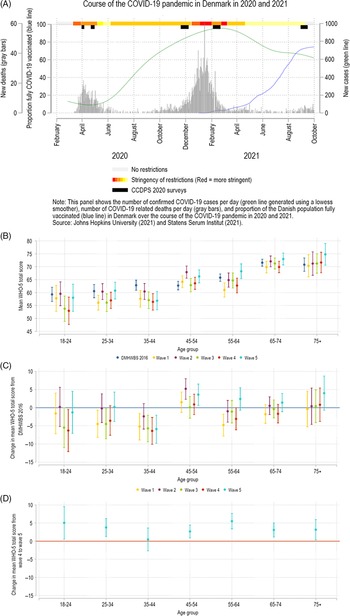
Fig. 1.
Panel A: Shows the timing of the five waves of the COVID-19 Consequences Denmark Panel Survey 2020 (CCDPS 2020) as well as the number of confirmed cases of COVID-19 in Denmark, the number of COVID-19-related deaths in Denmark, and the proportion of the Danish population being fully vaccinated against COVID-19. Furthermore, the level of societal restrictions/lockdowns in Denmark is illustrated using a colour schematic with yellow representing mild restrictions and red representing more severe restrictions. Panel B: Levels of psychological well-being (mean WHO-5 total scores with 95% CI) from the Danish Mental Health and Well-Being Survey 2016 (DMHWBS 2016) and from the five CCDPS 2020 waves, stratified by age. Panel C: Changes in psychological well-being (mean WHO-5 total scores with 95% CI) from the DMHWBS 2016 to the five individual CCDPS 2020 waves. Panel D: Change in psychological well-being (mean WHO-5 total scores with 95% CI) from wave four to wave five of the CCDPS 2020. Sources: CCDPS 2020, DMHWBS 2016, John Hopkins University (2021), and Statens Serum Institut (2021).
Evidence from the SARS outbreak in Taiwan in 2003 suggests that the negative psychological impact of an epidemic may persist into the post-epidemic period (Hsieh et al., Reference Hsieh, Kao, Li, Lu, Tsai, Chen, Chou, Huang, Hsu and Chou2020). Therefore, the aim of this study was to examine the degree of psychological well-being/distress in the Danish population after having returned to close to pre-pandemic societal conditions and to compare it against levels obtained over the preceding 18 months as well as before the COVID-19 pandemic.
Methods
All waves of the CCDPS 2020 were collected online by the survey agency Epinion (on commission), using the same target sample (invitees sampled from Epinion’s respondent pool). In the five CCDPS 2020 waves, measures of psychological well-being, that is the five-item World Health Organization well-being index (WHO-5) (Topp et al., Reference Topp, Østergaard, Søndergaard and Bech2015), and six questions on the severity of symptoms of depression/anxiety experienced over the past two weeks (reported on a scale going from 0 (not present) to 10 (present to an extreme degree)) were collected. Wave one was fielded from March 31 to April 6, 2020 (Sønderskov et al., Reference Sønderskov, Dinesen, Santini and Østergaard2020a), wave two from April 22 to April 30, 2020 (Sønderskov et al., Reference Sønderskov, Dinesen, Santini and Østergaard2020b), wave three from November 20 to December 8, 2020 (Sønderskov et al., Reference Sønderskov, Dinesen, Vistisen and Østergaard2021), and wave four from February 4 to February 21, 2021 (Vistisen et al., Reference Vistisen, Sønderskov, Dinesen and Østergaard2021). The fifth wave of the CCDPS 2020 with emphasis on psychological well-being was fielded from August 30 to September 15, 2021. The current study was based on respondents that participated in all five of these waves. After weighting (applied in all analyses), the sample is representative of the Danish population in terms of key demographic variables (gender, age, education, region, and self-reported party choice at the 2019 Parliament election in Denmark). Finally, psychological well-being measured prior to the pandemic was obtained through data from the Danish Mental Health and Well-being Survey 2016 (DMHWBS2016) (see the Supplementary Material for a description of this survey, which is independent of the CCDPS 2020). As the trajectories of psychological well-being across the first four waves of the CCDPS 2020 are described in detail elsewhere (Sønderskov et al., Reference Sønderskov, Dinesen, Santini and Østergaard2020a, b, Reference Sønderskov, Dinesen, Vistisen and Østergaard2021; Vistisen et al., Reference Vistisen, Sønderskov, Dinesen and Østergaard2021), our analyses focused primarily on the development from wave four (fielded during the second spike of the COVID-19 pandemic in Denmark) to wave five, as well as a comparison between wave five and the pre-pandemic state of the Danish population (from the DMHWBS 2016). Specifically, we compared the mean WHO-5 total scores and the proportion of respondents with a WHO-5 total score <50 [indicative of depression (Topp et al., Reference Topp, Østergaard, Søndergaard and Bech2015)] at wave five with scores from wave four (paired sample t-test), as well as with those measured in the DMHWBS 2016 (two-sample t-test). We also compared the individual WHO-5 item scores and the level of reported symptoms of anxiety and depression (not available for the DMHWBS 2016) at wave five with those from wave four (paired sample t-test). Furthermore, we investigated the correlation (Pearson’s) between changes in each of the six anxiety/depression symptom levels and changes in the WHO-5 total scores from wave four to wave five. All analyses were stratified by the age at wave one of the CCDPS 2020, using the following strata: 18–24, 25–34, 35–44, 45–54, 55–64, 65–74, and 75+. P-values <0.05 were considered statistically significant in all analyses.
Results
A total of 1195 respondents (47% women, weighted proportion) participated in all five waves of the CCDPS 2020 (49% of the 2458 respondents in wave 1). The sample had a mean age of 49.5 years (weighted mean). The age-stratified levels of psychological well-being (the WHO-5 total score) at the five CCDPS 2020 waves as well as prior to the pandemic (obtained from the DMHWBS 2016) are shown in Fig. 1, Panel B. Age-stratified changes in psychological well-being from 2016 to the five CCDPS 2020 waves, as well as from wave four to wave five of the CCDPS 2020, are shown in Fig. 1, Panel C and D, respectively. These results show that psychological well-being has increased with statistical significance from wave four to wave five and is generally at the same level as in 2016. The only exception to this general tendency is those aged 35–44 years, who did not experience a change in psychological well-being from wave four to wave five. Furthermore, their psychological well-being at wave five was statistically significantly lower than the 2016 level in the same age group. The results of gender-stratified analyses are similar to those described above (Supplementary Figures 1, 2 and 3, and Supplementary Table 2).
The results of the remaining analyses can be summarised as follows: Only among the 35–44-year-olds was the proportion with WHO-5 scores <50 (indicative of depression) significantly higher at wave five compared to the 2016 level (Supplementary Figure 4 and Supplementary Table 3). When comparing the proportions with WHO-5 scores <50 at wave four to wave five, statistically significant decreases were observed among those aged 18–24, 25–34 and 55–64 years (Supplementary Figure 4 and Supplementary Table 3). When assessing the development in psychological well-being at the individual WHO-5 item-level, it becomes evident that the increase in the WHO-5 total score from wave four to wave five was mainly driven by feeling more happy, more vigorous, more rested, and more occupied with things of interest – with some substantial variation, however, across the age groups (Supplementary Figure 5 and Table 4). With regard to the symptoms of anxiety and depression, hopelessness decreased with statistical significance across all age groups from wave four to wave five, while there were also statistically significant decreases in depression (all age groups except from the 18–24-year olds), anxiety (all age groups except from the 18–24 and 25–34-year-olds), anxiety (all age groups except from the 18–24, 25–34 and 35–44-year-olds), and worry (only among those aged 55–64, 65–74 and 75+ years) (Supplementary Figure 6 and Supplementary Table 5). Furthermore, there was a negative correlation between changes in the severity of anxiety/depression symptoms from wave four to wave five and changes in psychological well-being (Supplementary Table 6). In other words, the decreases in anxiety/depression symptom severity observed from wave four to five tended to be accompanied by increased psychological well-being.
Discussion
This is the fifth time we have surveyed the psychological state of Denmark during the COVID-19 pandemic. The results are consistent with our prior reports from this series of surveys in showing that there appears to be co-variation between the pandemic pressure and psychological well-being (Sønderskov et al., Reference Sønderskov, Dinesen, Santini and Østergaard2020a, b, Reference Sønderskov, Dinesen, Vistisen and Østergaard2021; Vistisen et al., Reference Vistisen, Sønderskov, Dinesen and Østergaard2021). Moreover, the results across the five survey waves are compatible with variation in symptoms of anxiety and depression being a key driving force behind the variation in psychological well-being. In wave five of the survey, however, the 35–44-year-olds represent a notable exception to this general pattern. Specifically, while symptoms of hopelessness and depression decreased in this group, their level of psychological well-being remained unaltered compared to wave four and compared to pre-pandemic levels. We can only speculate with regard to the reason for this finding, but will refrain from doing so, as there are likely many other sources than symptoms of anxiety and depression – unaccounted for in the present study – contributing to psychological well-being.
As for the prior studies of the CCDPS waves, the main limitation of this study is its observational design, which means that alternative explanations for the variation in psychological well-being – such as changing seasons – cannot be ruled out. For further discussion of this aspect, please see (Sønderskov et al., Reference Sønderskov, Dinesen, Vistisen and Østergaard2021).
In conclusion, in September 2021, when Denmark had returned to close to pre-pandemic societal conditions, the psychological well-being of the Danish population also appears to have returned to the pre-pandemic level – except, however, for the 35–44-year-olds. With the degree of co-variation between the pandemic pressure and psychological well-being observed across the CCDPS waves (Sønderskov et al., Reference Sønderskov, Dinesen, Santini and Østergaard2020a, b, Reference Sønderskov, Dinesen, Vistisen and Østergaard2021; Vistisen et al., Reference Vistisen, Sønderskov, Dinesen and Østergaard2021) and elsewhere (Fancourt et al., Reference Fancourt, Steptoe and Bu2020; Kimhi et al., Reference Kimhi, Eshel, Marciano and Adini2020; Mehrsafar et al., Reference Mehrsafar, Moghadam Zadeh, Gazerani, Jaenes Sanchez, Nejat, Rajabian Tabesh and Abolhasani2021; Ramiz et al., Reference Ramiz, Contrand, Rojas Castro, Dupuy, Lu, Sztal-Kutas and Lagarde2021; Ruggieri et al., Reference Ruggieri, Ingoglia, Bonfanti and Lo Coco2021; Savage et al., Reference Savage, Hennis, Magistro, Donaldson, Healy and James2021; Thygesen et al., Reference Thygesen, Møller, Ersbøll, Santini, Nielsen, Grønbæk and Ekholm2021; Varga et al., Reference Varga, Bu, Dissing, Elsenburg, Bustamante, Matta, van Zon, Brouwer, Bültmann, Fancourt, Hoeyer, Goldberg, Melchior, Strandberg-Larsen, Zins, Clotworthy and Rod2021), it is also a concern from a mental health perspective that the COVID-19 pandemic – at the time of writing – continues to affect populations across the globe.








 You have
Access
Introduction
On March 10, 2020, COVID-19 was officially declared a critical threat to the Danish society. Exactly 18 months after, on September 10, 2021, Denmark was the first country in the European Union to declare that COVID-19 was no longer a critical threat to society and to lift all COVID-19 restrictions (see Fig. 1, Panel A, for an illustration of the course of the COVID-19 pandemic in Denmark). Over the course of these 18 months, we conducted four studies based on data from the COVID-19 Consequences Denmark Panel Survey 2020 (CCDPS 2020), in which we found co-variation between the intensity of the pandemic (confirmed COVID-19 cases, COVID-19-related deaths, and COVID-19-related restrictions) and the level of psychological well-being among the adult Danish population. Our results suggested a particularly pronounced negative effect on young adults compared to older adults (Sønderskov et al., Reference Sønderskov, Dinesen, Santini and Østergaard2020a, b, Reference Sønderskov, Dinesen, Vistisen and Østergaard2021; Vistisen et al., Reference Vistisen, Sønderskov, Dinesen and Østergaard2021), which resonates well with findings from other Danish and international studies conducted in the same period (Fancourt et al., Reference Fancourt, Steptoe and Bu2020; Kimhi et al., Reference Kimhi, Eshel, Marciano and Adini2020; Mehrsafar et al., Reference Mehrsafar, Moghadam Zadeh, Gazerani, Jaenes Sanchez, Nejat, Rajabian Tabesh and Abolhasani2021; Ramiz et al., Reference Ramiz, Contrand, Rojas Castro, Dupuy, Lu, Sztal-Kutas and Lagarde2021; Ruggieri et al., Reference Ruggieri, Ingoglia, Bonfanti and Lo Coco2021; Savage et al., Reference Savage, Hennis, Magistro, Donaldson, Healy and James2021; Thygesen et al., Reference Thygesen, Møller, Ersbøll, Santini, Nielsen, Grønbæk and Ekholm2021; Varga et al., Reference Varga, Bu, Dissing, Elsenburg, Bustamante, Matta, van Zon, Brouwer, Bültmann, Fancourt, Hoeyer, Goldberg, Melchior, Strandberg-Larsen, Zins, Clotworthy and Rod2021).
Panel A: Shows the timing of the five waves of the COVID-19 Consequences Denmark Panel Survey 2020 (CCDPS 2020) as well as the number of confirmed cases of COVID-19 in Denmark, the number of COVID-19-related deaths in Denmark, and the proportion of the Danish population being fully vaccinated against COVID-19. Furthermore, the level of societal restrictions/lockdowns in Denmark is illustrated using a colour schematic with yellow representing mild restrictions and red representing more severe restrictions. Panel B: Levels of psychological well-being (mean WHO-5 total scores with 95% CI) from the Danish Mental Health and Well-Being Survey 2016 (DMHWBS 2016) and from the five CCDPS 2020 waves, stratified by age. Panel C: Changes in psychological well-being (mean WHO-5 total scores with 95% CI) from the DMHWBS 2016 to the five individual CCDPS 2020 waves. Panel D: Change in psychological well-being (mean WHO-5 total scores with 95% CI) from wave four to wave five of the CCDPS 2020. Sources: CCDPS 2020, DMHWBS 2016, John Hopkins University (2021), and Statens Serum Institut (2021).
Evidence from the SARS outbreak in Taiwan in 2003 suggests that the negative psychological impact of an epidemic may persist into the post-epidemic period (Hsieh et al., Reference Hsieh, Kao, Li, Lu, Tsai, Chen, Chou, Huang, Hsu and Chou2020). Therefore, the aim of this study was to examine the degree of psychological well-being/distress in the Danish population after having returned to close to pre-pandemic societal conditions and to compare it against levels obtained over the preceding 18 months as well as before the COVID-19 pandemic.
Methods
All waves of the CCDPS 2020 were collected online by the survey agency Epinion (on commission), using the same target sample (invitees sampled from Epinion’s respondent pool). In the five CCDPS 2020 waves, measures of psychological well-being, that is the five-item World Health Organization well-being index (WHO-5) (Topp et al., Reference Topp, Østergaard, Søndergaard and Bech2015), and six questions on the severity of symptoms of depression/anxiety experienced over the past two weeks (reported on a scale going from 0 (not present) to 10 (present to an extreme degree)) were collected. Wave one was fielded from March 31 to April 6, 2020 (Sønderskov et al., Reference Sønderskov, Dinesen, Santini and Østergaard2020a), wave two from April 22 to April 30, 2020 (Sønderskov et al., Reference Sønderskov, Dinesen, Santini and Østergaard2020b), wave three from November 20 to December 8, 2020 (Sønderskov et al., Reference Sønderskov, Dinesen, Vistisen and Østergaard2021), and wave four from February 4 to February 21, 2021 (Vistisen et al., Reference Vistisen, Sønderskov, Dinesen and Østergaard2021). The fifth wave of the CCDPS 2020 with emphasis on psychological well-being was fielded from August 30 to September 15, 2021. The current study was based on respondents that participated in all five of these waves. After weighting (applied in all analyses), the sample is representative of the Danish population in terms of key demographic variables (gender, age, education, region, and self-reported party choice at the 2019 Parliament election in Denmark). Finally, psychological well-being measured prior to the pandemic was obtained through data from the Danish Mental Health and Well-being Survey 2016 (DMHWBS2016) (see the Supplementary Material for a description of this survey, which is independent of the CCDPS 2020). As the trajectories of psychological well-being across the first four waves of the CCDPS 2020 are described in detail elsewhere (Sønderskov et al., Reference Sønderskov, Dinesen, Santini and Østergaard2020a, b, Reference Sønderskov, Dinesen, Vistisen and Østergaard2021; Vistisen et al., Reference Vistisen, Sønderskov, Dinesen and Østergaard2021), our analyses focused primarily on the development from wave four (fielded during the second spike of the COVID-19 pandemic in Denmark) to wave five, as well as a comparison between wave five and the pre-pandemic state of the Danish population (from the DMHWBS 2016). Specifically, we compared the mean WHO-5 total scores and the proportion of respondents with a WHO-5 total score <50 [indicative of depression (Topp et al., Reference Topp, Østergaard, Søndergaard and Bech2015)] at wave five with scores from wave four (paired sample t-test), as well as with those measured in the DMHWBS 2016 (two-sample t-test). We also compared the individual WHO-5 item scores and the level of reported symptoms of anxiety and depression (not available for the DMHWBS 2016) at wave five with those from wave four (paired sample t-test). Furthermore, we investigated the correlation (Pearson’s) between changes in each of the six anxiety/depression symptom levels and changes in the WHO-5 total scores from wave four to wave five. All analyses were stratified by the age at wave one of the CCDPS 2020, using the following strata: 18–24, 25–34, 35–44, 45–54, 55–64, 65–74, and 75+. P-values <0.05 were considered statistically significant in all analyses.
Results
A total of 1195 respondents (47% women, weighted proportion) participated in all five waves of the CCDPS 2020 (49% of the 2458 respondents in wave 1). The sample had a mean age of 49.5 years (weighted mean). The age-stratified levels of psychological well-being (the WHO-5 total score) at the five CCDPS 2020 waves as well as prior to the pandemic (obtained from the DMHWBS 2016) are shown in Fig. 1, Panel B. Age-stratified changes in psychological well-being from 2016 to the five CCDPS 2020 waves, as well as from wave four to wave five of the CCDPS 2020, are shown in Fig. 1, Panel C and D, respectively. These results show that psychological well-being has increased with statistical significance from wave four to wave five and is generally at the same level as in 2016. The only exception to this general tendency is those aged 35–44 years, who did not experience a change in psychological well-being from wave four to wave five. Furthermore, their psychological well-being at wave five was statistically significantly lower than the 2016 level in the same age group. The results of gender-stratified analyses are similar to those described above (Supplementary Figures 1, 2 and 3, and Supplementary Table 2).
The results of the remaining analyses can be summarised as follows: Only among the 35–44-year-olds was the proportion with WHO-5 scores <50 (indicative of depression) significantly higher at wave five compared to the 2016 level (Supplementary Figure 4 and Supplementary Table 3). When comparing the proportions with WHO-5 scores <50 at wave four to wave five, statistically significant decreases were observed among those aged 18–24, 25–34 and 55–64 years (Supplementary Figure 4 and Supplementary Table 3). When assessing the development in psychological well-being at the individual WHO-5 item-level, it becomes evident that the increase in the WHO-5 total score from wave four to wave five was mainly driven by feeling more happy, more vigorous, more rested, and more occupied with things of interest – with some substantial variation, however, across the age groups (Supplementary Figure 5 and Table 4). With regard to the symptoms of anxiety and depression, hopelessness decreased with statistical significance across all age groups from wave four to wave five, while there were also statistically significant decreases in depression (all age groups except from the 18–24-year olds), anxiety (all age groups except from the 18–24 and 25–34-year-olds), anxiety (all age groups except from the 18–24, 25–34 and 35–44-year-olds), and worry (only among those aged 55–64, 65–74 and 75+ years) (Supplementary Figure 6 and Supplementary Table 5). Furthermore, there was a negative correlation between changes in the severity of anxiety/depression symptoms from wave four to wave five and changes in psychological well-being (Supplementary Table 6). In other words, the decreases in anxiety/depression symptom severity observed from wave four to five tended to be accompanied by increased psychological well-being.
Discussion
This is the fifth time we have surveyed the psychological state of Denmark during the COVID-19 pandemic. The results are consistent with our prior reports from this series of surveys in showing that there appears to be co-variation between the pandemic pressure and psychological well-being (Sønderskov et al., Reference Sønderskov, Dinesen, Santini and Østergaard2020a, b, Reference Sønderskov, Dinesen, Vistisen and Østergaard2021; Vistisen et al., Reference Vistisen, Sønderskov, Dinesen and Østergaard2021). Moreover, the results across the five survey waves are compatible with variation in symptoms of anxiety and depression being a key driving force behind the variation in psychological well-being. In wave five of the survey, however, the 35–44-year-olds represent a notable exception to this general pattern. Specifically, while symptoms of hopelessness and depression decreased in this group, their level of psychological well-being remained unaltered compared to wave four and compared to pre-pandemic levels. We can only speculate with regard to the reason for this finding, but will refrain from doing so, as there are likely many other sources than symptoms of anxiety and depression – unaccounted for in the present study – contributing to psychological well-being.
As for the prior studies of the CCDPS waves, the main limitation of this study is its observational design, which means that alternative explanations for the variation in psychological well-being – such as changing seasons – cannot be ruled out. For further discussion of this aspect, please see (Sønderskov et al., Reference Sønderskov, Dinesen, Vistisen and Østergaard2021).
In conclusion, in September 2021, when Denmark had returned to close to pre-pandemic societal conditions, the psychological well-being of the Danish population also appears to have returned to the pre-pandemic level – except, however, for the 35–44-year-olds. With the degree of co-variation between the pandemic pressure and psychological well-being observed across the CCDPS waves (Sønderskov et al., Reference Sønderskov, Dinesen, Santini and Østergaard2020a, b, Reference Sønderskov, Dinesen, Vistisen and Østergaard2021; Vistisen et al., Reference Vistisen, Sønderskov, Dinesen and Østergaard2021) and elsewhere (Fancourt et al., Reference Fancourt, Steptoe and Bu2020; Kimhi et al., Reference Kimhi, Eshel, Marciano and Adini2020; Mehrsafar et al., Reference Mehrsafar, Moghadam Zadeh, Gazerani, Jaenes Sanchez, Nejat, Rajabian Tabesh and Abolhasani2021; Ramiz et al., Reference Ramiz, Contrand, Rojas Castro, Dupuy, Lu, Sztal-Kutas and Lagarde2021; Ruggieri et al., Reference Ruggieri, Ingoglia, Bonfanti and Lo Coco2021; Savage et al., Reference Savage, Hennis, Magistro, Donaldson, Healy and James2021; Thygesen et al., Reference Thygesen, Møller, Ersbøll, Santini, Nielsen, Grønbæk and Ekholm2021; Varga et al., Reference Varga, Bu, Dissing, Elsenburg, Bustamante, Matta, van Zon, Brouwer, Bültmann, Fancourt, Hoeyer, Goldberg, Melchior, Strandberg-Larsen, Zins, Clotworthy and Rod2021), it is also a concern from a mental health perspective that the COVID-19 pandemic – at the time of writing – continues to affect populations across the globe.
Supplementary material
For supplementary material accompanying this paper visit https://doi.org/10.1017/neu.2022.1
Acknowledgements
The authors are grateful to the group behind the DMHWBS 2016 for making the results of this survey available for our analyses.
Financial support
The study is supported by an unconditional grant from the Novo Nordisk Foundation (Grant number: NNF20SA0062874). Østergaard reports further funding from the Lundbeck Foundation (grant numbers: R358-2020-2341 and R344-2020-1073), the Danish Cancer Society (grant number: R283-A16461), the Central Denmark Region Fund for Strengthening of Health Science (grant number: 1-36-72-4-20), The Danish Agency for Digitisation Investment Fund for New Technologies (grant number 2020-6720), and Independent Research Fund Denmark (grant number: 7016-00048B). Sønderskov is supported by a grant from the Danish National Research Foundation (grant number: DNRF144). These funding bodies were not involved in the study design; in the collection, analysis, and interpretation of data; in the writing of the report; or in the decision to submit the paper for publication.
Conflict of interest
SDØ received the 2020 Lundbeck Foundation Young Investigator Prize. Furthermore, SDØ owns units of mutual funds with stock tickers DKIGI and WEKAFKI, as well as units of exchange-traded funds with stock tickers TRET, 2B76, EXH2, QDVE, QDVH, USPY, and BATE. The remaining authors report no conflicts of interest.