INTRODUCTION
In native habitats, plant diseases are common, but rarely do they form epidemics with devastating consequences to host populations (Burdon Reference BURDON1987, Gilbert Reference GILBERT2002, Meléndez & Ackerman Reference MELÉNDEZ and ACKERMAN1993). However, where disease-causing organisms have invaded novel environments, epidemics can be pervasive with severe outcomes for host species and the ecosystems in which they reside (Gessler et al. Reference GESSLER, PERTOT and PERAZZOLLI2011, Huang et al. Reference HUANG, DANE and KUBISIAK1998, Webber Reference WEBBER2004). Under those circumstances, spread of diseases is dependent on a number of factors, such as host life-history stage, propagule pressure, environmental conditions and spatial heterogeneity (Gilbert et al. Reference GILBERT, FOSTER and HUBBELL1994, Meentemeyer et al. Reference MEENTEMEYER, HAAS and VÁCLAVÍK2012, Plantegenest et al. Reference PLANTEGENEST, LE MAY and FABRE2007).
Recent outbreaks of Austropuccinia psidii (G. Winter) Beenken, known as myrtle, pimento or guava rust, have had severe consequences to species of Myrtaceae throughout the tropics and subtropics, including regions where the rust has not been previously reported (Coates-Beckford & Tennant Reference COATES-BECKFORD and TENNANT2013, Rayamajhi et al. Reference RAYAMAJHI, PRATT, KLOPFENSTEIN, ROSS-DAVIS and RODGERS2013, Uchida & Loope Reference UCHIDA and LOOPE2009). The potential for further invasions by A. psidii is high. Distribution modelling using climatic variables suggests that its potential distribution in the Neotropics exceeds its known range (Booth et al. Reference BOOTH, OLD and JOVANOVIC2000). Furthermore, the rust is genetically diverse, and different genotypes often have different sets of host species. Consequently, infection dynamics differ among regions depending on which of the genotypes are present (MacLachlan Reference MACLACHLAN1938, Ross-Davis et al. Reference ROSS-DAVIS, GRAÇA, ALFENAS, PEEVER, HANNA, UCHIDA, HAUFF, KADOOKA, KIM, CANNON, NAMBA, MINATO, SIMETO, PÉREZ, RAYAMAJHI, MORÁN, LODGE, ARGUEDAS, MEDEL-ORTIZ, LÓPEZ-RAMIREZ, TENNANT, GLEN, KLOPFENSTEIN and Chadwick2014).
On the Caribbean island of Puerto Rico, the A. psidii outbreak began in 2006 and continues to the present day, thus far only infecting Syzygium jambos (L.) Alston, probably reflecting a different strain than that initially reported for the island (Arthur Reference ARTHUR1915). Other than these observations, little is known of the drivers of guava rust infections on Puerto Rico or elsewhere. Here we describe the geographic extent and potential spread of A. psidii infections on S. jambos in Puerto Rico. Given that the island is physiographically heterogeneous (Ewel & Whitmore Reference EWEL and WHITMORE1973, López Marrero & Villanueva Colón Reference LÓPEZ MARRERO and VILLANUEVA COLÓN2006), do refugia exist for some S. jambos populations? Are geographic patterns of infection associated with prevailing wind direction? Is disease intensity related to environmental conditions and tree size? Epidemiological trends of infection are determined by seeking associations between intensity of rust infections and ecological conditions and tree traits. The geographic range and potential spread of A. psidii infections on S. jambos trees in Puerto Rico is expected to be extensive and follow patterns observed in literature, with trees showing signs of infection more often in warm, shaded, wet areas (Piza & Ribeiro Reference PIZA and RIBEIRO1988, Tessmann et al. Reference TESSMANN, DIANESE, MIRANDA and CASTRO2001) and infections occurring more frequently in young trees (Coutinho et al. Reference COUTINHO, WINGFIELD, ALFENAS and CROUS1998). Given the prevailing winds, and the initial detection of the epidemic in eastern mountains, guava rust is expected to infect fewer trees in the western part of the island.
MATERIALS AND METHODS
Austropuccinia psidii (syn. Puccinia psidii G. Winter; Beenken Reference BEENKEN2017) is a fungal pathogen that infects the foliage, flowers and fruit of Myrtaceae, causing defoliation and sometimes death. Originally observed on guava (Psidium guajava L.) in Brazil where it is thought to be native along with adjacent Uruguay, the rust is widespread in South America and has escaped the confines of its native range. It has subsequently been identified as infecting over 440 species of Myrtaceae in tropical regions across the globe (http://www.cabi.org/isc/datasheet/45846; Carnegie & Lidbetter Reference CARNEGIE and LIDBETTER2012, Coutinho et al. Reference COUTINHO, WINGFIELD, ALFENAS and CROUS1998, Glen et al. Reference GLEN, ALFENAS, ZAUZA, WINGFIELD and MOHAMMED2007, Morin et al. Reference MORIN, AVEYARD, LIDBETTER and WILSON2012, Pegg et al. Reference PEGG, GIBLIN, MCTAGGART, GUYMER, TAYLOR, IRELAND, SHIVAS and PERRY2014). The rust is naturally wind-dispersed, but invasion vectors include human clothing, animals and infected plants in the plant trade (Carnegie & Cooper Reference CARNEGIE and COOPER2011, Carnegie et al. Reference CARNEGIE, LIDBETTER, WALKER, HORWOOD, TESORIERO, GLEN and PRIEST2010, Zauza et al. Reference ZAUZA, LANA, MAFFIA, ARAUJO, ALFENAS, SILVA and ALFENAS2014).
Since the early 20th century, guava rust has been known from Puerto Rico as an occasional disease of both S. jambos and Psidium guajava (Arthur Reference ARTHUR1915), yet only in the last decade has it become noticeable when full leaf flushes of S. jambos trees in Puerto Rico's El Yunque National Forest turned mustard yellow from dense blooms of urediniospores. Ross-Davis et al. (Reference ROSS-DAVIS, GRAÇA, ALFENAS, PEEVER, HANNA, UCHIDA, HAUFF, KADOOKA, KIM, CANNON, NAMBA, MINATO, SIMETO, PÉREZ, RAYAMAJHI, MORÁN, LODGE, ARGUEDAS, MEDEL-ORTIZ, LÓPEZ-RAMIREZ, TENNANT, GLEN, KLOPFENSTEIN and Chadwick2014) discovered that A. psidii is comprised of multiple strains, each of which is genetically variable and attacks different, at times overlapping, sets of hosts. They also found that the current epidemic in Puerto Rico was caused by a particularly virulent and widespread strain of guava rust known as ‘pandemic’ A. psidii, but further genotyping is necessary to support the conjecture that this strain is responsible for most, if not all, S. jambos rust infections in Puerto Rico.
Syzygium jambos is a myrtaceous tree native to South-East Asia that was introduced and established throughout the tropics as an ornamental and fruit tree (Janick & Paull Reference JANICK and PAULL2008). It was present in Puerto Rico by 1811 and has since become invasive and widespread across the island (Descourtilz Reference DESCOURTILZ1827, Little & Wadsworth Reference LITTLE and WADSWORTH1964, Rojas-Sandoval & Acevedo-Rodríguez Reference ROJAS-SANDOVAL and ACEVEDO-RODRÍGUEZ2015). Although the tree can colonize mature forests, in Puerto Rico S. jambos is most prevalent in previously disturbed areas, particularly second-growth forests that established with the abandonment of agriculture in the mid-20th century. Where S. jambos has become abundant in Puerto Rico, it alters community composition and biodiversity (Brown et al. Reference BROWN, SCATENA and GUREVITCH2006).
We obtained Syzygium jambos localities from online herbarium databases of the University of Puerto Rico, Río Piedras (UPRRP), New York Botanical Garden (NY), and the University of Puerto Rico, Mayagüez (MAPR), which guided our search for S. jambos trees to assess and measure. Databases were accessed in June and July 2016. We surveyed 101 S. jambos trees across Puerto Rico, spanning a distance of ~130 km, nearly the full length of the island running from east to west. We randomly selected trees to sample, regardless of tree size or condition. During fieldwork, the data we collected on S. jambos included geographic coordinates of the tree, altitude, per cent shade cover (a visual estimate of the forest canopy above the tree canopy), general description of the location of the tree, basal area, canopy area (two dimensions measured and multiplied by one another), and visual estimation of the percentage of leaves showing signs of infection. All visual estimations were done by a single observer (EB).
We produced a map depicting the regions of Puerto Rico that are climatically and geographically suitable for S. jambos with MaxEnt species distribution modelling software, a maximum-entropy algorithm software for niche modelling (Merow et al. Reference MEROW, SMITH and SILANDER2013, Phillips et al. Reference PHILLIPS, ANDERSON and SCHAPIRE2006). We used climatic raster layers containing information about temperature, precipitation, altitude, humidity and other climatic data to determine predictive variables for species distribution based on species presence data from fieldwork and herbarium records of S. jambos occurrences. To prepare the S. jambos presence data for MaxEnt modelling, we removed presence points from the aggregated presence data to ensure that all points were at least 0.5 km apart to minimize pseudo-replication and sampling bias. Seventy-five points remained for MaxEnt modelling. We edited predictive variables in the form of raster maps, including the Bioclim global climatic layers dataset (http://www.worldclim.org/current), land-use data from the United States Department of Agriculture Forest Service (USDA, http://data.fs.usda.gov/geodata/other_fs/IITF/index.php), and altitude data from the National Oceanic and Atmosphere Administration (NOAA, http://www.ngdc.noaa.gov/dem/squareCellGrid/download/1561) to the same extent, resolution, and format using qGIS software (http://www.qgis.org/en/site/). The Bioclim global climatic layers used in this study have a spatial resolution of 30 arc-seconds (~1 km2) (Hijmans et al. Reference HIJMANS, CAMERON, PARRA, JONES and JARVIS2005), so we edited the altitude and land-use data to match this resolution. We clipped all environmental layers to include only Puerto Rico (17°48′–18°36′N, 67°21′–-65°12′W).
In creating the MaxEnt model, we ran 10 replicates with bootstrapping analysis, with 90% of the presence points randomly selected to be training points and 10% of the points selected to be test points. We chose environmental layers based on per cent contribution to the model and jackknife measure of variable importance, and the layers used in the final model included BIO_2 (a Bioclim layer describing mean diurnal temperature range), BIO_5 (maximum temperature of warmest month), BIO_7 (annual temperature range), BIO_8 (mean temperature of warmest quarter), BIO_14 (precipitation of driest month), BIO_15 (precipitation seasonality, coefficient of variation), BIO_16 (precipitation of wettest quarter), BIO_17 (precipitation of driest quarter), BIO_18 (precipitation of warmest quarter), a land-use layer and an altitude layer. We assessed the quality of the final model via training AUC (area under the receiver operating characteristic curve), a direct measure of the relationship between the predicted distribution and the input presence points. An AUC of over 0.9 is considered to be excellent, an AUC over 0.8 is considered to be good, and AUCs below 0.7 are considered to indicate poor model performance (Franklin Reference FRANKLIN2010).
To explore which factors are associated with the incidence and severity of rust infection, we first created a correlation matrix among all variables (excluding the response variable) using Kendall correlation coefficients and excluded variables that had high covariance (0.75%) to reduce collinearity. We retained the following predictive variables in the subsequent analyses: basal area, canopy area, per cent shade, annual mean temperature, annual precipitation, isothermality, mean diurnal temperature range, range of temperature seasonality and precipitation in the driest month. Subsequently, we evaluated the correlations among these variables and proportion of leaves damaged using a beta regression, which is a generalized linear model where the values are within 0 and 1. This statistical method was chosen because per cent leaf damage is non-normally distributed (and therefore unsuitable for linear regressions) and proportions have a beta distribution. Next, a complete model was constructed of all the variables using the betareg function from the betareg R package (Cribari-Neto & Zeileis Reference CRIBARI-NETO and ZEILEIS2010) and subsequently all possible combination of models were evaluated using the function dredge in the R package MuMIn (https://CRAN.R-project.org/package=MuMIn). A total of 512 models were evaluated and the best models were chosen based on each model's corrected Akaike information criterion (AICc) value, which penalizes the more complex models. AICc values indicate the quality of a model's fit, with the lowest value corresponding to the best model. Models whose AICc values differ by less than 2 are considered very similar and these are what we report, while models with AIC differences of more than 4 are considered to be very different (Arnold Reference ARNOLD2010). There were 55 models that had a ΔAICc < 4.0; therefore, we proceeded to construct an average model based on weights calculated for each of these models using the model.avg function in the MuMIn package.
We also explored whether there is a geographic signature to the incidence and severity of infection across Puerto Rico. We expected an east to west pattern following the prevailing direction of the trade winds, so we performed a beta regression using just longitude as our explanatory variable and proportion of leaves damaged as our response variable.
RESULTS
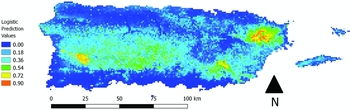
The MaxEnt model had good performance with an AUC of 0.88. The environmental layers with the greatest contribution to the model were the land-use layer, with a 36.8% contribution (the land-use categories corresponding to the greatest likelihood of presence were sierra palm, transitional and tall cloud forest and artificial barrens); BIO_16 (precipitation of wettest quarter), with a 24.3% contribution; the altitude layer, with 9.2% contribution; and BIO_14 (precipitation of driest month) covered 8.7% of the variation. The model indicates that S. jambos is widespread across the island, especially in protected, mountainous areas with relatively high rainfall, such as El Yunque National Rainforest, Maricao Forest Reserve, and Carite State Forest (Figure 1). All 101 trees located in the field showed signs of guava rust infection. Thus, a MaxEnt model was not constructed for A. psidii, because the predicted areas of suitability would exactly match that of S. jambos.
Species distribution model for Syzygium jambos and Austropuccinia psidii in the Caribbean island of Puerto Rico. MaxEnt model is based on S. jambos presence points; A. psidii present points overlap 100%, which would result in the same map. Warmer colours indicate areas predicted to be well suited for S. jambos – as well as for its parasite, guava rust, while cooler colours indicate lower suitability.

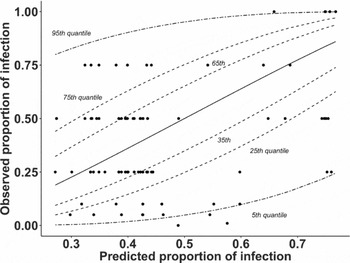
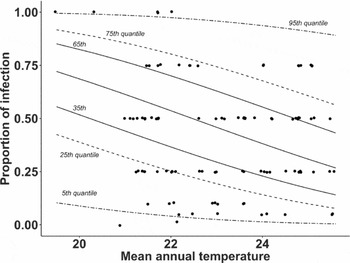
Our tree sampling produced a broad range of variation in tree and habitat variables. Average basal area was 340 cm2 (range: 0.8–2463 cm2) and average canopy area was 33.4 m2 (range: 1.9–177.4 m2). Shade above Syzygium canopies averaged 46% (range 0–100%), and severity of infection averaged 42% and ranged 1–100%. The best model from the beta regressions to explain the proportion of leaves damaged included annual mean temperature, mean diurnal temperature range, and mean precipitation of the driest month with all coefficients negative (Table 1). The predicted proportion of leaves damaged matched the observed, but variation was considerable (Figure 2), and only 16.5% (pseudo-r 2) of the variation was explained by this model when using a beta multiple regression. Of the three variables contained in the top model, annual mean temperature had the strongest contribution to the model, yet variation is also high (Figure 3). Our analyses also gave us 10 other models that are considered to be very similar to the top model (ΔAICc < 2.0). All of these models are consistent in that each one includes the variables annual mean temperature and mean precipitation of the driest month. These are the only significant variables in the average model. Trees that occur in regions that are cooler and have less precipitation in the driest month generally have greater severity of guava rust infection.
Drivers of Austropuccinia psidii damage to Syzygium jambos leaves (proportion of leaves damaged) in Puerto Rico, 2016, based on data from 101 trees and localities. The best−performing models (ACCc < 2.0) and their ΔAICc and weights. The best−fit model is at the top of the list and the average model is at the bottom. According to the corrected Akaike information criterion (AICc), all models shown are very similar to one another. T = temperature, Ppt = precipitation. * P < 0.05, ** P <0.01.

Performance of top beta regression model relative to observed data. Model explains proportion of Syzygium jambos leaves damaged by Austropuccinia psidii rust infection and includes the following variables: Annual mean temperature + Mean diurnal temperature range + Precipitation of driest month. Lines represent quantiles.

The association of annual mean temperature with the proportion of Syzygium jambos leaves damaged by Austropuccinia psidii infections. This is the driver with the greatest and most consistent influence in our top models (P < 0.01). Lines represent quantiles.

All S. jambos trees we inspected in our surveys showed evidence of P. psidii infections, so we could not compare the incidence of infection across Puerto Rico. This includes not only the trees that we measured, but also all others that we examined at each locality. However, we could compare the severity of the disease and expected that trees in the east, where the epidemic was first noticed, would be in poorer condition than those in the west. Our beta regression revealed longitude to be a poor predictor of the proportion of S. jambos leaves damaged (coefficient: −0.389, standard error estimate 0.216, z = −1.38, P = 0.17).
DISCUSSION
Species interactions gained in novel sites can have positive effects, such as providing pollinator service to native species (Fumero-Cabán & Meléndez-Ackerman Reference FUMERO-CABÁN and MELÉNDEZ-ACKERMAN2007). They may also facilitate invasions of other alien species resulting in an invasional meltdown (Ackerman et al. Reference ACKERMAN, FALCÓN, MOLINARI, VEGA, ESPINO and CUEVAS2014, Lach et al. Reference LACH, TILLBERG and SUAREZ2010, Simberloff & Von Holle Reference SIMBERLOFF and VON HOLLE1999). Syzygium jambos has been a recipient of such positive interactions as its flowers are visited by both native and non-native pollinators (JDA pers. obs.), which have probably contributed significantly to its success. However, S. jambos has recently gained a significant negative interaction, which is an alien as well: Austropuccinia psidii, the guava rust. We have found that S. jambos occurs in small, patchily distributed populations, which are widespread across Puerto Rico. Our species distribution modelling revealed that its habitat preferences are influenced by precipitation and land-use, among other factors.
Because A. psidii spores are wind-dispersed, the outbreak is assumed to be fairly recent, and plants are patchily distributed, we expected variation in infection incidence and/or severity to be related to the prevailing east to west tradewinds (Brown & Hovmøller Reference BROWN and HOVMØLLER2002). However, we found no relationship between longitude and either incidence or severity of infection. In fact, there was a non-significant trend for worse infection severities in the west. While we did not inspect every S. jambos tree on the island, we did search trees from near sea level to high-elevation cloud forests, and from dry to wet habitats. All trees that we encountered and inspected were infected with A. psidii. Either the rust dispersed very quickly, or was already ubiquitous yet latent until a stimulus triggered explosive growth drawing the attention of biologists.
Susceptibility of Austropuccinia psidii infections has been associated with low light, high humidity, warm temperatures and young plants (Coutinho et al. Reference COUTINHO, WINGFIELD, ALFENAS and CROUS1998, Piza & Ribeiro Reference PIZA and RIBEIRO1988, Tessmann et al. Reference TESSMANN, DIANESE, MIRANDA and CASTRO2001). Consequently, we attempted to associate infection severity in S. jambos trees with various explanatory variables. We found that canopy cover above the S. jambos trees, our surrogate measure of light, was not a factor. Canopy and basal areas, our surrogates for tree age, were included among some of the top models, but neither was a significant component in the average model (Table 1). On the other hand, both temperature and precipitation variables were consistently associated with the severity of infection. All our sites fall within the temperature range ideal for urediniospore germination (Coutinho et al. Reference COUTINHO, WINGFIELD, ALFENAS and CROUS1998), but within this range we found that severity of infection tends to be greater at cooler temperatures (Figure 3). Presence of free water (rain) has also been associated with spore germination, and all of our sites occurred in moist and wet regions of the island. The rust appears viable wherever S. jambos occurs on the island; there are no safe havens for S. jambos in Puerto Rico.
The epidemic of guava rust in Puerto Rico is clearly severe. Many infected trees that we surveyed were extremely unhealthy or recently dead. This is rather unusual since foliar diseases in natural tropical ecosystems generally do not cause mortality (Gilbert Reference GILBERT2002). While all trees we observed were infected, our cross-sectional study does not permit us to distinguish among various epidemiological and pathological scenarios. For example, we do not know whether the variation in severity is due to (1) variability in resistance among trees, which can be substantial (Burdon Reference BURDON1987); (2) reduced virulence of the rust; (3) succession of rust strains; or (4) simply a matter of time. However, we have pieced together a hypothesis of disease progression based on our observations, those of colleagues and the literature (S. A. Cantrell 2017, D. J. Lodge 2016, A. Vale 2015, pers. comm.; MacLachlan Reference MACLACHLAN1938, Rayamajhi et al. Reference RAYAMAJHI, PRATT, KLOPFENSTEIN, ROSS-DAVIS and RODGERS2013). Leaf flush in Syzygium jambos of Puerto Rico and elsewhere is normally a simultaneous event, and immature leaves are those that are vulnerable to the rust (Coutinho et al. Reference COUTINHO, WINGFIELD, ALFENAS and CROUS1998). At the onset of the rust invasion in Puerto Rico, young leaves became so infected that entire trees turned yellow-orange, soon killing the leaves. The trees responded by producing a second flush of leaves, though not as many as the first. These too became severely infected. Subsequent flushes became sporadic, confined to fewer branches, and the severity of infection in individual leaves was diminished. Meanwhile many S. jambos became weak as older leaves senesced and fewer younger leaves survived to maturity, perhaps creating a root-shoot imbalance. If this scenario is accurate, then S. jambos trees in Puerto Rico may be destined for local extinction. However, we frequently observed coppicing from the base of dead trunks, suggesting that if the trees can overcome the disease and the resulting root-shoot imbalance, then S. jambos may persist, perhaps relegated to the same fate as the American chestnut, which survives in most parts of its native range only as non-reproductive stump sprouts, victims of blight (Davelos & Jarosz Reference DAVELOS and JAROSZ2004).
Given the invasiveness of S. jambos in the Neotropics, the implications of an extinction or near-extinction event may be beneficial to some native species, as die-off of S. jambos would make niche space available. However, the potential spread of the guava rust to endemic trees is of particular concern everywhere in the pathogen's invasive range, especially on islands which are generally more vulnerable to invasions than continental areas (Denslow Reference DENSLOW2003, Kueffer et al. Reference KUEFFER, DAEHLER, TORRES-SANTANA, LAVERGNE, MEYER, OTTO and SILVA2010, Rejmánek Reference REJMÁNEK, Orians, Dirzo and Cushman1996, Smith & Shurin Reference SMITH, SHURIN, Cadotte, McMahon and Fukami2006). In Puerto Rico, S. jambos shares its range with about 60 native species of Myrtaceae, three of which are considered endangered or critically endangered (Axelrod Reference AXELROD2011), so the spread of guava rust to these species would constitute a conservation crisis. Similar to efforts in Australia and Hawaii (Carnegie & Cooper Reference CARNEGIE and COOPER2011, Loope Reference LOOPE2010, Morin et al. Reference MORIN, AVEYARD, LIDBETTER and WILSON2012, Pegg et al. Reference PEGG, GIBLIN, MCTAGGART, GUYMER, TAYLOR, IRELAND, SHIVAS and PERRY2014) alien and native Myrtaceae should be monitored for Austropuccinia psidii infestations. We have seen that in a short period of time, the rust can spread rapidly with devastating effects, making vigilance an important component of management strategies.
ACKNOWLEDGEMENTS
We thank David Clark and José Sánchez for technical assistance; Wilfredo Falcón for MaxEnt training sessions; and Bianka Morales and Andrea Tirrell for field and laboratory assistance. We are also grateful for support through the Research Experience for Undergraduates programme at El Verde Field Station, University of Puerto Rico (NSF-DBI-1559679, Alonso Ramírez, Principal Investigator).