Introduction
Body dysmorphic disorder (BDD), distressing or impairing preoccupation with imagined or slight defect(s) in appearance, is common, with a point prevalence in nationwide epidemiologic studies of 1.7–2.4% (Rief et al. Reference Rief, Buhlmann, Wilhelm, Borkenhagen and Brahler2006; Koran et al. Reference Koran, Abujaoude, Large and Serpe2008; Buhlmann et al. Reference Buhlmann, Glaesmer, Mewes, Fama, Wilhelm, Brahler and Rief2010). BDD is associated with markedly poor functioning and quality of life and with high rates of suicidality (Phillips et al. Reference Phillips, Menard, Fay and Pagano2005b; Phillips & Menard, Reference Phillips and Menard2006). However, very little is known about BDD's course of illness or predictors of course. Course and predictors of course are a fundamental aspect of psychopathology that have been well characterized in many other mental disorders and that have important implications for patient care (e.g. Coryell et al. Reference Coryell, Leon, Winokur, Endicott, Keller, Akiskal and Solomon1996; Yonkers et al. Reference Yonkers, Bruce, Dyck and Keller2003; Shea et al. Reference Shea, Stout, Yen, Pagano, Skodol, Morey, Gunderson, McGlashan, Grilo, Sanislow, Bender and Zanarini2004; Eisen et al. Reference Eisen, Pinto, Mancebo, Dyck, Orlando and Rasmussen2010).
In a cross-sectional study of BDD (n=188), 82% of subjects retrospectively reported a chronic course of BDD; that is <1 month of full remission since disorder onset (Phillips & Diaz, Reference Phillips and Diaz1997). At the time of assessment, BDD's mean duration was 15.7±11.9 (range 1–69) years. However, information on course of illness was very limited, course data were obtained retrospectively, and standard course measures were not used. In a chart-review study of 95 patients treated in a BDD specialty practice, BDD's course was less chronic (Phillips et al. Reference Phillips, Grant, Siniscalchi, Stout and Price2005a). After 4 years of follow-up, 58% had achieved full remission, and 84% had achieved partial or full remission, at one or more 6-month assessment points. Among subjects who attained partial or full remission, 29% relapsed. Limitations include use of retrospective chart-review methodology, study assessment of clinical status only every 6 months, and possible limited generalizability of the findings, as patients were treated in a BDD specialty program.
A recent study examined BDD's course in the Harvard/Brown Anxiety Research Project (HARP), a prospective observational longitudinal study of anxiety disorders (Bjornsson et al. Reference Bjornsson, Dyck, Moitra, Stout, Weisberg, Keller and Phillips2011). Among 17 subjects with co-morbid BDD, allowing for censoring the probability of full remission from BDD over 4 years was 0.36 and over 8 years was 0.76; once remitted, the probability of relapse over 8 years was 0.14. Strengths include the prospective design and rigorous methodology; limitations include the small BDD sample and ascertainment of all subjects for anxiety disorders, which may limit generalizability to other populations with BDD.
This paper reports data from what is, to our knowledge, the only prospective naturalistic study of BDD's course in subjects ascertained for BDD. We prospectively examine BDD's course and predictors of course over 4 years in a large, broadly ascertained sample. Weekly BDD symptom ratings and other data were obtained with reliable measures and methodology very similar to that used in other observational course studies such as the National Institute of Mental Health (NIMH) Collaborative Depression Study (Coryell et al. Reference Coryell, Leon, Winokur, Endicott, Keller, Akiskal and Solomon1996), the Collaborative Longitudinal Personality Disorders Study (Shea et al. Reference Shea, Stout, Yen, Pagano, Skodol, Morey, Gunderson, McGlashan, Grilo, Sanislow, Bender and Zanarini2004) and HARP (Yonkers et al. Reference Yonkers, Bruce, Dyck and Keller2003; Bruce et al. Reference Bruce, Yonkers, Otto, Eisen, Weisberg, Pagano, Shea and Keller2005). Treatment received was also determined. We previously reported on course and predictors of course in this sample over 1 year of follow-up (Phillips et al. Reference Phillips, Pagano, Menard, Fay and Stout2005d, Reference Phillips, Pagano, Menard and Stout2006 b); the present report extends those findings to 4 years and addresses some limitations of those reports. For example, because of the short follow-up period there was limited ability to determine relapse probabilities and lower statistical power to examine predictors of remission and relapse.
Our primary hypothesis was that BDD would usually be chronic, with continuous BDD symptoms and partial remission both occurring more frequently than full remission. We also hypothesized that delusional BDD symptoms, co-morbid major depressive disorder and a personality disorder at intake would predict a more chronic course (lower remission probability and higher relapse probability). Findings from other disorders suggest that psychotic features or poorer insight may predict a more chronic course and poorer clinical outcome (Soskis & Bowers, Reference Soskis and Bowers1969; Coryell et al. Reference Coryell, Leon, Winokur, Endicott, Keller, Akiskal and Solomon1996; Schwartz et al. Reference Schwartz, Cohen and Grubaugh1997; Flint & Rifat, Reference Flint and Rifat1998). This issue is important for BDD, not only because knowledge about predictors of course is very limited but also because the relationship between delusional and non-delusional BDD has been unclear and controversial (Phillips et al. Reference Phillips, McElroy, Keck, Pope and Hudson1994, Reference Phillips, Wilhelm, Koran, Didie, Fallon, Fuesner and Stein2010). Studies of other disorders have found that co-morbid major depressive disorder and personality disorders predict poorer outcome of a variety of Axis I disorders (e.g. Nagy et al. Reference Nagy, Krystal, Woods and Charney1989; Noyes et al. Reference Noyes, Reich, Christiansen, Suelzer, Pfohl and Coryell1990).
Method
Subjects
As described elsewhere (Phillips et al. Reference Phillips, Menard, Fay and Weisberg2005c), 200 adults and adolescents were enrolled over 2.5 years in this single-site prospective observational study of BDD's course. Subjects met DSM-IV criteria for current (n=176) or past (n=24) BDD, including its delusional variant, were age ⩾12 years, and were able to be interviewed in person. The only exclusion criterion was the presence of a mental disorder (e.g. dementia) that would interfere with the collection of valid interview data. Subjects were obtained from a variety of sources: mental health professionals (46.0%), advertisements (38.6%), our program's website and brochures (10.2%), subjects' friends and relatives (3.4%), and non-psychiatrist physicians (1.7%). Of 356 potential participants, 280 (78.7%) met study inclusion/exclusion criteria. The reasons qualifying individuals did not participate (n=80) were the following: did not come to the interview and could not be contacted (n=30), were not interested in participating (n=16), distance to the interview was too far (n=3), insufficient reimbursement (n=3), too busy (n=1), and guardianship issues (n=1) (data were missing for 26 individuals).
Because this report focuses on the probability of remission from BDD, it includes only subjects who met full DSM-IV criteria for current BDD at the intake interview and who also had at least one follow-up interview (n=166). Of all eligible subjects, 94% (166/176) had at least one follow-up interview and are included in this report. The hospital Institutional Review Board approved the study. Written informed consent was obtained (assent plus parental consent for adolescents).
Assessments
Subjects were evaluated at intake with interviewer-administered and self-report measures, as described elsewhere (Phillips et al. Reference Phillips, Menard, Fay and Weisberg2005c, Reference Phillips, Pagano, Menard and Stout2006 b). Intake measures relevant to this report are the following. The Structured Clinical Interview for DSM-IV – Non-Patient Version (SCID-NP; First et al. Reference First, Spitzer, Gibbon and Williams1996) diagnosed BDD and other Axis I disorders. The BDD Form, a semi-structured instrument (K. A. Phillips, unpublished observations) used in many previous BDD studies (e.g. Phillips et al. Reference Phillips, Pagano, Menard and Stout2006b; Phillips & Diaz, Reference Phillips and Diaz1997), obtained data on demographics, past and current treatment, and clinical characteristics of BDD (e.g. age at BDD onset and duration of BDD from disorder onset to the time of the intake interview). Current BDD severity was assessed with the Yale–Brown Obsessive Compulsive Scale Modified for BDD (BDD-YBOCS), a reliable and valid 12-item semi-structured measure (scores range from 0 to 48) (Phillips et al. Reference Phillips, Hollander, Rasmussen, Aronowitz, DeCaria and Goodman1997). Delusionality of BDD beliefs (e.g. ‘I look deformed’) was assessed with the seven-item reliable and valid Brown Assessment of Beliefs Scale (BABS; Eisen et al. Reference Eisen, Phillips, Baer, Beer, Atala and Rasmussen1998). The BABS rates delusionality/insight of beliefs both dimensionally (scores range from 0 to 24) and categorically (e.g. delusional versus non-delusional). A total BABS score ⩾18 plus a score of 4 on the first item (100% conviction) classifies a belief as delusional. The Global Assessment of Functioning Scale (GAF; First et al. Reference First, Spitzer, Gibbon and Williams1996) assessed global symptomatology and functioning; scores range from 0 to 100, with lower scores indicating more severe symptoms/impairment.
Annual follow-up interviews were conducted with the Longitudinal Interval Follow-Up Evaluation (LIFE), a semi-structured rater-administered interview and rating system that assesses the longitudinal course of mental disorders (Keller et al. Reference Keller, Lavori, Friedman and Nielsen1987; Warshaw et al. Reference Warshaw, Keller and Stout1994). The LIFE is based on an approach originally used in the NIMH Collaborative Depression Study (Coryell et al. Reference Coryell, Leon, Winokur, Endicott, Keller, Akiskal and Solomon1996); it has been used in many other longitudinal studies to track course of illness based on DSM criteria (e.g. Warshaw et al. Reference Warshaw, Keller and Stout1994; Keller et al. Reference Keller, Lavori, Coryell, Endicott and Meuller1998). The LIFE obtains information on symptom severity, diagnostic status and psychiatric treatment received. To track course of illness, the LIFE uses Psychiatric Status Ratings (PSRs), which are disorder-specific, three- to seven-point global ratings of disorder severity that mirror DSM disorder criteria. PSRs have cut-points for full DSM criteria, partial remission and full remission. Individual PSRs are assigned for each week of follow-up, providing summaries of course and allowing calculation of time to remission and relapse. PSRs have good inter-rater reliability, test–retest reliability and convergent validity (Warshaw et al. Reference Warshaw, Keller and Stout1994).
On the BDD-PSR, 1=no BDD symptoms, 2=some appearance concerns but no distress or functional impairment due to BDD, 3=some appearance concerns with either mild distress or mildly impaired functioning due to BDD, 4=appearance concerns with both mild distress and mild impairment in functioning due to BDD, 5=appearance concerns present for at least 1 h/day, and either moderate distress or moderate functional impairment due to BDD, 6=appearance preoccupations cause significant distress and significant functional impairment, and 7=appearance preoccupations cause severe or extreme distress and functional impairment. Definitions of BDD's course were similar to those in other course studies that used the LIFE: continuous BDD symptoms=met full DSM-IV criteria for BDD (PSR of 5–7) over the entire follow-up period; partial remission=less than full criteria (PSR of 3 or 4) for at least 8 consecutive weeks during the 4 years of follow-up; full remission=minimal or no BDD symptoms (PSR of 1 or 2) for at least 8 consecutive weeks during follow-up. Full relapse=full BDD criteria for at least 2 consecutive weeks after attaining full remission. Partial relapse=full BDD criteria for at least 2 consecutive weeks after attaining partial remission.
In this naturalistic observational study, treatment was not assigned or controlled. The LIFE obtained information on mental health treatment received during the follow-up period. The reliable Psychosocial Treatment Inventory (Steketee et al. Reference Steketee, Perry, Goisman, Warshaw, Massion, Peterson, Langford, Weinshenker, Farreras and Keller1997) determined subjects' perceptions of the type (modality) of psychotherapy they received [e.g. cognitive-behavioral therapy (CBT)]. Subjects described what occurred in the treatment, and the rater used the Psychosocial Treatment Inventory to determine what type of treatment was received. Subjects were considered to have received a particular therapy modality if they reported receiving from one clinician at least four sessions of that modality, plus a specified minimal number of techniques from that modality. [Fewer CBT components were required in our prior report (Phillips et al. Reference Phillips, Pagano, Menard and Stout2006b) than would now be considered minimally adequate treatment for BDD (Wilhelm et al. Reference Wilhelm, Phillips, Fama, Greenberg and Steketee2011) because less was known at that time about CBT for BDD.] Information was also obtained on types and doses of psychotropic medication received. Because serotonin reuptake inhibitors (SRIs) are considered the first-line pharmacotherapy for BDD (NICE, 2006; Phillips et al. Reference Phillips, Didie, Feusner and Wilhelm2008; Ipser et al. Reference Ipser, Sander and Stein2009), SRI trials were classified as ‘optimal’ or ‘minimally adequate’ based on previously suggested guidelines (Phillips et al. Reference Phillips, Albertini, Siniscalchi, Khan and Robinson2001).
Interviews were conducted by experienced clinical interviewers whom the first author (K.A.P.) extensively trained and closely supervised. They received rigorous training using procedures used in similar longitudinal studies (e.g. Goisman et al. Reference Goisman, Warshaw, Peterson, Rogers, Cuneo, Hunt, Tomlin-Albanese, Kazim, Gollan, Epstein-Kaye, Reich and Keller1994). Training included discussion of videotaped interviews and case examples, role-play interviews with other highly experienced interviewers, and conducting mock interviews with experienced interviewers. Interviewers were closely supervised during training sessions and initial interviews. Interview data were thoroughly edited clinically and clerically by senior staff. Shrout–Fleiss inter-rater reliabilities for maximum and minimum BDD-PSR values during the first 8 weeks and the last 8 weeks of a year were calculated for each subject (Warshaw et al. Reference Warshaw, Keller and Stout1994). Eight-week spans were used because this time period corresponds to the study's definition of remission. Reliabilities ranged from 0.91 to 1.0; the mean reliability was 0.96. Test–retest reliability for the BDD-PSR was examined by asking subjects about their symptom status during the 8 weeks before their last annual interview and comparing those scores to scores obtained in the previous year. The correlation for maximum BDD-PSRs was 0.79 (p<0.0001) and for minimum BDD-PSRs was 0.78 (p<0.0001).
Data analysis
SAS version 9 (SAS Institute Inc., USA) was used for data analysis. Means, standard deviations and frequencies were calculated for intake (baseline) data and for treatment received during the follow-up period. Kaplan–Meier life tables were constructed for time to remission and relapse. Cox proportional hazards regression (Cox, Reference Cox1972) was used to estimate relative hazards for predictor variables. For analyses of predictors of remission, we combined full and partial remission because the low number of full remissions (see Results section) limited statistical power to examine predictors of full remission alone. Similarly, the low number of full remissions meant that few subjects were subsequently eligible for full relapse; therefore, analyses of predictors of relapse combined full and partial relapse. To enhance statistical power for predictor analyses of race and ethnicity (Hispanic versus non-Hispanic), these two variables were combined. Statistical tests were two-tailed; the α level was 0.05. To test whether different assumptions about missing data could influence our findings, we repeated our Cox regressions under two extreme assumptions about why observations were missing: (1) a worst-case analysis in which a person whose data were censored before the end of the study was assumed to have a remission or relapse at the time of censoring, or continue indefinitely without remission or relapse, versus (2) the contrary assumption.
Results
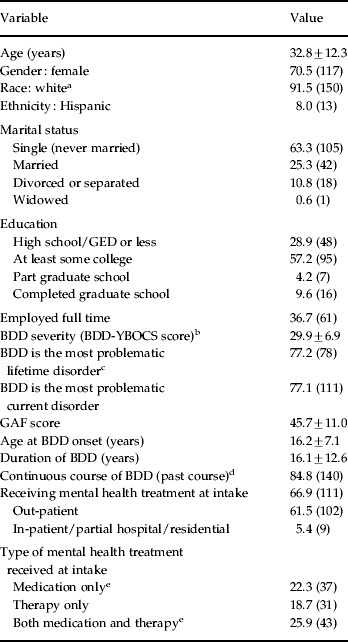
Table 1 presents demographic and clinical characteristics at intake. Mean BDD severity was at the high end of the moderate range; the mean GAF score reflected serious symptoms or serious impairment in functioning. BDD's mean duration (retrospectively assessed at intake) was 16.1±12.6 years. Two-thirds of the sample were currently receiving mental health treatment. Adolescents (age 14–18) constituted 10.8% of the sample.
Demographic and clinical characteristics of 166 subjects with body dysmorphic disorder (BDD) at the intake assessment

BDD-YBOCS, Yale–Brown Obsessive Compulsive Scale Modified for BDD; GAF, Global Assessment of Functioning Scale; GED, General Educational Development.
Values are expressed as % (n) or mean ± s.d.
a Non-white races: Black (8.5%), American Indian (6.7%), Asian (1.2%) and Native Hawaiian/Pacific Islander (0.6%). Some subjects endorsed more than one non-white race.
b On the BDD-YBOCS, a score of 20–48 designates current BDD; the mean score of 29.9 is at the high end of the moderate range.
c This variable was added later during the study.
d Retrospectively assessed lifetime course; continuous=symptoms had not remitted for at least 1 month since disorder onset.
e Type of medications: serotonin reuptake inhibitor (SRI; 62.1%), benzodiazepine (21.7%), non-SRI antidepressant (19.7%), mood stabilizer (18.1%), buspirone (10.2%), antipsychotic (8.7%), stimulant (6.6%), non-benzodiazepine anxiolytic (3.6%), non-benzodiazepine sedative (3.6%).
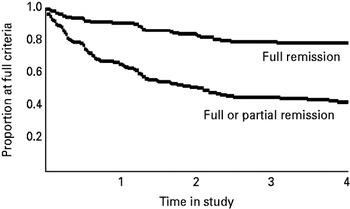
Follow-up data for the 166 eligible subjects were available for 90.0% of possible person-years over 4 years of follow-up (corrected for the three deceased subjects; two subjects were confirmed to have committed suicide, and one died of natural causes). Figure 1 displays remission probabilities at various time points over 4 years of prospective follow-up for the 166 subjects with current DSM-IV BDD at intake and at least 1 year of follow-up data. During the first 2 years of follow-up, the cumulative probability of full remission was 0.14; the cumulative probability of full or partial remission was 0.44. Over 4 years of follow-up, the cumulative probability of full remission was 0.20; the cumulative probability of full or partial remission was 0.55. The mean BDD-PSR score over 4 years was 4.8±1.5, which reflects nearly full DSM-IV BDD criteria. The mean proportion of time that subjects met full DSM-IV BDD criteria during the 4-year period was 69%.
Remission from body dysmorphic disorder over 4 years of prospective follow-up.

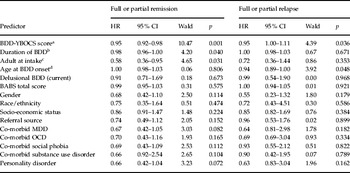
A lower likelihood of full or partial remission from BDD was predicted by more severe BDD symptoms at intake (p=0.001) (Table 2). For an increase of 1 s.d. (6.9 points) on the BDD-YBOCS, the hazard ratio (HR) was 0.71. A lower likelihood of full or partial remission was also predicted by a longer lifetime duration of BDD (p=0.040). For each increase of 10 years' duration of BDD, the HR was 0.82. Adults were significantly less likely to fully or partially remit from BDD than adolescents (p=0.031). Contrary to our hypothesis, a lower probability of full or partial remission was not predicted by delusional (versus non-delusional) BDD beliefs or by greater delusionality of BDD beliefs on the BABS at intake. Also contrary to our hypotheses, co-morbid major depressive disorder and a personality disorder at intake did not significantly predict a lower probability of BDD remission, although both were associated with a lower remission probability at a trend level. Race/ethnicity and gender did not predict remission; males and non-minority subjects were somewhat less likely to remit, but not significantly. In addition, referral source (referral to the study by a mental health professional or non-psychiatrist physician versus other sources) did not predict remission from BDD.
Predictors of full or partial remission and full or partial relapse in individuals with body dysmorphic disorder (BDD)

HR, Hazard ratio; CI, confidence interval; BDD-YBOCS, Yale–Brown Obsessive Compulsive Scale Modified for BDD; BABS, Brown Assessment of Beliefs Scale; MDD, major depressive disorder; OCD, obsessive–compulsive disorder.
a For an increase of 1 s.d. (6.9) on the BDD-YBOCS, the HR was 0.71 for both remission and relapse.
b For each increase of 10 years' duration of BDD, the HR was 0.82 (for remission).
c Adults were significantly less likely to fully or partially remit from BDD than adolescents.
d For each decrease of 1 s.d. (7.1 years), the HR was 0.65 (for relapse).
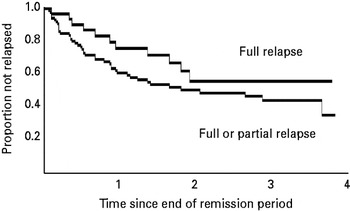
Figure 2 shows relapse probabilities for the 88 subjects who fully or partially remitted from BDD and were therefore eligible for relapse. During the first 2 years following remission, the cumulative probability of full relapse was 0.36; the cumulative probability of full or partial relapse was 0.48. Up to 4 years following remission, the cumulative probability of full relapse was 0.42 and of full or partial relapse 0.63. The probability of full or partial relapse was predicted by more severe BDD symptoms at intake (p=0.036) (Table 2). For an increase of 1 s.d. (6.9 points) on the BDD-YBOCS, the HR was 0.71 (p=0.001). The probability of full or partial relapse was also predicted by earlier age at BDD onset (p=0.048); for each decrease of 1 s.d. (7.1 years), the HR was 0.65. Contrary to our hypothesis, a higher probability of full or partial relapse was not predicted by delusional BDD beliefs or greater delusionality on the BABS, co-morbid major depression, or a personality disorder at intake. Race/ethnicity and gender did not predict relapse; females and minority subjects were somewhat more likely to relapse, but not significantly. Referral source (referral to the study by a mental health professional or non-psychiatrist physician versus other sources) did not predict relapse of BDD.
Relapse of body dysmorphic disorder over 4 years of prospective follow-up.

Eighty-eight percent (n=146) of subjects reported receiving mental health treatment at some point during the follow-up period; 49.4% (n=82) of the sample received mental health treatment focused specifically on BDD. Among the entire sample, 72.3% (n=120) received psychotherapy: supportive psychotherapy: 50.6% (n=84; mean number of sessions=11.8±2.1); psychodynamic psychotherapy: 18.1% (n=30; mean number of sessions=10.2±1.9); CBT: 10.2% (n=17; mean number of sessions=7.6±1.2); and family therapy: 10.2% (n=17; mean number of sessions=14.5±5.2). Psychotropic medication was received by 82.5% (n=137) of subjects during follow-up. At least one SRI was received by 72.9% (n=121); 34.3% (n=57) of the sample received at least one SRI trial considered optimal for BDD, 16.9% (n=28) received at least one minimally adequate SRI trial, and 21.7% (n=36) received only inadequate SRI trials. Other medications received were non-SRI antidepressants (30.7%, n=51), benzodiazepines (24.1%, n=40), antipsychotics (19.3%, n=32), mood stabilizers (18.7%, n=31), venlafaxine (12.1%, n=20), buspirone (10.8%, n=18), stimulants (7.2%, n=12), non-benzodiazepine anxiolytics (3.6%, n=6), non-benzodiazepine sedatives (3.6%, n=6) and monoamine oxidase inhibitors (1.2%, n=2).
Subjects with a longer duration of BDD (retrospectively assessed at intake) were less likely to drop out of the study (HR 0.96, p=0.007). Drop-out was not significantly predicted by any variables in Table 2 or by the total number of co-morbid disorders or GAF score at intake. We conducted sensitivity analyses examining 13 remission and 13 relapse analyses (see predictors in Table 2) and found only two instances in which conclusions might be altered by assumptions about missingness. For remission analyses, when we made the best-case assumption that censored data represented immediate remission, substance abuse/dependence became a significant positive predictor of remission (p=0.033). In relapse analyses, the p value for age of onset became slightly non-significant under either extreme assumption about missing data. Overall, the sensitivity analyses seem to confirm the validity of our primary results.
Discussion
BDD was often chronic, with a low probability of full remission and a high probability of relapse. As predicted, continuous BDD symptoms (no remission) and partial remission both occurred more frequently than full remission. This was the case even though the definition of remission required only 8 consecutive weeks of subthreshold BDD symptoms (partial remission) or no BDD symptoms (full remission) at any point during the follow-up period. Further reflecting BDD's chronicity, the mean BDD-PSR score during the follow-up period reflected almost full DSM-IV BDD criteria. In addition, a majority of remitted subjects subsequently relapsed.
These remission probabilities are lower than those reported for most disorders in course studies that used nearly identical methodology to ours (e.g. same definitions of remission and relapse, use of LIFE PSRs and a similar proportion of treated subjects). For example, in contrast to our 4-year full remission probability of 0.20, full remission probabilities over 4 years were 0.57 for major depressive disorder (Keller, Reference Keller2006), 1.0 for mania (Keller et al. Reference Keller, Lavori, Coryell, Endicott and Meuller1998), 0.66 for panic disorder, 0.31 for panic disorder with agoraphobia, and 0.34 for generalized anxiety disorder (Yonkers et al. Reference Yonkers, Bruce, Dyck and Keller2003). Full remission rates are lower for BDD after 4 years than after 2 or 4 years for personality disorders (Shea & Yen, Reference Shea and Yen2003; Gunderson et al. Reference Gunderson, Stout, McGlashan, Shea, Morey, Grilo, Zanarini, Yen, Markowitz, Sanislow, Ansell, Pinto and Skodol2011). However, social phobia was as chronic as BDD, with a full remission probability over 4 years of 0.22 (Yonkers et al. Reference Yonkers, Bruce, Dyck and Keller2003).
This study's cumulative probability of full remission of 0.20 is lower than that reported for co-morbid BDD in subjects ascertained for anxiety disorders in HARP (0.36 over 4 years; Bjornsson et al. Reference Bjornsson, Dyck, Moitra, Stout, Weisberg, Keller and Phillips2011). In addition, the cumulative probability of full relapse of 0.42 over 4 years is notably higher than for BDD in HARP over 8 years (0.14; Bjornsson et al. Reference Bjornsson, Dyck, Moitra, Stout, Weisberg, Keller and Phillips2011). A possible explanation for these different findings is that HARP subjects may have had milder BDD because they were ascertained for an anxiety disorder rather than BDD. The present study's finding that more severe BDD predicted a lower probability of remission offers some support for this hypothesis. It is worth noting, however, that the mean BDD-YBOCS score in the present study (29.9±6.9 on a 48-point scale) is in the range reported for other BDD samples and does not reflect particularly severe BDD (Wilhelm et al. Reference Wilhelm, Otto, Lohr and Deckersbach1999; Buhlmann et al. Reference Buhlmann, McNally, Etcoff, Tuschen-Caffier and Wilhelm2004).
Remission probabilities are also notably lower than in the chart-review study of treated patients in which 58% of patients achieved full remission and 84% achieved full or partial remission from BDD at some point during 4 years of follow-up; this was the case even though the present study's methodology was more likely to detect remission because symptom status was assessed weekly rather than only every 6 months as in the chart-review study. The reason for this marked difference is unknown; however, in the chart-review study all patients received treatment that focused on BDD and was delivered in a BDD specialty setting. By contrast, in the present study not all subjects received treatment, treatment was received primarily in the community, and only about half received mental health treatment focused specifically on BDD. In addition, only a minority reported receiving an optimal SRI trial for BDD (34.3%) or CBT (10.2%), which are the currently recommended treatments for BDD (NICE, 2006; Phillips et al. Reference Phillips, Didie, Feusner and Wilhelm2008). Furthermore, subjects received a mean of only 7.6±1.2 CBT sessions whereas the number of sessions in reports of CBT for BDD range from 12 sessions of 60-min duration to 60 sessions of 90-min duration (Phillips, Reference Phillips, Cash and Smolak2011). Response rates in efficacy studies of SRIs and CBT for BDD are relatively high (Phillips et al. Reference Phillips, Didie, Feusner and Wilhelm2008; Wilhelm et al. Reference Wilhelm, Phillips, Fama, Greenberg and Steketee2011). It is important to emphasize, however, that a causal relationship between treatment received and course of illness cannot be established in a naturalistic study such as this. Future reports will examine the relationship between treatment received and outcome of BDD in this sample.
Our finding that more severe BDD at intake predicted a lower remission probability is consistent with the chart-review study, in which more severe BDD at baseline was significantly correlated with greater BDD severity at the most recent clinic visit (r=0.34, p=0.003; Phillips et al. Reference Phillips, Grant, Siniscalchi, Stout and Price2005a). It is notable that, in the present study, for each seven-point increase on the 48-point BDD-YBOCS, the hazard rate for remission dropped by nearly 30%. Our findings suggest that patients with more severe BDD, a longer lifetime duration of BDD and earlier age at BDD onset may require closer clinical monitoring and perhaps more intensive treatment, as they seem to be at higher risk for chronic BDD. Contrary to our hypothesis, intake diagnoses of major depressive disorder (the most common co-morbid disorder in BDD; Phillips & Diaz, Reference Phillips and Diaz1997; Gunstad & Phillips, Reference Gunstad and Phillips2003) or a personality disorder did not predict more chronic BDD, although both predicted a lower remission probability at a trend level. In the chart-review study, current major depressive disorder (r=0.33, p=0.002) and current social phobia (r=0.24, p=0.03) at intake were significantly correlated with BDD severity at the most recent assessment (Phillips et al. Reference Phillips, Grant, Siniscalchi, Stout and Price2005a).
Contrary to our hypothesis, more chronic BDD was not predicted by delusional BDD beliefs or a greater degree of delusionality. Our finding is consistent, however, with studies indicating that, across many types of validators, BDD's delusional and non-delusional forms have many more similarities than differences, for example in terms of clinical features and medication response (Phillips et al. Reference Phillips, McElroy, Keck, Pope and Hudson1994, Reference Phillips, Menard, Pagano, Fay and Stout2006a; Mancuso et al. Reference Mancuso, Knoesen and Castle2010). This finding offers some support for the proposal to combine BDD's delusional and non-delusional variants in the upcoming DSM-5 (Phillips et al. Reference Phillips, Wilhelm, Koran, Didie, Fallon, Fuesner and Stein2010).
This study has several limitations. Treatment received was reported by subjects but not confirmed (e.g. by medical record review). It is possible that treatment information was not completely accurate because subjects did not report correct information due to difficulty with recall or for other reasons. (However, our methods for obtaining treatment data, using the LIFE and the Psychosocial Treatment Inventory, are widely accepted and have been used in other studies of course of illness; e.g. Yonkers et al. Reference Yonkers, Bruce, Dyck and Keller2003; Shea et al. Reference Shea, Stout, Yen, Pagano, Skodol, Morey, Gunderson, McGlashan, Grilo, Sanislow, Bender and Zanarini2004; Bruce et al. Reference Bruce, Yonkers, Otto, Eisen, Weisberg, Pagano, Shea and Keller2005.) Because the probability of full remission was so low, predictors of full remission were not examined separately. Expectation bias, or the Hawthorne effect, whereby course may have been affected by the fact that subjects were being assessed in a study, cannot be ruled out. Another potential limitation is that most subjects reported receiving mental health treatment during the follow-up period, making it unclear how generalizable the results are to untreated individuals with BDD. In addition, the study was conducted in the northeastern USA, and it is unclear how generalizable the results are to other geographic regions or cultures. Study strengths include use of broad inclusion criteria, which may increase generalizability of the results, use of highly trained and closely supervised raters, and use of state-of-the-art measures and procedures to assess course and obtain detailed information on BDD and other clinically important variables. Additional research on BDD is necessary; for example, BDD's course needs to be examined over a longer follow-up period and in other samples. Greater understanding of course of illness and predictors of course will enhance understanding and treatment of this often severe and understudied disorder.
Acknowledgments
This work was supported by grants R01-MH60241 and K24-MH063975 from the NIMH and a grant from the American Foundation for Suicide Prevention to Dr Phillips.
Declaration of Interest
None.