Introduction
Screening for depressive symptoms aims to detect clinically relevant symptoms for which an individual has not (yet) asked for help. A prerequisite for a screening program is that effective treatment is available for those people who are screen-positive, to prevent or delay onset of disease. However, this is not the only factor required to guarantee that such persons will benefit (Cuijpers et al., Reference Cuijpers, van Straten, van Schaik and Andersson2009). Although they voluntarily participated in the screening program, they are not necessarily willing to accept the subsequent treatment offer. Low acceptance of unsolicited intervention offers has been reported in diverse (screening) programs in primary care, among younger and older people, and for both somatic and psychological symptoms (Gussekloo et al., Reference Gussekloo2003; de Craen et al., Reference de Craen, Gussekloo, Blauw, Willems and Westendorp2006; Baas et al., Reference Baas2009; Joling et al., Reference Joling2011).
To understand the low intervention uptake, the transtheoretical model, originally developed in relation to addictive behaviors, might also be helpful in relation to mental problems (Prochaska et al., Reference Prochaska, DiClemente and Norcross1992; Norcross and Prochaska, Reference Norcross and Prochaska2002). This model distinguishes different motivational stages in the process towards change, in which screen-positive persons who have not (yet) asked for help can be seen as individuals who are in the pre-contemplation stage (not being aware of having a problem or that help could be sought) or the contemplation stage (being aware of a problem and starting to consider seeking help). According to this model, only a proportion of the screen-positive persons are expected to be in the preparation stage (thinking seriously about seeking help) or in the action stage (actually ready to change and seeking help), in which a therapy offer may be accepted.
Various factors that influence patients' acceptance of recommended health behaviors have been reported, such as personal health beliefs, faith in the efficacy of care, perceptions of investments needed, the physician-patient relationship, and social influences (Becker and Maiman, Reference Becker and Maiman1975). Additional factors include cognitive limitations, physical disabilities, and values and (religious) beliefs (Jacobson and O'Connor, Reference Jacobson and O'Connor2006). Moreover, studies examining the reluctance to undergo therapy for mental health problems more specifically identified factors such as rejection of a “diagnosis” of depression, not recognizing depressive symptoms as a medical problem, negative thoughts about the (effects of the) therapeutic options, fear of the stigma of being “mentally ill”, and believing that giving in to mental problems is a sign of weakness and inability to cope with life (Montano, Reference Montano1999; Murray et al., Reference Murray, Banerjee, Byng, Tylee, Bhugra and Macdonald2006; Burroughs et al., Reference Burroughs, Lovell, Morley, Baldwin, Burns and Chew-Graham2006; Chapman and Perry, Reference Chapman and Perry2008; Wittkampf et al., Reference Wittkampf, van Zwieten, Smits, Schene, Huyser and van Weert2008).
However, it is largely unknown which factors regarding mental health treatment decisions are important for the oldest-old people. Therefore, we explored the limiting and motivating factors that might play a role in the decision whether or not to accept the unsolicited offer to participate in a “coping with depression” course among persons aged ≥75 years who screened positive for depressive symptoms. In addition, we explored the subjective needs of these oldest old people to gain further insight into their motivation to accept help.
Methods
Setting
This study was conducted among persons screening positive for depressive symptoms in the PROMODE study (PRO-active Management Of Depression in the Elderly), a pragmatic randomized controlled trial (RCT) investigating the effects and costs of a combined screening and treatment program compared to usual general practitioner (GP) care among persons aged ≥75 years with untreated depressive symptoms in general practice. Screen-positive persons (defined as an interviewer-administered 15-item Geriatric Depression Scale ≥5 points) were included in the intervention trial (van der Weele et al., Reference van der Weele2011).
In intervention practices the GP was asked to inform screen-positive persons and to refer them to the community mental healthcare center. After referral the stepped-care intervention offer consisted of the following steps: (1) individual counseling by a community psychiatric nurse during a home visit; (2) the “coping with depression” course (Haringsma et al., Reference Haringsma, Engels, Cuijpers and Spinhoven2006), in a group or individually; (3) if indicated, referral back to the GP to consider further treatment. Within the PROMODE-study, 83% (101/121) of all screen-positive persons in the intervention practices accepted referral to the community mental healthcare center. After individual counseling (step1) only 23 persons accepted the offer to participate in the course.
Recruitment and interview procedures
We conducted this qualitative study when screening had been completed in 24 practices. Twelve of these practices had been randomly assigned to the intervention arm and all 26 persons who screened positive and agreed with referral were invited for an in-depth interview to explore the factors that had played a role in their decision whether or not to participate in the course. Each person received a written invitation explaining the goal of the interview and were telephoned one or two weeks later to ask for their participation. Those people who gave informed consent were visited by one interviewer (RdJ) for an interview that lasted 30–90 minutes and was digitally recorded. If they did not wish to be visited they were invited to answer questions by telephone.
Content of the interviews
Since we wanted to explore the factors that were most relevant to the interviewed persons, the interviews started with an open question about their most important reason(s) for accepting or declining the course offer. Next, the interviewer asked in a semi-structured way about the relevance of a list of potentially influencing factors, based on findings from previous studies. Three groups of potentially influencing factors were discerned: (1) factors related to depression: views on depression, self-recognition of depressive symptoms and personal coping style regarding depressive symptoms; (2) factors related to the offered course: expectations about the effect, the group participation, and the accessibility; and (3) the influence of others, such as relatives and the GP. During the third interview, “being old” was mentioned as a separate influencing factor, which was added to the topic list from then onwards. No new influencing factors emerged from the subsequent interviews. In addition, we asked for a person's own solutions and subjective needs regarding help to cope with depressive symptoms.
Data analysis
All recorded interviews were transcribed verbatim. Two researchers (GvdW and RdJ) read the transcripts, coded the emerging themes independently, discussed the codings, and repeated these steps until consensus was achieved. In the content analysis the interviews were scrutinized for emerging factors, views and combination of views and factors that, according to our informants, had influenced the decision to accept or reject the intervention. The Atlas.ti 5.2 program was used to code the themes.
Results
Study population
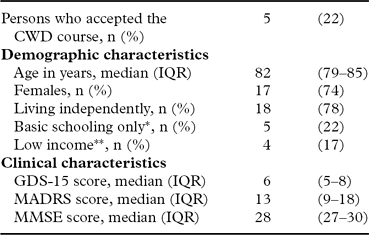
Of 26 invited persons, 23 were interviewed of whom 18 completed an in-depth face-to-face interview and five completed a telephone interview. The telephone interviews were mainly limited to the open question about the most important reasons for declining the course offer. Three invited persons could not be reached within the time frame of this study. Of the 23 interviewed persons (17 women and 6 men), 5 (22%) had accepted the course offer. Table 1 presents the characteristics of the 23 persons who were interviewed.
Demographic and clinical characteristics of the interviewed persons (n = 23)
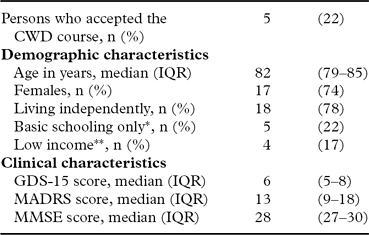
CWD course = Coping with Depression course; IQR = interquartile range; GDS-15 = 15-item Geriatric Depression Scale, with a maximum score of 15 points and higher scores indicating more depressive symptoms; MADRS = Montgomery-Åsberg Depression Rating Scale, with a maximum score of 60 points and higher scores indicating more serious depression; MMSE = Mini-Mental State Examination, with a maximum score of 30 points and lower scores indicating more cognitive impairment.
*Basic schooling means a maximum of only 6 years of schooling; ** low income means income from social security benefits only.
Most important factors associated with decisions about course participation according to the open question
All five individuals who accepted the course mentioned that they felt depressed and/or lonely, and that they had positive expectations about the course and/or meeting others. Those who declined the course most frequently answered that they did not feel depressed or were happy with their situation and generally enjoyed themselves. They had negative expectations about the course. Most importantly, they did not see the point of the course, did not want to be bothered by the problems of group members, felt too old to learn new things and meet new people, or had health problems that conflicted with treatment. Those people who declined the course offer despite having depressive symptoms either did not mention any special need for help, or mentioned a need for a person or small group to talk with “on their own level” because they were reluctant to join a group with all types of “complaining strangers”. Furthermore, many of them insisted on solving problems on their own or with help only from close relatives.
Being old was mentioned not only as an important factor for refraining from course participation – as stated, for example, by a 75-year-old man: “No, I'm at an age that I don't want anything new anymore . . . I just don't feel like learning” – but also as an important cause of feeling down or lonely – as stated, for example, by an 82-year-old woman who accepted the course: “I bet if I was still young and had a job, I wouldn't have such a problem with this situation. Then you have work and make new contacts . . . It's a problem that comes with age, with being alone . . .”
Factors related to depression according to predefined topic list
Views on “depression”
Some people had outspoken views on depression. Those who had declined the course offer mostly associated depression with complaining, whining or exaggerating, and giving in to depression through “weakness”. Almost everyone viewed depression as a much more severe mental state than that which they were experiencing themselves. For example, a 91-year-old man who had declined the course said: “That someone sees everything from the dark side and, well, has little expectation that it'll get better. . . . But luckily I'm not that type.”
Self-recognition of depressive symptoms
Those persons who acknowledged psychological problems mostly preferred to describe themselves as “sad, lonely, useless or gloomy”, rather than as being depressed; and one person explicitly called himself “a realist”. Of this group, only a minority accepted the course offer. For example, an 87-year-old woman who declined the course said: “I'm not down, I'm sad, very sad, but that's something different from being down or depressed. But I've given it a place, I think. I can handle it.” Another woman, aged 79 years, who did accept the course said: “There are days when I don't feel very happy . . . that I sit here alone and don't hear a voice for days on end.” Of the three persons who acknowledged feeling depressed, two accepted the course offer; the third person was afraid that course participation would worsen her situation.
Personal coping style
Several persons who had declined the course offer mentioned a history of depressive periods, for which they had found their own way of coping. For example, an 87-year-old woman said: “I participated in groups for years. I've done yoga, I've done self-defense, you have lots of conversations everywhere, group discussions . . . and I took it all in and as far as I can remember I put it into practice.” A 92-year-old woman, who also declined the course, said: “I'm too much or too often depressed, I've always been like that. And you have to do something, that's my solution; I need to go for a walk or go cycling.”
Factors related to the offered intervention according to predefined topic list
Expectations about the (effect of) offered course
An important reason for not participating were low expectations that the course would be effective. A 77-year-old woman summed this up as follows: “No, I don't see the benefit [of course participation] and secondly I feel apprehensive about sitting there.” Some feared that the course might be too difficult for them. However, those people who agreed to join the course expected the course to be effective, or were curious about its effect or about participating members' solutions. An 85-year-old man declared: “Yes, I thought this is how I'll get healed. I know that's really over-exaggerated, but. . .”; and an 82-year-old woman said: “Yes, I thought that if I participate it'll be out of a sort of curiosity; to experience everything you can, because that's how I am . . . but it won't alter anything in my situation.”
Perspectives on group participation
Although some people were positive about group participation, most of those interviewed persons had negative ideas about joining a group with unknown people to discuss personal problems. Some expressed concern that problems presented by others might be a burden to them, and feared that group members might complain about and aggravate insignificant problems. Some did not feel confident about sharing their own problems with perhaps as many as 8–10 strangers (“being a solitary person”) or felt they could not adequately describe their problem. Those who declined the course stated, for example: “It's like when you're in a doctor's waiting room – to put it bluntly – everyone's talking crap and making each other sick. No, I don't want to be involved in that” (75-year-old man); “[Discuss personal matters] with strangers? No, I don't think so, that's something I do with my children. It's nobody else's business” (82-year-old woman); and “For that you need to be able to describe your problem very well and I'm not good at that, because . . . I don't know which way to turn yet” (92-year-old woman).
Accessibility
Physical accessibility to the course was also a problem. One person failed to start the course because she could not find the right location. When transport problems were solved this sometimes allowed course participation “Well, I thought it's bothersome that it's so far away. That was a reason not to do it. . . the travelling is still a big nuisance . . . If I had to pay the taxi myself it would be a bit too much for me. Taxis are quite expensive. . .that would be reimbursed” (79-year-old woman). Physical illness also reduced accessibility. However, only 4 of 18 people interviewed stated that physical health problems were the main reason to decline the course offer, although others mentioned that frequent appointments with healthcare professionals made it almost impossible to attend the course at set times.
Influence of relatives and GP according to predefined topic list
We also explored whether the decision about course participation was influenced by others, such as relatives and GPs. Some study participants (mostly men) said they had made their decision on their own and before the individual counseling took place. This was mentioned both by those who had accepted or declined the course offer: “I was already sure [that I'd do the course]; but still, some encouragement never does any harm” (79-year-old man who accepted the course); and “I was already certain that I wouldn't do it! Then you don't take it any further” (80-year-old man who declined the course).
Some people discussed course participation with their children, which could positively or negatively influence their decision. For example: “I discussed this with my children, not with anyone else; they encouraged me to participate” (79-year-old man who accepted the course); and “I discussed this once, and they said: ‘Mum, why would you participate?’” (77-year-old woman who declined the course).
Very few participants could remember with certainty whether they had been contacted by their GP, whereas most would have appreciated (more) involvement by their GP, as we heard from an 84-year-old woman who accepted the course: “Look, it would've been nicer if the GP had said ‘Shall we do it like this or like that?’ But I think he didn't have time for that. I don't want to put the man down, but. . .”
However, the influence of the GP did not always motivate course participation: “I was visiting my GP and he said ‘You're not suitable for that . . . you don't need it’, and I said ‘No, I'm not going to sit in a group again and share talks about sadness, I've already done that.’. . . He just didn't see the need in my case” (87-year-old woman who declined the course).
Subjective needs to cope with depressive symptoms
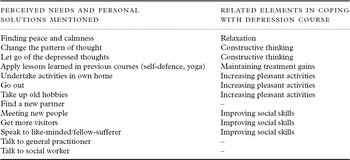
We asked people to describe their perceived needs and solutions to cope with depressive symptoms (Table 2). Most needs, such as learning to start managing the depression, meeting new people, and feeling useful, largely match the elements offered in the course. For some individuals these needs were a reason to join the course, but certainly not for everyone.
Perceived needs and personal solutions reported by study participants and their relation to elements of the Coping with Depression course

Discussion
In the present study, persons aged ≥75 years who screened positive for depressive symptoms reported many limiting and some motivating factors that influenced their decision to accept or reject the unsolicited invitation to participate in a “coping with depression” course. The perceived needs to relieve depressive symptoms largely matched the elements of the offered course. Those who accepted the course felt depressed and/or lonely and had positive expectations about the course outcomes and/or meeting with others, or were at least curious about what the course might be able to offer them. Those who declined to join the course had negative expectations, either about its effect or about participating in a group with depressed strangers, or had negative thoughts about themselves, such as being too old to change and learn new things.
Most of the limiting factors regarding treatment reported in the present study have been described previously, such as old age (Murray et al., Reference Murray, Banerjee, Byng, Tylee, Bhugra and Macdonald2006), practical concerns about accessibility of care and time(Cooper-Patrick et al., Reference Cooper-Patrick, Powe, Jenckes, Gonzales, Levine and Ford1997; Lang, Reference Lang2005) and wanting to solve one's own problems (Arean et al., Reference Arean, Alvidrez, Barrera, Robinson and Hicks2002). This may be explained by a sense of self-efficacy to solve their own problems that older adults have developed through their life experience (Wetherell et al., Reference Wetherell, Kaplan, Kallenberg, Dresselhaus, Sieber and Lang2004) and by a strong desire to be self-reliant arising from the fear of losing control and independence (Moore et al., Reference Moore, Metcalf and Schow2006). In our study, many participants reported a perceived lack of support from their GP in discussing the outcome of the screening and its consequences. This probably reflects the limited role of GPs in the PROMODE study, in which GPs were asked only to refer their screen-positive patients to the community mental healthcare centre. However, in the present study participants specifically mentioned that they expected more involvement and support from their GP. This message to GPs, which is in line with earlier research (Arean et al., Reference Arean, Alvidrez, Barrera, Robinson and Hicks2002), is particularly important when the problems concern mental health and emotional distress (Brody et al., Reference Brody, Khaliq and Thompson1997; Simon et al., Reference Simon, Loh, Wills and Harter2007).
Low expectations about the course and its effects were an important limiting factor for course acceptance, as also reported earlier (Becker and Maiman, Reference Becker and Maiman1975). This could be a result of inadequate or ill-timed information at the time of referral by the GP or the individual counseling (intervention step 1). Remarkably, several persons reported that they had hardly listened to the information because they had already decided about course participation before individual counseling took place. These findings suggest that a substantial number of those who screened positive for depressive symptoms and accepted referral by their GP were in fact not open to the treatment offer, and possibly not open to any intervention at all. This may also have hampered the intervention uptake in other screening studies (Baas et al., Reference Baas2009; Cuijpers et al., Reference Cuijpers, van Straten, van Schaik and Andersson2009).
From the viewpoint of the transtheoretical model, all interviewed screen-positive persons were at one of the motivational stages in the process towards change that the model distinguishes (Prochaska et al., Reference Prochaska, DiClemente and Norcross1992; Norcross and Prochaska, Reference Norcross and Prochaska2002). The majority of persons did not perceive themselves as suffering from depression and/or did not intend to seek professional help (pre-contemplation stage) or did perceive a problem but were ambivalent about seeking help (contemplation stage). Only a minority of screen-positive persons seriously considered seeking help (preparation stage) or were actually ready to change and to accept the intervention offer (action stage). According to this model and in line with our results, we should not treat all persons who screen positive for depressive symptoms as if they are prepared for action. Instead of immediately offering an intervention after screening, caregivers should first assess an individual's motivation and preparedness for change and tailor any intervention to this stage (Prochaska et al., Reference Prochaska, DiClemente and Norcross1992).
A major strength of this explorative study is that its findings can be related to the stages of change model, a concept already used in the national guideline on smoking cessation developed by the Dutch College of General Practitioners (Chavannes et al., Reference Chavannes2007). That this well-known model could also be applicable to older persons screening positive for depressive symptoms is new and can help set realistic goals in the management and treatment of patients after screening. Performing this explorative study alongside our RCT had some methodological advantages: all persons were identified by screening and all had been offered the same intervention shortly before the interviews took place. By exploring their motives to accept or decline our unsolicited intervention offer we gained insight into the reasons for our low intervention uptake. In this respect we agree with Lewin et al. that qualitative studies alongside RCTs of complex interventions can help “to better understand the effects of intervention and how they are experienced by recipients” (Lewin et al., Reference Lewin, Glenton and Oxman2009).
It can be seen as a limitation that the interviewed group which accepted the course offer was particularly small, which might have hampered data saturation (Glaser and Strauss, Reference Glaser and Strauss1979; Green and Thorogood, Reference Green and Thorogood2004). However, since no new topics emerged after the third interview and none at all from the interviews with persons who had accepted course participation, we feel confident that we acquired a good overview of the important factors that, according to the participants, influenced acceptance of the course offer. Another possible limitation of the study is that we interviewed persons shortly after they had made their decision about acceptance of the course offer, which might have introduced post-decision rationalization. However, this type of research can only be done in retrospect because interviewing would otherwise have disturbed the decision-making process and the trial-protocol. Finally, since most of the people interviewed were women (17/23), we cannot draw general conclusions with respect to the influence of gender.
In conclusion, in our study the factors that influenced the response to the intervention offer by the oldest-old persons who screened positive for depressive symptoms were very similar to those found among younger adults. However, “old age” was also mentioned as an important reason to decline the course offer, whereas “not feeling depressed” was mentioned even more frequently. To enhance the efficiency of screening programs, we suggest that not only should the symptoms that may require treatment be identified, but, in addition, special focus should be placed on the screened person's need for – and readiness to accept – help. For those people who are at the stage of contemplating or preparing to seek help, acceptance might be increased by adapting the intervention offer to their individual needs and (where possible) by removing barriers. For example, individual therapy could be offered at the person's home, and strategic locations chosen for group sessions thereby minimizing travel distances; in addition, help could be offered with transport, and appointments made more flexible. However, although it is possible that some people in our study may have recovered from depressive symptoms, most screen-positive participants seemed to be in the pre-contemplation stage, in which more time and personal confidants are required to explore subjective needs and expectations as well as their coping strategies, before a decision can be made about which support or treatment option is most suitable. Our findings suggest that GPs could play an important role in this process, since older persons appreciate their advice and support, especially with respect to mental health problems. Special attention could be given to obstacles such as feelings of being too old to learn or to change, and to preferences for an individual or group approach.
Conflict of interest
None.
Description of authors' roles
J. Gussekloo, G. M. van der Weele, R. de Jong, M. W. M. de Waal, and R. C. van der Mast were responsible for the study concept and design. R. de Jong, G. M. van der Weele and J. Gussekloo were responsible for the acquisition of data. The data were analyzed and interpreted by G. M. van der Weele, R. de Jong, J. Gussekloo, W. J. J. Assendelft, R. Reis, M. W. M. de Waal and R. C. van der Mast. Drafting of the paper was undertaken by G. M. van der Weele, R. de Jong, J. Gussekloo, W. J.J. Assendelft, R. Reis, M. W. M. de Waal and R. C. van der Mast; critical revision for important intellectual content was done by G. M. van der Weele, J. Gussekloo, W. J. J. Assendelft, R. Reis, M. W. M. de Waal, R. C. van der Mast, R. de Jong, P. Spinhoven and H. A. Rooze. All authors approved the final version to be published.