Early caregiving adversity (ECA) is characterized by environmental features that directly disrupt the caregiver-child relationship – for example, exposure to abuse, neglect, parent mental illness, parent substance abuse, or institutional (e.g., orphanage) care (Tottenham, Reference Tottenham2020). Exposure to ECA has profound implications for socioemotional, cognitive, and behavioral development and is a significant risk factor for the development of adolescent mental health disorders (Callaghan, & Tottenham, Reference Callaghan and Tottenham2016a, Reference Callaghan and Tottenham2016b; Kessler et al., Reference Kessler, McLaughlin, Green, Gruber, Sampson, Zaslavsky and Williams2010; Shaw, & Jong, Reference Shaw and Jong2012; Shonkoff et al., Reference Shonkoff and Garner2012; Witt et al., Reference Witt, Münzer, Ganser, Fegert, Goldbeck and Plener2016; Zeanah, & Humphreys, Reference Zeanah and Humphreys2018; McLaughlin et al., Reference McLaughlin, DeCross, Jovanovic and Tottenham2019). Though ECA exposures can be quite heterogeneous, youth with histories of ECA share an increased risk for stress-related symptoms in both the internalizing (anxiety, depression, and somatic) and externalizing (rule-breaking, aggression) domains (McLaughlin et al., Reference McLaughlin, Green, Gruber, Sampson, Zaslavsky and Kessler2012, Reference McLaughlin, Sheridan, Tibu, Fox, Zeanah and Nelson2015; Humphreys et al., Reference Humphreys, Gleason, Drury, Miron, Nelson, Fox and Zeanah2015; Heleniak et al., Reference Heleniak, Jenness, Vander Stoep, McCauley and McLaughlin2016; Witt et al., Reference Witt, Münzer, Ganser, Fegert, Goldbeck and Plener2016; Busso et al., Reference Busso, McLaughlin and Sheridan2017; McLaughlin et al., Reference McLaughlin, Colich, Rodman and Weissman2020; Blake et al., Reference Blake, Ruderman, Waterman and Langley2021). Much of the neurobehavioral research on ECA has thus focused on how exposures may impact the development of high-level cognitive and socioemotional capabilities that, if disrupted, increase risk for psychopathology (Callaghan, & Tottenham, Reference Callaghan and Tottenham2016b; Chen, & Baram, Reference Chen and Baram2016; Heleniak et al., Reference Heleniak, Jenness, Vander Stoep, McCauley and McLaughlin2016; McLaughlin, DeCross et al., Reference McLaughlin, DeCross, Jovanovic and Tottenham2019; McLaughlin, Weissman, & Bitrán, Reference McLaughlin, Weissman and Bitrán2019; McLaughlin et al., Reference McLaughlin, Colich, Rodman and Weissman2020). However, emerging evidence – including causal connections in primates (Schneider et al., Reference Schneider, Moore, Gajewski, Larson, Roberts, Converse and DeJesus2008, Reference Schneider, Moore, Adkins, Barr, Larson, Resch and Roberts2017) – suggests that ECA also confers increased risk for lower level sensory processing challenges that may also contribute to mental health outcomes (Lin et al., Reference Lin, Cermak, Coster and Miller2005; Schneider et al., Reference Schneider, Moore, Gajewski, Larson, Roberts, Converse and DeJesus2008, Reference Schneider, Moore, Adkins, Barr, Larson, Resch and Roberts2017; Wilbarger et al., Reference Wilbarger, Gunnar, Schneider and Pollak2010; Howard et al., Reference Howard, Lynch, Call and Cross2020; Armstrong-Heimsoth, Schoen, & Bennion, Reference Armstrong-Heimsoth, Schoen and Bennion2021; Joseph, Casteleijn, van der Linde, & Franzsen, Reference Joseph, Casteleijn, van der Linde and Franzsen2021).
Sensory processing challenges like those observed in youth with histories of ECA profoundly disrupt daily functioning and are linked to psychological symptomatology in both typically developing and clinical populations. These challenges often manifest in the way individuals modulate (experience and then respond to) sensory input. For example, sensory over-responsivity (SOR) is a prevalent and disruptive sensory processing challenge characterized by heightened or prolonged reactivity to sensory stimuli (e.g., bright lights, loud sounds, being touched; Miller et al., Reference Miller, Anzalone, Lane, Cermak and Osten2007; Tomchek, & Dunn, Reference Tomchek and Dunn2007; Reynolds, & Lane, 2008; Ben-Sasson, Carter, & Briggs-Gowan, Reference Ben-Sasson, Carter and Briggs-Gowan2009). Other common examples of atypical sensory processing and reactivity include sensory under-responsivity, an unawareness of or delayed response to salient sensory stimuli (e.g., reduced pain responses, not reacting to novel sounds), and sensation seeking, which typically involves searching for sensory input (e.g., seeking out deep pressure; mouthing nonfood items; Miller et al., Reference Miller, Anzalone, Lane, Cermak and Osten2007; Tomchek, & Dunn, Reference Tomchek and Dunn2007). In addition to contributing to family impairment and socialization challenges (Ben-Sasson et al., Reference Ben-Sasson, Hen, Fluss, Cermak, Engel-Yeger and Gal2009; Carter, Ben-Sasson, & Briggs-Gowan, Reference Carter, Ben-Sasson and Briggs-Gowan2011; Dellapiazza et al., Reference Dellapiazza, Vernhet, Blanc, Miot, Schmidt and Baghdadli2018, Reference Dellapiazza, Michelon, Oreve, Robel, Schoenberger and Chatel2020; Carpenter et al., Reference Carpenter, Baranek, Copeland, Compton, Zucker, Dawson and Egger2019), these sensory symptoms have implications for mental health. Though the directionality of the relationship between sensory processing challenges and developmental psychopathology warrants further investigation, sensory processing challenges in general, and SOR in particular, prospectively predict later internalizing symptoms (Carpenter et al., Reference Carpenter, Baranek, Copeland, Compton, Zucker, Dawson and Egger2019), and (to a lesser degree) are linked to externalizing behaviors (Gunn et al., Reference Gunn, Tavegia, Houskamp, McDonald, Bustrum, Welsh and Mok2009). While sensory processing challenges occur in otherwise typically developing youth, they are over-represented in individuals with neurodevelopmental disorders or psychopathology (Ben-Sasson et al., Reference Ben-Sasson, Hen, Fluss, Cermak, Engel-Yeger and Gal2009; Gunn et al., Reference Gunn, Tavegia, Houskamp, McDonald, Bustrum, Welsh and Mok2009; Ben-Sasson et al., Reference Ben-Sasson, Soto, Heberle, Carter and Briggs-Gowan2017; Ben-Sasson, & Podoly, Reference Ben-Sasson and Podoly2017; McMahon et al., Reference McMahon, Anand, Morris-Jones and Rosenthal2019; Parham et al., Reference Parham, Roush, Downing, Michael and McFarlane2019). Furthermore, within clinical populations, higher levels of sensory processing challenges are associated with greater levels of symptoms from the primary diagnosis, suggesting that sensory processing challenges may exacerbate other clinical outcomes (Kern et al., Reference Kern, Trivedi, Garver, Grannemann, Andrews, Savla and Schroeder2006; Conelea, Carter, & Freeman, Reference Conelea, Carter and Freeman2014; Engel-Yeger et al., Reference Engel-Yeger, Muzio, Rinosi, Solano and Serafini2016; Hannant et al., Reference Hannant, Cassidy, Tavassoli and Mann2016; Ben-Sasson, & Podoly, Reference Ben-Sasson and Podoly2017).
Theoretical connections between ECA and sensory processing challenges
There is both theoretical and empirical evidence to suggest that ECA can produce sensory processing challenges, which in turn may contribute to the later development of psychopathology.
Caregivers guide numerous features of development, ranging from early attention and language acquisition to affective processes including self-regulation, and may similarly shape sensory development (Hoff, Reference Hoff2006; Kuhl, Reference Kuhl2007; Tamis-LeMonda, Kuchirko, & Song, Reference Tamis-LeMonda, Kuchirko and Song2014; Amso, & Scerif, Reference Amso and Scerif2015; Callaghan, & Tottenham, Reference Callaghan and Tottenham2016a; Gee, Reference Gee2016; Méndez Leal, & Silvers, Reference Méndez Leal, Silvers, Dukes, Samson and Walle2022). Theoretically, the absence of stable caregiving early in life may alter sensory processing development through reduced caregiver scaffolding of initial sensory responses, regulation of attentional or affective reactions to sensory stimuli, or both. This is consistent with emerging neurodevelopmental theories of SOR that argue that SOR symptoms may reflect bottom-up differences in encoding of sensory stimuli – through either altered sensory perception or initial affective responses to sensory input – or alternatively, may be the result of disrupted top-down regulation of sensory responses (Amso, & Scerif, Reference Amso and Scerif2015; Green, & Wood, Reference Green, Hernandez, Lawrence, Liu, Tsang, Yeargin and Bookheimer2019).
In early life, the environment tunes experience-dependent neural and behavioral development (e.g., perceptual narrowing; Scott et al., Reference Scott, Pascalis and Nelson2007). Neural and behavioral evidence suggests that this tuning process is guided by attentional biases toward socially relevant stimuli (Johnson et al., Reference Johnson, Dziurawiec, Ellis and Morton1991; Simion et al., Reference Simion, Regolin and Bulf2008; Vouloumanos et al., Reference Vouloumanos, Hauser, Werker and Martin2010) and toward stimuli that are jointly viewed with others (a caregiver, for example; Parise et al., Reference Parise, Reid, Stets and Striano2008; Hoehl et al., Reference Hoehl, Michel, Reid, Parise and Striano2014; Lloyd-Fox et al., Reference Lloyd-Fox, Széplaki-Köllőd, Yin and Csibra2015; Suarez-Rivera, Smith, & Yu, Reference Suarez-Rivera, Smith and Yu2019). In typical development, primary caregivers scaffold the salience of environmental cues, guiding the interpretation of sensory signals through cognitive stimulation and providing context for what is otherwise a jumble of co-occurring sights and sounds (Rosen, Amso, & McLaughlin, Reference Rosen, Amso and McLaughlin2019). It follows that navigating unpredictable or stressful environments without a stable primary caregiver may require heightened sensitivity, which may eventually manifest as SOR. Empirically, youth with histories of ECA have heightened behavioral and neural vigilance and threat sensitivity, perhaps reflecting increased attunement to salient environmental cues (Machlin et al., Reference Machlin, Miller, Snyder, McLaughlin and Sheridan2019; McLaughlin & Sheridan, Reference McLaughlin and Sheridan2016; Muhammad et al., Reference Muhammad, Carroll and Kolb2012; Silvers et al., Reference Silvers, Lumian, Gabard-Durnam, Gee, Goff, Fareri and Tottenham2016, Reference Silvers, Goff, Gabard-Durnam, Gee, Fareri, Caldera and Tottenham2017). Notably, both these ECA-linked phenotypes and SOR are thought to be induced by altered development of the amygdala, the brain region most commonly implicated in the detection and appraisal of emotional stimuli (Gee, Reference Gee2016; Silvers et al., Reference Silvers, Goff, Gabard-Durnam, Gee, Fareri, Caldera and Tottenham2017; Green, & Wood, Reference Green, Hernandez, Lawrence, Liu, Tsang, Yeargin and Bookheimer2019).
Another way that the absence of a stable caregiver may evoke SOR is by altering regulation of sensory systems (Amso, & Scerif, Reference Amso and Scerif2015; Green, & Wood, Reference Green, Hernandez, Lawrence, Liu, Tsang, Yeargin and Bookheimer2019). Given the crucial role that caregivers play in the development of attentional and affective regulation systems, and the well-documented impact of ECA on these processes (Callaghan, & Tottenham, Reference Callaghan and Tottenham2016a, Reference Callaghan and Tottenham2016b; Gee, Reference Gee2016; Rosen et al., Reference Rosen, Amso and McLaughlin2019; Méndez Leal, & Silvers, Reference Méndez Leal, Silvers, Dukes, Samson and Walle2022), it is possible that the absence of stable caregiving disrupts regulation of affective responses to sensory stimuli to produce sensory processing challenges, including SOR (Amso, & Scerif, Reference Amso and Scerif2015; Green, & Wood, Reference Green, Hernandez, Lawrence, Liu, Tsang, Yeargin and Bookheimer2019; Rosen et al., Reference Rosen, Amso and McLaughlin2019). In line with this possibility, ECA alters the development of prefrontal regulation of amygdala responses to affective and nonaffective stimuli, producing poor behavioral self-regulation (Tottenham et al., Reference Tottenham, Hare, Quinn, McCarry, Nurse, Gilhooly and Casey2010; Callaghan, & Tottenham, Reference Callaghan and Tottenham2016b; Chen, & Baram, Reference Chen and Baram2016; Heleniak et al., Reference Heleniak, Jenness, Vander Stoep, McCauley and McLaughlin2016; Cohodes, Kitt, Baskin-Sommers, & Gee, 2020; Jenness et al., Reference Jenness, Peverill, Miller, Heleniak, Robertson, Sambrook and McLaughlin2020). The effects of ECA on these prefrontal regulatory circuits and associated attentional and affective self-regulatory processes are theorized to underlie the high prevalence of psychopathology (particularly internalizing disorders) in youth exposed to ECA (Gee et al., Reference Gee, Gabard-Durnam, Flannery, Goff, Humphreys, Telzer and Tottenham2013; Amso, & Scerif, Reference Amso and Scerif2015; Callaghan, & Tottenham, Reference Callaghan and Tottenham2016b; Silvers et al., Reference Silvers, Goff, Gabard-Durnam, Gee, Fareri, Caldera and Tottenham2017; VanTieghem, & Tottenham, Reference VanTieghem, Tottenham, Vermetten, Baker and Risbrough2018; Rosen et al., Reference Rosen, Amso and McLaughlin2019; Weissman et al., Reference Weissman, Bitran, Miller, Schaefer, Sheridan and McLaughlin2019; Johnson et al., Reference Johnson, Policelli, Li, Dharamsi, Hu, Sheridan and Wade2021). Additionally, changes to sensory processing circuits induced by altered cognitive stimulation in the context of ECA may themselves produce changes to the development of prefrontal affective and attentional regulatory systems, and vice versa (see Rosen et al., Reference Rosen, Amso and McLaughlin2019 for a relevant review).
Given this evidence and that development is hierarchical, it may be that changes to neural circuitry induced by a lack of stable caregiving first manifest as sensory processing challenges in childhood, before evolving into the broader psychological symptom profiles observed in youth with these experiences. Theoretically, ECA may act directly upon sensory processing first, given that the sensory cortices are developing rapidly in the first few years of life, and this in turn could have ripple effects on other aspects of development down the road (e.g., Rosen et al., Reference Rosen, Amso and McLaughlin2019). In line with this, empirical evidence in other populations suggests that sensory processing challenges emerge prior to and prospectively predict internalizing and externalizing symptoms (Green, Ben-Sasson, Soto, & Carter, Reference Green, Ben-Sasson, Soto and Carter2012; Carpenter et al., Reference Carpenter, Baranek, Copeland, Compton, Zucker, Dawson and Egger2019; McMahon et al., Reference McMahon, Anand, Morris-Jones and Rosenthal2019). For example, cross-lag analyses in youth with autism suggest that SOR emerges early and predicts later increases in anxiety, while anxiety does not predict later SOR (Green et al., Reference Green, Ben-Sasson, Soto and Carter2012). While it is possible that ECA independently causes sensory processing challenges, and later in development, internalizing and externalizing problems, this seems unlikely given that several small case studies suggest treating sensory processing challenges attenuates the development of other psychopathology in individuals with histories of ECA (Haradon et al., Reference Haradon, Bascom, Dragomir and Scripcaru1994; Purvis et al., Reference Purvis, McKenzie, Cross and Razuri2013; Warner et al., Reference Warner, Spinazzola, Westcott, Gunn and Hodgdon2014; Fraser, MacKenzie, & Versnel, Reference Fraser, MacKenzie and Versnel2017; Dowdy et al., Reference Dowdy, Estes, Linkugel and Dvornak2020; Lynch et al., Reference Lynch, Brokamp, Scheerer, Bishop, Stauble, Hagedorn and Endres2021).
Support for the theoretical model that ECA causes sensory processing challenges that in turn confer elevated risk for psychopathology ought to meet two criteria: first, sensory processing challenges ought to be prevalent in groups exposed to varied forms of ECA, and second, sensory symptoms ought to predict psychopathology in ECA-exposed youth. Several studies have reported that institutional (e.g., orphanage) caregiving elevates risk for sensory processing challenges (Cermak, & Daunhauer, Reference Cermak and Daunhauer1997; Lin et al., Reference Lin, Cermak, Coster and Miller2005; Wilbarger et al., Reference Wilbarger, Gunnar, Schneider and Pollak2010; Armstrong-Heimsoth et al., Reference Armstrong-Heimsoth, Schoen and Bennion2021). However, institutional care is an increasingly rare form of ECA characterized both by reduced caregiving and a unique social and sensory deprivation driven by a reduction in novelty. Establishing that ECA in general contributes to the development of sensory processing challenges therefore requires comparison with other forms of ECA beyond institutionalization. Wilbarger et al. (Reference Wilbarger, Gunnar, Schneider and Pollak2010) found that internationally adopted youth with histories of prolonged previous institutional caregiving experienced elevated sensory processing challenges relative to nonadopted youth and internationally adopted youth with short-term experiences of foster care, implying that institutional caregiving may confer a unique risk for sensory processing challenges. However, it is unclear from Wilbarger et al. whether the group differences in sensory processing challenges are related to type of ECA or simply to severity. Therefore, comparing sensory processing challenges in youth internationally adopted from institutional care to other groups with comparably severe ECA experiences – for example, youth in the United States adopted from domestic foster care (who have varied and often, more prolonged ECA experiences) may further clarify this finding. Although experiences surrounding placement into institutional and foster care have commonalities (e.g., separation from primary caregivers, lack of stable caregiving, and uncertainty about the future), these distinct types of caregiving adversity also typically differ on several important dimensions, including family circumstances leading to placement, the large-scale political or economic systems that determine the types of caregiving available, and qualitative features of the caregiving itself (Berens, & Nelson, Reference Berens and Nelson2015; van IJzendoorn et al., Reference van IJzendoorn, Bakermans-kranenburg, Duschinsky, Fox, Goldman, Johnson and Sonuga-Barke2020). Given that varied ECA exposures have been implicated in alterations of prefrontal-amygdala circuitry thought to underlie SOR (Silvers et al., Reference Silvers, Lumian, Gabard-Durnam, Gee, Goff, Fareri and Tottenham2016, Reference Silvers, Goff, Gabard-Durnam, Gee, Fareri, Caldera and Tottenham2017; Callaghan, & Tottenham, Reference Callaghan and Tottenham2016b; Green et al., Reference Green, Hernandez, Bowman, Bookheimer and Dapretto2018; Green, & Wood, Reference Green, Hernandez, Lawrence, Liu, Tsang, Yeargin and Bookheimer2019; Green et al., Reference Weissman, Bitran, Miller, Schaefer, Sheridan and McLaughlin2019), we would expect that diverse forms of ECA likely increase the risk of SOR. The present study allows us to test this possibility. Lastly, explicitly probing SOR and examining ties between sensory processing and mental health in middle childhood and adolescence (when most psychopathology begins to emerge; Solmi et al., Reference Solmi, Radua, Olivola, Croce, Soardo, Salazar de Pablo and Fusar-Poli2021) may clarify the importance of sensory processing in long-term outcomes in youth with histories of ECA.
Current Study
The current cross-sectional study examined whether two broad categories of ECA (experiences surrounding previous institutionalization or placement in domestic foster care) are associated with elevated sensory processing challenges in children and adolescents. Specifically, we explored links between ECA and both sensory processing challenges in general and SOR in particular, given the latter’s relationship with clinical outcomes in other populations (Green et al., Reference Green, Ben-Sasson, Soto and Carter2012; Carpenter et al., Reference Carpenter, Baranek, Copeland, Compton, Zucker, Dawson and Egger2019). We also examined whether sensory processing challenges are related to internalizing and externalizing symptoms, which are common in youth with ECA exposures. Given that varied forms of ECA exert similar deleterious effects on development in other domains, we hypothesized that both youth adopted from foster care (AFC) and previously institutionalized (PI) youth would have greater sensory processing challenges (including SOR) relative to nonadopted comparison youth, and did not have specific between-group hypotheses regarding sensory processing challenges. Additionally, we hypothesized that we would find significant indirect effects for the positive relationship between ECA and internalizing and externalizing symptoms through both general sensory processing challenges and SOR specifically. Lastly, we predicted that sensory processing challenges would be higher in participants who were placed into adoptive homes later in life (due to prolonged ECA exposure), consistent with a dose–response relationship between ECA and both sensory and psychopathology symptoms in some samples (Lin et al., Reference Lin, Cermak, Coster and Miller2005; Wilbarger et al., Reference Wilbarger, Gunnar, Schneider and Pollak2010; Julian, Reference Julian2013; Pitula et al., Reference Pitula, Thomas, Armstrong, Essex, Crick and Gunnar2014). Our a priori hypotheses and data analytic plan were preregistered on the Open Science Framework (osf.io/r9e8q).
Methods
Participants
Data were drawn from two projects examining the neurobehavioral sequelae of ECA in AFC, PI, and nonadopted comparison children and adolescents. Informed consent and assent were obtained from legal guardians and study participants, and study procedures were approved by the Institutional Review Board. During study visits, parents/guardians were asked to complete assessments of sensory processing challenges and psychological symptomatology for their child.
As outlined in our preregistration, child and adolescent participants were excluded from the study if they had a diagnosis of bipolar disorder, schizophrenia, autism spectrum disorder, or any known genetic conditions. While most parents completed all measures during one session, after preregistration we discovered that psychological symptomatology measures were collected during a separate clinical intake for 7 AFC youth. Although most of these participants completed both assessments within a two-year period, one child with a larger gap between sensory and symptomatology assessments was excluded. Lastly, 6 youth in the preregistered PI sample were later discovered to have been adopted internationally from foster (and not institutional) care and were thus excluded from the final analyses.
34 PI, 37 AFC, and 112 comparison youth aged 8–17 years had usable data and were included in analyses. Additional details about recruitment and exclusion are reported in the supplement.
Demographic information
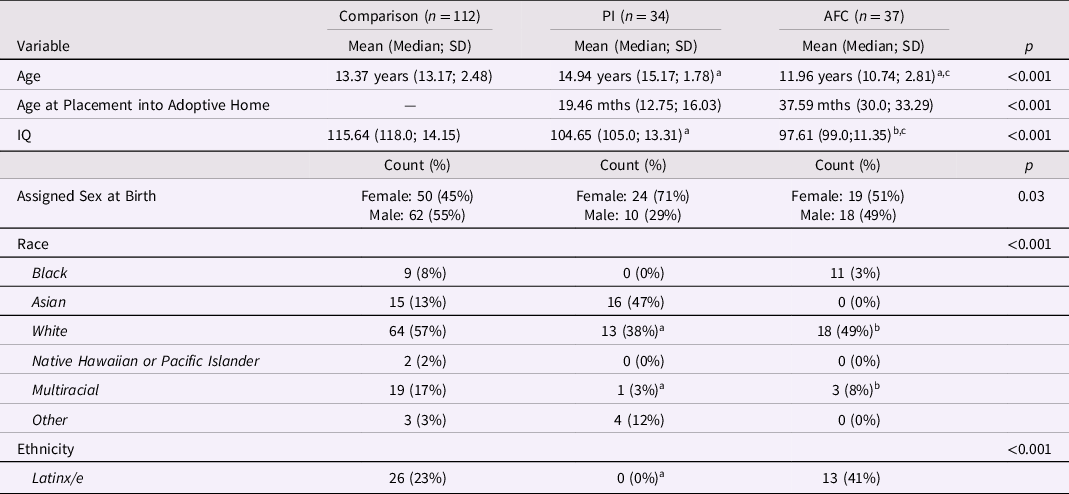
Chi-square analyses were performed to explore group differences in sex assigned at birth, race, and ethnicity. ANOVAs were used to assess group differences in child age, age at placement into adoptive home, and child IQ (measured using the Wechsler Abbreviated Intelligence Scale, Second Edition; WASI-II). Group differences in demographic information are presented in Table 1.
Sample demographic information

Note: AFC = adopted from foster care; PI = previously institutionalized. IQ was not collected in 14 AFC participants, and race/ethnicity is unknown for 5 AFC youth. Chi-square analyses were performed to explore group differences in sex assigned at birth, race, and ethnicity. ANOVA was used to explore group differences in IQ, child age, and age at placement into adoptive home. IQ was measured using the Wechsler Abbreviated Intelligence Scale, Second Edition (WASI-II; Wechsler, 2011). p values reflect the results of each chi-square or ANOVA.
Abbreviations: Previously Institutionalized (PI); Adopted from Foster Care (AFC).
a Denotes higher rates/scores in the comparison group than the PI group.
b Denotes higher rates/scores in the comparison group than the AFC group.
c Denotes higher rates/scores in the PI group than the AFC group.
Measures
To characterize sensory experiences following ECA, we used a general measure of sensory processing challenges focused on sensory modulation (Short Sensory Profile) and a targeted assessment of SOR symptoms (SP3D Inventory), given reported links between SOR and clinical outcomes (McIntosh et al., Reference McIntosh, Miller and Shyu1999; Schoen, Miller, & Green, Reference Schoen, Miller and Green2008). Additional measure details, discussion of the advantages of using both scales, and correlations between similar subscales across measures are reported in the supplement.
General sensory processing challenges
The Short Sensory Profile (SSP; McIntosh et al., Reference McIntosh, Miller and Shyu1999) assesses a child’s struggles with sensory processing. For example, parents indicate to what extent their child reacts emotionally to or avoids intense sensory stimuli (e.g., touch, sound, light, and tastes), seeks out touch/movement to a disruptive degree, or is affected by sensory distractors. SSP total scores are derived from parent ratings of their child’s sensory processing on all 38 items, each scored from 1 (Always) to 5 (Never). The SSP items are divided into seven subscales: Tactile Sensitivity, Taste/Smell Sensitivity, Movement Sensitivity, Visual/Auditory Sensitivity, Underresponsive/Seeks Sensation, Auditory Filtering, and Low Energy/Weak. Previous research suggests that the SSP subscales have reliability estimates in the moderate to excellent range (McIntosh et al., Reference McIntosh, Miller and Shyu1999). Lower SSP scores reflect less typical processing, with clinical categories characterized as typical sensory processing (190 to 155) or probable (154 to 142) or definite (141 to 31) sensory processing challenges.
Sensory over-responsivity
The Sensory Processing 3-Dimensions Scale Sensory Inventory (SP3D) assesses a child’s responses to common, potentially aversive sensory stimuli (Schoen et al., Reference Schoen, Miller and Green2008). Parents reported how bothered their child is by individual stimuli on a Likert scale ranging from 1 (Not bothered/never avoids) to 5 (Extremely bothered/always avoids) on 42 questions. For example, parents report to what extent the sound of fluorescent lights, clothes swishing, toilets flushing, and sirens bother their child. Tactile, visual, and auditory subscales were used and combined to create a total SOR score. Previous findings have shown that the SP3D total score has high internal consistency (α = .89; Schoen et al., Reference Schoen, Miller and Sullivan2017). SP3D scores range from 42 to 210, with higher scores corresponding to higher levels of SOR (greater impairment).
Clinical symptomatology
Internalizing symptoms and externalizing problems were measured using the Child Behavior Checklist, a parent-reported measure of mental health and behavioral symptoms for youth between the ages of 6 and 18 years (CBCL; Achenbach, & Rescorla, Reference Achenbach and Rescorla2001). On the CBCL, parents report their child’s clinical symptoms on 118 questions (rated 0 = Not True, 1 = Somewhat or Sometimes True, or 2 = Very True or Often True). The internalizing subscale combines anxious/depressed, withdrawn/depressed, and somatic complaint scores. The externalizing problems subscale sums rule-breaking and aggressive behavior items. These subscales have strong evidence for reliability and both discriminant and convergent validity: there is excellent test-retest reliability for the internalizing symptoms (r = 0.91) and externalizing symptoms (r = 0.92), as well as good criterion-related validity and construct validity (Achenbach, & Rescorla, Reference Achenbach and Rescorla2001). Due to IRB constraints, the CBCL suicidality questions were not collected, and thus were omitted from score calculations. As a result, CBCL Internalizing subscale scores were calculated without question 91, while all other subscale scores of interest were calculated as usual. To prevent truncation (Achenbach, & Rescorla, Reference Achenbach and Rescorla2001), all analyses used raw subscale scores rather than t-scores.
Data analytic plan
Statistical analyses were conducted using SPSS Version 27.0 (SPSS Inc., USA). Path analyses were conducted using the PROCESS macro (Hayes, Reference Hayes2017), using 95% percentile bootstrap confidence intervals (5,000 bootstraps). In line with recommendations (Thoemmes, Reference Thoemmes2015; Lemmer, & Gollwitzer, Reference Lemmer and Gollwitzer2017), we only ran statistical tests for the preregistered cross-sectional path analyses that aligned with our theoretical model (which posits that ECA causes sensory processing challenges that in turn confer elevated risk for psychopathology) and did not test alternative path models by flipping the M (sensory) and Y (psychological symptomatology) variables.
We conducted two ANCOVAs to probe differences in sensory processing between the PI and AFC groups and to determine whether they should be examined separately or as one ECA group. We set group (AFC or PI) as the independent variable and SSP total score (general sensory processing challenges) and SP3D total score (SOR) as the respective dependent variables, with age and sex assigned at birth as covariates.
Given demonstrated relationships between ECA and both SOR and internalizing symptoms, we used two primary path analysis models to examine the impact of ECA, a multicategorical predictor (two ECA groups relative to the comparison group), on internalizing symptoms (CBCL) through sensory processing challenges, while covarying for age and sex assigned at birth. The two models, respectively, tested the indirect effects of our two sensory measures: SOR (SP3D score) and general sensory processing challenges (SSP score). In both models, we first examined group differences in SOR and sensory processing challenges using the path between ECA and the sensory measure of interest. We then probed indirect effects of ECA on internalizing symptoms through the two sensory measures, respectively.
Since links between sensory processing challenges and externalizing symptoms are less well-documented, we conducted two exploratory path analyses examining indirect effects of ECA on externalizing symptoms through the sensory measures, covarying for sex and age.
Our preregistered analyses aimed to examine relative total effects (the sum of direct and indirect effects) of the ECA group on psychological symptoms using these path analyses. However, because some participants had asynchronous sensory and psychological assessments, we covaried for different ages on different paths of our models. This required four multiple regressions to evaluate the total effects of the ECA group (AFC or PI relative to nonadopted comparison) on internalizing and externalizing symptoms, respectively (covarying for age and sex). We also conducted a multiple regression within the combined ECA group (PI and AFC) to examine the effect of age at placement into a final adoptive home (predictors) on SOR, while covarying for sex.
To provide additional confidence in the reported findings, multiple post-hoc analyses focused on age and sex are reported in the supplement, including reanalysis of a smaller sample with age-matched groups. These results do not differ in any meaningful way from the original analyses, aside from observed differences in SOR between smaller age-matched AFC and comparison samples, which were marginally significant, presumably due to reduced statistical power.
Given the exploratory nature of our questions and that the populations in this study are very challenging to recruit (limiting statistical power), we did not correct for multiple comparisons. For this reason, we distinguished between our primary and exploratory questions of interest in both our preregistration and below, to strike a balance between limiting multiple comparisons within the primary questions of interest while also providing as much useful descriptive data as possible on the sensory measures collected. In addition, given our use of bootstrapping, we did not exclude outliers in our preregistered analyses in order to preserve statistical power in a small, hard to recruit sample from a population with high interindividual variability (Tottenham, Reference Tottenham2012). All findings reported below therefore include all eligible participants. Post hoc analyses excluding participants with SP3D or SSP scores more than three standard deviations from the overall sample mean (excluding 4 AFC and 2 PI participants for the SP3D and 3 AFC participants for the SSP) found nearly identical patterns of effects as those reported below. These analyses are reported in the supplement.
Results
Descriptive results
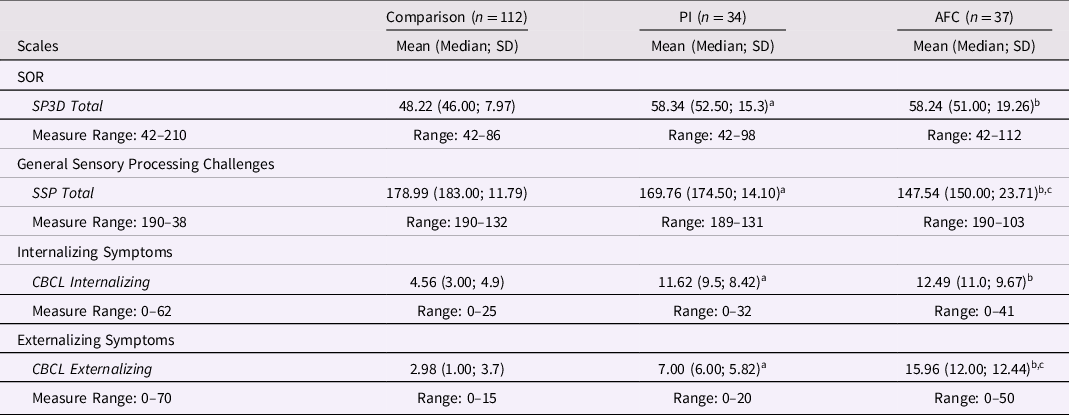
Sample demographic information is reported in Table 1, and descriptive statistics for all measures are presented in Table 2. While all subjects completed all primary measures, IQ was not collected in 14 AFC participants, and 5 AFC youth did not provide race/ethnicity information. Both the SP3D and the SSP measures had high internal consistency reliability in this sample (αSP3D = 0.91, αSSP = 0.94). Parent-reported partial information on ECA experienced by the PI and AFC groups is reported in the supplement.
Descriptive statistics for sensory over-responsivity, general sensory processing challenges, and clinical symptomatology

Note: Reported CBCL scores are raw subscale scores. T-scores and clinical cutoffs for the CBCL are reported in the supplement.
Abbreviations: Previously Institutionalized (PI); Adopted from Foster Care (AFC).
a Denotes elevated symptoms in the PI group relative to the Comparison group.
b Denotes elevated symptoms in the AFC group relative to the Comparison group.
c Denotes elevated symptoms in the AFC group relative to the PI group.
Differences in sensory processing challenges between ECA groups
We found no differences between ECA groups on SP3D scores (F(3,71) = 0.76, p = 0.39). However, the AFC group had significantly more sensory processing challenges on the SSP than the PI group (F (3,71) = 10.00, p = 0.002). The AFC and PI groups were therefore examined separately in all analyses, with ECA dummy coded and nonadopted comparison youth as the reference group.
Sensory processing challenges following ECA
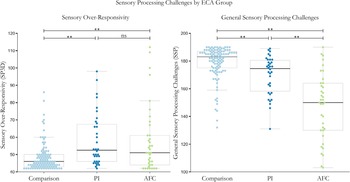
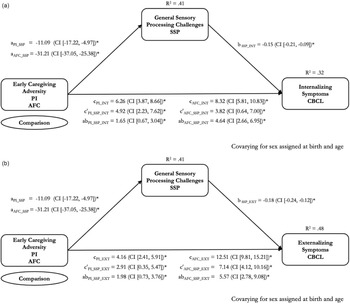
As expected, youth in both ECA groups had significantly elevated sensory processing challenges (Figure 1; Table 2). Youth in the PI (a PI_SP3D = 10.72, SE = 2.57, t = 4.18, 95% CI [5.65, 15.78], p < .001) and AFC (a AFC_SP3D = 9.82, SE = 2.45, t = 4.02, 95% CI (5.14, 0.65), p <.001) groups had higher SP3D scores (higher SOR) than the nonadopted comparison group, covarying for age and sex. Consistent with this finding, youth in both the PI (a PI_SSP = −11.09, SE = 3.10, t = −3.56, 95% CI [−17.22, −4.97], p <.001) and AFC (a AFC_SSP = −31.21, SE = 2.97, t = −10.56, 95% CI (–37.05, −25.38), p < 0.001) groups had significantly heightened general sensory processing challenges on the SSP (lower scores), relative to nonadopted comparison youth. This suggests that youth with histories of ECA experience elevated general sensory processing challenges and increased SOR, relative to comparison youth.
Left: PI and AFC participants show elevated levels of sensory over-responsivity (higher SP3D scores), relative to non-adopted, comparison youth. Right: PI and AFC participants show increased levels of general sensory processing challenges (lower SSP scores) relative to non-adopted, comparison youth. **p <.001, *p <.05.

A post hoc chi-square analysis showed a moderate association (ϕ = .57, p < 0.001) between group membership (PI, AFC, and comparison) and the distribution of participants in SSP clinical categories (χ2 (4) = 60.19, p < 0.001). Of the nonadopted comparison youth, 5.36% were classified as having probable and 1.7% as having definite sensory processing challenges, consistent with previous findings in younger children (Tomchek & Dunn, Reference Tomchek and Dunn2007). PI youth displayed more evidence of sensory processing challenges, with approximately 15% classified as having probable and 3% as having definite sensory processing challenges. Notably, 19% of AFC youth were considered to have probable, and an additional 40% to have definite sensory processing challenges. Group differences on the SSP and SP3D subscales are reported in the supplement for reference.
Psychological symptomatology following ECA
There were significant total effects of ECA on both internalizing and externalizing symptoms. Both PI (c PI_INT = 6.26, SE = 1.21, t = 5.17, 95% CI (3.87, 8.67), p < 0.001) and AFC (c AFC_INT = 8.32, SE = 1.27, t = 6.54, 95% CI (5.81, 10.83), p < 0.001) youth had higher internalizing symptom scores than comparison youth, covarying for age and sex. Similarly, both PI (c PI_EXT = 4.16, SE = 0.89, t = 4.70, 95% CI (2.41, 6.91), p < 0.001) and AFC (c AFC_EXT = 12.51, SE = 1.36, t = 9.17, 95% CI (9.81, 15.21), p < 0.001) youth had higher externalizing symptoms than comparison youth, covarying for age and sex. These results are consistent with those reported in other PI and AFC samples (e.g., Humphreys et al., Reference Humphreys, Gleason, Drury, Miron, Nelson, Fox and Zeanah2015).
Sensory processing challenges and links to psychological symptomatology
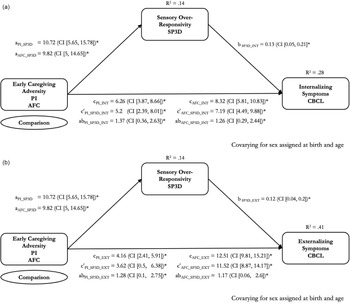
Findings from the path analyses were consistent with our theoretical framework, which posits that ECA inflates risk for psychological symptomatology in part through increased sensory processing challenges. First, we explored how SOR might contribute to links between ECA and internalizing symptoms. Covarying for age and sex assigned at birth, we found significant indirect effects of ECA on elevated internalizing symptoms through SOR, for both PI (ab PI_SP3D_INT =1.37, 95% CI [0.36, 2.63]) and AFC (ab AFC_SP3D_INT = 1.26, 95% CI [0.29, 2.44]) youth (Figure 2(a)). In a second model that examined general sensory processing challenges as a link between ECA and internalizing symptoms, we again found significant indirect effects through sensory processing challenges for both PI (ab PI_SSP_INT = 1.65, 95% CI [0.67, 3.04]) and AFC participants (ab AFC_SSP_INT = 4.64, 95% CI [2.66, 6.95]), relative to comparison youth (Figure 3(a)).
(a) 95% percentile bootstrapped regression coefficients for a path analysis model examining the association between ECA (predictor) and internalizing problems (outcome) through SP3D total score, while controlling for age and sex assigned at birth. (b) 95% percentile bootstrapped regression coefficients for a path analysis model examining the association between ECA (predictor) and externalizing problems (outcome) through SP3D total score, while controlling for age and sex assigned at birth. As in OLS regression, R2 for each component of the path analysis can be interpreted as the proportion of the variance in the outcome explained by that model (e.g. proportion of SP3D variance explained by OLS with ECA group, sex, and age predictors) **p<.001, *p<.05. PI = Previously Institutionalized; AFC = Adopted from Foster Care; SP3D = Sensory Processing 3-Dimensions Scale Sensory Inventory; SSP = Short Sensory Profile; CBCL = Child Behavior Checklist.

(a) 95% percentile bootstrapped regression coefficients for a path analysis model examining the association between ECA (predictor) and internalizing problems (outcome) through SSP total score, while controlling for age and sex assigned at birth. (b) 95% percentile bootstrapped regression coefficients for a path analysis model examining the association between ECA (predictor) and externalizing problems (outcome) through SSP total score, while controlling for age and sex assigned at birth. As in OLS regression, R2 for each component of the path analysis can be interpreted as the proportion of the variance in the outcome explained by that model (e.g. proportion of SSP variance explained by OLS with ECA group, sex, and age predictors) **p<.001, *p<.05. PI = Previously Institutionalized; AFC = Adopted from Foster Care; SP3D = Sensory Processing 3-Dimensions Scale Sensory Inventory; SSP = Short Sensory Profile; CBCL = Child Behavior Checklist (CBCL).

We also conducted two exploratory path analyses to examine how sensory processing challenges might explain the relationship between ECA and externalizing symptoms. The first examined SOR as a link between ECA and externalizing symptoms (Figure 2(b)). We found significant indirect effects of PI and AFC status on externalizing symptoms through SOR (PI: ab PI_SP3_EXT = 1.28, 95% CI [0.10, 2.75]; AFC: ab AFC_SP3D_EXT = 1.17, 95% CI [0.06, 2.6]). Similarly, we found a significant indirect effect of ECA on externalizing symptoms through sensory processing challenges (Figure 3(b); PI: (ab PI_SSP_EXT = 1.98, 95% CI [0.73, 3.76]; AFC: ab AFC_SSP_EXT = 5.57, 95% CI [2.78, 9.08]).
These findings support our hypothesis that sensory processing challenges and SOR symptoms may contribute to ECA-associated internalizing and externalizing symptoms.
SOR and age at placement into final adoptive home
Our results were not consistent with a dose-response relationship between preadoption ECA duration and SOR (B Placement = −0.11, t(70) = −1.47, 95% CI [−0.26, 0.04], p = .15). Post-hoc exploratory analyses showed age at placement was not associated with SOR within the PI (B Placement_PI = −0.13, t(33) = −0.77, 95% CI [ −0.48, 0.22] p = 0.45) or AFC groups (B Placement_AFC = −0.13, t(36) = −1.27, 95% CI [ −0.33, 0.08], p = 0.21). Additional analyses found no associations between age and SOR symptoms across both ECA groups, as reported in the supplement.
Discussion
This study examined the impact of ECA on sensory processing challenges in youth adopted from institutional (e.g., orphanage) or foster care. We found that relative to nonadopted comparison youth, children and adolescents adopted from institutional or foster care display elevated sensory processing challenges, including SOR. This suggests that ECA-linked sensory processing challenges persist into adolescence, in contrast with age-related reductions in sensory symptoms reported in typically developing and clinical samples of youth without known ECA (Kern et al., Reference Kern, Trivedi, Garver, Grannemann, Andrews, Savla and Schroeder2006; Van Hulle, Lemery-Chalfant, & Goldsmith, Reference Van Hulle, Lemery-Chalfant and Goldsmith2015; Little et al., Reference Little, Dean, Tomchek and Dunn2018). Our results also suggest that sensory processing challenges, including SOR, may contribute in part to elevated internalizing and externalizing symptoms observed in youth with histories of ECA. Taken together, our findings point to a commonality of sensory processing challenges among youth exposed to severe forms of ECA, with possible implications for mental health. Further work should examine whether similar effects are observed following more common, less severe forms of ECA.
That we observed sensory processing challenges in both PI and AFC youth both replicates and contradicts findings from a previous study, which reported sensory processing challenges (assessed using the SSP) in PI, but not AFC youth (Wilbarger et al., Reference Wilbarger, Gunnar, Schneider and Pollak2010). These discrepant findings in AFC youth could be explained in part by differences in time prior to placement in a final adoptive home between the current and prior studies, given that youth in the prior AFC sample were very young at adoption (MAge = 4.5 months, range = 1–8 months) relative to our AFC sample (MAge = 37.59 months, range = 0–108 months). However, as our current results do not suggest a dose-response relationship between duration of preadoption ECA and sensory processing difficulties, these differences merit further exploration of how ECA severity impacts outcomes in future work employing more targeted metrics.
Developmental heterogeneity after ECA exposure
Though the effects of ECA have primarily been documented in cognitive and affective domains (Callaghan, & Tottenham, Reference Callaghan and Tottenham2016a, Reference Callaghan and Tottenham2016b; Pechtel, & Pizzagalli, Reference Pechtel and Pizzagalli2011; Chen, & Baram, Reference Chen and Baram2016; McLaughlin, DeCross, et al., Reference McLaughlin, DeCross, Jovanovic and Tottenham2019), our results indicate that ECA also alters lower level sensory processing. Although our participant samples are not necessarily representative of all youth with similar paths to adoption, these findings suggest that across two distinct forms of ECA, each with considerable experiential heterogeneity, there is a shared elevated risk for sensory processing challenges. Though circumstances surrounding placement in institutional and foster caregiving differ on several features, they often share core adversities, including separation from primary caregivers, frequent transitions, and a lack of stable caregiving. Notably, while we observed a shared risk for sensory processing challenges in both the PI and AFC groups, there was substantial variability in sensory processing within each of these cohorts. Relative to comparison youth, the range of SOR scores was 27% wider for the PI group and 59% wider for the AFC group. This variability is consistent with a broader literature suggesting that while ECA exposure probabilistically increases the risk for psychopathology, this link is not deterministic (Kessler et al., Reference Kessler, McLaughlin, Green, Gruber, Sampson, Zaslavsky and Williams2010; McLaughlin et al., Reference McLaughlin, Green, Gruber, Sampson, Zaslavsky and Kessler2012; Tottenham, Reference Tottenham2012).
These observations speak to the diversity of exposures that youth with histories of ECA encounter. For example, for internationally adopted PI youth, institutional placements are often the result of political, societal, or economic pressures (e.g., poverty, national policies, and natural disasters), and not necessarily abuse or neglect (Gunnar, 2007; van IJzendoorn et al., 2020). As such, the initial family separation and qualitative features of the institutional rearing environment itself (including high child to caregiver ratios, rotating staff, and resultant lower quality caregiving) are often principal sources of ECA for these youth (Berens, & Nelson, Reference Berens and Nelson2015; van IJzendoorn et al., Reference van IJzendoorn, Bakermans-kranenburg, Duschinsky, Fox, Goldman, Johnson and Sonuga-Barke2020). By contrast, domestically adopted AFC youth have heterogeneous and varied experiences that, in addition to removal(s) from their home of origin themselves, may at times include exposure to violence or neglect (US Department of Health and Human Services, & US Department of Health and Human Services, 2020), in addition to other systemic or family-level factors contributing to interaction with the welfare system and placement in foster care (e.g., systemic racism, poverty). The heterogeneity of exposure AFC youth experience is consistent with the present AFC sample showing more variable sensory processing challenges than PI youth. Future work should examine whether specific features of ECA (e.g., trauma, unpredictability, degree of deprivation exposure, perceptions of experiences of ECA) contribute to variability in sensory development and specific sensory symptom profiles (McLaughlin, & Sheridan, Reference McLaughlin and Sheridan2016; Cohodes et al., 2020; Smith, & Pollak, Reference Smith and Pollak2021). Descriptive analyses in our sample (described in the supplement) are consistent with clearer links between ECA and SOR than other sensory processing challenges, but these tentative findings merit additional exploration in future work.
Potential mechanisms for development of sensory processing challenges after ECA exposure
Mechanistic pathways for the development of sensory processing challenges following ECA are not well characterized. However, key neural circuits thought to be impacted by ECA have also been implicated in the development of SOR. For example, preliminary neuroimaging evidence suggests that sensory symptoms may be driven by enhanced affective reactivity, altered top-down regulation of limbic circuitry, or both (Green et al., Reference Green, Rudie, Colich, Wood, Shirinyan, Hernandez and Bookheimer2013, Reference Green, Hernandez, Bowman, Bookheimer and Dapretto2018), mirroring altered prefrontal-amygdala circuit activity observed following ECA. The present results imply that ECA-associated threat vigilance (linked to amygdala hyper-reactivity in ECA-exposed youth; Silvers et al., Reference Silvers, Goff, Gabard-Durnam, Gee, Fareri, Caldera and Tottenham2017) may extend to the sensory domain and contribute to symptoms of both SOR and anxiety (Green, & Ben-Sasson, Reference Green and Ben-Sasson2010). Likewise, diminished regulation of affective responses to sensory stimuli may contribute to sensory processing challenges. Lower emotion regulation capacity is linked to SOR symptoms (McMahon et al., Reference McMahon, Anand, Morris-Jones and Rosenthal2019), and SOR is associated with both reduced amygdala habituation and prefrontal downregulation of the amygdala during aversive sensory stimulation (Green et al., Reference Green, Hernandez, Tottenham, Krasileva, Bookheimer and Dapretto2015, 2018, Reference Weissman, Bitran, Miller, Schaefer, Sheridan and McLaughlin2019; Green, & Wood, Reference Green, Hernandez, Lawrence, Liu, Tsang, Yeargin and Bookheimer2019). These findings mirror observations of altered prefrontal regulation of limbic circuitry in youth with histories of ECA during both affective and nonaffective self-regulation (Tottenham et al., Reference Tottenham, Hare, Quinn, McCarry, Nurse, Gilhooly and Casey2010; Callaghan, & Tottenham, Reference Callaghan and Tottenham2016b; Chen, & Baram, Reference Chen and Baram2016; Heleniak et al., Reference Heleniak, Jenness, Vander Stoep, McCauley and McLaughlin2016; Cohodes et al., 2020; Jenness et al., Reference Jenness, Peverill, Miller, Heleniak, Robertson, Sambrook and McLaughlin2020). While altered neurobehavioral vigilance and self-regulation profiles are likely adaptations to unpredictable or threatening environments, both phenotypes convey increased risk for internalizing symptoms among youth with histories of ECA (Gee et al., Reference Gee, Gabard-Durnam, Flannery, Goff, Humphreys, Telzer and Tottenham2013; Callaghan, & Tottenham, Reference Callaghan and Tottenham2016b; Silvers et al., Reference Silvers, Goff, Gabard-Durnam, Gee, Fareri, Caldera and Tottenham2017; VanTieghem, & Tottenham, Reference VanTieghem, Tottenham, Vermetten, Baker and Risbrough2018; Weissman et al., Reference Weissman, Bitran, Miller, Schaefer, Sheridan and McLaughlin2019). Testing mechanistic pathways could further clarify the connections between sensory processing challenges and internalizing (and externalizing) symptoms observed in the present study.
Clinical implications
Regardless of developmental mechanisms, our results are consistent with findings in other clinical populations that indicate that sensory processing challenges increase risk for a broad range of psychological and behavioral symptoms (Green et al., Reference Green, Ben-Sasson, Soto and Carter2012; Gourley et al., Reference Gourley, Wind, Henninger and Chinitz2013; Carpenter et al., Reference Carpenter, Baranek, Copeland, Compton, Zucker, Dawson and Egger2019; McMahon et al., Reference McMahon, Anand, Morris-Jones and Rosenthal2019). This fact has led some researchers to advocate for the addition of a sensation and perception domain to future versions of the Research Domain Criteria (Harrison et al., Reference Harrison, Kats, Williams and Aziz-Zadeh2019). These findings motivate further longitudinal exploration of sensory development in the context of ECA exposure to characterize developmental trajectories.
If replicated, the present findings motivate further work evaluating the impact of screening for sensory processing difficulties in clinical assessment and treatment in youth with histories of ECA. If additional longitudinal work establishes a directional relationship between sensory processing challenges and later psychopathology following ECA, it will be important to investigate whether monitoring or treating such challenges can support improved clinical outcomes. The present findings together with future work stand to have two implications. First, screening for sensory processing challenges could prove to be useful for early intervention in youth with histories of ECA. In some individuals, ECA-induced changes to psychosocial functioning (and underlying neural circuitry) may first manifest as sensory processing challenges – which emerge in early childhood – before evolving into broader psychological symptom profiles during adolescence, when psychopathology most commonly emerges (Ben-Sasson et al., Reference Ben-Sasson, Hen, Fluss, Cermak, Engel-Yeger and Gal2009; Carter et al., Reference Carter, Ben-Sasson and Briggs-Gowan2011; Green et al., Reference Green, Ben-Sasson, Soto and Carter2012; McLaughlin et al., Reference McLaughlin, Green, Gruber, Sampson, Zaslavsky and Kessler2012; Román-Oyola, & Reynolds, Reference Román-Oyola and Reynolds2013; Carpenter et al., Reference Carpenter, Baranek, Copeland, Compton, Zucker, Dawson and Egger2019; Solmi et al., Reference Solmi, Radua, Olivola, Croce, Soardo, Salazar de Pablo and Fusar-Poli2021). In line with this reasoning, our findings suggest sensory processing challenges in ECA-exposed youth remain elevated in adolescence, and do not disappear following early childhood. Second, sensory processing-focused assessments and targeted treatments may improve clinical care for youth with histories of ECA. Sensory processing symptoms in populations exposed to ECA may lead to misinterpretation of behavioral and mental health symptoms by parents and clinicians alike (Conelea et al., Reference Conelea, Carter and Freeman2014; Fernández-Andrés et al., Reference Fernández-Andrés, Pastor-Cerezuela, Sanz-Cervera and Tárraga-Mínguez2015; Howe, & Stagg, Reference Howe and Stagg2016; Harrison et al., Reference Harrison, Kats, Williams and Aziz-Zadeh2019). For instance, sensory processing challenges often manifest as tantrums, aggression, and both avoidance of and difficulty disengaging with stimulation. In addition to being psychologically taxing for youth, such responses cause distress, family impairment, and socialization challenges (Ben-Sasson et al., Reference Ben-Sasson, Hen, Fluss, Cermak, Engel-Yeger and Gal2009; Carter et al., Reference Carter, Ben-Sasson and Briggs-Gowan2011; Dellapiazza et al., Reference Dellapiazza, Vernhet, Blanc, Miot, Schmidt and Baghdadli2018, Reference Dellapiazza, Michelon, Oreve, Robel, Schoenberger and Chatel2020; Carpenter et al., Reference Carpenter, Baranek, Copeland, Compton, Zucker, Dawson and Egger2019). As a result, sensory-informed assessments may lead to more accurate, targeted, and effective treatments of both sensory symptoms and psychological symptomatology.
Limitations
These findings suggest ECA is associated with altered sensory processing, and that sensory processing challenges may contribute to internalizing and externalizing symptoms. However, the present study has several limitations that should be addressed by future work. First, we have limited information about preadoption experiences for PI and AFC participants, including exposure to other adversities common in these populations (e.g., abuse, prenatal substance exposure). Though this precludes conclusions about the effects of specific exposures on sensory processing, that both ECA groups demonstrated elevated risk for sensory processing challenges despite heterogeneous experiences suggests that ECA generally confers risk for sensory challenges. Second, while previous findings in typically developing and clinical samples suggest SOR symptoms predict later development of psychological symptoms (Green et al., Reference Green, Ben-Sasson, Soto and Carter2012; McMahon et al., Reference McMahon, Anand, Morris-Jones and Rosenthal2019), our analyses used cross-sectional, observational data. Although our path analyses indicate covariation between sensory processing challenges and psychological symptomatology, we cannot draw definitive conclusions about causality or temporal ordering effects. In the present study, we tested the most theoretically plausible model but acknowledge that the directional relationships between our variables ought to be probed by future longitudinal developmental work, ideally from very early in life, including sensitive periods of sensory development, and extending through adolescence (given that most psychopathology emerges during this life stage). Lastly, this study exclusively used parent-reported measures of sensory processing challenges and psychological symptomatology. Future studies should build upon present methods to include self-reported and behavioral measures of sensory processing and psychological symptomatology. In addition, ongoing work should probe directionality using longitudinal or experimental (e.g., animal model) designs, and evaluate whether the observed pattern of findings extends to more common and/or less severe forms of ECA than circumstances leading to adoption, potentially by characterizing early experiences using dimensional approaches (e.g., threat vs. deprivation), rather than categorical descriptors.
Conclusion
We report increased sensory processing challenges in children and adolescents exposed to heterogenous ECA (PI and AFC) and associations between ECA-linked sensory processing challenges and internalizing and externalizing symptoms. These findings motivate future work assessing whether inclusion of sensory processing challenges during screening and treatment for youth with histories of ECA may support improved clinical outcomes.
Supplementary material
The supplementary material for this article can be found at https://doi.org/10.1017/S0954579422000633
Funding statement
Preparation of this manuscript was supported by a National Science Foundation Graduate Research Fellowship (DGE-1650604) and a National Institutes of Health Predoctoral T32 Fellowship to ASML, National Institute of Mental Health K08 (MH112871) and F32 (MH105167) awards to SAG, and generous funds from the UCLA Academic Senate, UCLA Hellman Fellows Fund, and a National Science Foundation CAREER grant (1848004) to JAS.
Conflicts of interest
None.