Introduction
By 2050, over 25% of the total population in high income countries will be aged 65 years or over (UN, 2010). To date, epidemiological studies investigating the prevalence of mental illness in older adults have generated inconsistent findings (Alonso et al., Reference Alonso2004, Scott et al., Reference Scott, Mackenzie, Chipperfield and Sareen2010) and most did not use an age-sensitive diagnostic approach (Colenda et al., Reference Colenda2010). One recent survey, which used an age-appropriate version of the Composite International Diagnostic Interview (CIDI) – the CIDI65+ (Wittchen et al., Reference Wittchen2014) – found that one in three people in Europe had experienced a mental disorder within the last year and that nearly one in four were currently suffering from a mental disorder (Andreas et al., Reference Andreas2016).
Research on service utilization due to mental health problems in older people has found very low rates ranging between 7–8% for the entire sample, between 33–52% for those with psychological distress or a formal diagnosis of any mental disorder, and between 28–34% for those with major depressive and anxiety disorders (Garido et al., Reference Garido, Kane, Kaas and Kane2011; Han et al., Reference Han, Gfroerer, Colpe, Barker and Colliver2011; Gonçalves et al., Reference Gonçalves, Coelho and Byrne2014; Wang et al., Reference Wang, Lane, Olfson, Pincus, Wells and Kessler2005). Some studies suggest that service utilization varies between age groups (Wang et al., Reference Wang, Lane, Olfson, Pincus, Wells and Kessler2005; Cooper et al., Reference Cooper2010), with older adults: (1) significantly less likely than younger or middle-aged adults to receive outpatient specialty healthcare or counseling and psychotherapy (Cooper et al., Reference Cooper2010; Han et al., Reference Han, Gfroerer, Colpe, Barker and Colliver2011), and (2) significantly more likely to receive prescription medication (Cooper et al., Reference Cooper2010; Han et al., Reference Han, Gfroerer, Colpe, Barker and Colliver2011). A recent systematic review of health service use by elderly patients with depressive symptoms (Luppa et al., Reference Luppa, Sikorski, Motzek, Konnopka, König and Riedel-Heller2012) revealed a wide range in number of General Practitioner (GP) visits (48% to 83%) as well as mental health treatments: 5–37% of older depressive patients had been treated by psychiatrists and between 1% and 29% had received psychotherapy. Use of antidepressant (AD) medication ranged from 9 to 77%, the majority of studies reporting AD medication rates of 20% and 45% (Luppa et al., Reference Luppa, Sikorski, Motzek, Konnopka, König and Riedel-Heller2012). Moreover, older adults frequently receive antipsychotic medication (Shah et al., Reference Shah, Carey, Harris, DeWilde and Cook2011), which is associated with a risk for the development of a neuroleptic malignant syndrome (NMS; Belvederri Murri et al., Reference Belvederri Murri2015).
To achieve adequate access to mental health services in underserved populations, it is important to identify barriers and facilitators to service utilization. According to the Behavioral Model (Andersen, Reference Andersen2008), people's use of health services depends on their predisposition to use services (e.g. gender, education, and health beliefs), factors that enable or impede use (e.g. financial, family resources, and access to care), and their need for care (e.g. symptom severity) (Andersen, Reference Andersen2008).
A number of studies investigating predictors of mental health service use in the elderly report heterogeneous findings. Some studies found that service utilization is lower in older age (Crabb and Hunsley, Reference Crabb and Hunsley2006), in males (Garido et al., Reference Garido, Kane, Kaas and Kane2011; Han et al., Reference Han, Gfroerer, Colpe, Barker and Colliver2011; Barry et al., Reference Barry, Abou, Simen and Gill2012), and in those with lower educational attainment (Garido et al., Reference Garido, Kane, Kaas and Kane2011; Han et al., Reference Han, Gfroerer, Colpe, Barker and Colliver2011; Barry et al., Reference Barry, Abou, Simen and Gill2012). With regard to enabling factors, associations with socio-economic status (Hoeck et al., Reference Hoeck, Francois, Van Der Heyden, Geerts and Van Hal2011; Byers et al., Reference Byers, Arean and Yaffe2012), and marital status (Han et al., Reference Han, Gfroerer, Colpe, Barker and Colliver2011; Byers et al., Reference Byers, Arean and Yaffe2012; Veerbeek et al., Reference Veerbeek, Oude Voshaar, Depla and Pot2013) have been inconsistent. Further, with regard to evaluated need factors some studies found lower use of services by people with mood and anxiety disorders (Scott et al., Reference Scott, Mackenzie, Chipperfield and Sareen2010; Byers et al., Reference Byers, Arean and Yaffe2012), while others found higher use of services by people with depression (Han et al., Reference Han, Gfroerer, Colpe, Barker and Colliver2011; Barry et al., Reference Barry, Abou, Simen and Gill2012), anxiety and substance use disorders (Garido et al., Reference Garido, Kane, Kaas and Kane2011), and in patients with physical comorbidity (Garido et al., Reference Garido, Kane, Kaas and Kane2011; Han et al., Reference Han, Gfroerer, Colpe, Barker and Colliver2011). Moreover, lower perceived need, low motivation, and lower self-care abilities are need factors that have been found to be associated with non-use of services for mental health problems in older people (Mackenzie et al., Reference Mackenzie, Pagura and Sareen2010; Garido et al., Reference Garido, Kane, Kaas and Kane2011; Byers et al., Reference Byers, Arean and Yaffe2012).
In addition, the question arises as to which barriers stop people from accessing health services for mental health problems. Three types of perceived barriers have previously been identified: Practical barriers, personal beliefs, and stigma (e.g. Weissman, Reference Weissman2001; Thompson et al., Reference Thompson, Hunt and Issakidis2004; Sareen et al., Reference Sareen2007). The most commonly reported barriers in previous studies were personal beliefs (e.g. “I should not need help”), practical barriers (e.g. costs and distance to services) (Brenes et al., Reference Brenes, Danhauer, Lyles, Hogan and Miller2015), and self-sufficiency beliefs (including a desire to handle problems on one's own) (Mackenzie et al., Reference Mackenzie, Pagura and Sareen2010). However, barriers to service use in older adults have rarely been investigated and findings may differ across countries depending on the nature of the healthcare system.
This study aims to provide representative and reliable descriptive data on the frequency of mental health service utilization in older people aged between 65 and 84 years in catchment areas of six European and associated countries, using a standardized, age-sensitive interview. It aims to examine predisposing, enabling, and need factors of mental health service utilization, according to Anderson's Behavioral Model. Further, the aim is to identify barriers to mental health service utilization in older adults. Specifically, this study examines the following research questions:
1. What is the frequency of service utilization of community-dwelling elderly due to mental health problems in the past 12 months?
2. Which predisposing, enabling, and need factors predict service utilization in the elderly?
3. Which barriers hinder elderly to utilize health services for mental health problems?
Methods
The MentDis_ICF65+ study is a representative stepwise cross-sectional survey. Catchment areas of six European and associated countries were selected to be balanced according to geographical and socio-economic population distribution in Europe. The design is described in detail elsewhere (Andreas et al., Reference Andreas2013)
Sample
A random sample of N = 16,758 older men and women (65–84 years) living in selected catchment community areas of each participating country (at least 500 participants from each country), stratified by age and gender, was drawn from population registries in Hamburg (Germany) and Ferrara (Italy), and from postal addresses of market research companies in Madrid (Spain), Geneva (Switzerland), London/Canterbury (England), and Jerusalem (Israel).
In the majority of study centres (Ferrara, Geneva, Jerusalem, London, and Madrid), a written invitation letter was followed up with a phone call to ask potential participants if they were willing to take part in the study. Ethics regulations in Hamburg stipulated that people had to write back to show their interest in taking part; no phone call was allowed. The response rate varied between countries, ranging from 11% in Hamburg (Germany), to 17% in Madrid (Spain), 19% in Ferrara (Italy), 21% in London/Canterbury (England), 26% in Jerusalem (Israel), and 31% in Geneva (Switzerland); this resulted in a final total sample of N = 3,142 participants. The overall response rate in our study of 20% is comparable to previous studies’ with similar recruitment procedures (Keeter et al., Reference Keeter, Kennedy, Dimock, Best and Craighill2006).
Inclusion criteria for the participants were ability to provide informed consent, living in the predefined catchment area at the beginning of the cross-sectional study and being aged between 65 and 84 years old. Exclusion criteria were severe cognitive impairment as assessed with the Mini-Mental State Examination, Mini cut-off score > 18) (13), and insufficient level of corresponding language. The recruitment and consent procedure was approved by research ethics committees in all six participating countries (Andreas et al., Reference Andreas2013).
Measures
Assessment of mental disorders
Computer-assisted face-to-face interviews with an adapted, age-appropriate version of the Composite International Diagnostic Interview (CIDI65+, Wittchen et al., Reference Wittchen2014) were conducted by trained lay interviewers with household residents between January and October 2011.
An age-appropriate, computerized version of the fully structured lay interview CIDI (Wittchen and Pfister, Reference Wittchen and Pfister1997), the CIDI65+, was developed by the study group (Wittchen et al., Reference Wittchen2014) for the use in the elderly population to diagnose Axis I mental disorders according to the Diagnostic and Statistical Manual of Mental Disorders (DSM) version IV criteria (APA, 2000). The CIDI was adapted to the social, cognitive, and psychological abilities and needs of older adults and evaluates the syndrome domains of Axis I mental disorders (Wittchen et al., Reference Wittchen2014). The interview covers a wide range of mental health problems such as anxiety disorders, affective disorders, psychotic symptoms, obsessive–compulsive disorder, substance abuse, somatoform disorders, and acute and post-traumatic stress disorders. Cognitive impairment, somatic morbidity, and differential diagnoses for mental disorders due to general medical conditions were also assessed. The CIDI65+ included also additional incorporated self-report measures on quality of life (short form of WHOQoL-Bref) and level of functioning (WHODAS-II). The English paper–and-pencil version was translated into German, Spanish, Hebrew, Italian, and French with a back–translation and then computerized. The adopted CIDI65+ has shown good psychometric properties (Wittchen et al., Reference Wittchen2014).
Assessment of service utilization
Service utilization was assessed as part of a section in the adapted standardized CIDI65+ interview. Respondents were asked about their use of health services within the last 12 months prior to the interview due to mental health problems, including type and amount of services received. The section was adapted to make it applicable to the various health services in the six different countries. In the analyses, services were summarized into broader categories including GP visits, inpatient, outpatient, and other mental health services, including community psychiatric nurses and social workers. Furthermore, items were dichotomized for further analysis, i.e. service use versus no service use. Analyses were restricted to any mental disorder in the last 12 months, excluding nicotine dependence or abuse.
Assessment of barriers to service utilization
In addition, barriers to service utilization were assessed using an adopted self-report list (Sareen et al., Reference Sareen2007). Respondents were asked to indicate the types of barriers they perceived to using services for mental health problems: “Why did you not seek any help for your mental health problem(s)?” Participants had the possibility to select all barriers from a set list that applied to them, including personal beliefs (e.g. “I can deal with my problems or symptoms on my own”), practical barriers (e.g. “I did not get an appointment (in time)”), and stigma (“I was afraid to ask for help or of what others would think about my problem”).
Statistical analysis
In line with Andersen's (Reference Andersen2008) Behavioral Model, predisposing, enabling, and need factors were analyzed in multinomial logistic regression. For the survey analyses, post-stratification weights were used to restore the age and gender distribution of the sample for each country (i.e. male/ female gender and two age groups: 65-74 and older than 74 years). Differences were tested using odds ratios (OR) and 95% confidence limits. Interaction terms of sex and age were added and kept in the model if significant. The interaction effect was tested using adjusted Wald tests and orthogonal polynomial contrasts in the level values using also Wald tests. All analyses were computed using Stata 12.1 (Statacorp, 2011). Furthermore, descriptive analyses were conducted to analyze barriers of service utilization.
Results
Descriptive sociodemographic and health characteristics of service use in the elderly
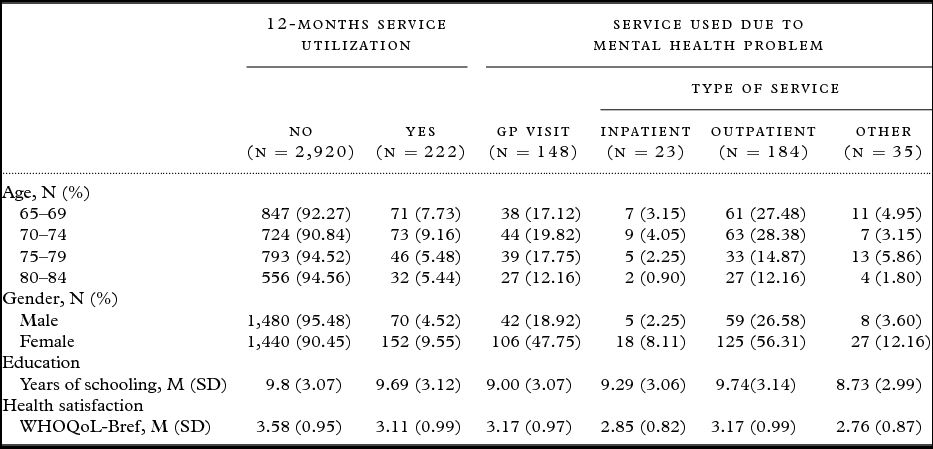
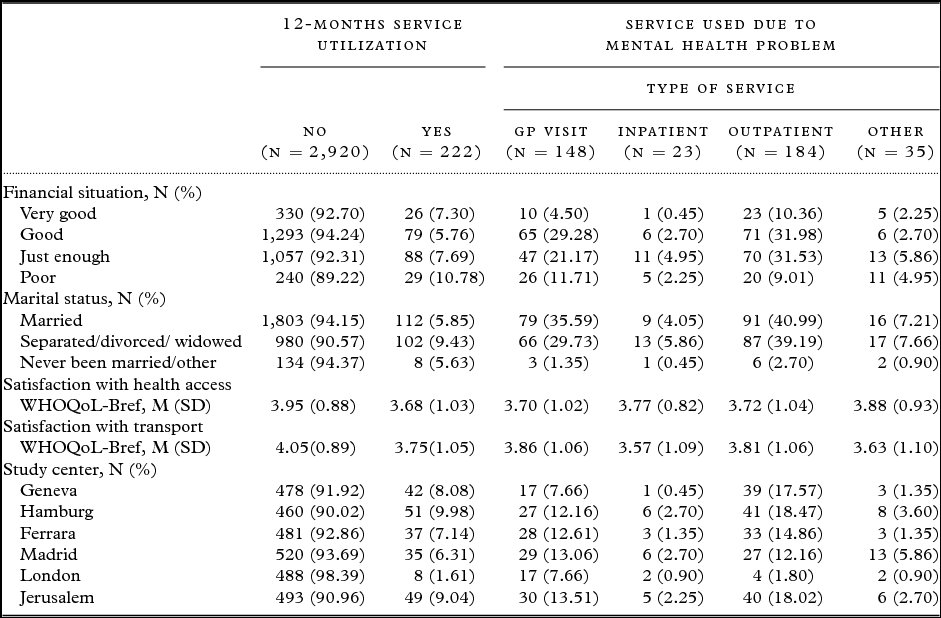
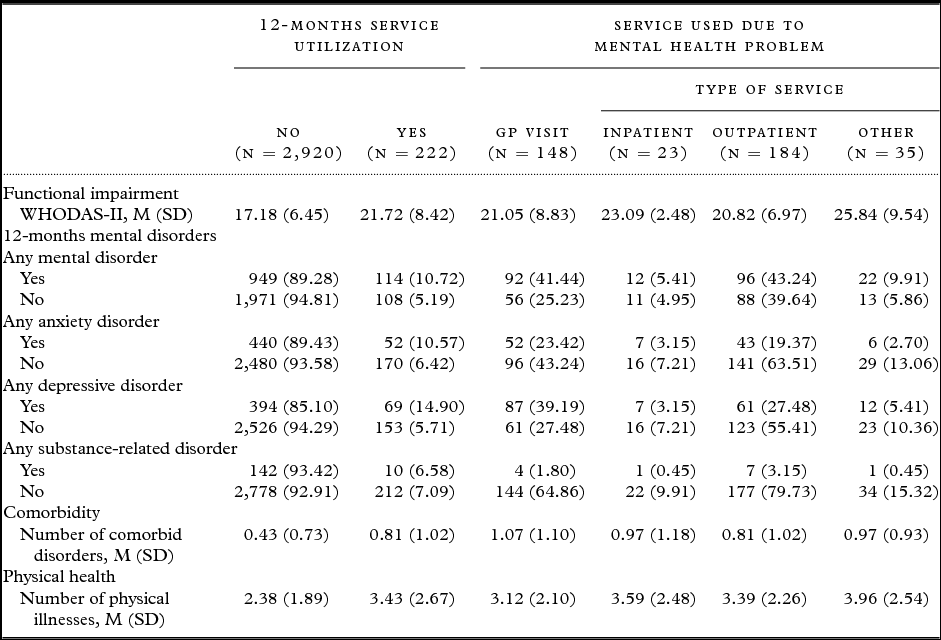
The sociodemographic and mental health characteristics of our sample for 12-months frequency and type of health service utilization are described in Tables 1, 2, and 3. Overall, the descriptive analyses show that 7% of the MentDis_ICF65+ sample had used health services for mental health problems in the past 12 months. Of those service users, 83.6% had used a mental health outpatient service, 67.3% had visited their GP, 10.5% had had inpatient care, and 15.9% had used another type of mental health service (see Table 1).
Predisposing factors of 12-months utilization of health services due to mental health problems and type of services used (N = 3,142) in community-dwelling European elderly

Note: WHOQoL-Bref = WHO Quality of Life BREF; M = mean, SD = standard deviation.
Enabling factors of 12-months utilization of health services due to mental health problems and type of services used (N = 3,142) in community-dwelling European elderly

Note: WHOQoL-Bref = WHO Quality of Life BREF; M = mean, SD = standard deviation.
Need factors of 12-months utilization of health services due to mental health problems and type of services used (N = 3,142) in community-dwelling European elderly

Note: WHODAS II = WHO Disability Assessment Schedule; M = mean, SD = standard deviation.
Type of mental disorder
Only 10.7% of older adults who had experienced any mental disorder in the last 12 months (excluding nicotine dependence or abuse) used a service for mental health problems in that time period (see Table 1). Service use among older people with depressive and anxiety disorders (14.9% and 10.57%, respectively) was higher than in those with substance-related disorders (6.6%). Among those with no classifiable mental disorder (according to CIDI65+ diagnostic criteria) 5.2% had used any services due to mental health problems (see Tables 1, 2, and 3).
Type of intervention
Medication was the most frequent intervention (70.7%) for service users. Other interventions included a longer discussion (20 minutes) of problems with a doctor or therapist (56.6%), a brief discussion (10 min) of problems with a doctor or therapist (28.3%), and group sessions (5.7%).
Association of service use with predisposing, enabling, and need factors
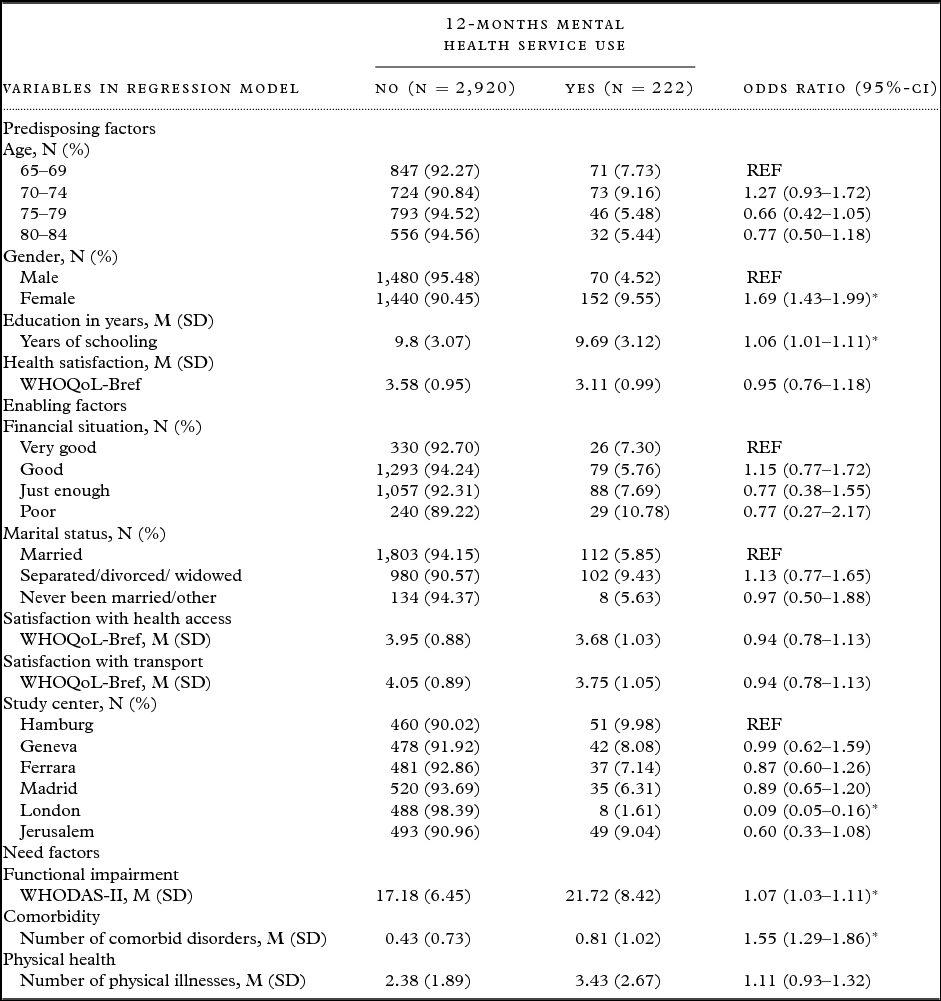
The results of the logistic regression analysis are displayed in Table 4. Significant predisposing factors associated with no service use for mental health problems in the past 12 months were male sex (female OR = 1.69, 95%–CI 1.43; 1.99], p < 0.001) and higher education (years of schooling OR = 1.06, 95%–CI [1.01.; 1.11], p = 0.015). A significant enabling factor was study center (i.e. geographical location), with lower levels of service utilization among those living in London/Canterbury (London/Canterbury OR = 0.09, 95%–CI [0.05; 0.16], p < 0.001; reference category: Hamburg). Significant need factors were higher functional impairment (WHODAS-II OR = 1.07, 95%–CI [1.03; 1.11], p = 0.002) and comorbidity (number of comorbid mental disorders OR = 1.55, 95%–CI [1.29; 1.86], p < 0.001). All other variables in the model were not significantly associated with service use in the past 12 months (see Table 4).
The association of predisposing, enabling, and need factors with mental health service use (in the last 12 months) in European community-dwelling elderly (N = 3,011)

Note: *Significant odds ratios. WHODAS II = WHO Disability Assessment Schedule, WHOQoL-Bref = WHO Quality of Life BREF; M = mean, SD = standard deviation; CI = confidence interval.
Barriers of service utilization
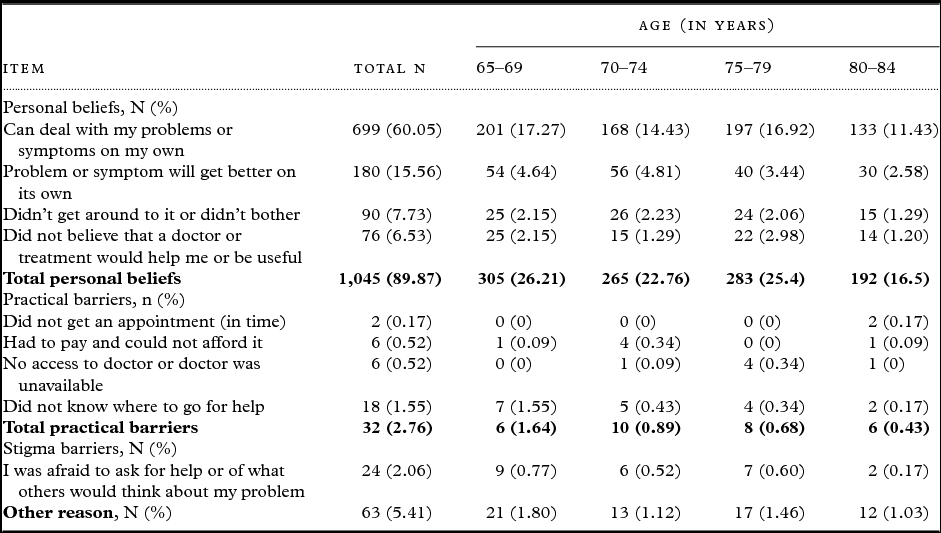
The most frequently reported barriers to service utilization in the elderly were personal beliefs (89.9%). Practical barriers (2.8%), stigma-related barriers (2%), and other reasons 5.4% were rarely cited (see Table 5). With regard to personal beliefs, the most frequently named item was “I can deal with my problems or symptoms on my own,” which was endorsed by 60% of participants, followed by the item “The problem or symptom will get better on its own” which was endorsed by 15.6%. Personal belief barriers were more frequently reported by those with no mental disorder (60.2%) compared with those with a mental disorder (29.6%). In addition, personal belief barriers were numerically higher in the younger age group (age group 65–69 years: 26.2%, 80–84 years: 16.5%) (Table 5).
Frequency of barriers to mental health service utilization in community-dwelling European elderly (N = 2,080)

Discussion
This study found that service utilization for mental health problems assessed with an age-appropriate, reliable, and standardized interview in a sample of European community-dwelling elderly is low with only 7%. These findings are comparable to previous epidemiological studies in the elderly population in the USA and Australia (Garido et al., Reference Garido, Kane, Kaas and Kane2011; Gonçalves et al., Reference Gonçalves, Coelho and Byrne2014) and also similar to a large European study in the adult age population (Alonso et al., Reference Alonso2004). It is particularly noteworthy that even among those with a 12-month DSM-IV diagnosis of a mental disorder, only 11% reported service use in the past 12 months and that service rates use did not differ substantially by type of diagnosis. While these low rates may partly be attributable to the higher item-thresholds for service use in our study, low utilization may also be associated with attitudes of older people toward services, including perception of symptom severity, a desire to solve problems independently, or a lack of knowledge about available services. Furthermore, among those with no classifiable mental disorder about 5% also used services. These may be at least partly identified as “sub threshold” cases, which do not fulfill all required diagnostic criteria for a mental disorder, but suffer from symptom distress or are in remission, and hence perceive a need for treatment.
The most frequently contacted health providers for mental health problems in our sample were mental health outpatient services (83%) and GPs (67%), while inpatient and other type of services were very rarely used. Previous studies found that GPs are the most frequently contacted health provider of older people (Gonçalves et al., Reference Gonçalves, Coelho and Byrne2014). However, as Gonçalves and colleagues (Reference Gonçalves, Coelho and Byrne2014) noted, GPs may lack time and training to properly identify and address mental health problems, especially in older people. In line with a number of previous studies (Cooper et al., Reference Cooper2010; Han et al., Reference Han, Gfroerer, Colpe, Barker and Colliver2011), this study also found that the most frequently received intervention was psychopharmacological medication (71%), followed by a consultation with doctor or therapist (57% and 28%, respectively). For example, Han et al. (Reference Han, Gfroerer, Colpe, Barker and Colliver2011) also found that most frequent types of treatment for older adults living in the community were prescription medication followed by outpatient services. However, this may be considered problematic as this does not comply with current treatment guidelines for example for depression or anxiety disorders (e.g. NICE guidelines). Moreover, considering the risk of adverse side effects – including the development of NMS – the prescription of antipsychotic medication can pose a severe threat to older people's health (Belvederri Murri et al., Reference Belvederri Murri2015). Thus, it has to be considered that even those in contact with services do not receive appropriate treatment or may even be potentially harmed (Dines et al., Reference Dines, Hu and Sajatovic2014).
With regard to factors associated with service utilization for mental health problems in the past 12 months a number of significant predisposing, enabling, and need factors were identified: Elderly females were almost twice as likely to use services in the past 12 months as their male counterparts. This gender effect has been consistently observed in previous studies (Han et al., Reference Han, Gfroerer, Colpe, Barker and Colliver2011; Barry et al., Reference Barry, Abou, Simen and Gill2012), and seems plausible as older men generally show lower help seeking behavior and a stronger believe to effectively self-manage mental health issues. Furthermore, our finding of a weak, but significant association of service utilization with lower educational attainment has also been reported in previous epidemiological studies in the elderly population (Garido et al., Reference Garido, Kane, Kaas and Kane2011; Han et al., Reference Han, Gfroerer, Colpe, Barker and Colliver2011; Barry et al., Reference Barry, Abou, Simen and Gill2012). With regard to enabling factors, service utilization was significantly lower in older people living in the London/Canterbury catchment area compared to those living in Hamburg. These may be at least partly attributable to differences in healthcare systems and access to services. Furthermore, in relation to need factors, higher functional impairment, and higher number of comorbid mental disorders were also significantly associated with service utilization in our elderly sample. A higher perceived need due to mental health problems has also been reported in previous studies (Mackenzie et al., Reference Mackenzie, Pagura and Sareen2010; Byers et al., Reference Byers, Arean and Yaffe2012). Contrary to some previous studies physical conditions were not significantly associated with service use (Garido et al., Reference Garido, Kane, Kaas and Kane2011; Han et al., Reference Han, Gfroerer, Colpe, Barker and Colliver2011). However, as we only investigated service use for mental health problems, the lack of association between physical illness and service use seems not surprising. At the same time, service users do report a higher number of physical illnesses, although the difference with non-users is not statistically significant. Hence, the type of disorder – mental or physical – may not be so relevant, but possibly the cumulative effect of the number of disorders and the associated functional impairment.
The analysis of perceived barriers to service utilization for mental health problems showed that our elderly participants most frequently reported personal beliefs, while practical, stigma, and other barriers were rarely named. The most frequently named personal beliefs were “I can deal with my problems or symptoms on my own” and “The problem or symptom will get better on its own”. While it could be argued that practical barriers are operationalized in Andersen's behavioral model of service utilization as enabling factors, personal belief barriers do not appear to be sufficiently covered in the model. However, it is possible that negative beliefs like “I should be able to deal with my problem on my own” are additional non-enabling factors of service use in older people. Furthermore, several researchers have found that attitudes associated with help seeking behavior contribute to older adults’ low utilization rates of mental health services. In particular, it has been reported that older adults feel responsible for solving problems on their own (Pepin et al., Reference Pepin, Segal and Coolidge2009). Additionally, Griffiths et al. (Reference Griffiths, Crisp, Jorm and Christensen2011) found that personal stigma is associated with a belief in the helpfulness of self-reliance in coping with depression in a national household survey in Australian adult population. Besides, an association of higher self-stigma and sociodemographic factors, such as lower income and education (Werner et al., Reference Werner, Stein-Shvachman and Heinik2009), has also been found. Hence, a mediating or moderating role of stigma with predisposing, enabling, and need factors is also plausible. In addition, low rates of reported practical barriers in our sample, may also be explained by a lack of awareness of older people with belief barriers about the availability of access or transport to services from which they have not tried to seek help. Moreover, our finding of personal belief barriers decreasing with age has also been found in a recent study (Brenes et al., Reference Brenes, Danhauer, Lyles, Hogan and Miller2015).
Limitations
The study has a number of limitations. First, definitions for describing use of mental health services do not reflect the intensity nor the appropriateness of services. Second, the size of the sample in each country and catchment area was limited. Third, it is possible that service utilization was underreported and/or subject to recall bias. Furthermore, it can be difficult for older people in particular to differentiate between physical and mental health problems, because the prevalence of comorbid physical illness and use of medication increases with age and may cause or interfere with mental disorders (Roy-Byrne et al., Reference Roy-Byrne2008; Gonçalves et al., Reference Gonçalves, Coelho and Byrne2014). Unfortunately, further subgroup analyses, for example with diagnostic subgroups, were not possible due to the low percentages of service users. Moreover, due to the categorical diagnosis of mental disorders and the low number of service users in the sample no assessment of how different levels of disorders could influence service utilization in the elderly population was possible. Additionally, the cross-sectional study design does not allow us to draw causal conclusions. Finally, Andersen's behavioral model may need further extension and investigation with regard to the possible additional (mediating) role of personal belief barriers of service use.
Conclusion and implications
Despite these limitations, this study shows that underutilization of services in older European community-dwelling people due to mental health problems is very common and that interventions are needed to improve access to appropriate services. Future research is needed with a more comprehensive data analysis, including an extension of the behavioral model with contextual variables and analyzing service utilization in older people prospectively, including health outcomes.
In order to increase access to services and reduce negative beliefs in this growing and vulnerable population, there is a need to promote literacy about mental health in old age in the general population and to provide adequate health and social care systems according to the recommendations of the WHO (WHO, 2016) and NICE guidelines (NICE, 2015). Professionals need to be able to adequately identify older people at risk for or already suffering from mental health problems and to be able to educate older people about mental health and explain and refer to adequate treatments (WHO, 2016).
Conflict of interest
None.
Description of authors’ roles
J. Volkert, H. Schulz, and S. Andreas formulated the research questions. H. Schulz, S. Andreas, and K. Wegscheider, designed the study. J. Volkert, M.C. Dehoust, B. Ausín, A.-B. Santos-Olmo, C. Da Ronch, Y. Hershkovitz, A. Quirk, O. Rotenstein, and K. Weber were responsible for carrying it out, and S. Andreas, M. Härter, A. Canuto, M.J. Crawford, L. Grassi, M. Muñoz, A.Y. Shalev, and H.-U. Wittchen took responsibility for supervision. S. Sehner, A. Suling, J. Volkert, K. Wegscheider, and S. Strehle undertook programing of diagnostic procedures and statistical analyses. J. Volkert, S. Andreas, M. Härter, and H. Schulz wrote a first draft of the paper, all authors provided feedback, J. Volkert and H. Schulz finalized the manuscript.
Acknowledgments
This study is funded by a grant from the European Commission (Grant No: 223105) within the 7th Framework Research Program of the EU. We gratefully thank all participants and all interviewers in our study.