Prior to the Civil Rights Movement, racial and ethnic minorities were
largely excluded from U.S. higher education. African Americans, in
particular, were barred from most colleges and universities by a
combination of de jure and de facto mechanisms, and they
faced particularly severe barriers at selective institutions. If they were
able to attend college at all, it was usually at a historically black
college or university. Although elite private institutions such as Howard,
Morehouse, and Spelman provided strong training for sons and daughters of
the Black elite, most African Americans were relegated to poorly equipped,
underfunded, racially segregated state institutions. The situation was not
much better for Latinos, especially in Texas, where Mexican Americans were
subject to the sanctions of Jim Crow.
The Civil Rights Movement transformed race relations in the United
States and produced vigorous efforts to incorporate African Americans and
Latinos into the mainstream of American society. Nowhere was this effort
more apparent than in higher education. Led by the nation's selective
institutions, American colleges and universities undertook deliberate
attempts to recruit minority students through a variety of
“affirmative actions” (Bowen and Bok,
1998). These efforts encompassed a range of different mechanisms
for enhancing minority recruitment and admissions.
The new recruitment and admissions practices had pronounced effects on
the racial and ethnic composition of students attending American colleges
and universities. The share of non-Whites among U.S. college students
increased substantially, going from 16% in 1976 to 27% in 1996 (National Center for Education Statistics 2001). Among
African Americans aged 18 to 24, the share attending college went from
18.1% in 1972 to 30.3% in 2000, while the percentage of Latinos attending
college went from 13.4% to 21.7%. By comparison, 36.5% of Whites and 55.9%
of Asians aged 18 to 24 were enrolled in college in 2000 (U.S. Census Bureau 2004).
As the decades wore on, however, it became clear that mere recruitment
into former bastions of white academic privilege would not be enough to
erase the large gap in educational attainment between Latinos and Blacks,
on the one hand, and Whites and Asians, on the other (Glazer 1997). Despite a variety of retention
efforts—including better financial aid, remedial education, special
tutoring, peer advising, culturally sensitive dorms, and ethnically
supportive student unions—once admitted to institutions of higher
education, African Americans and Latinos continued to underperform
relative to their white and Asian counterparts, earning lower grades,
progressing at a slower pace, and dropping out at higher rates. More
disturbing was the fact that these differentials persisted even after
controlling for obvious factors such as SAT scores and family
socioeconomic status (Bowen and Bok, 1998; Vars and Bowen, 1998).
The theory of stereotype threat was developed by Claude Steele (1988, 1992, 1998) to account for persistent minority
underachievement. He argued that members of a disparaged minority group
are prone to underperform academically because of a fear of living up to
negative group stereotypes about intellectual ability. If the fear is
strong enough, it interferes with performance and over the long term leads
to “disidentification,” a psychological defense mechanism in
which the domain where the threat occurs is dropped as a basis for
self-esteem (Steele and Aronson, 1995; Aronson et al., 1998). The results of Lovaglia et al.
(1998) suggest that stereotype threat may not be
limited to African Americans, but can undermine the performance of any
group symbolically identified as low status.
In the United States, a long-standing racist canard is that African
Americans are intellectually inferior to Whites and incapable of
performing academically at the same level as other groups (see Herrnstein and Murray, 1996; Tucker
2002). The stereotype of black intellectual inferiority is deeply
embedded in American culture (Bobo and Johnson,
2000; Schuman et al., 1997; Sniderman and Piazza, 1993) and Black students are
keenly aware of prevailing negative valuations of their mental abilities
(Crocker and Quinn, 1998; Steele 1988, 1992). Every time that
a Black student is called upon to perform academically, therefore, he or
she is at risk of confirming a deeply rooted negative stereotype. The
threat may be particularly salient at selective colleges and universities,
where minority students are widely perceived (rightly or wrongly) by White
faculty and students to have benefited from a “bending” of
academic standards to admit them through affirmative action.
Intimations of intellectual inferiority also extend to Latinos. In the
1996 Multi-City Survey of Urban Inequality, for example, a representative
sample of White respondents in Los Angeles rated Blacks as 37% less
intelligent than Whites and Latinos as 45% less intelligent (Charles 2000). In contrast, Whites rated Asians to be
9% more intelligent than Whites. Asians themselves perceive a
similar intellectual pecking order. Asians see themselves as 25% more
intelligent than Whites, and Blacks and Latinos as 141% less intelligent
than Whites (three times less intelligent than themselves!). Given this
pattern we would expect the theory of stereotype threat to apply to Blacks
and Latinos but not to Whites or Asians.
Failure to perform up to expected standards is psychologically
distressing because it implies that the stereotype may, in fact, be true:
perhaps Black and Latino students are intellectually inferior to
Whites and Asians. Even if minority students do not believe the canard
themselves, it is nonetheless socially embarrassing to reinforce such a
negative stereotype before a White and Asian audience. Moreover, if
minority students have internalized the negative stereotype themselves,
they may adapt psychologically by downplaying the importance of academic
success as a standard of self-worth, putting less effort toward academic
achievement. If they fail, they can always tell themselves that they
really did not try their hardest and that academic outcomes are not
important as a measure of self-worth anyway.
The theory of stereotype threat rests on three basic assumptions.
First, it assumes that people are motivated to think well of themselves
and have others do the same. Second, it assumes that anxieties about the
possibility of performing badly increase the likelihood of performing
poorly. Third, it assumes that disidentification—psychological
disengagement from the domain in question—stems from the
internalization of negative stereotypes over the long term.
Disidentification should not be confused with the related but more general
concept of devaluation, which refers to the abstract perception of a
domain as unimportant.
Disidentification involves the specific removal of the domain of
competition as a measure of self-esteem (Crocker and
Major, 1989; Crocker and Quinn, 1998). It
is well documented, for example, that African Americans generally value
education—indeed, they value it as much or more than other racial
and ethnic groups (Hochschild 1995, 2003). Despite this valuation, African Americans
consistently underperform academically but nonetheless have very high
levels of self-esteem (Mruk 1999). This is the
case, Steele would argue, because academic performance is not a central
domain in which African Americans construct self-esteem: they have
disidentified with academic achievement as a metric of
self-worth.
Laboratory experiments undertaken to test the theory of stereotype
vulnerability have yielded very supportive findings (Aronson et al., 1998; Steele and
Aronson, 1995). In the typical experiment, one group of students is
prompted to reduce stereotype threat before undertaking a test or
intellectual task, while another is left alone or primed to increase
stereotype threat. Results generally show an inverse relationship between
degree of stereotype threat and intellectual performance. A major
question, however, is the extent to which these results can be replicated
outside the laboratory.
In order to apply the theory of stereotype threat in the real world,
Steele et al. (in press) instituted a special
program for African American students at the University of Michigan.
Students were recruited into the program, but rather than stigmatize them
by labeling it as an effort to compensate for their shortcomings, they
were told that being in the program was an honor. They attended weekly
seminars to get to know each other and share common experiences and then
participated in specific “master workshops” to expose them to
advanced material. After several years, results showed that program
participants earned better grades and were less likely to drop out than
other Black students.
While evidence pertaining to stereotype threat so far has been
positive, the theory has yet to be tested on a broad population of
students. Mostly the data come from experimental studies of selected
undergraduate subjects at a relatively few universities. In this analysis
we test the theory of stereotype threat using a large, representative
sample of college and university students. We begin by outlining a
conceptual model of how stereotype threat is likely to operate in
real-world settings. We then operationalize and test the model using data
from the National Longitudinal Survey of Freshmen. Results offer clear
support for the theory of stereotype threat. To the extent that Black and
Latino students internalize negative stereotypes, they disidentify with
educational achievement and reduce their academic effort, which translates
directly into lower grades. To the extent that they expect others to
evaluate them on the basis of negative stereotypes, moreover, they
experience a performance burden that undermines achievement. Together
these two psychological mechanisms decisively reduce academic performance
among Blacks and Latinos relative to Whites and Asians.
RESEARCH DESIGN
Studying stereotype threat using a social survey is quite different
from doing so in a laboratory. On a survey one cannot manipulate the
degree of threat directly, but must tap into natural variation with
respect to this psychological state in real world populations. For this
reason, survey research is generally assumed to be less internally valid
than experiments. However, in compensation, surveys provide greater
external validity—an ability to generalize to a larger population
outside of the laboratory (Campbell and Stanley,
1966). Given widespread support for the theory of stereotype threat
in the laboratory, the crucial task at this juncture is to establish its
external validity by systematically studying a large population of
students located in diverse educational institutions.
In moving from the lab to the field, a crucial step is the
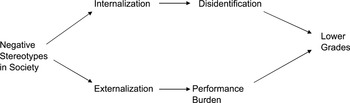
specification of a strong theoretical model to guide analysis. Figure 1 presents a schematic diagram that summarizes
our conceptualization of the process of stereotype threat and how it works
in the real world, as opposed to the staged world of the laboratory.
Exogenous to any individual are societal stereotypes that exist about
various racial and ethnic groups. Simply by living in American
society—by participating in its institutions and interacting with
its people—minority members become aware of negative stereotypes
about themselves, and depending on their position in the social structure,
absorb them to a greater or lesser degree.
Conceptual model of effect of stereotype threat on grade
point
We hypothesize that stereotypes manifest themselves among individuals
in two ways: internally and externally. Stereotypes are internalized when
they are wholly or partly adopted by the individual and incorporated into
social cognition (Fiske and Taylor, 1991). The
internalization may be conscious or unconscious. Recent work has shown the
remarkable degree to which stereotypes are absorbed implicitly, below the
level of conscious awareness (see Banaji and Hardin,
1996; Bargh 1997; Dovidio et al., 1997). Given the difficulty of
measuring unconscious attitudes in the context of a social survey,
however, we focus here on the explicit internalization of negative
stereotypes: the degree to which respondents consciously subscribe to
negative beliefs about their group's abilities. To the extent that
such explicit views represent the tip of a much larger cognitive iceberg,
then our limited measurement is conservative: if we find any variation at
all in the explicit endorsement of negative stereotypes by Blacks and
Latinos, and to the extent that we find any connection at all between it
and academic behavior, it is likely that better measurement would yield
even stronger results.
The externalization of stereotypes occurs when minority members
cognitively expect others to act on the basis of prejudicial notions when
evaluating them. Most African Americans, for example, are well aware of
the pervasiveness of the negative stereotype of Black intellectual
ability. Indeed, growing up in American society, it is nearly impossible
not to learn about the stigma of Black intellectual inferiority.
It is logical to assume, therefore, that many Black students
expect Whites and Asians to draw on this stereotype in evaluating
their performance on intellectual tasks.
The internalization and externalization of negative stereotypes yield
different behavioral outcomes. We posit that internalization—the
conscious acceptance of the negative stereotype of intellectual
inferiority—over time leads to a process of disidentification,
expressed among college students by a reduction of their academic work
effort. If academic success is removed from the domain of self-esteem,
then logically less effort should be expended to achieve it. A reduction
in effort, of course, yields poorer academic performance and lower
grades.
At the same time, externalization—the expectation that others
will draw on negative stereotypes in making evaluations—creates a
psychological performance burden that increases test anxiety and
undermines grade achievement. Students who believe that professors and
other students are prejudiced against them will come to feel as if they
are carrying the entire race on their backs every time they are asked to
perform. If they fail to acquit themselves well, it will reflect badly not
only on themselves and their family, but on the entire race. They are
always at risk of confirming the canard of intellectual inferiority.
The model shown graphically in Figure 1 can
be summarized mathematically in terms of five simple equations. The first
two equations in this structural model link the internalization and
externalization of stereotypes to background characteristics that reflect
an individual's position in the social structure:
where INT is a scale of internalization and EXT is a scale of
externalization, DEM is a set of demographic characteristics, SES is a set
of socioeconomic indicators, REX stands for measures of prior interracial
experience, and REI includes measures of racial-ethnic identity.
Prior interracial experiences are relevant because those who have had
less exposure to Whites are more likely to be vulnerable to the effects of
stereotype threat. We argue that students who grew up in more integrated
settings have had more time to develop coping mechanisms to deal with the
threat of intellectual inferiority and, to a greater or lesser extent,
overcome it. Regardless of prior exposure, however, we expect that for all
minority students' suspicions about their intellectual ability are
heightened in the context of selective institutions because affirmative
action is widely understood to be a factor in the admission of minority
students.
Similarly, we include several racial-ethnic identifiers to measure how
group-specific identity influences the internalization or externalization
of negative stereotypes. We include these measures of ingroup identity
because previous research suggests that a strong ingroup identity can
provide a buffer against the negative effects of stereotypes (Lockett and Harrell, 2003; Miller
1999). We also consider the effect of social distance felt toward
Whites, arguing that greater social distance insulates minorities from the
effects of White prejudice (Portes et al., 1980;
Portes and Rumbaut, 2001). Finally, we include a
measure of skin color in recognition of the fact that darker skin tone is
associated with higher levels of discrimination (Yinger
1994) and large unexplained differentials with respect to
socioeconomic achievement (Hill 2000; Keith and Herring, 1991). As a result, darker-skinned
minorities have a greater awareness of discrimination and are consequently
more likely to expect Whites to act on the basis of negative racial
stereotypes (Edwards 1973; Herman 2004).
The next two equations relate internalization and externalization to
specific behavioral and psychological
manifestations—disidentification and performance burden—while
holding socioeconomic status and demographic background constant and
controlling for the degree of academic preparation:
where all variables are defined as before and AEF and PPB are
indicators of academic effort and psychological performance burden,
respectively, and DAP is the degree of academic preparation. The negative
sign in front of INT means that its expected effect on academic effort is
negative: the more deeply the stereotype is internalized, the less
academic effort is put forth, as hypothesized by Steele (1997, 1999) and consistent
with the findings of Oyserman et al. (2003).
According to Steele and Aronson (1995, p. 809),
“lower expectations, as the literature has long emphasized can
further undermine performance by undermining motivation and effort. It is
precisely a process of stereotype threat fostering low expectations in a
domain that we suggest leads eventually to disidentification with the
domain.” In contrast, externalization is hypothesized to increase
performance burden: the more one expects others to use negative
stereotypes to frame minority performance, the greater the pressure to do
well so as not to “let down the race” (Massey and Fischer, 2002).
The last equation links the foregoing conditions with academic
performance as measured by grade point average:
where all constructs are defined as before and GPA refers to a
respondent's college grade point average. As before, the positive and
negative signs indicate the expected direction of effects, with academic
effort raising and performance burden lowering the earned grade point.
DATA AND MEASUREMENT
We operationalize the foregoing constructs using data from the
National Longitudinal Survey of Freshmen (NLSF), a probability sample of
students who entered selective U.S. colleges and universities as freshmen
in the fall of 1999. Some thirty-five schools were asked to participate in
the study, including all of the institutions studied by Bowen and Bok
(1998) plus the University of California at
Berkeley. The survey was sponsored by a grant from the Andrew W. Mellon
Foundation, whose president (Bowen) contacted each institution's
president or chancellor to request his or her support. In most cases the
request was favorably received. Only seven institutions declined or were
otherwise unable to participate (Duke, Hamilton, Morehouse, Spelman,
Vanderbilt, Wellesley, and Xavier), yielding an institutional
participation rate of 80%.
In the twenty-eight institutions that agreed to participate, we
approached 4,573 randomly selected students and completed 3,924
face-to-face interviews, for an overall response rate of 86% (Massey et al., 2003). The baseline sample included 998
Whites, 959 Asians, 916 Latinos, and 1,051 African Americans. The survey
was designed to gather extensive information about respondents prior to
their entering college and to measure in some detail their initial
attitudes, motivations, and perceptions. A detailed description of the
sampling methodology, including the twenty-eight institutions and their
characteristics, is contained in Massey et al. (2003).
The baseline survey was followed by a series of shorter telephone
surveys designed to determine how respondents had fared since the first
interview. Follow-up surveys were administered in the spring of 2000 and
the spring of 2001, when respondents were freshmen and sophomores. The
respective response rates on these waves were 96% and 90%. Whereas the
independent variables used in our analyses were defined from the baseline
survey, the dependent variable, academic achievement, was assessed using
the two follow-up surveys: grades earned during the fall and spring terms
of academic year 1999–2000 and during the fall term of academic year
2000–2001. In an earlier pilot survey carried out in 1998 at the
University of Pennsylvania, we matched self-reported grades to official
records and found that the grade reports were quite accurate (Massey et al., 2003).
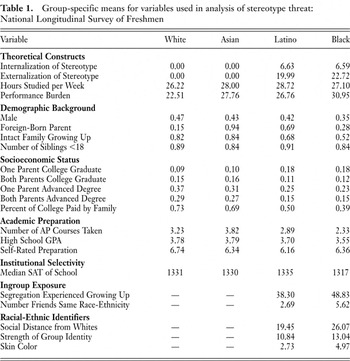
Table 1 shows group-specific means of
variables used to identify the constructs included in the five-equation
model. The internalization of negative stereotypes is measured only for
Latinos and Blacks and is based on respondent ratings of three items:
whether their group is intelligent or unintelligent, hardworking or lazy,
and whether their group “sticks with it or gives up easily.”
Each item was rated on a continuum from strongly disagree to strongly
agree, yielding summated ratings scale with a hypothetical range of
0–18 and a Cronbach's reliability coefficient of .610
(construction of this and the other indices is summarized in Appendix A).
As Table 1 shows, the mean level of
internalization was around 6.6 for both minority groups, with an observed
range of 0–14 and a standard deviation of around 2.3. There is thus
considerable variation in the degree to which disparaged minorities have
internalized negative stereotypes about their group.
Group-specific means for variables used in analysis of stereotype
threat: National Longitudinal Survey of Freshmen
The externalization scale is composed of four items, each rated on a
0–10 scale running from complete disagreement to complete agreement.
Respondents were asked whether they expected Whites to treat others
equally or discriminate, whether they expected Asians to treat others
equally or discriminate, whether they expected instructors holding
stereotypes to use them in evaluating group members, and whether they
thought students holding stereotypes would use them in making evaluations.
The resulting scale yielded a hypothetical range of 0–40 and a
reliability coefficient of .588 (see Appendix A). Externalization was
somewhat greater for Blacks than for Latinos, with a mean scale value of
22.7 compared with 20.0. The observed range was 0–34 and the
standard deviation of 6.5 for Blacks and 6.2 for Latinos again indicates
considerable interpersonal variation with respect to the externalization
of negative stereotypes.
The two proximate determinants of academic success we consider are the
amount of effort put forth toward academic achievement and the degree to
which respondents experienced an academic performance burden. Although all
respondents provided us with a self-rating of their academic effort using
a 0 to 100 scale (where 0 indicated no effort and 100 indicated maximum
possible effort), this subjective rating was highly correlated with
another, clearer indicator: the number of hours per week spent studying.
Given the latter variable's more objective meaning and
interpretation, we employ it in all subsequent analyses. All groups
reported studying an average of twenty-six to twenty-nine hours per week,
with Whites being the lowest and Latinos highest. Standard deviations were
on the order of 14–16, once again indicating considerable variation
among respondents in all groups.
The felt performance burden was measured using a nine-item scale that
asked subjects to use a ten-point scale to rate the extent of their
agreement or disagreement with items such as: “if my instructors
know my difficulty in class they will think less of me,” “if I
excel academically it reflects positively on my own group,” and
“I don't want to look foolish or stupid in class” (see
Appendix A for the full set of items). The resulting scale had a
theoretical range of 0 to 90, and a reliability of 0.714. As Table 1 indicates, Blacks experienced the greatest
performance burden with a scale score of 31.0, followed by Asians and
Latinos at 27.8 and 26.8, and Whites felt by far the least burden at 22.5.
The observed range was 0–65 and standard deviations were rather
large, ranging from 11 to 14.
All of the equations include controls for demographic background and
socioeconomic status. Demographic background was measured using gender,
whether the respondent had a foreign born parent, whether he or she grew
up in an intact family, and the number of siblings under the age of
eighteen. Socioeconomic status was measured using parental education
(whether college or advanced degrees were held by parents) and the
proportion of college costs being paid for out of family or personal
resources, which is a more reliable indicator of status than self-reports
of family income and wealth (see Massey et al.,
2003).
Models of academic achievement also include controls for the degree of
prior academic preparation and institutional selectivity. Preparation is
measured by the number of advanced placement courses taken, grade point
earned in high school, and a self-rating of the degree of preparedness on
a 0 to 10 scale. Selectivity of the institution was measured using the
median SAT score reported for students at each school as reported in the
college evaluation issue of US News and World Report (listed in
Massey et al., 2003).
The models estimated to predict internalization and externalization
include two measures of prior ingroup exposure: the degree of segregation
experienced while growing up (the average percentage of Blacks and Latinos
in schools and neighborhoods inhabited by respondents at ages six,
thirteen, and eighteen); and the number of ingroup members among the
respondent's ten best friends in high school. As can be seen in Table 1, on both indicators Blacks experienced more
racial isolation while growing up than did Latinos.
Finally, we also drew upon three racial identifiers to predict the
internalization and externalization of negative stereotypes. Skin color
was measured using interviewer ratings of the respondent on 0–10
scale ranging from very light to very dark. Social distance from Whites
was measured using 0–10 closeness ratings with respect to different
targets: young White men, young White women, rich Whites, middle-class
Whites, and Whites in general. The resulting scale had a range of
0–50 (both hypothetical and observed) and a reliability of .898 (see
Appendix A). Whereas Blacks evinced an average social distance rating of
26.1 with respect to Whites, the Latino distance rating was only 19.5.
Strength of ingroup identity was measured using seven items, five of
which were rated on a 0–10 scale, one on a 0–2 scale, and one
on a 0–4 scale, yielding a scale ranging from 0–55 (but an
observed range of only 1–26) and a reliability of .746. The items
asked respondents the extent of their disagreement or agreement that
members of their group should vote for other ingroup members, shop in
ingroup stores, live in ingroup neighborhoods, etc. (the full set of items
is shown in Appendix A). Again, Blacks displayed a stronger average
ingroup identity than Latinos, with a mean scale value of 13.0 compared
with 10.8.
SOURCES OF INTERNALIZATION AND
EXTERNALIZATION
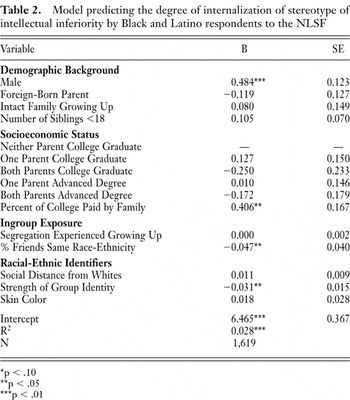
Table 2 presents estimates of an equation
predicting the degree to which Latinos and Blacks internalize negative
stereotypes about their group's intellectual abilities. These and
other equations were estimated using robust standard errors that adjusted
for the fact that our sample is clustered by university. We expect that
degree of internalization reflects a person's position and prior
experiences in American society. Although variation in our indicator
internalization is not very strongly related to the variables in the
equation (R2 = .027), we do find several significant
relationships. In general, males are more likely to internalize negative
stereotypes than females, and the tendency toward internalization rises as
economic status increases. Internalization appears to be lowered by having
more ingroup friends and by having a stronger ingroup identity. Those who
are most at risk of internalizing negative stereotypes appear to be Black
and Latino males who come from affluent families, who have made few Black
or Latino friends while growing up, and who have weak racial or ethnic
identities. A strong Black or Latino identity and rich ingroup experiences
thus seem to provide some immunity against negative societal
stereotypes.
Model predicting the degree of internalization of stereotype of
intellectual inferiority by Black and Latino respondents to the
NLSF
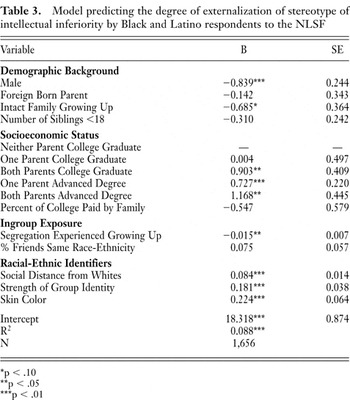
As the estimates of Table 3 indicate, the
externalization of negative stereotypes is more strongly predicted by
independent variables than in the internalization model (R2 =
.088). Among demographic factors, externalization is negatively predicted
by growing up in an intact family and is reduced by a rising number of
siblings under age eighteen and by being male. In terms of socioeconomic
status, the expectation of stereotyping rises with parental education.
Indeed, those Blacks and Latinos whose parents both have advanced
degrees are most likely to expect others to use stereotypes in making
evaluations about them.
Model predicting the degree of externalization of stereotype of
intellectual inferiority by Black and Latino respondents to the
NLSF
The expectation of stereotyping is also significantly increased by
growing up under segregated circumstances and by having a strong ingroup
identity. As the strength of a respondent's Black and Latino identity
increases and as perceived social distance from Whites rises, so does the
predilection to see stereotyping as prevalent in society. Moreover, the
darker the skin color the more likely respondents were to expect others to
use racial-ethnic stereotypes in evaluating them. Thus, having a strong
ingroup identity and coming from a segregated background appear
simultaneously to lower the internalization and increase the
externalization of stereotypes. The greater the adherence to a Black or
Latino identity the less students accepted negative societal views about
their intellectual abilities but the more they expected others to have and
use them in evaluating their performance.
DISIDENTIFICATION
We hypothesize that the internalization of negative stereotypes about
intellectual ability will put Black and Latino students at greater
academic risk compared with their White and Asian peers through a process
of disidentification, a psychological adjustment whose behavioral marker
is a reduction of academic effort (Oyserman et al.,
2003; Steele 1999). We thus expect to
find a negative relationship between internalization and the number of
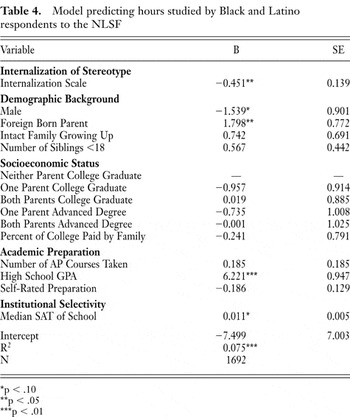
hours respondents report studying per week. In Table
4 we show the results of an OLS regression of hours studied on
internalization controlling for demographic background, socioeconomic
status, academic preparation, and institutional selectivity for Black and
Latino students.
Model predicting hours studied by Black and Latino respondents to the
NLSF
We find clear support for a process of disidentification—as
Black and Latino students come to internalize negative stereotypes about
themselves they systematically reduce their study effort, reducing their
weekly study time by one-half hour for each point increase in the
internalization score. Given that this index has an observed range of 0 to
14, moving from the lowest to highest level of internalization essentially
subtracts seven hours of weekly study time, eliminating the Black and
Latino advantage relative to Whites and turning them to deficits.
In other words, although the natural proclivity of Black and Latino
students is to study harder than Whites, other things equal,
internalization of the stereotype of intellectual inferiority counteracts
this proclivity and at the extremes can reduce study effort to a level
well below that of Whites. Other variables predicting hours studied
include gender (males study less), immigrant origins (those with an
immigrant parent study more), and prior academic achievement (those with
high GPAs in high school study more).
PERFORMANCE BURDEN
Our second hypothesis is that the externalization of
stereotypes—the belief that Whites and Asians hold negative views
about Black and Latino intellectual capacities and draw upon these
stereotypes in making evaluations—will contribute to a greater felt
performance burden among Black and Latino students. To test this idea we
regressed our indicator of externalization on the performance burden felt
by NLSF respondents, controlling for the various background
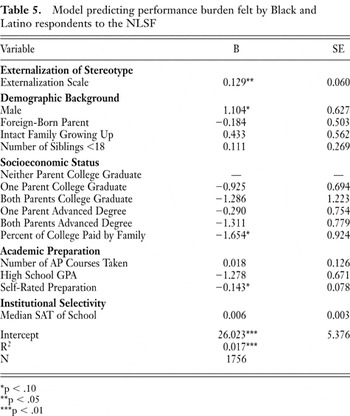
characteristics already specified. The OLS estimates shown in Table 5 offer modest support for this hypothesis. As
can be seen, a point increase in the degree of externalization is
associated with a .13-point increase in the perceived performance burden.
The scale range of 0 to 34 means that in moving from minimum to maximum
externalization, the performance burden increases by 4.4 points. Each
standard deviation is associated with about a half-point increase in
academic performance burden.
Model predicting performance burden felt by Black and Latino
respondents to the NLSF
The burden of performance is increased by being male and having a
foreign-born parent. Performance burden for Blacks and Latinos is
decreased by being better off financially (higher percentage of college
paid for personally), having higher levels of achievement in high school
(GPA), and perceiving oneself as being well prepared for college. It
should also be noted that of the models tested, this had the worse fit,
providing evidence that there is ample room to improve our understanding
of the roots of minority achievement.
STEREOTYPES AND ACADEMIC ACHIEVEMENT
The ultimate importance of the foregoing
processes—internalization, externalization, disidentification, and
the experience of a performance burden—is the degree to which they
translate into differential rates of academic success. A key indicator of
school success is grade point average. Maintaining an adequate grade point
is not only an intermediate step on the road to college graduation, it is
also important end in and of itself. GPA determines eligibility for
financial assistance and determines access to honors, awards, and
scholarships. Grades are also crucial in determining the likelihood of
getting into graduate and professional schools, and in shaping the quality
and prestige of any post-graduate program that is entered. In a more
abstract sense, they also indicate something about the thoroughness and
depth with which course materials were learned.
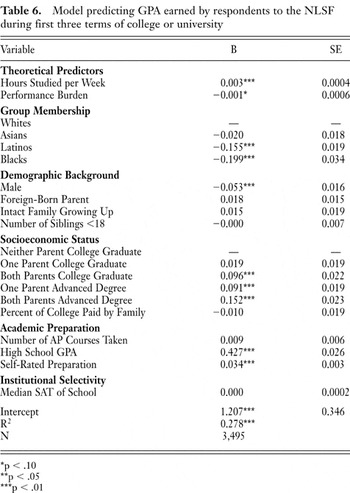
Table 6 contains OLS estimates of an
equation that regresses the GPA earned by students during their first
three terms at college on hours studied per week and performance burden,
controlling for background characteristics. We began our analysis by
testing for a possible interaction between the internalization and
externalization of stereotypes in the determination of grade point
average. Our thinking was that whereas it was detrimental to performance
to have internalized negative stereotypes and detrimental to have
externalized them, it was especially destructive simultaneously to have
doubts about one's group and to expect to be judged negatively by
others. However, we found no evidence of an interaction between the
internalization and externalization of stereotypes and therefore concluded
that the two effects operate independently in additive fashion.
Model predicting GPA earned by respondents to the NLSF during first
three terms of college or university
As can be seen in Table 6, hours studied per
week has a positive and highly significant effect on GPA: the more hours
studied the higher the grades earned. At the same time, the felt
performance burden is negatively related to academic performance: the more
one feels that one is representing the group when performing academically,
the lower the grades. The later effect, however is only marginally
significant (p < .10). We would not necessarily expect performance
burden to yield lower grades under all circumstances, however. In
particular, we would expect the implicit threat to be much greater when
Black and Latino students are called upon to perform before a White or
Asian professor than before a member of their own group.
In order to test this extension of the hypothesis of stereotype
threat, we computed the number of classes that each respondent reported
being taught by a White or Asian versus a Black or Latino professor. We
then determined the median number of minority versus majority faculty
members and divided the sample into two groups: those with an above
average number of Black and Latino faculty and those with a below average
number of minority faculty. We expect that the negative effect of
performance burden will be greater in the latter than the former case.
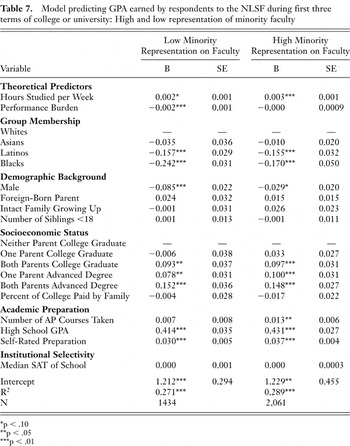
Table 7 presents two equations predicting
GPA, estimated separately for students whose classes were taught by
minority faculty members at a rate below the median and those whose
classes were taught by minority faculty at a rate above the median. For
the latter group, who perform before a relatively large number of Black
and Latino professors, there is no evidence of a performance burden
effect. Students may feel that they represent their race, but in the
presence of significant minority faculty, inhibition of performance is not
triggered. Moreover, the intergroup differentials, and particularly the
Black-White differential with respect to grade point, is significantly
moderated.
Model predicting GPA earned by respondents to the NLSF during first
three terms of college or university: High and low representation of
minority faculty
In contrast, in classroom contexts characterized by a notably low
minority presence, the performance burden is strong and highly
significant, with its coefficient essentially doubling in size compared to
the one estimated in Table 6. When performing
academically in classes characterized by a relative scarcity of minority
professors, the psychological burden of “representing the
race” apparently triggers inhibitions that reduce grade performance.
At the same time, the Black-White differential that remains after
controlling for variables in the model (−0.242) is much greater than
that estimated when minority faculty are present in relatively large
numbers (−.170), a difference that is statistically significant (p
< .05), which suggests that the mechanisms hypothesized under the
theory of stereotype threat are indeed at work in a broad population of
students attending a range of different selective institutions. Indeed,
the negative effect of African American origin on grade point estimated in
Table 7 is half that obtained in a zero-order
model containing only dichotomous indicators of group membership
(−.363—see Massey and Fischer,
2002).
CONCLUSION
In this article we have sought to bolster the external validity of
research on the hypothesis of stereotype threat by specifying a structural
model of the phenomenon and estimating it using data from a large
population of students attending twenty-eight different institutions of
higher education. We posited that the negative stereotype of Black and
Latino intellectual inferiority would manifest itself psychologically in
two ways. On the one hand, some minority students, by virtue of their
experiences in society, will have internalized negative stereotypes to
some extent and come to believe in the intellectual inferiority of Black
and Latino students. On the other hand, some minority students will have
externalized negative stereotypes, coming to believe that Whites and
Asians will necessarily draw on the stigma of intellectual inferiority in
evaluating Black and Latino students. The internalization of stereotypes
was hypothesized to lead to a disidentification with academic success and
a subsequent reduction of work effort that translates into lower grades.
The externalization of stereotypes was hypothesized to yield a performance
burden that also lowered grade achievement.
Statistical estimates of structural equations specified to represent
the foregoing model were generally consistent with the theory of
stereotype threat. In particular, our analyses yield the following
specific conclusions:
- There is variation in the degree to which Black and Latino students
subscribe to the stereotype of minority intellectual inferiority, and this
variation is related to students' social origins. Those most at risk
of internalizing negative stereotypes appear to be Black and Latino males
from affluent families who made few ingroup friends while growing up and
who had developed a weak racial/ethnic identity.
- There is variation in the degree to which Blacks and Latinos expect
others to draw on negative stereotypes in making evaluations. Those most
prone to externalize stereotypes are Black and Latino females from a
disrupted but well-educated family background who grew up under integrated
circumstances but with a strong ingroup identity and a high perceived
social distance from Whites. Dark-skinned minority respondents generally
expect more stereotyping than those with light complexions.
- The internalization of negative stereotypes has a very strong effect
in reducing weekly hours of study, suggesting a clear process of
disidentification.
- The externalization of negative stereotypes is generally associated
with a higher performance burden, though the relationship is not
strong.
- Together weekly hours of study and the performance burden felt by
respondents had strong and significant effects on grades earned during the
freshman and sophomore years, holding constant academic preparation,
demographic background, and socioeconomic status.
- The inhibiting effect of performance burden on grade point occurs
only in classrooms where minority professors are scarce or absent. In the
presence of minority faculty, the psychological performance burden
experienced by minority students does not translate into lower
performance, reinforcing the importance of increasing faculty diversity
(see Cole and Barber, 2003).
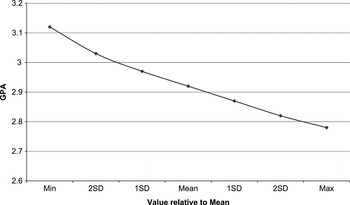
The potential for disidentification and performance burden to
influence minority performance is suggested by Figure
2, which shows the GPA predicted for Black students as hours of
study and performance burden move from their minima to maxima. Holding
other variables constant at the mean, we use the equation of Table 7 to generate predicted grade point averages for
different combinations of disidentification and performance burden. With
no disidentification and no performance burden, Blacks are predicted to
earn a grade point of 3.13. At two standard deviations below the mean for
both variables, the predicted GPA falls to around 3.03, and at one
standard deviation below the mean it reaches 2.98. As one moves from the
mean to one and then two standard deviations above mean levels of
disidentification and performance burden, the predicted grade point for
Blacks falls from 2.91 to 2.87 to 2.81. At maximum levels of
disidentification and performance burden, the predicted GPA is 2.78. In
other words, as Steele (1997, 1998) put it, influences seemingly as intangible as
“a threat in the air” can have significant effects on the
academic achievement of minority students.
Predicted grade point earned by Blacks at selected levels of
disidentification and performance burden.
APPENDIX A.
SOCIAL SCALES CONSTRUCTED FOR ANALYSIS OF STEREOTYPE
THREAT
ACTUAL QUESTIONS FROM NLSF INSTRUMENT