Introduction
Functional neurological disorder (FND) is a common and disabling condition at the intersection of neurology and psychiatry that until recently has been largely neglected by the clinical neuroscience community. Over the past two decades, significant advances have been made in understanding the pathophysiology of this condition, revealing evidence of neural mechanisms underlying the development of functional neurological symptoms.Reference Baizabal-Carvallo, Hallett and Jankovic 1 , Reference Begue, Adams, Stone and Perez 2 The growth in FND research has been catalyzed by an emphasis on diagnosing patients based on physical examination signs and semiological features.Reference Espay, Aybek and Carson 3 The start of a new international professional society, the Functional Neurological Disorder Society (www.fndsociety.org), and a published authoritative textbook have further established this as a valid field.Reference Hallett, Stone and Carson 4 In addition, there is an increasing appreciation of the value of a transdiagnostic approach to conceptualize FND across its various subtypes (eg, functional movement disorder vs functional [psychogenic nonepileptic] seizures), given that many individuals present with mixed symptoms at onset or develop distinct symptoms over the course of their illness.Reference McKenzie, Oto, Graham and Duncan 5 Obtaining a better understanding of the pathophysiology generating symptoms is particularly valuable when discussing the diagnosis with patients. Academic research interest in comprehensively characterizing FND is growing rapidly, yet researchers are currently faced with a lack of funding opportunities across government-sponsored agencies and foundations. Bridging this gap is essential to understand the neurobiology of this disorder, aid the development of biologically informed treatments,Reference Espay, Ries and Maloney 6 and address the growing public health need. As such, this perspective article defines a framework for understanding candidate constructs and neural circuits underlying the pathophysiology of FND. We also propose a research agenda highlighting areas of inquiry likely to yield high impact advances.
Constructs and Neural Circuits
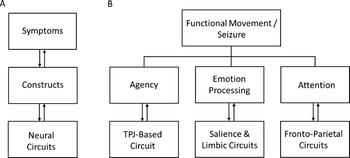
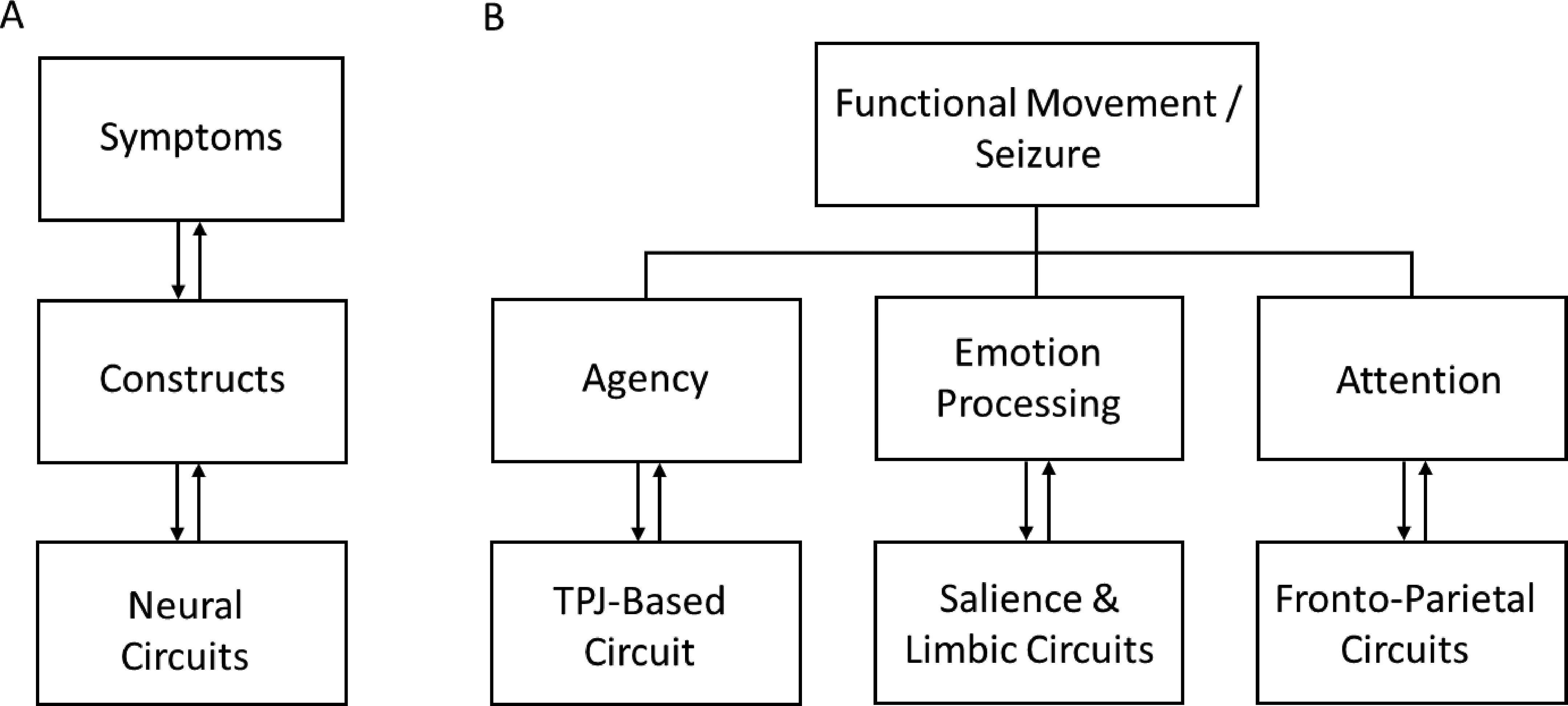
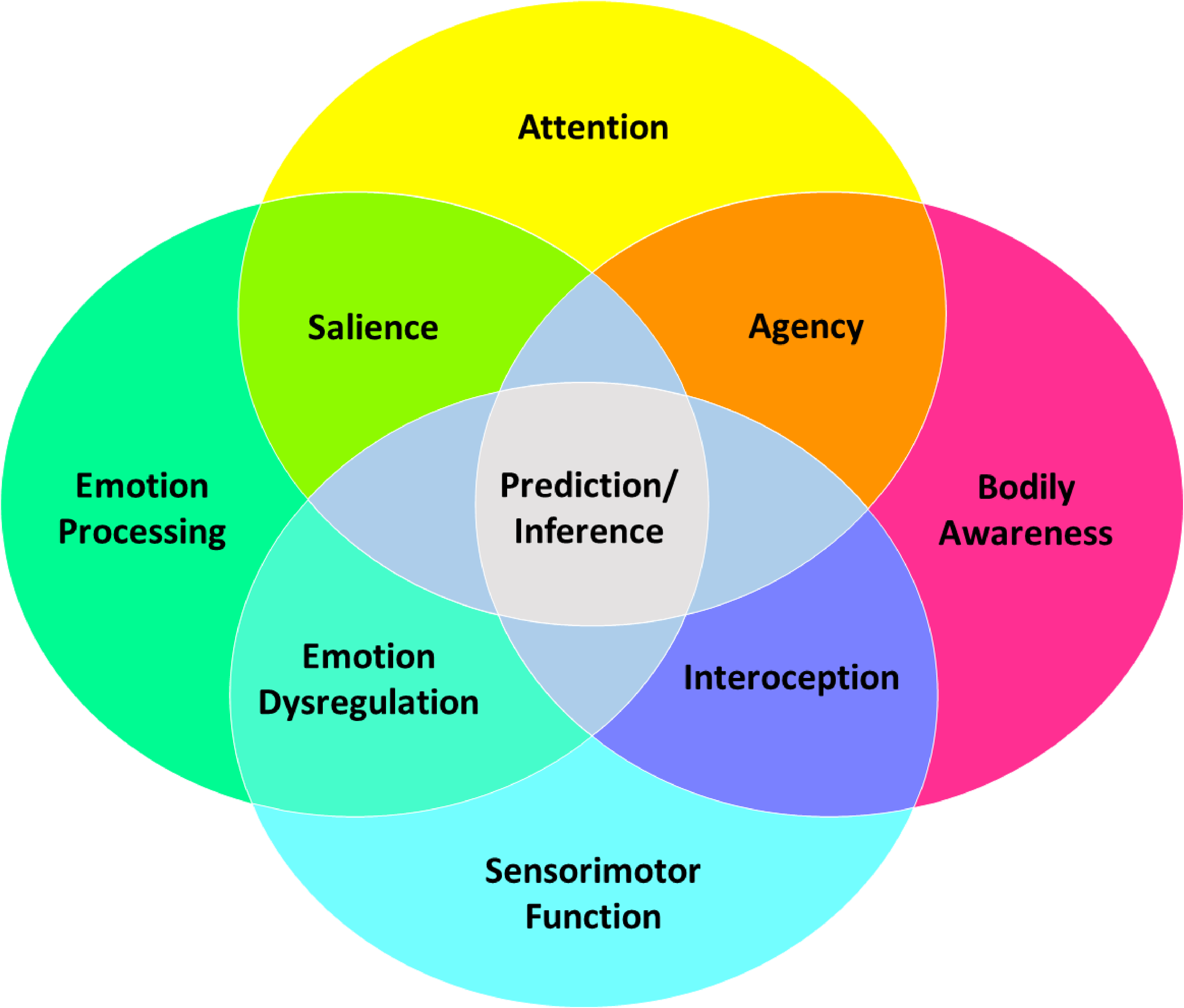
The brain operates in neural circuits, and symptoms in different disorders can be understood as mapping onto alterations within and across these circuits (Figure 1A). The different symptoms of FND arise from one or a combination of specific abnormal constructs. For example, paroxysmal functional movements are perceived as involuntary by patients due to abnormalities in the construct of agency (Figure 1B). Other constructs in FND include impairments in emotion processing, attention, interoception, predictive processing/inference, and their interactions. The implicated neural circuits can be explored using in vivo techniques including connectivity-based neuroimaging metrics, functional magnetic resonance imaging (fMRI), diffusion tensor imaging (DTI), nuclear imaging, electroencephalography (EEG), and transcranial magnetic stimulation (TMS). Abnormal constructs can be mapped onto specific brain circuits. A diminished sense of agency, for example, is mediated by dysfunction involving a multimodal integration network, including the right temporoparietal junction (TPJ).Reference Zito, Wiest and Aybek 7 Informed by phenomenological, neurobiological, and treatment research in FND to date, this article focuses on several candidate constructs and their neural circuits. Abnormalities of these brain circuits (and constructs) interact in different ways to produce the signs and symptoms of FND (Figure 2).
(A) Illustration of the relationship between symptoms, constructs and neural circuits underlying functional neurological disorder (FND). Symptoms can be understood as mapping onto alterations of different constructs, which are generated by neural circuit abnormalities. (B) Examples of how different symptoms or observable manifestations of FND can be understood as arising from one or a combination of specific abnormal constructs. For example, paroxysmal movements can be perceived as involuntary by an individual with FND due to a dysfunction of the construct of agency, which is driven by abnormalities of a TPJ-based circuit. Abbreviation: TPJ, temporo-parietal junction.
Abnormalities of several constructs (and their associated neural circuits) can interact in different ways to produce symptoms and observable signs of functional neurological disorder.
Emotion Processing
Emotion processing deficits are core features in some patients with FND. Evidence supports increased emotional reactivity, heightened arousal and avoidance, impaired top-down emotion regulation, amplification of functional neurological symptoms during negatively valenced or psychologically-threatening mood states (eg, panic, shame), deficits in emotional awareness (eg, physiological arousal in the absence of emotional arousal, alexithymia), aberrant salience processing, and errant activation of learned/innate defensive responses.Reference Pick, Goldstein, Perez and Nicholson 8 At the circuit-level, many of these interrelated emotion processing functions map onto salience and other limbic/paralimbic (eg, ventromedial and orbitofrontal prefrontal cortex, parahippocampus, hippocampus) circuits. The salience circuit, used as the primary example here, includes the dorsal anterior cingulate cortex, anterior insula, dorsal amygdala, periaqueductal gray (PAG), and hypothalamus, and is implicated in detecting and responding to homeostatic demands.Reference Seeley 9 Heightened emotional reactivity, arousal, and defensive responses occur from increased bottom-up amygdala and PAG activations. For example, studies have found reduced amygdala habituation and increased sensitization during negative emotion processing in patients with FND.Reference Voon, Brezing and Gallea 10 , Reference Aybek, Nicholson and Zelaya 11 Conversely, insufficient prefrontal control (regulation) of amygdala and PAG activations also promotes heightened emotional responses. This under-regulation of emotional response is relevant to deficits in fear extinction, while over-regulation is linked to dissociative responses.Reference Lanius, Vermetten and Loewenstein 12
Task and resting-state neuroimaging studies in FND show increased functional connectivity between salience/limbic/paralimbic and motor control circuits (eg, precentral gyrus, supplementary motor area).Reference Baizabal-Carvallo, Hallett and Jankovic 1 , Reference Aybek, Nicholson and Zelaya 11 Connectivity strength between cingulo-insular and motor control areas correlates with patient-reported symptom severity,Reference Diez, Ortiz-Terán and Williams 13 , Reference Li, Li, An, Gong, Zhou and Chen 14 and modulation of anterior cingulate activity has been linked to favorable cognitive behavioral psychotherapy response in FND.Reference Espay, Ries and Maloney 6 Increased limbic-motor circuit connectivity is theorized to represent heightened limbic influence over motor behavior in patients with FND.Reference Voon, Brezing and Gallea 10 This is seen clinically when FND patients report that negative affective states worsen their motor symptoms. Deficits in putting emotions into words (alexithymia)Reference Demartini, Petrochilos, Ricciardi, Price, Edwards and Joyce 15 and the experience of autonomic arousal in the absence of perceived negative affect have also been described in FND.Reference Indranada, Mullen, Duncan, Berlowitz and Kanaan 16 This is notable given that the cognitive-affective neuroscience literature implicates the anterior insula (and its related connectivity) to emotional and self-awareness.Reference Craig 17 Regarding the PAG, increased activation to negatively-valenced stimuli and heightened laterobasal amygdala-PAG functional connectivity have been described in FND cohorts,Reference Diez, Ortiz-Terán and Williams 13 , Reference Aybek, Nicholson, O’Daly, Zelaya, Kanaan and David 18 implicating abnormalities of defensive behaviors (eg, tonic immobility) in functional neurological symptom expression. Conceptually, it is important to highlight that the salience network overlaps with the central pain matrixReference Denk, McMahon and Tracey 19 and the multimodal integration network,Reference Sepulcre, Sabuncu, Yeo, Liu and Johnson 20 underscoring the importance of these overlapping circuits not only in emotion processing but also in other interrelated constructs.
Agency
Self-agency reflects a person’s belief that he or she is the agent of the action or thought—this is the sense of volition or free will that characterizes voluntary movement.Reference Hallett 21 Two events must occur to produce self-agency: (1) the person must have the sense of willing the movement and (2) the movement (congruent with what has been willed) has to happen. Movements deemed as voluntary are produced by the primary motor cortex that is activated by a network of structures, most proximally the premotor and supplementary motor cortices. When a movement is generated, the rest of the brain is notified by a feedforward signal. When movements happen, there is feedback through various sensory experiences about the movement. If the feedback matches the feedforward, then there is a sense of causality and self-agency. The networks involved in this process include cortico-cortical pathways from motor structures and sensory pathways to multimodal sensory areas where perceptions are generated. A primary site of matching of feedforward and feedback is the right TPJ. When there is a mismatch between willing and movement, the TPJ becomes activated. In studies of agency, the TPJ is one node of the multimodal integration brain network.Reference Sepulcre, Sabuncu, Yeo, Liu and Johnson 20
Patients with FND have movements that lack self-agency and are experienced as involuntary. There are many examples in neurology of involuntary movements that are produced by pathological processes, such as tremor in Parkinson’s disease. In hyperkinetic functional movement disorders such as tremor, and likely major motor functional seizures, the brain areas generating movements are the same as with voluntary movement, and typically operate normally.Reference Hallett 22 Patients with these disorders generally do not have an intrinsic sensory deficit that would make feedback incorrect. Yet, the movements are perceived to be involuntary. A number of studies have shown right TPJ dysfunction in patients with hyperkinetic movement disorders, as was first demonstrated in functional tremor.Reference Voon, Gallea, Hattori, Bruno, Ekanayake and Hallett 23 , Reference Maurer, LaFaver and Ameli 24 Hence, the agency network is not working properly in at least some patients with FND.
While more work is needed to clarify this process, there are at least two possibilities: either the TPJ agency circuit is impaired or the feedforward signal is abnormal due to abnormal influences on the motor apparatus. Moreover, it will be important to understand relationships across networks (eg, TPJ and insula interactions)Reference Diez, Ortiz-Terán and Williams 13 , Reference Maurer, LaFaver and Ameli 24.
Attention
Impairments in attention have been characterized in FND.Reference Baizabal-Carvallo, Hallett and Jankovic 1 These disruptions manifest as attentional perseveration—that is, a tendency to focus on a particular physiological system to the neglect of other systems and an impaired ability to adaptively, volitionally shift attention. Attending to unaffected body parts is effortful and difficult in FND; this attentional rigidity is analogous to hemineglect syndromes.Reference Perez, Barsky, Daffner and Silbersweig 25 Attentional abnormalities have been well characterized using neuropsychological testing, with disruptions in sustained and selective attention observed in some individuals with FND. 26–29 Further, there is preferential allocation of attentional resources to threat-relevant stimuli (angry faces) in FND populations, particularly those with functional seizures. 30–33
Inefficient or impaired attentional shifting, as well as involuntary attentional biases in FND, emerge from abnormal connections in both goal-directed and stimulus-driven neural networks. Certain FND symptoms emerge from an explicit and excessive focus on physiological states, whereas in others, the process is more implicit and involuntary. Decreased fronto-parietal network responses have been observed in FND patients.Reference Spence, Crimlisk, Cope, Ron and Grasby 34 , Reference Morris and Baek 35 However, meta-analytic evidence indicates overall greater activation in fronto-parietal networks, as well as in limbic regions such as the amygdala, in FND patients vs controls.Reference Boeckle, Liegl and Jank 36 This underscores the complex relationships between emotion processing and attention regulation in FND. Further, the network effects of psychiatric and neurologic comorbidities, as well as medication side effects impeding attentional mechanisms in this patient population (eg, psychotropics, opioids, and analgesics) must also be considered. In sum, attentional control deficits are found in FND, but there are likely multiple ways that these deficits are represented in neural circuits. More research exploring relationships between FND symptoms and attentional processes in both neutral and affectively-valenced, implicit and explicit contexts, is needed to identify common and distinct features of attentional disruptions in patients with FND.
Interoception
Interoception refers to the process by which the nervous system senses, interprets, and integrates internal bodily signals, providing a moment-by-moment mapping of the body’s internal landscape across conscious and unconscious levels.Reference Khalsa, Adolphs and Cameron 37 It is important for monitoring the internal state of the body, predicting future bodily states, and informing self-regulatory actions. Abnormal interoceptive awareness has been identified in FND via reduced perceptual accuracy for the resting heartbeat.Reference Ricciardi, Demartini, Crucianelli, Krahé, Edwards and Fotopoulou 38 , Reference Koreki, Garfkinel and Mula 39 However, some individuals with FND actually show intact perceptual discrimination during homeostatic perturbation of interoceptive states, and instead exhibit a dissociation characterized by heightened symptom intensity during the peri-stimulation time periods.Reference Bogaerts, Van Eylen and Li 40 This suggests that (1) aspects of FND symptoms might be explained by disrupted internal models of the body, (2) the ability to modulate physiological states and contextual cues is important to gaining insight into this processReference Ricciardi, Demartini, Crucianelli, Krahé, Edwards and Fotopoulou 38, and (3) our knowledge of interoceptive awareness deficits in FND is incomplete.Reference Bogaerts, Van Eylen and Li 40 , Reference Jungilligens, Wellmer, Schlegel, Kessler, Axmacher and Popkirov 41
Mechanistically, interoception is conceptualized as a bidirectional process between the brain and body, with feedback and feedforward loops leading to an internal representation of the body. Interoceptive abnormalities can contribute to the generation of the FND “symptom scaffold.”Reference Brown and Reuber 42 For example, abnormal interoceptively-focused attention in FND may preferentially influence the weighting of top-down or bottom-up information streams in the central nervous system,Reference Edwards, Adams, Brown, Pareés and Friston 43 leading to abnormally enhanced or diminished sensory perceptions (eg, attenuated visual, auditory, or skin sensitivity) or movements (tremor, dystonia, weakness, and seizures). Neural circuits of interoception include those mapping autonomic, chemosensory, endocrine, and immune systems. They include afferent signals from the lamina I spinothalamic system, and the vagus and glossopharyngeal cranial nerves through the brainstem (eg, nucleus tractus solitarius), that synapse onto the thalamus and subsequent cortical areas, including the posterior insula and somatosensory cortices. The neural circuitry contributing to the amplification of bodily signals in FND cuts across frontolimbic, subcortical, and brainstem structures.Reference Perez, Barsky, Vago, Baslet and Silbersweig 44
Perceptual Inference and Predictive Processing
While distinct from interoception, inference is an important overlapping construct that refers to the process by which a person generates beliefs (or explanations) about the causes and effects of events occurring within and outside the body.Reference Teufel and Fletcher 45 Perceptual inferences are strongly influenced by expectations (including suggestibility), either explicit or implicit, and can rapidly change depending on the environmental context. FND is a condition that can be characterized by the development of erroneous perceptual inference—about sensorimotor and emotionally valenced phenomena (Figure 2). Because they reflect beliefs, it is natural that these inferences are experienced as “real” by the patient.
Computational neuroscience has provided mechanistic insights into the underpinnings of causal inference in the nervous system. Unlike the classical hierarchical feedforward model of perception that involves a mostly linear filtering and translation of sensory signals to arrive at higher-order perception, a new argument has emerged that explains perception as arising from predictive processing.Reference Keller and Mrsic-Flogel 46 In this scenario, neurons transmitting predictions about sensory states communicate with neurons detecting deviations from those predictions (so-called “prediction errors”) to develop an explanation for the perceptual information received (called a “generative model”).Reference Walsh, McGovern, Clark and O’Connell 47 Over time, when the observed information deviates from what is predicted, the generative model is updated through learning. In addition, the metacognitive evaluation of perceptual content plays a role in generating awareness states,Reference Fleming 48 and it is conceivable that abnormalities in the neural circuitry underlying metacognition underpin aspects of the FND symptom scaffold.Reference Bègue, Blakemore and Klug 49
The predictive coding framework is one computational approach to predictive processing which uses the application of Bayesian mathematical principles to develop models of causal inference. Using computational modeling of behavior on a timed-decision task,Reference Sadnicka, Daum and Meppelink 50 individuals with motor FND showed deficits in decision-making and sensory processing. From a predictive coding perspective, the authors interpreted this as evidence that predictions were overemphasized in FND relative to the sensory information. Since prior experiences influence predictions, it was argued essentially that the FND patients’ prior history dominated their ongoing perceptions. Thus, someone who always expects the weather to be cold—and leaves home wearing a winter jacket on a sunny day in the middle of summer could represent a similar example. Applying predictive processing and other computational methods to sensory and motor domains (eg, with a focus on the role of agency and/or emotional awareness in predictive coding errors), will inform the pathophysiology of FND.
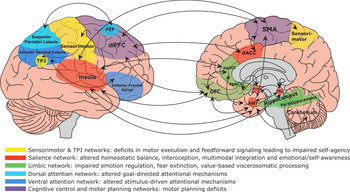
See Figure 3 for a display of brain circuits and constructs described above that are important in the pathophysiology of FND.
Display of brain circuits (and related constructs) that are emerging as important in the pathophysiology of functional neurological disorder (FND). As depicted, FND is a multi-network disorder involving abnormalities within and across brain circuits implicated in self-agency, emotion processing, attention, homeostatic balance, interoception, multimodal integration, and cognitive/motor control among other functions. Circuits are described by their related dysfunction in the pathophysiology of FND. It should also be noted that several areas cut across multiple networks; for example, the dorsal anterior insula is most strongly interconnected with the dorsal anterior cingulate cortex (dACC), while the posterior insula receives afferent projections from the lamina I spinothalamocortical pathway and somatosensory cortices. Similarly, the amygdala is part of both the salience and limbic networks. Prefrontal brain regions are interconnected with striatal-thalamic areas (not shown), and these pathways should also be factored into the neural circuitry of FND. Abbreviations: AMY, amygdala; dlPFC, dorsolateral prefrontal cortex; FEF, frontal eye fields; HYP, hypothalamus; OFC, orbitofrontal cortex; PAG, periaqueductal gray; pgACC, perigenual anterior cingulate cortex; sgACC, subgenual anterior cingulate cortex; SMA, supplementary motor area; TPJ, temporoparietal junction.

Bridging Pathophysiology and Etiology in FND
The pathophysiology of FND unfolds within the context of developmental trajectories, life experiences, sex differences, social-cultural norms, and many other factors within a biopsychosocial model. While it is useful to consider mechanisms (how) and etiology (why) separately, from a research perspective it is also important to bridge the two, as these processes are interrelated. In this section, we contextualize pathophysiological mechanisms within the framework of predisposing vulnerabilities, acute precipitants, and perpetuating factors.
Through the lens of inference models, socio-emotional-perceptual processes that are compromised in FND are shaped by prior experiences at the neural circuit level. These processes are refined through interactions between epigenetic substrates, the psychophysiological matrix, and the environment. In other words, daily life experiences are not just encoded as external events, but also require internal integration that shapes the brain’s predictions through neuroplastic mechanisms. To illustrate, beginning in infancy, a consistent experience of caregiver affectionate touch has the potential to shape development of interoceptive perceptions and the sense of (physical) self, and can facilitate sensorimotor integration as well.Reference Burleson and Quigley 51 In this way, attachment is not just a theoretical construct; it reflects the “real” (embodied) way that caregivers create a socioemotional context in which appropriate recognition and delineation of physical neural signals can develop. Throughout the lifespan, expectations about the body and its signals, which are also shaped by sociocultural beliefs and context (eg, religion, economic circumstances, language, and gender norms), further refine sensorimotor perceptions. In less favorable circumstances, these factors, coupled with genetic vulnerabilities and environmental demands, lead to compromised integration, resulting in FND symptoms.
Adverse early life events are one example (see Reference Reference Ludwig, Pasman and Nicholson52 for a systematic review and meta-analysis).Reference Ludwig, Pasman and Nicholson 52 It is well-established that trauma impacts the developing brain, with evidence that childhood maltreatment affects salience, emotion processing, and sensorimotor circuitsReference Teicher, Samson, Anderson and Ohashi 53; this, in turn, explains their role in predisposing the central nervous system to the development of FND symptoms. Furthermore, childhood trauma in the context of a specific genetic profile can lead to epigenetic changes and delayed-onset symptoms.Reference Spagnolo, Norato and Maurer 54 In patients with FND, the magnitude of experienced childhood abuse correlates with symptom severity,Reference Roelofs, Keijsers, Hoogduin, Näring and Moene 55 insecure attachment,Reference Williams, Ospina, Jalilianhasanpour, Fricchione and Perez 56 poor prognosis,Reference Hailes, Yu, Danese and Fazel 57 limbic-motor circuit connectivity,Reference Diez, Larson and Nakhate 58 and neuro-endocrine abnormalities.Reference Bakvis, Roelofs, Kuyk, Edelbroek, Swinkels and Spinhoven 30 It is important, however, to consider pathophysiological similarities and differences between FND patients with and without prominent adverse early-life experiences, as it is unclear if disease mechanisms are uniform across populations.
In FND, it is not only the occurrence of stressful events and elevation of biological stress markers, but also the addition of (1) greater perceived stress and/or (2) lack of awareness of this stress (ie, a mismatch in perception/interpretation/felt experience) that appears to contribute to and result from the underlying pathophysiology. Studying these processes teaches us more about how and why FND develops, while revealing in a fundamental way how these processes work, and where targeted treatments may be possible.
Limitations of Pathophysiology Research to Date
While a detailed description of pathophysiology-related research limitations in FND is beyond the scope of this article, several concerns are important to highlight. Across neurobiological research in FND, sample sizes have been modest (no studies with N > 100) limiting statistical power to adjust for variables that may also influence brain circuit profiles such as psychiatric comorbidities, chronic pain disorders, medication effects, and illness (and developmental) trajectories. For example, only a subset of studies controlled for antidepressant use, which is notable given that amygdala activity is modulated by serotonergic medicationsReference Godlewska, Norbury, Selvaraj, Cowen and Harmer 59; this may help explain inconsistent limbic profiles across studies.Reference Voon, Brezing and Gallea 10 , Reference Allendorfer, Nenert and Hernando 60 In addition to healthy subjects, the use of neurologic and psychiatric control groups to understand the specificity of disease findings has also been exceedingly limited.Reference Diez, Larson and Nakhate 58 Studies examining psychiatric comorbidities and etiologies, such as depression, anxiety, and trauma-related disorders, do find that these account for many of the nonspecific findings, such as poor emotion regulation in those with functional seizures; however, the processes highlighted here, such as sense of agency, interoceptive awareness, attention to somatic symptoms, and their intersection, are points of differentiation in FND, even accounting for medication use and comorbidities. In addition, few studies have included multimodal neuroimaging techniques, or combined neuroimaging data with autonomic, neuroendocrine or genetic/epigenetic information.Reference Spagnolo, Norato and Maurer 54 , Reference Allendorfer, Nenert and Hernando 60 The potential role of sex differences in a condition that has a well-established tendency to be more common in women has also been minimally investigated.Reference Perez, Matin and Barsky 61 Finally, longitudinal data, including but not limited to post vs pre-treatment, have only been collected in small pilot studies—suggesting that more work is needed to understand the relationship between disease pathophysiology and prognostic neural mechanisms.Reference Espay, Ries and Maloney 6
Pathophysiology-Focused Research Agenda
Key functional neurological symptoms have been characterized and much knowledge has been gained about their underlying pathophysiology, but the detailed biochemistry, structural/functional anatomy, and electrophysiological connectivity of these neural circuits and their interactions remain incompletely understood. Moreover, while a number of common FND symptoms and features are well recognized (eg, paroxysmal functional movement disorder, emotional dysregulation, alexithymia), gaps exist in our ability to reliably measure symptom presence and severity in order to optimally characterize their nature, extent, and resolution in a systematic manner. Some of the socio-emotional, cognitive, and awareness-based deficits and risk factors observed in FND are also common in other neuropsychiatric conditions (eg, epilepsy, post-traumatic stress disorder, dissociative disorders, schizophrenia); a mechanistic investigation of these symptoms will benefit from the synergy of methods and concepts available across distinct patient populations while simultaneously leading to gains in all areas (eg, studying socio-emotional processing in a patient undergoing stereoEEG for localization of seizures provides us with simultaneous in vivo neural information during task performance). In addition to understanding the pathophysiology underlying FND symptoms, rigorous studies are needed to comprehensively determine predisposing, precipitating, and perpetuating variables that contribute to their development and maintenance, and to characterize the nature of intervening variables that may serve to strengthen resilience (ie, Why do some trauma-exposed individuals develop FND symptoms and others do not?). Behavioral, autonomic, neuroendocrine, epigenetic, genetic, and social-environmental factors and developmental trajectories likely hold answers.Reference Allendorfer, Nenert and Hernando 60 , Reference Kozlowska, Griffiths, Foster, Linton, Williams and Korgaonkar 62
It is expected that additional research will allow us to understand and manage psychosocial/cultural/spiritual/environmental variables that influence FND symptom development and maintenance, and to identify and/or develop diagnostic and prognostic biomarkers and biologically-informed therapeutics, including rehabilitative, psychopharmacologic, and neuromodulatory strategies. As such, five core broadly defined research agendas at the pathophysiology level that would move the field forward should be considered. Below each research agenda is an illustrative example.
-
1. Identify how functional neurological symptoms, cognitive-affective-bodily-sensorimotor processing constructs, and brain circuits relate to one another, including but not limited to how interactions across circuits relate to symptoms and constructs.
For example, Do disturbances in self-agency map onto the right TPJ-related network across the hyperkinetic and hypokinetic motor spectrum of FND (including functional seizures)?
-
2. Characterize relationships between pathophysiology (how), etiological factors (why), and/or treatment responses (eg, physical therapy, psychotherapy, etc.) across constructs and brain circuits in FND.
For example, Do patients with and without prominent childhood maltreatment have the same neural mechanisms for their functional neurological symptoms, and if differences are present, do they have prognostic (and treatment response) implications?
-
3. Identify variables that bridge relationships between symptoms and circuits, including characterization of neuroendocrine, autonomic, cellular/molecular, and genetic/epigenetic factors.
For example, Do stress hormones (eg, salivary cortisol, amylase), sex hormones, and autonomic profiles (eg, heart rate variability) provide additional differentiating clinical-pathologic insights, and if so, might composite biomarkers of FND be important?
-
4. Describe the common (transdiagnostic) mechanistic pathways across FND, as well as subtype-specific disruptions; this includes the investigation of individual differences, sex differences, and potential biologically informed subtypes.
For example, Do men and women with similar functional neurological symptoms recruit the same neural circuits for symptom generation and maintenance?
-
5. Identify the specificity of constructs and brain circuits implicated in FND, by incorporating not only healthy subjects, but also neurologic, psychiatric, and medical control groups (eg, major depression, PTSD, functional somatic disorders).
For example, Are sensorimotor and agency network interactions with limbic and salience brain circuits distinguishing characteristics of FND when compared to other psychiatric and neurological conditions comorbid in FND.
Overall, while there are other fruitful research directions not addressed by this article, we have detailed important constructs and circuits implicated in the pathophysiology of FND that would benefit from additional rigorous research inquiry to move the field forward.
Acknowledgments
The authors thank Mark and Barbara Klein for their support.
Funding
Daniel L. Drane is funded by the National Institute of Neurological Disorders and Stroke (NINDS) grant R01NS088748. Mark Hallett is supported by the NINDS intramural program. Sahib S. Khalsa is supported by National Institute of Mental Health (NIMH) grant K23MH112949, National Institute of General Medical Sciences (NIGMS) Center grant 1P20GM121312, and The William K. Warren Foundation. David L. Perez is funded by the NIMH grant K23MH111983, the Massachusetts General Hospital Physician-Scientist Development Award, and the Sidney R. Baer Jr. Foundation. Nicole A. Roberts received support from the Arizona Institute for Mental Health Research and the Arizona State University Institute for Social Science Research.
The content is solely the responsibility of the authors and does not necessarily represent the official views of the National Institutes of Health.
Disclosures
David L. Perez has received honoraria for continuing medical education lectures in functional neurological disorder from Harvard Medical School, American Academy of Neurology, Movement Disorder Society, Toronto Western Hospital and Newton Wellesley Hospital. Daniel Drane, Negar Fani, Mark Hallett, Sahib Khalsa, and Nicole A. Roberts do not report any disclosures or competing interests.