Two main factors affect epiphyte diversity: abiotic elements such as light and moisture and biotic interactions such as characteristics of the host tree. The effects of microclimate on epiphyte diversity have been well studied. Small-scale variation in light and moisture can influence the abundance and richness of epiphyte species (Benzing Reference BENZING, Lowman and Rinker2004, Zotz & Hietz Reference ZOTZ and HIETZ2001).
Host-tree characteristics can strongly influence epiphyte diversity. While exclusive host specificity is rare, some host trees are better habitat for epiphytes than others (Laube & Zotz Reference LAUBE and ZOTZ2006, Silva et al. Reference SILVA, FERREIRA, LIMA and SOARES2010, Zimmerman & Olmsted Reference ZIMMERMAN and OLMSTED1992). Bark roughness, size and age can all affect epiphyte richness and cover (Hietz Reference HIETZ1999, Kellar et al. Reference KELLAR, SHORT and MILNE2006, Wyse & Burns Reference WYSE and BURNS2011).
Disentangling the effects on epiphytes of host substrate and light climate is difficult. It has been assumed that, in the same forest patch, light conditions are the same (Callaway et al. Reference CALLAWAY, REINHART, MOORE, MOORE and PENNINGS2002, Wyse & Burns Reference WYSE and BURNS2011). However, local variation in canopy cover causes understorey microclimate to vary (Canham et al. Reference CANHAM, DENSLOW, PLATT, RUNKLE, SPIES and WHITE1990, Fetcher et al. Reference FETCHER, OBERBAUER and STRAIN1985). Tropical cloud forests tend to have frequent canopy gaps (Arriaga Reference ARRIAGA1988, Williams-Linera Reference WILLIAMS-LINERA2002), making them highly likely to have variable understorey microclimates.
We test the hypothesis that the lower trunks of palms, tree ferns and dicot understorey trees differ in their epiphyte composition, richness and cover of vascular and non-vascular epiphytes, independent of total transmitted light.
Data were collected at the Fortuna Forest Reserve (8°45΄3΄΄N, 82°14΄22΄΄W; 1100 m asl), Chiriqui Province, Western Panama, in February–March 2014. The forest is lower montane tropical forest with an uneven canopy approximately 25 m tall, with large light gaps caused by tree falls. The region receives approximately 3300 mm y−1 of rainfall (Cavelier et al. Reference CAVELIER, SOLIS and JARAMILLO1996).
The epiphyte assemblage on tree ferns (Cyathea sp. and Alsophila sp.), palm trees (Chamaedorea sp., all individuals having shedding leaves) and understorey dicots of 5–10 cm dbh (measured at 130 cm height above ground) were compared. The understorey dicot class constituted several species, however, individuals with a uniformly coarse and non-flaking bark were selected. Twenty individuals from each group were selected at random from a forest patch approximately 5 ha in size. On each host tree, epiphyte cover on the lower 2 m of the trunk was estimated for total cover, filmy ferns, other ferns, other vascular species, mosses and liverworts. Vascular species were sorted to morphospecies and identified to genus or species level where possible. Twenty moss species and 17 liverwort species, all easily identifiable, were selected to be recorded as present or absent on each host tree.
Total transmitted light was measured at each host tree using hemispherical canopy photography. Light is a good measure of exposure to wind, and can be used as a proxy for moisture within a particular site (Catchpole Reference CATCHPOLE2004). A Cannon 5D mark III digital camera with a Rokinon 8 mm f/3.5 HD fisheye lens was used to take photos of the sky at four points on the host tree: at 0.5 m and 1.5 m on both the north and south sides. Photos were analysed using Gap Light Analyser Software Package (Institute for Ecosystem Studies, Burnaby, Canada) which calculates the percentage of total transmitted light for each image over an entire year. In this section of forest the canopy tree Oreomunnea mexicana (Standl.) J.-F. Leroy (Juglandaceae) accounted for more than half the trees >10 cm stem diameter. This species is known to be dry-season deciduous in lower montane forests in Mexico, where the average rainfall is 1500 mm y−1 and there is a strong dry season (Williams-Linera Reference WILLIAMS-LINERA1997). On the Caribbean slopes where the study site is located forests are green all year round as the rainfall is twice the amount and less seasonal (Condit et al. Reference CONDIT, PÉREZ and DAGUERRE2011). Dry-season deciduous trees tend to remain evergreen when growing in wetter sites (Reich & Borchert Reference REICH and BORCHERT1984)
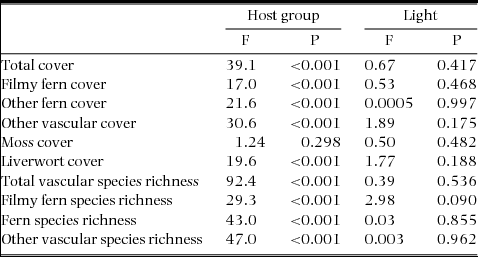
Ten cover and species richness variables based on epiphyte life-form were created for analysis (Table 1). Each variable was compared between the three hosts using Analysis of Covariance (ANCOVA) tests, with total transmitted light included as a covariate. Tukey's test was used to find differences between individual means. A one-way analysis of variance (ANOVA) was used to test the difference of total transmitted light between the tree host groups. Permutational analysis of variance (PERMANOVA; Anderson Reference ANDERSON2001) was used to test the difference in species composition of both vascular and non-vascular epiphytes between the three host trees. Univariate analysis were conducted using Minitab 16.1.0 0 (MINITAB, State College, PA, USA) and multivariate analyses used Primer v.6 (Primer-E Ltd, Plymouth, UK).
The F and P values for the ANCOVAs used to test for differences in the epiphyte cover and species richness variables among the three host groups (df = 2,56): dicots, palm and tree fern and for the covariate total transmitted light (df = 1,56) in lower montane cloud forest in Chiriqui Province, Western Panama.

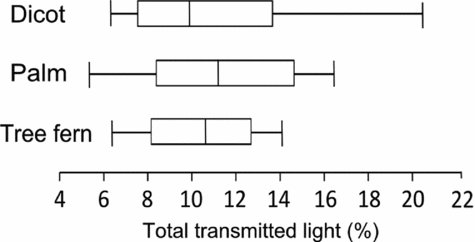
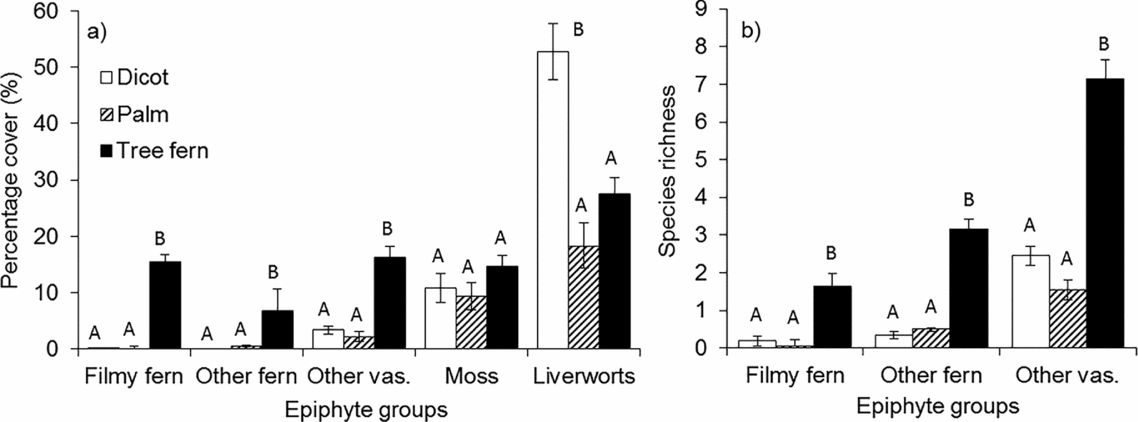
No difference was found between total transmitted light for the three host groups (F(2,57) = 0.45, P = 0.641), however the values for individual hosts were variable (Figure 1). A total of 102 morphospecies of vascular epiphyte were observed. Epiphyte composition differed between the three host groups (Pseudo-F = 4.69; P < 0.001), with tree ferns having the most distinct epiphyte species composition, a composition most different to that of palms. All epiphyte groups except for mosses differed in cover and/or species richness between the host groups (Table 1, Figure 2). The palms had a lower total cover of epiphytes than the other two host groups. The tree ferns had a higher percentage cover of filmy ferns, other ferns and vascular epiphytes than the other two host trees. The angiosperm host trees had a higher cover of liverworts than any of the other hosts. Total vascular species richness was higher on the tree ferns than the other two host groups, as was the species richness of filmy ferns, other ferns and dicots. Total transmitted light was not a significant covariate in any of the models (Table 1).
Box-and-whisker plot depicting the range in total transmitted light (%) among the individual host trees for the three host groups: dicot, palm and tree fern in lower montane cloud forest in Chiriqui Province, Western Panama. The boxes represent the interquartile range, the centre lines of the boxes represent the median, and the whiskers extend from the quartiles to the minimum/maximum.

The percentage cover (a) and vascular species richness (b) of the epiphyte groups for the three host groups: dicot, palm and tree fern in lower montane cloud forest in Chiriqui Province, Western Panama. Different letters signify significant differences.
We were able to rule out differences in microclimate as a cause of differences in species assemblages, richness and cover between the three types of host. While there were no significant differences in light environment between the hosts, the variation in light between individual hosts was large, with the lowest light values equivalent to the forest floor of a closed-canopy rain forest and the higher light values similar to the inner canopy of a large rain-forest emergent (J. Sanger, unpubl. data).
Most papers on host effects tend to focus on vascular species (Laube & Zotz Reference LAUBE and ZOTZ2006, Mehltreter et al. Reference MEHLTRETER, FLORES-PALACIOS and GARCÍA-FRANCO2005). We were able to conclude that host effects apply to both vascular and non-vascular epiphytes on the same trees. It is likely that the bark characteristics of the host trees are the major factor determining the differences in epiphyte composition, diversity and cover in our study area. The different properties of bark, such as texture, pH, age, ability to fissure and moisture retention can all affect the composition of epiphytes (Kellar et al. Reference KELLAR, SHORT and MILNE2006, Wyse & Burns Reference WYSE and BURNS2011).
Instead of having wood or bark, tree ferns possess a dense mass of intertwined adventitious roots that surround the stem (Roberts et al. Reference ROBERTS, DALTON and JORDAN2005). The mantle of the tree ferns has been found to store significantly more water than angiosperm host trees (Mehltreter et al. Reference MEHLTRETER, FLORES-PALACIOS and GARCÍA-FRANCO2005). This may explain why tree ferns had a higher species richness and cover of vascular species, especially of filmy ferns, which are among some of the most drought-sensitive epiphytes (Zotz & Büche Reference ZOTZ and BÜCHE2000). In addition to higher water storage, the rough surface of tree fern trunks may be better at capturing the seeds of vascular epiphytes than the smoother-surfaced palms and dicots (Mehltreter et al. Reference MEHLTRETER, FLORES-PALACIOS and GARCÍA-FRANCO2005).
The palms surveyed in this study lack many of the features that facilitate epiphyte establishment such as rough bark or the ability to accumulate humus (Laube & Zotz Reference LAUBE and ZOTZ2006). This may explain the lower overall cover of epiphytes compared with the other hosts, and why palms were one extreme in species composition. Interestingly, the vascular species richness and cover variables for the palms did not differ dramatically from the dicots, except that the dicots had a high percentage cover of liverworts. The dicot bark may have a higher water-holding capacity than the hard, glossy epidermis of the palms. Liverworts tend to be more sensitive to desiccation than mosses due to an inability to maintain a high cell water content (Gradstein et al. Reference GRADSTEIN, VAN REENEN and GRIFFIN1989), which may explain a higher percentage of liverwort cover on the dicot hosts. The lower percentage cover of liverworts on the tree ferns may result from competition with other life-forms, or the rough mantle may be unfavourable for liverwort establishment. Bark roughness and subtle differences in bark chemistry may also facilitate a higher abundance of liverworts on the angiosperm hosts (Hietz Reference HIETZ1999, ter Steege & Cornelissen Reference TER STEEGE and CORNELISSEN1989).
We conclude that the differences in host tree assemblages of vascular and non-vascular epiphytes on the lower trunk of understorey trees relate to the physical characteristics of the host tree rather than variation in the microclimatic conditions that is associated with the percentage of light that penetrates the canopy. Other studies have shown that the water-holding capacity of the bark of a host tree is the most important factor in determining host preference, with nutrient and chemical effects being a minor component (Callaway et al. Reference CALLAWAY, REINHART, MOORE, MOORE and PENNINGS2002, Studlar Reference STUDLAR1982), which is likely to also be the case in our study area.
ACKNOWLEDGEMENTS
We would like to thank Steven Pearce for field assistance. Thanks to Diana Gomez and her family, Gerhard Zotz, Calixto Rodriguez and the staff at the Smithsonian Tropical Research Institute for logistical support and advice.