The many transitions to democratic rule in the so-called “third wave” of democratization have renewed scholarly interest in what affects the prospects for democratization. So far, however, an understanding of the causes for the emergence of democratic political institutions has remained elusive. In retrospect, it is easy to look back on particular transitions to democracy as ineluctable. However, providing generalizations on circumstances that have been favorable for democratic transitions requires one to see beyond the idiosyncrasies of individual changes.
Is democracy “caused” by economic or social factors, or by political culture, or do transitions come about by just plain luck? The idea that democracy has certain requisites can be traced to Lipset's thesis that economic development is a key precondition for democratic rule.1
Lipset 1960.
See Bollen 1979; Casper and Taylor 1996; Moore 1993; O'Donnell, Schmitter, and Whitehead 1986; and Przeworski 1988.
These various explanations clearly differ and entail quite different predictions about prospects for democracy. Still, they are all “similar” in relating a country's prospects for democracy to various factors internal to societies and presuming that events in other countries do not affect political institutions or the likelihood of transitions. In this article, we argue that international factors influence the prospects for democracy, and that transitions are not simply random but are more likely in the wake of changes in the external environment. The temporal and spatial clustering in democracy and transitions suggests diffusion, or enduring, cross-boundary dependencies that influence the development and persistence of political institutions. We reconsider the role of diffusion in light of current theories of democratization, and focus on how external factors can change the balance of power between regimes and opposition forces as well as the evaluations that different groups hold over particular forms of governance. Although democratization can come about in multiple ways and can involve a wide range of different actors, international context and external shocks generally provide better indicators of the prospects for transition than do the attributes of individual states.
Democratization: Stylized Facts
We see democracy as a form of governance where the power of executives is limited by other institutions and where governments are selected either directly or indirectly through competitive elections, with open or unrestricted entry for candidates.6
Alternative definitions of democracy may emphasize other features, such as protection of political rights or the inclusiveness of participation; for overviews, see Beetham 1994; Doorenspleet 2000; and Vanhanen 1990. Some definitions of “substantive” democracy also include outcomes that procedural democracy is assumed to lead to; see Shapiro 2003.
We use a modified and expanded version of the Polity IV data, available from 〈http://privatewww.essex.ac.uk/∼ksg/Polity.html〉. Accessed 30 June 2006. Other empirical measures of democracy—including Alvarez et al. 1996; Bollen 1990; the Freedom House index described in Gastil 1985; and Vanhanen 1990—are only available for a smaller set of countries or a shorter time interval than the Polity data. Although definitions that emphasize other criteria, such as broad participation, can lead to somewhat different classifications of democracies in the late nineteenth and early twentieth centuries when women and many groups were denied voting rights—see Paxton 2000—alternative criteria for democracy, such as participation and protection of human rights, tend to go together with competitive elections in the contemporary era.
The threshold for “democracy” is here set to a score of seven or above, following the suggested threshold for “coherent democracies”; see Jaggers and Gurr 1995, 479. For the global means, we treat cases with institutions “in transition” or “interrupted” without regular values on the Polity scale as nondemocracies and assign a numerical value of −10.
Huntington 1991.

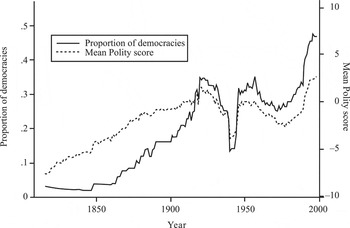
The global distribution of democracy, 1816–1998
The share of countries that are democracies, however, depends not only on changes within existing states but is also affected by changes in the number of independent states. Some have argued that “waves” of democracy are merely artifacts reflecting the growth of states over time rather than changes in institutions.10
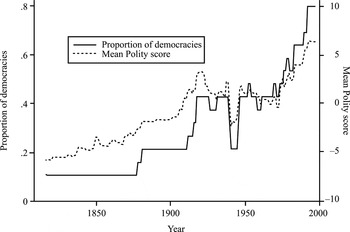
However, the distribution of democracy in nineteen states in continuous existence from 1816 (shown in Figure 2) suggests that there have been many institutional changes within states, evident in periods with large increases in the share of countries that are democratic as well as periods in which many states became less democratic, notably during the two world wars and the period of decolonialization.
Measures of democracy for a sample of nineteen continuously independent states, 1816–1998
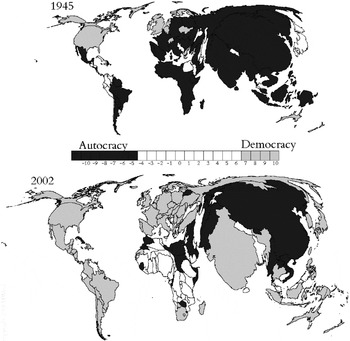
Assessing the share of democracy and changes over time based on independent states alone also excludes from the denominator all of the world's population in colonized territories. Figure 3 displays a cartogram of the distribution of democracy, where the relative size of a state is scaled according to population and assigned a shade according to its Polity score.11
We use Jaggers and Gurr's suggested cut-off points to distinguish between “coherent democracies,” “coherent autocracies,” and “anocracies”; see Jaggers and Gurr 1995, 479.
These cartograms are based on a “density equalizing” approach; see Gastner and Newman 2004; and historical population estimates from Gleditsch 2005.

Cartogram of democracies and autocracies, proportional to population
The notion of global “waves” of democracy and autocracy has alerted researchers to the possible role of international influences.13
Many point to how the second and third waves of democratization coincided with two major watersheds in world history, namely the end of World War II and the end of the Cold War. Merely attributing democratization or autocratization to some “international context,” however, explains little without clarifying the relevant international context and how this influences prospects for democracy, and many of the global trends highlighted do not vary consistently with the distribution of democracy. For example, wars seem to have preceded both democratization and autocratization, and there is no obvious relationship between war and democracy at the level of the international system.14 Likewise, attributing variation in democracy to shifts in political ideology or the changing position of the United States15For example, Robinson 1996.
In our view, international processes that influence democratization are not particularly likely to be found at a global level. Looking for universal global influences that affect all countries alike is probably as ill-conceived as assuming identical and independent processes within each country. The global level is an aggregate that masks large regional differences and variation. Although democracies presently dominate in some regions, autocracy has been widespread in the same regions at other time periods. Figure 3 clearly demonstrates regional clustering in the distribution of democracy in both 1945 and 2002, and similar patterns of geographical clustering hold for other time periods as well. Since 1815, the probability that a randomly chosen country will be a democracy is about 0.75 if the majority of its neighbors are democracies, but only 0.14 if the majority of its neighbors are nondemocracies.
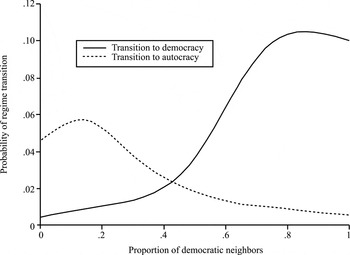
Transitions to democracy have also clustered geographically, and countries have been far more likely to undergo transitions to democracy following transitions in neighboring states. Figure 4 displays nonparametric local regression estimates of the likelihood of transitions between democratic and autocratic regimes in a given year, given the proportion of other states that are democracies within a 500 km radius of a country.16
The geographical information is taken from the Gleditsch and Ward 2001 minimum distance data.

Transition probabilities by proportion of democratic neighbors
The Diffusion of Democracy
Changes in the distribution of democracy could be attributed to increases in wealth and other social requisites held to be conducive to democracy. However, since the domestic social and economic conditions deemed important tend to change slowly over time, it is difficult to see how the great variability in democracy could arise from stable relationships between social requisites and democracy alone. The geographical patterns suggest that the likelihood of a transition in a country also depends on the international context and events in other states. Although other studies have shown similar empirical evidence of “diffusion” of democracy in the sense of spatial clustering,17
it is less clear what this stems from, or what it is about democracy in one state that influences the prospects for democracy in another. In this article, we extend existing theories of democratization to the role of international influences.The study of democratization is complicated by the many possible ways in which one regime may disappear and be replaced by another, and by the difficulties in assessing ex ante who should be regarded as the main agents or potential movers in transitions. In some cases, the most interesting feature in explaining transitions retrospectively is to account for how a new political coalition seizes power and develops new institutions, as when Slobodan Milošević was deposed in Yugoslavia. However, in other cases, autocratic regimes may withdraw for reasons unrelated to the forces and actors influencing institutions in their aftermath, as was the case with the fall of the military junta and subsequent restoration of democracy in Argentina after the Falklands war. Some transitions, such as the fall of Milošević, involve popular uprising, while other transitions are initiated by rulers themselves or carried out by actors closely associated with the previous leadership. In Paraguay, for example, a military government made the initial steps toward democracy with little popular pressure, whereas in Uruguay, representatives of the armed forces and politicians agreed to return to open elections at a closed meeting at the Naval Club.
Nonetheless, although it is perhaps a stretch to talk about a canonical theory of democratization, a wide range of possibilities in which regime transitions can occur may be subsumed under a framework focusing on power, mobilization, and the evaluations of important actors. Much of the literature on democratization argues that democracy emerges as an outcome of social conflict when no single actor or group can impose its rule on others.18
Bueno de Mesquita and colleagues suggest that political coalitions survive in proportion to the ratio of the size of the winning coalition to the size of the group of individuals who have a role in determining that winning coalition, the so-called selectorate.19Bueno de Mesquita et al. 2003.
For example, Almond and Verba 1963.
Diffusion and the Relative Power of Actors and Groups
Both domestic and external events and processes can influence the power of specific groups, thereby undermining existing regimes or assisting groups seeking democratic reforms. The idea of foreign-imposed regime change represents an extreme case of coercive external influence. Despite the recent calls for regime change in rogue states, there are few clear cases where democracy has emerged as a result of foreign intervention, and most imposed regimes are autocratic. The Soviet Union and its Warsaw Pact allies, for example, intervened in Hungary in 1956 and Czechoslovakia in 1968 partly out of fear that local reforms could lead to democracy and the abandonment of socialism. Accordingly, imposition through intervention does not seem an important source of democratization.
However, coercion may also take more subtle forms than direct intervention. The fear of Soviet intervention by itself generally sufficed to deter political reforms in Eastern Europe during the Cold War, until the adoption of the so-called Sinatra doctrine, where countries could “do it their way,” under Mikhail Gorbachev.22
Ash 1999.
See Deutsch 1954; Keck and Sikkink 1999; Randle 1991; Smith, Pagnucco, and Lopez 1998; and Solingen 1998.
External support can have a particularly dramatic impact on the relative power of groups when we see shifts in the coalitions that hold power in neighboring entities. Schelling's “tipping model” suggests that small changes in external context may suffice to yield cascades that can generate a critical mass in political contestation.24
Schelling 1971.
The military component of interstate coercion can also have implications for the prospects for democracy. Many researchers argue that conflict constrains the prospects for democratic rule, and that democracy is likely to break down under the threat of conflict.26
For example, Gates, Knutsen, and Moses 1996.
Thompson 1996.
Barzel and Kiser 1997.
Mansfield and Snyder 2002.
Thompson 1996.
Diffusion and Evaluations of Institutional Arrangements
Theories of democratization can also be cast in terms of evaluations of particular institutional arrangements. Even in situations where no single group can monopolize political power, power sharing need not lead to democratic institutions, as powerful actors often fear the consequences of unmitigated popular rule and resist democracy. Many nineteenth-century theorists, such as Mill and Marx, expected the expansion of suffrage to the labor class to inevitably lead to massive redistribution of private property and income.31
Muller 1999.
See Muller 2000.
For example, Przeworski and Limongi 1993.
The likelihood of democratic reform experiments depends not only on the perceived benefits from democracy, but also the expected costs of not being a democracy, which probably have increased considerably over time. During the Cold War, ruling a country in an authoritarian fashion did not necessarily impose particular problems for a country's standing or a leader's ability to maintain ties with other states, as most countries were not democracies, especially in the developing world. Despite U.S. rhetoric about protecting the free world, democracy was clearly not a requirement in the selection of allies and aid recipients.35
The increase in democracies in the developing world, however, changes the set of countries that a state is likely to be compared to. With the declining strategic importance of allies in the developing world after the Cold War, many autocratic rulers that had enjoyed long-standing international support found themselves increasingly isolated. Hence, many leaders may seek to initiate democratic reforms in efforts to keep on good terms with the rest of the world or not to look bad relative to other comparable states.Empirical Analysis
In this section, we reexamine how international and regional factors influence the likelihood that a country will be democratic. Although the specific mechanisms that lead to changes are not directly observable, we can observe whether transitions are more or less common following factors that reflect the mechanisms discussed in the previous section. We examine these propositions in an analysis of two-way transitions between democracy and autocracy. Gleditsch and Ward suggested that changes in political structures could be analyzed as a Markov chain process of transition between different states over time.36
Gleditsch and Ward 1997.
Harary, Norman, and Cartwright 1965, 371–77.

where p01 indicates the probability of change from 0 to 1 (that is, yit = 1, yit−1 = 0), and p11 indicates the probability of remaining at 1 from t − 1 to t (that is, yit = 1, yit−1 = 1).
We can estimate the conditional transition probabilities given some set of covariates of interest xit by

where F is either a logit or a probit link.
38 The β parameters indicate the effects of covariates on the probability of a 1 at time t given a 0 at time t − 1, that is, Pr(yit = 1|yit−1 = 0). The effects on the probability of a 1 at time t given a 1 at time t − 1, Pr(yit = 1|yit−1 = 1), are given by the parameters γ = α + β. To facilitate comparison with Przeworski and Limongi's results,39Przeworski and Limongi 1997.

coefficients can be interpreted as indicating the effects of a covariate on the likelihood that a democracy will become an autocracy;

indicates a covariate's effect on the likelihood that autocracies will remain autocracies. Since the probability for all the possible outcomes at time t given yit−1 = 1 must sum to unity, the likelihood that an autocracy at time t − 1 will become a democracy at time t is

, or 1 minus the probability that an autocracy will endure.
We examine diffusion, or the influence of international factors, through four covariates. The first three pertain to local and global diffusion of regime types. If local diffusion processes operate, we should expect autocracies to be more likely to experience transitions to democracy the greater the proportion of democratic neighboring countries (that is, γ < 0). We identify the local context by the proportion of neighboring states within a 500 km radius that are democracies, based on minimum distance data.40
Gleditsch and Ward 2001. Although a 500 km threshold is somewhat arbitrary, the results do not look dramatically different for other distance thresholds; see also Gleditsch 2002a, 94–95.
Our final covariate reflecting diffusion pertains to the role of conflict. We believe that conflicts reflecting threats to a state's territory may decrease the prospects for democracy. These, however, should be distinguished from conflict participation, which may include decisions to intervene in conflicts elsewhere in the international system that are unlikely to influence the prospects for democracy. We consider enduring territorial threats by a simple count of the number of years that a country has remained at peace on its territory as a proxy for the stability of peace. Our conflict data are based on the Correlates of War (COW) data, with some modifications and updates.41
Gleditsch 2004.
Most previous studies on diffusion or the role of international factors for transitions to democracy have disregarded the potential impact of domestic attributes and processes;42
we consider both international and domestic factors. An aggregate relationship between a country's institutions and the countries in its regional context alone does not provide convincing evidence of diffusion processes, because the principal social and economic conditions hypothesized to influence democracy, such as differences in gross domestic product (GDP) per capita, can also be shown to cluster geographically43Gleditsch 2002a.
Galton 1889.
The primary measure of “social requisites” is a country's GDP per capita, which we measure as the natural log of the lagged level of real GDP per capita.45
Gleditsch 2002b. We prefer the simpler natural log specification over using GDP per capita and its square as suggested by Przeworski and Limongi 1997, because we see no clear reason why democracy should become less likely beyond some level of income.
Rodrik 1999.
These data are unfortunately available only after 1965.
Gleditsch 2004.
Although the geographic and political data are available from 1875 to the present, the availability of data on lagged GDP per capita and economic growth constrains our sample to the years 1951 to 1998. Economic data are often missing for developing countries, socialist economies, and states involved in conflict in the standard data sources that have been used in most existing work.50
Przeworski et al. 2000, for example, only include countries in the Penn World Data, leaving out many socialist and developing states. Although we can replicate the key points in our analysis in terms of sign and significance of estimating coefficients using the Alvarez et al. 1996 democracy measure, this source dramatically reduces sample size and introduces possible problems of nonrandom sample attrition.
Gleditsch 2002b.
Results
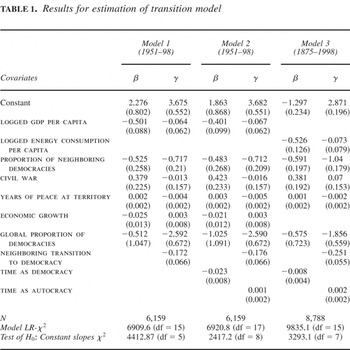
The results of our baseline model are shown as Model 1 in Table 1. Each row listing a covariate name displays the estimated

coefficient and the implied

coefficient for that covariate in the subsequent column fields. The standard errors for the coefficients are shown in parentheses in the row below.
52The variance for

is given by

.
Results for estimation of transition model

Most of our hypotheses on diffusion and democratization are strongly supported by the results for Model 1 in Table 1. As can be seen from the negative estimates for

in the fourth row of the main body of the table, a higher proportion of democratic neighbors significantly decreases the likelihood that autocracies will endure (that is,

) and increases the likelihood that democracies will break down (that is,

). Moreover, a transition in a neighboring country significantly decreases the likelihood that an autocracy will endure. A more peaceful regional environment decreases the likelihood that an autocracy will endure but does not have a statistically significant impact on the likelihood that democracies will break down.
53Additional tests with the Diehl and Goertz's 2000 measure of enduring rivals (not shown) likewise suggest that an enduring rivalry makes autocracies more likely to endure but has no consistent effect on the survival of democracy.
This contrasts somewhat with previous research, as Reiter 2001b and Pevehouse 2002a find that the regional proportion of democracies does not influence the duration of democracy, while Kadera, Crescenzi, and Shannon 2003 find that a higher global proportion of democracies increases the survival rates of democracies. The first two studies, however, use proportions within world regions as defined by the COW project rather than country-specific reference groups, and none of the studies consider both global and regional influences.
Przeworski and Limongi 1997.
Reestimating Model 3 without Eastern European states under Soviet influence after 1945 yields a larger and significant negative coefficient estimate for the log of energy consumption per capita, but does not change our results with respect to the impact of international factors.
The effects of the domestic covariates are largely consistent with expectations and previous research. The results for Model 1 in Table 1 can be read as supporting Przeworski and Limongi's conclusion that although a higher GDP per capita does decrease the risk that democracies will break down, it does not significantly increase the likelihood of a transition from autocracy to democracy (that is, the estimated

is effectively zero). Likewise, economic growth strengthens the survival of democracies but does not promote transitions in autocracies. Indeed, the estimated

coefficient is positive. Civil wars increase the likelihood that democracies will break down but have no substantive effect on the likelihood that autocracies will endure. Additional regressions (not shown) indicated that our measure of exogenous economic shocks was not related to regime type or transitions after 1965; however, this may be due to the limited data available.
57We have also considered international factors emphasized by other researchers, none of which changed our main results for the impact of international factors. Pevehouse 2002a and 2002b argues that leaders in new democracies rely on international organizations to “lock-in” policies and assuage elites who fear unmitigated populism. Adding Pevehouse's measure of the democratic density of international organizations (not shown) yields results somewhat inconsistent with his expectations, suggesting that transitions to democracy are more likely in autocracies connected to highly democratic international organizations, but international organizations do not appear to help to consolidate democracy. Others have highlighted the changing role of the Catholic Church, which historically often denounced democracy and supported autocratic rule but became an active promoter of democracy after the Second Vatican Council, 1962–65; see Huntington 1991. We found that democracy seems more likely to endure in Catholic societies after the Second Vatican Council (although the difference is not statistically significant), but transitions actually seemed less frequent.
It may be questioned whether our data actually follow a first-order Markov process or all the information about transition and survival probabilities can be summarized by the previous states of regimes plus the covariates. We were unable to reject the null hypothesis that a second-order Markov specification did not fit the data significantly better than the first-order Markov process for Model 1. This is not particularly surprising, as models for higher-order Markov processes invariably involve a very high number of parameters.58
Berchtold and Raftery 2002.
For example, Gasiorowski and Power 1997.
Gleditsch and Choung 2004.
We also tried a nonparametric model specification, allowing for nonlinear time dependence, but this did not notably improve on the linear specification.
Boix and Stokes have recently argued that Przeworski and Limongi's dismissal of modernization theory—that is, that development increases the prospects that autocracies will become democratic—is an artifact of limiting their data to a post-1951 sample.
62Boix and Stokes 2003.
We use energy consumption figures from the COW National Military Capabilities data and extend the current data (Version 2.1) beyond 1992 with estimates predicted from a linear regression of a country's logged GDP per capita and a time trend.

estimate for the log of energy consumption per capita is negative, but still not statistically significant. More importantly, the coefficient estimates for the other covariates remain consistent, and our conclusions regarding the importance of the regional and international context do not change when we look at the extended time period. To ensure that the Eastern European countries alone do not drive our results, we reestimated our Model 3 excluding all the Eastern European states under Soviet influence after 1945. This yields a larger negative coefficient estimate for the log of energy consumption per capita but does not change our results with respect to the impact of international factors.
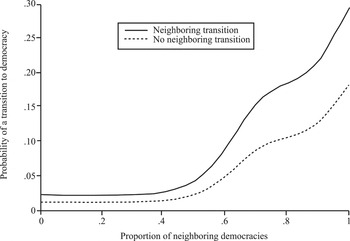
We have shown that the effect of differences in the regional context on transition probabilities persists even when taking into account country-specific covariates and common trends. The probability that an autocracy will become a democracy increases markedly as more of its neighboring states are democracies or experience transitions to democracy. Figure 5 displays a nonparametric estimate of the marginal effects over differences in the proportion of neighboring democracies, based on Model 3 in Table 1, keeping the value of other variables at their medians. Substantively, this translates to a middle-income country that does not experience a civil war and has been an autocracy without experiencing conflict for over three decades. The solid line indicates the predicted probabilities of a transition to democracy when there is a transition in a neighboring country. The dashed line indicates the transition probabilities for a case without a neighboring transition. As can be seen, the transition probabilities for a typical autocracy in a given year remain low, well below .015, when a small proportion of neighboring states are democracies—toward the left side of the horizontal axis—and there are no transitions in neighboring states. When the proportion of neighboring states exceeds one-half, however, the transition probabilities increase quite dramatically. The likelihood of a transition to democracy exceeds .10 when more than 75 percent of the neighboring states are democracies and is even higher when other countries in the region experience transitions to democracy.

Transition probabilities by regional context, holding other covariates at the median
Recall that the predicted probabilities from the model refer to the likelihood of transitions in a given year, and that the likelihood of a transition occurring over a longer time period will be higher. For an autocracy that has a moderately high predicted likelihood of transition to democracy in any one given year given its domestic and regional attributes (for example, .1), the implied likelihood that it will remain an autocracy for five years is (1 − .1)5, which is less than .6.
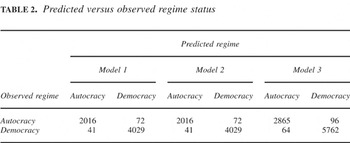
Table 2 compares the observed regimes to the predictions of the model. The percentage of observations classified correctly by the models ranges from 98.1 to 98.2 percent. The share of democracies in the sample correctly classified varies from 96.55 to 96.75 percent. More importantly, the predicted transition probabilities are much higher for the cases where we observe transitions than for the sets of autocracies and democracies in general.
Predicted versus observed regime status

Overall, these results lend strong support to our claims about the salience of the regional context on regime changes. Knowing a country's location and the characteristics of surrounding entities yields considerable predictive power. There is a marked tendency for cases to change in ways similar to their regional context over time, and transitions in one country often spill over to other connected states. Given such evidence of dependence and diffusion between countries, the claim that regime change is entirely random should not be accepted. Although transitions to democracy are relatively rare, they are clearly more common under some conditions than others. This undermines the claim that transitions to democracy are random events.64
Conclusion
Our results attest to how the prospects for democracy are not exclusively related to domestic attributes but are also affected by external conditions and events. Democratization cannot be seen exclusively as a result of functionally similar processes unfolding independently within each country. Rather, international events and processes appear to exert a strong influence on democratization, consistent with our argument that external influences can change the relative power of actors and groups as well as the evaluations or relative payoffs for particular institutional arrangements. Domestic political processes are deeply affected by what goes on in neighboring societies, even if the specific ways in which external events influence transitions vary from context to context. Diffusion processes among states influence the distribution of democracy in the international system and there is a strong association between a country's institutions and the extent of democracy in the surrounding region. Not only are regimes generally similar within regions, but there is also a strong tendency for transitions to impart a regional convergence. A history of prior regional conflict decreases the likelihood that a country will be democratic.
Many transitions involve some element of surprise and their timing may not be fully predictable. Our ability to predict other changes in external context such as conflict and peace is also limited at best, and it may be difficult to accurately forecast how regions are likely to evolve over the near future. However, we can still make inferences about an increase in the likelihood of transitions, conditional on transitions in other states and international events that influence the features shaping the prospects for democratization. Although it is difficult to fully specify the full range of possible micro-level processes of democratization and show how international factors influence these in a model at the aggregate level, it seems theoretically inappropriate to treat the domestic arena as isolated from or independent of the international context. Since the regional context is more permeable to changes in the short term than socioeconomic factors, international influences on democracy are likely to be as important as the domestic “social requisites.” We do not think that it will be feasible to sort through the multiple paths through which transitions may come about and select one avenue as more likely than others in advance. However, our results allow us to firmly reject the idea that institutional change is driven entirely by domestic processes and unaffected by regional and international events. It make little sense to exclude the regional context and assume that transitions to democracy are random and exogenously determined when the regional context appears to exert an important, dynamic influence in transition processes.