Introduction
Despite advances in treatment, cancer remains the leading cause of disease-related death in children (Siegel et al., Reference Siegel, Miller and Jemal2018). Approximately 11% of children with cancer die from their disease, but little is known about the barriers surrounding end of life communication or how best to support these conversations among caregivers and their terminally ill child. Evidence-based guidelines for best practices and optimal care in oncology recommend open physician communication that is maintained and improved near the end of life (Jankovic et al., Reference Jankovic, Spinetta and Masera2008; Spinetta et al., Reference Spinetta, Jankovic and Masera2009; Wiener et al., Reference Wiener, Kazak and Noll2015). Previous work has proposed that providers support caregivers in their endeavors to discuss end of life with their child (Himelstein et al., Reference Himelstein, Hilden and Boldt2004; Jalmsell et al., Reference Jalmsell, Kontio and Stein2015). Open and honest communication with children regarding end of life is now the standard of care, given extant literature providing evidence that it may prevent distrust and internalizing problems for children, as well as improving grief outcomes among their caregivers (Kreicbergs et al., Reference Kreicbergs, Valdimarsdóttir and Onelöv2004; Beale et al., Reference Beale, Baile and Aaron2005; Jankovic et al., Reference Jankovic, Spinetta and Masera2008; Spinetta et al., Reference Spinetta, Jankovic and Masera2009; Bates and Kearney, Reference Bates and Kearney2015; Aldridge et al., Reference Aldridge, Shimmon and Miller2017). Yet, limited work has examined communication between caregivers and their terminally ill child regarding prognosis and end of life. To best address the challenges involved with having these conversations, further information is needed from caregivers who do and do not communicate about prognosis and death with their child. This study was designed to fill the gap in the literature as to how often this communication occurs, what factors predict communication, as well as how best to support caregivers during these conversations.
Understandably, involving children and adolescents in end of life conversations is difficult due to the sensitive nature of the topic. Caregivers often serve as gatekeepers and may delay or prevent these conversations based on the child's age, or in an effort to protect them from distress (Granek et al., Reference Granek, Krzyzanowska and Tozer2013; Marsac et al., Reference Marsac, Kindler and Weiss2018). Studies have found that parents may have an overly optimistic view of their child's prognosis relative to physicians (Mack et al., Reference Mack, Fasciano and Block2018), and that a minority of parents (19% and 34%, respectively) reported discussing their child's impending death with them (Goldman and Christie, Reference Goldman and Christie1993; Kreicbergs et al., Reference Kreicbergs, Valdimarsdóttir and Onelöv2004). Despite such barriers to communication, children, even as young as three, may be aware of their prognosis and have the capacity to understand some aspects of death (Bluebond-Langner, Reference Bluebond-Langner1980; Aldridge et al., Reference Aldridge, Shimmon and Miller2017). As such, the literature strongly suggests that providers should encourage open and honest communication based on the child's cognitive maturity and experience, rather than age (Zadeh et al., Reference Zadeh, Pao and Wiener2015; Stein et al., Reference Stein, Dalton and Rapa2019).
A lack of communication about prognosis or death may lead to increased fear, distrust, isolation, and internalizing problems (i.e., anxiety and depression) among children and adolescents with cancer (Beale et al., Reference Beale, Baile and Aaron2005; Bates and Kearney, Reference Bates and Kearney2015; Aldridge et al., Reference Aldridge, Shimmon and Miller2017). Research has even suggested improved grief outcomes among bereaved caregivers who had conversations involving end of life with their child (Kreicbergs et al., Reference Kreicbergs, Valdimarsdóttir and Onelöv2004; Jankovic et al., Reference Jankovic, Spinetta and Masera2008). In a more recent study, 73% of bereaved parents reported regret and 33% reported unfinished business, which were both associated with distress and prolonged grief symptoms (Wiener et al., Reference Wiener, Tager and Mack2020). According to the study, the most common unfinished business was not engaging in conversations with the child about end of life (Wiener et al., Reference Wiener, Tager and Mack2020).
Providers should assess the child and caregiver's communication preferences and desire for information (Bates and Kearney, Reference Bates and Kearney2015; Aldridge et al., Reference Aldridge, Shimmon and Miller2017; Pao and Mahoney, Reference Pao and Mahoney2018). If family members have other preferences, forcing openness may be harmful to the relationship between parents, the child, and clinicians (Rosenberg et al., Reference Rosenberg, Wolfe and Wiener2016). Thus, it is important to better understand the factors associated with how communication occurs surrounding prognosis or the death of a child and to obtain guidance from caregivers on how providers can best facilitate these difficult conversations. Given the psychosocial standard of care calling for clear and open end of life communication in pediatric oncology (Jankovic et al., Reference Jankovic, Spinetta and Masera2008; Spinetta et al., Reference Spinetta, Jankovic and Masera2009; Wiener et al., Reference Wiener, Kazak and Noll2015), our aims were to examine how often this communication occurs and to explore what factors predict end of life conversations between parents and their children who died of cancer. To inform best practices for interdisciplinary teams within palliative care, we also qualitatively explored the support from health-care providers that is preferred by caregivers for having these important conversations.
Methods
Procedures
Parents and/or caregivers of children who died from cancer completed a 47-item online survey sent through a closed Facebook group entitled Parents who lost children to cancer. Group members were from a range of countries, including Canada, Australia, the Philippines, multiple European countries, and all fifty United States. After given permission from the closed Facebook group page administrator, one member posted a link to the survey in the form of a post. The survey was open from March to June 2018. The member posted the survey link to the group every three weeks during the initial months the survey was open and then once a week the last month it was open for recruitment purposes. Each post contained the link to the survey as well as an explanation of the study, including purpose, intention, voluntary and anonymous nature, and goals of the study. Other group members were asked not to share the link with other bereaved parents in order to restrict the sample to cancer-specific bereaved parents. Research team members were not added to the group. Personal identifiers were not collected and any identifying information from open-ended questions was removed. Study approval was obtained from the National Institutes of Health Office of Human Subjects Research Protection, which determined that signed informed consent was not required.
Participants
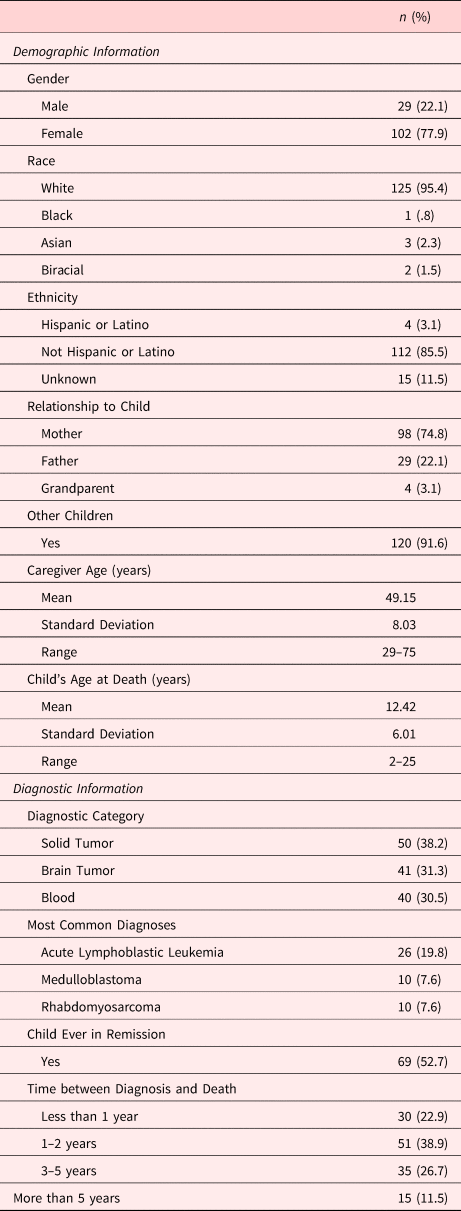
The sample included a total of 131 caregivers of children who died from cancer between the ages of 2 and 25 years. Caregivers answered questions pertaining to prognosis (n = 131), discussion of death (n = 99), and if the child asked or spoke about dying (n = 125). Caregivers were able to skip any question that they did not want to answer. Most survey respondents were female (77.9%, n = 102) and White (95.4%, n = 125); few reported being Hispanic or Latino (3.1%, n = 4). Caregivers were on average 49.15 years of age (SD = 8.03), and their child's age at death ranged from 2 to 25 years (M = 12.42; SD = 6.01). Approximately 74.8% (n = 98) of respondents were the deceased child's mother, and most had other children (91.6%, n = 120). All primary diagnostic categories were represented, including solid tumors (38.2%, n = 50), brain tumors (31.3%, n = 41), and blood cancers (30.5%, n = 40). Half of children (52.7%, n = 69) had experienced remission prior to death and died at home (50.4%, n = 66). The other half either died in the hospital (42.0%, n = 55), a hospice facility (4.6%, n = 6), or the location was not reported (3.1%, n = 4). Length of time between diagnosis and death varied from less than 1 year (22.9%, n = 30) to more than 5 years (11.5%, n = 15). All demographic and diagnostic information is available in Table 1.
Demographic and clinical characteristics (n = 131)

Measures
End of life survey
A 47-item multiple choice and open-ended question survey was developed by an interdisciplinary team of psychosocial oncology experts (i.e., psychologists, psychiatrists, oncologists, nurses, social workers, etc.) with consideration from bereaved parent advocates. The overall survey assessed support services provided throughout their child's end of life care as well as perceived psychosocial needs of the child and family before, during, and after the child's death. Questions regarding end of life communication (i.e., discussing prognosis and/or death) were included and used for the purpose of this study. Participants were also asked about which types of support provided by the child's health-care team would best help facilitate these conversations (i.e., provide resources to parents to help talk to the child, have a provider talk to the child, be in the room while parents talk to the child, or other). Published work pertaining to other aspects and questions involved in the survey can be found in the references section (Tager et al., Reference Tager, Battles and Bedoya2019; Wiener et al., Reference Wiener, Tager and Mack2020).
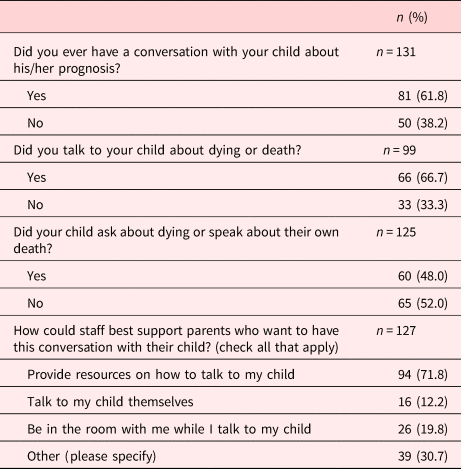
The survey was administered through Survey Monkey and included branching logic that directed participants to questions relevant to their own experiences. The survey took approximately 20 minutes to complete in its entirety. Questions pertaining to the purpose of this analysis can be found in Table 2.
Communication at end of life
Data analyses
Descriptive statistics were used to characterize the sample and variables of interest. The Statistical Package for the Social Sciences (SPSS) version 26 was used to examine quantitative factors in relation to questions regarding prognostic discussion, talking about death, and if the child asked about death. Factors examined included age of caregiver, age of child at death, sex, relationship to child, if the caregiver had other children, length of illness, cancer diagnosis, location of death, and remission period. Chi-square tests and independent sample t-tests were used to examine factors that were related to the respective conversations.
A qualitative approach was also used to obtain first-hand knowledge, offer insights, and help develop guides to action. The question regarding how staff may support parents who want to have a conversation about death included four multiple-choice answers (select all that apply), as well as an open-ended section. Content analysis was used to analyze the open-ended questions by coding and reporting participant responses (LoBiondo-Wood and Haber, Reference LoBiondo-Wood and Haber2006). Two researchers (A.K., C.G.) independently analyzed and coded the open-ended responses. Similar themes were first identified by clustering the first 10 responses and creating a preliminary coding scheme. This process was repeated with the next set of 10 responses adding additional codes as needed until all 39 responses were analyzed. The researchers then reviewed the suggested coding schemes and discussed the rationale for each theme until each was mutually agreed upon (i.e., combining themes, creating subthemes, etc.). Content analysis was then presented based on the final themes that emerged by pulling exemplary quotes from the responses in each category.
Results
Descriptive analyses
Bereaved caregivers were asked four questions regarding end of life communication (see Table 2). According to caregiver report, 61.8% (n = 131) had a conversation with their child about his/her prognosis, and 66.7% (n = 99) had talked to their child about death. About half (48%, n = 125) reported that their child asked or spoke about dying. When asked to select responses regarding how staff may best support parents who want to have this conversation with their child (n = 127), approximately 71.8% (n = 94) selected “provide resources on how to talk to my child,” few (12.2%, n = 16) selected “talk to my child themselves,” more than a quarter (29.8%, n = 26) selected “be in the room with me while I talk to my child,” and 30.7% (n = 39) chose “other,” which prompted them to specify. There were no significant differences between those who selected “other” and responded to the open-ended question and those who did not in terms of caregiver age, caregiver race, caregiver ethnicity, child age at death, cancer diagnosis, illness length, or remission period.
Factors related to conversations
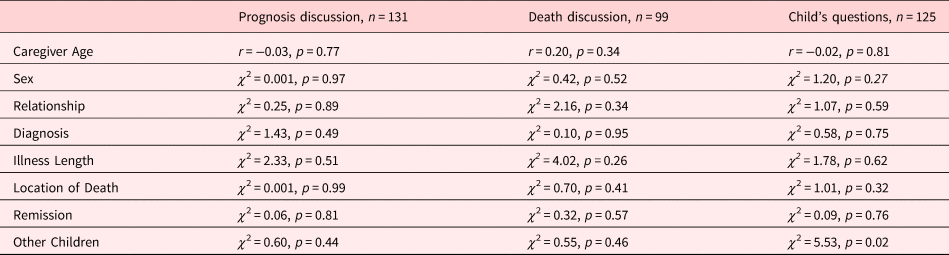
Caregiver–child conversations about prognosis, death, and the child's questions about death, if any, were all significantly associated with each other (p ≤ 0.001). Older children (51.9% ≥ 12 years) were more likely to have a conversation about prognosis, t(129) = 2.17, p = 0.03 and ask about dying, t(123) = 2.19, p = 0.03. The occurrence of these conversations was unrelated to caregiver age, sex, relationship to the child, diagnosis, time between diagnosis and death, location of death, or remission period (see Table 3). Interestingly, children were more likely to ask about dying if their caregiver had other children, χ 2(1, n = 125) = 5.33, p = 0.02, whereas discussion of prognosis or death was unrelated if the caregiver had other children, χ 2(1, n = 131) = 0.60, p = 0.44; χ 2(1, n = 99) = 0.55, p = 0.46, respectively.
Predictors of caregiver–child conversations

Qualitative analyses
A content analysis of the open-ended responses regarding the support preferences of bereaved caregivers (31%, n = 39) revealed six major themes. Two of the responses were incomplete and, therefore, placed in a not-applicable category, resulting in 37 coded responses. Major themes included: (1) help the family prepare by utilizing tools or resources, (2) provide others to help, such as other parents or a chaplain, (3) what not to do, (4) there was no opportunity because the death happened too quickly or the child was too young, (5) leave it to the family/parents in order to be age appropriate, highly individual, tailored, or guided, and (6) don't know.
Help the family prepare by utilizing tools or resources
Some bereaved caregivers (n = 6) reported that staff could support parents who want to have a conversation about prognosis or death with their dying child. They indicated staff could help them better prepare, perhaps through the use of tools or resources, in order to gain the necessary skills to engage in these difficult discussions. For example, one father stated, “Give them the tools they will need to talk to their child.” Further, a mother said, “Talk to me about this. Ask if this is something I want to do. Suggest ways to approach this.” Whereas another father suggested that guidance from staff in addition to resources may be helpful: “Perhaps help the parent prepare for such a talk (in other words, not just provide written materials).”
Provide others to help
Bereaved caregivers (n = 8) stated that staff may better support end of life conversations by providing others to help or support them in talking to their children. Through statements such as, “Connect parents to other parents who have been through it before,” and “Have a parent that has been through it talk if they are willing,” parents indicated a desire to learn from other parents, who have experienced the death of a child or who were in a similar situation. This was further expressed by a mother stating, “Every situation is unique and input from Hospice or any other care professionals should feel out how the parent feels about death as that will have a direct effect on how the child feels about death. Resources can help, but again, get parents in touch with other parents that have been through the experience!” Another alternative for support was providing pastoral care, such as “Have hospital chaplain discuss with parents,” “Provide spiritual companionship for the whole family,” or “The only comfort for me was with our pastor so provide a pastor if they don't have one.” Thus, caregivers felt other parents and spiritual resources could provide valuable insights into how to have challenging conversations about prognosis and death.
What not to do
Some caregivers (n = 6) gave examples or anecdotes about what the health-care team should not do, including, “It's a hard conversation but it was one we never had because we always believed he would beat it. I felt the hospital grossly failed in preparing us for death.” Another example suggested that health-care teams should take into account developmentally appropriate information to share: “The doctor revealed too much to my son at the wrong time. He was 12 and 12-year-olds can be very different. Some very mature, others not.” Whereas another mother reported it is important for the oncologist rather than other staff share the information, “His oncologist refused. Made a member of hospital staff tell me, he was too broken up to tell me or my son himself.” These comments indicated that parents wanted the health-care team, particularly the oncologist, to share timely information in a developmentally appropriate manner.
No opportunity
Four caregivers explained that their child was too young to have this conversation or that the death happened too quickly for them to have the conversation. One mother stated that their child was under 3 years old. One caregiver described that there was not enough time to prepare for the conversation saying, “Our relapse and time between death was very sudden. Really no time to prepare. Got news from doctors on a Monday and by Wednesday morning he had passed.” Thus, young age of the child and rapid disease progression were perceived barriers to end of life conversations.
Leave it to the family/parents
Caregivers (n = 9) also believed that end of life communication should be left to the family to decide, such that end of life conversations should be specifically tailored, guided, or highly individual to each family. One mother shared her story noting it may be different for others: “I feel most families need the privacy and respect to confront this issue on their own. There are many different belief systems and, based on a child's age, there are differing conversations that need to be had. Diagnosed at the age of 12 and in a medically savvy family, my son was always a part of discussions with his treatment. When we were flown to [hospital] for treatment and received the news of early relapse (never gained remission), I was able to ask the difficult questions. I know my medical background allowed for that discussion. My son was also made aware of the prognosis. He chose to take experimental treatments, and he and I had long talks about his faith in God and his belief in the afterlife. This is our journey. It may not be someone else's journey.” An additional mother expressed the individual nature of each family as well: “I think this is highly individual and best left for the parent unless the parent asks for help.” Whereas another mother felt the importance of privacy at end of life and didn't feel health-care staff was necessary for support. “Personally, there is NO resource you can give a parent that is going to help support this conversation. PERIOD! I also think some support staff insert themselves at inappropriate times, and end of life issues and pending death are very intimate times. If a parent realizes that no other options are available, then I do think the health-care team should approach parents and ask how they wish to be supported, rather than being directive or prescriptive. While your child is actively dying, most of us do not want to hear what the research says, what others have found helpful, and the list goes on!” A father shared the sentiment of privacy stating, “That was a sacred time and I didn't want staff involved.” Whereas another father expressed the individual needs of each family: “It all depends upon the family. Some might welcome a social worker in the room; others would find it an invasion of privacy. The situations are much more nuanced than your questionnaire allows.” Therefore, parents demonstrated the need for health-care providers to ask about preferred involvement and respect parent wishes to approach these conversations.
Do not know
Lastly, a few caregivers (n = 4) shared that they “did not know” how providers can best support them during these difficult conversations. One parent noted, “Honestly, five years later I still have no good solution for this question.” These statements reflect the continued challenges in understanding and addressing the unique needs of family members at the end of a child's life.
Discussion
To optimize end of life care and inform best practices within palliative care, we examined factors associated with having end of life conversations between parents and children who died of cancer and desired support from health-care providers. Findings revealed that approximately two-thirds of bereaved caregivers discussed end of life and death with their children and that half of children asked or spoke about their own death. Caregiver–child conversations about prognosis, death, and the child's questions about death, if any, were associated with each other. Older children were more likely to have a conversation about prognosis and ask about dying. Children were also more likely to ask about dying if their caregiver had other children. Although most caregivers did not offer suggestions or know how providers could help with communication at end of life, some provided suggestions about what providers should and should not do.
Our findings regarding the large number of families who talked about prognosis and death stand in stark contrast to previous, albeit few studies, that reported a considerably smaller percentage of caregivers who had these conversations (Goldman and Christie, Reference Goldman and Christie1993; Kreicbergs et al., Reference Kreicbergs, Valdimarsdóttir and Onelöv2004). It is possible that our findings may be due to cohort effects, given the recent increase in education about pediatric palliative care and evidence-based guidelines promoting more open communication at end of life (Weaver et al., Reference Weaver, Heinze and Kelly2015, Reference Weaver, Heinze and Bell2016; Wiener et al., Reference Wiener, Kazak and Noll2015). Most caregivers were mothers, and there is evidence that children with advanced and nonadvanced cancer report their fathers as less open in their communication than mothers and that communication with fathers is less open over time (Keim et al., Reference Keim, Lehmann and Shultz2017). The discrepancy in our findings may also be due to the wider age range of children included in our study. We included children up to age 25 due to the age of children treated for cancer at pediatric institutions, the frequent involvement of parents in the care of their older children (ages 18–25), and the fact that children often remain on their parent's health insurance policy until age 26.
With the exception of older child age and having a sibling, the occurrence of end of life conversations was generally unrelated to other demographic (e.g., caregiver age, sex, relationship to child) or medical factors (e.g., diagnosis, length of illness, location of death, remission period). Children over the age of 12 were more likely to ask questions and initiate conversations about prognosis and death. This is consistent with studies indicating that older children with cancer are more likely to desire information, ask about their treatment and prognosis, and want to be involved in decision-making (Ellis and Leventhal, Reference Ellis and Leventhal1993; Coyne and Gallagher, Reference Coyne and Gallagher2011). However, research also indicates that children often have difficulty discussing death with their parents (Theunissen et al., Reference Theunissen, Hoogerbrugge and van Achterberg2007). In our study, children were more likely to initiate a conversation about dying when they had a sibling. Siblings share a unique, often lifelong bond and can serve as confidantes, caregivers, and sources of support for one another. Perhaps children felt more comfortable having these difficult conversations with sibling or peer support or perhaps out of concern for these family members.
In most instances, however, parents and health-care providers will be the ones to initiate such conversations, particularly with younger children. Open-ended responses from caregivers indicated that discussions about prognosis and death should be developmentally appropriate and fit the needs of each child. Providers may educate caregivers on strategies to having these conversations with younger children, such that it is not necessary to explicitly mention end of life in order to have these discussions (Ekberg et al., Reference Ekberg, Danby and Rendle-Short2018). Other ways to facilitate communication surrounding end of life with younger children may include play or drawing (Sahler et al., Reference Sahler, Frager and Levetown2000; Sourkes, Reference Sourkes2018). The common barriers to open communication may be mitigated through provider guidance. Indeed, past work has demonstrated the critical role that health-care providers play in supporting the caregiver's decision in discussing end of life communication (Chesler et al., Reference Chesler, Paris and Barbarin1986; Mack and Joffe, Reference Mack and Joffe2014). More recent literature published from the current study offers provider guidelines and suggested language to help facilitate these challenging conversations (Wiener et al., Reference Wiener, Tager and Mack2020).
In an earlier qualitative study examining communication among families of children with life-threatening conditions, children who were present during consultations with their parents and health-care providers felt more confident to ask questions, suggesting that being present may play a moderating role for those who have end of life conversations (Young et al., Reference Young, Dixon-Woods and Windridge2003). However, our findings revealed that, although most caregivers wanted support to talk to their child, few wanted providers to speak to their child directly or to be present during the conversation. This finding is supported by later work by Young, investigating parent preferences on their child's presence during consultations, suggesting parents executively manage what and how children are told such information (Young et al., Reference Young, Dixon-Woods and Windridge2003, Reference Young, Ward and Salmon2011). Our content analysis of open-ended responses echoed this by identifying caregiver preferences for support, which included providing tools and resources from staff, as well as potential resources from others (i.e., chaplain, parents, etc.).
Thematic content further revealed the importance of the unique needs of each child and family, supporting the necessity for providers to seek out preferred involvement. Indeed, as noted by experts in the field, prognostic openness for the sake of following communication recommendations, without respect for family preferences, may be harmful (Sisk et al., Reference Sisk, Bluebond-Langner and Wiener2016). This is consistent with recommendations following a systematic review of communication in pediatric oncology to individualize communication practices based on the unique needs of individual families (Sisk et al., Reference Sisk, Mack and Ashworth2018). Lastly, content analysis revealed that other caregivers had no idea how to have these difficult conversations, which reflects the ongoing challenge in understanding how best to support family members at the end of a child's life. This may be remediated by early integration of palliative care, which could provide opportunities for more discussions and guidance on how caregivers can communicate with their child about death (Wolfe et al., Reference Wolfe, Klar and Grier2000; Mack and Wolfe, Reference Mack and Wolfe2006; Weaver et al., Reference Weaver, Heinze and Kelly2015; Stein et al., Reference Stein, Dalton and Rapa2019).
Strengths and limitations of the study
This study builds on a limited literature by using a moderately large sample of bereaved caregivers. In addition, results of this study fill a gap in the literature as to how often caregivers have end of life conversations with children with cancer, what factors are associated with this communication, as well as how best to support caregivers in having these conversations. Qualitative themes provide valuable insight into support desired by families to help them with these difficult conversations. Further, utilizing the social media survey platform allowed respondents from a vast number of geographic locations, enhancing cross-cultural generalizability. Our study design and qualitative approach provided a unique forum for bereaved caregivers to express their preferred methods in supporting end of life communication, which in turn, better informs health-care providers.
There are a number of limitations important to note. There was a potential for ascertainment bias, given that survey access was provided only to members of the closed Facebook support group and self-selection was involved. Although we included a relatively large number of families, few caregivers were male, and the overall response rate was unknown due to not knowing the total number of group members or how many group members signed onto the platform during the time the study was open. In addition, participants required access to the Internet, which may have inadvertently overlooked individuals with fewer financial resources. However, current research on Internet availability and growth suggests that most people have access now despite lack of resources or financial constraints (Pew Research Center, 2019). Lastly, this sample lacked the diversity required to explore predictors and preferences across race and ethnicity. Future prospective studies should examine predictors of communication and preferences among more diverse groups, including cultural differences and individual value systems, that may manifest as barriers to Western norms for end of life communication (Wiener et al., Reference Wiener, McConnell and Latella2013).
Despite these limitations, our findings provide guidance from bereaved caregivers in preparing families for end of life. Our findings suggest most caregivers want support in having conversations with their child about end of life, but few specifically want providers directly involved. Rather than having open discussions with the child present, we suggest that providers assess the family's preferences in order to facilitate support and encourage their efforts in end of life communication. Providers should take into account the unique preferences of each family (e.g., timing, spirituality, need for privacy, advice from other caregivers, etc.), and, therefore, address the challenges involved to best support and facilitate these difficult conversations. Bereaved caregivers should also be systematically incorporated into palliative care education, given their experience and the benefits to both clinicians and caregivers (e.g., improved clinician communication and care for terminally ill patients and their families) (Adams et al., Reference Adams, Green and Towe2013; Snaman et al., Reference Snaman, Kaye and Spraker-Perlman2018). Thus, end of life communication from health-care practitioners requires tailored approaches and should not be held solely as standardized guidelines.
Finally, our findings reveal an array of support preferences among caregivers. There is need for further investigation into the predictors unique to these preferences to enhance provider decisions on which type of communication support may best fit a family. Future work should include both caregiver and child report, as guidelines for open communication surrounding end of life in pediatric oncology may be enhanced by their insights into best practices and optimal care. It is important for health-care providers and clinicians to fully appreciate the challenges families face when talking about the impending death of a child. A continued focus on the barriers to communication will inform strategies to better prepare families at the end of life.
Acknowledgments
The authors acknowledge and thank Peter Brown for making this survey possible. We also appreciate the valuable guidance provided by Dr. Victoria Sardi-Brown in constructing the survey. We are further grateful to Dr. Justin Baker and the parents in the St. Jude Parent Bereavement Support Program for reviewing and assisting in the questions and wording used in the survey.
Funding
This work was supported by the Intramural Program of the National Cancer Institute at the National Institutes of Health.
Conflict of interest
There are no conflicts of interest.