Introduction
Farm to school (FTS) programs provide an opportunity to develop local food markets at a larger scale, with one goal being improved farm viability. Nearly 100,000 schools across the USA serve lunch to 30.5 million students each day, and the National School Lunch Program includes US$12.99 billion in federal dollars (SNA 2016). Joshi et al. (Reference Joshi, Azuma and Feenstra2008, p. 230) define FTS as ‘school-based programs that connect schools (K-12) and local farms with the objectives of serving local and healthy foods in school cafeterias or classrooms, improving student nutrition, providing health and nutrition education, and supporting small and medium-sized local regional farmers’.
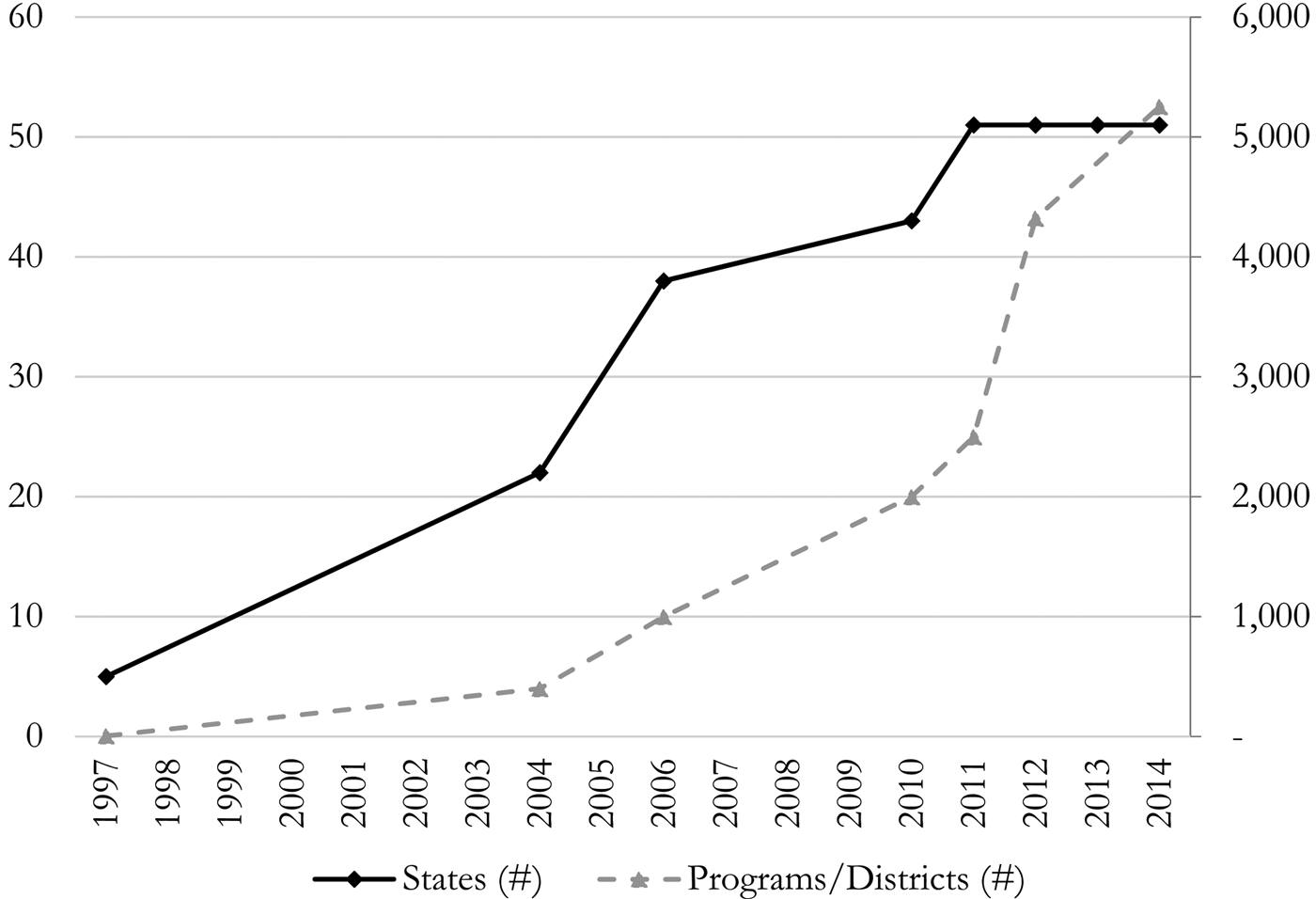
Beginning in 2012, Congress provided US$5 million/yr in mandatory funding for the Farm to School Grant Program. In addition, several programs included within the 2014 Farm Bill can provide financial support to local or state governments, farmers, non-profits, private businesses, higher education and K-12 institutions for FTS activities (USDA FNS 2016a). In part due to federal funding, as well as support from the state, private, community and philanthropic organizations, FTS programs have proliferated (see Fig. 1). According to the 2015 Farm to School Census, in the 2013/2014 school year 5254 districts (42%), 42,587 schools and 23.6 million children participated in FTS activities (ibid).
Growth of farm to school programs in the USA by state and school district participation, 1997–2014. Source: National Farm to School Network 2016.

Despite the interest in and support for FTS, there has been little research that examines how local food moves from FTS. This paper provides a preliminary analysis of how school districts procure local foods (i.e., directly from farmers, from non-traditional distributors that market locally branded food products such as ‘food hubs’, and/or traditional suppliers such as distributors and food service management companies) and the relationship to district non-milk local food expenditures per student. If a relationship exists between the supply chain utilized and a school district's local food expenditure per student, then it may imply that different transaction costs are associated with certain local food procurement methods. Further, as policies seek to expand local food sales to schools, this research can provide information on how different supply chains may support or hinder local food procurement.
Our Background section contains a review of trends in local food markets, FTS policies, and the relationship between local food markets and farm profitability. We subsequently discuss the FTS Census and research that use these datasets. Next, we use the 2015 Farm to School Census to estimate the relationship between non-milk local food expenditures per student and local food supply chains, including purchases directly from producers and non-traditional suppliers. Finally, we discuss implications for FTS local food procurement policy and opportunities for future research.
Background
Trends in local food markets
Interest and data about how local food gets to market continue to grow. As evidence, the USDA Census of Agriculture's 2015 Local Food Marketing Practices Survey was directed under the 2014 Farm Bill, and is the first-ever national survey focused on local food-marketing practices (USDA Census, 2016). The survey found that 167,009 producers sold through local markets in 2015, for a total sales value of US$8.7 billion. Of the US$8.7 billion in sales, 35% was sold direct to consumer (DTC) (e.g., farmers markets, road side stands, community supported agriculture (CSA)), 27% was sold to retailers (e.g., Whole Foods, Krogers) and 39% was sold to institutions (e.g., K-12 schools, universities and hospitals) and non-traditional suppliers (e.g., suppliers that market locally branded food products such as ‘food hubs’) (USDA NASS, 2016). Given that there is only one year of data available, we cannot use it to look at changes in local food sales or markets. Low et al. (Reference Low, Adalja, Beaulieu, Key, Martinez, Melton, Perez, Ralston, Stewart and Suttles2015), however, provide evidence from the USDA's Census of Agriculture and the USDA's Agricultural Resource Management Survey (ARMS) that growth in local food sales is occurring through intermediated markets, both traditional and non-traditional suppliers, while local food sales through DTC markets had plateaued. In the Northeast, O'Hara and Low (Reference O'Hara and Low2016) found that the recession was an important contributor to the plateau in DTC sales between 2007 and 2012.
Local food and FTS policies
Most Americans purchase food at home through intermediated (retail store) markets (USDA ERS, 2016). Perhaps because of this, USDA support to expand local and regional food systems has focused on developing food businesses, infrastructure and markets. Though FTS is not the explicit focus of most these policies (other than the USDA's Food and Nutrition Service's FTS grant program), many of these programs have supported FTS activities. For example, USDA programs include: farmers market and local food promotion program (Agricultural Marketing Service), farm loans and farm storage facility loans (Farm Service Agency), beginning farmer and rancher development grants, sustainable agriculture research and education grants (National Institute of Food and Agriculture), and business and industry guaranteed loans, rural business enterprise and opportunity grants, and value-added producer grants (Rural Development) (USDA FNS, 2016b).
Part of the rationale for these investments is due to a major perceived barrier for increasing sales to schools: complex supply chain networks required for school delivery (Vogt and Kaiser, Reference Vogt and Kaiser2008; Roche et al., Reference Roche, Conner and Kolondinsky2015; Matts et al., Reference Matts, Conner, Fisher, Tyler and Hamm2016; Becot et al., Reference Becot, Kolodinsky, Roche, Zipparo, Berlin, Buckwalter and Mclaughlin2017). Previous research found that farm sales to schools and institutions are limited due to challenges with supply chain logistics and regulations (Ohmart, Reference Ohmart2002; Izumi et al., Reference Izumi, Wright and Hamm2010; Dimitri et al., Reference Dimitri, Hanson and Oberholtzer2012; Thompson et al., Reference Thompson, Twomey, Hemphill, Keene, Seibert, Harrison and Stewart2014). Schools have noted a wide range of barriers to purchasing local products, including limited selection and unreliable supply due to seasonality, unreliable delivery, food safety concerns and additional labor and time for procuring product (Motta and Sharma, Reference Motta and Sharma2016). Challenges most commonly reported by farmers are limited selection/seasonality, frequent customer communication requirements, insufficient volume/supply to meet demand and seasonal limitations (Matts et al., Reference Matts, Conner, Fisher, Tyler and Hamm2016).
In many cases, distribution channels for local food sales to schools are not well developed (Dimitri et al., Reference Dimitri, Hanson and Oberholtzer2012). As a result, farmers who want to sell to schools rely on direct channels, which may limit overall sales. Farms with direct sales to schools report this channel as accounting for a small percent (between two and five) of total sales (Joshi and Beery, Reference Joshi and Beery2007; Joshi et al., Reference Joshi, Azuma and Feenstra2008; Feenstra and Ohmart, Reference Feenstra and Ohmart2012).
In an effort to support increased local food sales to school markets, food hubs are one of the supply chain infrastructure projects supported through several of the above-mentioned USDA programs. According to the USDA AMS (2016), food hubs support farmers and ranchers, especially smaller and mid-sized operations, to gain access to retail, institutional and commercial foodservice markets that they might not be able to access on their own. Food hubs are diverse, but usually offer a combination of aggregation, distribution and marketing services at a cost that makes it possible for producers to gain entry into larger volume markets, with the ultimate goal of increasing farmer income (ibid).
A growing literature on food hubs finds that they increase sales of local products (e.g., Fischer et al., Reference Fischer, Pirog and Hamm2015; Hardy et al., Reference Hardy, Hamm, Pirog, Fisk, Farbman and Fischer2016). Per the 2015 National Food Hub Survey, 31% of food hubs have K-12 foodservice customers (Hardy et al., Reference Hardy, Hamm, Pirog, Fisk, Farbman and Fischer2016). In their study of FTS in Vermont, Roche et al., (Reference Roche, Conner and Kolondinsky2014) find that food hubs can play an integral role in overcoming many of the barriers associated with direct FTS sales, including consistent availability, facilitating communication, food safety assurance and issues of quality control. Fischer et al. (Reference Fischer, Pirog and Hamm2015) similarly note that the commitment to supporting the economic viability of farmers is one of the key attributes that make food hubs distinct from traditional food distribution business. Jablonski et al., (Reference Jablonski, Schmit and Kay2016) use a case study of a food hub in New York State to provide empirical evidence that food hubs may have larger regional multiplier impacts than wholesale distributors in large part due to their commitment to source from local farmers. Further, they find that food hubs provide key distribution support for mid-scale producers with businesses that were too large to exclusively utilize direct-to-consumer markets and too small to access traditional distribution channels.
Yet, intermediated local food sales to schools are not without challenges. As Feenstra and Ohmart (Reference Feenstra and Ohmart2012) suggest, reliance on an intermediary reduces the transparency in the system and results in less of the total money spent by schools reaching the pocket of producers. Another challenge is due to the diverging perspectives of farmers and food service directors. Matts et al. (Reference Matts, Conner, Fisher, Tyler and Hamm2016) explain that while food service directors repeatedly call for a more convenient and streamlined way to purchase local produce, preferably through an already existing distributor, farmers do not see this as a priority. They find that additional ‘research is necessary to gain better insight on the availability and accessibility of processing and distribution infrastructure for FTI (farm to institution) and to realistically assess the cost and benefit of central processing and distribution locations from the farmers’ perspective’ (p. 67).
FTS Census
In 2013 and 2015, the USDA Food and Nutrition Service (FNS) conducted national surveys of schools and districts to better inform policies supporting FTS. The FTS Census (Census) included questions about the percentage of food obtained from local sources, top local food items and benefits and obstacles to implementing FTS. The 2013 survey included 9896 useable responses, with a response rate of 75% (USDA FNS, 2014). The 2015 survey included 12,585 responses, with a response rate of 70% (USDA FNS, 2016c). The data are publicly available on the USDA FNS website.
Our literature review revealed five research articles/USDA reports that use either the 2013 or 2015 Farm to School Census (Botkins and Roe, Reference Botkins and Roe2015; Lyson, Reference Lyson2016; McCarthy et al., Reference McCarthy, Steiner and Houser2017; O'Hara and Benson, Reference O'Hara and Benson2017; Ralston et al., Reference Ralston, Beaulieu Beaulieu, Hyman, Hyman, Benson and Smith2017). The current research can be classified into two broad categories.Footnote 1 The first explores the relationship between FTS and school district, community and farm level factors. Botkins and Roe (Reference Botkins and Roe2015) use the 2013 Farm to School Census, the National Center for Education Statistics’ Common Core data, and the USDA's 2012 Agricultural Census to investigate the relationship between a binary variable representing active FTS in a district with the type of activities implemented (i.e., serving local foods, maintaining a school garden, serving food from a school garden, organizing field trips, promoting local foods and conducting taste tests), the intensity of FTS participation (a simple count of the number of FTS activities implemented), and county agricultural and school district variables. The authors find a positive and significant relationship between a district serving local food and total county farm income, the number of farmers’ markets per 10,000 residents in the county, and the proportion of farms with DTC sales in the county. Regarding district characteristics, Botkins and Roe (Reference Botkins and Roe2015, p. 9) find a significant positive relationship between serving local food and the size of the school. They conclude ‘large schools are better able to implement FTS because of economies of scale’. O'Hara and Benson (Reference O'Hara and Benson2017) use the 2015 FTS Census to understand the impact of local agricultural conditions on school's local purchases. They find a positive and significant relationship between the number of students enrolled in a district and the probability that a district purchases non-milk local food products. They also find the percent of students eligible for free or reduced-price meals have a negative impact on the probability of purchasing non-milk local foods. Ralston et al. (Reference Ralston, Beaulieu Beaulieu, Hyman, Hyman, Benson and Smith2017) also find that schools with enrollment above 5000 students and with a higher density of nearby farmers’ markets were more likely to serve local foods.
The second group of studies examines the relationship between state FTS legislation and FTS implementation (Lyson, Reference Lyson2016; McCarthy et al., Reference McCarthy, Steiner and Houser2017). The authors in this line of research use the state as the unit of analysis in an effort to better understand how policy impacts the propensity of state public school districts to implement FTS programs. Using the 2013 Census, the 2013 Economic Census, the USDA Food Atlas food hub locations, and a binary variable representing statewide legislation supporting FTS, Lyson (Reference Lyson2016) shows that, although not statistically significant, federal FTS grant funding, state-level FTS legislation and accessibility to food hubs have a positive effect on FTS participation rates within the state, including but not limited to local food procurement. McCarthy et al. (Reference McCarthy, Steiner and Houser2017) investigate the role of state FTS legislation and find a positive relationship between state policies and FTS participation rates. None of the studies identified in our literature review examine the relationship between supply chain structure and local school food procurement.
Data and methods
Empirical model
We use the 2015 Farm to School Census to estimate the relationship between school district's local food expenditures per student and supply chain structure. We analyze the data using ordinary least squares regressions, controlling for the region of the USA, the type of local food products purchased, and other school-specific characteristics. Survey respondents were asked to report their total food expenditures and their local food expenditures including and excluding milk, which we use to create our dependent variable, the natural log of annual per-student expenditures on local foods for non-milk products. We use the natural log as the distribution of per-student expenditures as otherwise the distribution is highly skewed with considerable clustering at low levels of expenditures. Our analysis is restricted to schools that are purchasing positive levels of non-milk local products. Local milk accounts for 46% of local food expenditures by school districts (USDA, 2015). We do not model local milk purchases because milk is predominately marketed through cooperatives, up to 95% in many parts of the country (USDA RD, 2005). Thus, there is less variability in the types of supply chains used for local milk purchases relative to other food products.
The two primary independent variables of interest are whether schools purchase food: (a) directly from a producer and (b) directly from other-non-traditional suppliers but not directly from producers. We create these classifications from survey responses that indicate all of the distinct suppliers that the school districts utilize for local food purchases. We distinguish between traditional and non-traditional suppliers because in the latter instance, a school district would purchase from these businesses with the explicit intention of sourcing locally. Further, as mentioned above, there are many policies focused on supporting non-traditional suppliers with the explicit intent of increasing market access for small and mid-scale producers.
We classify school food purchases as being directly from a producer if the school district either purchased food directly from an individual food producer (i.e., farmer, fisher or rancher), at a farmers’ market, and/or via a CSA program. We merge farmers’ markets, CSA programs, and directly from producers together into one category since in the latter two instances, the school district presumably would have been purchasing food directly from individual food producers at such venues.
We classify other non-traditional suppliers to include: food hubs; farmer, rancher or fisher cooperatives; food buying cooperatives; and State Farm to School program offices. We classify food hubs as non-traditional since they are organizations that aggregate and market locally branded food products. Thus, a school district would be making an explicit effort to source locally by making purchases from food hubs. We also include cooperatives in this classification; cooperatives often explicitly exist to increase market access and the viability of their producer members. A similar rationale applies to the inclusion of the making local food purchases through a State FTS Program office, where the office exists to facilitate FTS relationships.
By default, we define ‘traditional’ suppliers as distributors, processors/manufacturers, Department of Defense Fresh Program vendors, USDA Foods and food service management companies. We emphasize that this regression does not allow for a causal interpretation, since decisions by the school district with regard to the amount of local food expenditures and local food suppliers are likely made simultaneously in most instances. However, the model can identify whether the two variables are correlated.
In order to test the robustness of our results, we run five sensitivity tests. In specification one, we include the size of the school district (divided by 10,000 students) as a control variable. We control for school size because larger school districts may be able to undertake local food purchases to a greater extent if the larger student body reduces the per-unit transaction costs associated with buying local food. We further include the percentage of students on free or reduced-price meals as a control variable, as schools with poorer student bodies (and thus likely receiving less revenue from property taxes) may not be able to afford to spend as much for local foods. We also include an indicator variable for whether the grades served by the school district influence local food expenditures. For instance, older students are less likely to participate in school lunch (Mirtcheva and Powell, Reference Mirtcheva and Powell2009) and may be more capable of engaging in other types of FTS initiatives, like a visit to the farm, both of which could influence a school's propensity to buy locally. We include dummy variables that control for the state and region of the country in which the school district resides to account for unobserved state and regional-level characteristics. We use regional definitions that correspond to FNS regional office territories.
Specification two includes the same variables as above plus we control for whether local food expenditures may be influenced by the types of food products that the district purchased locally from any supplier. These food categories, include fruit and vegetable, meat/poultry or seafood, and eggs.Footnote 2
In specification three, we interact the binary variable of whether a school district purchased directly from a farmer with (a) the types of food products purchased and (b) the grade structure of the school district. This is important as some food products may be more likely to be purchased directly from a farmer than other food products. We expect that schools with higher grades will have less propensity to purchase directly from producers because they have less money per student to spend on local food due to lower school lunch participation rates and greater focus on more active FTS curriculum in higher grades. We also include a binary control variable from the Census based on the respondent agreeing to the question, ‘Which of the following benefits have you enjoyed as a result of participating in farm to school activities? Greater community supports for school meals’. We control for this variable since there could be an association between community support for local sourcing and the amount spent on local food.
In specification four, we also test the overall sensitivity of the model to our market channel definitions by creating two binary variables that represent whether a school district exclusively purchased local foods directly from producers and whether a school district sourced locally both directly from producers as well as through other supply chains.
Finally, in specification five we test to see if a school district's definition of ‘local’ impacts our results by estimating our model with a subset of the data that defines local to be within the same city/county, or within a 50- or 100-mile radius. Testing whether our results are robust to variation in the definition of local is important as ‘local’ is self-defined by school districts in the survey, and is not answered consistently. Further, USDA does not have a standard definition for ‘local’ and determining if the relationship between supply chain and local food expenditure per student is sensitive to the definition of local could have important policy implications (e.g., determining if schools with certain definitions of local receive priority for funding).
Data adjustments
We make several adjustments to the Census dataset before conducting the analysis. We eliminate school districts that:
(1) did not identify that they had an active FTS program;
(2) are located in Guam, Puerto Rico and the US Virgin Islands;
(3) reported per-student expenditures either above the 98.5 percentile or below the 1.5 percentile of other districts in the dataset;
(4) reported having zero or missing student enrollment data;
(5) reported local food expenditures in excess of total food expenditures, which we assume is due to a clerical error;
(6) have non-numeric, zero, or missing observations for either non-milk local food expenditures or total food expenditures; and
(7) have per-student non-milk local food expenditures that exceed US$1000 per-student.
Next, we add district size information for 406 districts of the 953 districts that did not have school district size data reported in the Census database from the National Center for Education Statistics (2015) database. After these adjustments, our dataset includes 2689 observations from districts in schools in the 50 states and DC that implemented local food procurement as part of their FTS programs during the 2013/2014 school-year.
Descriptive statistics
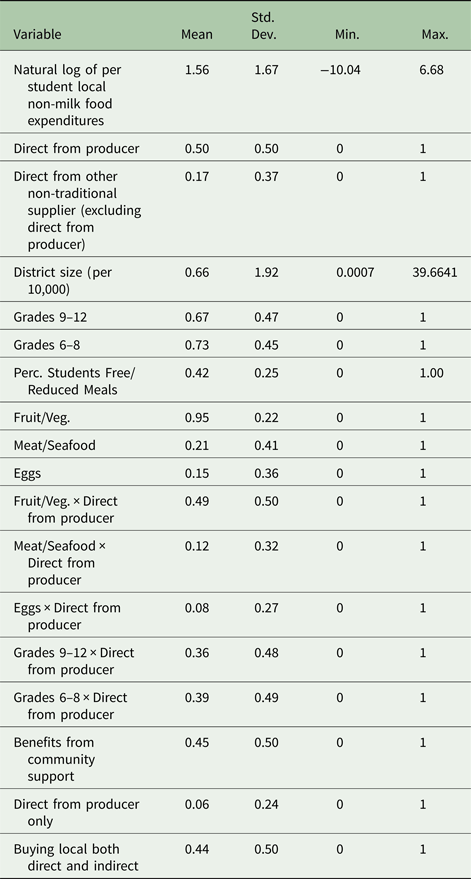
We present means, standard deviations, and ranges for all study variables in Table 1. According to the Census, 50% of school districts that purchased local foods made at least some of their purchases directly from producers, but only 6% of school districts purchased local foods exclusively from producers. Further, 17% of districts that purchased local foods made the purchase from other non-traditional suppliers and not directly from a producer.
Descriptive statistics

These descriptive statistics include 2689 observations.
Source: 2015 Farm to School Census.
The average district size included 6600 students with 67 and 73% of school districts in the survey serving students in grades 9 through 12 and 6 through 8, respectively. In our sample, the average percentage of students on free and reduced-price lunch was 42%. Forty-five percent of school districts reported that they enjoyed greater community support for school meals as a result of participating in FTS activities. The majority of school districts participating in FTS are purchasing local fruits and/or vegetables (95%), while a much smaller portion are purchasing local meats or seafood (21%) or local eggs (15%).
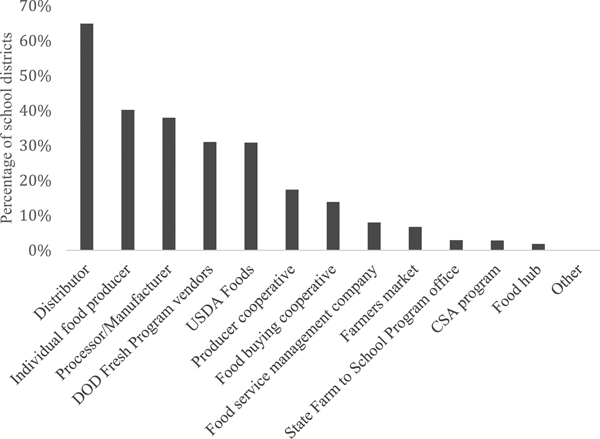
In Fig. 2, we present the percent of school districts using specific suppliers. We see that school districts are utilizing traditional suppliers to procure local foods to a considerable extent. In particular, 65% of school districts buy local foods from distributors, 38% purchase from processors/manufacturers, 31% purchase from Department of Defense Fresh Program vendors, 31% from USDA Foods, and 8% from a food service management company. Purchases directly from food producers were the second most common source for local foods, with 40% of school districts buying directly from producers, and an additional 7% at farmers’ markets and 3% from CSA programs. School districts made a smaller proportion of local food purchasers from non-traditional suppliers. Specifically, 2% of school districts buy from food hubs, 17% from producer cooperatives, 14% from food buying cooperatives and 3% from the State FTS Program offices.
Supply Chains Utilized by School Districts for Local Food Purchases. Source: 2015 Farm to School Census.

Results
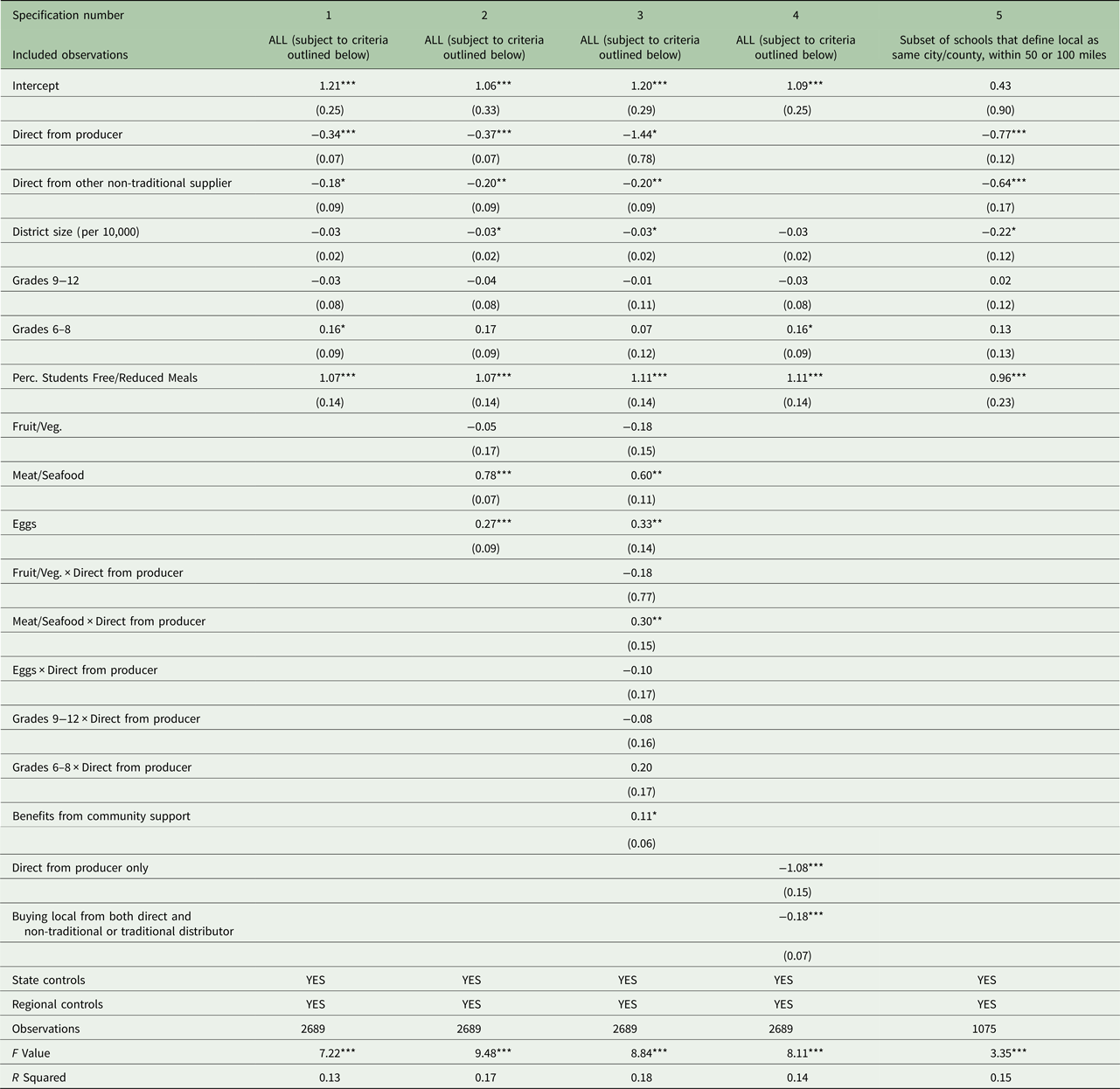
In all five specifications, we see that there is a negative and statistically significant relationship between the average non-milk local food expenditure per student and purchasing local food directly from a producer. In specifications one and two, the coefficient magnitudes range between −0.34 and −0.37. This implies that a change in the variable of buying directly from a producer is correlated with a 34–37% decline in the value of per-student expenditures for non-milk local food products. The coefficient is larger in specifications 3–5, ranging from −1.44 to −0.77. Note that in specification four, we find that exclusively buying directly from a producer had a negative and statistically significant coefficient that was larger than the parameter estimate in specifications one and two for schools buying directly from farmers (but not necessarily exclusively). This implies that purchasing exclusively local food products from producers is associated with a lower value of per-student expenditures for non-milk local food products as compared with purchasing directly from producers in coordination with other suppliers.
Further, we find a negative and statistically significant coefficient for purchasing from other non-traditional suppliers in all specifications (note that specification four includes the variable ‘buying local from both direct and non-traditional’). The coefficient magnitudes imply that purchasing from other non-traditional suppliers is associated with an 18–64% decline in the value of per-student expenditures for non-milk local food products. In specification five, we also see that when we restrict our data to the subsample of schools that define local in a similar manner that purchasing directly from a producer and purchasing from another non-traditional supplier are negative and statistically significant. Our results are robust to our sensitivity tests (Table 2).
The percent of students on free and reduced-price lunch is positive and significant in each of the specifications. We also find no significant relationship between per-student expenditure and districts serving grade levels 9–12 and only in specifications one and four do we find a significant relationship between the dependent variable and grade level 6–8. Further, only in specifications two, three, and five do we find a significant relationship between the dependent variable and size of the school.
The coefficients associated with purchasing certain types of agricultural products locally are consistent with the expected signs. Eggs and meat/seafood products have positive coefficients, implying that purchases of these products are associated with higher average non-milk local food expenditures per student.
Discussion and conclusion
Given that one goal of FTS is to increase local food purchases by schools, and steps have been taken to improve the efficiency of those transactions, understanding the relationship between supply chain and local food procurement is important and has potential policy implications. We use the 2015 FTS Census to estimate the relationship between the market channels used by school districts to purchase local foods and per-student non-milk local food purchases. We analyzed data using ordinary least squares regressions, controlling for the region of the USA, the type of local food products purchased, and other school-specific characteristics. Our results provide the first empirical evidence using a national dataset of the relationship between a school district's non-milk local food expenditures per student and supply chain structure. Importantly, we show that schools purchasing directly from producers and/or from non-traditional distributors spend significantly less per student on non-milk local foods. We also find that this effect is more pronounced when the district purchases local food products exclusively from producers.
The negative coefficients associated with purchasing local foods directly from producers could be due to many of the factors cited in the literature review. For school districts, there are higher transactions costs involved with local purchases, including limited selection/seasonality, reliable delivery, reliable supply, food safety concerns and additional labor and time required for procuring local product. Additionally, the high barriers to entry (e.g., regulations and minimum quantities) for producers to sell to schools may deter their sales. Intermediaries can thus reduce the transaction costs for both schools and producers.
The negative coefficient associated with purchasing local food from non-traditional distributors warrants further investigation. Food hubs are a relatively new type of supplier, and only 3% of school districts currently source local foods through them. The negative coefficient could be due to high transaction costs associated with purchasing from cooperatives, which are utilized by 17% of districts. Perhaps these cooperatives are focused on single commodities, and thus require additional time and effort from school buyers in purchasing product. Non-traditional distributors may not be as successful at reducing the transactions costs associated with selling to schools as suggested in the literature.
The positive coefficients associated with purchasing eggs and meat/seafood products imply that purchases of these products are associated with higher average non-milk local food expenditures per student. This may be because they are less frequently sourced locally than fruits and vegetables, so that the efforts that schools make to secure these local products may indicate a greater commitment to sourcing local foods. Another explanation for the positive coefficient associated with meat/seafood products is because meat and seafood purchases can comprise a relatively large share of the overall school food budget.
Other research has found that larger schools have a higher propensity to participate in FTS (O'Hara and Benson, Reference O'Hara and Benson2017). However, we found that there is not a significant association between district size and average non-milk local food expenditure per student. Further, the positive and significant coefficient for percent of students with free and reduced meals is inconsistent with our hypothesis. The positive coefficient may occur because districts with a large percent of these students may be able to access additional funding sources to supplement their food expenditure budgets, allowing them to purchase more local foods.
Policy implications and future research
This research provides preliminary evidence that there is a relationship between supply chain structure and school district's local food expenditure per student. Our results suggest that traditional distributors may be able to most efficiently supply local food to schools, and that there may be higher transaction costs associated with school procurement from producers and non-traditional suppliers.
Policy implications from our study depend on the relative importance of the various goals associated with FTS. Returning to Joshi et al.’s (Reference Joshi, Azuma and Feenstra2008) definition of FTS, two distinct but related objectives of FTS relate to the magnitude of local purchases and the size of supported farms. If, for example, the priority of FTS is to supply as much locally procured food as possible to schools, then the findings herein could suggest that there is an advantage to sourcing through traditional distributors. However, if the prioritized goal of FTS is to increase market access for small and medium-sized producers, further investigation is needed as to whether the traditional distributors are providing new market opportunities for small and medium-sized producers or if they are simply doing a better job of labeling ‘local’ without real shifts in their procurement patterns.
If a goal of FTS is increasing market access and relatedly the economic viability for small and midscale producers, then the FTS Census does not allow one to answer this question. Further, if large buyers are able to source and market local food, it is unclear what resulting economic impact this would have on farms, particularly those that are small and midscale (DeLind, Reference DeLind2010).
More research is needed that examines the farm profitability impacts of school sales using different distribution methods: direct, non-traditional distribution and traditional distribution channels. Several preliminary case studies find wide variability in costs associated with participation in local markets, particularly due to labor, and that often farms are selecting their marketing channel mix without fully considering the total costs involved (Hardesty and Leff, Reference Hardesty and Leff2010; LeRoux et al., Reference LeRoux, Schmit, Roth and Streeter2010; Jablonski et al., Reference Jablonski, Perez-Burgos and Gómez2011; Schmidt et al., Reference Schmidt, Kolodinsky, Desisto and Conte2011). Additional case study evidence provided by King et al. (Reference King, Hand, Digiacomo, Clancy, Gomez, Hardesty, Lev and Mclaughlin2010) shows that localized supply chains can enhance farm viability, as farms receive a greater share of retail prices in local food supply chains than in mainstream chains (up to seven times larger). However, none of these previous assessments looks specifically at farm sales to schools, or how school's procurement of local food impacts farm profitability. Investigation into how school markets impact farm profitability remains an important topic for future research.
OLS Regression results natural log of per student local non-milk food expenditures

***, significant at 1% level. **, significant at 5% level. *, significant at 10% level. Eight observations with average non-milk local food expenditures that exceeded US$1000 were removed. Observations with zero, missing or negative non-milk local food expenditures or total food expenditures were removed.
Source: 2015 Farm to School Census.
Acknowledgements
This work was supported by a grant to the National Farm to School Network by CoBank and AgriBank. The sponsors played no role in the study design, collection, analysis interpretation of data, writing of the report, or decision to submit the article for publication. The views expressed are those of the authors and should not be attributed to the U.S. Department of Agriculture or the National Farm to School Network.