

1. Introduction
Information is essential for the electorate to assess the quality of their government. Among all information sources, the media is primary. At the same time, media outlets also care about their reputations. Indeed, almost all media outlets claim that they are able to gather more—and more accurate—information than other media outlets. However, when popular opinion of a government is not too low, media outlets endorse government decisions instead of reporting critical opinions. Despite the principles of watchdog journalism being widely accepted in democracies, journalists do not always follow them (Boydstun, Reference Boydstun2013; Norris, Reference Norris, Bovens, Goodin and Schillemans2014).
This lack of independent and critical reporting could be an especially significant issue in areas in which the government is believed to have no strong partisan bias but have access to secret information. A classic example is the media coverage of the Gulf of Tonkin Incident in 1964, which was the basis for President Johnson ordering a retaliatory action against North Vietnam. In 1964, the U.S. media did not challenge the government but reported the incident as fact. Yet, in 2007, when classified information on the incident was made public following a Freedom of Information Act request, the public finally learned that this attack was imaginary. This cannot be explained by the lack of accessible information alone. In a seminal book about this event, Hallin (Reference Hallin1986) asserts that “[government] control of information by itself, however, by no means explains the effectiveness of their efforts. There was, in fact, a great deal of information available which contradicted the official account; it simply wasn't used” (p. 31). He considers the fact that the French newspaper Le Monde reported a story on the incident very different from those of the U.S. news outlets as evidence of the media's access to (non-reported) information.Footnote 1 Indeed, there are also many similar discussions surrounding, for example, the contemporary Iraq War.
In the political economy literature, explanations about the conformist reporting include “grabbing hand” (e.g., Besley and Prat, Reference Besley and Prat2006)—suggesting that the government may use its power to intervene in media reporting—and also include the political motives of media owners (e.g., Larcinese et al., Reference Larcinese, Puglisi and Snyder2011; Anderson and McLaren, Reference Anderson and McLaren2012). This paper argues that neither of these conditions is necessary. Instead, a media outlet may report untruthfully solely because of its reputational concerns. Using a game theoretical model, I show that a reputation-concerned media outlet usually refrains from truthfully reporting information. Instead of carrying out its role as a watchdog, a media outlet tends to act as a yes man,Footnote 2 which means it endorses the government's decisions despite possessing contradictory information. With access to only yes-man reports, the public cannot acquire relevant information about the government's competence.
This paper analyzes a game with three actors: the government, the media outlet, and the representative voter. The government makes a decision to implement a policy. Following the policy decision, the media outlet reports the information about it to the voter. To decide whether to retain the incumbent, the voter wants to determine the competence of the government from both the observed policy decision and the media report. However, the news report also reveals information about the quality of the media outlet, so the voter forms opinions not only about the government but also about the media outlet by Bayesian updating. The media outlet that is concerned about its own reputation thus has to make its reporting decision strategically.
With this model, I first consider the case when a single media outlet is the only source of information for the voter. The model shows that the media outlet never truthfully reports information because of its reputational concerns. The intuition is that when there is no other source of information that can reveal yes-man behavior, it is always beneficial for the media outlet to endorse the government's decision because doing so never decreases the media outlet's reputation: When the reader believes that the media outlet is reporting truthfully, a report matching the government policy improves its reputation. On the other hand, a report conflicting the government policy does not improve the media outlet's reputation since either the policy decision or the report can be wrong.
I next study the general case, in which the voter can also possibly receive a perfect signal from other sources of information. For example, the voter can receive information from foreign media or a natural disaster may take place that reveals the truth of low-quality governance. The analysis shows that, with the imperfect feedback, the media outlet becomes more likely to report truthfully. However, the conditions for a truthful reporting equilibrium to occur are still restrictive: The government has to be considered incompetent and the probability of the exogenous revelation has to be high. Otherwise, endorsing the government's decision usually yields higher reputation for the media outlet. This means, in general, that the voter is unlikely to acquire truthful information about the quality of the government from media reports. It is particularly true when the government is expected to be reasonably competent because in this case, an incompetent media outlet has a higher incentive to pander to the government policy in its reportingto maximize the probability of being correct. To have a truthful reporting equilibrium, two conditions must hold simultaneously: The expected competence of the government is sufficiently low, and the probability for the voter to learn from other information sources is sufficiently high.
Because media outlets in this model care only about reputation, do not have political agendas, and are not under the threat of media capture, the setup can be considered the most likely case for independent reporting. Importantly, the yes-man problem persists even when the electorate will know with certainty the true state ex post, as well as when there exist multiple media outlets. The results also hold when the media outlet cares not only about reputation but ideology.
The paper proceeds as follows. I first relate this topic to the existing literature. Then, I introduce the model and analyze the conditions for the existence of a truthful reporting equilibrium and present comparative statics in the case of one media outlet. I further analyze the cases when the media outlet is also concerned about political ideology, when the voter's primary concern is about the government's honesty, and when there exist multiple media outlets. I then conclude the paper. All proofs are presented in the online Appendix.
2. Related literature
This paper relates to the literature of strategic media reporting, media reputational concerns, and media's incumbency bias, particularly Gentzkow and Shapiro (Reference Gentzkow and Shapiro2006) and Ashworth and Shotts (Reference Ashworth and Shotts2010). This paper is connected more generally with the literature of strategic information transmission.
Because the electorate relies on media reports to learn information for political selection and to discipline politicians, there is a natural concern about the quality of the reports. Besley (Reference Besley2005) remarks that “the media can assist voters in identifying the quality of candidates and conversely, political selection will often work poorly in countries where the media is repressed” (p. 56). Chiang and Knight (Reference Chiang and Knight2011) show empirically that endorsements from newspapers are influential in voters' decisions, but the level of influence is conditioned on the perceived credibility of the media. Bruns and Himmler (Reference Bruns and Himmler2016) consider a model in which the media outlet is a profit maximizer, showing that voters are willing to incentivize the media to report valuable information to hold politicians accountable. Politicians also respond to the media environment of a society (Wolton, Reference Wolton2019).
However, this paper is one of several that argues that the media may fail to deliver on its promise of competency and truthfulness. In particular, a media outlet that wants to be regarded as high-quality may conceal information that endangers its reputation.
Gentzkow and Shapiro (Reference Gentzkow and Shapiro2006) show that media reports tend to pander toward voters' prior beliefs to build their reputations. In this paper, I show that, to bolster its reputation, a media outlet may become a yes man to the government. The two papers are similar in three ways: (1) the interim belief for the voter of what is the true policy (depending on the believed competence of the government) is similar to the prior in the model; (2) both papers characterize pandering reporting equilibrium of media outlets; and (3) both papers show that availability of feedback and competition between media market can induce truthful reporting. While applying the framework of Gentzkow and Shapiro (Reference Gentzkow and Shapiro2006) would be sufficient for characterizing the basic result of this paper, that is, the yes-man equilibrium, with a richer policy space adopted from Caillaud and Tirole (Reference Caillaud and Tirole2002), this paper shows that the media outlet does not always report truthfully even when the voter receives feedback with certainty. More importantly, my analysis shows the upper limit of the competition effect: Even when there are an infinite number of media outlets, the existence of a truthful reporting equilibrium is not guaranteed. Hence, the present paper demonstrates the existence of a more substantial yes-man problem of the media when the policy option is not binary.
In terms of the media's reputational incentive, this paper focuses on media's reputation for competence; previous research has considered reputation for neutrality. Shapiro (Reference Shapiro2016) argues that a media outlet that wants to be viewed as unbiased may not report the full set of facts to the voter, and, thus, the voter can only form an ambiguous impression about the debate even when there is a clear consensus among experts. Morris (Reference Morris2001) suggests that an information provider may conceal information to be considered as unbiased.
Ashworth and Shotts (Reference Ashworth and Shotts2010) discuss whether informative media commentary can help solve the problem of a government choosing to implement a popular, but incorrect, policy even when the policy-maker does know that this is not the correct decision. Their model shows that sometimes, a media report makes the problem of pandering worse, especially when the media outlet acts as a yes man. This paper is closely related to Ashworth and Shotts (Reference Ashworth and Shotts2010), but there are at least two significant differences: (1) This paper shows that the media outlet may act as a yes man even when it is more competent than the government, and (2) this model allows analysis of media competition, as well as of cases with various other information sources.
The media's reputational concerns thus lead to yes-man behavior, and media reports tend to be biased in favor of the incumbent government. In the political economy literature, there are other explanations of conformist reporting. A prominent explanation, “grabbing hand,” suggests that the government may use power to intervene into media reporting. Besley and Prat (Reference Besley and Prat2006) and Gehlbach and Sonin (Reference Gehlbach and Sonin2014) belong to this strand. By contrast, Baron (Reference Baron2006), Larcinese et al. (Reference Larcinese, Puglisi and Snyder2011), and Anderson and McLaren (Reference Anderson and McLaren2012) explain the existence of incumbency bias by political motives of media owners.
In the political communication literature, many studies aim to explain the lack of independent reports by “indexing theory” (Bennett, Reference Bennett1990); that is, the news coverage reflects the range of views that exists within the government. If there is a consensus within the government, there will be few critical reports, and non-official views are not covered (Zaller and Chiu, Reference Zaller and Chiu1996). Hallin (Reference Hallin1986) suggests that patriotism or principles of professional journalism led news outlets to conceal some information during wartime. Althaus et al. (Reference Althaus, Edy, Entman and Phalen1996) suggest that the norm of objectivity that encourages journalists to present conflict and balance in debate may contribute to the overemphasis on a one-sided elite voice. Boydstun (Reference Boydstun2013) explains why media cover some issues in detail but not others by the competition for attention across issues depending on the nature of the stories, along with a range of institutional incentives, such as policy-maker attention and public concern. Selective reporting across issues is an important research topic but beyond the scope of this paper.
In this paper, media reporting is cheap talk, and, thus, this paper is connected with the literature of strategic information transmission that begins with Crawford and Sobel (Reference Crawford and Sobel1982). It is especially close to Ottaviani and Sørensen (Reference Ottaviani and Sørensen2006), who discuss a reputation-concerned expert using a cheap-talk message to signal its quality to the evaluator. Unlike most cheap talk models, the media outlet in this paper is policy-wise unbiased. Nevertheless, due to the media outlet's reputational concerns, its report might still not reveal the truth to the voter.
3. The model
3.1. Players
There are three players in this model: a government G, a media outlet M, and a voter V. The government G and the media outlet M are either competent h or incompetent l. The type of the government (τ G = J) and the type of the media outlet (τ M = J), where J ∈ {l, h}, are each organization's private information. It is common knowledge, however, that Pr(τ G = h) = p and Pr(τ M = h) = q. The competent actors are more likely to learn the true state of the world than are the incompetent actors.
3.2. Policy choice and media report
Following the setup of Caillaud and Tirole (Reference Caillaud and Tirole2002), Nature draws the state of the world ω from a uniform distribution on the interval [0, 1], formally ω ∈ Ω ~ U(0, 1). The government chooses a policy x also from the uniform distribution. Among the infinite number of policy choices, only one unique policy is correct, meaning that only one policy matches the true state of the world. I apply this policy structure to clearly capture the event that the second mover herds its action to that of the first mover. It is noteworthy that, as in Caillaud and Tirole (Reference Caillaud and Tirole2002), the existence of an indefinite number of wrong choices makes the situation in which multiple actors receive private signals suggesting a same wrong choice to be a probability 0 event.
The government observes a signal $s^G_J$ indicating the correct policy, where J ∈ {l, h}. The signal may be noisy. When the government is competent, the probability of the signal matching the true state ${\rm Pr}(s^G_h=\omega )$
 is $\overline {\gamma }$
 . With probability $1-\overline \gamma$
 , $s^G_h$
 is randomly drawn from the infinitely many wrong options, and hence ${\rm Pr}(s^G_h=\omega )=0$
 . For an incompetent government, the probability ${\rm Pr}(s^G_l=\omega )$
 is $\underline {\gamma }$
 , and $0 \le \underline {\gamma }\le \overline {\gamma } \le 1$
 .
Similar to the government's decision, the media outlet chooses its report r from the same uniform distribution. The media outlet observes x and also a private signal $s^M_J$ , where J ∈ {l, h}, before reporting. The probability that the competent media outlet learns the correct policy is ${\rm Pr}(s^M_h=\omega )=\overline {\mu }$
 . For an incompetent media outlet, the probability ${\rm Pr}(s^M_l=\omega )$
 is $\underline {\mu }$
 , and $0 \le \underline {\mu }\le \overline {\mu } \le 1$
 . The media outlet then decides what information r to report to the voter. When $x \ne s^M_J$
 , I call $r=s^M_J$
 truthful reporting, and r = x yes-man reporting.
To simplify exposition, I denote the ex-ante expected quality of the government as $E(\gamma )=p\overline {\gamma }+ (1-p)\underline {\gamma },$ and the expected quality of the media outlet as $E(\mu )=q\overline {\mu }+ (1-q)\underline {\mu }.$
 To focus on the interesting cases, I consider that the qualities of the competent media outlet, the government, and the incompetent media outlet are ordered as $\overline {\mu }\ge E(\gamma )\ge \underline {\mu }$
 . For numerical analyses in the comparative statics section, we only need $\overline {\mu }\ge \underline {\mu }$
 .
An important attribute of this model is that, policy-wise, the government and the media are unbiased. This is because I aim to show that conformist reporting is possible even when no political bias is involved. This can be understood as all members of the society share a common interest in issues such as national security or economic stability.
As yes-man behavior is most likely to be detected in this situation than in other environments such as a binary choice setting, the Caillaud and Tirole setup, combined with the most severe punishment imposed by the voter (discussed below), means that the model is analyzing the most unlikely case that the media outlet will deviate from truthful reporting. After the analysis of the general model, I discuss how the equilibria change only slightly when there is also uncertainty about the ideological position of the media outlet and when the voter is concerned about the government's honesty.
3.3. Learning, reputation, and reelection
The voter decides whether to retain the incumbent by observing the policy implemented x and learning information from the media. The voter does not observe the consequences of the policy directly. The justification is that the consequences of a policy are sometimes witnessed long after it is implemented (Besley, Reference Besley2007, 80). Instead, the voter reads the related report from the media to determine the quality of the government and decides whether to reelect the incumbent. At the same time, the media outlet builds (or ruins) its reputation via its report.
This paper also considers the case that, with probability ρ, information from other exogenous sources, such as foreign media reports or natural disasters, reveal a perfect signal of the true state s V = ω to the voter. In other words, the voter could potentially, with probability ρ, receive perfect ex-post feedback about the state of the world. Formally, Pr(s V = ω) = ρ and ${\rm Pr}(s_{\rm V}=\emptyset )=1-\rho$ . With the policy decision x, the media report r, and the exogenous information s V, the voter updates her beliefs about the type of the government and the media outlet, and makes her reelection decision.Footnote 3 The voter chooses the new government G′ either by retaining the incumbent or by a random draw from the candidate pool. In the latter case, I suppose Pr(τ G′ = h) = p. Also, I assume that if indifferent, the voter retains the incumbent.
It is assumed that the voter applies the most severe punishment to the media outlet once she finds it does not report truthfully. That is, once the media outlet is caught cheating, the voter believes it is incompetent, or formally, Pr(τ M = h|s V = ω ≠ (r = x)) = 0. Relaxing this assumption only disincentivizes the media outlet to report truthfully.
3.4. The payoffs
The model incorporates the idea of reputational payoff used in Kartik and Van Weelden's (Reference Kartik and Van Weelden2019) analysis of cheap talk in elections. The payoff for the media outlet U M is a strictly increasing mapping of its reputation for competence. Formally, I denote $U_M =\Pi ({\hat q})$ , where ${\rm Pr}(\tau ^M=h \vert x, r, s_{\rm V})={\hat q}$
 , and $\Pi : {\hat q} \rightarrow {\opf R}_+$
 can be any strictly increasing function. The media outlet enjoys utility from an increase in its reputation. For example, higher reputation could lead to an expansion of readership or an increase in advertising revenue.
Similarly, I define the payoff of the government as $U_G =\Delta ({\hat p})$ , where ${\rm Pr}(\tau ^G=h \vert x, r, s_{\rm V})={\hat p}$
 . $\Delta : {\hat p} \rightarrow {\opf R}_+$
 can be any strictly increasing function. The government's increasing utility from reputation comes from the rising probability of winning reelection, increasing political donations due to popularity, etc.
The voter wants to know the quality of the government to facilitate her political selection. The payoff for the voter is $U_{\rm V} ={\tf="PS8B4B"\char"31}_{\{\tau ^{G'}=h\}}$ , which means the voter enjoys a utility normalized to one when she selects a competent government G′.
3.5. Timing
The timing of this game is as follows and can be summarized as in Figure 1:
1. Nature chooses the types of actors τ G = J and τ M = J, J ∈ {l, h} and the state of the world ω
2. G observes $s^G_J$
 and implements a policy x
3. M observes $s^M_J$
and x, and reports r4. With probability ρ, V learns the true state via other information sources
5. V forms the posterior belief about the types of G (${\hat p}$
) and M (${\hat q}$) and selects G′6. The payoffs are realized, and the game ends.


Timeline.

3.6. Equilibrium concept
The equilibrium concept applied is pure-strategy perfect Bayesian equilibrium, and weakly dominated strategies are excluded. Similar to Ottaviani and Sørensen (Reference Ottaviani and Sørensen2006), the main goal of the analysis is to check whether there could exist truthful equilibrium in which both types of media outlet report truthfully. Formally, truthful reporting equilibrium means the media outlet reports the information it learnt truthfully to the voter, that is, $r= s^M_J$ . When a truthful reporting equilibrium does not exist, I characterize a yes-man equilibrium, which is a pooling equilibrium in which both types of the media outlet report an endorsement of the government's decision independent of the private information, formally r = x. Discussing the yes-man equilibrium is reasonable because media outlets are not likely to challenge the government without very good reason. A good relationship with officials is usually critical for future news reporting (Eraslan and Özertürk, Reference Eraslan and Özertürk2017). Hence, intuitively, we can think that if a truthful reporting equilibrium fails to exist, the media outlet will automatically switch to the yes-man reporting strategy. With a truthful reporting equilibrium, the voter updates her belief about the quality of the government based on the media's report. With a yes-man equilibrium, the voter does not update her belief. Off the yes-man equilibrium path, it is required that the voter should not believe a media outlet to be more likely to be competent (${\hat q} \gt q$
 ) upon observing r ≠ x; otherwise, the outlet will always report r ≠ x even when ${s^M_J}=x$
 .
4. Analysis
4.1. Ideal case: when truthful reporting exists
The voter wants the media outlet to be an effective watchdog. The ideal world for the voter is one in which only a competent media outlet exists and it always truthfully reports its information. Thus, when the media report endorses the government's policy, the voter can infer that the government is more likely to be of high competence, and when the media report conflicts with the government's choice, then the voter knows the government is more likely to be of low quality. The voter can therefore decide whether to reelect the incumbent following the media report.
Formally, this first-best situation means

Suppose Pr(τ M = h) = 1 and the media outlet reports information truthfully. By Bayes' rule,

and Pr(τ G = h|r = x) is always greater than p when $\overline {\gamma } \gt \underline {\gamma }$ .
Similarly, we have

and p is always greater than Pr(τ G = h|r ≠ x) when $\overline {\gamma } \gt \underline {\gamma }$ .
Lemma 1. A media report is a meaningful signal of the government's competence if and only if the media outlet reports truthfully, independent of the quality of the media outlet.
As such, we know that a media report is a meaningful signal of the government's competence if the media outletFootnote 4 reports information truthfully (instead of reporting as a yes man), but in the following sections, I show that because of the media outlet's reputational concerns, the voter is not likely to learn the type of the government from the media report.
4.2. No other source of information
Following the practice of Gentzkow and Shapiro (Reference Gentzkow and Shapiro2006), the analysis begins with a case with a single media outlet. In this case, there are no other sources of information available for the voter, so she relies solely on one media outlet's report to learn the quality of the government. In a democratic context, this happens in a country with a media monopoly, such as Brazil (see Amaral and Guimarães, Reference Amaral and Guimarães1994), or with a very homogeneous media market evolved after a series of mergers (as discussed in Anderson and McLaren, Reference Anderson and McLaren2012).
I solve this game using backward induction and checking if there is a profitable deviation for the media outlet from the truthful reporting equilibrium. The voter updates her beliefs and makes her electoral decision based on the media report when the media outlet reports truthfully, instead of sending a babbling signal. It is obvious that once the media outlet receives a signal $s^M_J= x$ , it will transmit the signal truthfully. Whereas, if the media outlet receives a signal $s^M_J\ne x$
 , the media outlet needs to decide to report either r = x or r ≠ x. If the voter believes the media outlet reports truthfully, by Bayes' rule, the voter's posterior belief about the media outlet's competence when r ≠ x is:

If r = x, again supposing that the voter believes the media outlet reports truthfully, the posterior is:

By comparing the two posteriors, we can see that, except when the media outlet does not have to signal its type by its report,Footnote 5 endorsing the government (r = x) leads to strictly higher reputation for the media outlet. Thus, when receiving a signal that is different from the government's decision, the media outlet will deviate from truthful reporting. The mechanism driving this result is simple: Being a yes man yields higher posterior reputation for a media outlet if the voter believes the report is truthful. Thus, the truthful reporting equilibrium does not exist.
When it is in yes-man equilibrium, because the report is a babbling signal and the voter does not update beliefs with it, the posterior is Pr(τ M = h|r = x) = Pr(τ M = h|r ≠ x) = q. Thus, there is no profitable deviation for the media to report r ≠ x instead of r = x. As noted earlier, it is intuitive to understand that the media outlet will not issue a report challenging the government's decision for no obvious reason.
The government's action is very straightforward in this model. When the government is making the policy decision, the only information on hand is the signal $s^G_J$ . Thus, irrespective of the media outlet's reporting strategy, the probability that the decision and the report match ($r= s^G_J$
 ) is always higher than the probability that they don't match ($r \ne s^G_J$
 ).Footnote 6 Assuming a truthful reporting equilibrium, when observing $r= s^G_J$
 , the voter believes the government is more likely to be competent. Therefore, it is a dominant strategy for the government to set the policy $x= s^G_J$
 , and this is true in all cases discussed in this paper.
The yes-man equilibrium is the unique equilibrium in this case. It is robust to Cho and Kreps's Intuitive Criterion because the competent media outlet cannot do better by reporting r ≠ x. On the other hand, any separating equilibrium—for example, only the competent media outlet reports truthfully—cannot survive the Intuitive Criterion. In this situation, the incompetent media outlet has an incentive to always report r ≠ x to be viewed as competent. This paper focuses on studying pure-strategy equilibrium. Indeed, there are many mixed-strategy equilibria in which the media outlet randomizes its reporting independent of its private signal, but they are weakly dominated by the yes-man equilibrium, because the media outlet will not gain higher reputation by randomizing its reporting than by reporting as a yes-man.
The following example can demonstrate the mechanism clearly: Suppose the government and the media outlet received different signals, and $\{\overline {\mu }=0.6, \underline {\mu }=0.4, E(\gamma )=0.6, q=0.6\}$ . Then, if the voter believes the news report is truthful, the posterior about the media outlet's competence is 0.558. If, instead of reporting r ≠ x, the media outlet reports r = x, the posterior increases to 0.692. Thus, it is a profitable deviation for the media outlet. In this case, the media outlet never has an incentive to report truthfully. The media outlet is a yes man instead of a watchdog, and the voter cannot infer the quality of the government from the media report. Following the assumed tie-break rule, the voter retains the incumbent because she does not find the incumbent and challenger discernibly different from one another (${\hat p}=p$
 ).
Proposition 1. When the media outlet is the only source of information for the voter, there is no truthful reporting equilibrium. Even when the media outlet is more competent than the government, it does not report truthfully.
4.3. When the voter may learn from other sources
Now I analyze the general case of the model where, with some probability ρ ∈ (0, 1), the voter learns the true state from other information sources.
When ρ = 1: To find the conditions for the media outlet to report truthfully when ρ ∈ (0, 1), we need to find the posteriors attainable with different actions when ρ = 0 and ρ = 1. We already have the posteriors for ρ = 0, so now we need to find the posteriors for ρ = 1. The detailed calculations are given in the online Appendix. The analysis shows that when the voter can perfectly learn the true state ex post, the competent media outlet will always report truthfully because the probability for the competent media outlet to be correct is higher than that for the government ($\overline {\mu } \gt E(\gamma )$ ). However, the incompetent media outlet could still have an incentive to report untruthfully even when yes-man behavior is very likely to be detected.Footnote 7 To have a truthful reporting equilibrium, we need both types of media outlets to report truthfully. Thus, a truthful reporting equilibrium is not guaranteed despite the fact that the voter can perfectly learn the true state ex post. If the truthful reporting equilibrium is not guaranteed even in this extreme case,Footnote 8 we can expect that the truthful reporting equilibrium is less likely to exist in the general case.
When ρ ∈ (0, 1): With the posteriors in different situations when ρ = 0 and ρ = 1, we can analyze the general case and find the conditions for the existence of the truthful reporting equilibrium. The detailed calculations are given in the online Appendix.
The condition for the competent media to report truthfully is:

where $T=q(1-\overline {\mu }E(\gamma ))+(1-q)(1-\underline {\mu }E(\gamma ))$ .Footnote 9
The condition parallel to (5) for the incompetent media is:

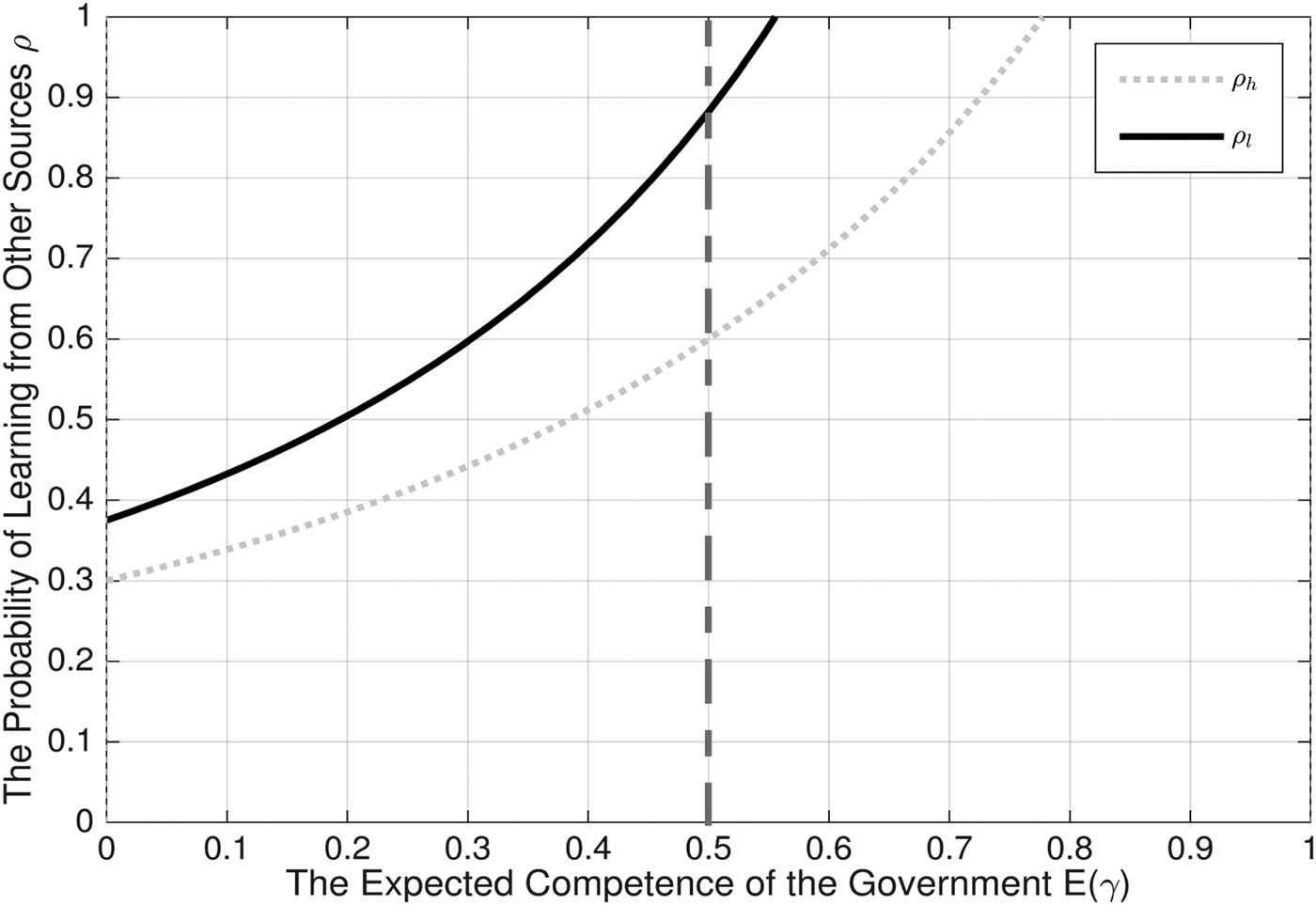
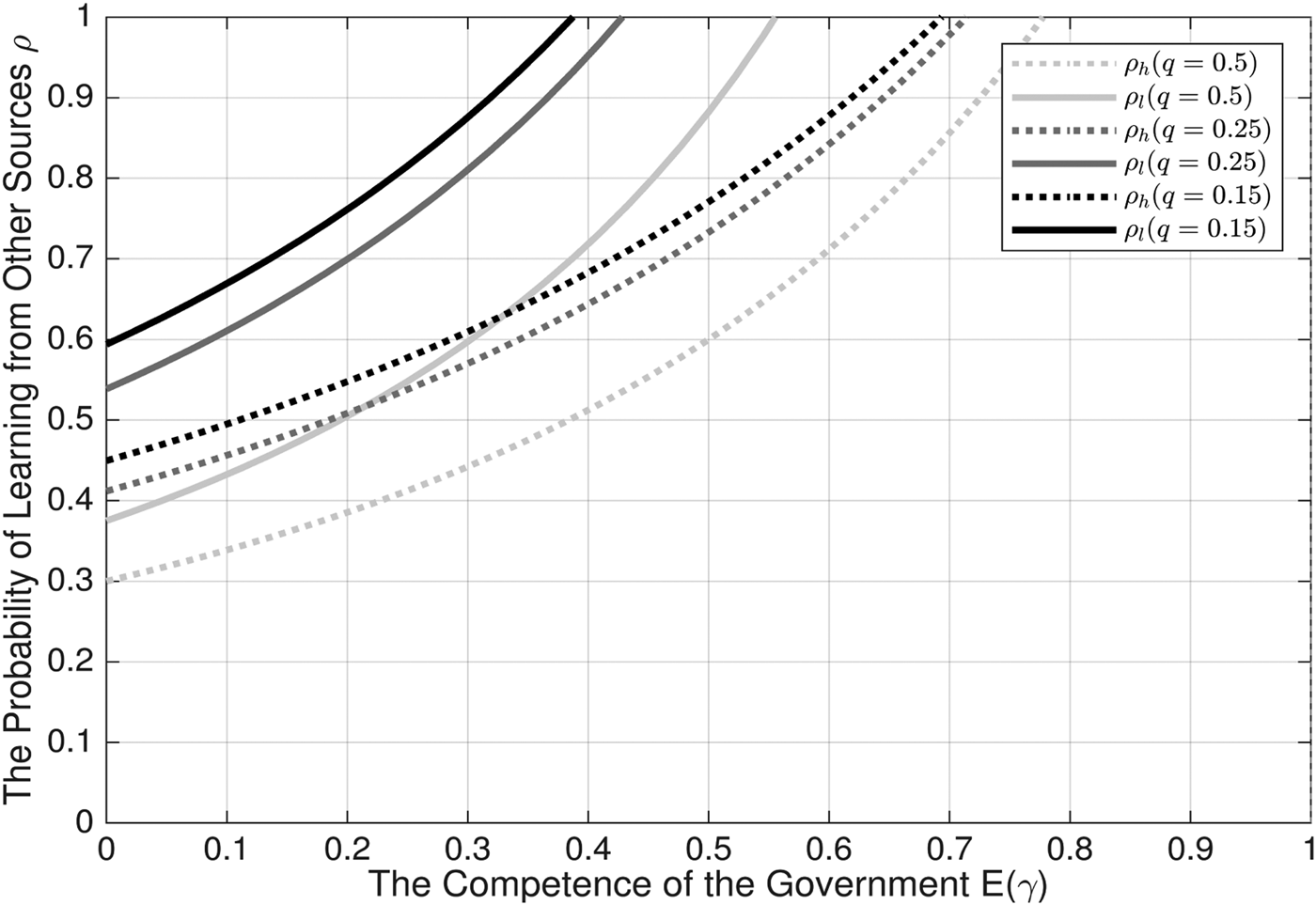
Given $\overline {\mu }\ge \underline {\mu }$ , we have ρ l ≥ ρ h. As expected, an incompetent media outlet is less likely to report truthfully than a competent one. Hence, ρ l is the binding condition for the truthful reporting equilibrium. A numerical example is when $\{E(\gamma )=0.5, \overline {\mu }=0.6, \underline {\mu }=0.2, q=0.5 \}$
 , we have ρ h = 0.6 and ρ l ≈ 0.882. Hence, the truthful reporting equilibrium exists if and only if ρ ≥ ρ l ≈ 0.882. This means that unless the probability of receiving information from other sources is very high, a truthful reporting equilibrium does not exist.
By fixing $\{\overline {\mu }=0.6, \underline {\mu }=0.2, q=0.5\}$ , the conditions for the two types of media outlets to report truthfully ρ h and ρ l can be graphically shown as in Figure 2.Footnote 10 The area between the horizontal line ρ = 1 and ρ l is where the truthful reporting equilibrium exists. If the government is expected to be reasonably competent, that is E(γ) ≥ 0.5, the truthful reporting equilibrium only exists in a very restricted area, and it requires a very high probability for the voter to learn from other sources to sustain this equilibrium. Figure 2 also demonstrates that even when the quality of the government is expected to be very low, the truthful reporting equilibrium can exist only with a sufficient probability for the voter to learn from other information sources.
Conditions for truthful reporting $(\{\overline {\mu }=0.6, \underline {\mu }=0.2, q=0.5 \})$ .
Proposition 2. Given the expected competence of the government (E(γ)), when the voter observes x, receives r from the media outlet and, with probability ρ, learns s V from other sources, the existence of the truthful reporting equilibrium requires the probability for the voter to learns from other sources to be ρ ≥ ρl.
4.4. Comparative statics
Based on Proposition 2, I perform three numerical comparative statics exercises.Footnote 11 First of all, I set the quality of the competent media outlet $\overline {\mu }$ as a variable and fix the quality of the incompetent outlet $\underline {\mu }$
 and the probability to have the competent outlet q. Figure 3 shows that, counter intuitively, when the quality of the competent media outlet increases, the truthful reporting equilibrium becomes less likely to occur.
Comparative statics 1 $({\rm fix }\ \underline {\mu }= 0.2, q= 0.5)$ .
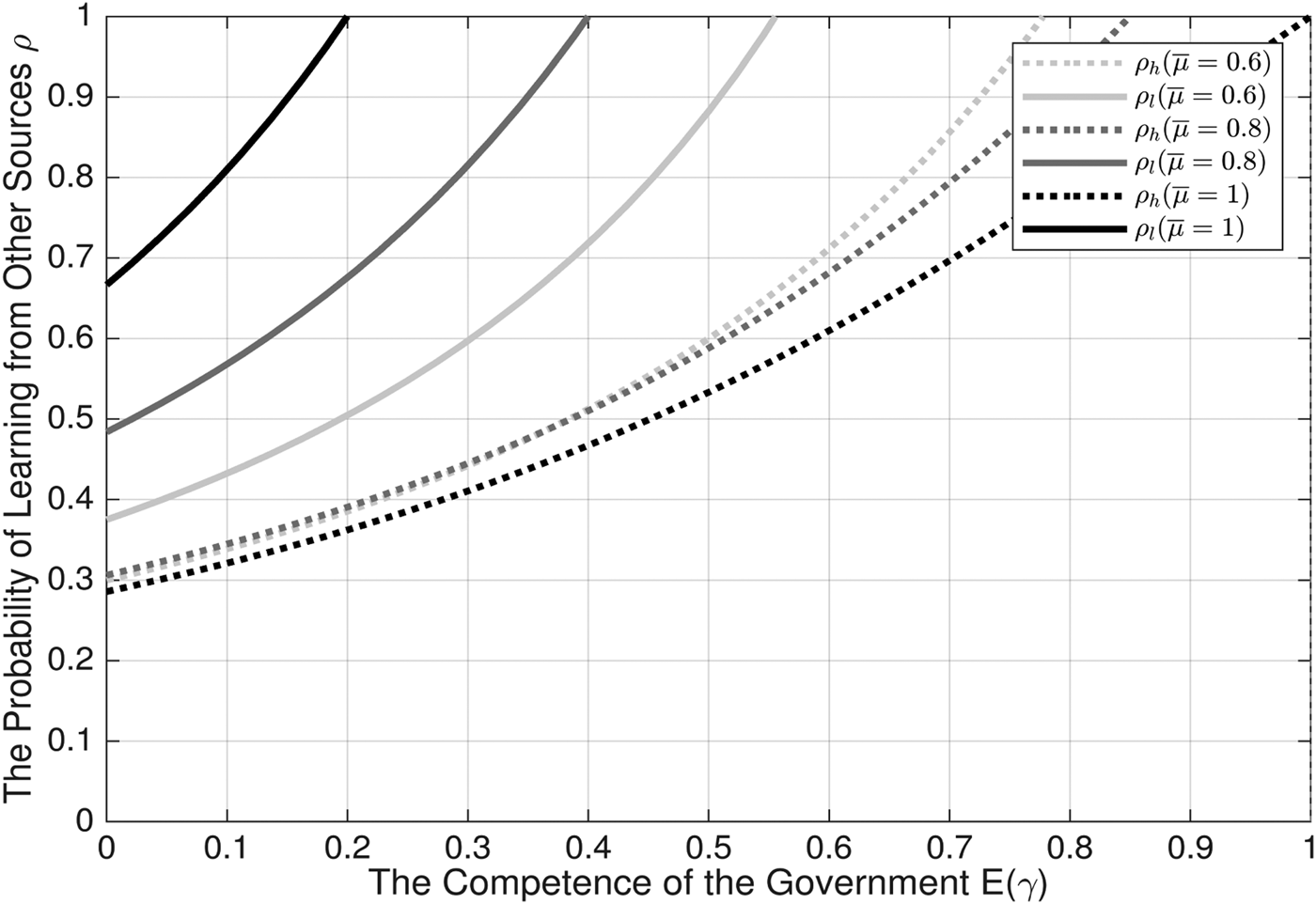
Two forces drive this surprising result. First, as the quality gap between the two types of media outlets widens, if the true state is not revealed ex post but the voter believes the media report is truthful, as before, the media outlet has a higher posterior when its report matches the policy decision and a lower posterior when its report does not match the policy decision. However, now the difference between these two posteriors becomes larger. Thus, matching the report to the policy leads to higher return from reputation. Second, if ex post the report is verified to be correct, the media outlet is more likely to be competent, and because the difference in posteriors of being correct and being incorrect increases when the quality gap widens, being correct becomes a strong signal of competence and leads to higher reputational returns. The incompetent outlet becomes more willing to take the risk of being caught cheating by reporting as a yes man.
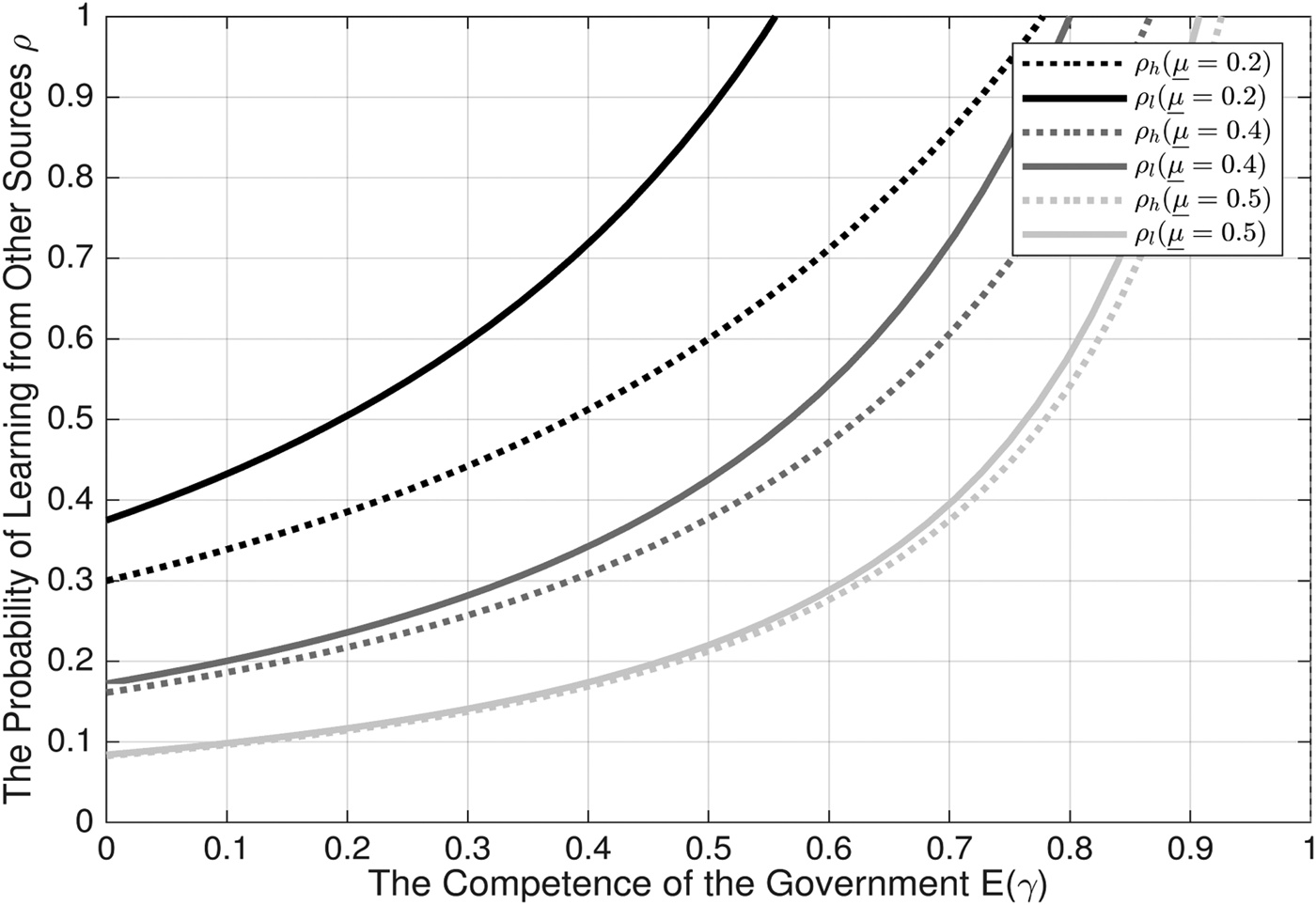
For the second set of comparative statics, I fix the quality of the competent media outlet $\overline {\mu }$ and the probability to have the competent media outlet q, and vary the quality of the incompetent outlet $\underline {\mu }$
 . From Figure 4, we know that when $\underline {\mu }$
 increases, the required ρ l to support the truthful reporting equilibrium decreases. The result again indicates that the likelihood of the truthful reporting equilibrium decreases as the difference between the types of media outlets increases. When the two types are of similar quality, such as the case where $\overline {\mu }=0.6$
 and $\underline {\mu }=0.5$
 , a truthful reporting equilibrium is more likely to exist. Even in this situation, though, the quality of the government cannot be too high, and the probability of learning from other sources of information cannot be too low. The driving force for this result is that deviating from truthful reporting is more rewarding for a media outlet with a lower competence $\underline {\mu }$
 . This is because when the incompetent media outlet is less likely to receive a correct signal, it is more willing to pander to the government policyto increase the probability the media report is correct.
Comparative statics 2 $({ \rm fix }\ \overline {\mu }= 0.6, q= 0.5)$ .
For the final set of comparative statics, I fix the qualities of the two types of media outlets $\overline {\mu }$ and $\underline {\mu }$
 , and allow the probability of having the competent media outlet q to vary. Figure 5 shows that when the media outlet is more likely to be competent, the likelihood of truthful reporting increases. Therefore, although the previous results show that homogeneity of the types of media outlet leads to truthful reporting, ceteris paribus, it is more likely for the voter to receive a truthful report when the probability of having a competent media outlet is higher.
Comparative statics 3 $({\rm fix} \ \overline {\mu }= 0.6, \underline {\mu }= 0.2)$ .
It is quite intuitive to think that critical reporting is less likely to occur when the quality of the incompetent outlet declines, but it is surprising that when the quality of the competent outlet is further improved, the probability of critical reporting also decreases. As government subsidy is usually considered as a promising means of improving the quality of news reporting (see Sunstein, Reference Sunstein2017), the first set of comparative statics serves as a warning. Those rewards and supports for competent news outlets, aiming at further improving their quality, may turn out to make critical reporting even more unlikely. Improving the quality of incompetent news outlets, as the second set of comparative statics shows, could be a more effective way to encourage critical reporting.
5. Political ideology of the media outlet
The baseline analysis intentionally avoids discussion about media ideological concerns to show that even without political agenda and media capture, media outlets may not report truthfully. However, it is interesting to see how the equilibrium reporting behavior changes when the media outlet is concerned not only with its own reputation but also with ideology. Specifically, I look at how the likelihood to reach the truthful reporting equilibrium changes once the media outlet's utility depends not only on its own posterior but also the incumbent's, because the outlet cares also about the popularity and reelection of the incumbent. Formally, the payoff functions are $U^f_M =\Pi ({\hat q})+I({\hat p})$ for a pro-incumbent outlet, and $U^e_M =\Pi ({\hat q})-I({\hat p})$
 for an anti-incumbent outlet. As in the baseline model, returns from the outlet's reputation $\Pi ({\hat q})$
 is a strictly increasing function of ${\hat q}$
 , and returns from the incumbent's reputation $I({\hat p})$
 is a strictly increasing function of ${\hat p}$
 . The superscript e stands for enemy (of the incumbent) and f stands for friend (of the incumbent).
To simplify exposition, I denote the following payoffs: $\Pi ({\rm Pr}(\tau ^M=h \vert r = x))\equiv \overline {\Pi }$ ; $\Pi ({\rm Pr}(\tau ^M=h \vert r \ne x))\equiv \underline {\Pi }$
 ; $I({\rm Pr}(\tau ^G=h \vert r = x))\equiv \overline {I}$
 ; $I({\rm Pr}(\tau ^G=h \vert r \ne x))\equiv \underline {I}$
 . The first two terms are the returns for the media outlet from its reputation, and the last two terms are the returns for the media outlet from the government's reputation. Both are conditional on whether the report matches with the policy decision. From the baseline analysis, we know that when the voter believes the media outlet is reporting truthfully, matching the report to the government policy yields higher reputation and, thus, higher returns than when the report does not agree with the policy. Hence, $\overline {\Pi } \gt \underline {\Pi }$
 . On the other hand, the voter's posterior belief about the government's competence is higher when the report matches with the policy than when they conflict. Hence, for a pro-incumbent media outlet, the return $\overline {I}$
 is greater than $\underline {I}$
 . An anti-incumbent outlet, on the other hand, prefers $-\underline {I}$
 to $-\overline {I}$
 .
When the media outlet is the only source of information for the voter (ρ = 0), and supposing that the voter believes the media outlet is reporting truthfully, a pro-incumbent outlet will always be a yes man, because $(\overline {\Pi }-\underline {\Pi })+(\overline {I}-\underline {I}) \gt 0$ . For an anti-incumbent outlet, it will report as a yes man if $(\overline {\Pi }-\underline {\Pi })-(\overline {I}-\underline {I}) \gt 0$
 . That means, if the outlet cares about its reputation over its ideology, it will still report as a yes man. If the media outlet values its ideology over its reputation ($(\overline {\Pi }-\underline {\Pi })-(\overline {I}-\underline {I}) \lt 0$
 ), it will always report a government criticism. Even when the media outlet receives a signal $s^M_J=x$
 , it will deviate to report $s^M_J \!\ne x$
 .
When the voter is able to learn the true state from other sources of information (s V) with certainty (ρ = 1), the voter can update the posterior of the government using s V. As a result, a fabricated critique or endorsement neither harms nor helps the government. Therefore, the media outlet's decision depends only on whether matching its report with the government policy improves its own reputation. The reasoning is entirely the same as in the baseline analysis. A competent media outlet will always transmit its signal truthfully, and the incompetent media outlet may pander its reporting to the government to maximize the media outlet's own reputation.
The general case is again in between of the two extremes, ρ = 0 and ρ = 1. Because the results when ρ = 0 or ρ = 1 only differ from the baseline results when the media outlet is anti-incumbent and cares more about ideology, a pro-incumbent media outlet and an anti-incumbent outlet that cares more about its own reputation behave identically to the baseline results. When the media outlet is anti-incumbent and cares more about ideology, the outlet is more likely to report government criticism. However, unfounded critical reporting is not equivalent to truthful reporting. The information problem for the voter still prevails.
It is worth noting that whether the voter knows if the media outlet is supporting the incumbent or not does not affect the media reporting strategy. When the voter is uncertain about the media outlet's ideology, she knows that a government criticism is more likely to be from an anti-incumbent outlet, and an endorsement is more likely to be from a pro-incumbent one. However, an anti-incumbent media outlet has no incentive to pretend to be a pro-incumbent one by endorsing the government (otherwise it suffers $-\overline {I}$ ), and vice versa. Hence, reputational concerns dominate a given media outlet's decision-making.
6. Government's reputation for honesty
In the baseline model, the voter is concerned about the competence of the government. In this section, I consider the case that the voter is concerned about whether the government is honest. The type of the government (τ G) is now about whether it is honest g (for good) or corruptive b (for bad), formally τ G = J′ ∈ {b, g}: An honest government wants to match its policy to the true state of the world, and a corruptive government cares both about reelection and its own policy preference. I denote its ideal policy x′, and it is the corruptive government's private information. The media outlet, on the other hand, is still either of competent or incompetent type (τ M = J, where J ∈ {l, h}). The types of the actors are each organization's private information. It is common knowledge that Pr(τ G = g) = t and Pr(τ M = h) = q. As in the baseline case, the government observes a signal s G indicating the correct policy, and the probability of the signal matching the true state Pr(s G = ω) is γ′. The probability that the competent media outlet learns the correct policy is ${\rm Pr}(s^M_h=\omega )=\overline {\mu }$ . For an incompetent media outlet, the probability ${\rm Pr}(s^M_l=\omega )$
 is $\underline {\mu }$
 , and $0 \le \underline {\mu }\le \overline {\mu } \le 1$
 . I consider that the qualities of the competent media outlet, the government, and the incompetent media outlet are ordered as $\overline {\mu }\ge \gamma ' \ge \underline {\mu }$
 .
The payoff for the media outlet U M remains the same as in the baseline case. The government's payoff is conditional on its type. An honest government enjoys a utility normalized to one when its policy successfully matches the true state of the world $U^g_G ={{\tf="PS8B4B"\char"31}}_{\{x=\omega \}}$ . The payoff function of a corruptive government is $U^b_G =R{\tf="PS8B4B"\char"31}_{\{{\rm if \;reelected}\}}+P{\tf="PS8B4B"\char"31}_{\{x=x'\}}$
 , which means the corruptive government enjoys an office rent of R if reelected and P units of utility if implementing its ideal policy x′. The voter wants to selects an honest government, and hence the payoff for the voter is $U_{\rm V} ={\tf="PS8B4B"\char"31}_{\{\tau ^{G'}=g\}}$
 .
The voter must decide whether to retain the incumbent. If not, a challenger that is honest with probability t will be elected. Hence, she needs to learn the type of the incumbent from the government policy, the media report, and probably from other sources of information (s V).
An honest government always implements a policy follows its own signal s G to maximize the possibility of matching the policy to the true state of the world. A corruptive government will do the same when receiving a private signal s G = x′. Upon receiving a private signal s G ≠ x′, the corruptive government must decide whether to implement a policy following its signal or to implement its ideal policy x = x′.
When the media outlet is the only source of information for the voter (ρ = 0), the corruptive government always implement its ideal policy x′ because even if the media outlet reports r ≠ x′, the voter cannot discern the reason of this disagreement.
For the media outlet, the decision is very similar to that in the baseline case. The media outlet reports truthfully whenever $s^M_J=x$ . When $s^M_J \ne x$
 , the outlet needs to decide whether to report truthfully. If the government is honest, the media outlet encounters a problem exactly the same as before. Hence, the outlet will report as a yes man. Even when the government is corruptive, because it is not possible for the voter to learn the government's type from its action and media report, the media outlet will act as a yes man following the same logic as before: Supposing truthful reporting and the government being honest, when the report matches the policy decision, it is more likely that the media outlet is competent.
When the voter is able to learn the true state from other sources of information (s V) with certainty (ρ = 1), the government's decision depends not only on its type but its evaluation of the office rent vis-à-vis its policy preference. For an honest government, it will still implement x = s G. For a corruptive government, if it cares more about the office rent, then it will also implement s G to build up its reputation of being honest. If it cares more about its policy preference, it will implement x′. The competent media outlet, as in the baseline case, will report truthfully. The incompetent media outlet, on the other hand, may have incentive to be a yes man. However, the yes-man problem here is less severe than in the baseline case. If the government is expected to be corruptive (t < 0.5) and concerned more about implementing its ideal policy, even the incompetent outlet will always report its information truthfully.
Similar to the result of Section 5, if the media outlet is also concerned about political ideology, an anti-incumbent outlet that cares more about ideology will always criticize the government decision when ρ = 0. The yes-man problem, however, prevails in all other situations. Overall, when the voter's primary concern is to select an honest government, a media outlet may still act as yes man under certain circumstances, but the yes-man problem is less severe than when the voter aims to select a competent government.
7. Multiple media outlets
I now extend the analysis from the baseline case of a unique outlet to cases with two or more media outlets. The media outlets are indexed as: M 1, M 2, …, M n. The type of each media outlet is private information, and the outlets report news r 1, r 2, …, r n simultaneously and independently, conditional on the true state of the world.Footnote 12 Without loss of generality, I analyze the game from the perspective of M 1.
7.1. Two media outlets
First, consider the case where the voter can learn the information from two media outlets M 1 and M 2. Suppose that the voter believes the two media outlets play the truthful reporting equilibrium, and the true state is not revealed by other sources (ρ = 0). The posteriors given different actions and the probabilities for these different situations to occur are summarized in Table 1. Throughout this section, to simplify the notation regarding the probability of occurrence of different situations, I use μ (without overline or underline) to denote that it is either of two cases: $\underline {\mu }$ when the media outlet M 1 is incompetent and $\overline {\mu }$
 when M 1 is competent.
Posteriors given different actions: two media outlets (ρ = 0)
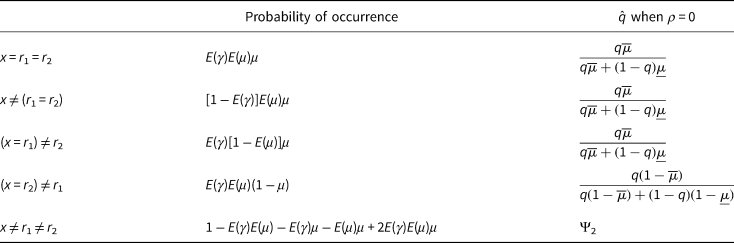
Note: Denote $\displaystyle{{q(1-E(\gamma)E(\mu)-E(\gamma)\overline{\mu}-E(\mu)\overline{\mu}+2E(\gamma)E(\mu)\overline{\mu})} \over {q(1-E(\gamma)E(\mu)-E(\gamma)\overline{\mu}-E(\mu)\overline{\mu}+2E(\gamma)E(\mu)\overline{\mu})+(1-q)(1-E(\gamma)E(\mu)-E(\gamma)\underline{\mu}-E(\mu)\underline{\mu}+2E(\gamma)E(\mu)\underline{\mu})}}$ as Ψ2.
When deviating from truthful reporting, the posterior will be ${q\overline {\mu }}/({q\overline {\mu }+(1-q)\underline {\mu }})$ , which is greater or equal to both Ψ2 and ${q(1-\overline {\mu })}/({q(1-\overline {\mu })+(1-q)(1-\underline {\mu })})$
 (unless q = 0, q = 1 or $\overline {\mu }=\underline {\mu }$
 ). Thus, the media outlet has an incentive to deviate from the truthful reporting equilibrium, and there is no truthful reporting equilibrium.
Now, consider the situation where the voter can learn the true state of the world from other sources of information with certainty (ρ = 1). Table 2 summarizes the posteriors given different actions and the probabilities for these different situations to occur when the voter believes the media outlets play the truthful reporting equilibrium.
Posteriors given different actions: two media outlets (ρ = 1)
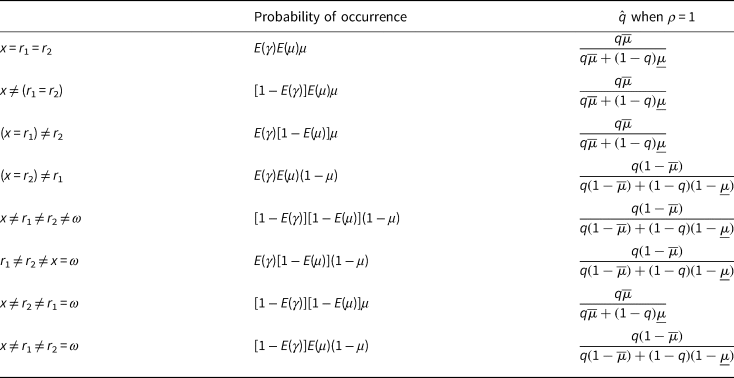
If a media outlet deviates from reporting truthfully when the voter will observe the true state with certainty, its posterior reputation is
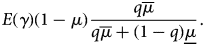
As in the baseline case, the competent media outlet has no incentive to deviate from truthful reporting, but the incompetent type will only report truthfully if the following condition is satisfied:

This condition does not always hold. For example, when $\{q= 0.2, \overline {\mu }= 0.8, \underline {\mu }= 0.2\}$ , the condition is only satisfied when E(γ) ≤ 0.34. Hence we know that ρ = 1, again, does not guarantee the existence of a truthful reporting equilibrium.
The general case we are interested in is a convex combination of the situations in terms of ρ, summarized in the two tables. That is, the voter may sometimes learn the true state from the perfect feedback, but not always. The analysis shows that, as in the baseline case, an incompetent media outlet does not always follow the truthful reporting strategy. Essentially, when there are two media outlets, they play the same signaling game simultaneously, so that one report cannot discredit the other since the voter cannot learn the state of the world from other sources. The decision made by the government then serves as a focal point for the media outlets to tend toward. The truthful reporting equilibrium exists only when the voter can learn the true state of the world from other sources with a sufficiently high probability.Footnote 13
7.2. Three or more media outlets
To analyze cases with three or more media outlets, I use a general approach and categorize n media outlets into three groups: M 1, M i, and M j. M i and M j partition the n − 1 media outlets other than M 1 into two groups, each of which consists of at least one media outlet. Each media outlet within a group does not necessarily receive the same signal.
Again, the analysis should focus on the situation where M 1 receives a signal different from the government's decision x and compare posteriors from r ≠ x and r = x in different scenarios, presuming every other actor follows the truthful reporting strategy. The different scenarios, their probabilities of occurrence, and the corresponding posterior beliefs, are summarized in Tables 3 and 4. Table 3 is for the situation ρ = 0, and Table 4 is for ρ = 1.
Posteriors given different actions: more than two media outlets (ρ = 0)
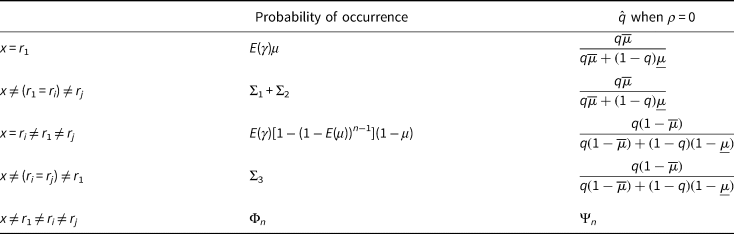
Note: Denote Σ1 ≡ [1 − E(γ)][(n − 1)E(μ)(1 − E(μ))n−2]μ; Σ2 ≡ [1 − E(γ)][1 − (1 − E(μ))n−1 − (n − 1)E(μ)(1 − E(μ))n−2]μ; Σ3 ≡ [1 − E(γ)][1 − (1 − E(μ))n−1 − (n − 1)E(μ)(1 − E(μ))n−2](1 − μ); Φn ≡ [1 − E(γ)][1 − E(μ)]n−1(1 − μ) + E(γ)[1 − E(μ)]n−1(1 − μ) + (n − 1)E(μ)[1 − E(γ)](1 − E(μ))n−2(1 − μ) + [1 − E(γ)][1 − E(μ)]n−1μ; $\displaystyle{\Psi _n\equiv {{q\Phi _n^h} \over {q\Phi _n^h+(1-q)\Phi _n^l}}}$ .
Posteriors given different actions: more than two media outlets (ρ = 1)
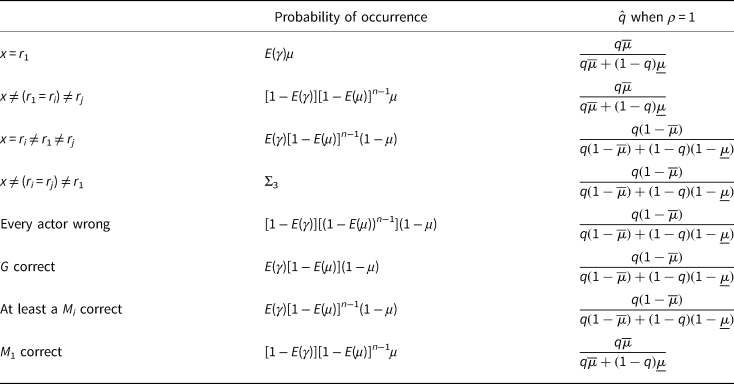
The difference between this case and those previously analyzed is that if some M i and M j receive the correct signal and report truthfully, yes-man behavior will be detected. Hence, supposing all other media outlets follow the truthful reporting strategy, even when ρ = 0, yes-man reporting is harmful (to the media outlet) if: (1) M 1 actually received a correct signal but deviates from truthful reporting (because it is possible to match reports with one or more other news outlets on a non-x option, and such a report is perfect evidence of being correct) or (2) there are at least two media outlets that receive the correct signal (because the true state is revealed, and the yes-man behavior is detected).
When the number of media outlets becomes large, it is certain that at least some media outlets will receive the correct signal, but truthful reporting equilibrium is still not guaranteed. The analysis shows that when the media market is in perfect competition (n → ∞), the role of exogenous information sources (ρ) can be replaced by the existence of a large number of media outlets because it is certain that at least two media outlets will receive the correct signal. Thus, supposing that the media outlets report truthfully, the voter is going to learn the true state for sure ex post. Indeed, when n → ∞, the case with ρ = 0 is equivalent to the case with ρ = 1. Even so, an incompetent media outlet still has an incentive to be a yes man whenever $[E(\gamma )-\underline {\mu }]\overline {\mu }-(1-\overline {\mu })E(\mu ) \ge 0$ (e.g., when $\{E(\gamma )=0.5, \overline {\mu }=0.8, \underline {\mu }=0.2, q=0.5\}$
 ). Thus, a truthful reporting equilibrium is still not guaranteed and the baseline result is robust in this extreme case.
Proposition 3. The existence of multiple media outlets does not guarantee truthful reporting. Even when there are an infinite number of media outlets, the truthful reporting equilibrium exists if and only if $[E(\gamma )-\underline {\mu }]\overline {\mu }-(1-\overline {\mu })E(\mu ) \lt 0$ .
8. Concluding remarks
In democracies, voters need to know whether the incumbent government is competent to make election decisions. Therefore, apart from observing the government's policy decisions, voters also acquire related information from various information sources, of which media is the primary one. However, all too often, media reports are neither critical nor independent. In this paper, I study a model to see why media outlets cannot dutifully serve as watchdogs.
I argue that reputational concerns can sufficiently lead to a lack of independent reporting; any coercive power or policy bias is not necessary. The mechanism is that the voter wants to learn the competence of the government, but news reports also reflect the quality of the media outlets, not just the quality of the government. Reputational concerns thus make the media outlets unable to commit to reporting information truthfully. Instead, the media outlets tend to endorse the government policy as yes men, because matching (or pandering) reports to the government's decisions weakly increases media reputation in most situations. Therefore, the voter is not able to learn valuable information from media reports even though media outlets may not be partisan or subject to coercive power. This result is robust under the different scenarios discussed in the paper: when the electorate can perfectly learn the true state ex post, when the media outlet cares also about political ideology, and when there exist multiple—even an infinite number of—media outlets.
The main implication of this paper is that when the government is believed to be at least reasonably competent, truthful reporting is very unlikely to exist. This is a serious problem for democratic accountability because we want to accurately assess the performance of the government, not be misled by its relative popularity. However, we will not have sufficient information at hand when the government seems to be competent. Essentially, to have a truthful reporting equilibrium, the expected competence of the government must be low enough, while the probability for the voter to learn from other information sources must be high enough.
Comparative statics of this model indicate that widening the quality gap between types of media is detrimental. It is intuitive to think that increasing the quality of competent media outlets could increase the probability of having truthful reporting. Consequently, there are many schemes and rewards aiming at supporting high-quality media outlets to further improve their quality. However, the model shows that, other things being equal, it worsens the yes-man problem as the quality gap between media types is widened. Instead, it would be helpful to encourage the low-quality media outlets to improve, thus narrowing the quality gap.
Future research can empirically test the argument by estimating the perceived competence of the government (i.e., the popularity of the government) and the media in different issue areas and applying a keyword based method adopted by Larcinese et al. (Reference Larcinese, Puglisi and Snyder2011), or performing quantitative textual analysis (Laver et al., Reference Laver, Benoit and Garry2003; Gentzkow and Shapiro, Reference Gentzkow and Shapiro2010), to identify the reporting stances of the media outlets on relevant issues. The relationship between the perceived competence of the actors and the criticalness of reports in different issue areas could then be evaluated.
Supplementary material
To view supplementary material for this article, please visit https://doi.org/10.1017/psrm.2019.42.
Acknowledgments
I thank Torun Dewan, Hülya Eraslan, Rafael Hortala-Vallve, Gilat Levy, Cesar Martinelli, Massimo Morelli, Emerson Niou, Ben Ogden, David Strömberg, participants at LSE PSPE Doctoral Workshop, Rational Choice and Politics Workshop at Academia Sinica, EPSA 2016, MPSA 2017, EITM 2017, APSA 2017, and especially Stephane Wolton, for their invaluable comments and advice. All remaining errors are the author's responsibility.



