INTRODUCTION
Red foxes, Vulpes vulpes belong to the family Canidae and are abundant in many parts of Greece, including Fthiotida prefecture. Foxes may play a role in the transmission of Leishmania infantum (causative agent of visceral leishmaniasis (VL) in humans and canine leishmaniasis (CanL)), via sandfly vectors, yet this has not been demonstrated with xenodiagnosis studies. Leishmania infantum has been reported in red foxes in France, Portugal, Italy, Serbia and Spain (Rioux et al. Reference Rioux, Albaret, Houin, Dedet and Lanotte1968; Bettini et al. Reference Bettini, Pozio and Gradoni1980; Abranches et al. Reference Abranches, Conceiçao-Silva and Silva-Pereira1984; Mancianti et al. Reference Mancianti, Mignone and Galastri1994; Criado-Fornelio et al. Reference Criado-Fornelio, Gutierrez-Garcia, Rodriguez-Caabeiro, Reus-Garcia, Roldan-Soriano and Diaz-Sanchez2000; Cirović et al. Reference Cirović, Chochlakis, Tomanović, Sukara, Penezić, Tselentis and Psaroulaki2014); and in Brazil (the synonym of L. infantum in the New World, Leishmania chagasi) (Courtenay et al. Reference Courtenay, Macdonald, Lainson, Shaw and Dye1994); but also wolves (Canis lupus) were found infected with L. infantum in Croatia (Beck et al. Reference Beck, Beck, Kusak, Gudan, Martinkovic, Artukovic, Hohsteter, Huber, Marinculic and Grabarevic2008), Portugal and Spain (Sastre et al. Reference Sastre, Francino, Ramirez, Ensenat, Sanchez and Altet2008; Sobrino et al. Reference Sobrino, Ferroglio, Oleaga, Romano, Millan, Revilla, Arnal, Trisciuoglio and Gortazar2008) as well as golden jackals (Canis aureus) in Israel (Hervás et al. Reference Hervás, Méndez, Carrasco and Gómez-Villamandos1996), Iraq (Sukker, Reference Sukker1984) and Kazakhstan (Musabekov et al. Reference Musabekov, Novak and Farisova1997). The causative agent of cutaneous leishmaniasis (CL), Leishmania tropica, although considered an anthroponotic infection, has been sporadically reported from domestic dogs in Iran and Morocco (Mohebali et al. Reference Mohebali, Hajjaran, Hamzavi, Mobedi, Arshi, Zarei, Akhoundi, Naeini, Avizeh and Fakhar2005; Rhajaoui et al. Reference Rhajaoui, Nasereddin, Fellah, Azmi, Amarir, Al-Jawabreh, Ereqat, Planer and Abdeen2007) and described in red foxes, golden jackals and the rock hyrax (Procavia capensis) in Israel (Talmi-Frank et al. Reference Talmi-Frank, Kedem-Vaanunu, King, Bar-Gal, Edery, Jaffe and Baneth2010), Jordan and the Palestinian Authority (Jacobson et al. Reference Jacobson, Eisenberger, Svobodova, Baneth, Sztern, Carvalho, Nasereddin, El Fari, Shalom, Volf, Votypka, Dedet, Pratlong, Schonian, Schnur, Jaffe and Warburg2003; Talmi-Frank et al. Reference Talmi-Frank, Kedem-Vaanunu, King, Bar-Gal, Edery, Jaffe and Baneth2010).
In Greece, two Leishmania species are known, L. infantum causing VL and CanL in 41/54 prefectures (in the majority of which it is endemic) and L. tropica causing CL in Crete and the Ionian islands (Ntais et al. Reference Ntais, Sifaki-Pistola, Christodoulou, Messaritakis, Pratlong, Poupalos and Antoniou2013). In Fthiotida prefecture, an average of 5 VL cases per year is reported and 58·8% of the dogs were found seropositive, whilst culture of the parasite showed L. infantum (Ntais et al. Reference Ntais, Sifaki-Pistola, Christodoulou, Messaritakis, Pratlong, Poupalos and Antoniou2013). Phlebotomus perfiliewi and Phlebotomus tobbi, known sandfly vectors of L. infantum, have been described in the area (Ivović et al. Reference Ivovic, Patakakis, Tselentis and Chaniotis2007; Xanthopoulou et al. Reference Xanthopoulou, Anagnostou, Ivović, Djurkovic-Djakovic, Rogozi, Sotiraki and Papa2011). Leishmaniasis prevalence data on foxes are not available for Greece. The survey was conducted in the prefecture of Fthiotida, central Greece, where 47 foxes were made available from local veterinarians. After necropsy, biological material was examined for Leishmania presence so that the possible role of these canids in the epidemiological chain of the parasite could be evaluated.
MATERIALS AND METHODS
Study area
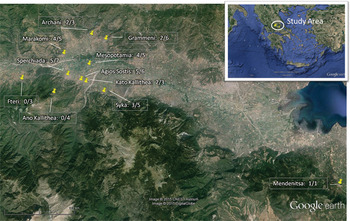
The study area involved the region in and around 11 villages in the West Fthiotida prefecture, endemic for leishmaniasis (VL and CanL). The villages were: Ano Kallithea (co-ordinates: 38.8786415, 22.106884100000002), Kato Kallithea (38.90217680000001, 22.159112100000016), Ag. Sostis (38.8957468, 22.164228099999946), Fteri (38.9004674, 22.047290799999928), Sperchiada (38.9075721, 22.127325400000018), Makrakomi (38.9424649, 22.115891199999965), Archanio (38.9727357, 22.167467100000067), Mesopotamia (38.92429449999999, 22.166226199999983), Grammeni (38.9649864, 22.19606909999993), Syka (38.8816247, 22.197596100000055), Mendenitsa (38.7514889, 22.6180944) (Fig. 1).
The geographical distribution of the red foxes tested for the presence of Leishmania. The position of the villages in the Sperchios valley, in the vicinity of which the animals were found, is shown, indicating the number of polymerase chain reaction positive animals over the number of animals tested.

The area is a protected valley, of the Sperchios River, providing water for wild life, with trees and bushes offering an all year round coverage of the terrain; at 125–840 m altitude.
Animal sampling
Animal samples (n = 47) were collected over a 3-year period, November 2009 to 2011, from areas where red foxes, V. vulpes (Linnaeus, 1758), are abundant. Animal carcasses were provided mainly by hunters. The animals had died due to vehicular accidents (n = 17), poaching (n = 16) or were found dead possibly due to disease (n = 12). In two cases animals were captured in trapping cages, narcotized and freed after bleeding. The veterinarian examined them for ectoparasites (fleas after combing the animal); identified the foxes using morphological characters; sexed; weighed and classified them as ‘adults’, ‘juveniles’ and ‘possibly old’ based on body size (taking into account differences due to sex) and the condition of the animal's teeth. Also, foxes were characterized as ‘possibly old’ if they had white hair on their face. They were examined for signs of classical CanL symptoms (low weight for their age, sex and species; dermatitis furfuracea; skin lesions; lymph node swelling; periophthalmic alopecia; onychogryphosis; splenomegaly) and were classified into three categories accordingly: ‘not in good health’ (with at least three CanL symptoms), ‘in moderate health’ (with two CanL symptoms), ‘in good health’ (no apparent clinical signs). Biological samples: blood, spleen and lymph nodes (mandibular and popliteal) were obtained at necropsy from each animal, when possible, and stored at −80 °C in plastic tubes for safety until testing. The organs of the animals as well as their intestine contains were examined for parasites and parasite eggs. All relevant data for each animal were recorded by the veterinarian in a questionnaire.
Serological testing
Red fox sera were tested serologically using anti-dog, anti-IgG (immunoglobulin G) antibodies, by indirect immunofluorescent antibody test (IFAT, Leishmania SPOT IF, BioMerieux France). A series of 2-fold serum dilutions, starting from 1/40 were performed and a cut-off titer of ⩾1/160 was regarded positive since all foxes lived in Leishmania endemic areas.
Polymerase chain reaction (PCR) and PCR-restriction fragment length polymorphism (PCR-RFLP)
DNA was extracted from all biological samples available from each fox using DNeasy blood and tissue kit (QIAGEN, EU) following the manufacturer's instructions. Leishmania molecular screening was performed by targeting a repetitive sequence (Minodier et al. Reference Minodier, Piarroux, Gambarelli, Joblet and Dumon1997) using the modifications of Christodoulou et al. (Reference Christodoulou, Antoniou, Ntais, Messaritakis, Ivovic, Dedet, Pratlong, Dvorak and Tselentis2012) as well as amplifying the Leishmania ITS1 region followed by a HaeIII restriction endonuclease digestion of the positive PCR products (Schönian et al. Reference Schönian, Nasereddin, Dinse, Schweynoch, Schallig, Presber and Jaffe2003) in order to identify which parasite species had infected the animal. All samples were tested in duplicates. Positive controls were used in all PCR assays which consisted of DNA extracted from L. infantum (Nicolle, 1908) (MCAN/GR/2009/GD70) and L. tropica (Wright, 1903) (MCAN/GR/2009/GD52) which had derived from Greek dogs and typed by enzyme electrophoresis (Ntais et al. Reference Ntais, Sifaki-Pistola, Christodoulou, Messaritakis, Pratlong, Poupalos and Antoniou2013). Negative controls included samples from dogs born and lived in non-endemic areas in Crete (at >1000 m altitude), that had been tested serologically, by PCR and culture and proved negative.
Statistical analysis and mapping of the results
The χ 2 test with SPSS v. 22 was applied to examine statistical significance of Leishmania positivity of the animal, by PCR, and: gender, sampling year, health status, presence of ecto- or/and endo-parasites, characteristics of the environment the animals lived; each factor was tested separately. In all cases a P value <0·05 was considered statistically significant.
RESULTS
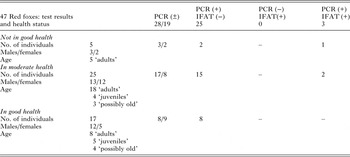
A total of 47 foxes were examined using blood, spleen and/or lymph nodes according to availability: 28 males and 19 females. The majority, 31 animals, were ‘adults’, 9 were ‘juveniles’ and 7 were ‘possibly old’. Five animals were classified as not in good health, 25 as in moderate health and 17 in good health (Table 1). Of these animals, 28 were PCR positive for Leishmania (59·5%): 23 spleens, 2 lymph nodes, 2 bone marrow, 1 blood (both from blood sample with and without the anticoagulant ethylenediaminetetraacetic acid, EDTA); 18 of the 28 males (64·3%) and 10 of the 19 females (52·6%).
Health status and results of 47 red foxes from Fthiotida prefecture, central Greece, by polymerase chain reaction (PCR) and indirect immunofluorescent antibody test (IFAT) performed in different tissues for Leishmania infantum

Three out of the 9 sera tested had IgG antibodies against Leishmania; since foxes and dogs may not react the same way to dog reagents, Leishmania positive animals were considered only if they were PCR positive. Nevertheless, no PCR negative animal presented IgG antibodies against the parasite. Two of the seropositive animals were in moderate health and hosted other parasites as well, (ecto- and endo-parasites) whilst the third animal was not in good health. PCR-RFLP analysis revealed the presence of L. infantum in the PCR positive animals. The geographical distribution of the animals tested and the PCR results are shown in Fig. 1.
The χ 2 test showed significantly higher number of PCR positive animals living in <300 m altitude compared with animals living in higher altitudes (χ 2 = 8·87; P = 0·003). There was no statistical relationship between gender, age and the presence of ecto- or endo-parasites with PCR positivity, nor the health status of the animal.
Three different ectoparasite spp and 6 endoparasites were found in PCR positive and PCR negative for Leishmania animals. Ectoparasites: fleas in 12 animals; Sarcoptes scabiei in 3; Demodex sp. in 1. Endoparasites: Dirofilaria immitis in the heart and/or lungs in 8 animals; Trichuris vulpis in 4; Toxascaris leonina in 3; Ancylostoma caninum in 2; Taenia sp. in 2; Dipylidium caninum in 1.
DISCUSSION
The role of red foxes in the epidemiology of canine and human leishmaniasis cannot be evaluated on the basis of this study. However, the results indicate that a considerable proportion of the red fox population in this area (59·5%) shows a high prevalence of infection/exposure. If this wild canid plays the role of reservoir host it may help in increasing the transmission rates of Leishmania to dogs and humans and its geographical dispersion. This is facilitated by the fact that red foxes are known to dwell in great distances (Dolev, Reference Dolev2006), according to the availability of resources, and that competent sandfly vectors are present in the area. The fact that dog densities are much higher than fox densities would make dogs more important hosts than wild canids. Nevertheless, quantitative xenodiagnosis studies are required in order to clarify the role of the red fox in Leishmania's epidemiological chain.
The natural ecosystem of the red foxes in the study is the Sperchios Valley consisting of agricultural land, forests and mountains. Mountain Oiti, an animal reserve south of these villages offers protection and cover to the animals (Fig. 1). The red foxes, due to the destruction of their habitats, visit inhabited areas during the night to search for food, seen in the gardens of houses where, in most cases, dogs live. Transmission, therefore, via sand fly vectors, may take place either when wild canids enter towns or when household dogs range in areas surrounding towns.
Asymptomatic L. infantum infections seem to be common in dogs and other canids (Courtenay et al. Reference Courtenay, Macdonald, Lainson, Shaw and Dye1994). However, intense cutaneous parasitism in dogs and foxes allows sand flies to become infected when feeding on the skin (Deane and Deane, Reference Deane and Deane1954). In Brazil, laboratory experiments showed that the crab eating fox (Cerdocyon thous) was infectious to sandflies, even in the absence of clinical leishmaniasis due to L. chagasi (Lainson et al. Reference Lainson, Shaw, Silveira and Braga1987, Reference Lainson, Dye, Shaw, Macdonald, Courtenay, Souza and Silveira1990), a situation that allows the parasite to circulate unnoticed. In the animals studied, at least three classical CanL symptoms were observed in 5 animals, 3 of which were PCR positive, and 2 classical CanL symptoms in 25 animals, 17 of which were PCR positive. That is, 20/28 PCR positive for Leishmania red foxes appeared symptomatic. This high percentage is unusual and may be related to other factors, such as availability of food and other diseases; the fact that the clinical signs recorded are not strictly specific to L. infantum should be noted. Interestingly, 27 of the 47 animals studied had ecto- and/or endo-parasites indicating unfavourable health conditions in the area; the presence of other parasites was not statistically associated with Leishmania PCR positivity.
Comparative data on the prevalence of leishmaniasis in foxes in Europe is limited. Using IFAT, enzyme-linked immunosorbent assay and microscopy for detection of Leishmania, Mancianti et al. (Reference Mancianti, Mignone and Galastri1994) and Bettini et al. (Reference Bettini, Pozio and Gradoni1980) reported 18% (9/50) and 6% (1/16) of the foxes tested, respectively, to be positive. These prevalence rates, however, which are lower than those reported in the present study, can be explained by the higher sensitivity of the PCR method. In similar studies in Italy, the parasite was detected by PCR from 40% of fox carcasses by Dipineto et al. (Reference Dipineto, Manna, Baiano, Gala, Fioretti, Gravino and Menna2007) and 52·2% by Verin et al. (Reference Verin, Poli, Ariti, Nardoni, Fanucchi and Mancianti2010). Interestingly, Gramiccia et al. (Reference Gramiccia, Maazoun, Lanotte, Rioux, le Blancq, Evans, Peters, Bettini, Gradoni and Pozio1982) demonstrated an enzymatic variant from a fox using enzyme typing by starch gel electrophoretic techniques.
Leishmania tropica has been reported in the spleens of infected asymptomatic wild canid species (foxes and jackals) which implies that these animals may also be infected and may play the host for this parasite (Talmi-Frank et al. Reference Talmi-Frank, Kedem-Vaanunu, King, Bar-Gal, Edery, Jaffe and Baneth2010). The involvement of wild canids in the sylvatic life of L. tropica may be important in Greece and red foxes from the Ionian islands Kerkyra, Leukada and Kefalonia must be examined for the presence of L. infantum and L. tropica since both species are found in humans and dogs and proven vectors of L. infantum (P. perfiliewi, P. tobbi, Phlebotomus neglectus) and L. tropica (Phlebotomus similis) have been reported in the area (Ntais et al. Reference Ntais, Sifaki-Pistola, Christodoulou, Messaritakis, Pratlong, Poupalos and Antoniou2013).
ACKNOWLEDGEMENTS
We thank the veterinarians who provided fox samples.
FINANCIAL SUPPORT
This work was funded by the EU grant FP7-261504 EDENext and is catalogued by the EDENext Steering Committee as EDENext364 (http://www.edenext.eu). The contents of this publication are the sole responsibility of the authors and do not necessarily reflect the views of the European Commission.