For Samuel P. K.
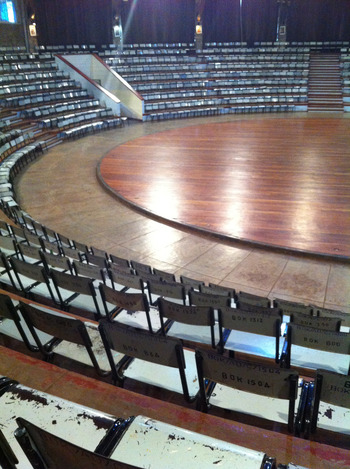
This article deals with the representation of Kenya national identity through dance.Footnote 1 It analyses the reenactment of a series of ethnic dances at Bomas of Kenya (the term Boma means homestead in Swahili), a cultural center located just outside Nairobi and part of the network of National Museums of Kenya, the body corporate responsible for managing all state-owned museums, sites, and monuments. Bomas offers a walking itinerary through a series of traditional villages, with each featuring the architecture of a particular ethnic group, and a show based on a multi-ethnic repertoire of dances (Gikuyu, Samburu, Maasai, Luo, Luhya, etc.), daily staged in a large auditorium (see Photo 1). In the past, Bomas, which is now presented as the “official custodian of Kenya's tangible and intangible heritage,”Footnote 2 was also defined as Cultural Village Museum,Footnote 3 and described in turn as a “national ethnographic park” (Bruner Reference Bruner and Kirshenblatt-Gimblett1994, 451) and a “government museum of the performing arts” (Bruner Reference Bruner2001, 884; Reference Bruner2005, 77). For many Kenyans, Bomas is also (if not mainly) the place associated with the new constitution drafted in 2003 during the National Constitutional Conference—one of the most delicate moments in Kenya's political life, a moment that was followed by extreme ethnic antagonism and political violence. More recently, Bomas was again a focal point of national politics when it was chosen as the vote counting center of the contested 2013 elections. These varying associations with Bomas are symptomatic of the transformations the Museum of 2013 has undergone since its inception, as well as of the different perspectives adopted by visitors and scholars toward its institutional and cultural role.
Auditorium of Bomas of Kenya. Copyright: Susanne Franco.

This article also explores some of the tensions that exist between state-led national heritage management and alternative visions of Kenya's cultural legacy and its historical past. The comparison between the representation of the ethnic dances staged at Bomas and Cut Off My Tongue (Reference Namwalie2009), a show by Kenyan writer and performer Sitawa Namwalie (Betty Wamalwa Muragori), highlights the implications that different approaches to concepts, such as identity, embodiment, and memory, could have for a meaningful political future (Namwalie Reference Namwalie2009).Footnote 4 Namwalie's book and show are centered on a collection of poems about life in Kenya, which discuss political critique, tradition, and genealogy. They were a response to the post-election violence in 2007 and 2008, which left an estimated 1,300 people dead and 650,000 persons displaced. This violence traumatized Kenyans’ collective identity, leading people to reflect upon their past and its influence on the present.
I start with an overview of the social and political situation of Kenya and of its contested historical narratives; in the second section, I illustrate the cultural project of Bomas, and discuss the relationship between ethnic dances and national identity in the creation of its repertoire; in the third section, I analyze Bomas's role in the larger framework of Kenya's investment into heritage politics, as opposed to its marginalization of historical investigation; in the last section, I analyze the archival strategies deployed by Bomas in the light of recent theoretical perspectives offered by dance and performance studies. Throughout the article, I use Namwalie's Cut Off My Tongue as a piece that dialectically highlights the dynamics and contradictions of Bomas's operations.Footnote 5
Histories and Memories of Kenya
The repertoire of ethnic dances staged at the Bomas, which presents a harmonious coexistence of different cultural traditions under the auspices of the nation, belies the profound divisions that continue to trouble Kenya fifty years after its independence in 1963. Like most African states, Kenya was a colonial invention—an arbitrary territorial segmentation that includes a wide diversity of peoples, languages, and cultures. Jomo Kenyatta, the founding father and the first President of the Republic of Kenya in 1964, promoted an ideal of national unity expressed by the official motto Harambee, which in Swahili means “all pulling together.” Simultaneously, he started a trend that is still fundamental to understanding the current political situation: each politician is invariably identified at popular level as a member or standard-bearer of a certain ethnic group and its contingent allies. Following Achilles Mbembe, I look at Kenya as a “postcolony,” a condition he described as:
a given historical trajectory—that of societies recently emerging from the experience of colonization and the violence which the colonial relationship involves. […] the postcolony is chaotically pluralistic; it has nonetheless an internal coherence. It is a specific system of signs, a particular way of fabricating simulacra or re-forming stereotypes. (Mbembe Reference Mbembe2001, 102)
In many postcolonial countries, the promises of decolonization have been betrayed and new elites have instated authoritarian regimes, provoking wars, endemic poverty, and exploitation. In these contexts, dance has often been put in the service of the display of power, manifesting the “aesthetics of vulgarity” (Mbembe Reference Mbembe2001, 123) that are part and parcel of the ceremonies and official parades that glorify the rulers. As the economist Xn Iraki writes in a recent article, “In Kenya every year the secondary school that wins the national drama festival books a free ticket to Kenya's State House where the students entertain the President through dancing, singing or acting, but the winners of science congress never visit the State House” (Reference Iraki2012, 38).
Kenya has often given the impression of having avoided the internecine violence of other African states—of being a stable democracy and a safe tourist destination. However, many of the dynamics of the postcolony are palpably present there and manifest themselves especially around the vexed question of ethnicity, associated in Kenya with the very ambiguous and slippery term “tribe.” Precisely because the ethnic issue is central to understanding the spectacle of Bomas, it is indispensable to highlight how the numerous ethnic groups with which Kenyans are identified or identify themselves are far from the “primordial” entities of Western popular discourse. In the case of Kenya, the colonial violence that Mbembe situates at the origins of the postcolony took the usual form of the redrawing of territories and boundaries and of forced relocations of many African communities into reservations in order to build European settlements. In addition to that, the colonizers also decisively intervened in a complex and fluid ethnic, linguistic, and economic scenario, thus transforming “a mosaic of scattered nodes of socially productive energy into a layered pyramid of profit and power, unequally divided between two key centers—one ‘white’, one black—and many marginalized peripheries” (Lonsdale Reference Lonsdale2008). The British opportunistically manipulated ethnic affiliations by stereotyping the supposed qualities and socio-economical traditions of the respective groups, hardened their divisions by granting differing potentials for social mobility, and promoted complementary ethnic economies that became more and more competitive with each other. When independence was achieved in 1963, the so-called tribes—a definition that appears in the first Kenyan constitution and was replaced with “ethnic group” in the 2010 new constitution, as “tribe” was coming back with a vengeance in everyday discourse—had become far more distinct entities, now exploited by the postcolonial elites who had replaced the colonizers. While the new Republic of Kenya proclaimed its policy of molding the many ethnic groups into a single national identity, its leaderships continued to foreground the supposed ethnic qualities of each community and transformed ethnic affiliation into the key criterion that determines a citizen's opportunities in life. As a result of this “entanglement” (Mbembe Reference Mbembe2001, 14) between a colonial past and a present that ethnicizes boundaries and politics, Kenya remains today an arena of unequal power (Karega-Munene Reference Karega-Munene, Njogu, Ngeta and Wanjau2009).
The polarization of ethnic identities was aggravated with each change of political regime. Kenyatta was replaced in 1978 by Daniel arap Moi, whose dictatorial regime lasted twenty-four years and heavily relied on privileging sectors of ethnic groups discriminated against by his predecessor. Only in 1992 was multiparty politics restored, though the real change arrived ten years later with the election of Mwai Kibaki, the leader of a new political coalition soon compromised by corruption and internal conflicts. The election in 2007 was contested by Kibaki's contender, and widespread politically instigated violence ensued. When international media described these traumatic events as ethnic or tribal, they promoted the wrong impression—that the peace of a relatively modern and developed state had been undermined by the reemergence of primitive identities, missing the point that the violence was yet another manifestation of a cynical political exploitation of cultural identities (Lonsdale Reference Lonsdale, Kaarsholm and Hultin1994; Lonsdale and Berman Reference Lonsdale and Berman1992). But the extent to which these ethnic affiliations could be abused and mobilized to violent ends also surprised many Kenyans, who had been raised to believe that the common national identity had superseded the various local identities. All of a sudden, as reported in many contemporary Kenyan texts, “tribe” mattered again, even in the most unlikely situations.
Sitawa Namwalie's Cut Off My Tongue directly addresses this situation, and, not surprisingly, its publisher and erstwhile member of the cast Muthoni Garland describes the show as “first and foremost an attempt to grapple with the tribal beast, to smile it by naming and shaming it” (Garland in Namwalie Reference Namwalie2009, 7). By way of prologue, Namwalie shares the following personal anecdote:
It is in cosmopolitan New York of all places that a Kenyan middle-class intellectual realizes that a local identity previously felt as a marginal is suddenly foregrounded as a prime concern. The same shock of recognition can be found, for instance, in the memoir of today's leading Kenyan intellectual and award-winning writer Binyavanga Wainaina, who is questioned about his tribe by a stewardess as he embarks on a plane to London (Wainaina Reference Wainaina2008). That Wainaina, like Namwalie and many other Kenyans, comes from a mixed ethnic background and that the dialogues on tribe take place in contexts where ethnicity is seemingly irrelevant are two recurring factors that speak to the ambivalent and alarming use of “tribe”—a discourse that spreads seamlessly alongside a rhetoric of neoliberal economic development aggressively touted in contemporary Kenya. (Even granted Barak Obama's immense popularity and the pride most Kenyans take in the success of the son of one of their countrymen, it is not rare to find discordant voices pointing out that the U.S. president belongs to a rival ethnic group.)
The divisive dimension of ethnic identity regained a central role in Kenyan political life before the elections of 2013, which coincided with the fiftieth anniversary of Kenyan independence and were obsessively dominated by appeals from all sides to avoid an ethnic approach to voting. The close victory of Uhuru Kenyatta, Jomo's youngest son, remained contested for a long time, confirming the precarious state of nationhood and ushering in a period of uncertainty aggravated by new international factors, such as the repeated terrorist attacks of the Al Shabaab militias and the ensuing religious tensions between the Christian majority and Muslim minorities.
As we are dealing with a choreographic representation that purports to offer a narrative of national unity that successfully subsumes ethnic and cultural diversity (a classical political allegory), it is important to remark how this protracted state of crisis is also manifest at different cultural levels, and signally in the production and transmission of historical narratives. Strongly affected by a typical postcolonial, nationalist process of history-making, Kenya has not been able yet to produce a shared historical narrative (Hughes 2014, 185–86). The politically manipulated ethnic rivalries and—another key example—the role of the Mau Mau, the anticolonial movement whose role in paving the way for independence through armed resistance remains contested in terms of its violent means and actual national representativeness, are factors that foreclose any possibility of a historiographical consensus.Footnote 6 For the Kenyan elites, historiography has always represented something potentially subversive because it could be used to question the legitimacy of the leadership. Jomo Kenyatta and his successor repeatedly exhorted citizens to forget the past in order to reconcile and unify the nation, provoking a “state-orchestrated amnesia” (Hugues Reference Hughes2011, 182) around certain foundational events. The debates generated by a lawsuit brought by some Mau Mau veterans against the British government for compensation for human rights abuses in 2009, along with the establishment of a “Kenyan Truth, Justice and Reconciliation Commission”Footnote 7 to investigate the post-independence era, brought about a spate of new, individual memorializations and increasing calls for a rewriting of Kenyan history. On account of the tension between such multiplication of personal and subnational narratives, the governmental desire for a national unifying vision, and an earnest desire to know the truth about many unresolved political crimes, a comprehensive and inclusive story of Kenya is yet to be written.Footnote 8
This long but necessary historical survey is instrumental to presenting the main thesis of this essay: Bomas stands for the use of dance as a means to promote a state-stipulated narrative of idealized national unity, while Sitawa Namwalie's show combines dance and words to offer a counter-narrative that brings to the surface the unspoken and unresolved troubles of Kenyan postcolonial existence.
Ethnic Dances, National Identity
The plan to set up a major cultural center in Kenya that functions as an encyclopedic representation of the cultural heritage of the nation was set in motion soon after independence, at a time when dance and music emerged as key components in the creation of a postcolonial national culture. Bomas of Kenya was established in 1971 and opened to the public in 1973 as a limited liability company subsidiary of the Kenya Tourist Development Corporation, which in turn is a government-owned public enterprise under the Ministry of Tourism and Wildlife. A state of the art of Kenya's cultural situation published by UNESCO in 1975 reports that Bomas shows how “young people anywhere in Kenya can perform dances from all the ethnic groups,” and how by promoting music and dancing, the young Republic is “able to produce a social and cultural transformation” (Ndeti Reference Ndeti1975, 31–32). The report also specifies that at Bomas, “the traditional dance styles were improved by using the latest choreographic techniques” (Ndeti Reference Ndeti1975, 46–47). At that time, the government also promoted modern dances of urban areas to exalt the national spirit (Otieno Reference Otieno2012, 18). To forge “unity in diversity” (Hugues 2014, 187–89) has been the diffused mantra that conveys a fundamental contradiction in Kenya's state cultural policy, with its de facto promotion of essentialized difference and simultaneous advocacy of national unity. To unite citizens from different ethnic groups is a goal that Jomo Kenyatta aspired to achieve at all costs from the beginning of his political mandate (Muigai Reference Muigai, Berman, Eyoh and Kymlicka2004). Trained in London as an anthropologist under Bronisław Malinowski, Kenyatta immersed himself into a brand of functionalism that suggested that social institutions exist to meet people's needs. How to achieve both preservation and change—a notion derived from Malinowski—without profound social disturbance was Kenyatta's political approach and his most evident contradiction as a “progressive preservationist” (Berman Reference Berman1996, 337).
Bomas has been a pivotal institution to realize this vision, and although its repertoire of ethnic dances purports to be politically neutral, as Mark Franko suggests, “the possibility for a cultural politics to manifest itself in/as dance presupposes the political feasibility of its performance in the face of cultural policy” (Franko Reference Franko2006, 9). The Authenticity Committee that was appointed to design the Bomas cultural offering at the very beginning of its adventure was actually faced with politically sensitive choices: which traditional huts should be constructed first and which at a later stage, and which dances should be selected for the shows? The Committee decided to start with the construction of the huts that were representative of the larger ethnic groups (mostly Bantu) and to postpone the “difficult” ones (those with no adjectival epithet) (Hugues 2014, 192–93). The same ethnic groups were selected to be part of the new dance company that was significantly named Harambee. The idealized equilibrium between the diverse ethnic cultures and the unifying body of the nation was to be achieved by making all the performers learn the dances of all the other groups.
Today the two-hour-long show consists of a dozen pieces selected from a multiethnic repertoire of forty-seven titles, including dances, acrobatic feats, and musical intermissions. The repertoire also includes some segments of circumcision and wedding ceremonies, whose “original” versions last for hours if not for months. The daily selection of the program depends on several factors: a good balance between dancing, instrumental, and acrobatics, following the needs of the Western conception of the genre entertainment; the appealing name of some of them, like Maasai dance (whose real name is actually Eunoto) for the international tourists who may recognize the famous impressive jumping of the Moran warriors, the rhythmic stamping, the shaking of the shoulders and bottoms, and leg rattling that are commonly associated with “African dance”; and last but not least, a determinant factor in selecting the daily program is the availability of the soloists, who play a very important role in some of the pieces because of their improvisation skills.Footnote 9
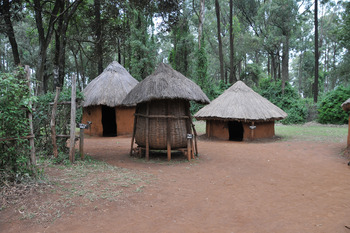
Bomas has certainly contributed to the nationalist project of transforming people from different ethnic groups into citizens of a nation. A recent article published in The Standard, one of the most widely read Kenyan newspapers, reports that traditional dances associated with the Harambee philosophy have perhaps done more to create a sense of nationhood than any other factor in modern Kenya (Otieno Reference Otieno2012, 18). But what kind of nationhood is represented here? The fact that today we look at ethnic identity as a shifting and mutable category that can be mobilized and re-activated in different ways makes even more visible that at Bomas, neither the repertoire of dances nor the reconstructed ethnic villages cover the effective variety of Kenya's population (Otieno Reference Otieno2012, 18) (see Photo 2). The picture is made even more complicated by the minimal differences between the cultural products of some ethnic groups and the difficulty in identifying their specific material or immaterial heritages. To build a typical village or to choose a dance for each of the official ethnic groups living in Kenya would reveal the similarities and their shared histories, more than the differences between most groups. The inter-ethnic relations between people living in what became the Kenyan state were much more frequent than most people are willing to admit today (Kakai-Wanyonyi Reference Wanyonyi, wa-Mungai and Gona2010, 32–49). At Bomas, the government wants the shows to be the best example of how equal Kenyan ethnic groups are (Bruner Reference Bruner2005, 214), but the fabric of Kenyan society is quite different. The standard traveller guidebook indicates that the country comprises forty-two different communities (and so does Bomas's Web site), but this number refers only to African groups. Bomas expediently selects only some of these African ethnic groups to build its repertoire, editing out the Asians, the British, and the Arabs who have lived in the country for over a century and occupy prominent positions in its society and in locating the “essence” of its national identity in a stable ethnic mosaic anchored in a harmless expression of cultural identity (Opondo Reference Opondo2000, 23). Direct observation also reveals that more than one ethnic identity may coexist in the same individual (the average Kenyan is at least trilingual), that physical features are often misleading, and that the same person may decide to perform a different ethnicity in different contexts. As John Lonsdale (Reference Lonsdale2008) usefully reminds us, factors of gender, generation, and class always lurk behind the discourse of tribal rivalry.
Reconstructed village at Bomas of Kenya. Copyright: Susanne Franco.

The multiple ways in which this diversity has been conceptualized across the linguistic, cultural, and political spectrum are themselves symptomatic of its highly controversial status. The use of terms such as “nationality,” “community,” “tribe,” or “ethnicity” varies according to context, and the same concept can be more neutral in a specific situation and politically loaded in another. Nowhere is this clearer than in the deployment of the word “tribe,” which scholars have tried to deconstruct systematically, and which Kenyan intellectuals have strived to defuse, but which remains nevertheless pervasive in the ordinary discourse and workings of the nation. The harsh reality is that today “tribe” is widely used in everyday life, and is often a determining factor in key political decisions as well as in countless daily interactions. As one commentator put it eloquently, “Almost invariably, the habit has been to approach ‘tribe’ with two mouths—to disown it aloud under the sun on one side, and to sing choruses to it under the stars on the other” (Ndago Reference Ndago2010). Bomas celebrates tribal unity and equality in diversity, while in the real world, diversity is continuously exploited to recriminate and promote inequality.
The most comprehensive study of Bomas to date has been produced by two anthropologists, Edward Bruner and Barbara Kirshenblatt Gimblett (Reference Bruner and Kirshenblatt-Gimblett1994), and later published as a chapter in Bruner's volume Culture on Tour: Ethnographies of Travel (Reference Bruner2005). The essay offers an important term of comparison for us insofar as it is based on fieldwork carried out in the mid-1990s, and it focuses on the language employed by the institution to present its program on the one hand and, on the other, on the observation of a sociopolitical context that is markedly different from the current one. Bruner affirms here that at the time of his research at Bomas, the dances were officially presented as “traditional,” and that the term tribe, which he assumes to have negative connotations, was used in the program only twice and merely as the equivalent of people or group. In contrast, private Kenyan tour companies largely employed the term “tribal” in tourist brochures issued for Western audiences in connection with other cultural attractions (Bruner Reference Bruner2005, 80). At Bomas, the term “traditional” was functional to present the dances as part of a previous historical era to a modern and local urban audience dealing with its national identity. “Tribal,” on the other hand, was used for foreign tourists. Bomas took the concept of “tribe,” archived it as “tradition” (set against “modernity”), and safely contained in within a museum logic: “[It] speaks about tribalism as memory” (Bruner Reference Bruner2005, 80; Hugues 2014, 190–193).
One may agree with Bruner when he suggests that Bomas was founded to convey a message of national identity and modern statehood, evidencing how many recent postcolonial nations “express ethnicity and yet simultaneously tr[y] to contain it” (Bruner Reference Bruner2005, 94). However, when he affirms that Bomas represents “what British colonialism was trying to achieve, the detribalization of Kenya” (Bruner Reference Bruner2005, 82), he fails to align the supposed message of the institution with the contemporary workings of ethnicity and the continuing: silent “tribalization” of society.
Twenty years later, the situation has changed: in the most recent version of its Web site, the dances staged at Bomas are defined as “tribal cultural shows” and “forms of popular cultural bonanza” (Bomas of Kenya 2014). The definition of “ethnic dances” is never employed, and in the program they are presented as “traditional dances” of various “ethnic groups.” At a different level, the terms traditional and tribal, and the shift they produce from the present to the past, complicate the reception of these dances by the international (tourist) audience. To present an ethnic dance as traditional or tribal means to reactivate deep-seated stereotypes—the association between Africa and primitivism, which situates the practice of dance in the realm of the ancestral rather than considering it as shot through and woven into the political and the contemporary. Bomas amplifies the risk for an African country of being perceived as unable to be represented by anything other than music and dance, and in a paradox typical of the postcolony, thus appropriating one of the most tenacious stereotypes produced by colonialism.
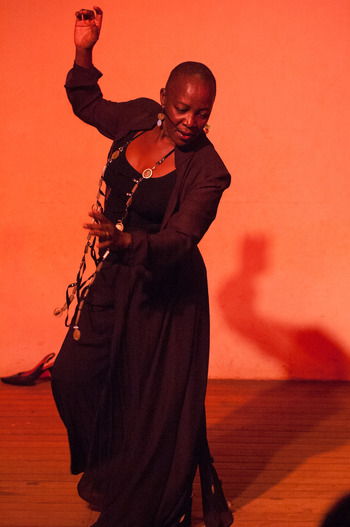
A radically different portrait of Kenya and its ethnic fabric is offered by Sitawa Namwalie. A former sport celebrity, and a consultant on management, women, and environmental issues, Namwalie's critical stand against the stereotyping of women and the aesthetization of the female black body takes the visible form of her totally shaved head (Photo 3). Cut Off My Tongue is a long-running show, which she re-assembles and updates at each performance according to the structural and social features of the performing space (theaters, museums, schools, community centers, jails, etc.). It targets a local audience, who are well versed in the linguistic and social dynamics of Kenyans society, and who are called on to face the recent past of the country. It is a show that combines poetry, music, and dance with a series of mostly satirical vignettes acted out by performers and accompanied by musicians playing African instruments. In a simple set made of a few stools and objects, the performers carry folders with the text of the poems, read alternatively in an accusatory, demanding, or anguished and doubting tone, or emphasizing satirical humor and caricaturing Kenyan stock characters. The movements and the dances, choreographed by Lilian Amimo Olembo, function as a connecting thread between the different parts of the show.
Sitawa Namwalie in Cut Off My Tongue. Copyright: Sitawa Namwalie.

The cast is programmatically multiethnic, a key component that is given prominence in the show when each member says something in his/her own mother tongue, with an emphasis on the plurilingualism of Kenya that is invisible at Bomas. Writing in the aftermath of the 2007/2008 trauma, Namwalie aims at tackling ethnicity as a problematic issue and stages the often ironic dimension of the social discourses and practices related to it. In her own words, the show, which is still touring inside the country and has been invited to perform on a few occasions in the UK, functions “as a way of piercing through the culture of silence so ingrained in Kenya” (Namwalie Reference Namwalie2009, 1).
The opening text of the show (that also exists in printed form as a poetry collection) is titled “Language of Tribe”:
Namwalie manages to run the whole gamut of articulations of tribe in Kenyans’ lives, taking her audience on a journey that starts with the seemingly innocuous conversation that took place in New York where her name is mistaken for a tribal identification to what is arguably the most emotionally intense moment of the show, the poem “Would You?,” where the audience is confronted with the unspeakable violence of the recent elections:
With their two diverging ways of inscribing the past of the nation in their performances, the Bomas show and Cut Off My Tongue can also be analyzed in light of the dialectic between heritage and history, which is central to the fashioning of Kenyan identity.
Heritage Versus History
As Lotte Hugues has recently pointed out, the government of Kenya perceives heritage “to be less threatening than history,” and therefore the state has decided to invest in cultural heritage as a “central plank in unification efforts” (Hugues 2014, 196). The passing of a new constitution in 2010 has also enshrined for the first time a wide range of rights to cultural heritage, which is a growth industry in contemporary Africa. Unlike history, which is a critical inquiry into the past, heritage is a celebration of the past following present-day purposes and seeking a consolidation of national identity (Lowenthal Reference Lowenthal1996, x). Heritage sites, as well as practices of immaterial heritage, frame our most basic assumptions about the past, inform who we are collectively, and envision our future.
Starting with the late twentieth century, heritage has become a highly active discourse, and the way we think, talk, and write about heritage has taken the form of a hegemonic rhetoric that legitimizes dominant narratives about nation, class, culture, and ethnicity (Smith Reference Smith2006, 299). One way to challenge and broaden the hegemonic concept of heritage and the cultural materialism that lies behind the 1972 World Heritage Convention of UNESCO was the adoption of intangible cultural heritage as a “class” of cultural heritage. The concept of intangible heritage refers to the nonmaterial aspects of culture that help societies to remember their past and their traditions, and to build a sense of identity, community, and locality in the present. This concept was warranted by UNESCO in 2003 and has been the subject of intense debates that question the notion of heritage itself, and more generally the criteria of World Heritage categorizations (UNESCO 2003). As Rodney Harrison remarks, intangible heritage is intimately connected with two dimensions of social memory: inscribed memory (monuments, texts, or representations that materialize it) and embodied memory (the performative, bodily, behavioral contexts in which memory is produced and reproduced) (Reference Harrison, Rose and Benton2010, 240). UNESCO's intangible heritage program is also informed by the concept of national “living treasures” that includes also the body as “living archive,” which is crucial in defining the strategies to preserve dance and performances as forms of embodied memory and knowledge. As Kirshenblatt-Gimblett (Reference Kirshenblatt-Gimblett2004) has observed: “‘Living archive’ and ‘library’ are common metaphors. Such terms do not assert a person's right to what they do, but rather their role in keeping the culture going (for others). According to this model, people come and go, but culture persists, as one generation passes it along to the next” (Kirshenblatt-Gimblett Reference Kirshenblatt-Gimblett2004, 58). In the case of Bomas, its mission, policy, and vision are clearly stated at the main entrance:
to maintain, preserve, educate and promote the rich and diverse culture of the various ethnic groups of Kenya; … to ensure the cultural experience provided to the local and international tourists are authentic and reflects our cultural values; … to be the leading custodian of Kenya's rich and diverse cultures as a national heritage for prosperity and posterity… .
Following UNESCO's classification, Bomas seems to present two forms of heritage, the tangible in the form of the huts and the intangible in the form of the dances. But do these categories apply so neatly to what happens at Bomas? The company and the repertoire are currently under the responsibility of two choreographers, John Mathenge and Bwire T. Ojiambo, the latter also Bomas's production manager. The selection of the ethnic dances reenacted and staged here is the result of a process that has led to innovation and adaptation of the dances to the space and to the audience. The choreographers have not been limited by copyright's restrictions, since Kenyan law is still processing this issue concerning dance and music (Opondo Reference Opondo2000, 23). The pieces, staged with professional lighting and sound effects, have been re-choreographed to adapt to the spatial limitations of the auditorium in the round, having only two wings, and adapted as well to the time frame of a standard two-hour show. Each piece is introduced by a recorded voice-over that provides a succinct description in folktale narrative style—a description also reproduced in the slim printed program. The verbal description is limited to a few basic anthropological notes and is devoid of technical detail. During the show, people enter or leave the auditorium at any time, taking pictures and videos, and commenting out loud on what they see.
Bomas's audience is mainly constituted of national or international tourists and Kenyan schoolchildren taking part in organized field trips. Visiting the site at a specific time of the year, or on a weekday as opposed to a holiday, may determine the prevailing presence of one group or the other, also altering the perception of the Museum's mission. For local schoolchildren, a visit to Bomas is a seminal educational experience that exposes them to their national culture. In a context in which national history is taught infrequently and selectively at the school level, this is one of the rare opportunities for Kenyan citizens to appreciate their own cultural diversity. For local artists and intellectuals, these dances appear as far too commercial, whereas spectators of the older generations, who in most cases have had direct exposure to some of the dances in their rural past, are “roused by tunes and dances particular of their ethnic group” (Hugues 2014, 192). This celebration of ethnic identity is particularly evident during the improvisations of the soloists, who are chosen by the choreographer according to the daily selection of dances and their respective ethnic backgrounds. Soloists will not be made to perform a dance belonging to a different ethnic group because members of the audience may recognize their bodily features and accents, as well as their improvisation abilities, and find them at variance with the dance.Footnote 10
For international tourists, Bomas is a place where they can appreciate what the guides call “Kenya in miniature” (Bomas of Kenya 2014). It is a moment of cultural enrichment for their vacation, during which tourists usually sit silently respecting the Western conventions of passive theater spectatorship, except for the short moments when some spectators are invited to participate in the dance. Generally speaking, they feel they are attending a genuinely authentic artistic experience, although it projects and reinforces all the clichés of African dance.
As Jane Desmond suggests in a different context, such experiences are the result of specific strategies deployed by the tourist industry for advertisement and staging, which simultaneously sketch “the wider social contexts and ideological frameworks through which tourists negotiate [their] meanings” (Reference Desmond1999, xviii). We may preliminarily conclude that Bomas does nothing to modify a stereotypical perception of African dance and instead guarantees to both national and foreign visitors the “authenticity” of its commodified performances.
Although the official presentation states that Bomas is committed to preserving the authenticity of Kenya's cultural values and to portraying them in their “pure form,” the repertoire is close to what the French anthropologist Jean-Loup Amselle describes as an “artificial synthesis of ethnic dance forms, often considered as an obligatory step to assert genuine African dance on the international scene” (Reference Amselle2004, 84–90). More specifically, the repertoire seems to embody a “poetics of detachment” (Kirshenblatt-Gimblett Reference Kirshenblatt-Gimblett1998, 78) in which performances are adapted to values such as uniformity, precision, and brevity, which suit cultural outsiders such as the international tourists as well as domestic audiences, principally comprising schoolchildren. Beyond the binary opposition between the “authentic” ritual and the “artificial” theatrical representation, the ritual at Bomas is the spectacle, the authentic is the outcome of the mediation (the repertoire), and entertainment is the cultural/political purpose. One is reminded of what leading postcolonial intellectuals Frantz Fanon (Reference Fanon2001) and Albert Memmi (Reference Memmi1967) identified as a process of petrification of colonized cultures. As Fanon suggests, the colonized are petrified insofar as they are stuck in cultural immobility, caused both by the regime of control of the colonizer and by the defensive reaction that drives them to adhere to rigid and ossified forms of their own traditions (Fanon Reference Fanon2001).
The transformation of complex local traditions of performances into aestheticized events has been described in terms of several related processes, such as folklorization and the invention of tradition. These dynamics are complicated by the fact that in the African context, as in other postcolonial sites, “transmission,” “culture,” and “tradition” are notions that were assimilated during colonial times, and also the fact that the dominant preservationist model in world heritage management is echoed at the local and national level, often without registering the recent discussions on alternative, more fluid, and dynamic ways of approaching the field. In her seminal study, Laurajane Smith (Reference Smith2006) suggests that the idea of heritage is used to construct, reconstruct, and negotiate a range of identities, values, and meanings in the present. Therefore we should consider it less a thing than a cultural and social process, which engages with acts of remembering that work to engage creatively with the present. In other words, heritage could be understood as something that is done, as an experience and as a social and cultural performance, rather than as something to manage. As Susan Reed noted, the rising interest in cultural heritage fueled by both states and private organizations has brought about the centrality of dance at a global level as a sign of identity (Reference Reed2010, 4). For these reasons, reenactment, as a strategy to re-activate a dance piece or a dance tradition, has taken on a specific meaning with respect to heritage. The Bomas seems to have travelled in the opposite direction: the reenacted ethnic dances were initially conceived as an experimental process, but over time the archival impulse has prevailed, with the inherent risk of crystallizing the repertoire into manageable products. Today these reenacted dances appear less as the expression of an intangible heritage than as reified, tangible artifacts that have lost their ideological edge and their ability to question the dominant political order.
Smith proposes to redefine all heritage as inherently intangible because the real subject of the preservation and management processes are the set of present values and meanings that are represented by these heritage sites and cultural practices (Smith Reference Smith2006, 11). This tension can be registered at Bomas from the very beginning of its adventure with major disagreements over its role between those who wanted it to be a museum and educational center, and those who were in favor of a more commercial enterprise. After long discussions and political tensions inside the first board, Bomas's chairman Peter Okondo affirmed that this institution “is the first and foremost commercial company whose overriding motive is to make profit. Our merchandize is authentic Kenya culture. We must sell this commodity as its best, in the form of authentic crafts, artifices, display[s] of skills, folk dances and performances of the genuinely cultured kind” (Okondo quoted by Hugues 2014, 191–92). But it was only in the 1980s that the institution became a tourist attraction offering “repeated and unimaginative programmes mainly to entertain and cause laughter” (Opondo Reference Opondo2000, 23)—a trend that continues today. In its official Web site, Bomas is presented as “the premier institution in cultural resources preservation and management” that is bound to play “a bigger role in the development and promotion of cultural tourism in Kenya” (Bomas of Kenya 2014). Its official goal is “to be the leading custodian of Kenya's cultures for cultural tourism,” and its activity is seen as the result of “the current growing interest in cultural heritage, growth in cultural tourism [that] has increased a positive worldview of the importance of cultural resources as a tool for creating economic development while preserving cultural resources” (Bomas of Kenya 2014). Even though Bomas is one of the institutions subscribing to Vision 2030, the ambitious country's development program was supposed to launch Kenya into a glorious age of prosperity; however, a longstanding funding crisis compounded with administrative problems and a lack of a contemporary vision (Opondo Reference Opondo2000, 24) prevents it from playing a leading role. On the other hand, Bomas has been able to promote its offering by touring abroad on a number of occasions.
On the stage of the grand auditorium of Bomas, a politically harmless heritage covers over and obscures the tribulations of history, while in her touring show Sitawa Namwalie performs a personal history intertwined with the traumas of the nation and the contradictions of heritage. In fact, there was on the part of Bomas a recent attempt to give a more diachronic and narrative version of Kenyan past. It took the form of a ninety-minute show titled Millennium Dance or alternatively A Nation Is Born, which consists of a sequence of the dances taken from the standard repertoire meant to (re)present Kenya's history as a continuum of events from the remote past to the day of independence. Produced to be part of the cultural program at the 2006 Berlin soccer World Cup, it was never staged despite a large investment (sixty-six dancers rehearsing for eight months) because of a final disagreement between the organizers. Paradoxically one can learn about the show from a description that is still part of the general printed program of the Bomas “Traditional Dances of Kenya—Narration.” In Millennium Dance, the ethnic diversity of Kenya is subsumed in a conveniently homogenous “native” identity—a “community relatively at peace with itself.” The dances of different ethnic communities follow in succession to emphasize the harambee dimension until the Kenyan flag is hoisted during a final dance that incorporates Western influences in its African style. As a telling example of this sanitized version of history, the anticolonial struggle is summarized in this way: “It is the pain of … injustices under colonial rule that ultimately sparks the communal uprising that leads to the war of independence and the climactic reward; our freedom.”Footnote 11 The specific and controversial role of the Mau Mau's violent guerilla action is effaced, and resistance becomes, against the evidence of history, one united, national liberation movement. History made its appearance at the National Museum of Kenya only in 2010 with a similarly reticent narration (Karega-Munene Reference Karega-Munene2011). Despite the approaching fiftieth anniversary of Kenyan independence and the need for Kenyan citizens “to be told the truth,” to paraphrase the title of an article by Hugues (2001), this show and this exhibition are an example of how both Bomas and the National Museum have reduced complex historical discourses to a less controversial heritage politics, and have represented the (re)birth of the nation as a unproblematic issue.
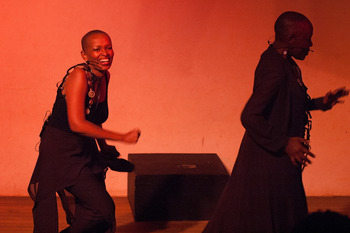
At a very different level, Namwalie has created a political and personal history of Kenya, with personal poems that try to evoke a collective Kenyan voice and an intense emotional experience in their staged reading. In one of the vignettes, two performers, Namwalie and Alice Karunditu, talk about their relationship with tradition. Namwalie starts singing a Luhyia children's song while trying a few dance steps, but every time she seems to get into the flow and to the pleasure of moving her body to the rhythm of Willie Munga's drums, she stops abruptly because she does not remember the lyrics. “Why can't I remember?” she asks herself, and cries, “Legends and half remembered stories!” The second performer enters the stage, humming and dancing a Kikuyu children's song and also suddenly stopping, surprised by her memory loss. Namwalie repeats, “Legends and half remembered stories! Therefore no meaning attached to them.” Their flux of embodied memories is interrupted, and they exchange lines on how their ways of carrying traditions are disappointing, starting from their poor cooking of the national dish ugali. But the very sense of alienation from the past stimulates them to resume their singing and dancing, which is again broken off by their memory loss (Photo 4). In this episode, Namwalie manages to perform the notion that dance may be evanescent, but the practice of dancing is not in danger of disappearing, as Bomas's reenactment philosophy and UNESCO's understanding of intangible heritage imply. The transmission of heritage is shown to be made up of misremembering and mis-stepping (and hence innovating) rather than a faithful reproduction of a codified legacy.
Sitawa Namwalie and Alice Karunditu in Cut Off My Tongue. Copyright: Sitawa Namwalie.

Dance, (Post)-Archive, and Repertoire(s)
Diana Taylor has proposed a binary model where the repertoire enacts embodied memory (performances, gestures, orality, movements, singing, dance) and functions as an ephemeral and embodied practice/knowledge (spoken language, dance, sport, ritual) as opposed to the knowledge derived from the written or “disembodied” archive of supposedly enduring materials (texts, documents, buildings) (Reference Taylor2003, 19). Taylor considers the repertoire as a site of reconstitution, not of pure reliving, as Carrie Noland (Reference Noland2013) points out: “There is less distance between the archive and the repertoire than there might at first appear,” because forms handed down from the past are experienced as present, and “the process of aesthetization has rendered the gesture more rather than less effective as a mnemonic device for recalling and preserving experience” (98).
Taylor uses the term repertoire in the etymological sense, as an inventory or something that requires presence. It does not offer a mode of pure inhabiting of the past, since the subject who re-experiences is also existing in a live present. The repertoire plays a mediated mode as much as the archive because the process of selection, memorization, and transmission takes place within specific systems of re-presentation. Historically, however, the term repertoire has been used in Western theater tradition to refer to a series of dance/movements that a dancer/performer is able to perform, or the series of pieces regularly performed by a company or offered by a theater. Its definition remains ambiguous, as it refers to something related either to the bodily memory of a single person or to a corpus of pieces belonging to an institution, which owns it but needs the presence of the performers (and their bodily memory) to activate it at any given time (Franco and Nordera Reference Franco and Nordera2010, 126).
The tension between these two concepts of repertoire appears at Bomas, where the forty-seven selected dances are reenacted in the present and standardized form drawing on the embodied knowledge that individual dancers bring with them when they join the Harambee company. Most of the dancers are recruited from the annual Music Festival Kenya, which may correspond to the repertoire in Taylor's term, insofar as it functions as an ephemeral and embodied practice/knowledge. The Music Festival Kenya is a competition founded by the Ministry of Education in the early 1970s with the goal of preserving the Kenyan cultural heritage and of involving thousands of students of different ages countrywide. It is organized every year in a different city where the young Kenyans represent their provinces on stage with traditional songs, dance, poetry, and gospel music. Even though the government is also trying to link it to the tourist industry, for many Kenyans this Festival is the occasion to see dances as they are still performed in everyday life.
As far as archiving is concerned, in recent years Bomas has produced a series of DVDs that are usually sold after the shows. Each volume presents a list of the many dances performed daily at the auditorium, but entirely reworked and restaged at the reconstructed villages. This more “stable” archival material has required a different representational strategy, and, precisely, a more realistic contextualization, a longer time frame, and a different performing style, in the absence of a live show and an audience. We consider these video-recorded versions of the dances as a post-archive resulting from an entirely proleptic strategy that offers a representation of both the idealized past and the dreamed of future of the postcolonial state—one that still strives to be a nation; a vision of concord, symmetry, and circularity between equal ethnic cultures, the representation, in short, of what has yet to happen. Conversely, Cut Off My Tongue, with its variable and audience-specific structure, offers an example of performance as an archival process, a mnemonic reserve, or what Joseph Roach would call a surrogation, the process by which “culture reproduces and re-creates itself” (Reference Roach1996, 2). In other words, Cut Off My Tongue is a way to carry into the present both ways of dancing and ways of thinking about dance.
Conclusion
Returning in conclusion to Mbembe's reference to the “chaotically pluralistic” Kenya of today, the huts and dances of Bomas offer an example of simulacra and reformed stereotypes of a nation and an ethnicity. In her counter-narrative, the words and dances of Sitawa Namwalie challenge these stereotypes to address the most urgent contemporary social and political issues. Cut Off My Tongue demonstrates that a national identity cannot be simply produced or represented in places consecrated to heritage preservation, but is actively and constantly re-created and negotiated between people, communities, and institutions. Dance in her show is part of a broader effort to reassess the meaning of the past for the needs of the present: a national identity is about change and continuity, and heritage is not “a passive subject of management and preservation or tourist visitation” (Smith 2000, 66), but an active process engaged with the construction and negotiation of meaning through remembering at an individual and collective level.
A new direction may be found in the Kenyan musicologist Patricia Opondo's suggestion to transform Bomas into an institution where choreographers and composers could create new works for a resident company, and to display these creations to the Kenyan public, thus providing alternative career paths for artists (2000, 23–24). In this way, this cultural center would no longer exist as a museum of reified artifacts—albeit performed live before live spectators—but instead as a laboratory for the innovative reenactments of Kenyan dance.