INTRODUCTION
In early 2016, citizens of the Central African Republic (CAR) and foreign observers hoped that the democratic election of a new president and parliament would put an end to the major crisis that had swept across the country from 2012 to 2014. Yet the current expansion of violence across the country and the growing presence of new and old armed groups controlling large parts of the territory demonstrate that the deployment of a UN peace-keeping mission and elections do not necessarily bring stability. Rather, to the contrary, the CAR seems to be slipping back into protracted insecurity with eruptions of violence that characterised it prior to the beginning of the 2012–2014 crisis.
With both the acute crisis and the transition period over, there is relevance in analysing the societal and political residues of the years from 2012 to 2016. Three major ruptures with the past seem to stand out as characteristics of this period. First, in 2012, the Séléka became the first alliance of armed groups to emerge from the provinces to take over power, instead of the more common coup attempts from within Bangui's political-military elite circle. Second, the deployment of the UN peacekeeping operation MINUSCA since 2014 marks the first robust mission that the CAR has known (MINUSCA 2014), despite the many international and regional missions that have been deployed in the country since 1997. The most recent and third rupture with the past is the fact that current President Faustin-Archange Touadéra is the first democratically and popularly elected head of state, never having attempted to rise to power via undemocratic means. He initially had also excluded previously armed actors from his government.
In this article, we confront and interrogate these recent ruptures – the history of events (l'histoire événementielle) – with a longue and moyenne durée perspective (Braudel Reference Braudel1980: 27f). As Bayart has argued, African politics today can only be understood when put in perspective of long-term traditions of governance (Bayart Reference Bayart1993). This longer-term perspective helps us to understand and situate the political and social events that have taken place in the time span of only a few years in their wider historical context. At the same time, as Jan Vansina has pointed out with regards to pre-colonial Central Africa, tradition has a Janus face and the exclusive focus on continuity risks under-appreciating change (Vansina Reference Vansina1990: 33). Patrick Manning too stresses the importance of transformations rather than continuities, and focuses on the ways in which African societies have responded and reformed themselves in response to challenges from within or from outside (Manning Reference Manning1999: 18). As Clapham wrote in his review on the longue durée in African politics, it is through a balance between continuity and dynamism and transformation that we can understand the present (Clapham Reference Clapham1994: 439).
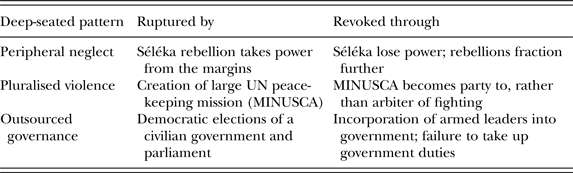
Keeping this balance in mind, we look at the broader trends from the colonial period to today, and outline the potential relevance of current events and their broader impacts on the relationship between citizens and their political authorities. On the one hand, we show how the recent rebellion, external intervention and democratic elections were significant ruptures with the past. On the other hand, we demonstrate that the impact of these ruptures has ultimately been subverted by the continuities of the past (Spurk Reference Spurk2004: 44): the new ruptures have been revoked. We define ruptures according to Christian Lund as ‘“open moments” when opportunities and risks multiply’ (Lund Reference Lund2016: 1202) and study the extent to which the pervasive trends of the CAR's political economy may slowly shift as a result of these ‘open moments’ provoked by the crisis. We therefore propose to situate the ruptures within the country's historical trends in order to observe their impact and relevance for the present. We argue that the ruptures have led to a spike in on-the-surface changes visible in violence, intervention and elections. However, rather than altering the deep-rooted continuities of outsourcing, plural violence and peripheral neglect, the involved actors risk to further entrench these dynamics.
The continuities we describe are not exclusive to the CAR, but important differences remain in states that seem similar at first sight (Glawion et al. Reference Glawion, De Vries and Mehler2018). In the wider region, political authority is shared, contested and divided between a wide array of actors (Debos Reference Debos2011; Mehler Reference Mehler2013). In comparison to the CAR's outsourcing by default (Lombard Reference Lombard2012), governments in Chad and South Sudan share sovereignty more strategically with other armed actors as a means to reduce the burden of governing the hinterlands (Debos Reference Debos2008; Raeymaekers Reference Raeymaekers2010; Schomerus & de Vries Reference Schomerus and de Vries2014). The comparatively weak state forces of the CAR have been unable to provide even minimal stability compared with, for instance, neighbouring Chad, where the president has successfully managed to control the territory by using different militias for his divide-and-rule strategy (Debos Reference Debos2013, Reference Debos2016). In neighbouring Cameroon, President Biya has maintained his regime over decades despite ongoing neglect of the rural hinterlands and insecurity at the country's fringes (International Crisis Group 2010a, 2010b; Mehler Reference Mehler2014). In the CAR, on the other hand, successive regimes have remained incapable of holding on to power for more than a decade. The CAR thus shares with some of its neighbours the challenges of vast peripheral hinterlands and plural public authority, but where neighbouring regimes have managed to use these characteristics to consolidate power, it produced a situation of protracted disorder in the CAR (Mehler & de Vries Reference Mehler and de Vries2018).
We base our analysis on historical and more recent literature on the CAR and on an assessment of recent events via news sources, policy briefs and reports. We undertook field research in the CAR – in Bangui, Bangassou, Obo and Paoua – in 2015, 2016 and 2017 during visits lasting five, eight and two weeks. We studied the ways in which communities maintained, organised or undermined local security, via interviews and focus group discussions with local institutions and state agencies. We begin here with a brief discussion of the CAR's long history of exploitation and negligence from the colonial period through to the crisis that started in 2012. We then discuss the three important ruptures that have occurred since the start of the Séléka rebellion. We demonstrate for each how they have differed from what used to characterise the country's political economy. We conclude, however, that despite the promising characteristics of these ‘open moments’ provoked by rupture, the CAR and its citizens nonetheless continue to face largely the same challenges that have characterised the lives of many since the early 1990s (see Table I).
Longue durée, ruptures, and revocations in the CAR

THE CAR'S HISTORY OF OUTSOURCING, VIOLENCE AND PERIPHERAL NEGLECT
The most recent crisis in the CAR started in September 2012 when the Séléka, an alliance of rebel groups that had operated in the north-east of the country from 2007 onward, set off to oust President François Bozizé. They succeeded in March 2013 and installed their leader, Michel Djotodia, as president. The violence, looting and abuse they caused provoked the mobilisation of a loose coalition of local defence groups, the Anti-balaka. Violence between and among the Séléka and Anti-balaka peaked in December 2013. Due to his inability to bring stability to the country and the failure to control his forces, international leaders pressured President Djotodia to step down in January 2014. A transitional government and parliament took over state duties for two years and were replaced in early 2016 after democratic elections. Despite the democratic resurgence, conflict between numerous armed groups continues, and tensions within local communities remain unresolved. As a result, the recent wave of violence has surpassed the protracted crisis that characterised the decades prior to 2012. Over the last five years more people have been killed and displaced than in any other five-year period since independence. The levels of armament have increased and armed groups have multiplied, with recruitment rhetoric that deepens social fault lines.
In order to examine the present situation and the ways in which it may or may not deviate from the past, we here briefly examine the country's history in relation to three connected trends that have characterised the territory from pre-colonial times to this day: outsourced and extractive governance; pluralised and violent power struggles; and a profound disconnect between the centre of power and its peripheries.
Outsourced and extractive governance marks the first continuity in the CAR's political economic history. Governance was outsourced even prior to the arrival of the French, via local sultans vying for control over their hinterlands. Compared with other overseas territories, the French colonial powers committed few resources to the expansion of their authority in the region. The CAR never lay at the heart of France's colonial interest. Rather, the Oubangi-Chari territories, as it was initially called, served as a region from which to extract resources. In order to ensure a minimum of control over the territory, the French colonial administrators sought ways to outsource security via protectorate treaties with the main sultans of the late 19th century (Kalck Reference Kalck2005: xxvi).Footnote 1 Another way in which France outsourced some of its political and economic interests was via a system of what Rebecca Hardin coined ‘concessionary politics’ (Hardin Reference Hardin2011; Smith Reference Smith, Carayannis and Lombard2015): it encouraged private companies to seize control of the land so as to extract profits and taxes for the colonial authorities. What these concessionary companies lacked in numbers and legitimacy they made up for in brutality (Saulnier Reference Saulnier1998: 81ff; Woodfork Reference Woodfork2006: 12). One result of the outsourced brutality was the rise of popular resistance movements, such as the Zande insurrection of 1916 and the 1928–1931 Baya uprising (Saulnier Reference Saulnier1998: 92ff; Kalck Reference Kalck2005: xxviii).
The post-colonial regimes that came to power shortly after independence largely maintained this system of ‘concessionary politics’, under which parts of the territory continued to be outsourced to private economic and security actors (Hardin Reference Hardin2011). The very few foreign companies showing interest in investing in the country were granted access in exchange for undisclosed entry fees. Bozizé, for instance, granted Canadian UraMin, which was later taken over by the French parastatal company Areva, the rights to exploit the uranium mines in Bakouma sub-prefecture. A few years later, he opted to compromise his good relations with the Elysée in order to negotiate a new deal with a Chinese company. Timber-logging companies and diamond-trading bureaus were equally used as means to outsource exploitation in return for a share of the profits. Smith explains how some forest companies have substituted for government service delivery by building roads, schools and clinics (Smith Reference Smith, Carayannis and Lombard2015: 104f). Successive presidents have also outsourced security to local defence groups in the hinterlands. This approach formed the backbone of Bozizé’s security policy against road robbers (Zaraguina s) in the north-west (Chauvin & Seignobos Reference Chauvin and Seignobos2014). He outsourced combating the more serious rebellions in the north-east to the French, who conducted air and ground attacks (International Crisis Group 2007: 23ff). Governance, whether in the field of service delivery, security or other public goods, was never a responsibility that different governments attempted to live up to.
The second remarkable continuity throughout CAR's history is the important role played by multiple forms of violence. Violence has taken the form of military coups, the everyday violence of state security forces against citizens, and rebellions in various parts of the country (Lombard & Batianga-Kinzi Reference Lombard and Batianga-Kinzi2015; Lombard Reference Lombard2016b). The first abuse of power in post-colonial CAR, although not via violent means, came after the unexpected death of the country's pre-independence hero Barthélémy Boganda. David Dacko ascended to power by promising the assembly deputies a five-year extension of their mandate in exchange for electing him president (Saulnier Reference Saulnier1998: 102f). The presidents who followed Dacko either came to power via coups (Bokassa, Kolingba, Bozizé) or first attempted unconstitutional takeovers before sealing power through elections (Patassé). While successive presidents violently accessed and maintained their power at the central level, local defence groups formed in response to the security gap that state forces left in the peripheries. Armed groups also tried to benefit from the void through waves of rebellion, road robbery, incursions from neighbouring states’ rebel groups, armed cattle herding and poaching. In the absence of state control, these groups together created a very fluid security situation in which the multiple actors continuously struggled against one another for access to economic benefits and security provision for certain parts of the population. From the 1990s onward this mixture developed into the protracted insecurity and low-intensity conflict that still marks the country today.
Third, part of the country's persisting insecurity lies in the history of a sharp disconnection between the centre and the periphery. This distance is not just spatial but also social: a small group of elites heads the government in the capital and benefits privately from the few resources available to state institutions. At a great distance follow the ordinary people, who have few opportunities. CAR's most well-known and notorious leader, Jean-Bédel Bokassa, centralised power not only in the capital but also in his own hands – as symbolised by his auto-proclamation as president for life in 1972 and emperor in 1976. Crucially, he consolidated a tradition of confining positions of power to a small group of people who rotated into and out of these positions. His successors have kept this tradition alive to the detriment of the periphery and the periphery's leaders, who remain disconnected from the power centred in Bangui.
None of the presidents managed to meaningfully govern the sovereign territory, and the few incentives and possibilities for development were used to benefit only the small and rotating elite in Bangui. In the absence of infrastructure, social services or the rule of law, the population grew frustrated with the inertia of its leaders. People initially greeted each takeover of power with enthusiasm before being deceived again. While our present-day interviewees often ascribed a spike in state-led development to Bokassa,Footnote 2 it was in fact during this period that the country's rule of thumb ‘the country ends at Kilometre 12’ was established: development projects and state administration were and continue to be largely confined to the 12-kilometre radius of the capital Bangui (Saulnier Reference Saulnier1998: 107).
Rather than relating to state authority over the country's peripheries, keeping a hold on power has depended on external relations. Throughout the five decades after the CAR's independence in 1960, the former coloniser remained highly influential through a continuous military presence, high-level positions in the state administration, and a dominant role in the economy (Baxter Reference Baxter2011). The presidents who tried breaking this grip on power were all deposed with massive support from outside. In September 1979, French troops took control of the Bangui airport, barred Bokassa from returning, and reinstalled former president David Dacko to the presidency (Kalck Reference Kalck2005: xxxvf). Patassé was in power until France and the regional forces aligned to get rid of him: France tacitly endorsed Bozizé’s return to the CAR (Mehler Reference Mehler2012: 52), Chad's president provided troops, and other neighbours provided funds and weapons (International Crisis Group 2007: 15f). France's power over developments in the CAR only underlined each successive government's acute lack of capacity to control even the central state. The CAR, as Roland Marchal succinctly summarises, is little more than ‘the sum of its neighbours’ peripheral hinterlands’ (Marchal Reference Marchal2009: 5). It was in this context that, after over 50 years of externally managed and violent power rotations among a small, recurring circle of elites, the Séléka rebellion managed to ascend to power. Its arrival marked the first of the three ruptures we discuss in the rest of the paper.
THE FIRST RUPTURE: THE SÉLÉKA ANOMALY
The Séléka rebellion was the first Central African rebel alliance that tried to break the elite circle in the capital. As the first Muslim president of the country, Séléka leader Djotodia, together with his allies, formed a broad coalition of outsiders. The Séléka became the first group to try and violently assert authority across the country. They briefly but brutally succeeded, except for the territory east of the Chinko river. However, they got caught up in the CAR's politics of limited central resources, fragmentation and resistance.
The predominantly Muslim Séléka alliance emerged in 2012 from a few rebel groups that controlled parts of the local artisanal mining in the north-east (Weyns et al. Reference Weyns, Hoex and Spittaels2014: 15).Footnote 3 These groups originated in the Vakaga province and originally competed with one another over the excavation and trade of the region's resources. The area lies close to the borders with Chad and Sudan, two countries that used to support each other's rebellions, which in turn had spillover effects on the CAR in terms of armed fighters, the flow of weapons, and cross-border relations with rebel leaders in the neighbouring country. Frustrations over the negligence of the central government, together with the presence of important mineral resources, led to the establishment of rebel groups beginning in 2006. By 2007 and 2008, they had signed several accords with President Bozizé in return for having their grievances – lack of roads, healthcare, education and clean drinking water – addressed (Spittaels & Hilgert Reference Spittaels and Hilgert2009: 11). The government never implemented its side of the deal and the rebellions festered (Weyns et al. Reference Weyns, Hoex and Spittaels2014: 24).
In 2008, President Bozizé himself attempted to break with the past tradition of outsourcing state governance in diamond areas – that is, of allowing local and transnational groups to profit from the diamond trade in return for part of the shares – and attempted to establish governmental control, albeit mainly for private purposes. During Operation Closing Gate, government forces – unannounced and overnight – confiscated diamonds, materials and even private goods from eight of the country's eleven diamond trading bureaus. These bureaus were accused of not fulfilling government quotas. Loyal followers and family members controlled the remaining bureaus and two newly created ones (International Crisis Group 2010c). Some rebel group leaders cited the operation as one of their reasons for forming the Séléka alliance a few years later (Weyns et al. Reference Weyns, Hoex and Spittaels2014). Thus, rather than extending the president's – and through him the state's – control, the operation ultimately led to his downfall: the Séléka advanced into the capital and took over power in March 2013.
The change of leadership brought about by the Séléka's takeover signified a break with the power shifts that had taken place since independence. With few exceptions, Séléka leaders had not previously held office in the CAR's government or army.Footnote 4 Not only did Séléka leaders replace the ruling elite with people from the peripheral areas, but they also maintained their own armed forces, which included mercenaries from Chad and Sudan. Although the Séléka was often portrayed as a religious (Muslim) alliance, many armed groups from the CAR joined it because of its increasing success in taking control of the country's territory. No former political or armed movement had attempted to create such a broad alliance of political-military entrepreneurs to topple a sitting president. Previous coups had always been based on a small circle of insiders with a small number of forces from the military or a specific militia, and aimed at bringing one specific leader to power. The Séléka alliance, in contrast, harboured multiple rebel leaders from the onset, such as Michel Djotodia, Nourredine Adam and Moussa Dhaffane. Especially at the onset, the rebel alliance was driven by foreign commanders and forces from Chad and Sudan, whose governments tacitly endorsed them to challenge President Bozizé, who had fallen out with Chad. Smaller groups and subcommanders, such as Ali Darassa, also joined the alliance. Instead of forming part of an integrated and coherent whole, each commander kept strong control of the rank and file they brought along. Thus, while Djotodia became the president, the other rebel leaders never expressed unquestionable loyalty towards him.
Unlike former rulers, who had concentrated on the capital, the collection of rebel groups managed to jointly control almost the entire territory.Footnote 5 Where previous governments led by Patassé and Bozizé had neglected the peripheries, Séléka generals attempted to consolidate their authority over these areas in a decentralised, predatory manner. Nevertheless, the central leadership did attempt to create some form of cohesion in the rebellion-turned-government by replacing local commanders who had gone too far: in Paoua, for instance, the population grew so frustrated with their foreign Séléka commander, who did not even speak French or Sango, that a local civil mediation committee complained to Bangui. In response to the complaints the Séléka leaders from the capital came to inquire and replaced the local commander with a less brutal one who spoke Sango (President of mediation board 2015 Int.). In Bangassou, a replacement Séléka contingent even engaged in armed combat with the already present Séléka group to force them to hand over power (Youth representative 2016 Int.).
Nonetheless, the Séléka's ruthlessness triggered widespread resistance throughout the country. Respondents in Paoua and Bangassou recounted how Séléka groups stole vehicles from churches, took NGO infrastructure, broke into prefectural state coffers, dismantled buildings’ roofing sheets and pillaged residential quarters (Priest Bangassou 2016 Int; Priest Paoua 2016 Int.). They then moved their wares to Chad and sold them at the markets (Trader 2015 Int.). Ultimately, competition over the spoils within extractive channels pulled the alliance apart. Most obvious and lasting was the rift between Ali Darassa's division, as an alleged defender of the nomadic Fulani Mbororo, and other Séléka groups that raided the Mbororo's cattle for profit. More devastatingly, the violence and looting of the Séléka caused both a general rupture in society – now often simplistically portrayed as a Muslim–Christian divide – and the formation of countless resistance groups, jointly labelled the Anti-balaka.Footnote 6 Anti-balaka groups reinforced the social rift by expelling large parts of local Muslim communities from many western and southern towns and the capital (Kilembe Reference Kilembe, Carayannis and Lombard2015) as part of their resistance against the Séléka rebellion. These social rifts continue to deepen to this day. In May 2017, an Anti-balaka group organised a concerted attack on Bangassou town, its MINUSCA base camp and the Muslim quarter, killing over 100 people and forcing thousands to flee, including the region's prefect (Prefect 2017 Int.; Trader 2017 Int.).
The Séléka leadership was thus unable to keep the alliance together and hold onto power. The promise of spoils upon taking over control of the government had motivated participants along the road to the capital. Upon gaining power, however, the central state proved less of a treasure than had been hoped. Large parts of the forces were primarily interested in immediate financial compensation, rather than the alleviation of long-held grievances against the successive governments’ lack of interest in the periphery. This dynamic was only reinforced by the fact that many members of the alliance came from Chad and Sudan. Djotodia dissolved the Séléka in September 2013 because he was unable to unite them under one Séléka banner. It was not enough to hold on to power: he was forced to leave office under great pressure by neighbouring heads of states (Chad's president Déby in particular) at a summit of the Economic Community of Central African States in Ndjamena in January 2014.
The Séléka outsiders from the provinces had managed for a brief moment in history to join the capital's elite circle. Rebel-leader-turned-president Djotodia and his minister of mining copied the extractive strategies of previous regimes, such as putting most mines under Séléka control and signing contracts with international firms for personal profit (Southward et al. Reference Southward, Weyns, Hoex and Hilgert2014: 10; Weyns et al. Reference Weyns, Hoex and Spittaels2014: 28). After Djotodia's resignation, only three Séléka leaders were nominated into Catherine Samba-Panza's transitional government (Mehler Reference Mehler, Elischer, Hofmeier, Melber and Mehler2015, Reference Mehler, Abbink, Elischer, Mehler and Melber2016). These co-opted leaders faced a double disincentive to promote governmental reform: they lost the legitimacy of their own rank and file, and the terms of the transitional government barred them from running for permanent office at the end of the transition period. The transitional government took inefficiency and abuse of office for personal profit to levels as high as former times (Marchal Reference Marchal2016).
The Séléka alliance marked an important rupture by bringing their grievances from distant places in the country into the centre of power in the capital. Additionally, upon taking power they attempted to spread their territorial control throughout the majority of the country. The rather loose alliance of different armed groups proved an asset for taking power but an important weakness in attempts to consolidate it. (Ex-) Séléka leaders and groups continue to make headlines. Similar to the situation prior to 2012, they have split again into numerous smaller factions, competing over spoils and trying to gain dominance in different parts of the country's territories. Thus, although as an alliance the Séléka caused an initial rupture, the subsequent split into even more and intricate rebel groups has reinforced the CAR's long history of plural authority. Their quick ascent to and departure from central power also triggered the heaviest external interventions the country has ever witnessed.
THE SECOND RUPTURE: THE DEPLOYMENT OF A FULL UN PEACEKEEPING MISSION
The second aspect that marks an important break with the past 20 years was the decision to deploy a full United Nations stabilisation mission (Mission Multidimensionnelle Intégrée des Nations Unies pour la Stabilisation en République Centrafricaine – MINUSCA). Before the mission was deployed in September 2014, two military missions had already intervened in the crisis that had started in 2013: the African Union Mission Internationale de Soutien à la Centrafrique (MISCA), and the French intervention Operation Sangaris. Since 1997, the CAR has hosted various regional and international peacekeeping missions under different mandates and flags (Meyer Reference Meyer2009). These missions have been regionally led – with heavy political, financial and logistical involvement by the French – and never were very strong. Most have focused on short-term stabilisation, such as restoring order by halting rebellions and acute violence, or they have been involved in only specific tasks – for instance, stabilising Patassé’s regime in the 1990s or stemming the cross-border violence in the north-east in the late 2000s. Their mandates have ranged from overseeing the electoral process, protecting the government and reforming the FACA to restoring the judiciary system. In the eyes of local people, the various missions have become indistinguishable since they have followed one another in quick succession, often without changing personnel or local command structures. In addition to the various regional military missions, the country also hosted two United Nations political affairs missions (BONUCA from 2000 to 2010 and BINUCA between 2010 and 2014), whose main tasks were to support the government in consolidating peace and reconciliation (Bradshaw & Fandos-Rius Reference Bradshaw and Fandos-Rius2016: 149). After 15 years of different political and military missions, the arrival of MINUSCA marked a real change. For the first time the UN provided its political agenda of supporting the CAR government with military means: a Chapter VII mandate, logistics and the deployment of 13,000 troops (United Nations Security Council 2014; Welz Reference Welz2016). While earlier missions had between 200 and 700 troops,Footnote 7 MINUSCA in theory could be the first mission that outnumbers the different rebel factions.Footnote 8
The mission has deployed in all 16 prefectures and is supposed to support the government in disarming non-state armed actors and establishing a monopoly on the use of force (United Nations Security Council 2014: §40). In the 50 years of CAR's independence such state monopoly has never existed, and despite MINUSCA's efforts approximately 60% of the country's territory is under the control of various armed groups (La Nouvelle Centrafrique 14.2.2017). The mission only controls the urban centres, while being unable to cover the outskirts and the rural hinterlands (Former rebel leader 2017 Int.). Nonetheless, MINUSCA has become engaged in fighting against several groups throughout the country. At times, it is fighting both sides of a local conflict, such as in Ouham-Pende, where it is in combat with both an ex-Séléka group and Anti-balaka groups (MINUSCA Officials 2016 Int.). Paradoxically, the more robustly MINUSCA has engaged in day-to-day security provision, the more it has had to adapt to local affairs. Locals have perceived this robust intervention as having an immediate effect on increasing security. However, such deep involvement has also meant that peacekeepers have become caught up in local affairs in their areas of deployment.
The key issue has been that foreign military interventions focus their actions on consolidated armed groups, first by fighting them, then by attempting to integrate them into disarmament programmes and peace negotiations. In December 2013, the French Sangaris mission, for instance, focused mostly on disarming the more organised Séléka and initially largely ignored the loosely connected Anti-balaka. It thereby contributed to creating a heavy imbalance in the capital that led to mass atrocities. Such events repeated themselves in the peripheries – for instance, when the Sangaris troops entered Paoua in December 2013 and dislodged the Séléka. In the wake of the Séléka's departure from various regions, hundreds of thousands of Muslims were chased from their homes as they were popularly perceived as Séléka supporters. After these first military measures, the more organised troops of the (ex-) Séléka became MINUSCA's main targets and interlocutors regarding talks about disarmament, for instance. This came to the detriment of keeping an eye on and responding to the more loosely organised auto-defence groups, including the different Anti-balaka factions. In Ouham-Pendé, MINUSCA collaborated with one such more-organised rebel group – the Révolution et Justice (RJ) – to combat the region's alleged ‘bandits’. However, some locals saw these bandits as protective forces against the RJ, whom they feared. The alliance became even more tenuous when the RJ made a volte-face and decided to form a powerful alliance with its enemy, the Mouvement Patriotique Centrafricain (MPC), a spinoff of the Séléka alliance. This ran counter to MINUSCA's own efforts to contain the MPC's expansion in the prefecture.
While MINUSCA's dealings with ex-Séléka groups like MPC and Unité pour la Centrafrique (UPC) were often marked by the use of force, local inhabitants spread rumours of MINUSCA's collaboration with the ex-Séléka groups in the country. In Bangassou, in Mbomou prefecture, for instance, people considered the Moroccan peacekeepers to be allies of the predominantly Muslim ex-Séléka groups. Local frustrations mounted to the point that auto-defence groups in Mbomou prefecture attacked the Muslim quarter and the MINUSCA base in May 2017 (Sultan Bangassou 2017 Int.). MINUSCA's alleged one-sidedness thus made them a party to, rather than an arbiter of fighting.
The unpopularity and accusations of one-sidedness came in the year after the mission was plagued by a different type of scandal that internationally was considered more detrimental to the mission's legitimacy: cases of individual peacekeepers’ sexual abuses. Numerous allegations, against mostly Congolese, UN peacekeepers and French Sangaris troops made international headlines. In response, the French authorities took up investigations – a court in December 2016 concluded that the allegations lacked evidence (Le Monde 2017) – and the Congolese contingent was excluded from the mission in January 2016. To avoid future scandals, MINUSCA staff both at the headquarters and in the field decided to minimise interaction between peacekeeping troops and the populace. Dealing with the population was left to the civilian staff of the mission (MINUSCA Officer Bangassou 2016 Int.; MINUSCA Officer Obo 2016 Int.). In Bangassou, a women's organisation representative was critical of the Congolese peacekeepers’ behaviour (Vice president OFCA Bangassou 2016 Int.). Nevertheless, she and many other local interlocutors preferred the embedded presence of the Congolese peacekeepers to the detached presence of the Moroccan peacekeepers that replaced them.
The relocation of MINUSCA's base within Bangassou in 2016 illustrated and corresponded to this detachment from society and everyday security matters. While in 2015 the Congolese peacekeepers were literally seated downtown in the old police station next to the market, the new Moroccan peacekeepers plus the civilian staff were stationed at a newly built base seven kilometres outside the town. From then on the mission interacted with the populace and security actors only according to official protocol and regulations. According to Michael Doyle and Nicholas Sambanis peace can be built within the triangle of local sources of hostility, local capacities for change and the degree of international commitment (Doyle & Sambanis Reference Doyle and Sambanis2000: 781f). Considering that despite the establishment of the UN mission, international commitment towards stabilising the CAR has remained low, peacekeepers’ detachment further opens two sides of this triangle by ignoring local capacities and tensions.
The cases of Paoua and Bangassou are an example of MINUSCA's acceptance of a plurality of competing actors intervening in the CAR's security realm. While initially peacekeepers and French forces intervened decisively, their actions caused unintended side-effects such as displacement. More recently, peacekeepers are retreating to their bases in an attempt to detach peacekeepers from everyday security matters. This has raised suspicions about their hidden aims and alleged support to ex-Séléka factions as well as frustrations about the lack of protection against attacks. Rather than provoking a rupture to the CAR's longue durée of pluralised violence, MINUSCA has allowed armed groups to proliferate. Arguably more problematic, however, is that public opinion expressed serious doubts over their role as an arbiter of violence when they do intervene.
THE THIRD RUPTURE: A DEMOCRATIC GOVERNMENT WITHOUT FORMER COMBATANTS
The elections that ended the transitional period in March 2016 brought forth the third and final break with the past that marked the crisis years. In the presidential elections, the former maths professor and prime minister Faustin-Archange Touadéra defeated the internationally experienced economist and former prime minister Anicet George Dologuélé with a decisive 63% of the votes.Footnote 9 The two rounds of elections were mostly without violence, and no organised manipulations were reported (Réseau Arc-en-ciel 2016; United Nations Security Council 2016). This in itself was an achievement considering the country's electoral history (Mehler Reference Mehler2011). Citizens contributed to a national grass-roots deliberation process in most areas of the country in February 2015, which was followed by a forum in Bangui in May the same year bringing together representatives from all regions. The last step in the round of consultations was the approval of the new constitution via a national referendum in December 2015. Elections for parliament and president took place in multiple rounds between December 2015 and May 2016, marking the official end of the two-year transitional period. All members of the transitional institutions were barred from running for office in the elections. While this prevented them from skewing the race in their favour, it also meant that members of the transitional government never engaged in reforming the system of governance. The closure of the transition period through democratic elections gave a semblance of putting authority back in the hands of the people and their elected government.
Both presidential candidates in the second round had never attempted to reach the highest office by violent means nor had a past relationship with armed groups. On taking office, President Touadéra initially put a stop to the trend of Central African elites merging political and armed leadership: he barred anyone with ties to armed groups from joining his cabinet. The move broke with the former regimes under presidents Djotodia, Samba-Panza, Bozizé and Patassé, which had tried to co-opt the leaders of armed groups in order to stay in power.
In September 2017, President Touadéra made a volte-face on his strict refusal to include armed leaders and called a number of representatives of ex-Séléka and Anti-balaka factions into his governmental cabinet, as an attempt to co-opt them and decrease instability. Marchal (Reference Marchal2016) observed that despite their heavy conflicts, Séléka and Anti-balaka groups converge in their opposition to the elite circles in the centre. Both sides have repeatedly refused loyalty to leaders that positioned themselves at the centre during Bozizé’s, Djotodia's and especially Samba-Panza's rule. It is thus doubtful whether Touadera's renewed attempt will yield better results.
While similar in their anti-centre attitude and their lack of disciplined hierarchies, the armed groups do differ widely as to their organisation and aims. In general, ex-Séléka groups are better armed, disciplined and more militarily structured than Anti-balaka groups, which seem to have more loose command structures and often use artisanal armaments. More crucially, some ex-Séléka groups are pursuing both territorial control and a stake in the national arena: they want (some of) their forces to be integrated into the national army through (what they believe to be lucrative) DDR schemes and positions in the national government. Anti-balaka groups – save for some self-proclaimed national leaders – are more local in their outlook. The army is composed in the largest part of old recruits from before and during Bozizé’s times, and recently has received the first 100 ex-Séléka forces to be integrated. This calls the professionalism and neutrality of the army into question as well as creating frustrations among those that are not yet or will not be integrated into the army. Additionally, stakeholders in the capital mix their political offices with their connection to armed groups. One MP, for instance, explained that he could put 3,000 armed men on the streets any time he wanted to and a traditional leader living in Bangui took pride in his ambiguous links to auto-defence groups in his home area (MP 2017 Int.; Sultan Bangassou 2017 Int.).
In a way, the countrywide grassroots consultations and the democratic elections of a new parliament and president marked a rupture with the trends of violent neglect of the peripheries and power-sharing agreements to accommodate opponents. However, President Touadéra revoked the rupture – of barring armed leaders from office – after a year as president and included multiple of them into his cabinet. Contrary to previous regimes, the democratic leaders in the capital show no signs of preying on the peripheries. Unfortunately, however, the government again largely neglects the peripheries, as governments have been doing since independence. The weak transitional government under Samba-Panza as well as the new democratic leaders and representatives fail to even nominally control the rural areas and have widened the void between minimal government services and people's expectations. Today at least 14 different armed factions compete amongst each other for control over the resource-rich parts of the territory. Other political leaders mix the authority of office with the threat of mobilising for violence. Today, the government is said to only control the major towns, and only with the help of MINUSCA's forces, leaving the rest of the territory to the control of different armed actors. Security and most public services remain outsourced to MINUSCA and international NGOs, respectively. Peripheral neglect, pluralised violence and outsourced governance have risen to levels above the pre-crisis era.
CONCLUSION
After the presidential elections in February 2016, the CAR had technically completed its transitional period and presumably entered the post-crisis phase. In this article, we have analysed three aspects of CAR's recent ‘histoire événementielle’ that at first sight diverge decisively from the country's situation before the crisis. Looking at those three anomalies through the perspective of the longue durée, however, offers an alternative reading. A high level of outsourcing of, initially, economic exploitation, and more recently, public services and security management has always characterised governance in the CAR. As a result of decades of protracted insecurity, foreign companies have become ever more reluctant to exploit the country's resources through long-term investments. Some exceptions can be found in the artisanal mining and timber-logging sectors. A mixture of armed groups, foreign trade networks and government officials exploits the former while the latter is organised through more official concessions. Basic services are outsourced to the ‘good intentions crowd’ – to borrow a term from Louisa Lombard's book on the CAR (Lombard Reference Lombard2016a). MINUSCA dominates the state's security sector, but appears unable to protect civilians when needed and is largely confined to the towns. Outsourced governance in the CAR is today less a deliberate government strategy and more an indication of the state's relative weakness compared with the multitude of other actors intervening in its territory.
The country's history and present is, secondly, marked by pluralised violence: a large array of actors maintains and disturbs the country's security. Despite MINUSCA's presence in each of the 16 prefectures and the mission's support for the government, the majority of the country is not under their control. The Séléka tried and failed to rupture the legacy of ‘pluralised’ violence by seeking to dominate the domain of violence by itself – a rather cynical alternative to the monopoly on the use of force. Yet, local resistance led to the formation of diverse armed groups loosely allied under the Anti-balaka label, which countered the Séléka's attempts to violent control. Today, violence is even more pluralised than before the 2012–2016 crisis: more rebel groups have sprung up after the end of the crisis aiming at the control of mining areas and roads or to violently proclaim the defence of exclusive societal groups; While the central institutions have been reinstated through elections, they form no reliable civil alternative for dealing with tense politics; and MINUSCA is increasingly seen as partial to, rather than an arbiter of fighting.
Neglect of the peripheries is the third and final historical characteristic of the CAR that still endures. This partly stems from logistical difficulties linked to poor road networks, low population densities and the subsequently high costs per capita to provide services and security. But the history of neglect has deeper roots. Prior to Séléka's take-over of power, the political risk of ignoring the periphery was minimal. The current president is trying to reduce the impression of government neglect through occasional visits to one of the prefectures, something that interim president Samba-Panza rarely did. But such visits come with little more than ceremony. The budgets allocated to the peripheries are negligible, no nationwide policies are put forth, and administrators' capacities to carry out potential plans remain limited. The UN mission contributes to ‘the restoration of the state’ mainly by transporting government officials to their affected posts, but does not provide the means for them to engage in state administration. As a result, people in the peripheries rely to a great extent on themselves, the respective dominant local security actor, and the service priorities of international NGOs for the provision of their daily needs.
The CAR's deep-rooted functioning through outsourced governance, pluralised violence and peripheral neglect have thus revoked the impact of the three recent ruptures provoked by the country's crisis between 2012 and 2016. Nevertheless, our analysis of the lasting characteristics of the CAR's political economy shows that things are slowly changing, for better or for worse: On the one hand, violence has increased and become even more pluralised since the Séléka rebellion. On the other hand, the UN intervention is making steps to bringing centre and periphery together, and the government aspires to increase control through collaborations with armed actors. The ruptures of the recent past, however, have been revoked and risk further contributing to the violent reordering of authority.