Introduction
The emissions of the construction industry, which includes the production and use of conventional building materials such as bricks, concrete, and metal, were responsible for 20% of the worldwide CO2 emissions in 2014.[1] These carbon emissions from the construction industry are projected to contribute more than 31% by 2020 and 52% by 2050.[Reference Du, Lu, Li, Wu, Bai and Yu2] The level of embodied CO2 in conventional construction materials is very high[Reference Monahan and Powell3] and urgently needs to be reduced to comply with climate change policies.[Reference Ansell, Ball, Lawrence, Maskell, Shea and Walker4] This embodied carbon of a material (EC, kgCO2e/kgMAT) is calculated based on criteria such as the energy required for the extraction and transportation of the raw materials, manufacturing process, building process on-site, use stage, and finally the management of the materials at the end of their service life (e.g., demolition and deposition in landfill or recycling).[Reference Hammond and Jones5–Reference Pomponi and Moncaster7] A comprehensive review published recently by Pomponi and Moncaster[Reference Pomponi and Moncaster7] showed relevant figures that enable the identification of the most relevant factors that influence the EC of building materials; steel for instance exhibits the highest EC (generally over 1.5 kgCO2e/kgMAT), whereas the EC of recycled steel is generally well below 0.5 kgCO2e/kgMAT. Similarly to steel, high temperatures are required for the production of cement, thus these very energy-intensive manufacturing processes increase the EC of these two very common construction materials. In addition to this, the current technology for the production of high-quality steel relies mostly on coal (70% of global steel production in 2017[8]). The transition to cleaner alternatives such as DRI-H-EAF route (hydrogen-based direct reduced iron which is fed in to an electric-arc-furnace) or PDSP (hydrogen-based plasma-direct-steel-production) would make electricity a crucial input entailing not only high technologic challenges but also with consequences that would need to be addressed at the macroeconomic and social levels.[Reference Mayer, Bachner and Steininger9] The emission of greenhouse gases is not the only negative environmental effect associated with the manufacturing process of these materials, the production of waste and pollution are also major drawbacks associated with the conventional construction industry.[Reference Hammond and Jones5,Reference Wang, Phelan, Harris, Langevin, Nelson and Sawyer10] For instance, during the extraction, transportation, and processing of raw materials for the production of Portland cement, there is a release of airborne pollutants such as toxic metals (Al, As, Hg, and Pb).[Reference Paoli, Winkler, Guttová, Sagnotti, Grassi, Lackovičová, Senko and Loppi11,Reference Zhang, Chen, Tong, Zhang, Yang, Liu, Liu, Wang and Wang12] These toxic compounds are persistent and accumulate in soils, plants, and water, demonstrating a threat to public health and wildlife. In this context, the life cycle assessment (LCA) tool is being widely adopted as a decision tool to identify opportunities for environmental improvement such as a reduction of the embodied carbon in building materials and minimization of other environmental impacts such as pollution, however it is important to take into account that the LCA may show variations solely due to its method of use (e.g., data used and assumptions made[Reference Pomponi and Moncaster7]).
Thus, there is a need for replacing conventional building materials with greener alternatives as these exhibit lower EC across some of their life stages (e.g., production process and the stage beyond their end of life) while at the same time they may even enable the storage of CO2e (e.g., hemp-lime walls).[Reference Ip and Miller13] Bio-based materials are not only generally more environmentally friendly and sustainable, but also exhibit multifunctional properties. For example, the plant-based building blocks known as agro-concrete, defined as a mixture of vegetable fibers and a mineral binder (usually lime),[Reference Nozahic, Amziane, Amziane, Arnaud and Challamel14] can exhibit improved hygrothermal characteristics compared to conventional concrete, as well as good sound insulation properties.[Reference Kinnane, Reilly, Grimes, Pavia and Walker15] One of the most common types of agro-concrete is hempcrete, comprised of hemp fibers (shiv), although the fibers of multiple plant species are now being used, such as flax, sunflower,[Reference Chabannes, Nozahic and Amziane16] palm, coconut, miscanthus, bamboo,[Reference Nozahic, Amziane, Amziane, Arnaud and Challamel14] and seagrass.[Reference Ferrero, Boronat, Moriana, Fenollar and Balart17] The source of the plant material depends on local availability, often dependent upon local agricultural practices, as this reduces the cost of transport and associated CO2 emissions, and also supports the local economy by adding value to agricultural waste streams. Material scientists continue to work toward the identification of new lignocellulosic fibrous materials and natural binders to produce biocomposites, aiming to make the most of the natural resources available and to ensure that these materials do not compete for food resources. The study developed by Ferrero et al.[Reference Ferrero, Boronat, Moriana, Fenollar and Balart17] is an interesting example, in which the seagrass fibers (seagrass is usually collected while cleaning touristic beaches and disposed of in landfills), together with wheat gluten as a binding agent, were used to make composites exhibiting excellent flexural strength that could replace commodity or even technical plastics.
The LCA of hempcretes has determined that the use of lime as a binder significantly increases the environmental impact of agro-concrete.[Reference Pretot, Collet and Garnier18,Reference Arrigoni, Pelosato, Melià, Ruggieri, Sabbadini and Dotelli19] For this reason, with the aim to reduce the carbon footprint and sustainability of agro-concretes, one of the current industry targets is to replace the lime with more eco-friendly binders such as clays,[Reference Mazhoud, Collet, Pretot and Lanos20] natural pozzolans (siliceous/aluminous materials such as volcanic ash and calcined clays),[Reference Escadeillas, Magniont, Amziane and Nozahic21] and other bio-based binders such as rice husk ash (RHA).[Reference Ganesan, Rajagopal and Thangavel22] Between mineral and biologic compounds, the latter are the most sustainable alternative in terms of renewability and biodegradability. Therefore, research in the field of bio-based construction materials, supported by advances in biotechnology and nanotechnology, is looking for alternatives to synthetic adhesives and binding materials, not only to minimize the environmental footprint but also to produce safer compounds (e.g., the replacement of formaldehyde-based resins by natural-based materials). The present literature review aims to cover the most relevant and up to date knowledge available about biologic binders that are totally, or partially, capable of replacing the synthetic or mineral binding/adhesive compounds used for manufacturing biologic construction materials and to highlight the way synthetic biology can contribute to their development and enable to scale-up their production in a cost efficient manner.
Biologic binders
General overview of sources and applications of bio-based binders
Bio-based compounds with adhesive or binding properties are obtained from a wide range of sources (e.g., animal, plants, and bacteria) and processes (Table I). The majority are derived from plants and are very diverse in terms of physicochemical properties (e.g., lignin, tannins, starch, nanosilica), whereas chitin and casein are animal-derived adhesives, and the biologic plastic poly(lactic) acid (PLA) is produced via a microbial fermentation process. Other binding agents such as alginate and nanocellulose may be obtained from both plants and bacteria.
Bio-based binders according to their origin and application.

The variety of the compounds reportedly used as binders is very diverse, with many being multifunctional, and a concise description of the most relevant biologic compounds identified in the literature, with useful properties as binders in the construction sector is described here. It is important to consider that the ideal physicochemical properties of binders (e.g., viscosity and mechanical strength) will depend on the material to be glued. However, properties such as resistance to water and biologic degradation, high bonding strength, and storage stability are always desirable traits.[Reference Hemmila, Adamopoulos, Karlsson and Kumar23]
Plant-based binders
Alginate
Alginate or alginic acid is a negatively charged polysaccharide found in brown seaweed and also produced by some bacterial species from the Pseudomonas and Azotobacter genera[Reference Remminghorst and Rehm48] (Fig. 1). One of the most characteristic properties of alginate is its solubility in water at low temperatures and the formation of gels, including complexes with divalent and trivalent cations.
Schematic representation of sources of alginic acid[49]from (A) brown seaweed or (B) from bacterial growing on sucrose.[Reference Gaytán, Peña, Núñez, Córdova, Espín and Galindo50]

Alginate shows the potential as an adhesive for the development of bio-based construction materials with diverse applications, including fire-retardant properties,[Reference Palumbo, Formosa and Lacasta42] depending on the fibers used. For instance, bio-composites produced with flexible fibers (e.g., cotton fibers) will serve as flexible filling insulation materials, whereas if harder fibers are used (e.g., wood fibers), the rigidity of the final material will increase offering better mechanical strength properties. Recently Lacoste et al.[Reference Lacoste, El Hage, Bergeret, Corn and Lacroix41] showed that sodium-alginate can act as a suitable binder for the production of semi-rigid bio-composites (mix of plant fibers and cotton fibers from recycled clothes) with applications such as insulation materials (conductivity was lower than 0.1 W/m/K). When alginate is used as a binder in biocomposites made from crop by-products (rice husk, barley straw, and corn pith), it can enhance the fire-retardant properties of the resulting material. This is due to the low heat release (HR = 2.5 MJ/kg) of the biocomposites, which have even been demonstrated as being much safer than some non-biologic insulating materials such as polystyrene and polyurethane.[Reference Palumbo, Formosa and Lacasta42]
Commercially produced alginate is usually brown seaweed derived,[Reference Szekalska, Puciłowska, Szymańska, Ciosek and Winnicka51] however, harvesting alginate from seaweed results in a material with less predictable characteristics due to the biomolecular diversity introduced through the variable growth conditions produced by natural weather systems and seasonal change. To address this, the use of bacterial species can be used to synthesize the binder[Reference Remminghorst and Rehm48] allowing for greater control over conditions and therefore a more consistent alginate.
The biosynthesis pathways in Pseudomonas and Azotobacter are very similar[Reference Remminghorst and Rehm48] and directly comparing the pathways along with any mutations therein has allowed for the development of an Azotobacter vinelandi-based process to give increased substrate production[Reference Galindo, Peña, Núñez, Segura and Espín52] and improved properties while still maintaining a high yield.[Reference Gaytán, Peña, Núñez, Córdova, Espín and Galindo50] These modifications were produced using randomized and directed transposon mutagenesis.[Reference Segura, Guzmán and Espín53,Reference Núñez, Bogachev, Guzmán, Tello, Guzmán and Espín54] While this method of genetic manipulation is good for high throughput screening, the efficiency is very low. The work conducted to date provides only the groundwork for the continued optimization of the process using synthetic biology tools. While few of these tools are available in Azotobacter sp. there are many available for Pseudomonads, specifically a CRISPR/Cas9 protocol has been developed for use in Pseudomonas aeruginosa,[Reference Chen, Zhang, Zhang, Pi, Gu, Song, Wang and Ji55] which potentially can be used to induce the same mutations and insertions in a more industrially relevant Pseudomonas species with greater design and control to further tailor the desirable effects.
Nanocellulose
The term nanocellulose relates to three major forms of cellulosic materials in the nano and micro scale range. The cellulose nanocrystals (CNCs) and cellulose nanofibril cellulose (NFC), also known as microfibrillated cellulose (MFC), are obtained from pure cellulose derived from plant biomass (e.g., wood, cotton, diverse fibrous vegetable material such as straw). The third major group is bacterial nanocellulose (BNC) produced by bacteria[Reference Klemm, Kramer, Moritz, Lindström, Ankerfors, Gray and Dorris56] via a fermentation process that can be fed from forest, agricultural, and food waste streams.[Reference Cavka, Guo, Tang, Winestrand, Jönsson and Hong57,Reference Tsouko, Kourmentza, Ladakis, Kopsahelis, Mandala, Papanikolaou, Paloukis, Alves and Koutinas58] These cellulosic nanomaterials exhibit very useful properties such as high surface area, high tensile strength, and a surface chemistry rich in hydroxyl groups that enables their functionalization.[Reference De France, Hoare and Cranston59,Reference Kedzior, Dubé and Cranston60] There are several production processes to obtain plant-derived nanocellulose,[Reference Klemm, Kramer, Moritz, Lindström, Ankerfors, Gray and Dorris56,Reference Ng, Sin, Bee, Tee and Rahmat61] with acid hydrolysis being the most common technique used for manufacturing CNCs resulting in whiskers of rod-shaped nanoparticles, 100–200 nm in length and 5–20 in diameter. The NFCs are generally produced by high-pressurized mechanical homogenization of the lignocellulosic pulp (vegetable fibers treated under alkaline conditions, e.g., sodium hydroxide and sodium sulfide). The fibrils can be longer than 1 µm in length with an average cross-section of 5 nm.[Reference Ng, Sin, Bee, Tee and Rahmat61] Ng et al.[Reference Ng, Sin, Bee, Tee and Rahmat61] recently published a comprehensive review comparing different aspects of CNCs and NFCs, such as their mechanical, thermal, and hygrothermal properties. Overall, these nanocellulosic materials have a very high water holding capacity due to their extremely large surface area and the presence of hydroxyl groups, which trap and bind the water molecules, respectively.[Reference Hubbe and Rojas62] Due to this property, nanocellulose is being used in hydrogels and aerogels for multiple applications as they confer enhanced properties in terms of mechanical strength, insulation,[Reference Xu, Ma, Zhou, Wang and Zhang31] and absorbance[Reference Belakroum, Gherfi, Bouchema, Gharbi, Kerboua, Kadja, Maalouf, Mai, El Wakil and Lachi32,Reference Szekalska, Puciłowska, Szymańska, Ciosek and Winnicka51] (Table II). Nanocellulose is also being used as a reinforcement agent in nanocomposite materials due to hornification (i.e., upon water removal from the nanocellulose network, an irreversible hardening of the cellulosic fibers takes place which increases the stiffness of the composite). Within the building industry, Claramunt et al.[Reference Le, Gacoin, Li, Mai, Rebay and Delmas33] showed that the hornification of lignocellulosic material (kraft pulp and cotton linterns), for the production of vegetable fiber-reinforced cement matrix composites, improved the durability and mechanical performance of the cement mortar.
Nanocellulose-based binders.

It is worth noting that BNC may exhibit better mechanical properties than plant-sourced nanocellulose due to its greater crystallinity and a higher degree of polymerization.[Reference Koutinas, Vlysidis, Pleissner, Kopsahelis, Lopez Garcia, Kookos, Papanikolaou, Kwan and Lin65] Lee et al.[Reference Lee, Shamsuddin, Fortea-Verdejo and Bismarck40] provided a detailed example of the manufacturing process of sisal fiber composite plates, in which BNC was included as a binder and as a strengthening agent. Recent work in the area of synthetic biology and the cellulose-producing bacterium Komagataeibacter rhaeticus may lead to the production of patterned biologic materials with unique properties in terms of macrostructure and function. Walker et al.[Reference Walker, Goosens, Das, Graham and Ellis66] have engineered K. rhaeticus with genetic manipulation tools to insert synthetic circuits into the cellulose pathway which respond to intercellular signaling. This may pave the way for improvements in cell-to-cell communication for engineered living materials, allowing for a greater range of responses to external conditions. Their work also displays the versatile uses of synthetic biology tools for genetic manipulation within cellulose-producing bacteria.
Lignin and lignosulfonates
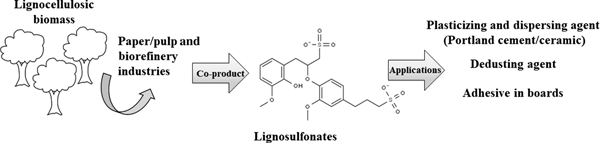
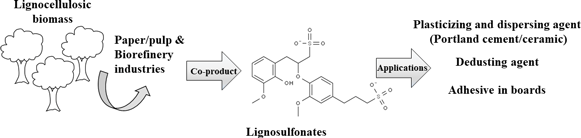
Calcium and sodium lignosulfonates are polyanions, very water-soluble compounds derived from lignin, an abundant and highly aromatic plant polymer obtained as a waste product from the pulp and paper industry.[Reference Ahvazi, Cloutier, Wojciechowicz and Ngo67] The chemical composition of lignin and lignosulfonates depends upon several factors, with the plant species (source of the lignocellulosic biomass) and the extraction method used to separate the lignin from cellulose and hemicellulose, being the most important. Essentially, lignosulfonates are sulfonated lignins; very condensed polymers with a high content in sulfonyl, carboxyl, and phenolic-hydroxyl groups[Reference Fredheim and Christensen68] as depicted in Fig. 2. Calcium lignosulfonate has been used as a plasticizing and dispersing agent in Portland cement for almost a century[Reference Ernsberger and France69] and as a binder and dispersant for the production of ceramic[Reference Wu70] and coal briquettes.[Reference Major and Radu71] Currently, lignosulfonate-based compounds are commercialized for a wide range of applications, although scarce information is available in the scientific literature about their uses as binders in agro-concrete or other biologic construction materials. The application of lignosulfonates as components of construction materials are diverse (Table III); they can act as wood adhesives in combination with chitosan[Reference Ji and Guo24] and as a dedusting agent in the formulation of vegetable oils, which are an alternative to mineral-based oil emulsions used, for instance, for the production of rock wool.[Reference Mirnik, Kovačič, Huskić, Pahovnik and Žagar27]
Schematic representation of the most common sources and applications of lignosulfonates and general chemical structure.[77]

Lignin-based binders.

a Medium density fiber.
b Modulus of rupture.
c Modulus of elasticity.
The method of enzymatically isolating lignin has been in use since 1990.[Reference Hortling, Marjatta and Jorma74] It has been used to isolate lignin from kraft pulp[Reference Yang and Lai75] and can be used to recover lignin from a range of waste sources such as the paper industry and sawmill waste streams.[Reference Harris76] This displays the plethora of redirectable sources of lignin that is currently untapped which could be utilized and again, there is the potential for synthetic biology tools to facilitate research in this area through the rapid improvement of enzymes and enzymatic processes.
Rice husk ash and SiO2 nanoparticles
The high silica (SiO2) content present in RHA makes this co-product of the rice industry a plant-based alternative to mineral cementitious materials. Work has shown that RHA can replace up to 30% in weight of ordinary Portland cement (OPC), without any loss in binding strength and improves its anticorrosion properties as the presence of RHA reduces water permeability (35%), chloride penetration (75%), and diffusion (28%).[Reference Ganesan, Rajagopal and Thangavel22] In addition to RHA, advances in nanotechnology have enabled the production of SiO2 nanoparticles that can be obtained from rice husk after HCl-treatment followed by controlled pyrolysis[Reference Wang, Martin, Fan, Han, Luo and Sun78] or alkali extraction followed by acid precipitation.[Reference Yuvakkumar, Elango, Rajendran and Kannan79] To date, the effects of SiO2 nanoparticles have not been investigated on agro-concrete but numerous studies performed with conventional concrete indicate that nano-silica improves the mechanical properties and durability.[Reference Aggarwal, Singh and Aggarwal30]
Another potential application of nano-silica in bio-construction is as a component of latex composite films to improve the hydrophobicity and water resistance of the building materials. Xu et al.[Reference Xu, Ma, Zhou, Wang and Zhang31] showed that the addition of SiO2 nanoparticles to casein–latex composites improved the hydrophobic properties and tensile strength of nano-composite latex, although on the other hand, the flexibility of the latex film decreased.
Starch
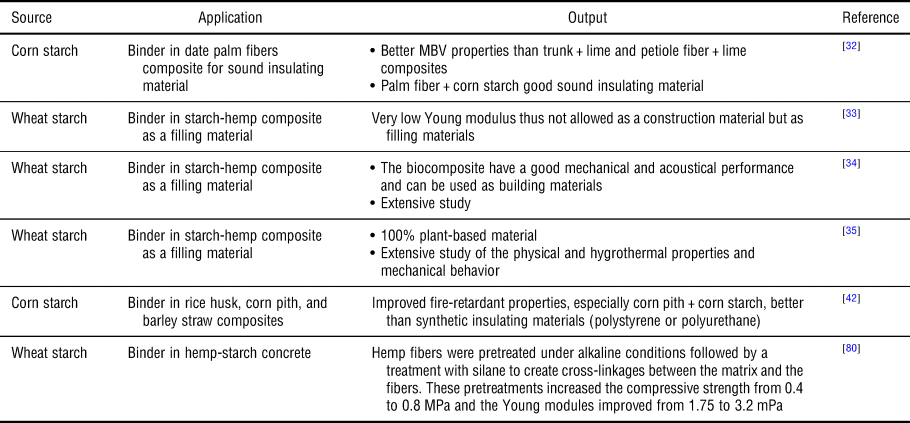
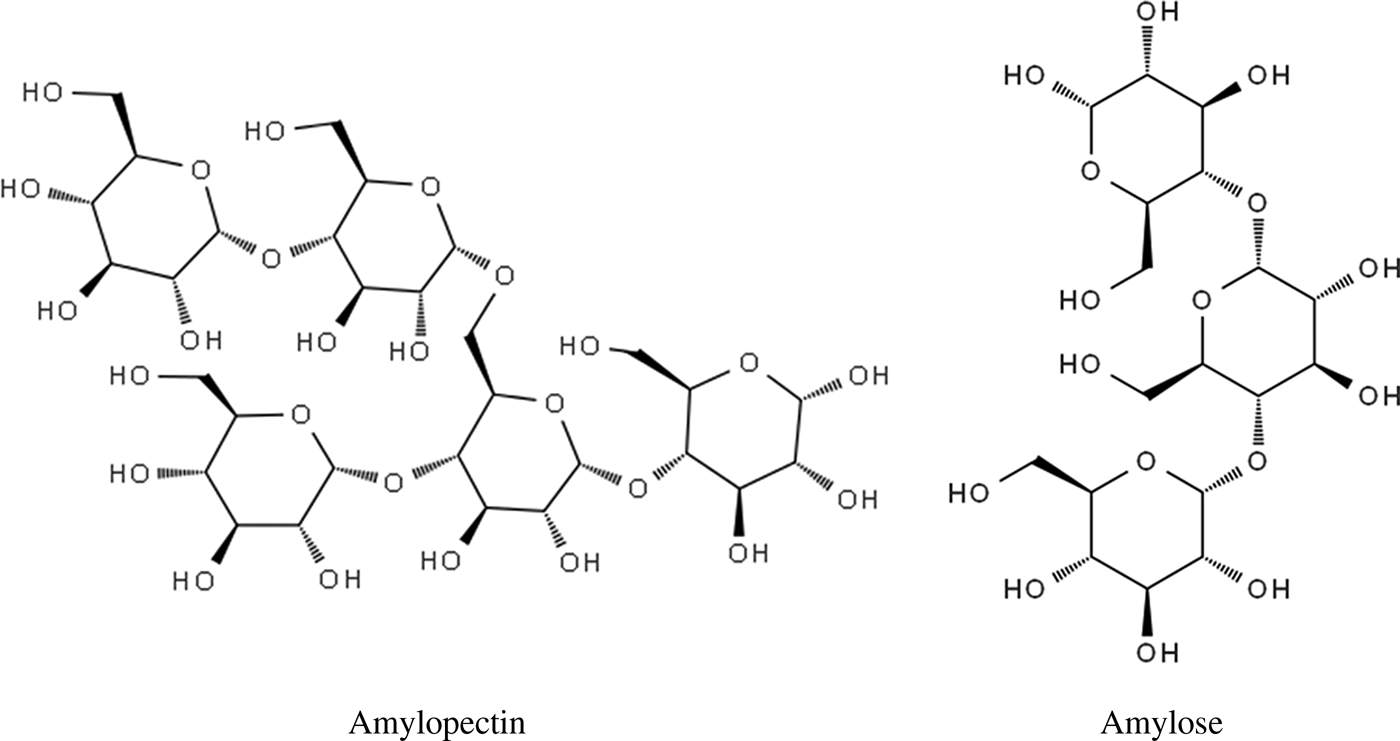
Starch is a carbohydrate constituted by long chains of glucose units joined by glycosidic bonds. Wheat starch has been used as a binder for the production of hemp-aggregates (Table IV) and, even though it could not be utilized as a structural material due to its low tensile strength (low elasticity modulus, below 2.16 MPa), it performed well as a filling material being light and exhibiting good mechanical strength (compressive and tensile strength)[Reference Le, Gacoin, Li, Mai, Rebay and Delmas33] which can be improved by pre-treating hemp fibers with NaOH and silane.[Reference Benitha Sandrine, Isabelle, Ton Hoang and Chadi80] Further studies conducted by Le et al.[Reference Le, Gacoin, Li, Mai and El Wakil34] concluded that smaller hemp shives (also known as hemp hurds, the woody part of the hemp stalk) and lower hemp/starch ratio conferred higher compressive and tensile strength to the plant composite, which exhibited the potential as a sound insulating material (sound absorption coefficient was around 0.7) due to the porosity of this plant fibrous material. Later work showed that a combination of small (0–5 mm, 30%) and bigger shive sizes (0–20 mm, 70%) leads to the best mechanical properties, not to the standard of the hemp-lime composite, but with superior Moisture Buffering Values (MBV).[Reference Bourdot, Moussa, Gacoin, Maalouf, Vazquez, Thomachot-Schneider, Bliard, Merabtine, Lachi, Douzane, Karaky and Polidori35] MBV indicate the ability of a material to store or release moisture when the relative humidity (RH) of the air that surrounds the material changes. Materials with MBV >2 (g/m2%RH) are considered to exhibit excellent buffering capacity.[Reference Rode, Peuhkuri, Time, Svennberg, Ojanen, Mukhopadhyaya, Kumaran and Dean81] Starch confers good moister buffering properties when used as a binder in hemp-based materials due to its water sorption properties associated to the interaction between the water molecules and the hydroxyl groups (−OH) present in the starch polymer[Reference Manek, Builders, Kolling, Emeje and Kunle82] depicted in Fig. 3.
Starch-based binders.

Chemical structure of amylopectin and amylose,[83] the two main molecules that form the starch polymer.

Similar findings to Le's work were obtained in a different study conducted by Belakroum et al.,[Reference Belakroum, Gherfi, Bouchema, Gharbi, Kerboua, Kadja, Maalouf, Mai, El Wakil and Lachi32] in which it was observed that including corn starch as a binder in palm fibers resulted in the production of composites more efficient than lime-palm fibers in terms of sound insulating material for high and medium frequencies (between the ranges of 1500 and 6300 Hz, the absorption coefficient for sound exceeds 0.7), and that at increasing concentrations of corn starch the MBV (4.05 g/m2/%RH1) improved as well.
Tannins
Tannins are plant polymers present in vascular and non-vascular plants. They are rich in phenolic and aliphatic hydroxyl groups, the second most abundant green source of aromatic compounds after lignin. Tannins are present in the soft tissue of plants (e.g., inner bark and leaves) and have been incorporated as an adhesive in wood panels as an alternative to formaldehyde-based resins.[Reference Arbenz and Averous84] Work developed in this area has shown that synthetic resins can be partially substituted by using a combination of tannins and another biologic compound, such as corn starch.[Reference Moubarik, Pizzi, Allal, Charrier, Khoukh and Charrier29] While more recent work developed by Santiago-Medina et al.[Reference Santiago-Medina, Foyer, Pizzi, Caillol and Delmotte28] demonstrated that formaldehyde can be replaced completely in wood ply boards, by 4-phenoxybenzaldehyde, a bio-based aldehyde, derived from vanillin, a small aromatic compound obtained from lignin.
In recent times, synthetic biology offers an alternative to crop growth for plant-derived products in the form of plant-based in vitro systems such as calluses and plant cell cultures.[Reference Efferth85] The production of tannins has been observed in plant calluses as far back as the 1960s[Reference Constabel86,Reference Davies87] but while the production of tannins in this method is more industrially favorable, it does result in lower yields compared to plants.[Reference Suvanto, Nohynek, Seppänen-Laakso, Rischer, Salminen and Puupponen-Pimiä88] Suvanto et al. compared a selection of plant cell cultures for tannin production, this revealed that a combination of three species (Sorbus aucuparia, Vaccinium myrtillus, and Empetrum nigrum) proved an exception to this lower yield.[Reference Suvanto, Nohynek, Seppänen-Laakso, Rischer, Salminen and Puupponen-Pimiä88] With the advances in synthetic biology, it may be possible to characterize the genes involved in this collaboration and improve the yield under these callus cultivation and cell culture conditions. In vitro plant systems provide the perfect conditions for genetic manipulation with a number of synthetic biology tools, including CRISPR/Cas9[Reference Klimek-Chodacka, Oleszkiewicz, Lowder, Qi and Baranski89] and transgenic modification[Reference Ikeuchi, Sugimoto and Iwase90] These tools can be used for the synthesis of bioactive secondary metabolites or to develop desirable polymer traits for a more specialized product.[Reference Efferth85]
Non-plant-derived biologic binders
Casein
The adhesive properties of casein, the most abundant protein in milk, have been known for centuries. It was utilized as a wood adhesive to be later put aside by synthetic resins.[Reference Audic, Chaufer and Daufin91] Nowadays this is likely to change as there is an increasing interest for using biologic compounds, such as casein, to manufacture biodegradable plastics[Reference Turan, Gunes, Kilic, Jawaid and Swain92] as a result of the environmental impact caused by the use of synthetic plastic. In addition to this, casein can be sourced from the waste streams of the milk industry, adding value to the resulting by-products.[Reference Ryder, Ali, Carne and Billakanti93] Powdered casein glues are commercially available, and used for bottle labeling as it makes them easily removable with washing.[Reference Guo and Wang94] In addition to being a component in adhesives, casein forms a part of coatings and paints[Reference Audic, Chaufer and Daufin91,Reference Derksen, Cuperus and Kolster95] (e.g., in silica nano-composite latex[Reference Xu, Ma, Zhou, Wang and Zhang31]), with potential applications for the production of hydrophobic films and coatings. Casein is also useful as a dispersant and a binding agent for the synthesis of PLA-nanocellulose biologic reinforcements.[Reference Gu and Catchmark45]
Chitin and chitosan
Chitin is an aminopolysaccharide, the second most abundant biologic polymer on Earth after cellulose,[Reference Rinaudo96] as it forms part of the exoskeleton of insects and crustaceans, and the cell wall of fungi. Chitin exhibits a similar structure to cellulose, this is glucose molecules linked by β-(1,4) glycosidic linkages, but it is less exploited, possibly because the cost of its extraction and purification is higher than that of cellulose.[Reference Rinaudo96] Chitosan is derived from chitin by deacetylation under alkaline conditions; it is water soluble in acidic media, whereas chitin does not dissolve in water. The adhesive properties of chitosan have been exploited extensively in products of high value such as biomedical applications.[Reference Mati-Baouche, Elchinger, de Baynast, Pierre, Delattre and Michaud97] The presence of numerous reactive functional groups in chitosan confers to this polymer important electrolyte properties, high adsorption capacity, and gel-forming capability. These characteristics together with its biodegradability and low toxicity enable its utilization in drug delivery systems, as scaffolds in tissue engineering, for gene therapy and bio-imaging.[Reference Dash, Chiellini, Ottenbrite and Chiellini98] However, regarding bioconstruction, it has also been used successfully as a glue agent in plywood[Reference Umemura, Inoue and Kawai46] and mycelium biocomposites,[Reference Dahmen47] and for the production of plant-based (sunflower stalks) insulating blocks.[Reference Mati-Baouche, De Baynast, Lebert, Sun, Lopez-Mingo, Leclaire and Michaud99]
While chitin is highly abundant, the difficulty comes from the recovery and purification of the polymer. This is traditionally done with mechanical grinding and extreme shifts in pH,[Reference Tharanathan and Kittur100–Reference Thirunavukkarasu, Dhinamala and Moses Inbaraj102] which can affect the properties of the polymer such as molecular weight and degrees of acetylation.[Reference Gortari and Hours103] The biotechnological solution is to use microbial fermentation or enzymatic hydrolysis of the chitin-rich biowaste to purify the chitin in a form which does not damage the polymer, maintains high yields, and offers a route free of caustic and acidic reagents.[Reference Gortari and Hours103]
Poly(lactic acid)
PLA or polylactide is a biodegradable polymer, an aliphatic polyester produced from the microbial fermentation of sugars which fungi and bacteria can source from agricultural and food industry waste streams.[Reference Jin, Yin, Ma and Zhao104] PLA has been used successfully as a binder for bio-based composite materials, for example, in the construction of a pedestrian bridge,[Reference Yang and Cranston38] and to improve the compressive strength of hemp composites.[Reference Kobayashi, Saito and Isogai37] PLA is also a component of biological nanocomposites, for example, dispersed with casein in a matrix of nanocellulose that results in efficient reinforcement nanomaterials.[Reference Claramunt, Ardanuy, García-Hortal and Filho39]
PLA is generally produced chemically from lactic acid, which can be chemically synthesized or made by microbial fermentation,[Reference Ghaffar, Irshad, Anwar, Aqil, Zulifqar, Tariq, Kamran, Ehsan and Mehmood105] the latter being a more pure product than chemical synthesis which produces a racemic mixture.[Reference Farooq, Anjum, Zahoor and Rahman106] More recently, organisms have been specifically engineered using synthetic biology to create an original metabolic pathway allowing for long chains of pure PLA to be produced.[Reference Riaz, Fatima, Rasheed, Riaz, Anwar and Khatoon107] This process has been further improved in Escherichia coli by creating deletions using homologous recombination,[Reference Jung and Lee108] introduction of propionate CoA transferase from Clostridium propionicum [Reference Selmer, Willanzheimer and Hetzel109] and the enzyme polyhydroxyalkanoates synthase.[Reference Rehm and Steinbüchel110] This combination allows for the removal of the secondary synthesis step and allows for PLA to be produced entirely by E. coli. [Reference Riaz, Fatima, Rasheed, Riaz, Anwar and Khatoon107]
Other biotechnologic solutions
Self-bonding/binderless boards
The production of self-bonding particleboards, also known as binderless boards, to avoid the use of formaldehyde-based resins has been under study for decades, initially because of the health concerns associated to the formaldehyde emissions indoors, and more recently due to the need for the production of more sustainable materials.[Reference Hemmila, Adamopoulos, Karlsson and Kumar23] In this line of research, one of the most relevant approaches to produce bio-based binderless boards, without the addition of adhesives, relies on the functionalization of the natural fiber surface (wood material or other lignocellulosic particles) that can be obtained from agricultural co-products such as wheat straw[Reference Yang, Song, Cao, Wang, Hu, Yang and Zhang111] or from agro-industries' residues such as leaf sheath fiber bundles from plantain.[Reference Álvarez, Rojano, Almaza, Rojas and Gañán112] The functionalization of the fibers is mostly based on the enzymatic oxidation of the native lignin (naturally present in the lignocellulosic material).
In regards to the enzymes required during the pretreatment, laccases are the most common enzymes used to pre-treat fibers, although peroxidases have also been used.[Reference Widsten and Kandelbauer113] These enzymes are synthesized naturally by bacteria and fungi although they can be produced on a much larger scale with genetically engineered microorganisms[Reference Rosini, Allegretti, Melis, Cerioli, Conti, Pollegioni and D'Arrigo114] at a reduced production cost. The research developed by Felby et al. showed evidence that cross-links in the native lignin of the wood fibers and boards were formed after the pretreatment with laccase.[Reference Felby, Hassingboe and Lund115] Moreover, an increased hydrophobicity of the fiber surface was observed and it is likely that the surface compatibility between the fibers' surfaces was also enhanced.[Reference Felby, Thygesen, Sanadi and Barsberg116]
The use of commercial lignin (e.g., kraft lignin, lignosulfonates) instead of the native lignin treated with laccase as board adhesives has been patented.[Reference Viikari, Hase, Qvintus-Leino, Kataja, Tuominen and Gädda25,Reference Viikari, Hase, Qvintus-Leino, Kataja, Tuominen and Gädda26,Reference Hüttermann, Nonninger and Kharazipour72] Lignosulfonates are not suitable due to their hydrophilic nature[Reference Kharazipour, Mai and Hüttermann117] and another drawback, pointed out by Widsten and Kandelbauer, could be the high cost of some commercial lignin types if large quantities are needed.[Reference Widsten and Kandelbauer118] With this in mind, Velásquez et al.[Reference Velásquez, Ferrando and Salvadó119] compared the effects of replacing fibers of steam-exploded Miscanthus sinensis with commercial kraft lignin and observed that the properties of the board improved when 20% of M. sinensis was replaced by the commercial lignin. This demonstrates that while the use of the native lignin may offer a cheaper alternative, the addition of commercial lignins, which are produced in large quantities and with diverse physicochemical properties,[Reference Ahvazi, Cloutier, Wojciechowicz and Ngo67] deserves further investigation.
Bacterial-sand bio-bricks
The cementation of sand by bacteria, to produce bricks with the same mechanical properties and features as conventional bricks, has been a great success. Bacteria can produce the cementation media from urea and calcium.[Reference Bernardi, DeJong, Montoya and Martinez120] In a brick mould, the bacterial growth leads to the precipitation of calcite between particles, cementing the sand particles and creating a solid and stiff material. This bacterial function is also being exploited for crack reparation in conventional concrete[Reference Wong121] known as self-repairing bioconcrete, through the incorporation of living bacteria.[Reference Williams, Kirisits and Ferron122] After the production of the material, the bacteria used to cement the bricks together are left within the material, and can survive there for several months without food or oxygen.[Reference Reddy, Manjusha and Arun Kumar123] This means that the repairing mechanism is very easy to use and can repair cracks in as little as 28 days.[Reference Reddy, Manjusha and Arun Kumar123] However, there are still several drawbacks as the use of laboratory grade nutrient sources reduces the viability of use in field applications, and the organisms within the material would not survive long term. While there is a great deal of potential for bio-bricks, since the nutrient supply being the highest cost (60% of total operating costs[Reference Reddy, Manjusha and Arun Kumar123]), the durability of the bacteria could be improved. An alternative could be the use of bacterial-free solutions such as bacterial carbonic anhydrase (CA) enzymes responsible for the conversion of CO2 into calcite. This type of enzyme can be produced by wild-type bacteria[Reference Sundaram and Thakur124,Reference Bhagat, Dudhagara and Tank125] or bacteria engineered using genetic tools[Reference Kim, Jo, Kang, Kim, Choi and Cha126] and offers great potential not only for CO2 atmospheric sequestration but also for the development of environmentally friendly solutions in the construction sector.
Current constraints in the field might be aided by the ongoing research being developed in the area of synthetic biology which is looking at the feasibility of building 3D-patterned living materials with applications in diverse fields including civil engineering[Reference Schmieden, Basalo Vázquez, Sangüesa, Van Der Does, Idema and Meyer127] and to scale-up the production of promising enzymes such as the CA.[Reference Kim, Jo, Kang, Kim, Choi and Cha126]
Mycelium biocomposites
The importance of microorganisms to help us design and manufacture new materials is immeasurable, and the biocomposites of mycelium, more commonly known as mushroom roots, depict a perfect example in the areas of sustainable construction and architecture. These blocks exhibit similar properties to polystyrene foams with the advantages of being made of 100% renewable materials (small building blocks of mycelium glued with chitin supported on plywood) that can be disposed of safely, as they are easily biodegradable.[Reference Dahmen47]
Challenges and opportunities
Existing technology and current knowledge enable the production of bio-based binders and adhesives that allow the production of 100% biological materials. These biocomposites could completely replace some of the conventional materials used in construction, such as filling/insulating materials, coatings, and boards. In this context, biotechnological approaches aided by the use of synthetic biology tools can support the production of the biologic binders by several means: (1) by scaling-up the production of enzymes allowing cost-efficient treatment of feedstock (e.g., functionalization of lignin), (2) through the bioremediation of industrial water and waste streams to enable their valorization,[Reference Padmaperuma, Kapoore, Gilmour and Vaidyanathan128] (3) by up-cycling organic material (e.g., food waste) into more valuable compounds such as nanocellulose. The optimization of these processes should lead to the maximized use of resources, as well as the re-purposing of waste as a resource, preventing competition with basic needs such as food and water.
While re-purposing waste as a raw material can decrease the costs involved with biological-based binders and does not compete with food production, where there is not a waste stream to tap into, bacterial production of the polymer could be an alternative. This would allow greater control over the properties of the synthesized polymer, tailoring it specifically for the construction industry, and reduced production costs. Plant in vitro systems can also be used as they have similar growing conditions to those in bacterial production, but they are an alternative in cases where the synthetic pathways are too complex to be transferred to bacteria themselves. Bacterial and plant callus factories are also ideal candidates for gene and pathway characterization.
The production of biological structural building blocks with comparable performance to agro-concrete containing mineral-based binders, or to conventional bricks and concrete is still under development. This is because some mechanical properties (e.g., compressive strength) of biological materials need to be improved. Consumer demand for more sustainable construction materials is a key contributing factor for driving these improvements. The synthetic biology tools mentioned in this review can be applied to support future developments in the field as well as to scale-up their production to make them more competitive and cost-effective. The availability of raw materials for the synthesis of bio-based binders should not be a constraint because they can be obtained from renewable and sustainable feedstocks produced as co-products or sourced from the waste streams of different industries (e.g., agro-food industry, biorefineries, and pulp/paper industry).
A shift in culture in the construction sector is also required as it is notable for exhibiting resistance to new technologies.[Reference Alwan, Jones and Holgate129] Action toward a “zero carbon” construction sector is urgently needed to prevent the acceleration of climate change and to ensure the more sustainable use of natural resources to move us toward a more circular economy and secure the availability of materials in the future.[Reference Glass, Greenfield and Longhurst130] Besides this, innovation in the sector will create new export opportunities[131] and contribute to the clean growth of the world economy.
Acknowledgment
This research was supported by the BBSRC (BB1150A-BIV-S) and EPSRC (EP/N026519/1). We are grateful to Scott Simpson for his suggestions and technical advice.