Introduction
Glyphosate is a nonselective herbicide used worldwide to control weeds. It is a post-emergent systemic herbicide, usually applied to leaves, and is absorbed and transported quickly via the phloem to root and shoot meristems (Dewey and Appleby Reference Dewey and Appleby1983; Gougler and Geiger Reference Gougler and Geiger1981; Martin and Edgington Reference Martin and Edgington1981). Glyphosate binds to 5-enolpyruvylshikimate-3-phosphate (EPSP) synthase (EC 2.5.1.19), where it blocks aromatic amino acid synthesis (phenylalanine, tryptophan, tyrosine), thereby affecting protein synthesis, as well as many metabolic pathways, such as phenylpropanoid and auxin biosynthesis (Zablotowicz and Reddy Reference Zablotowicz and Reddy2007). Glyphosate can be secreted in root exudates (Coupland and Caseley Reference Coupland and Caseley1979; Coupland and Peabody Reference Coupland and Peabody1981; Rodrigues et al. Reference Rodrigues, Worsham and Corbin1982). In the soil, glyphosate is catabolized by rhizosphere microorganisms (Pipke and Amrhein Reference Pipke and Amrhein1988; Shinabarger and Braymer 2008) or bound to soil, where it competes with phosphorus for binding sites (De Jonge et al Reference De Jonge, De Jonge, Jacobsen, Yamaguchi and Moldrup2001). Glyphosate is the preferred herbicide for weed management in eucalypt cropping systems and is used multiple times during the eucalypt growing season to control weeds such as marmalade grass [Brachiaria plantaginea (Link) Hitch.], Jamaican crabgrass (Digitaria horizontalis Willd.), sourgrass [Digitaria insularis (L.) Mez ex Ekman], Sida spp., and spreading liverseed grass [Urochloa decumbens (Stapf) R. Webster], among others. Worldwide, eucalypts are mostly grown in phosphorus-deficient soils, and phosphorus limitation is further exacerbated by competition with weeds.
While many agricultural soils have high phosphorus or high phosphorus retention, the phosphorus is not in a form available to plants (Gamuyao et al. Reference Gamuyao, Chin, Pariasca-Tanaka, Pesaresi, Catausan, Dalid, Slamet-Loedin, Tecson-Mendoza, Wissuwa and Heuer2012; Kochian Reference Kochian2012). Plants have evolved strategies to increase phosphorus acquisition under phosphorus-limiting conditions, such as changes in gene expression of phosphate transporters (Lee Reference Lee1993; Misson et al. Reference Misson, Raghothama, Jain, Jouhet, Block, Bligny, Ortet, Creff, Somerville, Rolland, Doumas, Nacry, Herrerra-Estrella, Nussaume and Thibaud2005; Raghothama Reference Raghothama1999). Phosphate uptake is mediated by spatiotemporal regulation of low- and high-affinity phosphate transporters in response to phosphate availability. Phosphate transporters and transporter-like proteins serve as phosphate sensors to modulate the expression of the phosphate transporters and thus maintain phosphate homeostasis to optimize nutrient and mineral utilization (Calderon-Vazquez et al. Reference Calderon-Vazquez, Ibarra-Laclette, Caballero-Perez and Herrera-Estrella2008; Hammond et al. Reference Hammond, Bennett, Bowen, Broadley, Eastwood, May, Rahn, Swarup, Woolaway and White2003; Li et al. Reference Li, Xu, Zhang, Yang and Zhang2007, Reference Li, Xu, Li, Zhang, Yang and Zhang2008; Morcuende et al. Reference Morcuende, Bari, Gibon, Zheng, Pant, Bläsing, Usadel, Czechowski, Udvardi, Stitt and Scheible2007; Wu et al. Reference Wu, Ma, Hou, Wang, Wu, Liu and Deng2003). Under phosphate-limiting conditions, expression of high-affinity phosphate transporters is upregulated to increase phosphate uptake (Gu et al. Reference Gu, Chen, Sun and Xu2016; Lee Reference Lee1993). Most of the research has been conducted in the herbaceous annual model plant mouse-ear cress [Arabidopsis thaliana (L.) Heynh.], which showed strong induction of high-affinity phosphate the transporters during the first 12 h of phosphate starvation (Gu et al. Reference Gu, Chen, Sun and Xu2016; Misson et al. Reference Misson, Raghothama, Jain, Jouhet, Block, Bligny, Ortet, Creff, Somerville, Rolland, Doumas, Nacry, Herrerra-Estrella, Nussaume and Thibaud2005).
Previous studies with leaf disks of the herbaceous biennial common beet (Beta vulgaris L.) (Gougler and Geiger Reference Gougler and Geiger1981) and the herbaceous annual broad bean (Vicia faba L.) (Ibaoui et al. Reference Ibaoui, Delrot, Besson and Bonnemain1986) showed that cellular uptake of glyphosate occurred by passive diffusion. However, these studies used adjuvants, which may have enhanced glyphosate uptake by changing cell membrane permeability (De Ruiter et al. Reference De Ruiter, Verbeek and Uffing1988; Richard and Slife Reference Richard and Slife1979; Sherrick et al. Reference Sherrick, Holt and Hess1986; Wyrill and Burnside Reference Wyrill and Burnside1976). Other researchers have hypothesized that the cell membrane may be relatively impermeable to glyphosate, as this compound is a dipolar, hydrophilic ion, and therefore not given to passive diffusion (De Ruiter and Meinen Reference De Ruiter and Meinen1996). Thus, transmembrane transporters would be essential for glyphosate uptake into the cell. Studies with broad bean protoplasts and Madagascar periwinkle [Catharanthus roseus (L.) G. Don] cell cultures showed that, in addition to diffusion, a plasma membrane phosphate transporter is probably involved in glyphosate uptake (Denis and Delrot Reference Denis and Delrot1993; Morin et al. Reference Morin, Vera, Nurit, Tissut and Marigo1997). This mechanism may be common across kingdoms, as glyphosate uptake was shown to be mediated by a phosphate transporter, and the uptake activity was competitively inhibited by phosphate absorption in Arthrobacter Conn & Dimmick (Pipke and Amrhein Reference Pipke and Amrhein1988; Pipke et al. Reference Pipke, Schulz and Amrhein1987).
Previous studies have mainly focused on herbaceous species. Here, we examine the interaction of phosphate and glyphosate in the perennial woody tree species grand eucalyptus (Eucalyptus grandis W. Hill ex. Maid.). The aim of this research is to examine the effects of phosphate limitation on E. grandis at whole-plant and cellular levels by examining expression of phosphate transporters, glyphosate translocation in seedlings, and glyphosate uptake kinetics in protoplasts.
Materials and Methods
Phylogenetic Tree
Arabidopsis thaliana phosphate transporter amino acid sequences were obtained from the Arabidopsis Information Resource (TAIR v. 10; https://www.arabidopsis.org). A BLAST search was conducted with the A. thaliana (Arabidopsis Genome Initiative Reference Arabidopsis Genome Initiative2000) and E. grandis genomes (Myburg et al. Reference Myburg, Grattapaglia, Tuskan, Hellsten, Hayes, Grimwood, Jenkins, Lindquist, Tice, Bauer, Goodstein, Dubchak, Poliakov, Mizrachi, Kullan, Hussey, Pinard, van der Merwe, Singh, van Jaarsveld, Silva-Junior, Togawa, Pappas, Faria, Sansaloni, Petroli, Yang, Ranjan, Tschaplinski, Ye, Li, Sterck, Vanneste, Murat, Soler, Clemente, Saidi, Cassan-Wang, Dunand, Hefer, Bornberg-Bauer, Kersting, Vining, Amarasinghe, Ranik, Naithani, Elser, Boyd, Liston, Spatafora, Dharmwardhana, Raja, Sullivan, Romanel, Alves-Ferreira, Külheim, Foley, Carocha, Paiva, Kudrna, Brommonschenkel, Pasquali, Byrne, Rigault, Tibbits, Spokevicius, Jones, Steane, Vaillancourt, Potts, Joubert, Barry, Pappas, Strauss, Jaiswal, Grima-Pettenati, Salse, Van de Peer, Rokhsar and Schmutz2014) in Phytozome v. 7.0 (www.phytozome.net), and predicted phosphate transporter protein sequences were obtained. CustalW v. 2.0 (Larkin et al. Reference Larkin, Blackshields, Brown, Chenna, McGettigan, McWilliam, Valentin, Wallace, Wilm, Lopez, Thompson, Gibson and Higgins2007) was used to align the E. grandis and A. thaliana phosphate transporter amino acid sequences. The alignment file was used to generate an unrooted tree with MEGA v. 6.0 (Tamura et al. Reference Tamura, Stecher, Peterson, Filipski and Kumar2013) by applying the neighbor-joining method (Saitou and Nei Reference Saitou and Nei1987), with 2,500 bootstrap replications, and handling gaps with pairwise deletion.
Plant Material and Growth Conditions
Eucalyptus grandis seeds were germinated in a mix of perlite and sand (3:1) covered by a thin layer of sand in a growth chamber at 26 C, 16-h light/8-h dark photoperiod, and light intensity of 140 µmol m−1 s−1. After the appearance of the first pair of true leaves, seedlings were transplanted into a mixture of soil and vermiculite (1:1). Plants were watered every 2 d and fertilized twice a week with modified Hoagland’s solution (ammonium phosphate 115.03 mg−1 L, boric acid 2.86 mg−1 L, calcium nitrate 656.4 mg−1 L, cupric sulfate · 5H2O 0.08 mg−1 L, Na2-EDTA 33.534 mg−1 L, ferrous sulfate · 7H2O 25.02 mg−1 L, magnesium sulfate 240.76 mg−1 L, manganese chloride · 4H2O 1.81 mg−1 L, molybdenum trioxide 0.016 mg−1 L, potassium nitrate 606.6 mg−1 L, zinc sulfate · 7H2O 0.22 mg−1 L; MP Biomedicals, mpbio.com; Hoagland and Arnon Reference Hoagland and Arnon1950). For phosphate-limitation experiments, 3-mo-old plants were transferred to a hydroponic system with 50% Hoagland and Arnon solution (Hoagland and Arnon Reference Hoagland and Arnon1950) and acclimated for 7 d. Plants were then submitted to P+ treatment (modified Hoagland and Arnon complete nutritive solution plus 1.25 mM KH2PO4) or P− treatment (modified Hoagland and Arnon nutritive solution with 1.25 mM KH2PO4 replaced with 1.25 mM K2SO4 to maintain the potassium concentration in the P− treatment (according to Jain et al. Reference Jain, Poling, Karthikeyan, Blakeslee, Peer, Titapiwatanakun, Murphy and Raghothama2007) for 5 d. The solution was maintained at pH 6.0±3.
Phosphate Determination
Inorganic phosphate (Pi) was extracted from E. grandis dry root and leaf samples. Samples were weighed in an Eppendorf tube before being ground into a fine powder using plastic micro-pestles. The finely ground powder was homogenized in 500 µl 0.3 M H2SO4 and continuously shaken in a cold room (4 C) for 1 h. Samples were spun down in a cooled centrifuge at maximum speed for 20 min, and the supernatant (500 µl) was added to cuvettes that were previously placed on ice. Subsequently, a freshly prepared 500 µl of Fiske and Subbarow solution (Fiske and Subbarow Reference Fiske and Subbarow1925) was added to the chilled cuvettes and this was followed by absorbance readings on a Helios Zeta UV-vis spectrophotometer (Thermo Scientific, Waltham, MA). Phosphate concentration in the root and leaf samples was determined via a standard curve generated based on Pi absorbance readings from 0, 50, 100, 200, 300, 400, and 500 µmol standards.
RNA Extraction and First-Strand cDNA Synthesis
Three-month-old plants exhibiting homogeneous size (10 to 15 cm) and developmental stage were harvested, and the roots were gently washed with distilled water to remove excess soil. For total RNA extraction, leaves and roots of E. grandis plants were collected separately and immediately frozen in liquid nitrogen. The leaves or roots of three plants were pooled for each of three biological replicates for each phosphorus treatment. Total RNA was extracted using mirVana™ miRNA Isolation Kit (Life Technologies, Waltham, MA, USA) according to the manufacturer’s instructions. The RNA quality and quantity were previously checked by spectrophotometer and agarose gel analysis. The RNA obtained was used as the template for reverse transcription using the SuperScript® III First-Strand Synthesis System for RT-PCR (Invitrogen, Carlsbad, CA, USA) according to the manufacturer’s instructions. For EgEPSP synthase expression, total RNA was extracted from roots and leaves collected from E. grandis seedlings grown in the presence and absence of Pi using the ZR Plant RNA MiniPrep according to the manufacturer’s instructions (Zymo Research, Irvine, CA). On-column DNAse treatment was performed to degrade genomic DNA contamination. Complementary DNA (cDNA) was synthesized using the SuperScript III® First-Strand Synthesis System (Invitrogen).
Quantitative Real-Time PCR
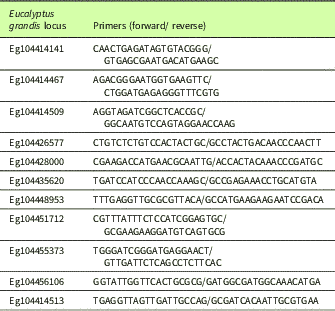
Eleven predicted phosphate transporters were selected for quantitative real-time PCR (RT-qPCR) based on the phylogenetic distance between E. grandis and A. thaliana phosphate transporters. Gene-specific primers for RT-qPCR were designed for each gene investigated using the Integrated DNA Technologies RealTime qPCR Assay Entry. The RT-qPCR was conducted according to the guidelines for minimum information for publication of RT-qPCR experiments (Bustin et al. Reference Bustin, Benes, Garson, Hellemans, Huggett, Kubista, Mueller, Nolan, Pfaffl, Shipley and Wittwer2009) using a CFX96 C1000 Touch Thermal Cycler Real-Time PCR Detection System (Bio-Rad, Hercules, CA, USA). For each target gene, three biological replicates, each with three technical replicates were used. The amplification of a single product was confirmed by melting curve observation. Only primers that produced a linear amplification and products with single-peak melting curves were used for further analysis. Reactions were conducted in 20 μl of solution containing 20 ng of cDNA and 1.25 μM primer mix (10 μl RT-PCR mix with SYBR +5 μl 1.25 μM primer +5 μl cDNA [5 μl SYBR diluted in 45 μl dimethyl sulfoxide]). For each primer pair, a negative “no-template control” was included. The amplification parameters consisted of an initial 1-min denaturation at 94 C and then cycles of 94 C for 15 s, annealing at 60 C for 20 s, and extension at 72 for 30s for 40 times. Cycle threshold (Ct) values were obtained for each sample, and relative quantification was determined using the 2ΔΔCt method (Livak and Schimittgen Reference Livak and Schmittgen2001). The primers were used for amplification are presented in Table 1. Transporter expression data were normalized using the following reference genes: E. grandis TRANSCRIPTION ELONGATION FACTOR S-II (Oliveira et al. Reference Oliveira, Breton, Bastolla, Camargo, Frazzon and Pasquali2012) and an E. grandis CLATHRIN ADAPTOR COMPLEX SUBUNIT (CACS) (Cassan-Wang et al. Reference Cassan-Wang, Soler, Yu, Camargo, Carocha, Ladouce, Savelli, Paiva, Leplé and Grima-Pettenati2012). For EgEPSP synthase expression analysis, reactions were as above, except in 10-μl volumes containing 24 ng of cDNA and 900 nM primers. The following primers were used for amplification: EgEPSPSF2 5′ TCCCTGAATGCCAAACAAAGGA and EgEPSPSR2 5′ TTTGATGGTGGCATGGCTCT. Amplification parameters consisted of an initial 10-min denaturation at 95 C and then cycles of 95 C for 15 s, annealing at 60 C for 20 s, and extension at 72 C for 30 s for 40 times. EgEPSP synthase data were normalized using the reference gene predicted E. grandis TRANSCRIPTION ELONGATION FACTOR S-II (Oliveira et al. Reference Oliveira, Breton, Bastolla, Camargo, Frazzon and Pasquali2012). Ct values were obtained for each sample and relative quantification was determined using the 2ΔΔCt method (Livak and Schimmitgen Reference Livak and Schmittgen2001).
Primers used for quantitative real-time PCR for putative phosphate transporters.

[14C]Glyphosate Absorption and Translocation Assays by Leaves and Roots
For translocation assays, plants were grown as described earlier. Plants exhibiting six pairs of true leaves were selected for analysis. The same process as for RT-qPCR preparation was performed, that is, washing of roots, nutritive solution acclimation, and then P+ and P− treatments for 5 d.
Eucalyptus grandis plants were placed on petri dishes in plastic boxes and kept in contact with corresponding nutrient solution (P− or P+) through filter paper strips. [14C]glyphosate [glyphosate (phosphonomethyl-14C), 50 mCi mmol−1, 1.85 mmol−1; American Radiolabeled Chemicals, St Louis, MO] was mixed with commercially formulated glyphosate (Roundup Pro®, Monsanto, St Louis, MO, USA) to prepare emulsions with a specific activity of 0.1 μCi μl−1 and a glyphosate final concentration of 720 g ae L−1 (in 200 L ha−1), corresponding to what is used in the field. For leaf absorption and translocation assays, the emulsion mix [unlabeled+labeled glyphosate] was applied to the adaxial surface of the second leaf of each plant in one 1.0-μl droplet. The second leaf was chosen to examine basipetal and acropetal glyphosate translocation. For root assays, the emulsion mix was applied to the main root of each plant (one 1.0-μl droplet) about 2 cm below the shoot–root junction. This region of the root was chosen because of glyphosate application and absorption to the rhizosphere. Six plants were used (3 control plants +3 glyphosate-treated plants) for each time point assay, totaling 42 plants for leaf absorption and translocation assays and 42 plants for root assays.
At 1, 4, 8, 24, 48, 72, and 96 h after treatment (HAT), the treated leaf surface was rinsed with 3 ml of 50% acetone (v/v) to collect unabsorbed [14C]glyphosate. Rinses from all replications were mixed with 5 ml of scintillation liquid and analyzed by liquid scintillation spectrometry (LSS; Beckman Coulter LS6800, Brea, CA, USA). At 1, 4, 8, 24, 48, 72, and 96 HAT, treated whole plants were gently rinsed, blotted dry, pressed, and oven-dried (50 C for 4 d). Dried plants were pressed against a 25 cm by 12.5 cm X-ray film for 4 d (−80 C) and scanned for radiolabel dispersion in planta. For root-applied [14C]glyphosate, autoradiographs were made from 1 to 24 HAT. Scanned plants were separated into shoots (leaves and stem) and roots, placed in scintillation vials, and mixed with 5 ml of scintillation liquid. The samples were analyzed by LSS after a minimum of 24 h to allow for quenching. Three plants were analyzed for each time point. The time points are the same for leaf and root assays. The leaf absorption and translocation assays were replicated three times, and root absorption and translocation assays were conducted once. The LSS data were converted to disintegrations per minute.
Shikimate Assays
Plants were grown as described earlier. Either 1 μl of 10 mM ammonium phosphate plus 0.01% Tween-20 (mock treatment) or 720 g ae L−1 (in 200 L ha−1) glyphosate was applied to a leaf as for the whole-plant translocation assays. After 48 h, 4-mm leaf disks were harvested, and the samples were processed following the protocol described in Shaner et al. (Reference Shaner, Nadler‐Hassar, Henry and Koger2005), except that Tween-20 was used instead of Tween-80 and the microtiter plates were incubated at 37 C for 45 min (as in Kretzmer et al. Reference Kretzmer, Hughes, Maines and Sammons2007) instead of 25 C for 90 min. Shikimate accumulation was measured as described in Shaner et al. (Reference Shaner, Nadler‐Hassar, Henry and Koger2005) using a Synergy II HT spectrophotometric microtiter plate reader (BioTek Instruments, Winooski, VT).
[14C]Glyphosate Transport Assays in Protoplasts
Protoplasts were prepared from E. grandis plants grown in a tissue culture system and maintained in an LS medium (Linsmaier and Skoog Reference Linsmaier and Skoog1965) to generate tender leaves (about 3.0 by 2.0 cm) for protoplasting. Eucalyptus grandis leaves were cut into thin horizontal sections with respect to the leaf midvein and immediately immersed in a 0.5 M mannitol solution in a petri dish and then placed in an incubator at 30 C, centrifuged at 20 rpm, and stored in the dark for 1 h. Then the 0.5 M mannitol solution was aspirated and replaced with a cell wall digestion solution (20 mM MES, 0.5 M mannitol, 20 mM KCl, 1% cellulase, 1% macerozyme, 0.5% pectolyase, and 1% bovine serum albumin; Sigma-Aldrich, St Louis, MO, USA). The petri dish was returned to the incubator for at least 6 h. At the end of the digestion period, the leaves were gently placed in a new petri dish with MMG solution (0.5 M mannitol, 4.0 mM MES, and 15.0 mM MgCl2). The plate was gently agitated to release the protoplasts. The protoplasts were purified by flotation in a Falcon tube with 21% sucrose (w/v). The tube was centrifuged at 60 × g for 4 min, 20 μl of the supernatent were transferred to a Neubauer chamber, and the number and size of the protoplasts were determined.
For transport assays, protoplast suspensions were incubated with [14C]glyphosate (50 mCi mg−1 mmol, 1.85 GBq mg−1 mmol; American Radiolabeled Chemicals), sodium phosphate, dibasic (Na2HPO4; Sigma-Aldrich; after Denis and Delrot Reference Denis and Delrot1993) or both for 0, 0.66, 2.5, 5, 7.5, 10, 15, 20, and 25 min. After each time point, the suspension (with [14C]glyphosate, Na2HPO4, or both) was transferred to an Eppendorf tube with 50 µl 33% Percoll in MMG solution and 200 µl of silicon oil and centrifuged for 40 s at 2000 rpm. Supernatant and pellet were separated and transferred to scintillation vials. For each time point, three replicates were prepared. After at least 24 h, samples were analyzed by LSS (Beckman Coulter LS6800).
Experimental Design and Statistical Analyses
For the RT-qPCR, the experiment was repeated three times; each experiment had three biological replicates, and each biological replicate had three technical replicates. The relative expression of each normalized gene in P+ and P− treatments of each sample was analyzed by Student’s t-test. For the phosphate assays, the experiment was repeated three times with three plants for each treatment. ANOVA was used for the statistical analysis. For the shikimate assays, the experiment was repeated twice with three plants, and 3 leaf disks from each plant for each treatment. The data were analyzed using Student’s t-test. For the whole-plant foliar-applied glyphosate translocation assays, the experiment was repeated three times, with three plants per time point. For the whole-plant root-applied glyphosate translocation assays, the experiment was conducted once, with three plants per time point. The absorption and translocation of [14C]glyphosate in P− and P+ treatment data were paired and analyzed using Student’s t-test. For the protoplast assays, the experiment was repeated three times, with three replicates per time point. ANOVA was used for statistical analysis. The statistical packages used were SAS (SAS Institute, Cary, NC, USA), SigmaStat (CambridgeSoft, Cambridge, MA, USA), and Microsoft Excel (Microsoft Redmond, WA, USA).
Results and Discussion
Differential Expression of Phosphate Transporters in Phosphorus-limiting Treatments
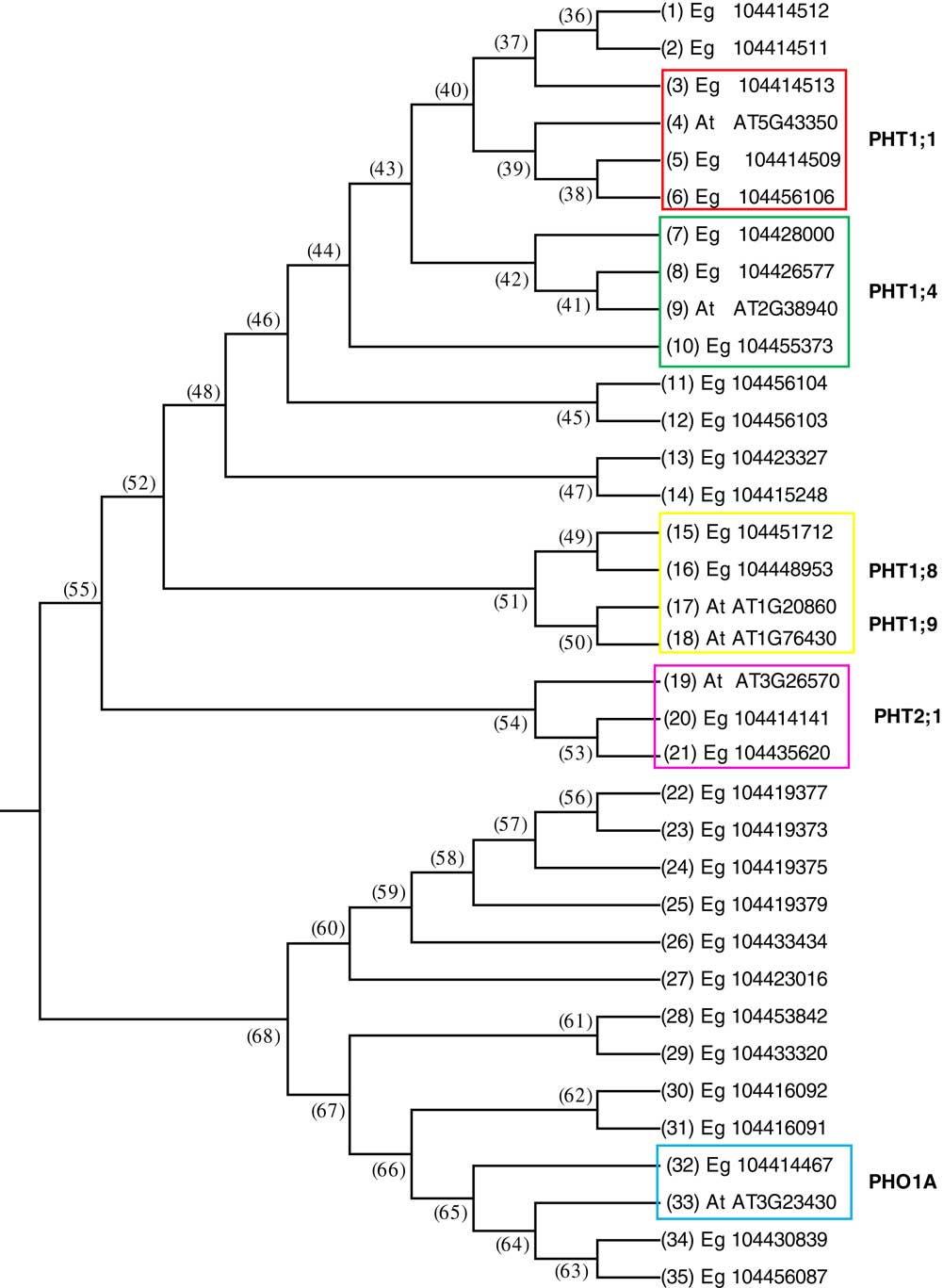
The diploid E. grandis has 35 putative phosphate transporters (NCBI 2017) compared with 29 known or putative phosphate transporters in A. thaliana (TAIR 2017). Putative low- and high-affinity phosphate transporters in E. grandis were identified (Figure 1) with the aim of evaluating transcriptional responses to phosphate limitation for targeted analyses under different phosphorus regimes. Six representative A. thaliana phosphate transporters were chosen from three gene families based on expression patterns: PHT1, phosphate inducible and constitutive expression across different tissue and cell types; PHT2, plastid localized and modulates phosphorus-limitation responses; and PHO1, xylem loading in roots (Daram et al. Reference Daram, Brunner, Rausch, Steiner, Amrhein and Bucher1999; Hamburger et al. Reference Hamburger, Rezzonico, MacDonald-Comber Petétot, Somerville and Poirier2002; Karthikeyan et al. Reference Karthikeyan, Varadarajan, Mukatira, Paino D’urzo, Damsz and Raghothama2002; Muchhal et al. Reference Muchhal, Pardo and Raghothama1996; Mudge et al. Reference Mudge, Rae, Diatloff and Smith2002; Secco et al. Reference Secco, Baumann and Poirier2010; Versaw and Harrison Reference Versaw and Harrison2002; Wang et al. Reference Wang, Ribot, Rezzonico and Poirier2004, Reference Wang, Secco and Poirier2008).
Phylogenetic tree of phosphate transporters in Eucalyptus grandis and Arabidopsis thaliana. The evolutionary relationships among E. grandis (Eg) and A. thaliana (At) phosphate transporters were inferred using the neighbor-joining method. The tree is drawn to scale, with branch lengths representing evolutionary distances used to infer the phylogenetic tree. Boxes: red, PHT1;1; green, PHT1;4; yellow, PHT1;8/9; magenta, PHT2;1; blue, PHO1.

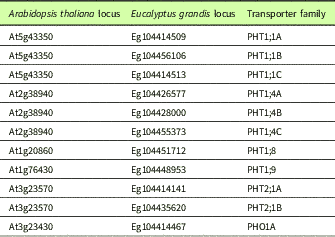
The phylogenetic tree showed relatively short branches for all groups, indicative of the conservation of these proteins across species (Figure 1). The E. grandis loci were designated with the respective A. thaliana phosphate transporter family names based on clades for ease of presentation (Table 2). The bootstrap values for each group were as follows: PHT1;1 was 40%; PHT1;4 was 42% to 44%; PHT1;8 and PHT1;9 were 51%, PHT2;1 was 55%; and PHO1 was 65% (Figure 1).
Putative phosphate transporter family assignments of Eucalyptus grandis loci based on phylogeny to Arabidopsis thaliana.

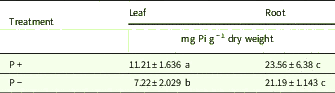
Across species, phosphate transporters show tissue-specific expression patterns, and in rare cases, the transporters are expressed in both roots and leaves. Therefore, the spatial expression pattern of E. grandis putative phosphate transporters under phosphate-replete (P+) and phosphate-limiting (P−) treatments was investigated via RT-qPCR. The leaf phosphate levels in plants grown in P− treatments were significantly reduced compared with those in P+ treatments (P<0.05; Table 3), indicating that the plants were grown under phosphate-limiting conditions.
Quantitation of Pi in leaves and roots after P+ and P− treatments in Eucalyptus grandis.

aEach data value represents two experiments pooled with three replicates. Values (means±SD) followed by different letters are significantly different (Student’s t-test, P<0.05).
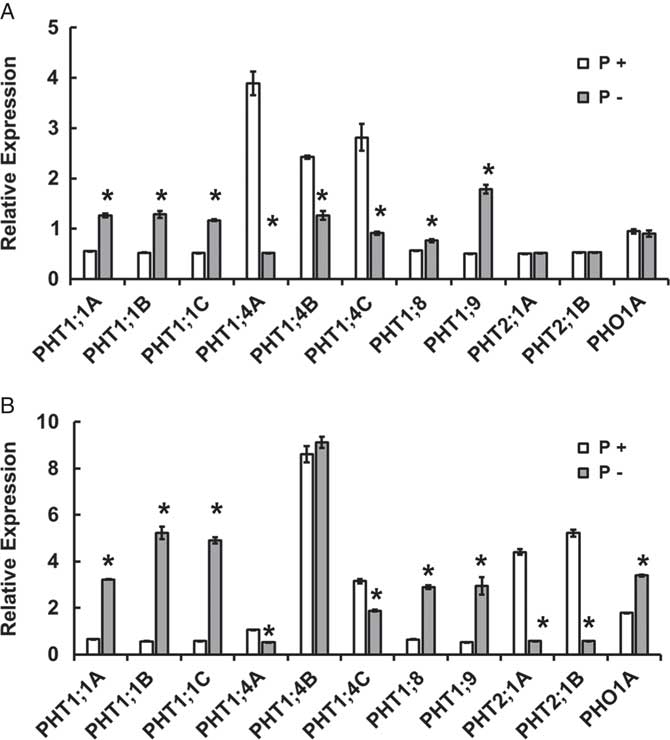
In leaves, expression of EgPHT1;1A, B, and C, EgPHT1;8, and EgPHT1;9 increased approximately 2-fold in P− compared with P+ treatments (P<0.05; Figure 2A). In contrast, EgPHT1;4A, B, and C showed decreased expression under P− treatments compared with P+ (P<0.05; Figure 2A). Phosphate-dependent differential expression was not observed for EgPHT2;1A and B and EgPHO1A (P>0.05; Figure 2A). Among these transporters, EgPHT1;4A, B, and C had the highest relative expression in leaves (2.5- and 4.0-fold) compared with the other transporters. In roots, EgPHT1;1A, B, and C, EgPHT1;8 and 9, and PHO1A expression increased 2- to 5-fold in plants grown under P− treatments compared with P+ (P<0.05; Figure 2B). EgPHT1;4A and C and EgPHT2;1A and B decreased in P− treatments (P<0.05; Figure 2B), but EgPHT1;4B expression was not altered by P treatments (P>0.05). EgPHT1;1A, B, and C, showed similar expression in leaves and roots and were upregulated in P− leaves and roots (P>0.05; Figure 2A and B). EgPHT1;4A was highly expressed in leaves, but not in roots, while EgPHT1;4B and C were highly expressed in both. The closest orthologues to the A. thaliana PHT1;8 and 9 transporters, EgPHT1;8 and EgPHT1;9, were both upregulated in P− leaves and roots (P<0.05; Figure 2 A and B). While the AtPHO1 orthologue EgPHO1A was upregulated in P− roots, it was constitutively expressed in leaves (P>0.05; Figure 2A and B).
Relative gene expression of predicted phosphate transporters in Eucalyptus grandis. Quantitative real-time PCR of putative E. grandis phosphate transporters in leaves (A) and roots (B) in phosphate-replete (P+) and phosphate-limiting (P−) treatments. Error bars represent the SD. Data are mean±SD of three biological replicates; each biological replicate contained three technical replicates. Different letters indicate statistical differences, Student’s t-test, P<0.05.

The gene expression pattern of phosphate transporters in E. grandis appears to exhibit the complex transcriptional regulation under P-replete and P-limiting conditions observed in other species (Gu et al. Reference Gu, Chen, Sun and Xu2016; Sun et al. Reference Sun, Gu, Cao, Huang, Zhang, Ai, Zhao, Fan and Xu2012), as reduction of Pi in leaves and roots resulted in altered gene expression patterns of phosphate transporters. The PHT1 family in rice (Oryza sativa L.) encodes both low- and high-affinity H+/P plasma membrane symporters (Ai et al. Reference Ai, Sun, Zhao, Fan, Xin, Guo, Yu, Shen, Wu, Miller and Xu2009), and both rice and A. thaliana PHT1 genes generally show increased expression under P− conditions (Gu et al. Reference Gu, Chen, Sun and Xu2016). This increase was also observed for the majority of the putative PHT1 genes in E. grandis leaves and roots, suggesting this is a conserved response to P-limiting conditions. The PHT2 family are plastid-localized, low-affinity H+/P symporters and play an important role in P− conditions (Versaw and Harrison Reference Versaw and Harrison2002), although the putative E. grandis PHT2 examined here was not induced under P-limiting treatments. Arabidopsis thaliana PHO1 localizes to the Golgi and trans-Golgi network, is involved in xylem loading in roots, and plays a role in P-limitation responses/cellular P homeostasis (Arpat et al. Reference Arpat, Magliano, Wege, Rouached, Stefanovic and Poirier2012). PHO1 family gene expression increases under phosphorus-limiting conditions in physcomitrella moss [Physcomitrella patens (Hedw.) Bruch & Schimp.] and A. thaliana (Misson et al. Reference Misson, Raghothama, Jain, Jouhet, Block, Bligny, Ortet, Creff, Somerville, Rolland, Doumas, Nacry, Herrerra-Estrella, Nussaume and Thibaud2005; Morcuende et al. Reference Morcuende, Bari, Gibon, Zheng, Pant, Bläsing, Usadel, Czechowski, Udvardi, Stitt and Scheible2007; Wang et al. Reference Wang, Secco and Poirier2008), and in roots, EgPHO1A expression increased under low P, indicating conservation of P-limitation responses across species. Previous studies have identified transcriptional (Rubio et al. Reference Rubio, Linhares, Solano, Martin, Iglesias, Leyva and Paz-Ares2001) and post-translational regulation (Liu et al. Reference Liu, Huang, Tseng, Lai, Lin, Lin, Chen and Chiou2012) of phosphate transporters during phosphate deficiency. However, the molecular mechanism regulating gene expression is still not completely understood, as it may be the result of changes in several regulatory pathways (Rouached et al. Reference Rouached, Arpat and Poirier2010).
Phosphate Status Affects Foliar Absorption and Translocation of Glyphosate
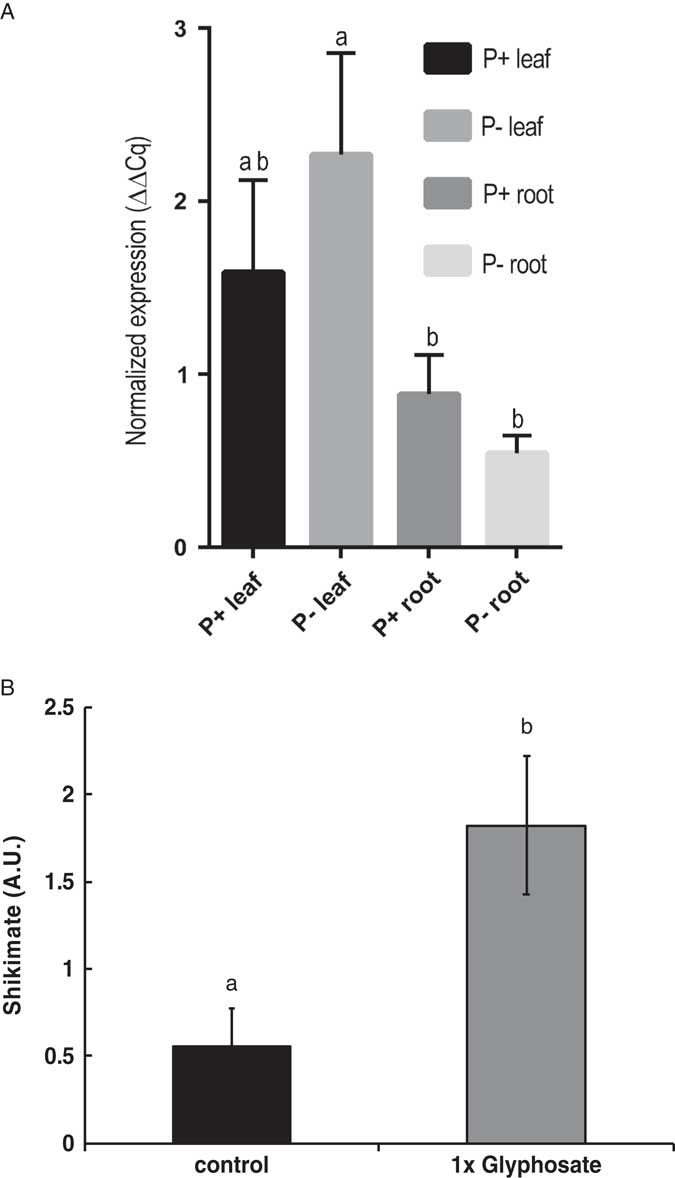
Translocation of radiolabeled [14C]glyphosate applied to the leaves or roots of E. grandis grown in P+ and P− treatments was measured over time. The efficacy of the amount of glyphosate applied for the translocation assays was evaluated by EPSP synthase gene expression and shikimate accumulation. EPSP synthase expression was not affected by P treatments (P>0.05; Figure 3A), consistent with expression patterns of EPSP synthase under P-limitation regimes observed in Arabidopsis (geoprofiles/71773827; Lin et al. Reference Lin, Liao, Yang, Pan, Buckhout and Schmidt2011). Shikimate levels significantly increased in leaves of glyphosate-treated plants compared with mock treatments (P<0.001; Figure 3B). These data indicate that the amount of glyphosate applied was sufficient to block EPSP synthase activity.
Effects of phosphorus status on EPSP synthase expression and glyphosate on shikimate accumulation in Eucalyptus grandis. (A) Expression of EPSP synthase in leaves and roots in phosphate-replete (P+) and phosphate-limiting (P−) treatments. Data are mean±SD of three biological replicates; each biological replicate contained three technical replicates. Cq, quantification cycle. Different letters indicate statistical differences, Student’s t-test, P<0.05. (B) Accumulation of shikimate after application of glyphosate used for whole-plant translocation studies. Data are mean±SD of three replicates. Different letters indicate statistical differences, Student’s t-test, P<0.05.

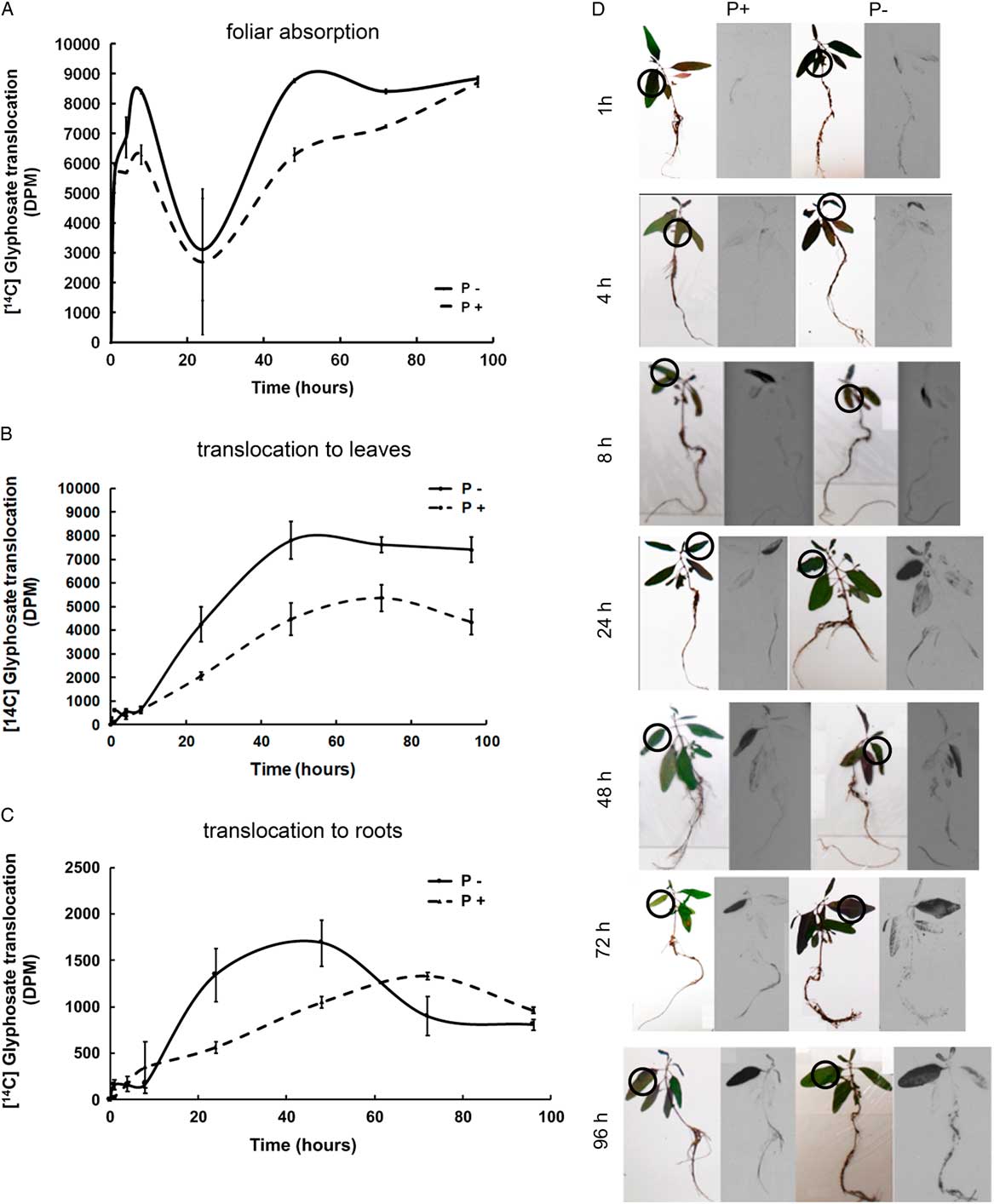
Differential foliar absorption of [14C]glyphosate (as measured by dislodgeable [14C]glyphosate residue) was observed in plants grown in P+ compared with P− treatments. More glyphosate was absorbed in P− plants compared with P+ plants (P<0.01; Figure 4A). After the initial uptake (0 to 8 h), a transition phase occurred at approximately 24 h, when absorption decreased in both P− and P+ plants; this was followed by an increase in uptake (Figure 4A). The high standard deviation at 24 h may be due to genetic diversity. Glyphosate translocation to the leaves was greater in P− plants compared with P+ plants (P<0.01; Figure 4B). Rootward glyphosate translocation was greater in P− plants over the first 48 h (P<0.01), while P+ plants showed similar glyphosate distributions in roots and leaves (Figure 4C). The plateau observed at 72 h is consistent with studies that showed the majority of glyphosate is absorbed by 72 h (Cardinali et al. Reference Cardinali, Dias, Mueller, Abercrombie, Stewart, Tornisielo and Christoffoleti2015). Autoradiography showed that the glyphosate translocation was consistent with these quantifications (Figure 4D). The translocation of the radiolabeled herbicide to roots was observed throughout the P− plants within 24 HAT, but in P+ plants the signals were initially restricted to the shoots, and faint signals in the roots were observed at 24 HAT. While more [14C]glyphosate was translocated in P− plants than in P+ plants (Figure 4C), by 96 h, P− and P+ exhibited a similar [14C]glyphosate signals in the roots (Figure 4D).
Phosphate status affects foliar-applied glyphosate absorption and translocation to shoots and roots in Eucalyptus grandis. (A) Absorption of foliar-applied [14C]glyphosate in E. grandis at 1, 4, 8, 24, 48, 72, and 96 h, expressed as the percentage of recovered radioactivity in phosphate-replete (P+) and phosphate-limiting (P−) treatments. Translocation of foliar-applied [14C]glyphosate to shoots (B) and roots (C) in E. grandis at 1, 4, 8, 24, 48, 72, and 96 h, expressed as the percentage of absorbed radioactivity. Data are mean±SD of three replicates; and the experiment was repeated three times. (D) Autoradiographs of translocation of foliar-applied [14C]glyphosate over time. Pressed plant (right) and autoradiograph of translocation (left). DPM, disintegrations per minute. Circles indicate where radiolabeled glyphosate was placed. N=3; the experiment was repeated twice.

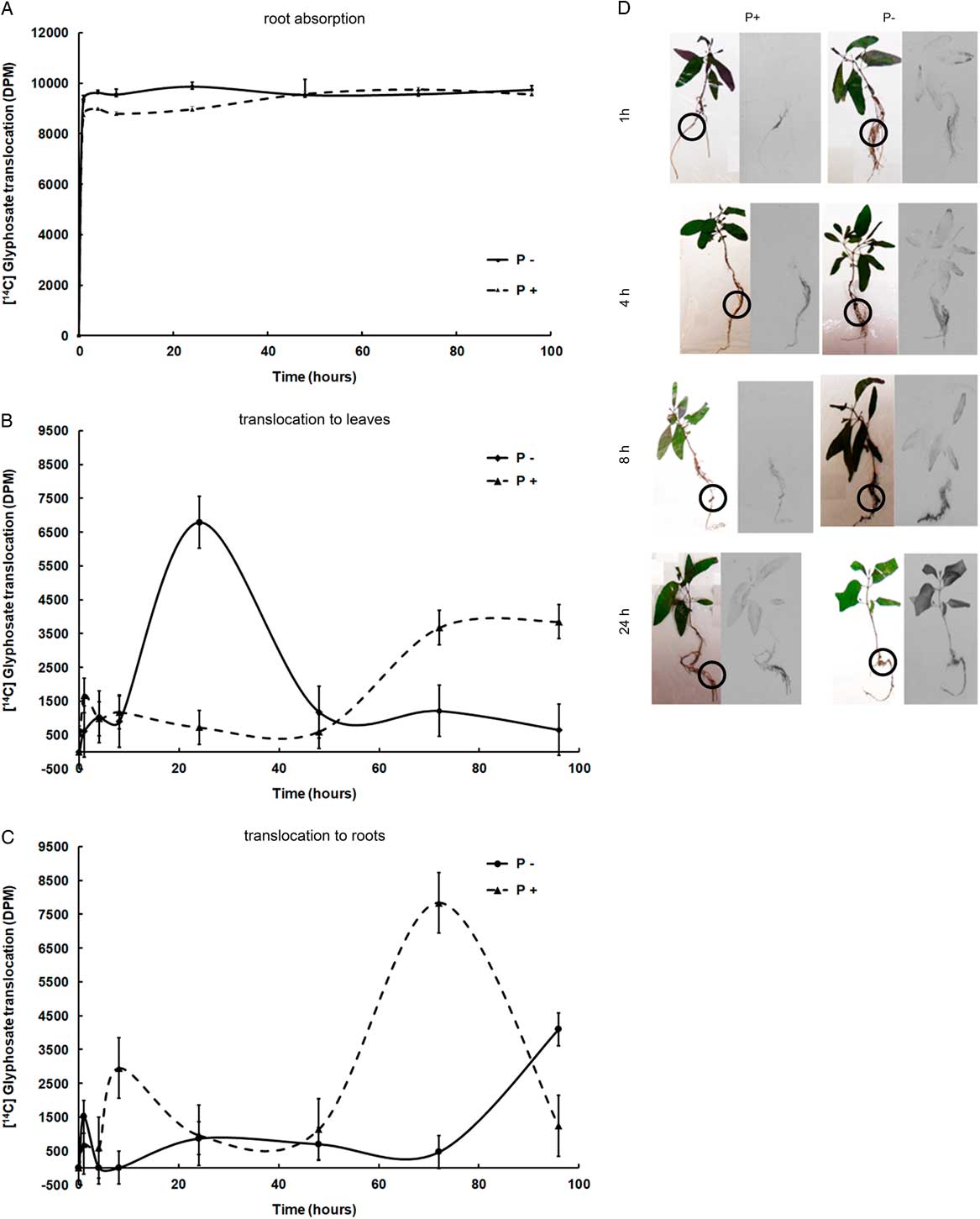
In roots, glyphosate absorption is rare, because glyphosate is quickly adsorbed to the colloidal fraction in soil (Bott et al. Reference Bott, Tesfamariam, Kania, Eman, Aslan, Romheld and Neumann2011; Neumann et al. Reference Neumann, Kohls, Landsberg, Stock-Oliveira Souza, Yamada and Römheld2006; Tesfamariam et al. Reference Tesfamariam, Bott, Cakmak, Römheld and Neumann2009). In field conditions, the root uptake of glyphosate by plants would be practically nil, justifying the lack of research in this area. However, as glyphosate is present in root exudates of glyphosate-treated plants (Coupland and Caseley Reference Coupland and Caseley1979; Coupland and Peabody Reference Coupland and Peabody1981; Rodrigues et al. Reference Rodrigues, Worsham and Corbin1982), the reuptake of glyphosate by the roots could be possible. The initial absorption of [14C]glyphosate applied to roots was greater in P− plants than P+ plants during the first 24 HAT (P<0.01; Figure 5A).
Phosphate status affects root-applied glyphosate absorption and translocation to shoots and roots in Eucalyptus grandis. (A) Absorption of root-applied [14C]glyphosate in E. grandis at 1, 4, 8, 24, 48, 72, and 96 h, expressed as the percentage of recovered radioactivity in phosphate-replete (P+) and phosphate-limiting (P−) treatments. Translocation of root-applied [14C]glyphosate to shoots (B) and roots (C) in E. grandis at 1, 4, 8, 24, 48, 72, and 96 h, expressed as the percentage of absorbed radioactivity. Error bars represent the SD. Data are mean±SD of three replicates (N=3); the experiment was repeated twice. DPM, disintegrations per minute. (D) Autoradiographs of translocation of root-applied [14C]glyphosate over time (1 to 24 h). Pressed plant (right) and autoradiograph of translocation (left). Circles indicate where radiolabeled glyphosate was placed.

Translocation of root-absorbed glyphosate was more complex than leaf-absorbed glyphosate. More glyphosate was translocated to leaves in P− compared with P+ plants, peaking at 24 HAT (Figure 5B). In contrast, the glyphosate distribution throughout the root in P− plants was slower and peaked at 96 h (Figure 5C). In P+ plants, glyphosate distribution in roots showed two peaks at 8 and 72 HAT (Figure 4C), while the peak in the leaves was at 72 HAT (Figure 5B). The autoradiographs indicated that rapid uptake and translation of [14C]glyphosate throughout P− plants occurred within 1 h, while in the P+ plants the signal was restricted to the main root until 8 HAT. At 24 h, glyphosate distribution was noted in the whole plant, regardless of P treatment (Figure 5D).
Glyphosate absorption is dependent on the species, environmental conditions, herbicide concentration, adjuvant used, and application method (Caseley and Coupland Reference Caseley and Coupland1985; Franz et al. Reference Franz, Mao and Sikorski1997; Monquero et al. Reference Monquero, Christoffoleti, Osuna and De Prado2004). After glyphosate absorption through the leaf cuticle and plasma membrane (Gottrup et al. Reference Gottrup, O’Sullivan, Shraa and Vanden1976; Jachetta et al. Reference Jachetta, Appleby and Boersma1986), glyphosate is translocated to the herbicide site of action via the vascular tissue (Satichivi et al. Reference Satichivi, Wax, Stoller and Briskin2000). In addition, glyphosate transport via the phloem has been shown to occur in several plants species (Honegger et al. Reference Honegger, Brooks, Anderson and Porter1986; Schultz and Burnside Reference Schultz and Burnside1980; Schultz and Amrhein Reference Schultz and Amrhein1984; Sprankle et al. Reference Sprankle, Meggitt and Penner1975). Glyphosate absorption by leaves and roots was greater in E. grandis grown under phosphate-deficient (P−) treatments. In E. grandis leaves, glyphosate absorption was biphasic, although translocation to the rest of the plant showed a steady increase for 72 h. This suggests a complex regulation of phosphate uptake and homeostasis, and that glyphosate (glycine+phosphate) may be recognized as a phosphate substrate. In contrast, root absorption peaked at the first time point (1 h), and this rapid absorption is consistent with the root apoplast–rhizosphere continuum. The differences in glyphosate absorption between P+ and P− treatments may be attributed to the phosphate transporters present under each treatment, as the expression of high-affinity transporters increases under P− treatments. Once absorbed, more glyphosate was translocated from leaves to roots and from roots to leaves in P− treated plants, and low-affinity phosphate transporters are important for loading phosphate into the phloem in leaves and xylem in roots. As the rice PHT1 family encodes both low- and high-affinity phosphate transporters, more research is needed to characterize the E. grandis phosphate transporters. Glyphosate uptake under phosphate limitation has also been shown to occur across kingdoms, as with Pseudomonas sp. strain PG2982 (Fitzgibbon and Braymer Reference Fitzgibbon and Braymer1988). The data presented here also suggest that under phosphate-limiting treatments, phosphate status affects glyphosate uptake.
Phosphate Affects Cellular Uptake and Retention of Glyphosate
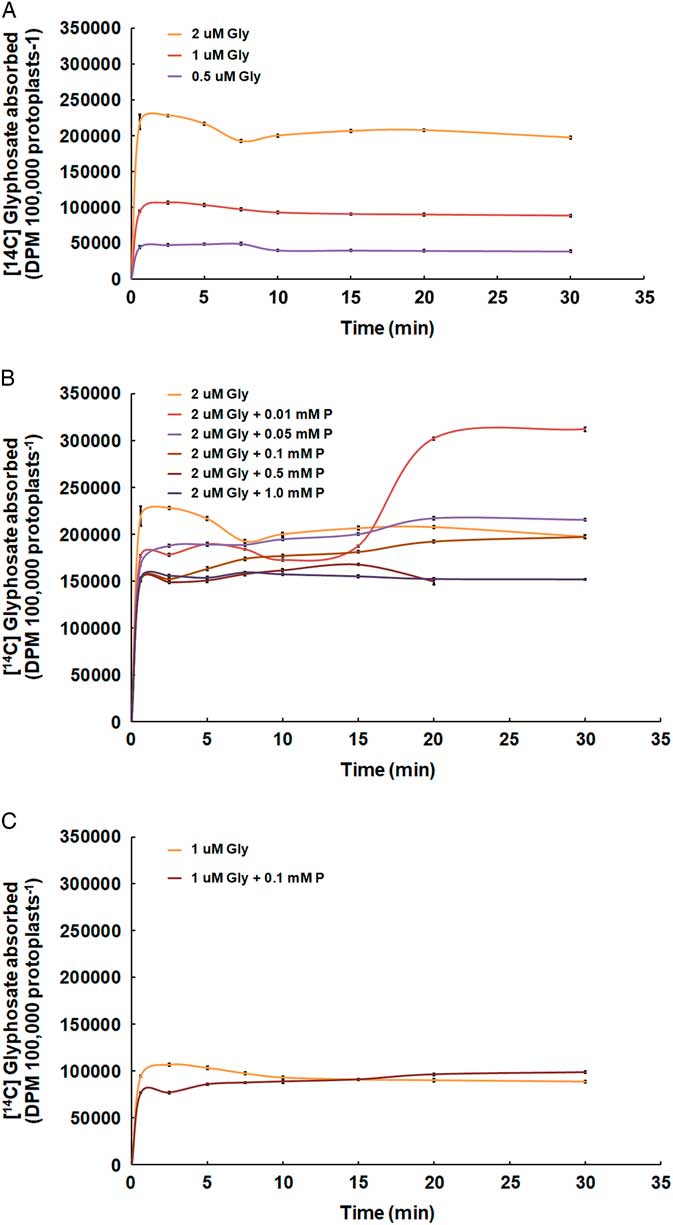
The absorption and transport kinetics of glyphosate on the cellular level were investigated using protoplasts from E. grandis leaf mesophyll cells. [14C]Glyphosate uptake increased proportionally to the amount of glyphosate supplied (Figure 6A). Rapid glyphosate uptake was observed at the earliest time point, and glyphosate was retained within the cells over the course of the experiment.
Uptake, retention, and phosphate competition of [14C]glyphosate in Eucalyptus grandis protoplasts. (A) [14C]Glyphosate uptake by protoplasts at indicated concentrations. Time points were 0.6, 2.5, 5, 7.5, 10, 15, 20, 25, and 30 min. (B) Phosphate competition assays with 2 µM [14C]glyphosate at 0.01, 0.05, 0.1, 0.5, and 1.0 mM P. (C) Phosphate competition assays with 2 µM [14C]glyphosate +0.1 mM P. DPM, disintegrations per minute. Data are mean and SD of three replicates; the experiment was repeated three times.

Because glyphosate uptake is thought to be mediated by phosphate transporters, uptake competition assays were conducted with phosphate added to the assay buffer. Phosphate competed with glyphosate uptake at all phosphate and glyphosate concentrations tested during the first 7 min (P<0.01; Figure 6B and C). However, after 15 to 20 min, the lowest phosphate concentrations (2 µM glyphosate +0.01 mM or 0.05 mM P) enhanced rate of glyphosate uptake, and 0.1 mM P did not compete with 2 µM glyphosate after 30 min (P<0.01; Figure 6B). This phenomenon was tested with 1 µM glyphosate +0.1 mM P, and glyphosate accumulation increased after 20 min (P<0.05; Figure 6C). The enhanced uptake of glyphosate may have been due to depletion of the phosphate competitor in the buffer, and the results also suggest that glyphosate may have partitioned into the vacuole. The timing of the enhanced glyphosate uptake could also correspond to a transcriptional response in the protoplasts.
[14C]Glyphosate was quickly absorbed (within 40 s after application [as fast as could be measured]) by protoplasts at all concentrations tested (0.5, 1, and 2 µM) in the absence of phosphate. The rapid absorption of glyphosate was most likely mediated by phosphate transporter recognition of the phosphonate group in the glyphosate molecule. The initial rapid absorption peak at 40 s was followed by a constant absorption phase, which can be indicative of transporter saturation or the balance of intra- and extracellular concentrations. Denis and Delrot (Reference Denis and Delrot1993) and Morin et al. (Reference Morin, Vera, Nurit, Tissut and Marigo1997) demonstrated that phosphate transporters facilitated glyphosate uptake in broad bean and C. roseus, respectively. The absence of a pronounced absorption peak suggests that glyphosate absorption may have been due to simple diffusion, as previously reported (De Ruiter and Meinen Reference De Ruiter and Meinen1996; Gougler and Geiger Reference Gougler and Geiger1981; Ibaoui et al. Reference Ibaoui, Delrot, Besson and Bonnemain1986). However, linear glyphosate absorption was previously observed in broad bean protoplasts with glyphosate concentrations up to 100 µM (Denis and Delrot Reference Denis and Delrot1993). Unlike previous studies, glyphosate uptake in E. grandis did not exhibit Michaelis-Menten kinetics (Denis and Delrot Reference Denis and Delrot1993; Morin et al.Reference Morin, Vera, Nurit, Tissut and Marigo1997). This suggests that glyphosate uptake in this tree species is complex.
Phosphate competed with [14C]glyphosate uptake, and at higher phosphate concentrations, it is likely that the phosphate uptake was preferential. Because the cells were continuously supplied with phosphate over the course of the experiment, it is likely that the glyphosate uptake was limited. However, after the available phosphate was preferentially taken up at the lowest phosphate concentrations used here, glyphosate uptake appeared to be stimulated, and perhaps sequestered in the vacuole. In the presence of phosphate, glyphosate uptake may also have occurred secondarily or by another mechanism, such as via an amino acid permease or a transporter recognizing the amino group on the glyphosate molecule. This was recently demonstrated in Caco-2 cells (Xu et al. Reference Xu, Li, Wang, Si, He, Cai, Huang and Donovan2016) and is consistent with proton-dependent uptake shown in C. roseus cells (Morin et al. Reference Morin, Vera, Nurit, Tissut and Marigo1997), and further, iron also appears to be required for glyphosate uptake (Barja et al. Reference Barja, Herszage and Dos Santos Afonso2001; Tilquin et al. Reference Tilquin, Peltier and Marigo2000). While the expression of selected phosphate transporters was examined here, post-transcriptional and post-translational mechanisms also affect transporter activity, and the specific transporters mediating glyphosate uptake have not been identified in any organism. Further, phosphate status affects other signaling pathways as well, such hormone and nutrient signaling (Chiou and Lin Reference Chiou and Lin2011), and these effects are difficult to tease apart (Gu et al. Reference Gu, Chen, Sun and Xu2016).
The data obtained in this study show glyphosate absorption, translocation, and transport in a tree species, E. grandis. In a recent study, P fertilization enhanced glyphosate uptake by roots in hydroponically grown willows (Salix miyabeana Seemen ‘SX64’), which has implications for riparian buffer strips (Gomes et al. Reference Gomes, Maccario, Lucotte, Labrecque and Juneau2015). These different results in two tree species highlight the complex pathway of glyphosate uptake in plants, reinforcing the need for further studies and genetic resources in model trees like Eucalyptus spp., Populus spp., and Salix spp. to elucidate the mechanisms of glyphosate uptake in trees.
We show that the phosphate status in E. grandis affects glyphosate uptake. The results also suggest that under low-P conditions, the expression of high-affinity phosphate transporters in both shoots and root increases. The increase in phosphate transporters in roots may lead to enhanced glyphosate uptake. Other strategies used by plants to enhance P uptake may also result in glyphosate remobilization from the soil. Because E. grandis is grown in low-P soils, and weeds compete for P, the enhanced uptake of glyphosate by E. grandis has implications for this cropping system, as mineral nutrition, such as low soil nitrogen, can reduce the efficacy of glyphosate (Mithila et al. Reference Mithila, Swanton, Blackshaw, Cathcart and Hall2008). These data also suggest that foliar-applied glyphosate efficacy may be reduced when the plants are grown in high-phosphate soils, such as on the Eastern Shore of Maryland. The loss of glyphosate efficacy in high-P soils could contribute to glyphosate resistance among weeds. The results presented here have implications for best management practices for weed control and glyphosate application under phosphate-application regimes.
Acknowledgments
This work was funded by CAPES (BEX 9553/14-2) and the College of Agriculture and Natural Resources, University of Maryland to FCMP, and by Hatch Capacity Grant [Project No. MD-ENST-7377/project accession no. 1002600] from the USDA National Institute of Food and Agriculture, the Maryland Agricultural Experiment Station to WAP. Publication costs were provided by CNPq. We thank IPEF (Forestry Science and Research Institute) for seeds, Steve Strauss for the Eucalyptus grandis tissue, Gary Coleman for the Eucalyptus grandis tissue culture plants, and Sydney Wallace and Meghan Fisher at the University of Maryland Plant Growth Facility complex for their help. No conflicts of interest have been declared. Any opinions, findings, conclusions, or recommendations expressed in this publication are those of the author(s) and do not necessarily reflect the view of the U.S. Department of Agriculture.