Introduction
Recent evidence indicates that several parasitic helminths are able to bioaccumulate higher element concentrations than their host tissues. This phenomenon has been demonstrated in many host–parasite systems in the aquatic environment (Sures et al., Reference Sures, Taraschewski and Rokicki1997, Reference Sures, Siddall and Taraschewski1999; Baruš et al., Reference Baruš, Tenora, Kračmár and Prokeš2001; Schludermann et al., Reference Schludermann, Konecny, Laimgruber, Lewis, Schiemer, Chovanec and Sures2003; Sures, Reference Sures2003, Reference Sures2004; Thielen et al., Reference Thielen, Zimmermann, Baskab, Taraschewskia and Sures2004; Jankovská et al., Reference Jankovská, Miholová, Lukešová, Kalous, Válek, Romočuský, Vadlejch, Petrtýl, Langrová and Čadková2012b; Nhi et al., Reference Nhi, Shazili and Shaharom-Harrison2013). However, in the terrestrial environment, it has only been demonstrated in a few studies of mammalian helminths (Sures, Reference Sures2004; Torres et al., Reference Torres, de Lapuente, Eira and Nadal2004, Reference Torres, Peig, Eira and Borrás2006; Jankovská et al., Reference Jankovská, Langrová, Bejček, Miholová, Vadlejch and Petrtýl2008, Reference Jankovská, Miholová, Langrová, Bejček, Vadlejch, Kolihová and Šulc2009, Reference Jankovská, Száková, Lukešová, Langrová, Válek, Vadlejch, Čadková and Petrtýl2012a).
Various rat intestinal parasites can bioconcentrate several elements to significantly higher concentrations than the host tissues (Sures et al., Reference Sures, Franken and Tarschewski2000a, Reference Sures, Jurges and Tarschewskib). In a laboratory study by Sures et al. (Reference Sures, Grube and Taraschewski2002), the rat cestode Hymenolepis diminuta was shown to contain higher lead (Pb) concentrations than the host rat tissues. Some field studies followed and confirmed the higher uptake and bioconcentration of lead inside the parasite tissues in this host–parasite system (Sures et al., Reference Sures, Scheible, Bashtar and Taraschewski2003; Al-Quraishy et al., Reference Al-Quraishy, Gewik and Abdel-Baki2014). Čadková et al. (Reference Čadková, Miholová, Száková, Válek, Jankovská and Langrová2014) also studied H. diminuta under laboratory conditions and confirmed a higher uptake of lead by this parasite. Although this parasite is well known to bioaccumulate lead in its tissues, information about the exact Pb localization along the tapeworm's strobila is lacking.
According to Sures et al. (Reference Sures, Taraschewski and Rokicki1997), lead and cadmium (Cd) are generally concentrated in the posterior gravid proglottids of fish cestodes Monobothrium wageneri and Bothriocephalus scorpii. The gravid proglottids of tapeworms of aquatic birds (Ligula intestinalis, Contluarie capillarioides, Microsomacanthus compressa, Diploposthe laevis, Microsomacanthus parvula and Parvitaenia ardeolae) also contain higher concentrations of heavy metals compared to the anterior parts (Tenora et al., Reference Tenora, Baruš and Prokeš2002). Riggs et al. (Reference Riggs, Lemly and Esch1987) determined selenium (Se) levels in tissues from Bothriocephalus acheilognathi in polluted and unpolluted areas. The gravid proglottids of this tapeworm contained higher Se levels than immature proglottids in polluted sites, while concentrations in unpolluted sites were almost the same in the scolices and proglottids (Riggs et al., Reference Riggs, Lemly and Esch1987). Concerning the parasitic tapeworm Diphyllobothrium latum, smaller parasites accumulate up to 80 times more iron (Fe), nickel (Ni), manganese (Mn), Pb and copper (Cu) than large parasites (Woelfl et al., Reference Woelfl, Mages and Torres2008).
Metabolic activity in the whole tapeworm tegument is high and can provide an intake of nutrients from the host's gut (Dalton et al., Reference Dalton, Skelly and Halton2004). Essential and risk elements are most likely ingested like nutrients into the tapeworm's body. However, there is not enough information about the fate of these elements after they are ingested. Each part of the tapeworm strobila has a different structure and function, so identification of specific regions with elevated element concentration may enable us to understand better the behaviour of these elements in parasite tissues.
The aim of this study is to determine whether risk (Pb, Cd) or essential (Cu, zinc (Zn), Mn and Fe) elements are bioaccumulated in the anterior or posterior parts of H. diminuta strobila and whether the form of Pb to which the rats are exposed influences the accumulation of this element.
Materials and methods
Experimental infection of rats
This study was carried out using 18 male Wistar rats, weighing approximately 200 g each, obtained from a commercial source (Velaz, Czech Republic). All rats were artificially infected with H. diminuta. Mealworm beetles (Tenebrio molitor) from the Department of Zoology and Fisheries experimental breeding programme were used in this experiment. Beetles were infected with H. diminuta and infective larvae (cysticercoids) were allowed to develop for 2 weeks at 29°C. Matured cysticercoids were collected from the beetles and were administered orally to rats. Five weeks post infection, a coproscopic examination of rat faeces was performed to ascertain the presence of the parasite. Rats were housed in E4 boxes (1730 cm2) at 22°C (±2°C) and 50% humidity, and provided food (a commercial pellet food ST-1, obtained from Velaz, Czech Republic) and water ad libitum.
Preparation and exposure to lead (Pb)
The lead-hyperaccumulating plant, Pistia stratiotes, was used to administer Pb to one group of rats. To culture P. stratiotes, an aqueous solution containing 3200 ± 40 mg of Pb per litre was used. Plants were cultivated in plastic barrels in the experimental greenhouse of Czech University of Life Sciences in Prague. The Pb concentration in aqueous solution was measured constantly, using an inductively coupled plasma atomic emission spectrometer (ICP-OES, Varian AA280Z, Varian, Australia). After gathering, plants were carefully washed with double-distilled water, weighed, dried and lyophilized. The plant material was then homogenized and the total concentration of Pb and other elements was determined using an inductively coupled plasma atomic emission spectrometer. Lead nitrate (Pb(NO3)2) was obtained from a commercial source (Sigma Aldrich, Prague, Czech Republic).
After the presence of H. diminuta in rats was confirmed, rats were housed individually, kept in a 12-h light/dark cycle and fed commercial pellet food and water ad libitum. Experimental rats were subdivided into three groups, each comprising six rats: (1) the control group – rats were fed only food pellets; these rats were not exposed to increased amounts of risk or essential elements; (2) the nitrate group – rats were fed food pellets and administered 6 mg of Pb in the form of lead nitrate by oral gavage once a week; (3) the Pistia group – rats were fed pellet food and administered 6 mg of Pb once a week. For the latter group Pb was bound in the lead-hyperaccumulating water lettuce (P. stratiotes). Some other elements are naturally bound in this plant; therefore, these rats were also exposed to other elements in higher concentrations than rats in the control or nitrate groups.
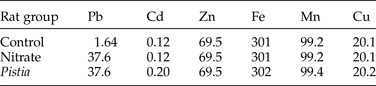
Total element intakes during the exposure period are shown in table 1. Values of elements in the control group were given to rats in commercial pellet food. In the nitrate and Pistia groups, rats were exposed to the same total Pb intake – 6 mg of Pb per week; however, the Pb administered to each group was in a different form. The intake of other elements in the nitrate group was identical to that of the control group. The intake of other elements in the Pistia group were higher because these rats were administered the same food as the other two groups but were additionally given P. stratiotes, in which other elements were also bound.
The total intake of six elements (mg) given to three rat groups.

After 6 weeks of exposure, all rats were euthanized and tapeworms were collected from their intestines. Each tapeworm was carefully washed in double-distilled water and its strobila was divided into two fragments. The anterior part comprised the scolex, the neck (a growth zone from which the strobila is formed) and immature segments with the genital primordial – the youngest segments. The posterior part comprised mature proglottids with early uteri as well as mature gravid segments filled with eggs – the oldest segments. Both parts were freeze-dried and weighed. The anterior and posterior sections weighed approximately 200 mg and 500 mg, respectively.
Element determination
Both parts of H. diminuta were mineralized in 6 ml of 65% pa+ nitric acid (Analytika®, spol. s r.o., Prague, Czech Republic) and 2 ml of hydrogen peroxide (Analytika®), followed by increased-pressure wet digestion through the use of microwave heating (microwave oven Ethos 1, Milestone, Leutkirch im Allgäu, Germany) for 25 min at 231°C. After digestion, the excess acid was blown off into an extractor fan. Subsequently, samples were transferred into a 10-ml volumetric flask containing deionized water. Blanks, prepared using the identical procedure as in the case of the tissue samples, represented 10% of the total number of samples. In all cases, the blank element values were below the detection limit of the analytical technique used.
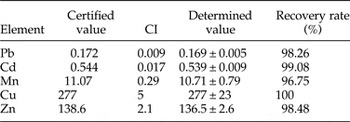
A certified reference material, BCR 185R bovine liver (table 2), was analysed for quality assurance of analytical data in the above-mentioned manner. Pb, Cd, Zn, Fe, Cu and Mn contents were determined using an inductively coupled plasma mass spectrometer (ICP-MS method, Agilent 7700x, Agilent Technologies Inc., Santa Clara, California, USA). Parasitological work was conducted at the Department of Zoology and Fisheries, while analytical work was carried out at the Department of Agroenvironmental Chemistry and Plant Nutrition of the Czech University of Life Sciences in Prague.
The recovery rate (%) of elements and mean certified and determined material values (μg/g) of bovine liver; CI, confidence interval.

Data analysis
Results were analysed using Statistica 6.1 software (StatSoft Inc., Tulsa, Oklahoma, USA). The arithmetic mean and standard deviation (SD) were calculated for mature and immature proglottids. As most of distributions deviated from the norm, a non-parametric analogue of a paired t-test (Wilcoxon signed-rank test) was used. The significance level was set at P < 0.05. Correlations between Pb and other elements were examined using simple linear regression analysis.
Results
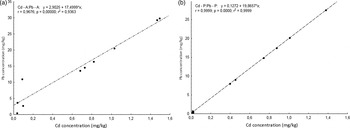
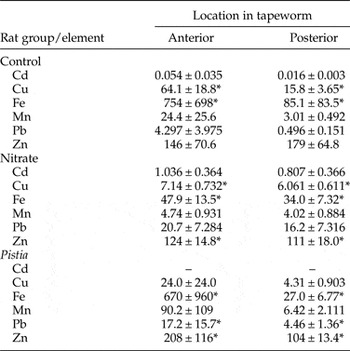
Thirty-six samples of H. diminuta tissues were collected in total. From these tissues, Pb, Cd, Cu, Fe, Mn and Zn concentrations were detected using an ICP-MS. The results are illustrated in table 3. The majority of the monitored elements (Cd, Cu, Fe, Mn and Pb) were found in higher concentrations in the anterior parts of the control group; significantly higher concentrations of Cu and Fe were observed in this group. However, in the control group, Zn showed an opposite trend when compared to the other elements. In the nitrate and Pistia groups, all monitored element levels were higher in the anterior parts than in the posterior parts. These differences were significant for Cu, Fe and Zn in the nitrate group, and for Fe, Pb and Zn in the Pistia group. In the Pistia group, the majority of the Cd concentrations were below the limit of detection for ICP-MS (0.001 mg/l). Therefore, Cd was excluded from statistical evaluation in this group. However, detected Cd values were higher in the anterior parts than in the posterior. The Pistia group had the highest dietary levels of all elements. There was a highly positive correlation (r 2 = 0.9363) (fig. 1a) between Pb and Cd in the anterior part. The correlation between these two elements was also highly positive (r 2 = 0.9999) in the posterior section of the tapeworms (fig. 1b). Correlations between Pb and other risk elements were not detected.
Correlations between lead and cadmium concentrations (mg/kg) in (a) the anterior and (b) the posterior parts of H. diminuta.

The mean concentrations (mg/kg ± SD) of elements in the anterior and posterior parts of the tapeworm using the Wilcoxon signed-rank test; ‘–′ indicates below the limit of detection.

* Level of significance with P < 0.05.
Discussion
Each section of the tapeworm strobila has a different structure and function. Tapeworm proglottids continually grow and mature from the most anterior structure of their body – the scolex. The scolex of H. diminuta is made up of a rostellum (without hooks) and four muscular suckers. New proglottids are produced continuously from the neck, which follows the scolex. There is a continuous gradient of development between the most anterior and the most posterior proglottids. Pappas et al. (Reference Pappas, Barley and Wardrop1999) stated that these morphological changes are accompanied by physiological and biochemical changes that take place between these two parts. These changes have been confirmed by Bennet et al. (Reference Bennet, Behm and Bryant1990). Pappas et al. (Reference Pappas, Barley and Wardrop1999) studied glucose and glycogen intake and found that the anterior part of the strobila of H. diminuta is metabolically more active than the posterior part. This may account for the high element concentrations detected in the anterior parts of tapeworms used in our study.
In the present study, we investigated whether risk and essential elements are accumulated more intensively by the anterior or posterior parts of H. diminuta. Our study revealed that the majority of these elements are stored by the anterior part of the tapeworm. When compared to the posterior parts, Pb, Cu, Fe and Mn concentrations in the anterior parts were higher in all groups. Cd concentrations showed the same trend when detected. This is not in accordance with Sures et al. (Reference Sures, Taraschewski and Rokicki1997), who observed higher lead and cadmium levels in gravid proglottids, meaning that these two elements were accumulated by posterior proglottids. Moreover, Tenora et al. (Reference Tenora, Baruš and Prokeš2002) underscore the importance of gravid proglottids as accumulators of Pb and Cd in tapeworms of aquatic birds. Woelfl et al. (Reference Woelfl, Mages and Torres2008) determined that smaller tapeworms accumulate significantly higher amounts of metals than do large tapeworms. Their findings may be comparable with our results, since smaller tapeworms do not have as many gravid posterior proglottids as do larger individuals. These authors also mentioned that this phenomenon is not applicable to zinc. In our study, zinc was also the only element found at higher concentrations in the posterior parts than in the anterior parts of the control group, although these differences were not significant. However, Zn concentrations were significantly higher in the anterior parts of the nitrate and Pistia groups. This shows that Zn is accumulated mainly by the posterior parts if there is no increase in the intake of any other risk or essential elements. Sures et al. (Reference Sures, Jurges and Tarschewski2000b) investigated the accumulation of Pb in tissues of male and female acanthocephalans (Moniliformis moniliformis). The highest Pb concentrations were detected in female eggs, followed by the male cement glands. As with our study, they detected higher Pb concentrations in the anterior parts of M. moniliformis as compared to the posterior parts.
Riggs et al. (Reference Riggs, Lemly and Esch1987) stated that when tapeworms are exposed to low levels of Se, the anterior and posterior parts exhibit equal amounts of Se. In their study, Se was mainly accumulated by gravid proglottids when Se exposure was high. Their results concerning tapeworms with non-gravid proglottids are comparable to ours. They observed equal concentrations of Se in both immature proglottids and in the scolex. Riggs et al. (Reference Riggs, Lemly and Esch1987) also mentioned that posterior sections may contain higher concentrations of metals due to longer exposure periods. Sures et al. (Reference Sures, Taraschewski and Rokicki1997) observed the same phenomenon. However, it is important to note that the oldest part of the tapeworm is also the most anterior – the scolex. Even the most posterior proglottids are younger than the scolex. In our study, the exposure period of the scolex to the subject elements may influence average element levels.
Variability among element concentrations in both the anterior and posterior sections of tapeworms in the Pistia group is attributed to the intake of P. stratiotes, which accumulates elements in various concentrations (table 1). Antagonistic and synergistic interactions between these elements most likely influence risk element accumulation. Even though there were no statistically significant differences in the levels of Cd and Pb (P = 0.075) between the anterior and posterior parts, we observed a clear trend of higher concentrations of toxic elements in the anterior parts in control and nitrate groups. More highly significant results could likely be achieved with the use of a higher number of experimental rats in each group. However, this may be in contradiction to current laws concerning the protection of animals used for scientific purposes (Directive 2010/63/EU).
There was an extremely high positive correlation between Pb and Cd in both tapeworm sections. The correlation between Pb and Cd was almost 100% in the posterior part. We can speculate the possible role of metallothioneins (MT) in this case although the MT values were not determined in our study (Nolan & Shaikh, Reference Nolan and Shaikh1992). As reviewed by Wang & Fowler (Reference Wang and Fowler2008), the induction of MT by one metal could impact the transportation, accumulation and sequestration of another metal.
Previous studies have used disparate techniques, and none of these have focused on defining and locating areas with increased risk element accumulation in tapeworm tissues. Some studies have analysed adult tapeworms cut into segments, while others have utilized whole tapeworms of different ages; therefore, drawing comparisons between these types of studies is difficult. Previous research has focused on parasites from an aquatic environment, in which the element intake differs from that of a terrestrial environment. Moreover, the localization of element hot-spots may depend on the type of environment in which the parasite and its host reside. This study determined that risk and some essential elements in the rat/tapeworm parasitic system are mainly accumulated by the anterior parts of H. diminuta, and that an increased intake of inorganic Pb and Pb bound to plant biomass influences the accumulation of not only Pb but also other elements.
Acknowledgements
The authors would like to thank Proof-Reading-Service.com.
Financial support
This work was supported financially by the Czech Science Foundation (project no. 13-18154S) and by the Czech University of Life Sciences (project CIGA no. 20142053).
Conflict of interest
None.
Ethical standards
The authors assert that all procedures contributing to this work comply with the ethical standards of relevant national and institutional guidelines on the care and use of laboratory animals. Rat care was supervised by an authorized person (Z.Č.), holder of the Central Commission for Animal Welfare Certificate no. CZ 00354.