Archaeological analyses of political economies tend to highlight how elites manipulate production, distribution, and consumption processes to enhance their power over the actions of others. Efforts to counter such top-down pretensions attribute more agency to commoners, modeling the ways in which they employed these economic processes in efforts to exercise the power to define and achieve their own aims (Saitta Reference Saitta1994; Wolf Reference Wolf1990).
Craft production (fashioning goods for exchange with those outside an artisan's household) has figured prominently in these discussions (Clark and Parry Reference Clark and Parry1990; Costin Reference Costin and Schiffer1991, Reference Costin, Feinman and Douglas Price2001; Schortman and Urban Reference Schortman and Urban2004a). For example, some have contended that efforts to concentrate power may be enabled by exclusive elite control over the manufacture and exchange of generally needed resources (Brumfiel Reference Brumfiel, Brumfiel and Fox1994; Brumfiel and Earle Reference Brumfiel, Earle, Brumfiel and Earle1987; Hirth Reference Hirth1996). The monopolists thereby create a hierarchically structured social net in which subordinates are bound to leaders by enduring debt relations (Brumfiel and Earle Reference Brumfiel, Earle, Brumfiel and Earle1987; Ekholm Reference Ekholm1972; Friedman and Rowlands Reference Friedman, Rowlands, Friedman and Rowlands1978).
People may frustrate these strategies by acting to secure essential items and knowledge on their own terms, by their own efforts (Brumfiel and Earle Reference Brumfiel, Earle, Brumfiel and Earle1987; Dietler Reference Dietler2010; Gosden Reference Gosden2004). Crafts and the skills and materials needed to pursue them are acquired and put to work through social connections that are not captured and controlled by a few magnates.
The former perspective presupposes highly centralized economies in which attached artisans fashion some items that distinguish rulers from subjects as well as other objects that are redistributed in displays of elite largesse intended to constitute and legitimize inequality (Brumfiel and Earle Reference Brumfiel, Earle, Brumfiel and Earle1987; Clark and Parry Reference Clark and Parry1990; Costin Reference Costin and Schiffer1991, Reference Costin, Feinman and Douglas Price2001; Feinman Reference Feinman, Douglas Price and Feinman1995; Peregrine Reference Peregrine1991). The latter formulation posits the existence of independent craftworkers who exchange their output largely free of elite intervention, often through markets (Bernier Reference Bernier2010; Costin Reference Costin and Schiffer1991; Garraty Reference Garraty2009, Reference Garraty, Garraty and Stark2010; Hirth Reference Hirth1998, Reference Hirth2008, Reference Hirth, Garraty and Stark2010, Reference Hirth2013; Masson and Freidel Reference Masson and Freidel2002).
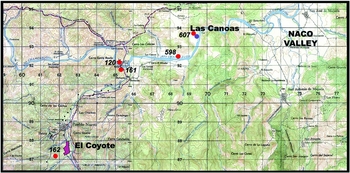
These arrangements comprise two points within a matrix of socioeconomic possibilities defined by how people realize goals as they make, exchange, and use goods within and across social nets. As many have noted (e.g., Feinman Reference Feinman2013; Hirth Reference Hirth1996, Reference Hirth1998; Rice Reference Rice2009), the resulting socioeconomic configurations often combine varying means of accomplishing all three highlighted tasks (Stark Reference Stark1992; Stark and Garraty Reference Stark, Garraty, Garraty and Stark2010). Grasping how craft production figured in these complex structures requires specifying who made particular items and at what scales and levels of intensity. Further, it is important to know which techniques were employed to transform the raw materials and how the goods were used and distributed. Questions of what economic and political benefits accrued to the craftworkers and under what political constraints, if any, they operated must also be answered (Costin Reference Costin and Schiffer1991, Reference Costin, Feinman and Douglas Price2001). We will address these queries for the Late Classic (AD 600–800) lower Cacaulapa Valley in northwestern Honduras (Figure 1), where survey and excavation at a wide range of settlements have revealed a complex political economy that defies easy categorization.
Location of the lower Cacaculapa Valley and obsidian sources.

The Lower Cacaulapa Valley
The Cacaulapa River, a perennial southern tributary of the Rio Chamelecon, cuts a narrow defile through steeply sloping hills. The 14 km2 lower valley is characterized by small expanses of arable land situated on narrow river terraces and in diminutive upland valleys. Survey of the basin revealed 7 km2 of agriculturally productive tracts, the largest extent of suitable farmland being less than 1 km wide. The archaeological resources of the area are known through six seasons of research beginning in 1999 during which 57 sites in the basin were recorded, 10 sites were excavated, and roughly 170,000 artifacts were analyzed (McFarlane Reference McFarlane2005; Urban Reference Urban2007; Urban et al. Reference Urban, Ausec, Christian Wells and Rice1997; Urban et al. Reference Urban, Schortman, Shugar, Richardson, Simmons and Shugar2013; Wells Reference Wells2003). The primary focus of these investigations has been the site of El Coyote. With 415 buildings, this center was more than 14 times the size of the next largest contemporary. Indeed, the 21 coeval settlements found beyond El Coyote consist of artifact scatters and small households of no more than 28 constructions (Figure 2).
Settlement map indicating El Coyote, Site PVC162, and other sites.

Occupation began at El Coyote by the Middle Preclassic (1200–400 BC), the site becoming a regional capital in the Late Classic. During the latter interval, El Coyote was dominated by a monumental core (Figure 3) organized according to principles identified in the Maya Lowlands; that is, a transition from sacred public spaces to secluded, elite domestic ones moving north to south (Ashmore Reference Ashmore and Robinson1987, Reference Ashmore1991; Ashmore and Sabloff Reference Ashmore and Sabloff2002; cf. Joyce et al. Reference Joyce, Hendon, Lopiparo, Bowser and Nieves Zedeño2009). The rectilinear, plaster-floored main plaza covers 5,000 m2 and is entered on the northeast by a causeway that extends 250 m to the north. Lying to the south are two ball courts, constricted plazas, and densely nucleated sizable platforms, likely elite residences, access to which was restricted. Smaller domestic platforms that housed people of lower ranks are concentrated south of the monumental core.
Structure map of El Coyote.

This settlement hierarchy strongly indicates that power during the Late Classic was concentrated at El Coyote, specifically within its epicenter. How economic processes figured in these political developments is complicated.
Crafting at El Coyote
Production at El Coyote appears in two forms: pottery production and work-party feasts.
Pottery Production
Though no firing facilities have been identified at the center, several lines of evidence indicate that pottery vessels were fabricated in southern El Coyote. First, Late Classic ceramics found throughout the lower Cacaulapa Valley are made from pastes that are macroscopically distinct from those characterizing vessels made in the coeval Naco and middle Chamelecon Valleys immediately to the northeast. Second, excavations on El Coyote's southeast edge recovered a dense deposit of sherds, ash, and ceramic fragments modified for use in shaping pots (3,526 pieces/m3). Finally, a historical period oven for firing ceramic roof tiles was found nearby, suggesting that pottery production using local clays was feasible at the center.
Though not definitive, these observations suggest that pottery vessels were made at El Coyote during the Late Classic. Most likely, the containers were manufactured on a relatively small scale by artisans residing in southeastern El Coyote, their outputs exchanged with consumers in the center and its hinterland. There is no evidence that these processes of production and distribution were under elite control, nor do they seem to have resulted in elevated status or power for the artisans.
Work-Party Feasts
Political centralization at El Coyote was apparently initiated, in part, through activities conducted in the site core. The very form of the epicenter reinforced status distinctions in that passage, through its various components, became increasingly restricted as people moved south from the main plaza into secluded areas of elite residence and ritual (the latter conducted in the ball courts located here; Moore Reference Moore1996; Stockett Reference Stockett2005). The extensive plaza likely hosted public rites performed by the rulers of El Coyote.
Wells's investigations in the main plaza (Reference Wells2003, Reference Wells2004, Reference Wells, Wells and Davis-Salazar2007, Reference Wells2010) strongly indicate that these observances were associated with feasts where food and chicha were prepared and consumed by participants. Those producers were not craftworkers, as they were engaged in common domestic tasks, albeit at large scales, the surpluses being used and consumed by fellow participants in public gatherings. Nonetheless, work-party feasts required the coordinated, if episodic, labor of numerous people presumably directed by rulers. The latter probably benefited from these celebrations as they placed themselves at the center of rites and feasts that instantiated a social affiliation uniting the entire populace (Schortman and Urban Reference Schortman and Urban2011; Wells Reference Wells2006).
Summary
Evidence from El Coyote suggests that the Late Classic political economy of the lower Cacaulapa Valley consisted primarily of a domestic mode of production. The economy functioned to meet the basic physical needs of households and periodically to produce large quantities of food and drink to support public gatherings directed by elites in the central plaza. These feasts were coupled with religious rites through which a valley-wide identity, and the prominence of the rulers who led it, were reproduced and celebrated.
Pottery vessels and obsidian blades were essential to the tasks by which households and hierarchies were sustained. The former were seemingly fabricated for local consumption at the center by artisans who may have operated independently of elite control. Obsidian blades were equally ubiquitous parts of assemblages associated with buildings of all sizes and locations within the lower Cacaulapa Valley. Unlike pottery, however, through 2004 there was no evidence that blades were fashioned in the basin. It seemed that these implements were imported, some measure of elite power possibly deriving from control over their acquisition and local distribution. This interpretation was definitively disproven during investigations at Site PVC162.
Site PVC162
Site PVC162 (Figure 4) consists of four modest structures arranged around a patio with three low terraces trailing off downhill to the northeast. It was first recorded during the initial valley survey and excavated in 2004 (McFarlane et al. Reference McFarlane, Webber and Anne Ellison2005; Urban Reference Urban2007). Located 1.5 km southwest of El Coyote, Site PVC162 was singled out for investigation because of its locally unusual placement atop a hill some 75 m above and overlooking the terrace occupied by that center. The ground here slopes down southwest to northeast, dropping precipitously into steep-sided ravines immediately northwest and southeast of the settlement.
Site map of Site PVC162 and topography.

Aside from a commanding view, the location of Site PVC162’s location holds few obvious advantages. There is no easy passage to the only perennial water source, the Rio Cacaulapa, 1.25 km to the east. Today, soils in the immediate vicinity of the site are thin, and there is no evidence to suggest that farming conditions would have been more favorable during the Late Classic. As Urban (Reference Urban2007:48) noted, “Site PVC162 seemed admirably located to make meeting the needs of daily life as difficult for its inhabitants as possible.”
The two largest structures were investigated through excavations exposing 73.5 m2 of architecture and surrounding ground surface, which unearthed a combined volume of 22.9 m3 (11.6 m3 from Structure 1 and 11.3 m3 from Structure 2). Analyses of recovered artifacts indicate that occupation of Site PVC162 was largely limited to the Late Classic, the settlement being abandoned early in the Terminal Classic (AD 800–1000). Throughout this period, the investigated structures underwent multiple episodes of significant architectural alteration (Figure 5). The widespread use of shaped limestone masonry in both buildings is notable as this practice is rarely recorded outside the main plaza of El Coyote.
Map with excavation limits and construction units.

Structure 1 was remodeled at least four times. An early circular or semi circular limestone surface was succeeded by a 0.35–0.58 m tall, stone-faced and -filled platform that covered 7.1 m2 and was aligned 128° (i.e., roughly NW-SE; Figure 6). This construction supported two rooms and faced to the southwest. Subsequent modifications made to Structure 1 likely correspond to the construction of Structure 2. The addition of a 0.1 m high cobble terrace doubled the basal dimensions of this building and reoriented Structure 1 to the plaza on the northeast. Finally, rooms were erected on the ancient ground surface along all sides of the building save the northeast.
Section drawings of Structure 1.

The earliest version of Structure 2 was a 0.50–0.86 m high basal platform that encompassed 23.4 m2 and was aligned 130°. Three of the four rooms are set in a line overlooking the patio and are backed on the northeast by the narrow (0.5 m wide) fourth compartment (Figure 7). A step that projects into the patio provided entry to the central room of Structure 2. This enclosure was surfaced with earth as was the back, northeast compartment to which it leads. The northwest and southeast rooms were floored with a white crushed limestone plaster. Burned patches on the plaster surfaces in both cubicles suggest the intermittent use of a hearth or incense burners. Plaster-floored rooms are unknown in the lower Cacaulapa Valley beyond El Coyote's monumental core.
Section drawings of Structure 2.

Subsequently, the basal platform of Structure 2 was expanded to cover 49.1 m2 by the construction of a 0.26–0.45 m tall cobble terrace that was raised on all sides of the edifice. The final construction efforts sealed the summit rooms. The northwest and southeast compartments were filled with a very soft clay brought in from off-site, then the whole summit was raised using a mix of rocks and earth. This fill episode thus erased earlier divisions and possibly created one large room atop the platform.
Building Functions
The architecture and associated material assemblage indicate that Site PVC162 housed a year-round occupation. Structure sizes and forms are comparable to those identified as residences and outbuildings in Late Classic lower Cacaulapa Valley households. Artifacts were collected from various contexts, including terminal debris, fill, and a large midden lying between the northwestern faces of both buildings and the steep drop to the river. Artifact densities (177/m3 overall) generally match those seen at other Late and Terminal Classic domiciles recorded in this and adjacent valleys.
There are slight discrepancies between the assemblages of Structures 1 and 2. The larger Structure 2 has the more typical domestic collection. For example, it has marginally more incense burners (three) than does Structure 1 (one) and possesses paraphernalia related to daily activities, such as grinding stones and figurines, which are absent from Structure 1. The midden associated with Structure 2 also yielded far more freshwater snails (Pachychilus sp.) than did any context on and around Structure 1, possibly hinting that food processing was more common here than at its southwestern neighbor.
The ceramic assemblage from Structure 2 is also richer in elaborately decorated or imported ceramics (EDICs) than is the case for materials associated with Structure 1. Of the 891 analyzed sherds from terminal debris contexts at Structure 2, 9% are from these presumably high-value items. Their frequency increases if we take into account the building's midden where 19% of the 489 analyzed sherds were EDICs. Only 1% of ceramics from terminal debris contexts of Structure 1 and 3% from its midden are EDICs (N = 326 and 117).
There are also marked differences in the relative amounts of jars and bowls between the investigated constructions. Of the 79 analyzed rims from the terminal debris deposits of Structure 2, 70% are from bowls, whereas at Structure 1, jars predominate (52% of 29 studied rims). The midden collections follow the same pattern; 74% of 53 analyzed rims from trash at Structure 2 are bowls, whereas jars make up 53% of the analyzed rims (N = 13) from the Structure 1 midden. The proportion of bowls and jars at Structure 1 conforms to patterns seen in Late and Terminal Classic domestic buildings in the lower Cacaulapa and neighboring valleys where evidence for food storing and serving are more or less equally represented (Schortman and Urban Reference Schortman and Urban2004b). The relatively small sample sizes urge caution in their interpretation. Nonetheless, differences in vessel forms could point to a concentration of food serving and preparation in and around Structure 2, while the storage of comestibles was centered in Structure 1.
Summary
Analyses of architecture and artifacts from Site PVC162 suggest that the settlement was occupied year-round and underwent significant renovations during the Late and very early Terminal Classic. Although the investigated buildings are contemporaries, there is variation in the activities conducted in each. Structure 1 served as a residence in which curating food and drink were significant activities. Structure 2 may have been a relatively exalted venue where select domestic tasks were pursued, such as food preparation and serving. The small sizes of the rooms of Structure 2 (2.0–4.8 m2) and lack of built-in furniture implies that some residential activities, including sleeping, were relegated to other locales including Structure 1, where benches are attested. The social significance of sharing comestibles at Structure 2 was possibly enhanced by the relatively imposing appearance of the structure and the elaborate paraphernalia employed in these tasks. Structure 2, therefore, may have been a focal point for dramatic episodes of food sharing that united the residents of Site PVC162 but that might not have privileged the occupants of any one domicile. Feasting may thus have helped constitute social identities at El Coyote and Site PVC162, albeit at distinct scales and with divergent political consequences.
The occupants of Site PVC162 were people of relatively high status who exercised considerable control over skilled and unskilled labor. The selective application of plaster and extensive use of cut blocks, materials not commonly seen outside the Late Classic core of El Coyote, are striking indicators of social preeminence (Wells Reference Wells2006). The high frequencies of EDICs found here, unmatched elsewhere in the Late Classic lower Cacaulapa Valley even at El Coyote, is suggestive of significant prosperity. We argue that the prominence of these hilltop dwellers throughout the Late Classic is associated with their roles as producers of obsidian blades.
Blade Production and Site PVC162
The recovery at Site PVC162 of 82 exhausted prismatic blade cores along with numerous prismatic blades and debris related to their production raised questions about how the settlement's residents fit within the Late Classic political economy of the lower Cacaulapa Valley and how their roles in that structure changed over time. To address these queries, we consider three main points. First, how was the technology of prismatic blade production organized at Site PVC162? Second, how was the workshop integrated within local and regional production and exchange relations? Finally, how did these practices of manufacture, consumption, and distribution shift over time in relation to political processes operating at multiple spatial scales?
Methods
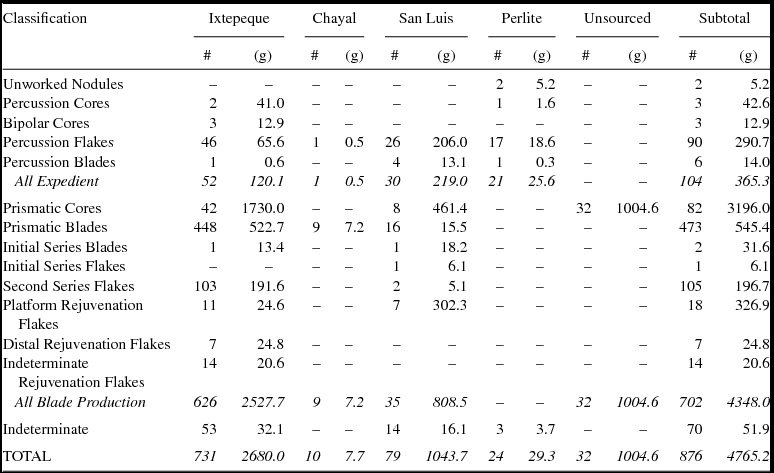
Fully 876 chipped obsidian artifacts (55 chert artifacts are excluded from this analysis) were recovered from Site PVC162 (Table 1). All of the material was classified using a behavioral or technological typology (Clark Reference Clark1997; Clark and Bryant Reference Clark and Bryant1997; Sheets Reference Sheets1975). This scheme classifies artifacts by their method of manufacture and is well suited for revealing the structure of lithic industries. More importantly, each artifact can be assigned to a specific segment of a reductive sequence, thereby facilitating inferences concerning where and at what scales and intensities stone tool manufacture was pursued. The popularity of this approach across Mesoamerica is due partly to its facility in designating each chipped stone specimen by its use-life trajectory, behavioral stage, and place in a chaîne opératoire (Braswell Reference Braswell, Golden and Borgsteade2004; Hirth Reference Hirth and Hirth2003:5; Moholy-Nagy Reference Moholy-Nagy, Hruby, Braswell and Chinchilla Mazariegos2011; Schiffer Reference Schiffer1972; Sheets Reference Sheets and Hirth2003). This approach also reveals much about how these technological systems articulated with the political economy.
Obsidian Artifacts Tabulated by Source and Technological Classification.

In addition to classifying each artifact, key attributes were recorded to place the specimens within the reductive sequence of the industry. Noted attributes include the presence or absence of cortex, platform treatment, segment of the artifact, presence or absence of retouch, macroscopic assessment of use-wear or edge damage, and weight. With the exception of indeterminate shatter, maximal length, width, and thickness were also recorded.
Geological sources were determined visually (Braswell et al. Reference Braswell, Clark, Aoyama, McKillop and Glascock2000). Because the exhausted blade cores were too thick for confident application of this method, 50 nuclei were submitted to the Archaeometry Laboratory at the University of Missouri Research Reactor. The cores were subjected to energy dispersive X-ray fluorescence and neutron activation analysis. Nodules of perlite, volcanic ejecta with a thoroughly hydrated cortex, were also noted. Having virtually the same properties as obsidian, these nodules could have been collected along the Cacaulapa River and from tuff deposits in the vicinity of El Coyote.
Organization of Blade Production at Site PVC162
The evidence from Site PVC162 reveals much about the organization of blade production at this workshop. Raw material was acquired through long-distance exchanges as well as from local outcrops. Although blades were produced at the workshop, very few of these goods were consumed or discarded here. Techniques for knapping blades varied over time and also by obsidian source. These patterns of variation suggest that, prior to the abandonment of the household, regional obsidian exchange networks had destabilized, necessitating the implementation of an alternative production technique.
Prismatic blade segments and blade production debris were scattered throughout the excavations. Blade production was a consistent activity throughout the occupation of Site PVC162, and the assemblage does not represent a single episode of craft production activity. Concentrations of debris were noted within the southeastern rooms of both excavated structures and along the northwestern base of each platform (Table 2). This pattern suggests that production activities may have been conducted indoors, while waste material was commonly disposed in middens along the edges of the buildings, presumably to wash down the steep decline. It is important to note that these midden deposits also include non-production waste such as pottery and other paraphernalia discarded through the course of daily activities. Apparently, materials associated with blade production were not conceptualized as distinct from household detritus.
Distribution of Blades and Production Debris by Contexts, Site PVC162.

* Two exhausted blade cores were collected from a nearby roadcut, and although they are clearly associated with this site, they cannot be assigned to either of these structures.
The results of sourcing analysis demonstrate that obsidian from the Ixtepeque flows was the most frequently imported material at Site PVC162. Based on its extensive complex of quarries and workshops extending over 30 km2, Ixtepeque was potentially the most intensively exploited source of obsidian in southeast Mesoamerica (Graham and Heizer Reference Graham and Heizer1968; Sheets Reference Sheets and Sharer1983:91; Sidrys et al. Reference Sidrys, Andresen and Marcucci1976; Williams et al. Reference Williams, McBirney and Dengo1964:38).
Eight of the cores submitted for elemental analysis were attributed to sources in close proximity to the lower Cacaulapa Valley. Two distinct sources were identified, Source Y and San Luis. To date, Source Y has only been identified chemically, and no physical outcropping or quarry has been located. Given its chemical composition and visual characteristics, Source Y is probably quite close to the San Luis source, which is 20 km south of Site PVC162 (Aoyama et al. Reference Aoyama, Tashiro and Glascock1999).
More recently, Steven Shackley (Joyce et al. Reference Joyce, Steven Shackley, McCandless, Sheptak and Rubén Ávalos2004) documented yet another outcropping on the eastern edge of the San Luis source area consisting of a large series of tuff domes. This outcropping, which Shackley designated as La Union after a nearby village, is situated above a tributary to the Quebrada Agua Helada from which Aoyama's group collected their San Luis sample. As the La Union and San Luis materials are chemically indistinguishable and physically adjacent, we, along with Hendon (Reference Hendon2004:7), consider both to be part of the same extensive source and will refer to all of these outcroppings as San Luis. Currently, the presence of large nodules has yet to be noted in any of the descriptions of the San Luis source area.
The vast majority of the obsidian artifacts in the assemblage were identified as by-products of prismatic blade manufacture or the products themselves. The remainder is made up of the output from expedient flake-core technologies. In the entire assemblage, only eight artifacts were reshaped or modified by retouch. All of these were prismatic blades altered to form a haft or into pointed drill bits. No bifacially worked tools or bifacial thinning flakes were identified.
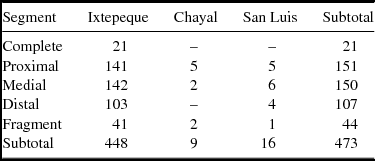
Prismatic blade segments were the most common type of chipped stone artifact recovered from this site (Table 3). Among other measures, calculation of cutting edge-to-mass ratios (CE/M) suggests that the efficient use of obsidian was a limited concern for the artisans of Site PVC162. Sheets and Muto (Reference Sheets and Muto1972) first proposed this measure as a reflection of the efficiency with which blades were used, and Sidrys (Reference Sidrys1979) later applied this concept to indirectly assess ease of access to obsidian.
Prismatic Blades Tabulated by Segment and Source.

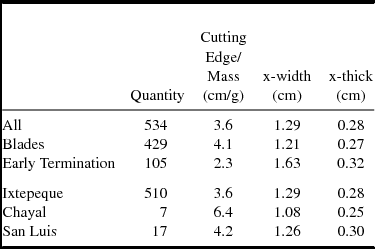
CE/M calculations for prismatic blades of Site PVC162 were computed by doubling the lengths of all blades in the assemblage and dividing this figure by the total mass of blades. The higher the ratio, the harder it was to acquire blades and the more effort was devoted to conserving them. For our calculation (Table 4), we excluded specimens whose extremely small sizes resulted from postdepositional fracture or crushing. Included in this figure are 105 early termination prismatic blades. Although typically classified as blade production debris, they maintain the same morphology as blade segments. Therefore, we view early termination blades as potentially equivalent to blade segments in terms of their utility.
Characteristics of Prismatic Blades and Early Termination Flakes Combined and by Source.

The CE/M ratios for Site PVC162 blades fall within the range of 5 to 7 for sites beyond 300 km from the source posited by Sidrys (Reference Sidrys1979:595). El Chayal lies more than 340 km away, and Ixtepeque is somewhat closer (257 km). Blade producers at Site PVC162 were less conservative with material from Ixtepeque. CE/M ratios for blades reduced from local sources (20 km) are much higher than anticipated. This discrepancy may result from the small sample size, although, as noted below, it probably has more to do with changing conditions of obsidian working and use.
Two other lines of evidence support the impression that efficient use of obsidian was not a pressing concern for inhabitants of Site PVC162. First, only five expedient percussion flakes show signs of moderate or heavy use-wear. Locally available chert was also relatively rare at the settlement. Limited use of obsidian and chert flakes tentatively implies that the available prismatic blades adequately met the needs of those engaged in tasks requiring stone tools. Second, of the blade segments recovered from this site, 60 had moderate or heavy use-wear. The low proportions of tools showing significant damage suggest that inhabitants were able to discard blade segments before use significantly altered their cutting edges.
Relative to other households in the lower Cacaulapa Valley, the volume of obsidian recovered from these structures is quite high. The quantity of blades recovered from Site PVC162, however, is low considering the number of exhausted cores at this site. The number of complete blades that can be reduced from a single core varies, but most estimates suggest a range of 100 to 180 blades produced per core (Clark Reference Clark and Isaac1986:36, Reference Clark1997:154). The discrepancy between recovered blade segments and the vastly higher potential yield from the 82 cores suggests that, although manufactured at Site PVC162, very few blades were consumed or discarded there. This demonstrates that blades were not being produced in conjunction with another craft at this locale (Clark Reference Clark and Isaac1986:26). Moreover, it reinforces the notion that the goods manufactured by these artisans were distributed elsewhere.
The most outstanding feature of the assemblage is the quantity of exhausted prismatic blade cores retrieved from excavated contexts (Supplemental Table 1). Although some are partial fragments, many are complete or nearly so and retain well-preserved platforms, blade removal scars, and, in some cases, evidence for attempts at error removal. Of this assemblage, 21 prismatic cores were reused as expedient cores.
A growing body of literature (Clark Reference Clark1982; Hirth Reference Hirth and Hirth2003; Hirth and Andrews Reference Hirth and Andrews2002; Hruby et al. Reference Hruby, Braswell and Chinchilla Mazariegos2011) has demonstrated that techniques used in manufacturing prismatic blades were not uniform across Mesoamerica. Nevertheless, there are a few common procedures that addressed recurring problems in reducing prismatic cores (Clark Reference Clark1997; Clark and Bryant Reference Clark and Bryant1997; Crabtree Reference Crabtree1968). These steps include platform rejuvenation, correction of blade removal errors, removal of inclusions, and platform preparation, all of which were identified in the Site PVC162 assemblage.
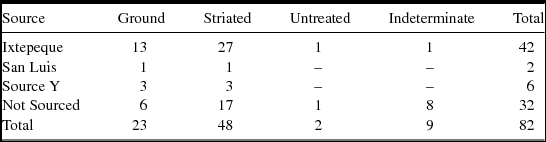
Platform treatment was a characteristic noted on most cores, complete artifacts, and proximal fragments. It took the form of grinding the entire surface or striating the edge of the platform; very rarely platforms were untreated (see Table 5; treatments of cores that did not retain a platform were recorded as Indeterminate).
Platform Preparation of Prismatic Blade Cores from Site PVC162.

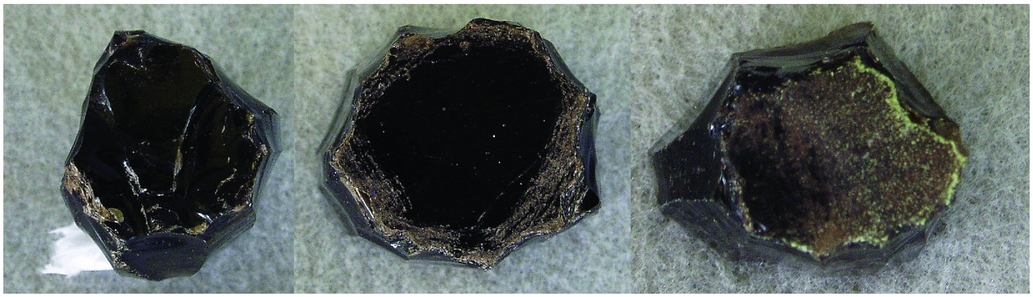
Although striation or scratching was the most common preparation technique in the assemblage, ground platforms on cores are well represented (Figure 8). A similar pattern is recorded on complete and proximal blade fragments. Of those sourced to Ixtepeque, nearly two-thirds (64%) retain evidence of striation. For those artifacts obtained from local sources, the platform treatment is equally divided between ground and striated techniques.
Platform treatments, left to right: platform rejuvenation, striation, and grinding.

Sheets (Reference Sheets and Sharer1983:95) noted for El Salvadoran assemblages that striation is the most common preparation technique during the Late Classic, with ground platforms increasing in frequency from the Terminal Classic into the Postclassic (AD 1100–1530). A similar chronological pattern is noted in central Mexico and western Mesoamerica (Healan Reference Healan2009:104). Platform treatments, therefore, suggest that the occupation of Site PVC162 spans the Late Classic into the early part of the Terminal Classic. Given that excavated deposits in and around the site are relatively shallow, discerning the chronological relationships of contexts has been difficult. The absence of diagnostics that define the full Terminal Classic in the lower Cacaulapa Valley, especially Pachuca obsidian and Plumbate pottery, indicates that the occupation of Site PVC162 did not extend very far into this period (Urban Reference Urban2016).
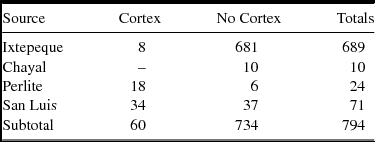
Aside from the chronological implications, it is clear that the initial treatment of raw materials and macro-cores varied by source. Cortex is noted with high frequency on cores, blades, and debris reduced from locally sourced obsidian. Among the 50 sourced cores, the only ones retaining cortex are from nearby flows. For all of the remaining unsourced cores, there are two fragments that retain cortex, and both have the same visual characteristics as the local San Luis or Source Y obsidian.
Analysis of the non-core chipped stone assemblage reinforces this pattern (Table 6). The few cortex-bearing artifacts reduced from Ixtepeque material were classified as expedient percussion flakes, an initial series prismatic blade, or indeterminate shatter. In contrast, artifacts retaining cortex that were reduced from local sources include blade production debris as well as first and second series blades. A significant portion of the locally sourced obsidian includes blade production debris related to macro-core preparation.
Cortex-Bearing Obsidian Artifacts by Source.

Therefore, we can argue with some confidence that prismatic blade cores reduced from local sources were brought as nodules to the Site PVC162 workshop and then reduced to macro-cores. It is striking that none of the cores or blade production debris sourced to Ixtepeque bear evidence of cortex. Put simply, materials originating from Ixtepeque and local sources were treated differently. This variation underscores the importance of recognizing heterogeneity in blade production technologies.
Regional Segmentation of Blade Production
Blade-core technologies were often regionally organized, with specialists coordinating their expertise to conduct specific stages of reduction (Braswell Reference Braswell, Hruby, Braswell and Chinchilla Mazariegos2011:12; Hirth and Flenniken Reference Hirth, Flenniken, Hirth and Andrews2002:125). Our evidence supports a model in which blade production was regionally segmented for some but not all sources. Nearly all of the obsidian from Ixtepeque was imported to the Site PVC162 workshop as preformed macro-cores. Presumably, specialists working in close proximity to the quarry at Ixtepeque undertook the initial stage of the blade production sequence. For obsidian obtained from local sources, preparation of macro-cores was undertaken at the workshop.
Thinking about how each step in this production sequence may vary spatially helps to explain why cores were, initially at least, being utilized from sources that are not geographically nearest to the workshop. Others describe the preferential importation of obsidian from Ixtepeque in terms of maintaining ties to the Copan polity or via other exchange networks (Aoyama et al. Reference Aoyama, Tashiro and Glascock1999; Hendon Reference Hendon2004). Although this may be the case, it fails to account for variation in the regional organization of prismatic blade technology. By extracting the raw materials and forming macro-cores, specialists at Ixtepeque would have enhanced the desirability of their products to blade producers during the Late Classic. The absence of specialists knapping macro-cores at local sources may well have made obsidian from these flows less preferable as it would have shifted the burden of initial core shaping to blade producers. Clark (Reference Clark1997:156) makes a similar argument about the preference for obsidian from the El Chayal source at Ojo de Agua despite its proximity to the San Martin Jilotepeque flows.
Few systematic investigations address how raw materials were quarried and macro-cores produced (Braswell Reference Braswell, Golden and Borgsteade2004:182), and the precise nature of how commodities were exchanged across Late Classic southern and southeastern Mesoamerica is not clear. Most likely, Ixtepeque obsidian moved by various means, including direct exchanges between producers and consumers, the intervention of such middlemen as itinerant traders, and elite-funded trading expeditions (Feinman and Garraty Reference Feinman and Garraty2010; Garraty Reference Garraty, Garraty and Stark2010; Hirth Reference Hirth2008).
Whatever the mechanisms of exchange, there is good reason to believe that access to Ixtepeque macro-cores in the case of Site PVC162 relied at least indirectly on enduring inter-elite alliances that would have created the relatively peaceful conditions on which long-distance exchanges of all sorts depended. The relatively high volume of Ixtepeque obsidian at Site PVC162 and throughout the lower Cacaulapa Valley correlates with the Late Classic apogee of the El Coyote polity. Taken together with the CE/M ratios of Ixtepeque blades, it appears that the seventh through ninth centuries marked a period of relatively easy and reliable access by knappers at Site PVC162 to Ixtepeque macro-cores.
The ready availability of macro-cores from high-quality obsidian flows meant that the artisans at Site PVC162 did not rely on alternative sources of tool stone. Chert, for example, was not commonly used at Site PVC162 nor well represented in Late Classic assemblages throughout the lower Cacaulapa Valley. This regional economic structure was vulnerable to any perturbations that upset the flow of macro-cores from quarries to knappers. Given the ubiquity of obsidian blades throughout the Late Classic lower Cacaulapa Valley, such disruptions would pose serious challenges to reproducing households and affiliations instantiated through work-party feasts.
Shifting Patterns of Exchange and Production
The abandonment of Site PVC162 apparently occurred during the Late to Terminal Classic transition in the ninth century. Among the lines of evidence suggesting this date are the ways in which the platforms of polyhedral cores were modified.
The high frequency of ground platforms on cores originating from sources near Site PVC162 may indicate that these outcrops were being exploited late in the history of the settlement possibly because its residents were struggling to acquire suitable material from distant Ixtepeque. The Late to Terminal Classic transition is marked throughout southern Mesoamerica by political fragmentation, population declines, and ruptures in long-distance trade (Demarest et al. Reference Demarest, Rice and Rice2005). The ninth-century abandonment of El Coyote's Late Classic monumental epicenter suggests that the polity was not immune to these processes (McFarlane Reference McFarlane2005).
Obsidian from Ixtepeque may have no longer been reliably available due to these disruptions. In order to meet continuing demands for blades, knappers had to draw on sources and use skills they had not been called on to employ previously. Now, in addition to producing the blades, they first had to produce macro-cores. This interpretation accounts for the prevalence of both ground platforms and cortex on San Luis and Source Y cores, blades, and blade production debris from Site PVC162 (see Tables 5 and 6). It also explains why a significant portion of the locally sourced obsidian includes debris from macro-core preparation.
Variations in the frequencies of cortex and different platform treatments across materials from distinct sources highlight the importance of recognizing heterogeneity in blade production technologies even within one workshop. Such patterning may point to the shifting ways people engaged over time with suppliers of different raw materials.
In sum, residents of Site PVC162 demonstrated considerable skill as they innovatively employed new manufacturing procedures on materials they had previously deemed inferior to Ixtepeque obsidian. Given the apparent decline in elite power at El Coyote and elsewhere in southeast Mesoamerica during the ninth century, it seems reasonable to infer that artisans were now largely securing, working, and distributing obsidian tools within the lower Cacaulapa Valley on their own. Unable to acquire Ixtepeque obsidian, they participated in a more territorially restricted economic structure. Tasks that had been spatially segregated, such as macro-core preparation, were now conducted in the same workshop where blades were knapped. The anomalously high CE/M ratio for local blades hints at the tenuousness of the new framework as even assets from nearby flows were being carefully conserved.
Sequestered Craft Production and Shifting Political Economies
We return to what first attracted us to Site PVC162: its isolated location. Sequestered blade workshops are rarely reported in Mesoamerica (cf. Burton Reference Burton and Grove1987; Sheets Reference Sheets1972). Why would the occupants opt for such an unusual setting despite shifts in production technologies, sources of raw materials, and the decline of elite power at El Coyote? This locational strategy is especially puzzling as it set these artisans apart from potential consumers and high-ranking patrons.
The choice may have been part of a strategy to monopolize prismatic blade production. As the sole known suppliers of obsidian blades within the Late Classic lower Cacaulapa Valley, the inhabitants of Site PVC162 were in an excellent position to make themselves indispensable to elites and commoners. Their isolation from consumers, competitors, and notables would help guarantee such a monopoly over the knowledge needed to knap blades and, eventually, shape macro-cores. This putative exclusive control over the local distribution of a valued good may well have translated into the artisans’ relative prominence as measured by the substantial architecture they could raise and valuables they could obtain.
Hiding from prying eyes came at a cost. Given the poor soils and difficulty accessing water that their location entailed, the inhabitants of Site PVC162 would have been dependent on others for basic resources. Whether or not they chose to live and work in such austere surroundings, this locale ensured the integrity of their monopoly while simultaneously undercutting their economic autonomy. As such, the power over others exercised by the residents of Site PVC162 was limited by their reliance on those same people for essential goods.
This relationship might have created a cycle in which survival and preeminence was dependent on their continued success in fashioning blades. When the changes that transpired during the Terminal Classic threatened their capacity to acquire raw materials, people improvised. They began using skills they had never employed before on materials they had previously rejected. Although it did not prevent the abandonment of this household, these artisans’ efforts emphasize the importance of blade-making to their continued survival as a distinct faction within lower Cacaulapa Valley society.
How, if at all, did the workshop relate to the political aspirations of the local rulers? These potentates, together with their ilk throughout southern and southeastern Mesoamerica, likely created the conditions for successful long-distance interactions in which the knappers thrived. That said, there is little evidence that these elites directly controlled the acquisition, production, and use of obsidian. If distances of workshops from elite residences and administrative facilities correlate with degrees of centralized control over these processes, the location of Site PVC162 was apparently an ostentatious expression of political independence. Work-party feasts were far more directly implicated in elite domination strategies, while the place of pottery production in these efforts remains unclear.
If artisans were relatively independent of elite control in the Late Classic, this was even more the case during the ninth century when the potentates of El Coyote seem to have experienced a sharp decline in their power. By this point, the artisans likely operated as autonomous agents, creatively, if ultimately unsuccessfully, maneuvering to maintain their specialized niche in a volatile lower Cacaulapa political economy. By the time a new political center emerged at El Coyote in the tenth century, there were no signs of obsidian blade manufacture at the center or in its environs (McFarlane Reference McFarlane2005). However they came to live atop that hill, the residents of Site PVC162 for several centuries appear to have played an important economic role in supplying the lower Cacaulapa Valley with essential blades. Their place in the local power structure was, however, far more ambiguous.
Conclusions
There are several points following from this discussion that we think bear reiteration. First, this relatively small society exhibits considerable variability in how its component economic and political processes were related. The domestic economy pursued by numerous valley households contributed to their economic autonomy. Household independence was apparently counterbalanced by reliance on craft workshops for pottery and obsidian blades.
Manufacturing ceramic vessels might have been centered at the capital and could have been supervised by the rulers of El Coyote. There is, however, no clear evidence that this was the case. Obsidian blades, on the other hand, were fashioned well away from the center by craftworkers who probably monopolized the local manufacture and distribution of these tools. Exclusive local control over the industry provided these artisans with some power over those who used their products. While that dominion may have contributed to their material well-being, it was balanced by the artisans’ dependence on their clients for basic subsistence.
Households, therefore, met most of their essential needs with the help of obsidian tools obtained from producers who were seemingly hard-pressed to feed themselves without the aid of those who relied on them for blades. At the same time, hierarchical relations were likely sustained by means of occasional overproduction of comestibles to support the work-party feasts through which expansive social identities were materialized. Enacting these gatherings, in turn, required access to obsidian blades.
Second, this complex political economy does not conform easily to models based on dichotomies between attached and independent specialists. These taxa define points within a matrix of possible relations among the production, exchange, and use of goods and the exercise of power. The Site PVC162 case reminds us that we should not get too comfortable with familiar models whose application may obscure more of past political economies than they illumine. Instead, we might profitably attend to questions of who was producing what goods, at what scales, and with what political and economic consequences.
Third, political economies are rarely static. Paying attention to variability within even this small lithic assemblage emphasizes the subtle but significant ways in which relations of power, production, exchange, and consumption can shift. Moreover, recognizing how processes of obsidian blade manufacture varied spatially reveals the ways in which technological systems can be regionally organized.
Fourth, the lower Cacaulapa Valley is hardly typical of Late Classic political economies in this region. For example, political centralization and hierarchy were apparently underwritten in the Naco Valley, 9 km to the northeast, by centralized control over several crafts, including blade manufacture (Schortman and Urban Reference Schortman and Urban1994; Schortman et al. Reference Schortman, Urban and Ausec2001). The dispersal of power together with craft-working from that center during the Terminal Classic suggests that producing essential goods was both a means of exercising power over others and for resisting such pretensions (Ross Reference Ross1997; Schortman and Urban Reference Schortman and Urban2004b, Reference Schortman and Urban2012).
In contrast, there is scant evidence of craft manufacture in the Late Classic middle Ulua drainage about 35 km south of the lower Cacaulapa Valley. Most probably, control over public rites by notables residing at the regional capital of Gualjoquito was one means by which they sought to overcome the relative economic autonomy of households under their command (Ashmore Reference Ashmore and Robinson1987; Schortman et al. Reference Schortman, Urban, Ashmore and Benyo1986). This variation does not preclude a search for general statements concerning relations among political and economic processes. It does urge caution in advancing those claims, especially of adopting models derived from better-known areas, such as the Late Classic Maya Lowlands.
Fifth, unraveling ancient political economies requires investigating behavioral variation across entire polities. Pursuing extensive programs of survey and excavation is the only way we can hope to recognize the varied forms and histories of ancient political economies (Hirth Reference Hirth2013; Montmollin Reference Montmollin1989; Smith Reference Smith2004). That said, even ambitious field programs can easily miss those rare sites that hold the key to understanding political and economic forms. We came very close to not excavating Site PVC162, and there are other equally unprepossessing settlements on other hills that could yield finds challenging the interpretations presented here.
Acknowledgments
The excavations and analyses on which this report is based were conducted with the permission and support of our colleagues at the Instituto Hondureño de Antropología e Historia and with funding generously provided by the Foundation for the Advancement of Mesoamerican Studies (FAMSI), Kenyon College, and Johnson County Community College. We are very grateful for the support of these institutions and to the meticulous and indefatigable research of Charlie Webber and Leigh Anne Ellison who directed the excavations at Site PVC162. The residents of Pueblo Nuevo and Petoa were welcoming and helpful, as they have been since the inception of our work in the area during the summer of 1999. Fieldworkers from both towns, as well as other smaller locales in the area, did a superb job of unearthing the remains described herein. Any errors of omission or commission in this report are solely the authors’ responsibilities.
Data Availability Statement
Obsidian analyzed for this study is archived in the Department of Anthropology at Johnson County Community College and in the Lima office of the Instituto de Hondureño Antropología e Historia.
Supplemental Material
Supplemental materials are linked to the online version of the manuscript, accessible via the SAA member login at https://doi.org/10.1017/laq.2017.53
Supplemental Table 1. Measurements and Characteristics for Analyzed Prismatic Cores.