Introduction
Many of people are struck by one or more major traumas throughout the lifetime, such as physical assault or serious injury, and older adults may have higher possibilities to be exposed to these traumatic events compared to younger people due to their older ages. Although post-traumatic stress disorder (PTSD) in older adults as a severe consequence of trauma earlier in life is known to decrease to very low prevalence rates (Creamer et al., Reference Creamer, Burgess and McFarlane2001), comorbid mood, or anxiety disorders other than PTSD and subclinical mental health problems originating from LTE can persist to or re-emerge at older ages (Durai et al., Reference Durai2011). Also, they can cause significant functional impairment in older people (Jeste et al., Reference Jeste, Blazer and First2005). Furthermore, considering that mental health is conceptualized as a state of well-being, not only as disease-free state, a more positive concept than simple recovery from trauma is also needed. Mental well-being even after experience of trauma may represent a state of positive mental health with a more comprehensive perspective. Although it has been referred to a little differently according to studies, one common factor of mental well-being is the subjective appraisal of one's life. Although knowledge of specific trauma exposures and consequent PTSD in older people has recently accumulated (Spitzer et al., Reference Spitzer, Barnow, Volzke, John, Freyberger and Grabe2008), there is little evidence about the associations between LTE and older people's positive mental state, especially from nationally representative studies (Freitag et al., Reference Freitag, Braehler, Schmidt and Glaesmer2013).
How some older adults remain mentally well while others become mentally ill after similar LTEs has been a question in recent studies. Some sociodemographic and trauma-related factors associated with a greater impact of LTE in older adults has been reported, including being female and having multiple traumas (Chen et al., Reference Chen2011). However, the influence of older adults’ internal factors, such as personality traits, on the consequences of LTE has rarely been investigated. Personality traits are characteristics that are innate or develop early, but are consistent, showing individual differences in patterns of thought, feeling, and behaviors across the lifetime (McCrae and Costa, Reference McCrae and Costa1987). They may affect emotional responses to, or coping strategies for, stressful events (Ajdukovic et al., Reference Ajdukovic2013). A previous study suggested that higher stoicism was related to poorer mental health in older adults after experience of a natural disaster (Bei et al., Reference Bei2013), suggesting that stoicism might lead people to play down their difficulties and not seek help when it is needed. The five-factor personality model is the most validated and widely adopted such model. The five major traits – neuroticism, extraversion, openness, agreeableness, and conscientiousness – are known to have a physiological and genetic basis, and show heritability (McCrae and Costa, Reference McCrae and Costa1987). Some previous studies have shown associations of these personality traits with resilience to trauma in younger people (Campbell-Sills et al., Reference Campbell-Sills, Cohan and Stein2006; Bei et al., Reference Bei2013), and a recent study indicated that successful psychological adaptation to spousal loss was associated with high extraversion and low neuroticism in old age (Spahni et al., Reference Spahni, Morselli, Perrig-Chiello and Bennett2015). However, to the best of our knowledge, there is no report in which this model was used to investigate the association between earlier traumatic events and mental health consequences in older adults.
There were two main research aims in this study. First, we compared the prevalence of mental disorders and the degree of QoL between older adults with LTE and those without, in a nationally representative sample of older Koreans. Second, among the older people who experienced traumatic events, we investigated the correlates of mental health outcomes including sociodemographic variables, trauma-related characteristics, and personality traits: two major outcomes, current mood, or anxiety disorder and current mental well-being, were used. The latter outcome was operationally defined to meet all of three conditions: (1) no current mood or anxiety disorder, (2) good health-related QoL, and (3) above average satisfaction with life. If an older adult is not only free of mental illnesses but also is experiencing a stable state of well-being even after serious traumatic events, he/she might be able to be referred as resilient to the traumatic experiences.
Methods
Data collection and study population
Data were from the 2011 Korean Epidemiologic Catchment Area (KECA-2011) study, a nationally representative survey of major psychiatric disorders in community-dwelling adults that was conducted between July 19, 2011 and November 16, 2011. A multi-stage stratified cluster sampling method was used to select the subjects based on 2010 population census data: all eligible household residents between 18 and 74 years of age were included in the survey. Full details of the KECA-2011 study were provided in a previous report (Park et al., Reference Park2014).
A total of 6,022 individuals responded and agreed to be interviewed (response rate: 78.7%), and the subjects aged ≥60 years were selected for inclusion in this study (N = 1,621). All participants were fully informed regarding the aims and methods of the study prior to the completion of the interview, and informed consent was obtained prior to participation. This study was approved by the Institutional Review Board of Seoul National University Hospital.
Measurements
We used the PTSD section of the Korean version of Composite International Diagnostic Interview 2.1 (K-CIDI; World Health Organization [WHO], 1997a) to investigate lifetime traumatic events. The K-CIDI was validated by Cho et al. (Cho et al., Reference Cho1999) according to WHO guidelines (WHO, 1997b). It was administered by trained interviewers to determine the diagnoses and onset age of psychiatric disorders based on the diagnostic criteria of the Diagnostic and Statistical Manual of Mental Disorders, Fourth Edition (DSM-IV; American Psychiatric Association, 1994).
At the beginning of the PTSD section, subjects were asked about traumatic events and answered dichotomously (yes or no). They were handed a card on which were printed 11 kinds of trauma, including military combat; life-threatening accidents; natural disasters or fire; rape; sexual assault; physical assault; being threatened with a weapon, held captive, or kidnapped; being tortured or the subject of terrorism; any other extremely stressful events; and being confronted with others’ trauma. If the last two items were related to bereavement, chronic medical illness, business loss, or marital or family conflict, they were not regarded as traumatic events. Although they could be also traumatic to some people, we limited the definition of traumatic events as severe and extreme ones at least more than these usual events. The age at which the traumatic events occurred was also evaluated in this section.
Lifetime and current major psychiatric disorders during the previous year were also examined by the K-CIDI (Cho et al., Reference Cho1999). They included substance use disorders (alcohol/nicotine use disorders), mood disorders, anxiety disorders, psychotic disorders, and somatoform disorders. Among anxiety disorders, we classified PTSD into two categories: full PTSD and partial PTSD. Respondents who satisfied all PTSD criteria were diagnosed as having full PTSD, and those who had one or more symptoms in each of three symptom groups (Criteria B, C, and D) and had a symptom duration of at least one month (Criterion E) were defined as having partial PTSD (Breslau et al., Reference Breslau, Lucia and Davis2004).
There were two indicators of QoL. First, the Korean version of EuroQol health classification system (EQ-5D; EuroQol Group, 1990; Kim et al., Reference Kim, Cho, Uhm, Kim and Bae2005) was used to assess health-related QoL, which is an index of perceived functional outcome of an illness or disability. Respondents rated their health (three levels of severity) in terms of five health domains: mobility, self-care, usual activities, pain/discomfort, and anxiety/depression. People who responded with the lowest score (1: no problem) for all domains were regarded to have good health-related QoL. Second, a life satisfaction questionnaire was used to evaluate general life satisfaction, which was described using a 5-point Likert scale for five domains: health, economic status, job/achievement, interpersonal relationships, and general life (e.g. I am satisfied with my life generally). People who gave scores above the average (3: satisfied to an average degree) for all domains were regarded as being satisfied with their lives.
As one of the possible correlates of mental health in elderly people with LTE, personality traits were investigated using the BFI-10 (Rammstedt et al., Reference Rammstedt and John2007). The BFI-10 is a short self-rating instrument based on the five-factor model of personality (McCrae and Costa, Reference McCrae and Costa1987), which included the five traits neuroticism, extraversion, openness, agreeableness, and conscientiousness. Derived from the original and longer BFI-44 (Pervin and John, Reference Pervin and John1999), the BFI-10 has two items measuring each of five personality dimensions. Each BFI-10 item is rated on a 5-point Likert scale. The score for each personality dimension was calculated as the average value of the two items (one of which was a reverse-coded item) for each dimension. Higher scores indicate a stronger personality trait.
During the interview, self-reported demographic characteristics including age, gender, marital status, years of education, employment, and religion were collected from the participants, along with clinical information regarding the presence of chronic medical illnesses. The participants were asked whether they had ever been diagnosed by a medical doctor with hypertension, diabetes, dyslipidemia, heart disease, stroke, or cancer. If any of these diseases were present, the individual was considered to have a chronic medical illness.
Statistical analysis
Comparisons of sociodemographic characteristics, personality traits, current mental disorders, and indicators of QoL between elderly individuals with and without LTE were performed with Pearson's χ 2 and Student t-tests. Cramer's V and r 2 were included as the effect sizes for the χ 2 and t-tests, respectively. To control for inflation of the type I error due to multiple χ 2 and t-tests, adjusted p value was applied with Bonferroni correction.
Bivariate correlation analyses were performed between personality traits and mental health outcomes among all subjects; group-wise correlations were then examined according to LTE status.
Logistic regression analyses were performed to identify factors associated with two major outcomes: current mood or anxiety disorder and mental well-being. Separate logistic regression analyses were conducted for variables in three categories (characteristics of traumatic events: Model 1–1; consequences of traumatic events: Model 1–2; personality traits: Model 1–3) after adjusting for sociodemographic variables (age, gender, marital status, years of education, employment, religion, and chronic medical illness). Then, a multivariate logistic regression analysis adjusted for those sociodemographic factors, as well as for the variables from the three categories for which p was < 0.10 in Model 1, was performed (Model 2). We found no multicollinearity between the independent variables, as the maximum variance inflation factor (VIF) was 3.210 among all variables in the logistic regression models. Additionally, the goodness of fit of the model was evaluated using the Hosmer–Lemeshow test. Statistical significance was set at a p value of <0.05.
All statistical analyses were conducted using SPSS, version 21.0 (IBM Corp., Armonk, NY, USA).
Results
Sociodemographic and personality characteristics according to presence of lifetime traumatic events
In the sample (N = 1,621), 577 older adults (35.6%) had experienced one or more traumatic events during their lifetime. The most common type of trauma was military combat (N = 271); this was followed by life-threatening accidents (N = 226), witnessing someone being killed or seriously injured (N = 161), natural disasters or fire (N = 125), other extremely stressful events (N = 67), confronted with trauma of others (N = 43), physical assault (N = 40), being threatened with a weapon/held captive/kidnapped/tortured/terrorized (N = 21), and rape or sexual assault (N = 9). Three individuals (0.2%) had no data on lifetime traumatic events. The mean age at trauma was 30.8 years old (standard deviation = 19.8).
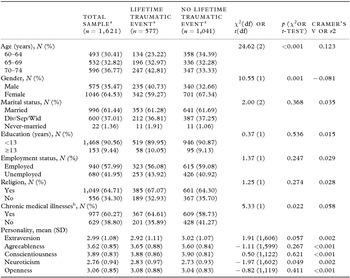
Of the elderly individuals with LTE, a higher proportion was older (those aged 60–64 years, 23.2%; those aged 65–69 years, 33.0%; those aged 70–74 years, 42.8%), and the proportion of males was higher (40.7%) than in those without lifetime traumatic events (32.7%; Table 1). Otherwise, there were no sociodemographic differences between the groups with and without LTE after Bonferroni correction. In general, the personality characteristics measured by the BFI-10 did not differ between two groups. Although neuroticism scores tended to be higher in elderly individuals with LTE than in those without LTE, the significance of this relationship disappeared after the Bonferroni correction (p = 0.049).
Sociodemographic and personality characteristics of the sample according to presence of lifetime traumatic events

Abbreviation: Div/Sep/Wid = divorced, separated, or widowed.
a N (%) for categorical variables; numbers may not add up to the total because of missing data.
b Any chronic medical illness (hypertension, diabetes, dyslipidemia, stroke, heart disease, or cancer).
Mental health outcomes according to presence of lifetime traumatic events
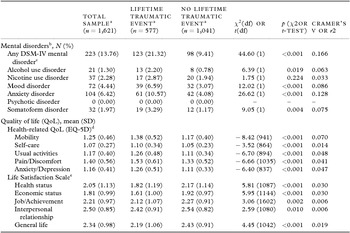
There were significant and consistent differences in the prevalence of current mental disorders between elderly people with and without LTE (Table 2). Any DSM-IV major mental disorders, mood disorders, and anxiety disorders were more than twice as frequent in the group with LTE as in those without LTE (p < 0.001 for all). Among mood disorders, major depressive disorder (neither bipolar disorder nor dysthymic disorder) was more observed in older adults with LTE compared to those without LTE (p = 0.003), whereas among anxiety disorders, specific phobia (p = 0.001) were more prevalent in older people with LTE. Additionally, somatoform disorder (p = 0.003) were also frequently observed in older adults with LTE compared to those without. Conversely, among elderly individuals with any DSM-IV major mental disorder, the proportion of people who suffered from more than one mental disorder was 19.3%, and the comorbidity rates did not differ according to LTE status (20.7% vs. 17.5%, p = 0.607).
Current mental disorders and quality of life in elderly individuals according to lifetime traumatic events

a N (%) for categorical variables; numbers may not add up to the total because of missing data.
b Mental disorders during the year prior to the interview.
c Includes substance use disorders (alcohol/nicotine use disorders), mood disorders, anxiety disorders, psychotic disorders, and somatoform disorders.
d Three levels of severity for five health domains: “no problem” (1), “a problem to a certain degree” (2), and “a severe problem” (3).
e Rated on five-point Likert scales for five domains of life satisfaction: “never satisfied’ (0), “tend to be dissatisfied’ (1), “neither satisfied nor dissatisfied” (2), “tend to be satisfied” (3), and “very satisfied” (4).
In terms of QoL, elderly individuals with LTE showed higher scores in all domains of EQ-5D (poorer health-related QoL) compared to those who without LTE, and they also had lower scores in all domains of life satisfaction scale (less satisfaction with life; Table 2).
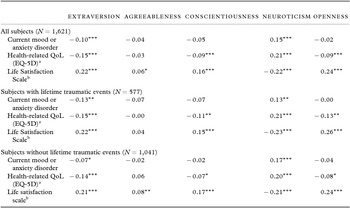
Conversely, bivariate correlation analyses were performed between personality traits and mental health outcomes (Table 3). In general, extraversion and neuroticism showed significant correlations with all outcome measures, whereas conscientiousness and openness were correlated with only health-related QoL and life satisfaction. Although the two groups with and without LTE did not differ in terms of significant correlations, they did differ somewhat with regard to Pearson's correlation coefficients (r). For instance, the “r” for the correlation between extraversion and current mood or anxiety disorder was stronger in the group with LTE (r = −0.13) compared with the group without LTE (r = −0.07).
Correlations between the big five personality factors and current mood or anxiety disorder and quality of life (QoL)

Presented as Pearson's correlation coefficients (r).
a Three levels of severity for five health domains: “no problem” (1), “a problem to a certain degree” (2), and “a severe problem” (3).
b Rated on 5-point Likert scales for five domains of life satisfaction: “never satisfied” (0), “tend to be dissatisfied” (1), “neither satisfied nor dissatisfied” (2), “tend to be satisfied” (3), and “very satisfied” (4).
Factors associated with current mood or anxiety disorders
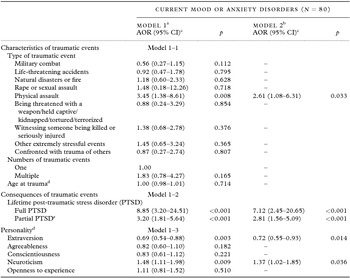
As the first outcome of this study, the risk of current mood or anxiety disorders in elderly people with lifetime traumatic events was estimated using multivariate logistic regression models (Table 4).
Sociodemographic, trauma-related, and personality factors associated with current mood or anxiety disorders in elderly individuals with lifetime traumatic events (N = 577)

Abbreviations: AOR, adjusted odds ratio; CI, confidence interval.
a Adjusted for sociodemographic variables (age group, gender, marital status, education, employment, religion, and chronic medical illnesses) and controlled for characteristics of traumatic events (Model 1–1), consequences of traumatic events (Model 1–2), and personality (Model 1–3).
b Adjusted for sociodemographic variables as well as for trauma-related and personality variables for which p was < 0.10 in Model 1. Cox & Snell R square was 0.152, and Nagelkerke R square was 0.277.
c The reference group was those with no current mood or anxiety disorder. For example, the adjusted odds ratio (AOR) of those with multiple traumas was 1.83, which indicates that the risk of having a current mood or anxiety disorder was increased by a factor of 1.83 in older adults with multiple traumas compared with those who have one trauma.
d In the logistic regression models, the adjusted odds ratio was a 1-point increase.
e Partial PTSD was defined as one or more symptoms in each of three symptom groups (Criteria B, C, and D) and a duration of symptoms ≥ 1 month (Criterion E).
Of the sociodemographic characteristics, only female gender significantly increased the risk of current mood or anxiety disorders in elderly individuals with LTE (adjusted odds ratio [AOR] 2.96, p = 0.002; not shown in the table).
Regarding the characteristics of the traumatic event, “physical assault” was associated with having a current mood or anxiety disorder in Model 1–1 (adjusted for sociodemographic variables only). After adjusting for the other trauma-related and personality variables that were significant in Model 1 (p < 0.10), they also showed significant associations in Model 2. Conversely, lifetime full and partial PTSD both significantly increased the risk of current mood or anxiety disorders in elderly individuals (Model 1–2); these correlations remained significant even after full adjustment in Model 2.
In terms of personality traits, higher extraversion scores were associated with a lower risk of having a current mood or anxiety disorder, whereas higher neuroticism scores were associated with a higher risk of these disorders in Model 1–3; these relationships were also significant in the fully adjusted Model 2.
Factors associated with current mental well-being
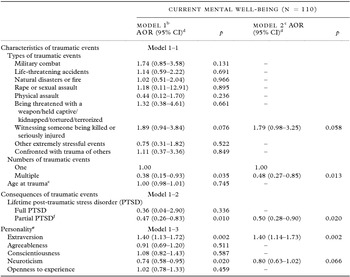
Mental well-being, defined by the absence of current mood or anxiety disorders, no problems for all domains in EQ-5D, and above average life satisfaction was the second outcome in the present study (Table 5).
Sociodemographic, trauma-related, and personality factors associated with current mental well-beinga in elderly individuals with lifetime traumatic events (N = 577)

Abbreviation: AOR, adjusted odds ratio; CI, confidence interval; Div/Sep/Wid, divorced, separated, widowed, or never-married.
a Current mental well-being was defined as (1) no current mood or anxiety disorder, (2) no problems for all domains of health-related quality of life (QoL), and (3) above average scores for all domains of the life satisfaction scale.
b Adjusted only for sociodemographic variables (age, gender, marital status, education, employment, religion, and chronic medical illnesses) and controlled for characteristics of traumatic events (Model 1–1), consequences of traumatic events (Model 1–2), and personality (Model 1–3).
c Adjusted for sociodemographic variables as well as trauma-related and personality variables for which p was < 0.10 in Model 1. Cox & Snell R square was 0.115 and Nagelkerke R square was 0.185.
d The reference group was those with poor mental well-being group. For example, the adjusted odds ratio (AOR) of those with multiple traumas was 0.38, which indicates that the odds of good (vs. poor) mental well-being were decreased by a factor of 0.38 in older adults with multiple traumas compared with those who have one trauma.
e In the logistic regression models, adjusted odds ratio as a 1-point increase.
f Partial PTSD was defined as one or more symptoms in each of three symptom groups (Criteria B, C, and D) and duration of symptoms ≥ 1 month (Criterion E).
Among elderly people with lifetime traumatic events, unmarried subjects (AOR 0.54, p = 0.016), those with less education (AOR 0.47, p = 0.018), and those with a chronic medical illness (AOR 0.46, p = 0.001) showed significantly lower odds of experiencing mental well-being (not shown in the table).
In terms of the characteristics of the traumatic event, multiple traumas and a lifetime history of partial PTSD significantly decreased the chance that older adults would rate their current mental well-being as good in the fully adjusted model (Models 1–1, 1–2, and 2).
Higher extraversion increased the probability of mental well-being, while higher neuroticism decreased it (Model 1–3). However, only higher extraversion was significantly associated with mental well-being in the fully adjusted model (Model 2).
Discussion
This nationally representative study suggests that trauma exposure across the lifespan has negative effects on the mental health outcomes of elderly individuals: old adults with LTE showed not only a higher prevalence of psychiatric disorders but also generally poorer mental health compared with those without LTE. Among possible correlates of mental health outcomes in older adults with LTE, higher extraversion was associated with both decreased mental illnesses (current mood or anxiety disorder) and increased mental well-being, whereas higher neuroticism increased the odds of suffering from mental illnesses after adjusting for sociodemographic and trauma-related factors. This finding implies that personality traits should be considered as an important factor affecting the resilience to trauma exposure in older people.
The prevalence of trauma exposure in this study was lower than those in previous community-based studies (Spitzer et al., Reference Spitzer, Barnow, Volzke, John, Freyberger and Grabe2008). This may be due to methodological differences (e.g. we did not include death of a loved one as a traumatic event). However, the higher risks of trauma exposure in older individuals and males were consistent with previous studies (Creamer et al., Reference Creamer, Burgess and McFarlane2001; Spitzer et al., Reference Spitzer, Barnow, Volzke, John, Freyberger and Grabe2008).
In the present study, exposure to trauma, even at an earlier time, led to various psychological difficulties in older adults, from mild problems (poorer health-related QoL and less satisfaction with life) to severe ones (mental disorders). Although PTSD is the prototype of trauma-related mental disorder, it has been criticized as being too restricted: while it was reported that 40–60% of the general population experience lifetime trauma (Spitzer et al., Reference Spitzer, Barnow, Volzke, John, Freyberger and Grabe2008), only a small number of people are diagnosed with PTSD between 0.6% and 2.1% of elderly people (Sareen et al., Reference Sareen, Cox, Stein, Afifi, Fleet and Asmundson2007). A Korean sample showed the same thing (Jeon et al., Reference Jeon2007). Therefore, investigating the association of psychiatric disorders with LTE limited to PTSD could underestimate the real psychological difficulties of older adults with LTE. Furthermore, major mental disorders other than PTSD, such as depressive disorder, have also been reported to be prevalent in younger individuals with trauma exposure (McQuaid et al., Reference McQuaid, Pedrelli, McCahill and Stein2001). We have provided additional evidence for this in older people.
Relatively large numbers of studies regarding elderly people's perceived health states or QoL related to LTE have been conducted (Krause, Reference Krause2004; Petkus et al., Reference Petkus, Gum, King-Kallimanis and Wetherell2009; Bei et al., Reference Bei2013; Freitag et al., Reference Freitag, Braehler, Schmidt and Glaesmer2013). Our findings of significant associations of poorer health-related QoL and lower life satisfaction with trauma exposure are consistent with most of the results of these studies. Although the measurements of QoL vary between studies, they commonly investigate one's own perspective on QoL regarding health or mental states (Krause, Reference Krause2004; Petkus et al., Reference Petkus, Gum, King-Kallimanis and Wetherell2009; Bei et al., Reference Bei2013; Freitag et al., Reference Freitag, Braehler, Schmidt and Glaesmer2013).
This study found that older adults with higher extraversion and lower neuroticism scores were more likely to report positive mental health consequences following earlier traumatic events. To confirm this finding, we additionally conducted logistic regression analyses with all subjects including LTE variable (no LTE = 0; one or more LTE = 1) and the terms for interaction between LTE and significant variables. The results were not different from those of original analyses: the only correlate of both mental health outcomes was extraversion, and interaction between LTE and extraversion was significant. Some previous studies showed that individual differences in personality might play an important role in the development of PTSD, and led to a proposed dimensional model for PTSD based on different personality traits regarding vulnerability or resilience to mental distress (Jaksic et al., Reference Jaksic, Brajkovic, Ivezic, Topic and Jakovljevic2012). Our finding is consistent with the results of these studies, and we additionally provide evidence that personality traits, especially extraversion and neuroticism, affect all mental health outcomes, not only PTSD, among older adults with LTE.
In general, extraversion has been characterized by tendencies of experiencing things in a more positive affective state, seeking out social interaction, and finding interpersonal closeness more easily (McCrae and Costa, Reference McCrae and Costa1987). Positive affect may help to alleviate stressful experiences, and may increase individuals’ mental resources, with more flexible thinking and expended behavioral options (Campbell-Sills et al., Reference Campbell-Sills, Cohan and Stein2006). Furthermore, the tendency of extraverted people to build stronger social networks may allow them to easily find help when they experience trauma (Rutter, Reference Rutter1985). Additionally, some recent studies demonstrated neural correlates of the association between extraversion and emotional functioning by presenting increased amygdala volume and increased function integrity of amygdala-centered network in extraverts (Aghajani et al., Reference Aghajani2014). These results may link personality to the neurobiology of resilience to psychological difficulties. Of the five personality factors, neuroticism has been investigated intensively in previous studies. It has been shown to be related to negative health outcomes, especially PTSD (Campbell-Sills et al., Reference Campbell-Sills, Cohan and Stein2006). In this study, neuroticism was positively associated with current mood or anxiety disorders, although the negative relationship with current mental well-being was not confirmed in the fully adjusted model. While neuroticism may be directly related to negative emotional responses after traumatic events, extraversion may be more strongly related to better coping strategies, which could lead to steady social support from others; however, this suggestion should be evidenced by further longitudinal studies. Additionally, a review suggested that focusing on a single personality trait was not enough to understand the multi-dimensional aspects of trauma-related outcomes (Jaksic et al., Reference Jaksic, Brajkovic, Ivezic, Topic and Jakovljevic2012). Therefore, further studies are needed to investigate the relationship between LTE and mental health consequences with combinations of various personality factors and subtypes.
Among the trauma-related variables, having experienced a physical assault and multiple traumatic events were associated with having a current mood or anxiety disorder and being less likely to rate one's current mental well-being as good, respectively. Conversely, having a history of full or partial PTSD after traumatic events also affected both mental health outcomes in elderly individuals with LTE. PTSD is highly comorbid with other mental disorders: between 60% and 90% of people diagnosed with PTSD have experienced other psychiatric disorders (Brady et al., Reference Brady, Killeen, Brewerton and Lucerini2000). We found that lifetime DSM-IV mental disorders were more prevalent in older adults with LTE; however, because current mental disorders were also prevalent in older adults with LTE, the possibility that psychiatric disorders re-emerge in elderly individuals as biopsychological vulnerability increases with age should also be considered (Petkus et al., Reference Petkus, Gum, King-Kallimanis and Wetherell2009). In any case, screening for PTSD, even a partial form, after trauma exposure is important to prevent comorbid or future mental disorders at older ages.
Limitations
This study had several limitations. First, it was a cross-sectional study in which assessments of LTE and psychiatric disorders were based on retrospective reports. We could not access to an objective mental health history, such as by medical records. Thus, recall bias may have affected the accuracy, especially in elderly people with cognitive impairment. It is also possible that elderly people who are suffering currently from depressed or anxious mood may be biased towards recalling traumatic events earlier in life compared to those with a normal mood. On the other hands, some elderly people may not report the traumatic event because they felt so dreadful or shameful about it. Further longitudinal studies investigating the relationship between traumatic events and mental health outcomes over long-term periods are needed. Second, this study did not include subjects over 75 years of age, who are known to be more vulnerable to mental illness. Thus, our findings can be applied only to “younger elderly” individuals and not to the general elderly population. Third, the second outcome of this study, “mental well-being,” was an operationally defined concept. This could make our results difficult to compare with other studies. However, we tried to make this outcome more comprehensive and integrative, pertaining to both objective (no mental disorders using a structured diagnostic tool) and subjective (perceived health-related QoL and subjective satisfaction) components and reflecting both affective (no mood or anxiety disorder) and cognitive (subjective evaluation of QoL) dimensions of mental well-being. Fourth, the life satisfaction questionnaire, one of the instruments used to assess the QoL of elderly individuals, is not a validated tool, although it uses very simple sentences (I am satisfied with. . .) with simple answers on a 5-point Likert scale. Finally, although personality traits were regarded as one's consistent characteristics affecting mental health consequences to stressful events, there is a possibility that extremely traumatic stressor could change one's personality: it should be considered when to interpretate the results of this study.
Conclusion
This nationwide community-based study suggests that although trauma exposure earlier in life exerted long-lasting negative effects on older adults’ mental health, and the impact of traumatic events may be differentiated by personality traits for a subgroup of elderly people with LTE. The identification of personality traits, especially extraversion and neuroticism, could be useful for predicting the consequences of trauma exposure and for establishing more effective prevention and intervention strategies for those who have experienced a traumatic event.
Conflict of interest
None.
Description of author's role
Maeng Je Cho designed the study. Jee Eun Park analyzed the data and wrote the paper. Su Jeong Sung, Ji Hoon Sohn, Bong-Jin Hahm, and Dong-Woo Lee collected the data. Hye Won Suk helped to analyze the data. All authors contributed to and approved the final manuscript.
Acknowledgments
This study was funded by the Korean Ministry of Health and Welfare, which had no role in study design; the collection, analysis, and interpretation of data; the writing of the report; or the decision to publish.