Violent ethnic conflict has been one of the key causes of mass killing, economic underdevelopment, regional instability, and interstate conflict in the world since World War II.Footnote 1 Such conflicts are particularly concentrated in weak states that lack effective institutions to regulate the distribution of power and broadcast authority.Footnote 2 But not all weak states are plagued by ethnically based civil wars. In some, large-scale political violence has been averted or managed through power sharing in which rival groups agree to share control of the state.Footnote 3 Understanding the sources of durable power sharing is important to address the scourge of civil war—the dominant mode of political violence in contemporary international affairs.
Existing research tends to focus on the importance of either formal institutionsFootnote 4 or external third-party intervention.Footnote 5 While both factors can serve to reduce uncertainty, most power-sharing regimes since World War II have emerged without external intervention, and in most weak states informal institutions have greater influence than formal ones.Footnote 6
In such quasi-anarchical environments in which societal groups cannot rely on strong institutions or external actors to enforce power sharing, the distribution of power is ultimately determined by the threat of force.Footnote 7 Rivals must be able to credibly threaten a rebellion that would oust the ruler should he reject or violate power sharing.Footnote 8 But herein lies a paradox: the threat of force is necessary to hold rulers accountable and sustain power sharing but, because it can also be abused by rivals to grab and monopolize power for themselves, the shadow of violence can incite the very exclusion it seeks to deter. When does the threat of force lead to a peaceful and productive equilibrium underwritten by power sharing and when does it merely reproduce the exclusion-conflict cycle? Addressing this question is critical to understanding the foundations of political order. We argue that the roots of peaceful power sharing lie in the distribution of societal power. In contrast to the international relations literature in which the study of the balance of power has been central to theories of conflict and cooperation under anarchy,Footnote 9 the link between threat capabilities and war has been largely undertheorized in the comparative politics literature.
We argue that the threat of force acts as a credible deterrent against exclusion when it is backed up by strong societal power in which a given rival group possesses the mobilizational potential to credibly threaten to recapture state power from its societal base if it is excluded from the central government—what we describe as a group's threat capabilities. Unless a group possesses strong threat capabilities, the ruler faces minimal constraints from excluding that group and appropriating its share of power for himself and his co-ethnics. However, for power sharing to be self-enforcing, the ruling group similarly must possess strong threat capabilities—otherwise a rival group will face few constraints from exploiting access to the central government to appropriate the ruling group's share of power.
In the absence of strong institutions to regulate self-enforcing power sharing, mutually strong threat capabilities transform the choices made in response to the coup/civil war trap that plagues weak, ethnically divided states.Footnote 10 Strong rivals commit to power sharing to avoid mutually costly civil wars, but in turn such arrangements open the door to future coups d’état. Under such conditions, interethnic power sharing is more likely, and violent contestation for power—when it does occur—takes the form of coups that lead to a change in executive authority but do not significantly disrupt the relative distribution of political power.
We empirically test these theoretical expectations both qualitatively and quantitatively, focusing on sub-Saharan Africa from independence to 2013. We expect the distribution of societal power to have a particularly important effect on power sharing in postcolonial Africa given the “strong societies and weak states” political order that has emerged after decolonization.Footnote 11 Unable to rely on strong formal institutions to regulate society, political structure and societal peace hinges on a ruler's ability to strike alliances and share power with “Big Men” embedded in rival ethnic groups.
Quantitatively, we use data from the Ethnic Power Relations (EPR) 2014 data setFootnote 12 and a compatible geo-referenced data set, GeoEPR,Footnote 13 to develop a parsimonious operationalization of threat capabilities derived from a group's ethnic geography—its location and size as a proportion of the population—with the expectation that the larger and the closer to the capital city a group is, the more likely its members can credibly threaten to take power if excluded from the central government. Statistical analysis of 233 politically relevant ethnic groups in forty sub-Saharan African countries demonstrates that ethnic power sharing is most likely when the ruling group and a nonruling group possess strong threat capabilities. Strikingly, this is the case despite an elevated risk of coups. In contrast, when the threat capabilities of either the ruler or the rival are weak, rulers are more likely to reject power sharing. This strategy is effective at coup-proofing the regime from ethnic rivals but at an increased risk of civil war.
Qualitatively, we employ a diverse case-selection approach to explore the dynamics of ethnopolitical bargaining, coups, and civil war across different distributions of societal power. The logic of self-enforcing power sharing accounts for the puzzling historical pattern seen in Ghana and Benin where ethnic rivals traded executive power via coups yet no one group sought to monopolize power and coup-proof their regimes using ethnopolitical exclusion. This stands in stark contrast to Sudan, Liberia, and South Africa where rulers and their co-ethnics chose policies of ethnopolitical exclusion to monopolize their hold on power, leading to civil war.
In this paper we advance existing knowledge on power sharing and on civil war in several important ways. First, we offer a novel theory of self-enforcing power sharing, explaining how rival groups in weak states can credibly commit to divide economic rents and political power in a quasi-anarchic environment. While there has been a substantial literature linking civil war to the inability of societal rivals to commit to share power,Footnote 14 how groups in weak states overcome this challenge remains a key puzzle. Prior work either emphasizes exogenous policy solutions—external third-party mediationFootnote 15—or attributes power sharing to formal institutions without accounting for why elites are willing to constrain their power in the first place.Footnote 16 We diverge from this and instead offer an internal, structural theory of power sharing that links it to the distribution of societal power and the balance of threat capabilities between ethnic rivals.
Second, we incorporate the study of civil war into a broader framework that considers the competing risks rulers face to their hold on power. Civil war studies, especially the study of ethnic-based conflict, continue to be dominated by a focus on grievances or opportunity structure,Footnote 17 often failing to consider how rulers assess competing threats and why they are unable to simply increase concessions in the face of an aggrieved population and weakened capacity to repress.Footnote 18 A bargaining framework is essential to address these questions.Footnote 19
Third, this bargaining approach leads us to challenge the conventional view of civil war as a form of “effective resistance”Footnote 20 in which guerillas win by not losing.Footnote 21 We conceive of groups mounting peripheral insurgencies holed up in distant mountainous terrain as possessing low threat capabilities; they are tolerated exactly because they are weak. The fact that most theories of civil war draw from this stylized version of a guerilla army is problematic because it reveals a selection problem in the study of civil war—inferences are drawn disproportionately from observable (i.e., weak) insurgencies because those groups with the greatest potential to wage violent opposition are compensated to not do so.Footnote 22 Reconceptualizing civil war as a contest for state power, rather than as simply conflicts in which the opposition is able to avoid defeat at the hands of the government, shows that (in contrast to the conventional wisdom) strong threat capabilities underwrite peace, not conflict, because they constrain the ruler from reneging on power sharing. This represents a departure from some power-parity theories of interstate conflict that suggest equal capabilities worsen information asymmetries, thus increasing the risk of bargaining failure and war.Footnote 23 While parity may obscure who will triumph in war, the high mutual costs of achieving such an outcome will be readily apparent. This will be particularly the case in the intrastate context, where decisive victory is unlikely to be achieved short of militarily vanquishing the opposing side. The shadow of total war thus pushes both sides to choose ethnic accommodation.
Fourth, this theoretical framework helps account for why large, weak states such as Sudan, Democratic Republic of Congo, Angola, Chad, and Ethiopia are particularly prone to ethnic exclusion and civil war—a problem particularly acute in sub-Saharan Africa.Footnote 24 Big states tend to contain a greater number of distant groups with accordingly low threat capabilities that lack the ability to hold the ruler accountable for violating power sharing.
The Problem of Power Sharing in Weak States
Power sharing entails the joint participation of elites of two or more rival groups in a governing coalition in which both sides agree to parcel out the rents that come from control of the state and each refrains from using force to grab a larger share of power.Footnote 25 This implies two necessary conditions. First, the leader in power must choose to bring a given rival into the government. Rather than attempt to rule the country unilaterally, keep potential opposition at arm's length, and extract all of the rents accompanying dominant control of the state apparatus, the ruler must prefer accommodation and accept the costs and risk of giving rivals positions of some power. Second, the rival group, once invited to participate in the central government, must accept its share of power and refrain from leveraging its privileged position to attempt to overthrow the government to gain absolute power.
In accounting for power sharing, extant research tends to focus on the role of formal institutions and external third-party mediators. The institutional approach emphasizes the importance that formal rules, such as consociational arrangements,Footnote 26 and political organizations, such as parties and legislatures,Footnote 27 play in helping to regulate the distribution of power. Such institutions guarantee minorities representation in government, constrain rulers, and increase transparency, reducing fear and misperceptions about opponents’ intentions. External approaches view third-party enforcers, which can both help to forge a political agreement and coerce or sanction rivals if they renege on the political agreement, as necessary to overcome the commitment problem.Footnote 28 These represent important contributions to the study of peacemaking in ethnically divided states, but leave several puzzles unresolved. Empirically, most power-sharing regimes since World War II have emerged without external intervention, and in many weak states politics is defined by personalistic rule with limited formal institutionalization.Footnote 29
In the absence of third-party intervention and strong institutions, what sustains power sharing? One of the few measures that groups can employ to hold each other accountable is the threat of violence.Footnote 30 However, the problem with violence as a tool of deterrence is it can also be used for offensive purposes—to not only protect one's share of power but to usurp the power of others.Footnote 31 Following from Hobbes, this represents the fundamental barrier to the emergence of political order.Footnote 32
Analogous to the interstate security dilemma, the inability of rival factions to credibly commit not to use force to lock in a larger share of power is a key source of instability in weak states. In weak, ethnically divided states this commitment problem gives rise to a coup/civil war trade-off.Footnote 33 The lack of administrative capacity to broadcast power over their territory and citizens forces weak state rulers to strike alliances with rivals to extend the reach of the regime and prevent societal-based rebellion. But bringing one's rivals to the center of power is risky because it lowers the costs they face to seize power for themselves in a coup d’état.Footnote 34 When rulers are uncertain of their rivals’ commitment to power sharing and fearful of losing sovereign authority they can employ ethnopolitical exclusion in a bid to consolidate their hold on power. Although this may lead to civil war, under certain circumstances rulers see armed rebellion from outside their government as a lesser threat than a coup from within. This model is consistent with the outbreak of a number of prominent civil wars such as the Biafran War, the Rwandan genocide, and successive civil wars in Afghanistan, as well as contemporary conflicts in South Sudan, Syria, and Iraq.Footnote 35 Yet this outcome is not ubiquitous. In some weak states, ruling groups have consistently chosen power sharing—despite an elevated (and sometimes realized) risk of coup.Footnote 36 What accounts for whether rival groups choose, and are able to sustain, power sharing in the shadow of the coup d’état?
Threat Credibility and the Origins of Self-Enforcing Power Sharing
Balance of Power and Inclusive Governance
Political exclusion is an instrument for the consolidation of power. In denying rivals access to the central government and increasing the costs they face to seize power, exclusion is a means for rulers to strengthen short-term regime securityFootnote 37 and maximize their control of rents. We would expect such a strategy, however, to be conditional on a rival's mobilizational potential.Footnote 38 The stronger a potentially excluded group's capacity to recapture state power from its societal base, the less appealing such a policy becomes. If pursuing ethnic dominance at the cost of civil war necessitates an expensive counterinsurgency campaign with no guarantee of success, the benefits of exclusion dissipate and may no longer outweigh the costs. Thus an outside group's societal power and threat capabilities—the coercive capacity it has independent of what it might gain from any role in government—represent the key levers it has to hold the ruler accountable if he attempts to reject or violate power sharing.
The ruler's commitment to power sharing, however, is not just a function of another group's threat capabilities but also of his own group's societal power. Unless the rival faces the same constraints as the ruling group, such that it too would face a strategically costly civil war if it tried to monopolize power after a coup, there is little preventing it from exploiting access to the central government to appropriate the ruling group's share of power. Thus, for power sharing to be self-enforcing, such that neither group has incentives to exclude the other, the costs of reneging on power sharing must constrain not just the incumbent, but constrain in expectation any actor that may seize power in the future. Only when both sides see little strategic benefit to choosing exclusion will each reluctantly accept power sharing. Thus, balances of power are necessary to discourage either side from attempting to seize total control as well as to reassure both sides that the other is unlikely to do so. While parity can exacerbate information asymmetries and uncertainty about who would ultimately prevail in war,Footnote 39 in an intrastate context in which neither side can retreat to its sovereign territory, politically eliminating or neutralizing one's rival is unlikely to be achieved short of complete military conquest. The readily apparent mutual costs of such a total war will encourage ethnic accommodation.
The presence of mutually strong civil war capabilities—and the shadow of total war—does not resolve (initially, at least) the commitment problem at the heart of the coup/civil war trap. Without agreed-upon rules or institutions regulating the distribution and transfer of sovereign power, elites embedded in each group are still vying to control the executive (and gain the international recognition and rents that come with it), and anticipate their rivals have the same intentions. This can lead to political instability and increase coup risk.Footnote 40 Under such conditions, however, rival groups reluctantly choose to attempt power sharing and may trade executive authority via coups—which do not significantly alter the relative distribution of power—rather than accept the high mutual costs associated with a war for exclusive control of the state.
This is a striking and counterintuitive implication of the theory: mutually strong threat capabilities induce rulers to accept coup risk over civil war risk. Why would authoritarian rulers adopt a strategy that brings about such high individual political risks? This seemingly goes against a number of seminal studies on political survival that suggest the opposite: authoritarian rulers, in an effort to secure their political and physical survival, have few qualms about using exclusion and other strategies that may be in their personal interest but bring about devastating costs for their citizens and the state, such as economic crises, international conflict, civil war, and state collapse.Footnote 41
To account for this, it is important to distinguish between the interests of the ruler and interests of the ruling group in which the ruler is embedded (and upon whose support the ruler depends to stay in power).Footnote 42 While rulers may prefer to use exclusion to substitute coup risk for civil war risk to protect their personal hold on power, under conditions of mutually strong threat capabilities this offers little political or strategic advantage for the ruling group as a whole, whose relative share of power is secured by its societal power but also constrained by the strength of its rival. Consequently, in the face of a devastating civil war—the costs of which would be borne by the group's members—the ruling group is unlikely to support the ruler's rejection of power sharing in a bid to consolidate his personal hold on power.
However, the same does not hold for weak groups that lack the capabilities to reclaim power once displaced from the central government. For these groups, the ruler's and the group's interests are better aligned. A coup from their stronger rivals threatens not only the individual ruler's position but also the group's relative share of power since it lacks the strength to deter the new ruling group from monopolizing power. Under these conditions, both the ruler and the ruling group favor exclusion and are more willing to accept the costs that come along with it.
Rethinking Civil War
In conceiving of civil war as an instrument of deterrence and lever of political accountability, we diverge from existing scholarship on the subject. Most studies equate civil war with insurgency, which Fearon and Laitin define as “a technology of military conflict characterized by small, lightly armed bands practicing guerrilla warfare from rural base areas.”Footnote 43 The success of an insurgency is often measured based on a group's ability to effectively resist the government—that is, inflict at least a minimal level of costs while avoiding defeat.Footnote 44 As Henry Kissinger famously quipped, “the guerrilla wins if he does not lose.”Footnote 45 Equating civil war with armed insurgency has led scholars to focus on those conditions that “render insurgency more feasible and attractive”Footnote 46 and make it hard for the government to effectively defeat the insurgents. Such factors include distance from the capital, sanctuary in neighboring countries, mountainous terrain, and ethnic group concentration.Footnote 47
We instead conceive of civil war as a contest for state power between the central government and an organized, armed opposition movement. Rebellion is the lever a given rival employs, or threatens to employ, to gain a share of power and rents. A group's civil war capability, then, is its potential capacity to contest for control of state power in a dynamic and uncertain bargaining environment. This approach suggests a different conception of capabilities than is conventionally used in the civil war literature. We expect groups located in remote, mountainous areas far from the capital to pose a weaker, not stronger, civil war threat. Although these factors make it difficult for the government to project power over such groups, they also inhibit the use of force in the opposite direction, constraining the group's ability to challenge the center. In contrast, we expect large groups, located closer to the capital, with control over valuable resources and economic markets, to have the greatest capacity to credibly threaten to seize control of the central government and thus lock in a share of power.
Balance of Threat Capabilities and Power Sharing: Hypotheses
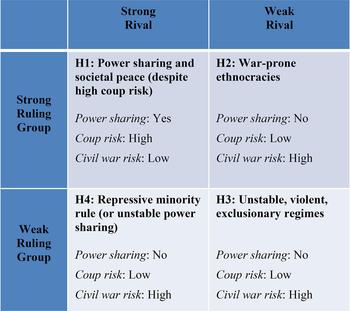
We argue that strong threat capabilities produce durable (though sometimes fluid) power sharing in which rivals prefer inclusion—even when it risks trading power via coups—to engaging in mutually costly civil wars for absolute power. This leads to our first hypothesis:
H1
When both the ruling group and rival group have strong threat capabilities, the rival is included in the central government, reducing civil war risk but increasing coup risk.
When groups have asymmetric threat capabilities, however, self-enforcing power sharing is significantly less likely. While both sides may wish to divide rents and avoid costly conflict, the power differential undermines any agreement.
Most obviously, a weak group bargaining with a strong ruling group lacks the threat capabilities to hold the ruler accountable if it violates the terms of a deal. The stronger group's inability to credibly commit itself to not exploit its greater bargaining leverage induces the weaker group to stay on a war footing or face political irrelevance. This increases the likelihood of protracted conflict.Footnote 48
Additionally, because the weak group's low civil war capabilities render them unlikely to be able to reclaim power if they lose access to the central government, they are more likely to approach political bargaining as a one-shot game and adopt extreme policies (e.g., coup attempts followed by consolidating power in a repressive ethnocracy) to hold on to power at all costs. This further drives a strong group toward exclusion because it sees the marginal costs of a relatively less-threatening civil war as being significantly lower than the marginal costs of a coup. This leads to our second hypothesis:
H2
When the ruling group's threat capabilities are high and the rival group's are low, the rival is excluded from the central government, reducing coup risk but increasing the risk of civil war.
Similar dynamics lead a weak ruling group to universally reject power sharing with either a strong or a weak competitor. Again, the breakdown of power sharing arises from the weak group's limited threat capabilities and thus their political vulnerability. When bargaining with another weak group, neither side possesses the mobilizational potential to hold the other to account if they renege on power sharing. Consequently, both have strong incentives to eliminate the other from state power before they themselves are eliminated, leading to ethnic exclusion and civil war. This leads to our third hypothesis.
H3
When the ruling group's threat capabilities are low and the rival group's are also low, the rival is excluded from the central government, reducing coup risk but increasing the risk of civil war.
When the competing group is strong, a weak ruling group faces a more acute dilemma. Power sharing puts the stronger rival in a position to usurp power in a coup, likely leading to the permanent exclusion of the weak group. But employing exclusion to prevent such an outcome provokes a strategically costly civil war. Both are bad outcomes, but losing power through civil war is seen as more uncertain than in a coup in which its rival already controls a significant share of the state. This leads to our fourth hypothesis.
H4
When the ruling group's threat capabilities are low and the rival group's are high, the rival is excluded from the central government, reducing coup risk but increasing the risk of civil war.
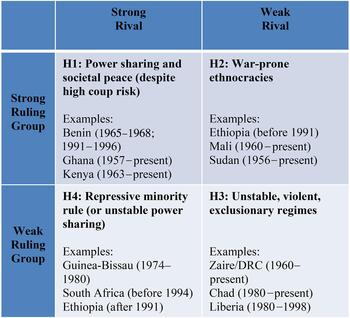
Figure 1 summarizes the theoretical predictions and how they align with H1–H4.
Threat capabilities, self-enforcing power sharing, and coup and civil war risk

Quantitative Empirical Evidence
To assess the threat-capabilities theory of power sharing, we focus our analysis on the subset of states in sub-Saharan Africa. While we expect the argument to apply to all weak states with strong, spatially concentrated societal groups, sub-Saharan Africa provides a set of comparable states that meet these criteria, with consistent societal data on access to state powerFootnote 49 as well as the ethnicity of those groups launching rebellions and executing coups.Footnote 50
There are two primary reasons we would expect the theory to be particularly relevant to African states. First, the “strong societies and weak states” problem is a defining characteristic of the political order that emerged after decolonization.Footnote 51 Unable to rely on strong state structures to broadcast power, rulers have needed to strike power-sharing deals with ethnic rivals.Footnote 52 Second, politics in postindependence Africa has centered almost completely on control of the central government. The decision by African heads of states at the founding of the Organization of African Unity in the early 1960s to accept the inviolability of colonial state borders has contributed to strong norms and institutions against state partition, reducing the viability of exit as a policy response to marginalization or discrimination compared to other regions in the world.Footnote 53 Consequently, even the most peripheral groups have had to target control of the central government as a means of addressing their material grievances.Footnote 54
To test our main hypotheses, we estimate models of interethnic power sharing, coups, and civil war using the Ethnic Power Relations (EPR) 2014 data set of ethnic groups in forty African states from 1946 to 2013.Footnote 55 The EPR data set draws from a survey of country experts to provide information on the inclusion or exclusion of politically relevant ethnic groups in central governments across countries in which ethnicity is politically salient. Because it does not restrict its analysis to only cabinet posts but also to representation within the executive and the military (depending on its de facto power in a given country), it captures well the actual power structure. Since the theory is about the interaction between the ruling group and a given rival group, the unit of analysis is a given incumbent group/nonincumbent group dyad-year, with models including all politically relevant ethnic groups in relation to the ruling group. Ruling groups are those identified as being politically dominant, or having the most politically powerful status (generally, though not always, this corresponds to the ethnic group of the executive).Footnote 56
Because we are interested in whether particular binary outcomes do or do not occur, we use a logistic regression specification with standard errors clustered by country to account for nonindependence of ongoing political relationships within states. To account for temporal dependence within outcomes, each model includes the cubic polynomial of the dependent variable to approximate the hazard.Footnote 57
Variables
There are three dependent variables of interest. The first, ethnic power sharing, is operationalized using a measure of whether a given nonruling group was included in a governing coalition in that year. The dichotomous variable, ethnic power sharing, takes a value of 1 if the nonruling group was included in government (coded as monopoly, dominant, senior partner, or junior partner) and a 0 if it was not (coded as regional autonomy, separatist, powerless, or discriminated).Footnote 58
The second dependent variable, successful coup, identifies whether members of a given group were key conspirators in a successful coup attempt that year.Footnote 59 The dichotomous variable, successful coup, takes a value of 1 if there was at least one successful coup and 0 if there was not.
The third dependent variable, group rebellion, identifies whether members of a given ethnic group initiated a major armed rebellion or insurgency against the central government in a given year.Footnote 60 The dichotomous variable, group rebellion, takes a value of 1 if members of the group launched a rebellion in a given year and 0 if not.
To proxy threat capabilities, we develop a measure based on two factors that determine a group's mobilizational potential to threaten the central government. First, the larger the size of a group, the more popular power it can wield and the larger the rebellion or uprising it can mobilize.Footnote 61 To measure this, we use the group's proportion of the state's total population—group size.Footnote 62 Second, the more proximate a group is to the center of power, the lower the mobilizational costs necessary to seize control of the state apparatus. To measure this, we calculate the centroid distance in kilometers between the capital city and the centroid of the ethnic group's homeland.Footnote 63 These variables are normalizedFootnote 64 and the distance data are reversed so larger groups and closer groups have higher values. We then take the arithmetic mean of the distance and size variables to create a continuous threat capabilities variable that ranges from 0.03 (least threatening) to 0.97 (most threatening).Footnote 65 The variable ruler threat capabilities measures the capabilities of the ruling group for a given year using the same approach.
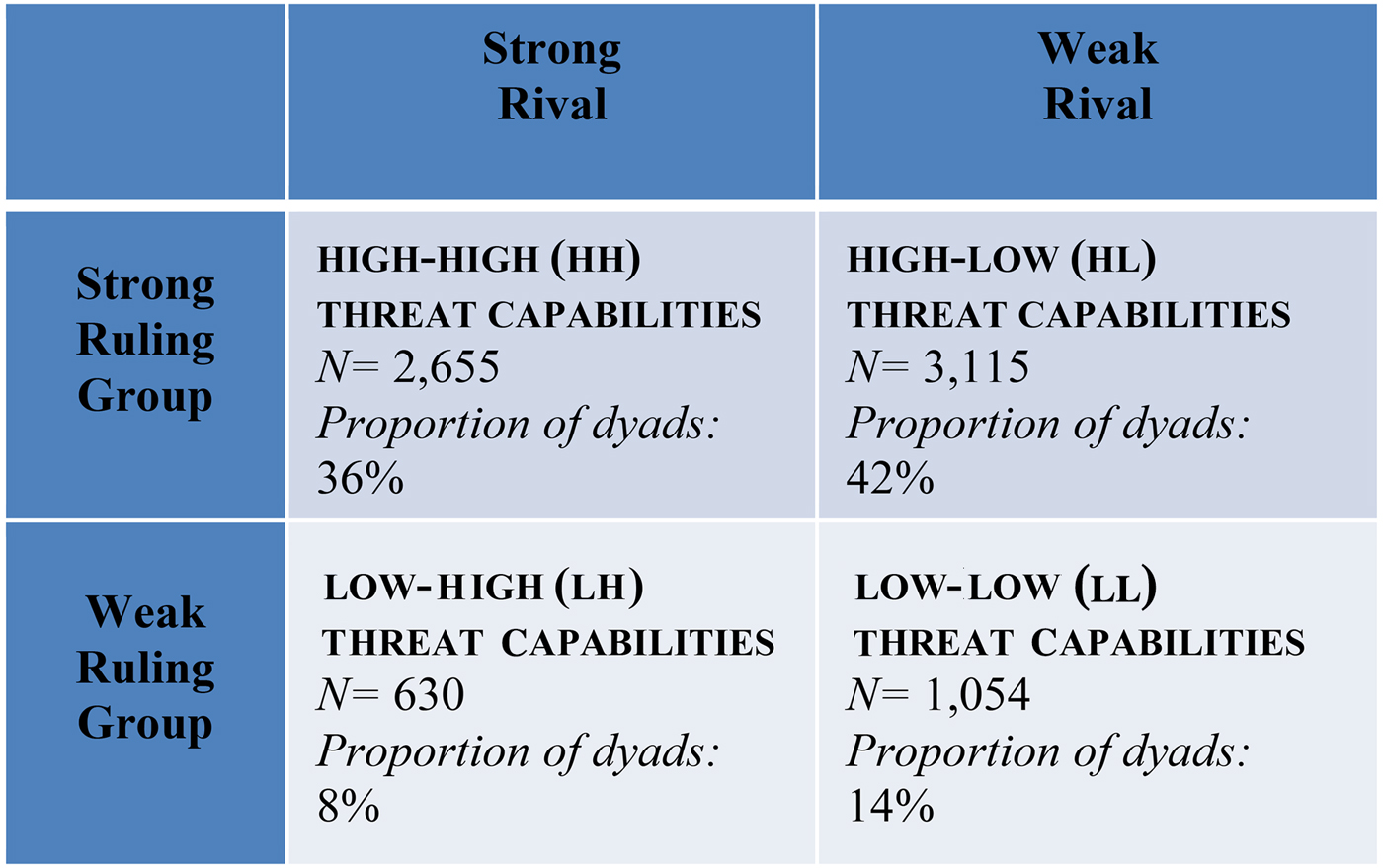
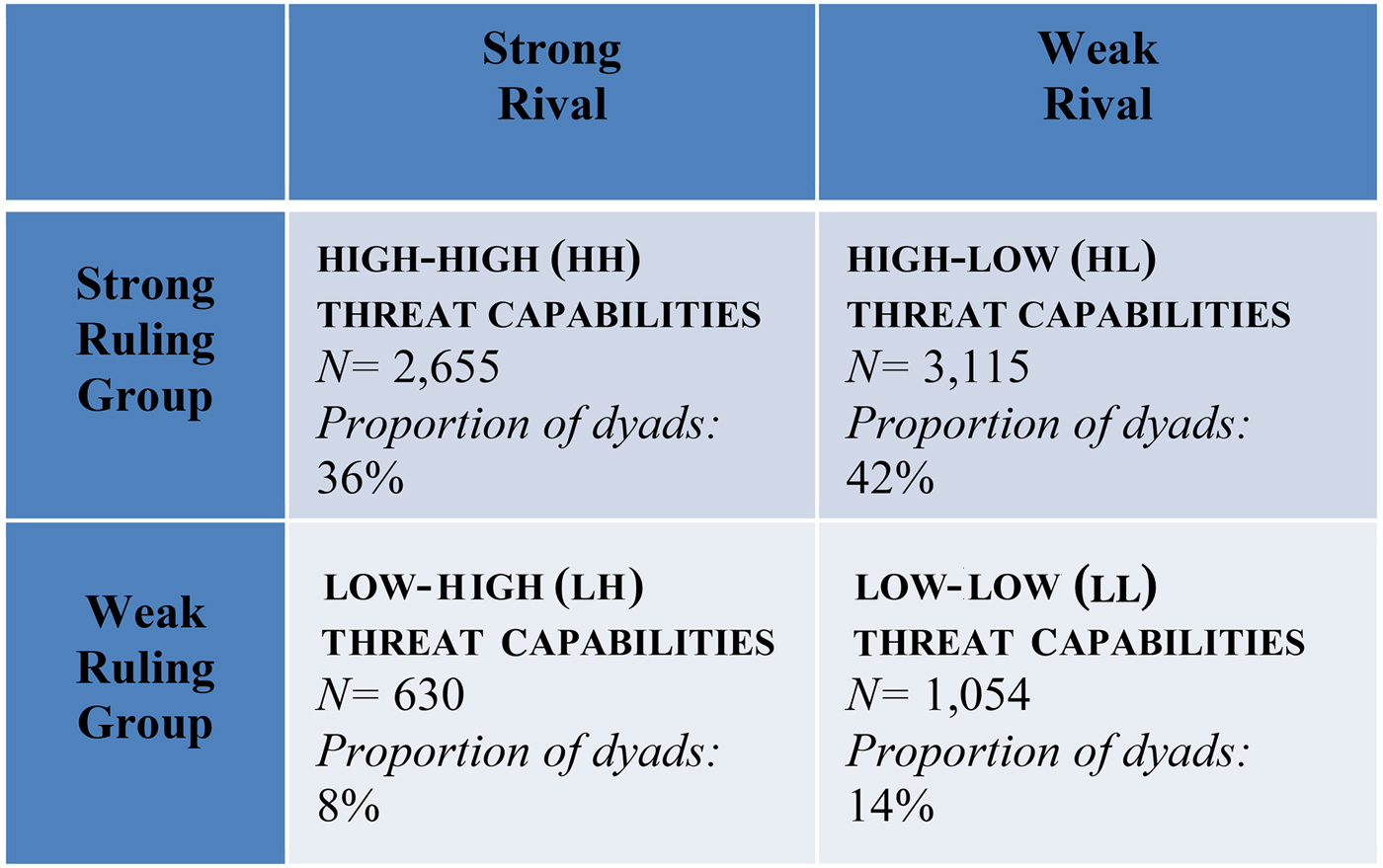
Using this coding of rival and ruling group threat capabilities, we construct our key independent variable—the balance of threat capabilities between the ruling group and a given competitor. For ease of interpretation, and because we do not expect the joint effect to necessarily be continuous,Footnote 66 the balance-of-threat-capabilities measure is captured through four interaction dummy variables (following Figure 1) based on whether the ruling group and a given rival have threat capabilities scores above or below the median for all groups in sub-Saharan Africa.Footnote 67 Not surprisingly, LH dyads are least common, while HH and HL dyads (where the ruling group is strong) are most common, as reported in Figure 2.
Distribution of ruling group/rival group dyads by balance of threat capabilities across sub-Saharan Africa, independence to 2013
To evaluate the effect of these various configurations of balance of threat capabilities on power sharing, coups, and civil war, we estimate specifications containing a number of control variables that account for alternative explanations of these outcomes:Footnote 68
• gdp per capita: income-level and state capacity; (lagged) natural log of GDP per capita in that state-year.Footnote 69
• log country population: population size; (lagged) natural log of the total population of the state.Footnote 70
• number of ethnic groups: country's ethnic diversity; number of politically relevant ethnic groups at independence.Footnote 71
• institutionalized regime: institutionalization of political power and the stabilizing effects of party rule; dummy measure of whether a given country is governed by a constitutionally based regime (single-party, multiparty, or full democracy) versus military government.Footnote 72
• former French colony: France's proactive and interventionist foreign policies in their former colonies;Footnote 73 dummy measure of a whether a given country was a former French colony.
• cold war: increase in externally brokered power-sharing governments in Africa since the end of the Cold War; dummy measure of whether the year is after 1990.
• pastcoup: a dummy variable indicating if members of a given group had launched a successful coup in the past;Footnote 74
• pastconflict: a dummy variable indicating if members of a given group had launched a large-scale rebellion in the past;
• ongoing rebellion: ongoing civil wars; whether there is an ongoing rebellion in the country in the previous year.Footnote 75
• year: time trends; the year.
Results
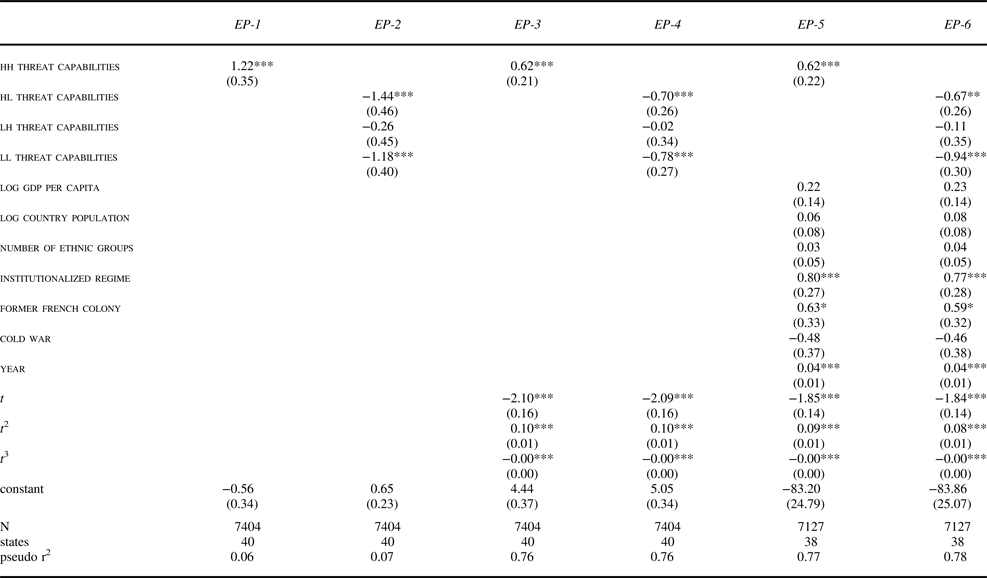
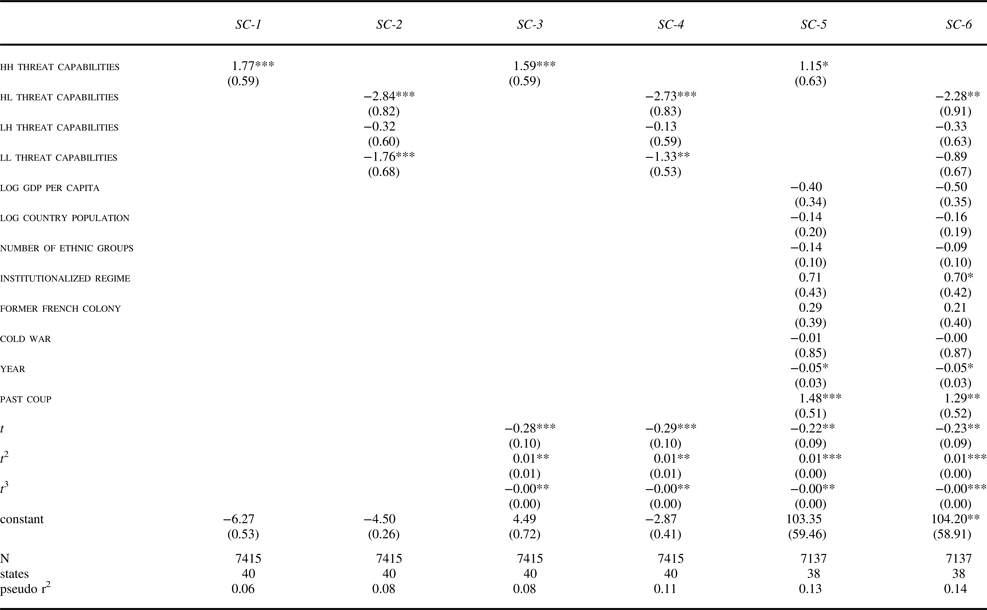
The statistical results provide strong support for our central argument that mutually strong threat capabilities promote power sharing. The models estimate the likelihood that members of a given nonruling group are: included in the central government (Table 1); lead conspirators in a successful coup (Table 2); or significant participants in initiating or joining an armed rebellion (Table 3). Since HH dyads are of primary theoretical interest, we estimate models isolating this type (with all others combined as the reference category) as well as models including all other types individually (with HH omitted as the reference category).Footnote 76
Balance of threat capabilities and the likelihood of ethnic power sharing
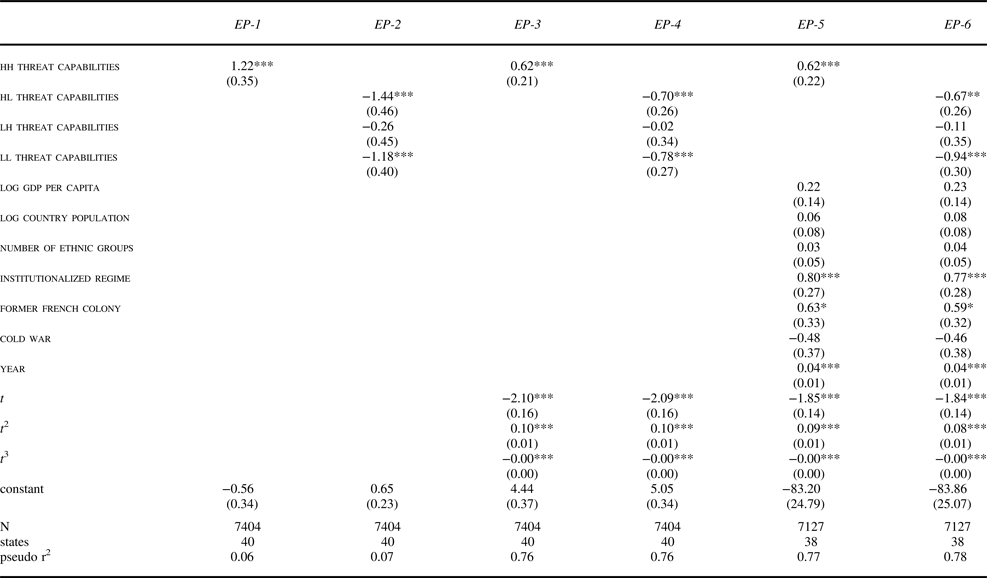
Notes: This table reports logistic regression estimates. The sample includes all politically relevant nonruling group-years in forty countries in Sub-Saharan Africa from independence (or 1946 for older states) through 2013. The dependent variable is whether the group's representatives were represented in the central government at the Junior Partner level or above (EPR 2014). Threat capabilities independent variables (HH, HL, LH, LL) indicate whether the ruling group and the given nonruling group, respectively, are above (high) or below (low) the median threat capabilities for the full sample. Cubic polynomials of time since last power sharing (t, t2, t 3) are included to account for temporal dependence. Standard errors are clustered by country and statistical significance is denoted by *p <.10; **p < .05; ***p < .01.
Balance of threat capabilities and the likelihood of successful coup
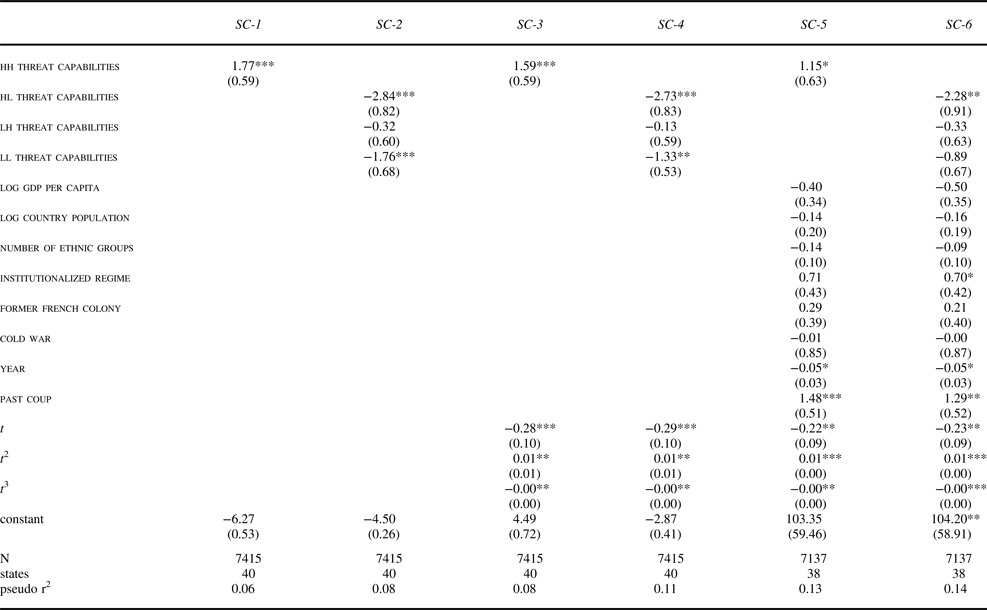
Notes: This table reports logistic regression estimates. The sample includes all politically relevant nonruling group-years in forty countries in Sub-Saharan Africa from independence (or 1946 for older states) through 2013. The dependent variable is whether the group carried out a successful coup. Threat capabilities independent variables (HH, HL, LH, LL) indicate whether the ruling group and the given nonruling group, respectively, are above (high) or below (low) the median threat capabilities for the full sample. Cubic polynomials of time since last successful coup (t, t2, t 3) are included to account for temporal dependence. Standard errors are clustered by country and statistical significance is denoted by *p <.10; **p < .05; ***p < .01.
Balance of threat capabilities and the likelihood of civil war onset
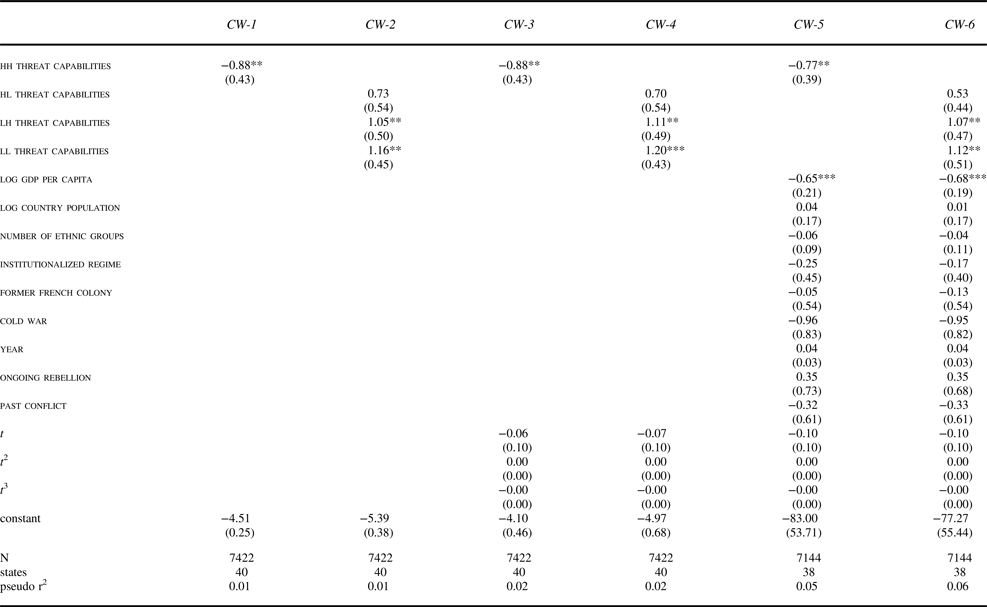
Notes: This table reports logistic regression estimates. The sample includes all politically relevant nonruling group-years in forty countries in Sub-Saharan Africa from independence (or 1946 for older states) through 2013. The dependent variable is whether the group initiated a major armed rebellion or insurgency against the central government. Threat capabilities independent variables (HH, HL, LH, LL) indicate whether the ruling group and the given nonruling group, respectively, are above (high) or below (low) the median threat capabilities for the full sample. Cubic polynomials of time since last rebellion onset (t, t2, t 3) are included to account for temporal dependence. Standard errors are clustered by country and statistical significance is denoted by *p <.10; **p < .05; ***p < .01.
As Table 1 shows, our first hypothesis is broadly supported. HH dyads are significantly more likely to feature interethnic power sharing (models EP-1, EP-3, and EP-5). In contrast, HL and LL dyads are statistically significantly less likely to lead to inclusion when compared to HH dyads (models EP-2, EP-4, and EP-6). Consistent with the theorized bargaining dynamics, this suggests a group's inability to credibly threaten the center reduces horizontal accountability and an equitable distribution of power. Only two other variables are found to have a robust effect on power sharing: institutionalized regime and the year. The former suggests that institutionalized regimes can support power sharing even under conditions of unfavorable ethnic geography, whereas the latter suggests that more governments have become more amenable to power-sharing regimes over time. Both of these dynamics require further analysis to disentangle how weak states can escape adverse societal balances of power. The origins of institutionalized regimes, especially under disadvantageous power configurations, remain poorly understood.
The second part of the argument posits that while mutually strong threat capabilities produce self-enforcing power sharing, they merely shift, rather than resolve, the coup/civil war trap that plagues weak, ethnically divided states. Strong rivals commit to power sharing even as it opens the door to future coups d’état. Relative to the prospects of a mutually costly civil war if any side was to try to rule unilaterally, trading power via coups is a preferable outcome. The ruling group knows that should a rival successfully seize control over the executive office, it will nonetheless be unlikely to risk civil war and will be forced to restore power sharing in the future, resulting in a marginal rather than absolute shift in rents from power. Table 2 shows that, consistent with this expectation, we find that successful coups are statistically significantly more likely in ethnic dyads characterized by mutually high threat capabilities (models SC-1, SC-3, and SC-5), particularly compared to HL dyads (models SC-2, SC-4, and SC-6).Footnote 77
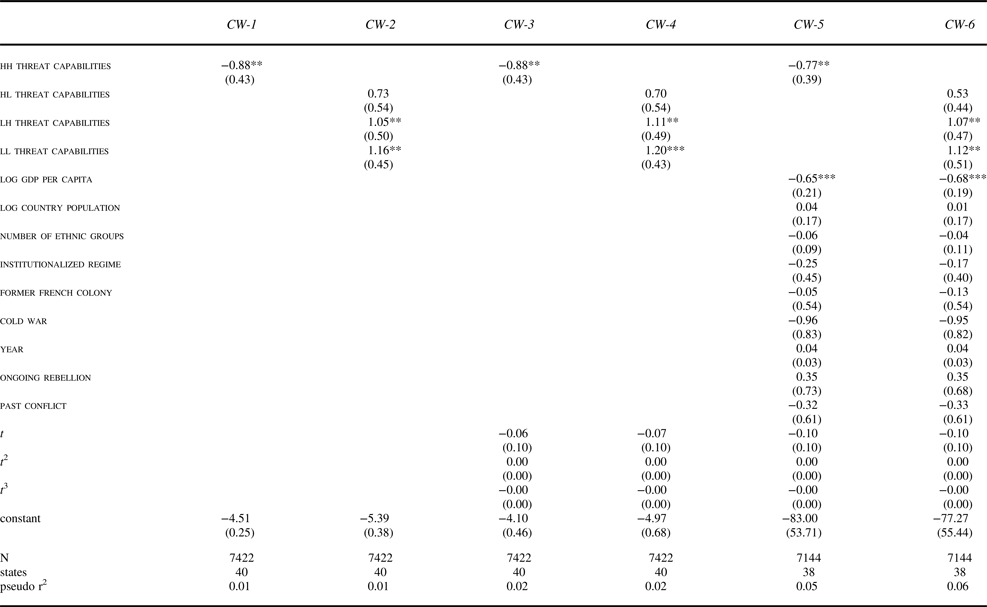
The final set of models tests the effect of the balance of threat capabilities on civil war risk. We expect the inverse of the results from the coup models: as strong rivals share power and accept coup risk, they reduce the likelihood either side will choose to militarily challenge the state from outside of the central government. Thus, we expect armed rebellion to be more likely in dyads in which at least one bargaining partner is weak because rulers see exclusion as a means to increase the costs their rivals face to displacing them from power. As Table 3 shows, the results support this expectation. The balance-of-threat-capabilities variables are generally statistically significant and have the (expected) opposite signs: HH dyads are negatively associated, and other dyads positively associated, with the onset of rebellion.Footnote 78
The findings are substantively important as well. Figure 3 reports predicted probabilities of ethnic power sharing, successful coup, and group rebellion (from Models EP-6, SC-6, and CW-6) using the Clarify statistical software and keeping all control variables at representative levels.Footnote 79 The substantive results align closely with the expectations presented in Figure 1. For dyads in which the ruling group and a given rival possess threat capabilities above the median of all groups in the sample, the likelihood of the rival group being included in the central government is approximately 63 percent, compared to 35 to 40 percent in HL and LH dyads. Meanwhile, coup risk in HH dyads is six-fold higher than in HL dyads and twice as high as in LL dyads, and civil war risk in HH dyads is lower than other types by one half to two thirds. The substantive results also illustrate the strategic challenges that arise in LH dyads: weak ruling groups bargaining with stronger groups face both elevated coup and civil war risk.
Predicted probabilities of power sharing, coups, and armed rebellion

Summary
Overall the quantitative evidence offers strong support for a threat-capabilities theory of power sharing,Footnote 80 which brings a new perspective to old debates on balance of power, bargaining, and war. In contrast to economic theories that predict rulers should prefer to share power with small, weak groups to maximize their control of rents,Footnote 81 or power-parity theories that predict an equal distribution of power increases the risk of war as a result of greater uncertainty about who will ultimately win,Footnote 82 we find that strong rivals—as measured by their capabilities to project power in the capital city—are significantly more likely to share power. Notably, this holds despite the fact that power sharing also brings an elevated coup risk.
In contrast, when a rival is weak and unable to credibly hold the ruler to account for reneging on power sharing, exclusion results. This significantly lowers coup risk, though at the cost of a higher risk of civil war, especially when the ruling group is weak. Rulers seem to calculate that the strategic benefits of ethnopolitical exclusion outweigh the strategic costs, and are willing to tolerate the potential threat of an armed rebellion. For weak ruling groups bargaining with strong groups, they are between a rock and a hard place—both power sharing and exclusion are dangerous because they leave the government vulnerable to coups and strong civil wars, respectively. The empirical record suggests weak groups employ a mix of strategies—some favor exclusion and others inclusion—each of which has high costs. Consequently, these dyads experience both high coup risk (nearly on par with HH dyads) but also high civil war risk (on par with LL dyads).
Qualitative Empirical Evidence
The quantitative evidence suggests systematic support for the effect of the balance of societal power on ethnopolitical bargaining. To further substantiate our four hypotheses, we now turn to qualitative evidence. Figure 4 identifies representative regime types consistent with our four hypotheses. To explore the full range of predictions, we employ a diverse case-selection method—drawing on typical cases from each quadrant.Footnote 83 While these cases do not in themselves constitute a definitive test, they are able to illustrate the theorized causal mechanisms in action.
Balance of threat capabilities and power sharing in Africa

H1: High-High (HH) Threat Capabilities—Ghana and Benin
In countries where multiple groups with strong threat capabilities dominate politics, we expect consistent, if uneasy, power sharing. Although any one group may prefer to dominate the central government, its ability to do so is constrained by the strategic costs and benefits of exclusion. Ghana and Benin represent two cases in which the main axis of political competition has been between strong ethnic groups (based on their size and proximity to the capital). Both countries are relatively small in area (below the median for Africa) and are divided between four relatively large ethnic or ethno-regional blocs,Footnote 84 giving each substantial societal power and making it challenging for any one group to rule alone.
In both cases control of the state and its associated rents largely played out between elites embedded in these rival groups who mobilized their co-ethnics in a bid to maximize their power vis-à-vis their rivals. Despite the existence of formal party structures, this dynamic often played out through informal or personalist channels.Footnote 85 The high-stakes contest between ethno-regional rivals for control of state power made politics in Benin and Ghana similar in kind to many other weak states. The difference lay in their rulers’ inability to employ ethnopolitical exclusion as a means to lock in state power, thus creating vulnerability to coups d’état from ethnic rivals. In fact, both countries experienced five successful interethnic coups (in which at least some of the conspirators hailed from a different ethnic group than the head of state) in the first decades after independence.
This is not to suggest that some rulers did not try to structure their regimes along ethnic lines in a bid to consolidate power. But when they did, consistent with our theory, we see evidence that such a policy provoked popular mobilization from a strong rival which, raising the specter of civil war, reversed ethnic exclusion. A paradigmatic example of this is found in Benin in the first few years after independence. Benin's inaugural president, Hubert Maga, hailed from the Northern groupFootnote 86 and formed an unstable alliance with various leaders from the south. As these alliances frayed because of political conflicts between rival ethnic elites, Maga moved to consolidate his hold on power by promoting “northerners in large numbers … throughout the entire governmental system, and the gendarmerie, in particular, was packed with Baribas who often regarded themselves as Maga's private militia.”Footnote 87 But in the face of what were perceived as discriminatory practices combined with austerity measures in the public sector, southerners, led by the trade unions, launched a general strike and paralyzed the country's largest cities along the southern coast of the country, Porto Novo (the official capital) and Cotonou (the seat of government).
As the conflict intensified, “Colonel Christopher Soglo, Chief of Staff of the Army [a Fon from South/Central group], announced that the armed forces were taking over power in order to avert civil war.”Footnote 88 Soglo's coup not only prevented civil war but upheld an inclusive equilibrium. Though Maga's Northern group was politically marginalized, they were never fully purged from the military. Overall power sharing endured, but given the weakness of political institutions, irregular competition for executive authority continued. Over the next decade there would be another five coups, including three that involved military officers from the Northern group who exploited their continued presence in the military to stay in the political game. While trading power via coups can lead to instability and uncertainty, these cases illustrate how the societal strength of rivals may force ruling groups to accept such an outcome over civil war.Footnote 89
H2: High-Low (HL) Threat Capabilities—Sudan
For strong groups bargaining with weak groups, the strategic problems arising from consolidating power through ethnopolitical exclusion are less acute. Once their rivals are excluded they pose little threat to the regime's hold on power, except through remote armed rebellions. Sudan is the archetypical example of this pathway to ethnopolitical exclusion and civil war. After independence the Sudanese state was dominated by those primarily from three riverine Arab tribes (Shaygiyya, Ja'alin, and Danagla) who “inherited” the state from British colonial rule. Situated in the Nile River Valley just above the capital, Khartoum, and collectively making up some 15 percent of the population (and scored as having high threat capabilities), these groups have dominated power in Sudan. Helping to consolidate their hold on power has been an alliance with other Arab tribes located in the heart of the state in Kordofan and Al-Gezira State (also scored as having high threat capabilities), historically the country's two dominant economic zones of production. Sudan's “Arab”-dominated regimes left little room for smaller non-Arab ethnic groups located in Darfur and South Sudan (including the Dinka, Nuer, Shilluk, Nuba, Fur, and Zaghawa, all scored as having low threat capabilities). De facto policies of ethnopolitical exclusion helped to consolidate the riverine Arabs’ hold on power, though at the cost of multiple civil wars.Footnote 90 Yet given the size of the country and the fractionalization of society—that the rebels sought to overcome but never successfully did—the insurgents were unable to mount a credible threat to the government's hold on the capital. Instead, the conflicts burned on the periphery with the costs disproportionately borne by the excluded groups—leading one Sudan observer to characterize them as a “perfect war” for the ruling elite.Footnote 91 Only through heavy international pressure, third-party intervention between the central government, and southern-based rebel groups and the rare case of state partition did Sudan's longest running war finally end with the Comprehensive Peace Agreement in 2005 and secession for South Sudan in 2011.
H3: Low-Low (LL) Threat Capabilities—Liberia
The Liberia case illustrates the pattern in which elites embedded in two weak groups far from the capital are unable to maintain power sharing, leading to ethnic exclusion and civil war. In 1980 a group of noncommissioned officers, led by Samuel Doe, seized power in a coup, upending the country's power structure that had been dominated by the Americo-Liberians for the previous 153 years. Doe's political position was much weaker than that of riverine Arabs in Sudan. Coming from a relatively small ethnic group in the hinterland (the Krahn tribe located primarily in Grand Gedeh County, scored as having weak threat capabilities), Doe's political base was relatively narrow. This increased his vulnerability while weakening his group's capabilities to come back to power if it lost hold of it. However, Doe rose to power backed by individuals from other small ethnic groups in the hinterland, particularly the Gio tribe located in Nimba County (also scored as having weak threat capabilities) and led by his high-school friend, Thomas Quiwonkpa. Both sides thus had a lot to lose from infighting. But each also recognized that their small power base made them vulnerable. When a power struggle arose between the two shortly after coming to power, Doe felt he could not afford to allow Quiwonkpa to remain head of the army and purged him.
Fearing for his life, Quiwonkpa fled the capital. Bitter that the man he put in power betrayed him, Quiwonkpa sought to organize support from his co-ethnics and other allies to try to forcibly reclaim power. In 1985, Quiwonkpa launched an attack on the Liberian government from Sierra Leone. Though Quiwonkpa reached the capital with his small force of some two dozen men, they lacked the capabilities and local support to overthrow Doe.Footnote 92 After Quiwonkpa's failed bid to oust him from power, Doe continued to reject power sharing with Quiwonkpa's co-ethnics while increasing his reliance on repression to regulate the excluded group. This provoked a civil war in 1989 when Quiwonkpa's lieutenants launched a rebellion to continue the revolutionary struggle started by their patron.Footnote 93
H4: Low-High (LH) Threat Capabilities—Guinea–Bissau and South Africa
Guinea–Bissau, like Liberia before the overthrow of Americo-Liberian rule, was dominated by a non-indigenous minority. In Guinea–Bissau, the inaugural government was controlled politically by Cape Verdeans (numbering only in the thousands) who had been brought in from the islands during the colonial period to work in the bureaucracy.Footnote 94 Enjoying the modernizing effects of participating in the colonial state, the Cape Verdeans would play a leadership role in the anticolonial movement (PAIGC) and the inaugural government. Although the government was led by the Cape Verdeans, the military, especially the lower ranks, was dominated by individuals from the Balanta, the largest ethnic group in Guinea–Bissau, making up some 30 percent of the population (scored as having high threat capabilities). The Balanta resented their subordinate political status.Footnote 95 In 1980 the Balanta-dominated military backed a coup that dismantled Cape Verdian rule.
The Guinea–Bissau case reveals one of the fundamental dilemmas confronting minority-rule regimes. Reluctant to open the door for their stronger rivals in a way that might initiate a permanent shift in the distribution of power, rulers favor exclusion. But exclusion foments resistance and necessitates repression to counter the greater civil war capabilities of the majority. The problem for the minority group is that they often lack the human resources to effectively countermobilize and may have little choice but to employ members of the rival majority group to run the coercive apparatus. Without strong organizational control over the military, this can be the minority group's undoing, as the Cape Verdeans experienced (the same fate befell the Americo-Liberians in 1980).
The Afrikaners in South Africa chose an alternate approach. Benefiting from a much larger size (roughly 10 percent of the population), though still a significant minority (and still scored as having low threat capabilities relative to other groups in Africa), they institutionalized segregation through Apartheid, including in the military, to consolidate their hold on power.Footnote 96 This effectively blocked any internal risk posed by “nonwhites,” even as they had to rely more and more on black South Africans in the military in the 1970s.Footnote 97 Ultimately, this provoked societal resistance that crossed the threshold of civil war in the 1980s.Footnote 98
Both Guinea–Bissau and South Africa reveal the acute strategic dilemma that minorities face in attempting to rule over larger groups. Trying to partially accommodate their ethnic rivals can lead to a coup d’état, but excluding them can provoke civil war.
Conclusion
A large and growing literature points to the pacifying effects of power sharing.Footnote 99 Yet the conditions giving rise to inclusive governance are not well understood. In this paper we have advanced a theory to account for credible power sharing in weak states in the absence of strong political institutions or external guarantors. Counterintuitively, we argue that ethnic power sharing is a positive function of the civil war capabilities of both the ruling and rival groups—that is, their mobilizational potential to forcibly seize power when they are excluded from the central government. When mutually strong, both prefer to accept the risk of coups to the risk of civil wars and neither is willing to systematically exclude the other from government. Continuous, if fluid, power sharing emerges. Extensive quantitative and qualitative evidence supports our theoretical argument and provides novel empirical insights into the outcome of the coup/civil war trap across postcolonial Africa. This paper is one of the first to offer an integrated and concise theory to account for how the distribution of societal power leads to durable power sharing in weak states. In doing so, it also unpacks the strategic relationship between coups and civil war. Coups are significantly more likely from groups that can credibly demand inclusion with the threat of a strong civil war.
We also point to several avenues for future research. One important question is if the exclusion-civil war equilibrium is partially determined by a country's ethnic geography, what then is the way out? Are these countries not doomed to further cycles of ethnopolitical exclusion and devastating civil war? Overcoming the hurdle posed by highly uneven balances of power is paramount for effective peacemaking and longer-term political resolution. In this, perhaps outside actors can have a role: by acting as a guarantor of status for groups that have insufficient threat capabilities of their own, international intervention may be able to reduce incentives for the sort of exclusion through coups and purges that lead to civil war.
Another related avenue of research is the interplay between societal power and political institutionalization.Footnote 100 To what degree has a societal balance of power helped to undergird democracy in some countries, such as Benin and Ghana? Can political institutionalization foster interethnic power sharing even under conditions of unfavorable ethnic geography? The empirical results are suggestive of this possibility but much more rigorous research is warranted on this front and the antecedent question of how party rule emerges in the first place, especially in countries with strong power imbalances.
A final avenue for future investigation is to analyze how potential secession affects the strategic dynamics and increases peripheral groups’ bargaining power vis-à-vis the ruling group. Throughout postindependence Africa the regional system has strongly discouraged secession in an attempt to reduce the risk of interstate war. However, this has eliminated a powerful source of leverage for peripheral groups—the threat of exit—and contributed to their political marginalization.Footnote 101 Opening the door to secession is, of course, no panacea because it can substitute one source of instability for another—as seen between Ethiopia and Somalia in 1977 and 1978. How to resolve this conundrum—increasing the bargaining power of weak groups while maintaining regional stability—remains a major theoretical question and policy challenge but is critical to understanding and ending the exclusion-conflict cycle in large, weak states.
Supplementary Material
Supplementary material for this article is available at <https://doi.org/10.1017/S0020818318000073>.