Introduction
With economic reform entering its fourth decade, social security in China has achieved major advances in its overall structures for coverage, finance and administration. Successive waves of policy initiatives have been introduced to reform urban state-owned enterprises and alleviate poverty, as well as in the areas of rural pensions, cooperative medical care and social assistance. Since the 2000s, new ideas such as ‘take humanity as basis’ (yiren weiben) or ‘inclusive growth’ (baorongxing zengzhang) demonstrate the growing awareness within the party-state about the importance of social protection as an essential complement to the Chinese market economy, and to guarantee its strong foundation (Gong and Su, Reference Gong and Su2010). Among these changes, the emerging trend towards urban–rural harmonisation (chengxiang yitihua) is particularly intriguing, an approach that aims to eliminate the unequal entitlements in social protection rigidly divided between urban and rural residents according to the conventional household registration system. Many localities have launched various pilot schemes to explore approaches aimed at eliminating discriminatory treatment of residents with different household registration status (hukou) for entitlements to social benefits. These active engagements in discourse and practice signal a new direction in social policy, thereby posing a challenge for scholars to offer an adequate theoretical account to explain these institutional changes, and to empirically assess their implications for future developments.
The existing literature interprets China's social policy from various perspectives. One prevalent view is that changes in social structures have created problems that require welfare reforms. Scholars generally sketch the development of social policy and seek to provide policy solutions in response to these problems (e.g. Saunders and Shang, Reference Saunders and Shang2001; Leung, Reference Leung2003; Guan, Reference Guan and Kwon2005). Another body of literature pays attention to the trends of social policy in the transition from socialist to pluralist welfare production (Leung and Nann, Reference Leung and Nann1995; Wong and Macpherson, Reference Wong and Macpherson1995; Wong, Reference Wong1998; Wong and Flynn, Reference Wong and Flynn2001; Saich, Reference Saich2008; Duckett and Carillo, Reference Duckett and Carrillo2011). A further group of studies focuses on the cultural dimensions underlying welfare reforms, emphasising the value of family and community within traditional Chinese culture in providing the state a rationale to eschew its responsibility for public welfare (Chan and Chow, Reference Chan and Chow1992; Chang, Reference Chang1993; Chen, Reference Chen1996). Recent studies tend to view social policy expansion as an attempt of the ruling communist party to maintain its political legitimacy (Chan, Reference Chan2010; Frazier, Reference Frazier2010a, Reference Goldman2010b). In short, the various strands of existing literature concentrate on the changing nature of Chinese social policy in terms of the state's retreat from (or return to) welfare responsibilities during the transition to a market economy.
Meanwhile, research on social citizenship development in China discusses this issue from the state–society nexus. The state-centred perspective analyses social citizenship according to the social rights guaranteed by state policies, thereby concentrating on the unequal nature of social security in the urban–rural divide due to the rigid household registration system (Selden and You, Reference Selden and You1997; Liu, Reference Liu2007). Conversely, the society-centred perspective focuses on the marginalised social groups who are engaged in a contest for their rights with the authoritarian state (Solinger, Reference Solinger1999; Goldman, Reference Goldman2007; Lee, Reference Lee2007; Perry and Goldman, Reference Perry and Goldman2007; Frazier, Reference Frazier2010b). The conceptual image of state versus society underlying these studies tends to understand social citizenship as the result of either the state's benevolence to its citizens or civil society's struggle for greater welfare rights.
These studies have highlighted important aspects of social policy and social citizenship in China, especially the developments during the 1980s and 1990s. Since the 2000s, however, active state involvement in the field of social protection has been propelled by the central government's bid to maintain a ‘harmonious society’. The emerging trend towards urban–rural harmonisation breathes new life into current social security reforms; yet, the existing literature seems less attentive to these institutional dynamics, let alone their effects on the development of social citizenship. The essential question in need of elaboration relates to the blurring boundaries of the urban–rural divide as a consequence of the hukou reform and the corresponding transformations of social citizenship. A further question concerns the adequate conceptualisation of current institutional change in social security and the implications for future policy development.
In an attempt to shed new light on these issues, this article directs attention to the multi-speed evolution of social security and the changing spatial politics of social citizenship. The following analysis draws on official documents and semi-structured expert interviews conducted by the author in Chengdu, Beijing, Hangzhou and Guangzhou between 2008 and 2011 with fifteen scholars of local universities and social science academies who were involved as consultants in the policymaking processes, as well as with eight officials in central and local governments responsible for social security affairs. These sites were selected as cases to take account of regional diversity in the policy design and implementation of urban–rural harmonisation (Ragin and Becker, Reference Ragin and Becker1992). The informants were recruited based on their familiarity with the policies concerned. Expert interviews were conducted in an issue-related manner that motivated the respondents to express their viewpoints, with queries revolving around the policy processes at the central level and the variety of local experiences. This approach was adopted to collect detailed policy information from respondents with insider perspectives. Various other sources of material (research reports and media news, etc.) were also used to verify the information collected from the interviews.
Due to the respondents’ suspicion about recording on audiotape, all interviews were noted at length by this author on site. These written materials were evaluated using thematic coding techniques and content analysis to interpret the data with a particular focus on how local social security institutions changed in the course of urban–rural harmonisation, and the possible impacts of these institutional dynamics in terms of what social rights were conferred (or withheld) to different categories of population groups (Flick, Reference Flick2009). Research results are presented in the following institutional analysis of China's social policy. In the next section, we offer an overview of the recent developments of urban–rural harmonisation with reference to the pilot experimentation in Chengdu; the subsequent section focuses on the changing nature of social citizenship unfolded by this policy approach. The penultimate section presents a conceptual typology to analyse the various degrees of current institutional change in social security, complemented with the collected data that compare various policy domains among the four cities under survey. The final section concludes the findings and reflects on their implications for social policy and social citizenship in China.
Urban–rural harmonisation in social policy development
Urban–rural harmonisation emanates from reflections on the social disparities resulting from the urban–rural divide which has plagued China since the 1950s. Particularly since the inception of economic reform, the fundamental problem of uneven development has become worse, expressed by the term ‘three rural problems’ (sannong wenti) which refers to the depressing situations of underdevelopment, peasant poverty and inflexible utilisation of rural land due to ambiguous land property rights (Wun, Reference Wun2009). Meanwhile, income inequalities between regions have motivated a large flow of rural migrant workers to move to urban areas in search of higher wages. Owing to the rigid hukou system, however, these migrants have been denied entitlements to social benefits in their cities of residence, leading to economic marginalisation and social discrimination (Solinger, Reference Solinger1999; Wu, Reference Wu and Whyte2010). The root of these problems lies in the over-concentration of resources in urban areas at the expense of their rural counterparts, which in turn limits the former's growth because of the latter's sluggish development. Attempting to balance this uneven growth has become an acute task.
The idea of harmonising urban–rural development originated in the pilot experimentation conducted by wealthy coastal regions since 1978 (Lu and Tang, Reference Lu and Tang2010). The harbinger of urban–rural harmonisation includes local governments in Southern Jiangsu, not least among them Shanghai, which has taken the lead in exploring innovative policy initiatives in conjunction with the industrial base of township and village enterprises (Sunan model). In the course of economic reforms, coastal provinces such as Zhejiang and Guangdong gradually gained fiscal strength and piloted policies aimed at tackling problems of urbanisation and industrialisation (Zhu et al., Reference Zhu, Zhan and Han2008; Liu et al., Reference Liu, Zhang and Sun2010). The 1990s and 2000s witnessed various endeavours by local governments to seek out feasible options for sustainable development within their regions, which in turn led to the idea of urban–rural harmonisation.
The initial rhetoric of ‘urban–rural pooling’ (chengxiang tongchou) denoted the incorporation of rural and urban areas into overall regional clusters in issues of hukou reform, service provision and regional governance (Wang, Reference Wang2010; Ma, Reference Ma2011). For social security reform, urban–rural pooling stood for the attempts to narrow the urban–rural gap by establishing rural social schemes emulating the institutional blueprints of their urban counterparts, as prevalent in various local initiatives during the 1980s and 1990s which experimented with rural pension schemes or cooperative medical programmes (Shi, Reference Shi2006; Brown et al., Reference Brown, de Brauw and Du2009; Shen and Williamson, Reference Shen and Williamson2010). With new pilot social schemes for rural populations in progress, local governments also realised the necessity of coordinating various schemes between urban and rural areas in the face of rising employment changes between these sectors. Without streamlining social security institutions, it would have been difficult to promote urban–rural cohesion in regional development.
Piecemeal reforms in several policy domains in advanced regions have outlined the contours of urban–rural harmonisation, leading to the final endorsement by the central government in the ensuing plenums of the 16th Chinese Communist Party (CCP) National Congress in 2002. The term ‘urban–rural harmonisation’ did not gain formal recognition until the 17th CCP National Congress in 2007, along with six Document No. 1 papers issued in the years 2004 to 2009, which put this reform issue on top of the political agenda. In particular, a decision by the Central Committee of the CCP in 2008 recognised the significance of this developmental strategy, mainly out of concern that lopsided emphasis on economic growth since the reform era has inflicted tremendous social harm (Ye, Reference Ye2009). In 2003 and 2007 respectively, the central government delegated Chengdu and Chongqing, two leading cities in Midwest regions, the task to launch pilot schemes in line with the urban–rural harmonisation.
The pilot experiment promoting urban–rural harmonisation in Chengdu refers to an overarching framework covering all pertinent policy terrains to promote balanced regional developments (Cai and Cheng, Reference Cai and Cheng2008; Cheng, Reference Cheng2011).Footnote 1 One of the main issues concerns the overall resource reallocation to achieve balanced development between the respective regions. For social security, these involve the hukou reform (resident status change from rural to urban, nongzhuanju, or even unification of both into one single resident category), coordination of social security systems and allocation of public resources between urban and rural areas. In these issues, the Chongqing and Chengdu experiments have achieved substantial progress – particularly the Chengdu experiment, which has gone the farthest in all aspects of reform (see Li and Zhou, Reference Li and Zhou2008; Peking University, 2010; Zhang, Reference Zhang2011). The hukou reform in Chengdu, for example, caught intensive media coverage after the local government had declared that, starting in April 2011, all residents would possess the same hukou status, and would thus gain equal access to social insurance programmes previously only open to urban workers.Footnote 2 Based on this new doctrine, land requisition is no longer a prerequisite for rural farmers to acquire urban resident status, and all inhabitants are free to move, having equal access to social benefits of the government.
In addition, Chengdu has exerted concerted efforts to restructure its fragmented social security schemes, especially pension and health insurance. The idea is to establish basic schemes in both areas with the financial subvention of the Chengdu government to ensure equal contribution rates, subsidy standards and benefit levels for all Chengdu residents. On top of these basic schemes, various pension or health insurance schemes for different occupational groups persist, but at least all Chengdu residents are free to choose these schemes, or change from one scheme to another, according to their own occupational or income situations. In other social security areas, such as unemployment insurance or the minimum living standard scheme (dibao), benefits have been equally levelled among residents.
Balancing supply of public goods and service in urban and rural areas is a further endeavour to tackle the consequences of longstanding segregation in infrastructure, healthcare and education (Cai and Cheng, Reference Cai and Cheng2008; Fan, Reference Fan2008). In particular, the underdevelopment of medical facilities and soaring medical costs in rural areas has caused woes to farmers unable to afford high medical expenses in case of illness. The extension of public finances to provide ready access to these public resources in rural areas should make way for more adequate social provision that can adjust the urban bias. For instance, during the eleventh 5-year plan, rural medical service construction programmes involved 21 billion CNY investment funds provided by central and local governments (Ye, Reference Ye2009: 137). The establishment of a new rural cooperative medical system in 2003 was followed by its nationwide implementation by the end of 2008 (Brown et al., Reference Brown, de Brauw and Du2009). In Chengdu's experiment, the government has unified the existing seven local schemes for different occupational groups, providing the same basic level of medical care to a unified resident status (Gong et al., Reference Gong, Hao and Zhai2009).
Chengdu's experiment with urban–rural harmonisation has kindled the hope that stratification of social citizenship based on the resident status divide would eventually be abolished. In particular, the hukou reform and coordination of various local social security schemes have considerably improved the position of rural residents by granting them social benefits previously available only to their urban fellow citizens. Land expropriation by local governments is now under stricter supervision, both legally and administratively, by the central government that dictates adequate compensation measures for the peasants concerned. As is the case with other social security reforms, incremental policy experimentation with urban–rural harmonisation is likely to persist for a long time before any final central statutory regulation takes shape. Among various local approaches, narrowing the urban–rural gap in social protection has taken centre stage of this new welfare engineering.
The emergence of regional social citizenship
If urban–rural harmonisation is set to influence the next direction of social security reform, a crucial question concerns whether we can observe the rise of more inclusive social citizenship in China. In this vein, it is apposite to review the insight of T. H. Marshall (Reference Marshall1964: 71), who proposed a three-stage evolution of citizenship in Britain in terms of the provision of civil, political and social rights. Marshall particularly viewed the rise of social rights as the answer to solving the dilemma between economic inequality (resulting from civil rights in a market economy) and political equality (resulting from political rights in democratic polity). Whereas Marshall's definition of citizenship in terms of membership of a community is familiar to students of social policy, his remarks on citizenship boundaries in terms of institutional fusion and separation are often overlooked. According to Marshall (Reference Marshall1964: 73), institutional fusion is geographical, detaching the privileges of social groups from their local character and reattaching rights and obligations to national territory. Separation is functional, entailing the creation of national authority and jurisdiction for the implementation of social security programmes. For Marshall, the nationalisation of citizenship laid the foundation for the internal differentiation of citizenship into the three well-known components – and the rise of the modern welfare state.Footnote 3 Exclusion of outsiders (non-citizens) through border control is the prerequisite for the inclusion of citizenship as legal rights and duties are bestowed upon all inhabitants of a state territory.
In recent decades, however, various forces of regionalisation and globalisation are de-coupling and re-coupling welfare institutions alongside the territorial dimension, and accordingly redrawing the spatial demarcation that redefines the boundaries of social citizenship (Ferrera, Reference Ferrera2005; Dwyer, Reference Dwyer2010). The erosion of nation-states in the era of globalisation has fundamentally changed our understanding of social citizenship from membership rights confined within national territories to those tied with pluralised and heterogeneous communities. Trans-national citizenship is a case in point. Increased migration across national borders is placing the welfare state in an uneasy position to balance the economic utilisation of migration and social recognition of immigrant rights. In what Lockwood (Reference Lockwood1996) terms ‘civic stratification’, the access to, and the ability to exercise, the rights of citizenship critically depend on the possession of moral or material resources, which entails social inequality in its nature because these limited resources are allocated by the state bureaucracy according to the immigrant's merit or demerit de jure. Immigration control proceeds largely through classification of various status categories and, accordingly, approval of differentiated welfare benefits. Indeed, modern welfare states often restrict or even withhold work and welfare rights to immigrants by means of status distinction (e.g. denizen, non-citizen or asylum seeker). The ability to migrate, furthermore, is often conditional on stipulated criteria, such as education attainment or the possession of the means to maintain oneself (Morris, Reference Morris and Morris2006). The consequent contraction in entitlement has often led to social exclusion of immigrants in terms of diminished life chances.
The above discussion points to the important link between welfare institutions and social citizenship. Precisely in this regard one should keep alert to the impact of institutional change on the evolution of social citizenship interlocked with geographical boundaries, since it ultimately touches upon the inclusion and exclusion of social rights. The implications of the above discussion on social citizenship for China's social security are twofold: welfare reforms since 1978 have changed the relationship between the state and its citizens, resulting in fundamental transformations of social citizenship in welfare rights and duties. The existing literature has extensively explored this aspect, as discussed above. However, a less noted but increasingly important issue is arising with regard to the shifting boundaries of social citizenship in the development towards urban–rural harmonisation, whereby the demarcation mechanism of the within–without divide takes effect in channelling welfare rights in addition to the conventional urban–rural divide (Shi, Reference Shi2009). The distinction of urban–rural resident status seems to be losing some of its defining power for social citizenship when pilot schemes in localities such as Chengdu begin harmonisation endeavours to obliterate the status separation. As local social activism is gaining strength, local social schemes are also growing in significance to categorise the social rights of residents within their respective jurisdictions. In places where urban–rural harmonisation takes hold, the pivotal criterion for claiming social benefits is the possession of local resident status, regardless of whether this is urban or rural.
Understanding this boundary relocation in social citizenship can enable a heuristic perspective to elucidate the impact of the peculiar social policy approach in China. Despite much acclamation attached to the urban–rural harmonisation in general, and the Chengdu model in particular, caution is needed in evaluating the overall movement of social policy, because the key issue concerns whether these efforts are sufficient to reduce the institutional discrepancies among regional social security schemes. The potential to promote nationwide urban–rural harmonisation appears to be limited by substantial obstacles which still lie ahead if the central government is to persuade all other localities to follow suit. The achievements in Chengdu have only been possible thanks to the clear authorisation of the central government, flanked by the steady financial strength of the local government. As informants in Chengdu pointed out in interviews, a large portion of local financial revenues emanated from increased taxes and land leasing or sale thanks to favourable local economic growth. Despite this, even among the subordinate localities within Chengdu's jurisdiction, economic and social disparities persist. Without financial subsidies from various government echelons, unification efforts to harmonise the contribution rates and benefit levels among various social security schemes in Chengdu would have been futile.
The inability to overcome the institutional fragmentation of social security among regions further casts doubt on the extent of urban–rural harmonisation in promoting inclusive social citizenship. It is true that the urban–rural divide in Chengdu has given way to a unified resident status, along with the coordination of various social security schemes that grant all Chengdu inhabitants equal statutory entitlement to local social benefits. However, if a resident of Chengdu moves beyond the territory, the picture is completely different. Officials in central government indicated in interviews that enormous difficulties emerge immediately when it comes to streamlining the institutional regulations of local schemes in accordance with those of schemes elsewhere. Consequently, the entitlements to social benefits earned in a locality are typically not transferable to similar schemes in other places unless provisions have been made by the relevant local governments.
The widespread institutional diversity of social security among regions has an important bearing on the boundary setting of social citizenship, as the tight link between welfare entitlements and local resident status (hukou) breeds instinctive protectionism to exclude outsiders (urban and rural alike) from claiming local social benefits because the latter are almost solely financed by local budgets. In spite of periodic calls from the public to eliminate the discriminatory treatment of migrant workers, wealthy localities still insist obstinately on preserving differential status categories for inter-regional migration control on grounds of capacity limit in local finance (cf. Chan and Buckingham, Reference Chan and Buckingham2008; Wu, Reference Wu and Whyte2010). Even the harmonisation policies in Chengdu address, first and foremost, its residents and not migrant workers. In recent years, preliminary experiments have been under way in Chengdu, as in some other localities to reduce the hurdle for non-residents to acquire local citizenship, but migrant workers remain ineligible for important local social benefits and possess inferior social protection.
In other words, the nature of ‘civic stratification’ inherent in China's social security has been reconfigured rather than redressed. The policy direction is most likely to evolve towards the sub-nationalisation of social protection and the corresponding compartmentalisation of social citizenship largely defined by regional social programmes. The movement towards institutional fusion of social security within regions is accompanied by the simultaneously converse trend towards institutional separation among regions. This regionalisation of social protection and its impact on social citizenship become explicit if we take the territorial dimension, in addition to the membership dimension, of social citizenship into consideration.Footnote 4Figure 1 illustrates this shifting boundary of social citizenship (in terms of membership divide and territorial divide) in a simplified version of social security developments based on the information collected regarding pension insurance reforms for different population groups in Chengdu and Guangzhou (the same applies to Beijing and Hangzhou). Entitlements of social security schemes for various groups within one region (Chengdu and Guangzhou alike) are largely coordinated or harmonised in accordance with local circumstance. For instance, landless peasants are now included in the basic pension or medical insurances for urban/rural residents; in the event of taking up employment in urban enterprises, their entitlements earned in the basic pension insurance for residents are transferrable to the scheme for urban workers (indicated by arrows in the figure). However, when coordinating the parallel schemes of different regions, difficulties of entitlement transfer due to institutional fragmentation could arise. Only recently have several cities reached agreements with their neighbours on coherent entitlement portability in social security schemes such as urban pension insurance for workers, or arrange networks of medical care allowing costs incurred in one place to be temporarily borne by another local administration. For example, Chengdu has signed an agreement with Guangzhou allowing medical provision of both localities to their residents since March 2010.Footnote 5 The same applies to social insurance for migrant workers, which have been refashioned in recent years as individual accounts, which are easier for the insured migrants to export accumulated benefits to similar schemes elsewhere (indicated by dotted arrows in the figure; cf. also Table 3). However, even in these cases, coordination has only been feasible among regions with a comparable development level (such as Chengdu and Guangzhou) because financial interest conflicts would otherwise arise between rich and poor localities.
Contours of social citizenship in local social security systems

Urban–rural harmonisation presents a conspicuous territorial reconfiguration in social policy development. Achievements to integrate fragmented social security institutions are bound within the respective regional jurisdictions, while coordination initiatives among regions have only started from scratch. This is manifest in the example of Chengdu's hukou regulation that has integrated urban–rural residence registration and granted equal social rights to its inhabitants, whereas migrant workers remain excluded from major social benefits except for those specifically designed for them (social insurance for migrants). The same holds for Chengdu residents who emigrate to other localities where they have no local resident status, as they would also encounter the problem of limited or a denial of access to social security benefits there. In this sense, the stratification of social citizenship in China is undergoing significant transformations in spatial politics, with the inclusion/exclusion of social rights rearranged by the dynamics of institutional harmonisation within regions and institutional diversification among regions.
The ‘variable geometry’ of China's social policy development
The rising significance of regional social policy has led to multi-speed dynamics of institutional differentiation in China's social security, a covert phenomenon which requires a more nuanced conceptualisation. The common parlance among Chinese practitioners conceives of the term ‘yitihua’ as a synonym for ‘integration’, denoting a scenario of synchronous and linear developments in all social policy domains (e.g. Ye, Reference Ye2009; Wang, Reference Wang2010). This is unfortunately a misleading translation that obscures the manifold institutional change. In fact, the current state of China's social security is far from institutional integration as various programmes are targeted at different population groups, and differ considerably from one region to another. The extent of these programmatic discrepancies is so pronounced that even leaders of both central and local governments would think twice in pursuing an ‘integration’ approach. Indicative of their prudence is the recurrent appeal against the dissemination of one-size-fits-all solutions in all social security domains and to all regions (yidaoqie), on the grounds that central commands of national integration would undermine the efficacy of local policy implementation. Given wide regional disparities in the reform era, considerable autonomy has been granted to local governments in their responsibility for social policy, leading to further regional variety of social security design (cf. Heilmann, Reference Heilmann2008, Reference Heilmann2009; Shi, Reference Shi2012).
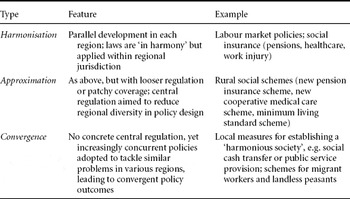
Particularly since the social policy reforms of the 1990s, the diverse progress of institutional change in various social security schemes has become distinctive. Even the term ‘harmonisation’ can be used only to characterise particular policy domains with the greatest advancement; in other areas, the same term would appear premature in face of wide local variety. Table 1 proposes three interrelated concepts to depict this. Judging by the pace of policy developments, social insurance and labour market policies have been those ‘mature’ areas, i.e. programmes associated with the reform of state-owned enterprises. They manifest the highest degree of institutional cohesion, with statutory laws (e.g. Social Insurance Law of 2010, or Labour Contract Law of 2007) that are eventually promulgated to regulate the organisational, financial and administrative principles of social insurance schemes (pension, medical care, etc.). However, we must not overestimate the progress of institutional developments in these policy domains as ‘homogeneous integration’, since statutory harmonisation as decreed by the Social Insurance Law merely refers to a regulatory framework that broadly addresses the organisational principles, financial methods and administrative jurisdictions of the respective social insurances. Even the Law itself is widely criticised for allowing too much leeway for further clarification by the competent central government ministries.Footnote 6 Indeed, given the gap between local state capacities, one commonplace in Chinese politics is not to set policy formulation in a way which prescribes its precise implementation. The same social insurance scheme may arise from one overarching institutional framework with significant differences in local levels of entitlement.Footnote 7 As a result, ‘harmonisation’ refers primarily to statutory coordination and organisational streamlining, whereas policy implementation remains subject to diverse local circumstances.
Various degrees of social policy development in China

Source: Author's account with adjusted typology by Threlfall (Reference Threlfall2003: 125).
A relatively weaker degree of policy development can be characterised as ‘approximation’, denoting the parallel development of the same policies among different regions in the absence of clear statutory regulations from the central government. In these policy areas, a common practice is a looser interaction mode between central and local governments, with the former merely issuing commands of a provisional nature, such as directives, decisions, circulars and opinions, while leaving the latter ample leeway in policy design and implementation. Areas where such policy tools find their application are less-developed policy domains such as rural social schemes (pensions, cooperative medical care, etc.). This can be observed in the recent phenomenon that social policy directives issued by the central government encourage urban and rural areas to establish basic social protection frameworks, while devolving regional autonomy in devising supplementary schemes. The tentative nature of the central government's regulations helps circumscribe the extent of regional diversity in policy design, but fails to curtail the scope of deviant policy implementation. Consequently, these social security schemes tend to take on identical contours but diverge in their substance, i.e. quality difference in institutional arrangements and quantity difference in benefit levels, largely depending on the financial and administrative capacities of local governments.
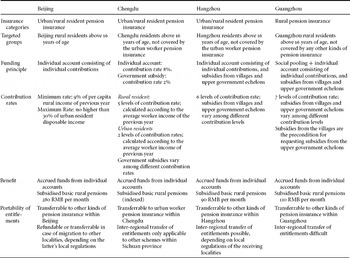
Table 2 provides an exemplary summary featuring the pension insurance schemes for peasants in the cities considered in this paper. This policy realm had undergone a bumpy period of trial and error before the central government finally issued opinions in 2009 requiring local governments to launch pilot schemes subject to the local circumstances (Shi, Reference Shi2006; Shen and Williamson, Reference Shen and Williamson2010). The policy framework encompasses a basic pension and the combination of social pooling and individual accounts co-financed by the central and local governments. Various pilot models have sprouted ever since, with the coverage rate of this new programme increasing rapidly upon the central government's directive to expedite policy implementation by the end of 2012. Clearly, Table 2 (and the subsequent Table 3) cannot do justice to the full extent of local variety since the illustrated cases represent the advanced geographical parts that have gone furthest in promoting urban–rural harmonisation, but it highlights certain features as an approximation of rural pension policy. Beijing, Chengdu and Hangzhou have already incorporated schemes of this kind into the basic pension insurance for urban–rural residents, while Guangzhou still retains a separate scheme for rural residents. Despite similar frameworks, differences between these four examples stand out, such as the funding principles or contribution rates. Portability of entitlements also hinges on the respective local regulations.
Features of rural pension insurances in surveyed localities

Sources: Data provided by the interviewed local officials, supplemented with updated information collected from the local government documents and websites.
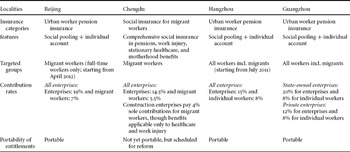
Social Insurance for migrant workers in surveyed localities

Sources: Data provided by the interviewed local officials, supplemented with updated information collected from the local government documents and websites.
The widening regional heterogeneity in economic and social development has brought forth local policy activism, particularly on the part of well-off regions, in response to new social problems which have emerged in recent decades. A new type of social policy governance has come into existence, by which the central government merely issues documents ordering local officials to take social unrest seriously and proffer sufficient social protection without clarifying further policy details. Hence, synchronous endeavours to establish new pilot schemes at the local level are discernible given the equivocal guidelines from the centre, referred to as the weakest degree of policy development ‘convergence’. Ambiguities about the essence of problems and adequate policies to mitigate these problems are crucial reasons why the central government refrains from binding regulations.
Social insurance for migrant workers epitomises one such policy area, as illustrated in Table 3, which juxtaposes local schemes of the four cities. Issues of social security for migrant workers have been haunting China since the 1990s, motivating several local governments to launch pilot schemes in search of appropriate solutions. It was not until the 2000s that the central government raised concerns and urged local governments to take efficacious countermeasures, as did the well-known ‘State Council Opinions on Resolving the Problems of Migrant Workers’ of 2006. The incipient local policies generally introduced a separate insurance scheme with inferior protection for this specific group, followed by recent initiatives to grant the employed migrants access to the urban worker social insurance. Policies of Beijing, Hangzhou and Guangzhou resemble this strategy, while Chengdu's scheme is affiliated to the harmonised urban social insurances. As noted above, these seemingly similar policy measures of the well-off cities discussed here should not disguise the wide variety of the schemes implemented elsewhere, nor the prevalent practice of discriminatory treatment towards rural migrants (cf. Xie, Reference Xie2009; Wu, Reference Wu and Whyte2010). Much depends on local discretion, though there have been convergent efforts to offer the floating population basic labour protection.
The overall harmonisation trend should achieve greater progress when diverse regional programmes merge to become a larger programme within the jurisdiction of the upper government echelon. In recent decades, provinces have arisen as an important administrative level for the central government to harmonise diverse local programmes. Endeavours to upgrade risk pooling and financial sharing in urban pension insurance and medical insurance at the provincial level (shengji tongchou) highlight this strategy. The promulgation of Social Insurance Law further foreshadows the direction towards codification of social security programmes. However, these developments stand to consolidate the regionalisation rather than nationalisation of social protection, since institutional fusion still proceeds within bounded territories such as provinces or prefectures. Even at the provincial level, intra-provincial disparities have delayed scaling up the risk pooling of social insurance programmes; particularly in urban pension insurance, shengji tongchou has proven to be an intricate task as rich prefectures tend to resist sharing the surplus of their local schemes with other poor counterparts.Footnote 8 In many places, the administrative level of financial pooling is even lower, remaining at the county level (xianji tongchou). These provinces have also established provincial cohesion funds (tiaoji jijin) consisting of contributions from various subordinate localities, thereby wielding certain power in fiscal redistribution to plug the financial gap among localities. The range of these arrangements will determine the extent of harmonisation efforts, though current developments indicate slim prospect for eventual national integration.
To be sure, the existence of multiple dynamics of social policy in a big country is anything but an anomaly, yet the diversity of institutional change bears salient Chinese characteristics. The uneven regional developments in the reform era have resulted in a gravitation towards social decentralisation in favour of active local social experimentation. As urban–rural harmonisation accelerates, the centrifugal force of versatile local approaches to economic and social developments is likely to gain momentum. Under these circumstances, central coordination of diverse local welfare programmes has become a key governance challenge. Harmonised policy terrains pertain to those issues closely coupled with free movement of workers or unbounded access to medical provision – an essential prerequisite facilitative of labour mobility across regions. Both central and local governments share common interests in boosting more concerted social policy developments among regions of a similar economic level, as technical issues of financial pooling and benefit portability are easier to handle. By contrast, policy domains that fall beyond the concerns of labour protection or labour market have less pressing imperative for nationwide harmonisation, thereby providing local governments with greater autonomy in the design and implementation of local social programmes. Current endeavours of urban–rural harmonisation certainly contribute to mitigating the social disparities within the regions, but they appear unable to reverse the ongoing decentralisation of social protection, which would precipitate the ‘variable geometry’ of social policy development in the foreseeable future.
Conclusion
Amid the widening regional disparities in terms of financial strength and administrative capacity, the conceivable common denominator of social policy as dictated by the central government is to erect a basic pillar of social security with universal coverage and needs-based entitlement (guangfugai, dishuiping), to which supplementary schemes can be established according to local circumstances (duocengci), while equally securing their long-term financial sustainability (kechixu). In many domains, signs of similar policy approaches are looming, such as the provision for basic medical protection in urban health insurance or new rural cooperative medical care. Localities who have experimented with the urban–rural harmonisation have generally followed such strategies in policy areas of pensions and healthcare. The constitution of a multi-pillar social security system that accommodates regional diversity is becoming a dominant social policy option.
In light of the growing local autonomy for economic growth and social provision, welfare regions are emerging as a key figure in China's social security, which raises an essential implication of the ‘competitive solidarity’ among regions.Footnote 9 Similar to regional competition and emulation in economic policy, the same interaction logic is on the rise in the realm of social protection (cf. Chien, Reference Chien2007, Reference Chien2008). Territorial competition is linked not only to comparative advantages of economic assets, but also to social and institutional infrastructures in attracting desirable mobile resources. In echoing the pledge of the central government to build a ‘harmonious society’ in recent decades, local officials have been keen to launch various pilot schemes in a bid to enhance economic and social developments – and with them the prospect of personal career.Footnote 10 The new dynamics of territorial competition as unleashed by economic decentralisation has likewise empowered the capacities of local governments in moulding their own welfare regimes complementary to local economic models, thus generating a new constellation of actors and opportunity structures in the sphere of social protection. Further exploration of the politics of ‘competitive solidarity’ would contribute to understanding the future progress of China's social policy.
These developments have activated a significant recalibration of central–local relationship in social protection. In the trend towards urban–rural harmonisation, China's social security is susceptible to the politicisation of territorial cleavages and the associated issue of interregional redistribution. At first flush, this may seem paradoxical since the policy agenda of urban–rural harmonisation is supposed to eliminate social disparities due to the urban–rural gap. However, the crucial hints offered by the above analysis indicate that the related institutional reforms remain confined to certain administrative levels (provinces, mostly prefectures), as evident in the predominant role of local governments in policy-making and implementation for this new welfare engineering. If urban–rural harmonisation is mainly focused on rectifying the urban–rural divide instead of regional disparities, local governments in sound financial shape occupy a superior position to their poor counterparts in substantiating and harmonising their own social security programmes. Despite encouraging signs of recent initiatives to provide the poorer regions with a certain amount of subsidies for individual policy programmes, strong resolution on the part of the central government to introduce further measures of nationwide pooling or interregional monetary transfers is not yet in sight. Without this requisite, urban–rural pooling or harmonisation would fail to tackle widening regional disparities, which in turn would shape the future contours of social policy and social citizenship in China.
Acknowledgements
Ideas contained within this article were first presented at the Centre for Greater China Studies, Hong Kong Institute of Education. Many thanks to Professor Ka-Ho Mok for his generous support. The constructive comments by Professors David Fu-Keung Ip, Te-Pei Huang, as well as the editors and anonymous referees of JSP are much appreciated. The National Science Council of Taiwan funded the research (NSC 100-2410-H-002-131-MY2).