Although workhorse models of legislative choice differ from one another in their assumptions about majority party advantages, they are essentially identical in their denial of rights and resources to the minority party. This paper provides a theoretical account of lawmaking in which the minority receives some procedural rights or resources, albeit fewer than those of the majority. We find important exceptions to the thrust of extant theories and argue that a more nuanced appreciation of both parties’ procedural and resource tools may allow future work to better integrate legislative politics with interest group and electoral politics.
Our theory is situated between two extreme tendencies in current theories of lawmaking. The first extreme is composed of theories that are lopsidedly partisan. These models postulate that legislators in the majority party—and only the majority party—collude to form a “procedural cartel” (e.g. Cox and McCubbins Reference Cox and McCubbins1993, Reference Cox and McCubbins2002, Reference Cox and McCubbins2005). The primary mechanisms in the exercise of concentrated power are agenda-setting and favor-trading. Although different authors conceive of agenda-setting powers differently, the basic thrust of this work involves the assignment of gatekeeping and/or closed rules to the majority party or its leader. Theories that treat the majority party with such deference—and the minority party with such insouciance—are aptly labeled monopartisan, because, at best, their proponents give only conditional lip service to the minority party:
Provided that the majority party has… more powers and resources to employ than the minority party, then legislation should reveal this fact. In particular, the greater the degree of satisfaction of the condition of conditional party government, the farther policy outcomes should be skewed from the center of the whole Congress toward the center of opinion in the majority party (Aldrich and Rohde Reference Aldrich and Rohde2000, 34; see also Rohde Reference Rohde1991; Sinclair Reference Sinclair1995; Smith Reference Smith2007).
In other words, minority party legislators may try to imitate the majority party by endowing their leaders with resources to influence legislative policymaking. In all likelihood, however, the minority party’s natural supply of allocable resources and its ability to generate them endogenously are dwarfed by the resources of the majority party. Policies, therefore, are predicted to diverge not only from the preferences of most minority party legislators but also from the most preferred position of the House’s median voter. Consistent with the cartel theory, then, the minority party is neither seen nor heard, and the majority party is the big winner.
The complementary extreme consists of theories that are radically nonpartisan. These models postulate that legislators are individualistic and, as such, behave in accordance with their primitive preferences irrespective of their party affiliations. Neither of the parties plays a formal-analytical role, and, indeed, their omission is at times proudly conspicuous. Weingast and Marshall (Reference Weingast and Marshall1988, 137), for instance, emphasize the party exclusion by stating as an assumption that “parties place no constraints on the behavior of individual representatives” (italics in original). Mayhew (Reference Mayhew1974, 27), likewise, minces no words: “The fact is that no theoretical treatment of the United States Congress that posits parties as analytic units will go very far”. More recently, the pivotal politics theory, too, is brashly nonpartisan (Krehbiel Reference Krehbiel1996, Reference Krehbiel1998; Brady and Volden Reference Brady and Volden1998).
The point is not that majority party organizations and their deployment of resources are inconsequential. Rather, it is to suggest that competing party organizations bidding for pivotal voters roughly counterbalance one another, so final outcomes are not much different from what a simpler but completely specified nonpartisan theory predicts (Krehbiel Reference Krehbiel1998, 171).
In other words, as long as both parties are endowed with rights and resources in approximate parity, the parties’ counteractive influence may result in lawmaking outcomes in the neighborhood of the chamber median.
Although most theories of lawmaking fit comfortably within these two categories, portrayals of parties in most empirical research are nearly always situated between the extremes of monopartisanship and nonpartisanship. A distinguishing feature of this middle ground is that the otherwise silent minority party is given some voice. Examples include empirical studies of bipartisanship as a form of cooperation and measured by cosponsorship activity and roll-call voting behavior (e.g. Harbridge Reference Harbridge2010, Reference Harbridge2011; Clark Reference Clark2013) and bipartisanship in the form of acquiescence to the executive in the making of foreign policy (e.g. Kendall 1984–Reference Kendall85, McCormick and Wittkopf Reference McCormick and Wittkopf1990, Meernik Reference Meernik1993, and Nelson Reference Nelson1987). These works do not directly address relative majority- and minority-party influence, however, so the net consequence of two-party competition remains uncertain.
A few works address the issue of minority party influence more directly, however. In a path-breaking article, Jones (Reference Jones1968) builds on a notion of “counteractive” party influence and presents a typology for minority party influence, suggesting conditions under which the minority party is likely to be influential. Krehbiel and Wiseman (Reference Krehbiel and Wiseman2005) advance a concept of “legislative bipartisanship” that is compatible with Jones’s counteractive minority party and suggest that the minority party is influential commensurate with its relative electoral strength vis-à-vis the majority party.Footnote 1 Binder (Reference Binder1996) presents similar arguments in her exploration of minority parliamentary rights,Footnote 2 while Lebo, McGlynn, and Koger (Reference Lebo, McGlynn and Koger2007) introduce a theory of “strategic party government” wherein the majority and minority parties are assumed to choose a level of party cohesion that has consequences for policy outcomes, which presumably serve their electoral fortunes.
While these perspectives all acknowledge some role for the minority party in lawmaking and thereby provide needed balance to the literature, they also share a shortcoming: none offers an explicit theory of majority- and minority-party strategic interaction in lawmaking. As a result, the connections between exogenous variables of interest (e.g. committee seats, parliamentary rights, transferable resources) and the endogenous variables (individual behavior and collective choices) are murky. This theoretical gap, in turn, inhibits our understanding of the roles of both parties in legislatures, and makes it impossible to resolve potentially contradictory claims regarding the policy impact of the minority party in competitive partisan legislatures.
To begin to fill the gap between radical nonpartisanship and lopsided monopartisanship in models of legislative policymaking, this paper introduces a framework for assessing theoretical possibilities of minority party influence in a partisan legislature.Footnote 3 In seeking a theoretical juste-milieu, we hope not only to acquire a deeper understanding of nonpartisan and monopartisan theories but also to gain new insights from two new models that—in two distinct and independent ways—reserve for the minority party a figurative seat at the lawmaking table.
To make the comparisons stark, we begin by revisiting and building on Snyder’s (Reference Snyder1991) seminal model of vote-buying. We use the terms vote-buying, favor-trading, side-payments, resource transfers, and bribes synonymously. Our theoretical justifications for the focus on how transfers can influence policymaking is simple. Politicians often look and think beyond decisions immediately at hand and, in so doing, entertain offers for reciprocal behavior of a variety of forms. Although direct transfers of cash-for-votes are examples of vote-buying, the term as used here goes well beyond unlawful or morally depraved behavior. More broadly, our general conception of resource transfers may refer to logrolls, implicit promises of support, or a general expectation of good will on future issues in exchange for immediate votes. Similarly, one might interpret party transfers as essentially coming from interest groups that are aligned with those parties. For example, a promise of transfers from the Democratic Party could be interpreted as a meaningful commitment of support from labor-oriented political action committees that share the objectives of the Democratic Party leaders, who in turn have nontrivial financial and electioneering resources at their disposal.
Employing this concept, we begin by considering a closed-rule legislature with an endogenous proposal put forth by a majority party leader who can allocate side-payments to crucial voters who otherwise prefer the status quo to the bill. This first model provides a preliminary insight into the relative strategic benefits of restrictive procedures versus side-payments in a monopartisan legislature. It also lays the foundation for our original contributions: two new models of competitive partisanship in which the two parties’ leaders have conflicting interests and hence compete for the votes of moderates. The first model is a simple procedural variation on the monopartisan model. It gives the minority party leader one and only one strategic tool to exploit—the ability to counter the majority party’s bill with a single amendment—while leaving intact the majority party leader’s monopoly supply of transferable resources. The change from the closed rule to a modified-closed rule, which we call agenda-based competition, has a significant, counteractive, moderating effect on the baseline monopartisan equilibrium.
The second model is also incremental with respect to monopartisanship. Instead of affording the minority agenda rights, however, the model of resource-based competition allows both parties—rather than just the majority party—to engage in vote-buying. When parties are evenly matched in regards to resources, gridlock is very likely to ensue, because the costs that the majority party must incur to secure policy change (by ensuring that the minority party cannot succeed in counteractive vote-buying) are not worth the policy gains it would experience. Moreover, the ability for even a highly resource-handicapped minority party to make side-payments acutely constrains the ability of the majority to pull the outcome away from the legislative median, as happens in the monopartisan model, and thereby gives the minority party a big policy bang for its small resource buck.
Although our models are motivated by parties within legislatures, the analytic results are also amenable to broader, extra-legislative interpretations concerning resources, agenda-rights, and the relative powers of competitive parties. For example, our finding that the minority party benefits more than the majority party from an increment in resources also has implications for interest groups’ partisan strategies, party competition in the electorate, and revealed preferences for any type of reform concerning money and parties in legislative politics.
ASSUMPTIONS
At the heart of our modeling strategy is the possibly controversial but ultimately defensible choice to build onto canonical vote-buying models (Snyder Reference Snyder1991, Groseclose Reference Groseclose1996, Groseclose and Snyder Reference Groseclose1996).Footnote 4 Although some readers may have qualms about some specific assumptions of this framework, such as its common tendency to model vote-buying competition as a sequential rather than a simultaneous move game, we refrain from embellishing features of the basic game simply for the sake of substantive realism for three reasons. First is cumulativeness. When new models are closely connected to previous models, it is much easier to isolate the precise mechanics that make a difference in the models’ theoretical implications and empirical predictions. Second is recent precedent. Dekel, Jackson, and Wolinsky (Reference Dekel, Jackson and Wolinsky2009), for example, gain novel and important insights by working rigorously and fruitfully within this framework. And third is practicality. As in the proverbial caution not to try running before learning to walk, it is misguided to be insistent on realism if, as so often happens, the result is the creation of a model that, due to its realistic complexity, cannot be solved. It will be clear eventually that, notwithstanding their substantively simplified nature, our modest steps toward realism push the limits of analytic tractability. Yet, not so much that our choice of assumptions precludes the identification of equilibria and, for the first time, gaining insights from solving a two-sided vote-buying model with endogenous proposals.
We confine our attention to a one-dimensional policy space in which
legislators’ ideal points on a continuum form a uniform distribution over the
interval
 $$[{\minus}{1 \over 2},{1 \over 2}]$$
. Therefore, the legislature’s median voter m
has ideal point x
m
=0. Legislators’ preferences are defined over the policies over which
they vote and the side-payments that they may receive from party leaders.
Specifically, the utility of voter with ideal point x from
voting for policy p and receiving a side-payment or resource
transfer t is defined as
 $$U(p,t)={\minus}\left( {x{\minus}p} \right)^{2} {\plus}t,$$
where p is a generic policy in
 $$\Re ^{1} $$
(either a bill b, an amendment
a, or an exogenous status quo q), and
t≥0 is the transfer or side-payment that a leader offers
this legislator in exchange for a vote. When it is needed to avoid ambiguity,
we denote the transfer to a specific legislator with ideal point
x by t(x). Legislators
are position-taking oriented insofar as they receive promised payments for the
act of voting a specified way—not for the realization of the collective
choice.
In each of three models, at least one party leader also has policy preferences. We assume the majority party leader R has an ideal point x R >0 on the right side of the policy space, and the minority party leader L has an ideal point x L <0 on the left. Leaders differ from other legislators in two respects. First, their preferences are outcome-based rather than action-based; that is, leaders’ payoffs are a function of what the legislature as a whole chooses—not on leaders’ voting actions.
Second, leaders may have at their disposal a non-negative endowment of
resources that they can distribute to rank-and-file legislators in exchange for
their votes. In each of the three models at least one party leader selects a
transfer schedule, which is a mapping from the policy space into the
non-negative real numbers. We let t
j
(·) denote a schedule of this form, and the value of the
transfer by leader j to a legislator with ideal point
x is then denoted t
j
(x).Footnote
5
We denote the total cost to the leader of party j of a
schedule t
j
by
 $T^{\,j} =\mathop{\int}\nolimits_{{\minus}{1 \over 2}}^{{1 \over 2}} {t^{\,j} (x)dx} $
.
Groseclose and Snyder (Reference Groseclose and Snyder1996) model vote-buying competition by assuming that the second-moving vote-buyer (the minority party in our model) has a fixed pool of resources and is willing to expend all of these resources to block any policy movements away from his ideal point. In contrast, they assume that the first-moving vote-buyer (the majority party in our model) does value its resources, thereby capturing the trade-off between spending money and gaining policy benefits. We depart from this asymmetric modeling strategy and instead assume that both the first-mover (majority party) and the second-mover (minority party) value resources and therefore incur costs from their transfer.
More specifically, in variants of the model in which a party has resources at its disposal to allocate to legislators, we assume that the party has an infinite (sufficiently large) resource endowment, denoted E j for party j, and that preferences are quasi-linear in policy and total transfers, T.Footnote 6 Formally, the leader of party j has preferences represented by the utility function over the final policy p and transfer schedule t j (·):
 $$U_{j} \left( {p,T^{j} } \right)={\minus}\left( {x_{j} {\minus}p} \right)^{2} {\minus}T^{j} ,$$
where (recall) T j is the total amount of transfers authorized by party leader j. Note that we assume that rank-and-file legislators’ preferences are not influenced by their party affiliations, per se. Indeed, we treat all rank-and-file legislators identically in regard to party labels and focus instead on their preference heterogeneity. For convenience, we assume that all legislators place the same per unit value on transfers as one another and regardless of the source.Footnote 7
Given these assumptions, the blueprint for analysis is straightforward. We are interested in two independent facets of potential counteractive minority party influence. While assessing the analytic possibilities, we wish to specify conditions under which minority party influence arises endogenously. In other words, to what extent is minority party influence a property of equilibrium play in a well-specified game? We investigate two such games that reflect different dimensions of party competition. Agenda-based competition is defined in terms of whether rights to propose policies are shared by party leaders or are monopolized by the majority party leader.Footnote 8 Resource-based competition is defined in terms of whether both parties have endowments available for disbursements as side-payments, or whether endowments, also, are monopolized by the majority party. This simple three-model scheme allows for transparent comparisons of the two different forms of minority–majority interaction with a fixed, monopartisan, baseline model.Footnote 9
A MONOPARTISAN LEGISLATURE
First, we summarize the baseline case in which the majority party monopolizes both procedural rights and transferable resources. This game is a close analytic approximation of Cox and McCubbins’s (Reference Cox and McCubbins2005) verbal discussion of a “procedural cartel,”Footnote 10 and is analytically identical to Snyder’s one-sided vote-buying model with an endogenous proposal (1991, Proposition 2). An empirical manifestation of the procedure is the US House of Representatives’ closed rule, that is, a single up or down vote on a proposal that was generated by a centralized majority party leadership.Footnote 11
The formal monopartisan game has three stages:
-
(1) The majority party leader R proposes a bill b and offers a schedule of transfers t(·) giving resources t(x) to legislator x.Footnote 12
-
(2) Legislators with ideal point, x, cast their votes v(x) for or against the bill b implicitly comparing b to an exogenous status quo q and taking into account transfers t(x).
-
(3) The winning policy p∈{b, q} is realized, transfers t occur, and players receive payoffs.
Our three propositions each summarize equilibrium behavior in one of the models. Formal statements and proofs are relegated to an appendix so that the main body can supply more heuristics, intuition, and interpretations.
Proposition 1: In the uniqueFootnote 13 subgame perfect Nash equilibrium to the monopartisan game, behavior depends on the location of the status quo as follows:
-
(a) Unconstrained, costless agenda-setting. For extreme status quo points (q<−x R and/or q>x R ), the majority party leader proposes a bill at her ideal point, offers no transfers to legislators, and
 $b^{{\asterisk}} {\rm =\,}x_{R}$
is the outcome.
-
(b) Gridlock. For status quo points
$$q\in [\bar{q},x_{R} ]$$
, the majority party leader proposes a bill
equal to the status quo, offers no transfers, and
$b^{{\asterisk}} {\rm =\,}{q}$
is the outcome (where
$$\bar{q}={\minus}1{\plus}\sqrt {1{\plus}2x_{R} } $$
). -
(c) Constrained, costly agenda-setting. For status quo points
$$q\in [{\minus}x_{R} ,\bar{q}]$$
, the majority party leader proposes
$b^{{\asterisk}} {\rm =}{{2\sqrt {4{\rm {\plus}}2q{\rm {\plus}}q^{2} {\rm {\plus}}6x_{R} } {\minus}4{\minus}q} \over 3}$
and offers transfers
$\scale96%{t^{{\rm {\asterisk}}} (x){\rm =}(x{\minus}{{2\sqrt {4{\plus}2q{\plus}q^{2} {\plus}6x_{R} } {\minus}4{\minus}q} \over 3})^{2} {\minus}(x{\minus}q)^{2} $
to all legislators with ideal points
$$x\in \left[ {0,{{b^{{\asterisk}} {\plus}q} \over 2}} \right]$$
to make them indifferent between voting for
$b^{{\asterisk}}$
and the status quo q. The
bill,
$b^{{\asterisk}}$
passes with a minimum-majority.


Proof. See Appendix.
The main strategic tension for the majority leader is that she always wants to pull policy toward her ideal point, but the median voter and other voters in his proximity oppose such changes and require compensation.Footnote 14 Any such incremental shifts beyond those obtainable in the classic setter model are, therefore, costly for the majority leader. Given that the majority leader R has monopoly access to the agenda, and that the median voter has an ideal point normalized at x m =0, the leader can always guarantee an outcome of at least q (or the reflection of q about 0) without expending any transferable resources. This is because the median voter is pivotal, and so any policy proposal that makes him indifferent to the status quo passes with the support of the median and all voters to his right. The focal issue is whether the leader can obtain a more right-leaning policy than q (or −q) via resource transfers. The proposition states that she sometimes can and specifies exactly when, why, and at what cost in side-payments.
Cases (a) and (b) exhibit behavior that duplicates that observed in the
canonical setter model without side-payments (Romer and Rosenthal Reference Romer and Rosenthal1978). For the most extreme status quo
points(q<−x
R
and q>x
R
), the majority party leader optimizes by proposing a bill
b equal to her ideal point and offering no transfers. That
proposal passes because the median strictly prefers it to the status quo. For
more intermediate status quo points (those between
 $$\bar{q}$$
and x
R
), however, the agenda setter optimizes by (trivially) proposing a bill
equal to the status quo. Although vote-buying to get a better bill is possible,
it is not optimal for the agenda setter, because any rightward movement of the
policy beyond the status quo costs the leader more in side-payments than the
gain in utility she would obtain from an only slightly more desirable policy.
Because the endogenous price of buying policy gains is too high, gridlock
prevails.
Case (c), which comprises the remaining status quo points, is the more
interesting part of the proposition, because here behavior deviates from that
in the canonical setter model. An optimizing agenda setter, in effect, goes
through the following thought process. She contemplates an array of possible
bills (b>q for q>0,
b>−q otherwise), their associated
vote-determining cutpoints (b+q)/2, and the
cost of making the cheapest series of transfers that will just secure passage
of that bill. She then selects the utility-maximizing
 $b^{{\asterisk}}$
and
 $T^{{\asterisk}}$
combination. The proposition reveals that the majority leader
R’s optimal strategy is to propose a bill strictly greater
than that in the setter model and to make side-payments to a narrow band of
pivotal voters whose ideal points span 0 (the median) up to and including the
midpoint (cutpoint) between the bill and status quo,
 $x{\rm =}{{b^{{\rm {\asterisk}}} {\rm {\plus}}q} \over 2}$
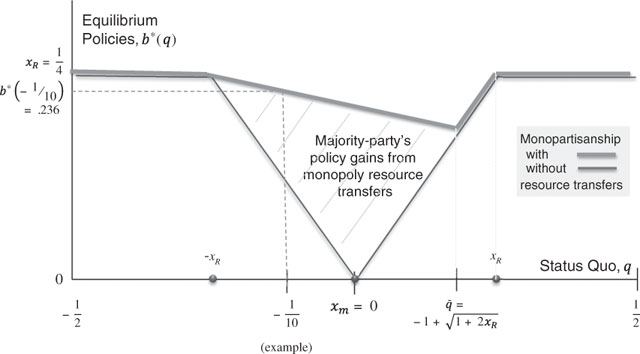
. Figure 1 provides a
specific example.
Example 1: Designate as majority party agenda setter the legislator with ideal point
 $x^{R} {\rm =}{1 \over 4}$
. For this specific illustration, assume also that the
status quo is slightly left of center,
 $$q={\minus}\!{1 \over {10}}$$
.
An opportunistic majority party leader observes that the status quo is
not stable. For instance, a bill of b=0 would pass with
no side-payments (as would other bills up to
 $${\rm {\plus}}\!{1 \over {10}}$$
). How might she obtain the best balance between moving
policy to the right and expending minimal resources subject to the
constraints that her proposed bill attracts a simple majority of yes
votes? She knows, of course, that typically there is a trade-off between
desirable policy shifts and conservation of her resources, so she does
not necessarily want to move policy all the way to her ideal point. The
equilibrium involves finding the cheapest way to buy any particular
policy and then finding, among those policies, the one policy for which
the marginal gain from policy utility equals the marginal cost of the
cheapest vote-buying strategy that attracts a simple majority of
votes.
The leader’s first step is transparent. She can obtain 0.2 units of
policy gain: a change from
 $q\,{\rm =}{\minus}{1 \over {10}}\,{\rm to }\,b\,{\rm =}{1 \over {10}}$
for free, according to canonical agenda-setting logic.
But can she do better, and, if so, how much better and at what cost? That
is, at what point
 $b^{{\rm {\asterisk}}} \gt {\minus}q{\rm =}{1 \over {10}}{\rm }$
do the net benefits of the transfers-for-votes cease to
be positive? The proposition answers that the farthest to the right that
the majority leader is willing to propose a bill is
 $b^{{\asterisk}}$
≈0.236, which involves making transfer payments as a
function of ideal points x of approximately
t(x)=0.00458–0.672x
to all legislators located at or between the median voter
(x
m
=0) and
 $x{\rm =}{{b^{{\rm {\asterisk}}} {\rm {\plus}}q} \over 2}\,\approx\,0.0681$
. This leads to a total payment
 $T^{{\asterisk}}$
of approximately 0.00156. Any additional rightward
shift of the bill would require paying a greater number of legislators
and paying greater amounts to those who are already
receiving payments. These incremental expenses are not worth the small
policy benefit.■
Figure 1 also provides a convenient summary of the similarities and differences between agenda-setting with and without resource transfers—or, in our nomenclature, the setter model and the monopartisan model, respectively. For extreme values of the status quo and values in the interior neighborhood of the setter’s ideal point (cases (a) and (b) in Proposition 1), the two theories exhibit identical behavior. In contrast, for a wide band of moderate status quo policies, the majority party exhibits net policy gains from its monopoly on resources combined with its agenda monopoly.
It bears emphasis, however, that these are net policy gains and, as such, tell only part of the story. The complete story must add that such outcomes come at a price that, in Example 1, is increasing in q throughout most of the interval in Figure 1 in which vote-buying occurs.
Example 1: Monopartisanship with and without resource transfers

AGENDA-BASED COMPETITION
What are the consequences of giving the minority party more voice? Specifically, what happens if the minority party leader, L, is given the right to craft and offer a single counterproposal—call it an amendment, denoted a—to the majority party leader’s bill, b? Such an arrangement approximates a modified-closed rule in the US House of Representatives or, likewise, the motion to recommit with instructions in many legislatures, including the US House. Our formulation of agenda-based competition relaxes only the proposal monopoly in the monopartisan baseline model; the majority party’s resource monopoly remains intact. Formally, then, the stages of the agenda-based competitive-partisan game are as follows:
-
(1) The majority party leader proposes a bill b and offers a schedule of transfers t(·) to legislators.
-
(2) The minority party leader proposes an amendment a to the bill.
-
(3) Legislators vote first on whether to amend the bill (i.e. whether a or b faces the status quo q in the final vote), and second on whether to pass the (possibly amended) bill or to accept the status quo.
-
(4) The winning policy p∈{a, b, q} is realized, transfers t occur, and players receive payoffs.
We interpret the transfer schedule t(x) as a pledge of resource transfers to legislator x for voting in support of b over a and b over q. Proposition 2 characterizes the equilibrium.
Proposition 2: In the essentially uniqueFootnote 15 subgame perfect Nash equilibrium to the agenda-based competitive partisan game, for any status quo q:
-
(a) The majority party leader proposes a bill
$b^{{\rm {\asterisk}}} {\rm =}{\minus}1{\rm {\plus}}\sqrt {1{\rm {\plus}}2x_{R} } $
and offers positive transfers
$t^{{\rm {\asterisk}}} (x){\rm =}(x{\rm {\plus}}1{\minus}\sqrt {1{\rm {\plus}}2x_{R} } )^{2} $
, to all legislators with ideal points
$x\in [0,{\minus}1{\rm {\plus}}\sqrt {1{\rm {\plus}}2x_{R} } ]$
such that each such voter is indifferent
between her bill-and-transfer pair and a hypothetical policy
located at her ideal point x.
-
(b) An amendment,
$a^{{\asterisk}}$
, is made but does not pass given
R’s transfer schedule; therefore, many
amendments are best responses on the equilibrium path. -
(c) The amendment
$a^{{\asterisk}}$
fails, the bill
$b^{{\asterisk}}$
passes, and the sum of transfers is
$T^{{\rm {\asterisk}}} {\rm =}{1 \over 3}({\minus}1{\rm {\plus}}\sqrt {1{\rm {\plus}}2x_{R} } )^{3} $
.


Proof. See Appendix.
The core intuition in the proposition is evident in the special case of the game without transfers. When the minority party leader L has the right to offer an amendment, the majority party leader R, as first mover, cannot simply optimize with respect to the exogenous status quo but must also anticipate and optimize with respect to the forthcoming minority party amendment. This feature of the game gives rise to an implicitly dynamic form of counteractive convergence. Specifically, if the majority leader were to attempt to extract the same-sized rightward policy shift that she successfully obtains in the closed-rule agenda-setting model, the minority leader, as second mover, could counteract with an amendment that is slightly closer (on the left) to the median voter than is the majority leader’s contemplated bill (on the right). Anticipating this, the majority leader will moderate her power-grabbing ambitions. But then the minority party leader will undercut the majority leader again. This reasoning can be iterated creating a figurative race to the center, the limit of which is a median-voter outcome.
Now consider the competitive-partisan game in which the majority can make side-payments. Proposition 2 reveals how the median gravitational pull of the simpler model is asymmetrically attenuated by the majority party’s monopoly over resources. Sizing up the game ex ante, the majority party leader R sees that, in the absence of side-payments, the minority party leader L can achieve a median-voter outcome as in the race-to-the-center special case. Therefore, to get anything better than that, R must compensate moderate voters for any hypothetical bill to the right of the median. In other words, R must compensate some voters in a manner that protects its bill b from any possible amendment a that the minority may be willing to put on the agenda. Consider first an incremental majority party power grab, b=x m +ɛ. Such a strategy is intuitive, because it makes the majority party leader and most of her party members better off. It is relatively inexpensive, because only the median voter and those directly to his right require compensation—and only a small amount of compensation at that. So long as the majority agenda setter pays all legislators located between (and including) x m =0 and ɛ so that they each weakly prefer the bill to a hypothetical amendment located at their ideal points, such a strategy is impervious to counteraction by the minority party, because the minority party has no resources with which to compete. Therefore, R can in fact obtain a non-median, majority party-leaning outcome.
This cautious power grab by the majority leader is not optimal, however, unless and until her marginal cost of side-payments catches up with her marginal benefit from the rightward policy shift. R therefore considers bills farther and farther to the right until the cost and benefit margins are equal. En route to this optimally placed bill, however, total transfer costs rise quickly, because not only is the size of the compensation-demanding coalition increasing in b, but so, too, are the per capita costs. The schedule of equilibrium transfers t(x) has the property that each side-payment recipient with ideal point x receives a utility equal to what he would get if policy were at his ideal point and there were no transfers. Viewed this way, it is clear that when the minority party can propose an amendment, a sizable share of what would otherwise be the majority leader’s rents instead goes to the pivotal recipients of transfers.
The equilibrium bears an important similarity with, and an important difference
from, the optimal “bribe function” in Snyder’s (Reference Snyder1991) model. The similarity is that the greatest
side-payment goes to the median voter, because she is most harmed by the
optimal rightward shift of
 $b^{{\asterisk}}$
and must therefore be compensated most for her vote. Moving
right, then, as the pivotal block of legislators become increasingly hospitable
toward the bill, they require less and less compensation. In other words, as in
Snyder’s model, individuals’ side-payments are monotonically decreasing in
distance from the median (moving toward the vote-buyer).
The difference between this equilibrium and Snyder’s is somewhat subtler, yet more significant. In Snyder’s model, bribes are required only up to the cutpoint midway between the status quo and the optimal bill. With the addition in our model of the possibility of a counteractive proposal, however, the majority leader must compensate voters beyond the cutpoint, and all the way up to the right-most voter whose ideal point equals the optimal bill. Otherwise, any such member can be poached by a minority-party amendment that lies slightly to the left of his ideal point. Power grabs by the majority party are therefore much more expensive in the presence of the mere possibility of a counteractive proposal by the minority party.
Example 2:
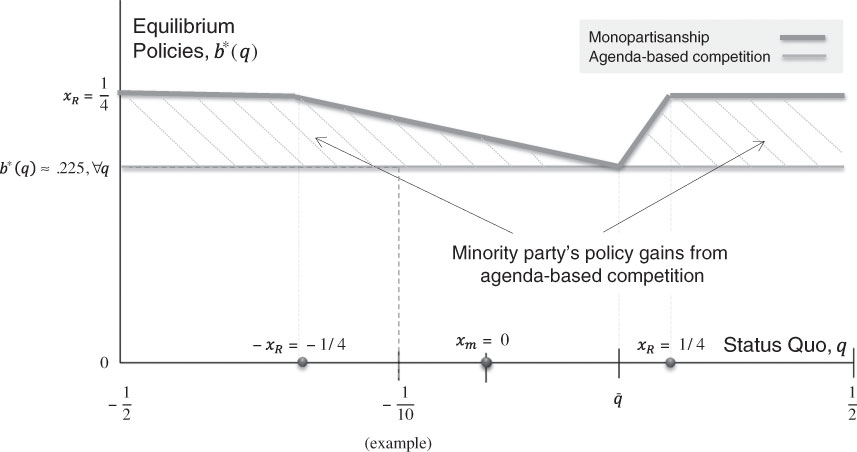
Figure 2 revisits the same
parametric setup as Example 1. For this case, equilibrium transfers are
 $t(x)^{{\asterisk}}$
≈(x−0.2247)2 to all
legislators who have ideal points x∈[0,0.2247].
To better understand the intuition underlying minority party influence in
the equilibrium, consider in greater detail what happens
out of equilibrium. Suppose the majority party leader
miscalculates and, say, offers a legislator located at 0.1 a transfer
0.015 units instead of the slightly greater equilibrium value of
 $(0.1{\rm {\plus}}1{\minus}\sqrt {1{\plus}0.5} )^{2} \,\approx\,0.0155$
. This presents an opportunity for minority party
exploitation. The resourceless minority leader L cannot
outbid her adversary R with side-payments, but she can
acquire a more favorable policy than
 $b^{{\asterisk}}$
≈0.2247, which is the outcome on the equilibrium path.
All L must do to fare better is to poach the underpaid
legislator at 0.1 by proposing an amendment a that is
the legislator’s utility equivalent to the proposed bill plus her
promised side-payment (i.e. the policy that generates
−(0.1−b)2+0.015). Thus, the minority can
find amendments that induce an interval of legislators to vote against
b. Such amendments are necessarily to the left of the
stiffed legislator’s ideal point x=0.1 (in this case,
 $a^{{\asterisk}}$
≈0.0763), and it is crafted to defeat
R’s erroneously devised (b,
t) pair by a minimal majority.
More generally, the optimal amendment strategy of the minority party
leader is to look for such an error and exploit the left-most instance in
the manner described for legislator with x=0.1. If no
such error occurs (which it won’t, in equilibrium), L
proposes any amendment, including, possibly,
 $a^{{\asterisk}}$
=0, which, in equilibrium, is inconsequential because
 $b^{{\asterisk}}$
always wins.■
Figure 2 also clarifies the bigger picture by comparing, for all q, equilibrium outcomes of the monopartisan and the agenda-based competition models. The figure speaks directly to the question posed above about the value to the minority party of a simple one-and-done amendment right. The minority party is always at least as well off with a proposal right than without it, and the shading in the figure represents this erosion of majority party influence relative to the monopartisan model. Moreover, in contrast with Figure 1, this difference represents total utility gains to the minority party; there are no background side-payment costs, because the minority leader may not buy votes in this game.
The majority party leader, meanwhile, incurs a significant reduction in overall utility relative to the monopartisan game. Although she is able, figuratively, to buy a constant policy shift away from the median voter, the constant cost of doing so is sufficiently great that, for all q, her transfer costs exceed her policy benefits and, thus, she is worse off under agenda-competition in spite of her resource monopoly.
A final characteristic, which differentiates agenda-competition from each of
the other models we analyze, is that the minority party’s minimal access to the
agenda essentially renders the status quo q irrelevant,
therefore, gridlock never occurs except at the sole point at which
q by happenstance exactly equals
 $b^{{\asterisk}}$
.
Example 2: Agenda-based competition with a majority-party resource monopoly

RESOURCE-BASED COMPETITION
Narratives of majority party leadership in the US Congress regularly describe not only the concomitant interplay of majority leaders’ side-payments and shaping legislation but also their keen attention to how the minority party will respond to majority initiatives.Footnote 16 Minority party responses may come in the form of alternative proposals, as addressed above, or in the form of competing side-payments, which we undertake next. To do this, we revert back to the monopartisan model (Proposition 1) to use as a frame of reference and then introduce and solve a variation of a “two-sided vote-buying model” (Groseclose and Snyder Reference Groseclose1996). A substantively unique feature in our approach is to consider a game in which the bill is endogenous, i.e. a calculated action by the majority party agenda setter. Formally, the stages of the resource-based competitive-partisanship game are:
-
(1) The majority party leader R proposes a bill, b, and offers a schedule of transfers t R (·) to legislators.
-
(2) The minority party leader L offers a schedule of transfers t L (·) to legislators.
-
(3) Legislators cast their votes for or against the bill (implicitly versus the status quo).
-
(4) The winning policy p∈{b,q} is implemented, transfers T occur, and players receive payoffs.
Snyder and Groseclose show that counteractive vote-buying strategies come in diverse forms, and it should not be surprising that endogenizing bill formation further complicates matters significantly. Due to the technical and somewhat tedious nature of the analysis, most of the derivation of results is in the Appendix.
In a sentence, the behavior implicit in the equilibrium can be summarized as
anticipatory and counteractive lowest-price coalition-building. To see the
logic, we can break it down further by referencing players and their
incentives. As optimizing agenda setter, the majority party leader
R must do the following when forming her proposal
b and transfer schedule t
R
(x). First, for all possible bills b
that R prefers to the status quo q, she must
anticipate how much the minority leader L is willing to spend
to preclude rightward movements in policy. In the Appendix, we parameterize this willingness-to-spend value
as W
L
(b,q). While doing this,
R assumes L will respond to
R’s strategy with the lowest-cost minimum-winning coalition
that maintains the status quo q. Player R
then uses her knowledge of W
L
(b,q) as a constraint when optimizing
in her choice of the bill and her transfer schedule. In equilibrium, the
minority leader never engages in counteractive vote-buying, even though she is
able to, because the majority leader is always in one of two positions. Either
it does not pay for her to move the bill farther to the right than the status
quo, much like what happens in the monopartisan game (Proposition 1). In this
case,
 $b^{{\asterisk}}$
=q, so L gets
q without needing side-payments. Or else, it does pay for
R to move the policy, in which case she does so in the
least-cost way: with a bill,
 $b^{{\asterisk}}$
>q plus a transfer schedule that can be
blocked only by a counteractive transfer schedule by L that
would cost L exactly its maximum willingness to spend,
W(b,q). In other words,
this condition is effectively crafted to price the minority party leader out of
the vote-buying market.
A salient feature of equilibrium behavior in the resource-competition game is the preponderance of gridlock, particularly in conditions that seem, a priori, to be empirically most plausible. To help provide intuition and precision for this broad claim, it is helpful to elaborate on a diverse sample of substantively interesting combinations of the parameter space. Six such cases are summarized in Proposition 3.
Proposition 3: In the subgame perfect Nash equilibrium to the resource-based competitive partisan game, the following conditions for gridlock and policy change hold:
-
(a) If q>x R , then
$b^{{\asterisk}}$
=x
R
and
$$T_{R}^{{\rm {\asterisk}}} =T_{L}^{{\rm {\asterisk}}} =0.$$
-
(b) If q=x R , then
$b^{{\asterisk}}$
=q=x
R
and gridlock occurs. -
(c) If q=x L , then policy always changes via majority party resource transfers.
-
(d) If q=0, then policy changes only if x R >−2x L .
-
(e) If
$x_{L} {\rm =}{\minus}x_{R} \leq {1 \over 4}$
policy changes only if
q>x
R
or q<
$q^{{\asterisk}}$
where
$q^{{\asterisk}}$
solves
$2(x_{R} {\minus}q){\rm =}(2\sqrt {q{\plus}x_{R} } {\plus}q)^{2} $
. -
(f) If
$x_{L} ={\minus}x_{R} \gt {1 \over 4}$
policy changes only if
q>x
R
or q<
$q^{{\asterisk}}$
where
$q^{{\asterisk}}$
=min{q′,q′′}
where q′ solves
$2(x_{R} {\minus}q){\rm =}(2\sqrt {q{\rm {\plus}}x_{R} } {\plus}q)^{2} $
and q′′ solves
$x_{R} {\rm =}{1 \over 4}{\minus}2q{\rm {\plus}}q^{2} $
.


Proof. See Appendix.
Case (a) conforms with the standard setter model. It is analytically familiar and behaviorally straightforward but almost surely empirically rare. If the status quo is more extreme than the majority party monopoly agenda setter, then R proposes her ideal point. The minority party prefers this change to the status quo; hence, there is no threat of her engaging in counteractive vote-buying. As a result, no resource transfers are required, and the majority party leader wins big for free, with a new policy being located at her ideal point.
Cases (b) and (c) establish rough bounds on the range of status quo points that
we regard as relatively empirically plausible. At the upper boundary is case
(b) (also the lower limit of case (a)) where
q=x
R
. When existing policy is already at the majority party agenda leader’s
ideal point R, by definition, she cannot be made better off,
so she simply proposes
 $b^{{\asterisk}}$
=q=R, and gridlock results.
At the lower boundary is case (c) where q=x
L
. This case represents a scenario in which, for instance, a powerful
left-of-center former majority party was evidently
legislatively successful in enacting policies, yet was electorally unsuccessful
in retaining seats. Consequently, the Left Party now finds itself in the
minority, enjoying—for the time being, at least—a favorable, inherited status
quo. Case (c) of the proposition affirms that this situation is unstable.
Specifically, the majority party leader can always craft a bill
b and a nonzero transfer schedule t
R
(x), forming a supermajority coalition to move policy to
the right. In other words, gridlock never occurs for
sufficiently left-of-center status quo points. Yet, for the majority to break
gridlock and figuratively correct the disequilibrium she
always uses side-payments. Depending on the parameter
values of leaders’ ideal points, total side-payments can be substantial.Footnote
17
Case (d) represents perhaps the most plausible scenario or, at least, the most
neutral starting point. The status quo policy is located at the legislative
median, thereby favoring neither the majority nor the minority party. Gridlock
occurs here, too, unless an extreme condition is met, namely, that the majority
party leader has an ideal point that is at least twice as extreme than as the
minority party leader’s. While conceptually imaginable, such a situation seems
empirically improbable.Footnote
18
Conjectures about plausibility aside, the behavioral logic of this
asymmetry condition bears emphasis. Consider various values of the minority
party leader’s ideal point, beginning at zero and moving to the left by an
increment of δ. When status quo policies are centrist, as in
this example, the proposition implies that any leftward shift by the minority
party leader by an amount δ must be matched by a rightward
shift of the majority party leader by an amount greater than
2δ in order for vote-buying to be net-beneficial to the
majority. But this possibility ceases to exist for all
 $\delta \,\gt\, {1 \over 4}$
, because at that point
 ${\minus}2x_{L} \,\gt\, {1 \over 2}$
, i.e. the majority party leader will have exceeded the outer
boundary of her party and the maximum of our ideal point space. Therefore,
simply having a minority party leader with an ideal point x
L
<−1/4 (i.e. in the lower quadrant of the policy
space) unilaterally destroys the necessary condition for effective
majority-party vote-buying. Consequently, gridlock reigns yet again.
Finally, cases (e) and (f) fix leaders’ ideal points at symmetric, (e) moderate and (f) extreme locations on opposite sides of the median voter, as in the standard setup in the theoretical literature on parties in legislatures. The key finding in this symmetric case is that gridlock occurs for a region of status quo points that starts left of the median (less than 0) and ends at x R . The lower bound of this gridlock interval moves farther from the median as the majority leader becomes more extreme. The gridlock interval expands for two reasons as the party leaders become more polarized. First, the interval of status quo points that fall between the median and the majority leader expands. Second, also enlarged is the set of status quo points that could easily be moved by the majority leader in model 1; these are now too costly to move given the minority party leader’s willingness and ability to pay for gridlock.Footnote 19
Example 3: For
 $x_{L} {\rm =}{\minus}{1 \over 4}$
and
 $$x_{R} {\rm =}{1 \over 4}$$
, we solve for the conditions under which gridlock
occurs as a function of q, which, in turn, allows
solving for the equilibrium bill proposal
 $b^{{\asterisk}}$
as a function of q. If the status quo
lies at, or to the left of, a critical point
 $q^{{\asterisk}}$
such that gridlock does not occur, then the final
policy b solves a first order condition equating the
marginal gain to R from policy movements,
 $2({1 \over 4}{\minus}b)$
, with the marginal cost of the transfer
T′. (The marginal cost is defined in Claim 1 in the
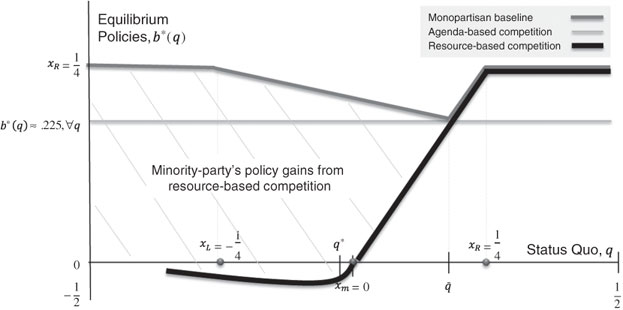
Appendix.) Figure 3 plots the equilibrium policy outcome as a
function of q. Three substantively different intervals
are evident: a left-of-center interval in which gridlock is broken at a
cost to the majority party, a large central-to-right gridlock interval,
and an unlikely right interval in which policy springs back to the
majority leader’s ideal point.■
Combining these various features of equilibrium in the resource-competition game, we extract three additional implications and interpretations.
First, competitive bidding by two party leaders (Proposition 3) relative to vote-buying by only the majority party (Proposition 1) has a dramatic impact, both on policy outcomes and on players’ payoffs. The policy impact is illustrated graphically in Figure 3 by the lightly hatched space between thick and medium-thick lines. If anything, this difference understates the minority party’s benefits from its entry into the vote-buying market, because the figure shows only the policy losses to the majority. At the same time, and indeed whenever gridlock is broken, the majority party pays handsomely for the modest changes it effects (see also Figure 4 below). We say “modest” because, as Figure 3 illustrates, when status quo points lie on the minority side of the spectrum, equilibrium outcomes stay on the minority side of the spectrum, unless they are very extreme. This is a much different result than that of other simple-majority theories of lawmaking.
Some nonobvious empirical implications are closely related. Inasmuch as the
gridlock interval for the equilibrium is a proper superset of all points
between the chamber median and majority party leader, the model shares the
implication of Cox and McCubbins’s “cartel agenda model” that the majority
party is never “rolled” (defeated when a majority of the majority opposes the
bill). Data will therefore not be generated for those situations under either
theory—but, for much different reasons. In the cartel agenda model, the reason
is that majority-party gatekeeping keeps such bills off of what otherwise would
be an open-rule agenda that, in turn, would result in an undesirable outcome at
the chamber medium. In the resource-competition model, the majority party’s
procedural deck is more favorably stacked by the closed rule, whose advantage
to the majority party agenda setter was illustrated above when the minority
party has no resources. Yet, even so, in the presence of minority-party
resources, the majority leader finds it not to be cost-effective to build a
winning coalition for any b>q after
q reaches a critical point
 $q^{{\asterisk}}$
that lies on the minority side of the chamber median. The
models are not fully observationally equivalent, however. In fact, for all
q<0, they are different in substantively interesting
ways. Below
 $q^{{\asterisk}}$
the cartel model predicts full convergence to the chamber
median, while the resource-competition model predicts only partial convergence.
Between
 $q^{{\asterisk}}$
and 0 the cartel model again predicts full convergence, while
the resource-competition model now predicts gridlock.Footnote
20
In both conditions, the extra margin of minority party influence in the
resource-competition model is directly traceable to its ability to make
counter-offers.
It follows broadly from this analysis that, as the resource-competition model
plays out, the minority party gets a bigger bang for its buck than the majority
party does. One way to illustrate this fact is to ask how much it costs the
majority to overcome an off-the-equilibrium path transfer of T
L
. Although, in equilibrium, the answer depends on the parameters in
complicated ways, one qualitative feature is robust. The majority must expend
considerably more than T
L
to overcome T
L
and implement its bill,
 $b^{{\asterisk}}$
. Therefore, even though this model (like Snyder and
Groseclose’s simpler counterpart) predicts that only the majority party expends
resources in equilibrium, it is a mistake to conclude that the majority party
is the greater beneficiary from the ability to make side-payments. On the
contrary, the minority party benefits more than the majority from the admission
of resource transfers into legislative bargaining.
It may seem that the insights from the resource-based competition model are due to the assumption that both parties have infinite resources, but this is not true. In the supplemental appendix, we augment the current model by assuming that the minority has a fixed and small endowment of resources, E, which is less than the amount he would use in the equilibrium characterized in Proposition 3. Two conclusions emerge. First, approximate parity in resources is not a necessary condition for minority party influence. Even a more poorly endowed minority party puts a significant damper on majority party’s policy gains. When the status quo favors the minority party (q<0), the minority party’s mere threat of counteractive resource provision keeps new policies from gravitating to the chamber median voter. Complementarily, when the status quo favors the majority party (q>0), a small pool of minority party resources is sufficient for precluding a large majority party gain via vote-buying. Second, these observations and the comparative statics within them appear to be smooth and monotonic. Consistent with intuition, the greater are the minority party’s resources, the greater is its influence as measured by outcomes and their associated payoffs. Somewhat more surprisingly, this feature holds even with minuscule minority resources. That is, no critical mass is required for minority party influence of the form generated in Game 3.
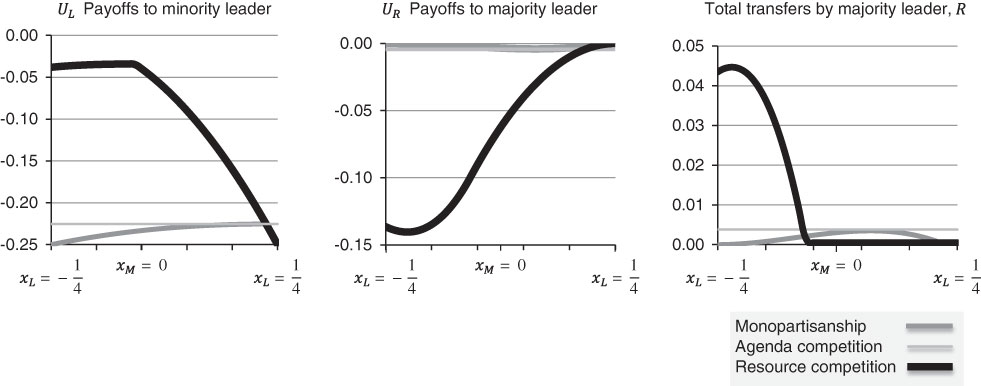
Figure 4 summarizes Propositions 1–3 in
terms of party leaders’ payoffs and the majority-party leader’s vote-buying
costs throughout the range of status quo points bounded by leaders’ ideal
points,
 $$[{\minus}{1 \over 4},{1 \over 4}]$$
. One fact is immediately evident: the payoffs and transfers
in the resource-competition model (thick curves) are distinctly different from
those in its two predecessor models (thinner curves). The center panel shows
that, for all status quo points with the exception of those in a very small
neighborhood of the majority party leader’s ideal point, the majority party
leader does significantly worse when the minority leader has the right to make
a counter-offer of side-payments in the leaders’ bidding for critical votes.
Conversely, the left panel shows that the minority almost always does better in
the resource-competition game than in games 1 and 2.Footnote
21
In the equilibrium of the resource-based competition game, the majority
leader always nominally wins a policy gain or ties by settling
for gridlock in the policy-making competition, but this characterization is
somewhat deceptively strong. Such “wins” come at a high cost to the majority
party. For left-tending status quo points they involve substantial transfers
(see right panel of Figure 4), and for
center and right-tending status quo points they involve no net policy benefit
(see wide gridlock interval in Figure
3). Therefore, given the choice or opportunity, the minority leader (and
his party) would almost always prefer to play the resource-competition game,
even if the minority is relatively resource-deprived.Footnote
22
A final intriguing feature illustrated in Figure 4 is that the differences in payoffs between games 1 and 2 (monopartisanship and agenda-based competition) are small relative to those between games 1 and 3 (monopartisanship and resource-based competition). Remembering that the monopartisanship game represents a strong majority party-government baseline, the observed difference in differences suggests broadly (albeit perhaps crudely) that a small stockpile of transferable resources and its associated implicit and unexercised threats may be a more important enhancement to minority party strength than a much more overt role in agenda formation. At minimum, this nonobvious possibility seems worth flagging for future, more rigorous consideration.
Example 3: Resource-based competition with a majority-party agenda monopoly, and summary of the three competitive-partisanship games

Equilibrium payoffs and aggregate transfers as function of status quo.

DISCUSSION
Empirical tests of these results exceed the scope of the current analysis, however, several of our findings can be constructively connected to existing empirical claims. For example, the quoted excerpt from Aldrich and Rohde in the section “Introduction” alludes to a hypothesis of interest to scholars in the cottage industry of polarization studies (see, e.g. Fiorina, Abrams, and Pope Reference Fiorina, Abrams and Pope2006; McCarty, Poole, and Rosenthal Reference McCarty, Poole and Rosenthal2006; Bartels Reference Bartels2008; Hetherington Reference Hetherington2009). The authors suggest that as the condition for “conditional party government” (Rohde Reference Rohde1991) is increasingly met, outcomes will become more extreme and consistent with majority party preferences. In contrast to this claim, the results of Proposition 3 suggest that as the parties become more polarized, gridlock becomes ever more pervasive, and policies figuratively get stuck in the vast interior between party extremes. Moreover, as illustrated by our numerical example, for those cases in which policy change is possible, increasing the distance between the minority leader’s ideal point and the status quo yields equilibrium policies that are relatively closer to the minority party’s than the majority party’s interests. Similarly, although Krehbiel (Reference Krehbiel1998) suggests that party pressures may roughly cancel out one another, yielding outcomes in the neighborhood of the chamber median, the analysis here suggests that the size of that so-called neighborhood may be more like that of a city or small state. Outcomes at any given time can be quite far from the chamber median and, indeed, proximal to either of the two party leaders, depending on historically inherited status quo policies.
Although the rights-resources framework is motivated by research mostly on congressional politics and US government, it can nearly as easily be applied and interpreted in parliamentary, non-presidential, or multi-party settings. Granted, modeling a comparable three-or-more-party vote-buying game would be much more complicated, but this is not really necessary for illustrating what we take to be our primary analytical insight. For the passage of more moderate policies, it is sufficient to give only a small endowment of resources—or only one proposal—to only one party on the non-majority-party side of the policy spectrum.
As the first section concedes, among the assumptions more vulnerable to criticism is the strictly sequential nature of our notion of competitive partisanship. In the case of resource transfers, such a structure is indeed an analytic convenience, but one that is reasonably well-defended elsewhere (see Groseclose Reference Groseclose1996, for example).Footnote 23 Multi-round sequential bidding or more literal market-like mechanisms for vote-trading are nevertheless other possibilities that could, in principle, be embedded into the framework.Footnote 24 In the case of amendment activity, it is not difficult to reverse the order of offering proposals, as in, for instance Weingast’s (Reference Weingast1989) “fighting fire with fire” argument.Footnote 25 This alteration does not seem to be very informative or defensible, however. For one thing, the analytical consequences are not much different if the minority moves first and the majority moves last, because this model, too, has the median-gravitational, race-to-the-center property discussed in the third section. For another thing, designating the majority party as last mover in agenda-setting seems not to comport with the procedural facts in the legislative body in which we are most interested at this stage of the research agenda.Footnote 26
Another unresolved issue is how the results change under competitive vote-buying with party-specific pricing rather than with purely preference-based compensation. It should be noted, however, that it is not abundantly clear what assumptions should be made in this regard. On first pass, it seems intuitive to think that votes of majority party moderates are cheaper to the majority party leader than are votes of minority party moderates, and vice versa from the minority party leader’s perspective. On second pass, if, as is commonly assumed, the majority party wants to remain in the majority, then its leaders are uniquely sensitive to the electoral fates of its legislators from swing districts, which tend to elect moderates. Moderates, therefore, may be high on leaders’ lists for getting an exemption from voting for the party’s position, in which case it may be cost-effective for a leader to cross the aisle to shop for votes. Ultimately, which is the better assumption seems to be an empirical question.Footnote 27
When considering theoretical results or empirical instances of minority party power, scholars of legislative studies occasionally ask: why does the majority party tolerate any institutional feature that weakens its influence over outcomes (Krehbiel and Meirowitz Reference Krehbiel and Meirowitz2002)? One commonly stated possibility is that these concessions are part of a more complicated dynamic game in which every party that is fortunate enough to find itself in the majority recognizes that it will one day return to the minority (e.g. Dixit, Grossman and Gul Reference Dixit, Grossman and Gul2000). In addressing the relative rights, resources, and powers of majority versus minority parties, this paper makes an important distinction between the ability of the minority party to exercise procedural rights and its ability to transfer resources. Although, in contrast to our agenda-based competition model, proponents of strong majority party theories argue that the majority party always restricts the minority party’s access to the agenda, it is at least plausible that they would tolerate an institutional arrangement in which the minority party has occasional access to the agenda or, at a bare minimum, some transferable resources. A fundamental implication of our findings is that, under either of these conditions, the legislative median can obtain policy outcomes that are more favorable to his interests than what might be obtained in the presence of a monolithic majority party. As such, our results resonate with classical arguments regarding the positive impacts of vibrant counterbalancing political factions (dating back to Madison’s arguments in the Federalist Papers), as well as with more recent scholarship on the institutional determinants of policy moderation (e.g. Stephenson Reference Stephenson2013; Dragu, Fan, and Kuklinksi Reference Dragu, Fan and Kuklinski2014).
Finally, a natural topic for future research is to improve both descriptions and explanations of how and why important institutional features emerge and come to attain what appears to be binding status. In this spirit, a promising next step is to begin to endogenize some of the exogenous components in our framework as a way of analyzing competitive-partisanship from the perspective of organizational design or institutional choice. Why, how, and from whom do party leaders acquire procedural rights and transferable resources? Are the processes of determining the delegation of procedural authority actually partisan processes, or do they simply appear to be partisan after the fact because delegators are well-sorted into preference types? Are procedures such as the House’s motion to recommit durable institutions because they protect the minority party or because they protect minority viewpoints or preferences, which are highly correlated with partisanship on the issues of the day? These are challenging questions, but questions that are likely to be addressed more effectively by considering theoretical possibilities in conjunction with empirical analysis.Footnote 28 The framework of competitive partisanship provides a parsimonious and potentially useful way of conceptualizing ongoing research on legislative parties, preferences, behavior, and institutions.
Appendix
Nonpartisanship model
Proof of Proposition 1. The proof is essentially the same as that of Snyder (Reference Snyder1991)’s proof of Proposition 2. Using standard arguments the following characterization obtains.
Define
 $$\bar{q}={\minus}1{\plus}\sqrt {1{\plus}2x_{R} } $$
.
For
 $$q\leq \bar{q}$$
, the bill is
 $$b^{{\rm {\asterisk}}} ={{2\sqrt {4{\plus}2q{\plus}q^{2} {\plus}6x_{R} } {\minus}4{\minus}q} \over 3}$$
. The transfers are
 $$t_{i} =(x_{i} {\minus}{{2\sqrt {4{\plus}2q{\plus}q^{2} {\plus}6x_{R} } {\minus}4{\minus}q} \over 3})^{2} {\minus}(x_{i} {\minus}q)^{2} $$
to all legislators with ideal points x
i
∈[0,(
 $b^{{\asterisk}}$
+q)/(2)], total transfers is
 $$T={4 \over {27}}(\sqrt {4{\plus}2q{\plus}q^{2} {\plus}6x_{R} } (8{\minus}q^{2} {\plus}q{\plus}3x_{R} ){\minus}16{\minus}6q{\minus}q^{3} {\minus}18x_{R} )$$
.
In all cases, voting is side-payment sincere: that is,
∀i∈N,
 $v_{i}^{{\asterisk}}$
=Yes if
 $$\left( {x_{i} {\minus}b} \right)^{2} {\plus}t_{i} \geq {\rm }{\minus}(x_{i} {\minus}q)^{2} $$
and No otherwise.
Agenda Competition model
Proof of Proposition 2. The equilibrium of the Agenda Competition game is derived via backwards induction. In stage 4, a voter with ideal point x will vote for a new policy over the status quo if one of the following inequalities hold:
 $${\minus}\left( {x{\minus}b} \right)^{2} {\plus}t\left( x \right)\geq {\minus}\left( {x{\minus}q} \right)^{2} ,$$
 $${\minus}\left( {x{\minus}a} \right)^{2} \geq {\minus}\left( {x{\minus}q} \right)^{2} ,$$
with expression (1) being the relevant constraint if b is chosen by the legislature over a in stage 3, and (2) being the relevant constraint otherwise.
In stage 3, then, given that both b and a will beat q if they reach a vote against q, a voter with ideal x will vote for the majority party bill, b, over the minority party amendment, a, if the following holds:
 $${\minus}\left( {x{\minus}b} \right)^{2} {\plus}t\left( x \right)\geq {\minus}\left( {x{\minus}a} \right)^{2} .$$
If either policy, b or a would fail
against q then the appropriate substitution is needed in
(3). Working back to stage 2, the minority leader L
would have already observed b and t(⋅)
as proposed by the majority leader R, and must now
choose the optimal amendment
 $a^{{\asterisk}}$
that maximizes its utility subject to the constraint
that it can beat the majority party leader’s bill (taking into account
the observed transfers from R to selected legislators),
and can also beat the status quo.
The minority party leader’s problem (if she is going to successfully pass an amendment a<b) can be represented as the following:
 $$\matrix{ {\mathop{{{\rm max}}}\limits_{a} {\minus}(x_{L} {\minus}a)^{2} {\rm such}\,{\rm that}:{\rm }} \hfill \cr {{\minus}(x{\minus}a)^{2} \gt {\minus}(x{\minus}b)^{2} {\plus}t(x)\,{\rm for}\,{\rm a}\,{\rm set}\,{\rm of}\,{\rm voters}\,{\rm of}\,{\rm measure}\,{\rm no}\,{\rm less}\,{\rm than}\,{1 \over 2},} \hfill \cr {{\minus}(0{\minus}a)^{2} \geq {\minus}(0{\minus}q)^{2} .} \hfill \cr } $$
The first constraint captures the requirement that a majority will support a over b despite the transfers offered by the majority with the observation that in equilibrium voters will need to resolve indifference in favor of b, and the second constraint captures the requirement that the minority amendment will pass over the status quo (here using the fact that the median is representative on the binary choice between a and q). Note that the first constraint may not be possible to satisfy. If this set is empty and b will pass over q than every proposal by the minority is optimal (and the final policy will be b). If b will not pass over q than the minority’s optimum is to propose the policy closest to her ideal that beats q—which is well defined and mirrors the case of a monopolist from the previous section.
It is useful to define the function
 $$\hat{x}(x,t(x))\,\equiv\,x{\plus}\sqrt {x^{2} {\minus}2xb{\plus}b^{2} {\minus}t(x)} $$
. This is the policy that yields a voter with ideal
point x the same utility (without a transfer) as the
policy b and the transfer
t(x). For a voter obtaining no
transfer this is just the reflection point.
Finally, moving back to stage 1, the majority party leader will either
select the most constraining bill and no transfers, b=0
or it will choose
 $b^{{\asterisk}}$
and t(⋅) to maximize his/her utility,
subject to the constraint that the minority cannot find an amendment that
beats b and moves policy closer to the minority’s ideal.
This requires that for every possible a that the
minority would prefer to
 $b^{{\asterisk}}$
there is at most one value of x for
which t(x)>0 and
−(x−a)2≥−(x−b)2+t(x).
This condition captures the requirement that no amendment can attract the
support of a non null set of voters that the majority is spending
resources on. Were this condition false than either after this amendment
b would still pass and the majority would be wasting
resources, or following this amendment b would fail and
the majority missed the chance to obtain a policy better than
q. Hence, if the majority is changing policy to
b the majority party leader will chose
b and T to maximize:
 $$\matrix{ {U(b)={\minus}\left( {x_{R} {\minus}b} \right)^{2} {\minus}T\left( b \right)} \hfill \cr {{\rm where}\;T(b)\,=\,\mathop{\int}\limits_0^b {\left( {x{\minus}b} \right)^{2} dx.} } \hfill \cr } $$
Hence,
 $U(b)={\minus}(x_{R} {\minus}b)^{2} {\minus}{1 \over 3}b^{3} ,\ {\rm and }\ U\prime(b)=2x_{R} {\minus}2b{\minus}b^{2} $
, which implies that
 $b^{{\rm {\asterisk}}} {\rm =}{\minus}1{\rm {\plus}}\sqrt {1{\rm {\plus}}2x_{R} } $
, and the majority party leader will pay out transfers
 $t(x){\rm =}(x{\rm {\plus}}1{\minus}\sqrt {1{\rm {\plus}}2x_{R} } )^{2} $
, to all legislators
 $$x\in [0,{\minus}1{\rm {\plus}}\sqrt {1{\rm {\plus}}2x_{R} } ]$$
. It is straightforward to demonstrate that
 $b^{{\asterisk}}$
beats
 $$q\ {\rm }\forall q\in \Re $$
.
It remains only to check that the majority prefers to play this strategy
and obtain the value U(
 $b^{{\asterisk}}$
) as opposed to selecting b=0, which
will result in a final policy of 0. Substituting the above value of
 $b^{{\asterisk}}$
we obtain the relevant condition:
 $${\minus}\left( {x_{R} {\minus}1{\minus}\sqrt {1{\plus}2x_{R} } } \right)^{2} {\minus}{1 \over 3}\left( {{\minus}1{\plus}\sqrt {1{\plus}2x_{R} } } \right)^{3} \geq {\minus}\left( {x_{R} } \right)^{2} ,$$
which is true on the policy space with strict inequality for x R ≠ 0 and equality for x R =0.
Drawing on this analysis, we characterize the unique subgame perfect Nash equilibrium to the agenda-based competition as
 $$\matrix{ {b^{{\rm {\asterisk}}} ={\minus}1{\plus}\sqrt {1{\plus}2x_{R} } {\rm }\,{\rm and}\,{\rm }t\left( x \right)=\left\{ {\matrix{ {\left( {x{\plus}1{\minus}\sqrt {1{\plus}2x_{R} } } \right)^{2} ,{\rm }\forall {\rm }x\in \left[ {0,{\minus}1{\plus}\sqrt {1{\plus}2x_{R} } } \right]} \hfill \cr {0,{\rm otherwise}} \hfill \cr } } \right.} \hfill \cr } .$$
Total payments
 $T^{{\rm {\asterisk}}} {\rm =}{1 \over 3}({\minus}1{\rm {\plus}}\sqrt {1{\rm {\plus}}2x_{R} } )^{3} $
,
 $a^{{\asterisk}}$
(b,T) as described
above and voting strategies,
 $v^{{\asterisk}}$
that are sincere. The equilibrium outcome is then
 $x^{{\asterisk}}$
=
 $b^{{\asterisk}}$
.
Resource Competition model
Our presentation of the analysis of the resource competition model is less complete and thus the structure of this section of the Appendix differs from the previous two sections. We begin by laying out the details of how the game is analyzed, then present two intermediate results and end by deriving and stating a generalization of Proposition 3. The generalization is stated here as Proposition 3a and appears at the bottom of this section.
We must first partially characterize the equilibrium. The conditions can
be obtained from the following observations. First, for any fixed bill
b that R might propose, it is
necessary to characterize precisely the transfer schedule for
R that exactly exhausts L’s
willingness to spend to defeat the proposed bill. The insights about the
structure of these solutions are then used to determine conditions on
optimal proposals
 $b^{{\asterisk}}$
by R. A strategy by R
can be reformulated slightly as a per-voter transfer schedule
t
R
(⋅) (as before), and a supermajority margin s,
where the overall size of the bill-supporting coalition is the fraction
 ${1 \over 2}{\rm {\plus}}s$
. In equilibrium, the transfers are chosen so as to
equalize the utility obtained by each voter who receives a positive
side-payment. The strategies can be characterized by the parameter
s (i.e. the size of the supermajority margin) and
then s is a choice variable by R, who
selects b and s to maximize her
utility.
We begin by taking b and q as fixed, with b>q. The most that L is willing to spend to block b is given by the utility difference (to L) from the two policies, −(x L −b)2+(x L −q)2. This policy utility differential is denoted W L . Therefore, optimality (and thus, equilibrium) requires that, under the best response that L can play, bribed voters are indifferent between voting for b or q, and that enough of them resolve this indifference in favor of b. Thus, in equilibrium it must cost exactly W L to build a coalition of voters that is sufficiently large to block b, such that each voter in the coalition is indifferent between voting for b or q. Accordingly, if R is going to make transfers to pass b then she would select the least costly transfer schedule that could be blocked by W L .Footnote 29
To construct such a schedule, we begin by defining v(x; b,q)=−(b−x)2+(x−q)2, which is the difference in policy utility to a voter with ideal point x from voting for b over q. This difference can be simplified to
 $$v\left( {x;b,q} \right)=2\left( {b{\minus}q} \right)y{\minus}\left( {b^{2} {\minus}q^{2} } \right).$$
We let
 $v^{{{\minus}1}} (t;b,q){\rm =}{t \over {2(b{\minus}q)}}{\rm {\plus}}{{(b{\rm {\plus}}q)} \over 2}$
denote the inverse of the difference in utility to
voter y. This quantity is the ideal point of the voter
who obtains utility difference t from the choice between
b and q. When the meaning is clear
we suppress the (b,q) arguments. We may
write the willingness to pay for a bill b over the
status quo q for the majority party leader
as
 $$W^{R} \left( {b,q} \right)=2\left( {b{\minus}q} \right)x_{R} {\minus}\left( {b^{2} {\minus}q^{2} } \right).$$
Likewise, we can characterize the willingness to pay for the minority party leader to block a bill, b, given the status quo q, as
 $$W^{L} \left( {b,q} \right){\rm =}{\minus}2\left( {b{\minus}q} \right)x_{L} {\minus}\left( {b^{2} {\minus}q^{2} } \right).$$
For fixed W L ,b, and q, the problem of selecting an optimal transfer schedule (for party leader R) is solved in Snyder and Groseclose. Correcting a minor typo in their proposition and employing our notation, we obtain the relevant characterization of vote-buying strategies. More specifically, the optimal supermajority, s, is obtained by minimizing R’s total expenditure:
 $$T_{R} \left( {b,s} \right)=\mathop{\int}\limits_{{\minus}s}^{{\rm min}\left\{ {v^{{{\minus}1}} \left( {{{W^{L} } \over s}} \right),{1 \over 2}} \right\}} {\left( {{{W^{L} } \over s}{\minus}v\left( y \right)} \right)} dy.$$
With quadratic preferences over policy, the function
v(⋅) is linear, and thus this problem reduces to one
of minimizing the area of simple geometric shapes, subject to the
constraint that the minority is driven to indifference (and in
equilibrium it will not engage in vote-buying). Snyder and Groseclose
employ the labels of flooded and
nonflooded coalitions to distinguish between cases in
which only a subset of the legislators supporting the majority-favored
bill are actually bribed (nonflooded) and those in which all legislators
in the majority’s coalition are bribed (flooded). Employing our notation,
a nonflooded coalition occurs when
 $v^{{{\minus}1}} ({{W^{L} } \over s})\leq {1 \over 2}$
, while a flooded coalition ensues when
 $v^{{{\minus}1}} ({{W^{L} } \over s})\gt {1 \over 2}$
.
As a function of exogenous parameters and the proposal, b Snyder and Groseclose’s result yields the subgame perfect transfer costs for the majority party leader. We restate their result here and add the partial derivatives of the transfer with respect to the policy b as subsequent analysis will build on these characterizations.
Fact 1 (Subgame perfect transfers): For fixed b and W L , the following transfer schedules correspond to the solution of Snyder and Groseclose’s model:
-
(1) When q<0,−2x L ≤((b+q)2)/(4)−(b+q), T=0;
-
(2) (Nonflooded Coalition) When q<0,
${{(b{\plus}q)^{2} } \over 4}{\minus}(b{\plus}q)\lt {\minus}2x_{L} \lt {{(b{\plus}q)^{2} } \over 2}{\minus}(b{\plus}q)$
,(8)
$$T={\minus}2\left( {b{\minus}q} \right)x_{L} {\plus}\left( {b^{2} {\minus}q^{2} } \right){\minus}{{b{\minus}q} \over 4}\left( {b{\plus}q} \right)^{2} ,$$
(9)
$${{dT} \over {db}}={\minus}2x_{L} {\plus}2b{\minus}{{3b^{2} {\plus}2bq{\minus}q^{2} } \over 4}.$$
-
(3) (Nonflooded Coalition)When
$${{(b{\plus}q)^{2} } \over 2}{\minus}(b{\plus}q)\leq {\minus}2x_{L} \leq {{1{\minus}(b{\plus}q)]^{2} } \over 2}{\minus}(b{\plus}q)$$
,Footnote
30
$$s={\rm min}\{ \sqrt {{{b{\plus}q} \over 2}{\minus}x_{L} } ,{1 \over 2}\} $$
,Footnote
31
(10)
$$T=\left[ {v^{{{\minus}1}} \left( {{{W^{L} } \over s}} \right){\plus}s} \right]\left[ {{{W^{L} } \over s}{\plus}\left( {b^{2} {\minus}q^{2} } \right)} \right]{\minus}\left( {b{\minus}q} \right)\left[ {v^{{{\minus}1}} \left( {{{W^{L} } \over s}} \right)^{2} {\minus}s^{2} } \right].$$
(11)where
$${{dT} \over {db}}=2\left[ {v^{{{\minus}1}} \left( {{{W^{L} } \over s}} \right){\plus}s} \right]\left[ {{{b{\minus}x_{L} } \over s}{\plus}b} \right]{\minus}\left[ {v^{{{\minus}1}} \left( {{{W^{L} } \over s}} \right)^{2} {\minus}s^{2} } \right],$$
$$v^{{{\minus}1}} \left( {{{W^{L} } \over s}} \right){\rm =}{{{{b{\plus}q} \over 2}{\minus}x_{L} } \over s}{\rm {\plus}}{{b{\plus}q} \over 2},{{W^{L} } \over s}{\rm =}2(b{\minus}q){{{{b{\plus}q} \over 2}{\minus}x_{L} } \over s}.$$
-
(4) (Flooded and Nonuniversalistic Coalition) When
${{[1{\minus}(b{\plus}q)]^{2} } \over 2}{\minus}(b{\plus}q)\lt {\minus}2x_{L} \lt {1 \over 2}{\minus}{{b{\plus}q} \over 2}$
, s is uniquely and well
defined by 4s
3+2(b+q)s
2=b+q−2x
L
.(12)
$$T=\left[ {{{W^{L} } \over s}{\plus}\left( {b^{2} {\minus}q^{2} } \right)} \right]\left( {{1 \over 2}{\plus}s} \right){\minus}\left( {b{\minus}q} \right)\left( {{1 \over 4}{\minus}s^{2} } \right),$$
(13)
$${{dT} \over {db}}=2\left( {{{b{\minus}x_{L} } \over s}{\plus}b} \right)\left( {s{\plus}{1 \over 2}} \right){\minus}\left[ {{1 \over 4}{\minus}s^{2} } \right].$$
-
(5) (Flooded and Universalistic Coalition) When
$${\minus}2x_{L} \geq {1 \over 2}{\minus}{{b{\plus}q} \over 2}$$
,
$$s={1 \over 2}.$$
(14)
$$T=3\left( {b^{2} {\minus}q^{2} } \right){\minus}4\left( {b{\minus}q} \right)x_{L} ,$$
(15)
$${{dT} \over {db}}=2\left( {3b{\minus}2x_{L} } \right).$$


To characterize necessary and sufficient conditions for gridlock, we conduct a local analysis for small changes from q. In particular, we use the partial derivatives, (dT)/(db) in each of the cases and the derivative of policy utility, 2(b−x R ) evaluated at b=q to characterize conditions under which R prefers to make a small move from q. This argument is appropriate because, although the transfer functions, T are not concave we show in the next lemma (proof appears in supplementary appendix) that the total utility is single-peaked in b in each case.
Lemma 1 (concavity of R’s objective): As a function of b, the utility to R from making subgame perfect transfers, V(b) is concave.
Given the concavity of V(W L ) the following result is obtained by using the characterization in Fact 1 to determine when V′(b)>0 at b=q. If this inequality holds then gridlock does not occur. If it fails then gridlock occurs.
Proposition 3A (Resource Competition and Gridlock): The parameters (x L ,q,x R ) induces gridlock in equilibrium (i.e. there is no policy change or vote-buying) if and only if the exogenous parameters (x L ,q,x R ) are in one of the sets:
 $$\eqalignno{ & A_{1} =\{ (x_{L} ,q,x_{R} ):q\lt 0,q^{2} {\minus}2q\lt {\minus}2x_{L} \lt 2q^{2} {\minus}2q,2(x_{R} {\minus}q)\leq {\minus}2x_{L} {\minus}(q^{2} {\minus}2q)\} \cr & A_{2} =\{ (x_{L} ,q,x_{R} ):2q^{2} {\minus}2q\leq {\minus}2x_{L} \lt {{(1{\minus}2q)^{2} } \over 2}{\minus}2q,2(x_{R} {\minus}q)\leq (2\sqrt {q{\minus}x_{L} } {\plus}q)^{2} \} \cr & A_{3} =\{ (x_{L} ,q,x_{R} ):{{(1{\minus}2q)^{2} } \over 2}{\minus}2q\leq {\minus}2x_{L} \lt {1 \over 2}{\minus}q,2(x_{R} {\minus}q)\leq ({{q{\minus}x_{L} } \over s}{\plus}q)(s{\plus}{1 \over 2}){\minus}({1 \over 4}{\minus}s^{2} ), $$
where s is uniquely and well defined by 4s 3+2(b+q)s 2=b+q−2x L },
 $$A_{4} =\left\{ {\left( {x_{L} ,q,x} \right):{\minus}2x_{L} \gt {1 \over 2}{\minus}q,x_{R} \leq 4q{\minus}2x_{L} } \right\}.$$
The statement of Proposition 3A is much more general than that of the result, Proposition 3 in the paper. The former is a characterization of necessary and sufficient conditions for gridlock. The latter, Proposition 3 in the body is a corollary listing several substantively interesting conditions for gridlock. Proposition 3 is obtained by substitution of the stated parametric assumptions into the definitions of the sets in Proposition 3A.