INTRODUCTION
Skates (Rajidae) are one of the more commercially important groups of demersal fish around the British Isles, and there has been a long history of their exploitation in the Celtic Seas ecoregion (ICES, 2009). In recent years, there has been an increasing interest in the assessment and management of their stocks, due to their potential sensitivity to overfishing. The biology of skates, characterized by slow growth rates, high longevity, late age at maturity and low fecundity, make them vulnerable to over-exploitation, and their size and body morphology makes them susceptible to capture in a variety of fishing gears from a young age (Holden, Reference Holden and Harden Jones1974; Ellis et al., Reference Ellis, Clarke, Cortés, Heessen, Apostolaki, Carlson, Kulka, Payne, Cotter and Potter2008b). In UK waters, the populations of several skate species have declined in response to commercial fisheries (Brander, Reference Brander1981). Indeed, two of the largest species that were formerly common in the western English Channel (Couch, Reference Couch1864), common skate Dipturus batis and white skate Rostroraja alba, have declined severely in the area (e.g. Rogers & Ellis, Reference Rogers and Ellis2000; ICES, 2009) and north-east Atlantic populations of these species are now listed as Critically Endangered by the IUCN.
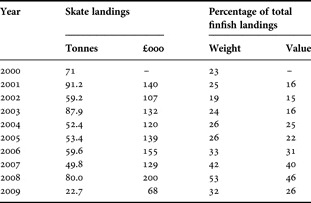
Skates in the western English Channel are caught using demersal otter trawl, beam trawl, gill and trammel nets and longline (ICES, 2009), and are also important in recreational fisheries. Skates are an increasingly important part of the fish catch of the Jersey fleet. Annual skate landings are approximately 50 tonnes (Table 1), which accounts for about 19–53% (by weight) and 15–46% (by value) of annual finfish landings (Fisheries and Marine Resources, 2009, 2010). Commercial landings data for skates have generally been reported at the family level, and the lack of species-specific landings data has restricted assessment and management advice. Fishery-independent survey data currently forms the basis of ICES advice, as these are the only species-specific time-series of data available for many areas. Such information is sparse for the western English Channel (ICES Division VIIe), with earlier UK surveys having a poor spatial coverage of the western English Channel (Ellis et al., Reference Ellis, Dulvy, Jennings, Parker-Humphreys and Rogers2005b). In recent years, a more spatially comprehensive survey of the western English Channel has been initiated, although this is currently limited by the short time span. Furthermore, the stock structure of demersal elasmobranchs in the Celtic Seas ecoregion is poorly known.
Reported landings of skates by Jersey vessels (tonnes and value) and as a proportion of total finfish landings (from Fisheries and Marine Resources Annual Reports, 2009, 2010)

Tagging studies can inform on the degree of mixing between skates from different areas and identification of stocks, which is needed for assessment and management purposes (Pawson & Ellis, Reference Pawson and Ellis2005). Additionally, tag and recapture data may be particularly important in identifying regular migrations to and from important spawning or feeding grounds (Walker et al., Reference Walker, Howlett and Millner1997). Spawning, parturition and nursery areas are considered to be ecologically important habitats for the survival and growth of neonatal and juvenile elasmobranchs (Heupel et al., Reference Heupel, Carlson and Simpfendorfer2007), yet little is known about such areas around the UK (Ellis et al., Reference Ellis, Cruz-Martinez, Rackham and Rogers2005a).
Four skate species are commonly caught in Jersey waters: blonde ray Raja brachyura Lafont, 1873, small-eyed Raja microocellata Montagu, 1818; thornback Raja clavata L., 1758 and undulate ray Raja undulata Lacépède, 1802. Although the biology of thornback ray is much studied, little is known about the biology of the other three species. In this paper, we provide preliminary observations on the biology and movements of these skate species around Jersey based on tagging experiments undertaken from September 2006 to December 2008.
MATERIALS AND METHODS
Study area
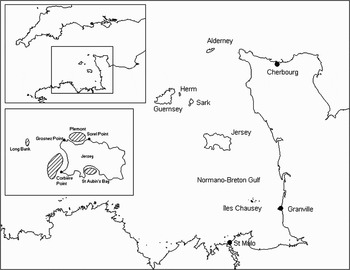
The study was conducted in Jersey territorial waters, in the Normano-Breton Gulf (western English Channel; Figure 1). This area is subject to rapid currents (4–5 knots on spring tides) and one of the larger tidal amplitudes (~12 m range) in the world. Eulerian residual currents propagate anticlockwise around the island (Pingree & Mardell, Reference Pingree and Mardell1987) and there are separate cyclonic circulation systems around the îles Chausey, les Minquiers, Sark and Guernsey. Sampling and tagging were conducted within 3 km of the coast of Jersey, in waters 10–40 m deep.
Map of the Normano-Breton Gulf, showing study area in relation to the English Channel (top inset) and sampling sites around Jersey (bottom inset).

Field sampling
Skates were caught and tagged between September 2006 and December 2008 and were caught by angling, beam trawl and otter trawl. Angling was conducted from MFV ‘Anna II’ and MFV ‘Blue Marlin’, using either conventional ‘J’ or circle hooks. Beam and otter trawling were conducted on the Fisheries Protection Vessel ‘Norman Le Brocq’ and MFV ‘Provider’, respectively and all tows were less than 45 minutes.
Species were identified on-board and fish were tagged with serially numbered Petersen discs (16 mm diameter), with smaller individuals (<45 cm length) tagged with mini-Petersen discs (10 mm diameter). Tags were attached with stainless steel wire placed through the pectoral fins, with space allowed for some growth of the fish. The release date, position, depth, species, total length (LT), disc width (DW), sex, maturity of males (based on the size and state of the claspers, see ICES (2009)) and condition (lively or sluggish) was noted for each specimen. Fish were released immediately after tagging. A reward was offered for the return of the tag together with information on the recapture date and position, method of capture and size of the fish.
Skates were tagged and released at three main fishing grounds, along the northern, western and southern coasts of Jersey (Figure 1). The northern site included the fishing grounds from Grosnez Point to Sorel Point (depths ~30 m), including some limited sampling undertaken at Long Bank. The western area was in St Ouen's Bay and off Corbière (25 m deep) and the southern area was St Aubin's Bay (10 m deep). The MFV ‘Anna II’ and ‘Blue Marlin’ fished at the northern and western sites. The ‘Norman Le Brocq’ and MFV ‘Provider’ trawled at the southern site. The substrate consisted of coarse sand at all sites, although fine sand and mud is present in parts of St Aubin's Bay.
RESULTS
Life history
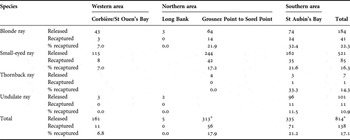
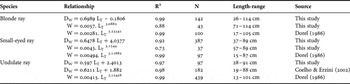
Overall, 814 skates were caught and released, including 521 (64%) small-eyed ray, 184 (22.6%) blonde ray and 101 (12.4%) undulate ray (Table 2). Seven thornback rays and one unrecorded species were also tagged and released. The relationships between disc width (DW) and total length (TL), and the length–weight relationships for the main species caught are summarized in Table 3.
Number of skates tagged and released (N = 809) from sites around Jersey and corresponding recapture rates.

*, includes one rajid for which the release details are not reported.
Morphometric relationships between disc width (DW, cm), total length (LT, cm) and weight (W, g) for three skate species (sexes combined) caught off Jersey, and earlier data from the English Channel (Dorel, Reference Dorel1986).

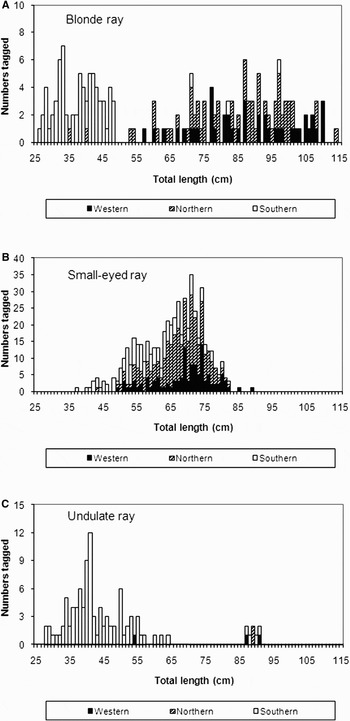
Blonde rays (26–114 cm LT; Figure 2) were caught primarily at the southern and northern site (40% and 36% respectively), with remaining fish captured at the western site (23%). The trawl caught samples at the southern site were generally immature. The majority of undulate rays (95%) were also caught at the southern site (St Aubin's Bay), and these were juveniles taken in beam and otter trawls (Figure 2). A few larger individuals were taken from the western study site and the Long Bank, but none were caught at the main northern site. Small-eyed ray was the main skate species caught at the northern site (47% were released here), with smaller numbers tagged in the southern and western sites (31% and 22%, respectively). The observed size-range was 37–89 cm LT (Figure 2). The overall sex-ratios of blonde ray (90 females, 93 males and one unsexed) and small-eyed ray (244 males, 275 females and two unsexed) were not significantly different from the expected 1:1 sex-ratio. The sex-ratio of undulate ray (36 males and 65 females) was 1:1.8 and comprised significantly more females (χ2 test, P < 0.01).
Length–frequency distributions of (A) blonde ray, (B) small-eyed ray and (C) undulate ray tagged and released in the southern area (St Aubin's Bay, trawl samples), and the western (Corbière and St Ouen's Bay) and northern (from Grosnez Point to Sorel Point) areas (rod and line samples).

Maturity was recorded for male blonde ray (N = 81), of which the smallest mature fish was 82 cm and all males ≥99 cm were mature. Male small-eyed ray (N = 180) indicated that first maturity occurred at 64 cm, all fish ≥77 cm were mature and the length at 50% maturity was approximately 68 cm. Data were limited for undulate ray, with two males of 62–64 cm maturing and the largest male (87 cm) mature. Although the maturity of females could not be ascertained, the smallest small-eyed, undulate and blonde rays with egg-cases exuding from the cloaca were 75, 89 and 93 cm, respectively.
Tagging
The qualitative assessment of health state of released fish following capture and tagging was generally good (91.7% of fish were considered lively and 8.3% considered sluggish). Fish tagged following scientific trawling were considered lively (97–99%), with 86.5% of rod and line caught fish also considered lively. Recapture rates for fish that were lively and sluggish at release were 17.7% and 13.6%, respectively. However, given the subjective nature of assigning the health state of tagged fish, and that individual taggers may have slightly differing perceptions, it is difficult to undertake more detailed analyses of these data.
Of the 814 skates tagged, 138 (17.1%) were recaptured during the time frame considered (Table 2), including one tag (from a 61 cm small-eyed ray) recovered from the stomach of a conger eel. The recapture rates of undulate, small-eyed and blonde ray were 11%, 16.3% and 22.3%, respectively. In terms of tagging location, fish tagged at the southern site had the greatest recapture rate (21%), followed by the northern site (18%), and the western site (7%).
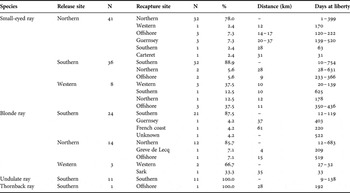
Most skates were recaptured close to the area where they had been tagged and released (Table 4). For example, of the small-eyed rays tagged and released in the northern area, 78% of the recaptured fish (N = 41) were taken at the release area, and the remaining fish (22%) travelled <40 km. Similarly, small-eyed and blonde rays released in the southern site were generally recaptured in the same bay (89% and 87%, respectively), even though the time at liberty reached 754 days for a small-eyed ray (the maximum time at liberty in the present study).
Spatial and temporal patterns of recaptured skates (N = 138) by species and release site.

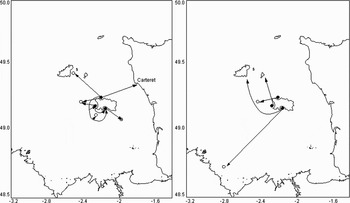
Although the majority of recaptured fish were from around Jersey (~94%), five fish were taken from Guernsey and Sark, and two were caught along the French coast (Figure 3). The maximum distance travelled by a recaptured skate was approximately 61 km, for a blonde ray moving from St Aubin's Bay to the Bay of St-Brieuc (France) over a period of 220 days. Thirteen fish were recaptured on 2–4 occasions, and in most instances these fish were caught within the release site. No recaptures were reported from outside the Normano-Breton Gulf.
Recapture locations of small-eyed ray (left) and blonde ray (right) showing release locations (filled circles) and locations of longer movements (open circles). Most recaptures were from the release location.

DISCUSSION
Although the biology of some of the more common fish of the English Channel is relatively well documented (Pawson, Reference Pawson1995), there have been few studies of the ichthyofauna of the Channel Islands (Jackson et al., Reference Jackson, Attrill and Jones2006a, Reference Jackson, Attrill, Rowden and Jonesb) and other parts of the Normano-Breton Gulf (de Noter & Hureau, Reference de Noter and Hureau1996). Due to the coarse grounds that are a typical feature of the western English Channel, groundfish surveys have had a limited capacity to provide data on demersal elasmobranchs in the area (Ellis et al., Reference Ellis, Cruz-Martinez, Rackham and Rogers2005a, Reference Ellis, Dulvy, Jennings, Parker-Humphreys and Rogersb). In recent years, more comprehensive studies of this area have been undertaken with 4 m beam trawl, and may help redress this. However, given that 4 m beam trawls are more selective for juvenile skates, and may have a low catch efficiency for larger skates (Ellis et al., Reference Ellis, Dulvy, Jennings, Parker-Humphreys and Rogers2005b), other surveys may be required if larger skate species are to be sampled effectively.
The present study focused on three skate species (undulate, blonde and small-eyed ray), and the biology of these species is little known. Good relationships between DW and LT were found for all three species, although length–weight data were limited. These data were broadly comparable to those reported previously (Dorel, Reference Dorel1986). Maturity data were limited for undulate ray, although the current data for small-eyed and blonde ray suggest that males mature at a smaller total length than reported by Dorel (Reference Dorel1986). The smallest mature male small-eyed and blonde rays recorded in our study were 64 cm and 82 cm LT, respectively; which contrasts with the lengths of 70 cm and 100 cm reported by Dorel (Reference Dorel1986). The samples examined in the present study contained more fish >65 cm than examined by Dorel (Reference Dorel1986), which may account for these differences. In terms of undulate ray, studies in Portuguese waters indicated that 50% maturity occurs at 76.2–83.8 cm and 73.6–78.1 cm for females and males, respectively (Coelho & Erzini, Reference Coelho and Erzini2006; Moura et al., Reference Moura, Figueiredo, Farias, Serra-Pereira, Coelho, Erzini, Neves and Gordo2007), and better estimates for the length at maturity for this species in the English Channel are required.
A wide length-range (26–114 cm) of blonde ray was sampled, with juveniles (26–48 cm) taken by trawl in St Aubin's Bay, and larger fish taken by rod and line at northern and western sites. Blonde ray hatch at a length of 16–18 cm (e.g. Clark, Reference Clark1922) and attain a maximum length of approximately 120 cm (Stehmann & Bürkel, Reference Stehmann, Bürkel, Whitehead, Bouchot, Hureau, Nielsen and Tortonese1984). The results of the present study indicate that Jersey's coastal zone is important for most life history stages, including secondary nursery grounds. Further information on the location of any spawning grounds and primary nursery grounds (i.e. those used by neonatal rays) in the area is still needed.
Undulate rays were also observed over a wide length-range (28–91 cm), with juveniles (28–64 cm) taken at the southern site (St Aubin's Bay), highlighting the potential importance of this bay as a nursery ground for both undulate and blonde ray. Rod and line sampling caught relatively few large undulate rays (N = 5) and further work is needed to better examine the status of this species around the Channel Islands and in the wider English Channel. The biology of this species is little known, with previous scientific studies mostly from Iberian waters (e.g. Coelho & Erzini, Reference Coelho and Erzini2006; Moura et al., Reference Moura, Figueiredo, Farias, Serra-Pereira, Coelho, Erzini, Neves and Gordo2007, Reference Moura, Figueiredo, Farias, Serra-Pereira, Neves, Borges and Gordo2008).
Small-eyed ray were sampled over a length-range of 37–89 cm. It is unclear whether or not smaller juveniles inhabit Jersey coastal waters, as fish 10–36 cm were not reported. Further field studies in shallow, sandy bays of the Channel Islands and along the French coast are required to determine whether there are spawning and primary nursery grounds for this species in the western English Channel.
Several studies have examined the movements of skates in northern European waters (Walker et al., Reference Walker, Howlett and Millner1997; Hunter et al., Reference Hunter, Buckley, Stewart and Metcalfe2005). These studies have typically focused on thornback ray, which is one of the more abundant and widely distributed skates around the British Isles, and data are more limited for the species considered in the present study. Overall 17% of tagged skates have been recaptured, although there was some variation between sample sites and species, with return rates for undulate, small-eyed and blonde ray 10.9%, 16.3% and 22.3%, respectively. The lower return rate of undulate ray may be due to most of the tagged fish being juveniles, which may be less prone to capture in recreational and commercial fisheries in the short term. Nevertheless, the return rates were broadly comparable to other tag and recapture studies (Walker et al., Reference Walker, Howlett and Millner1997; Ellis et al., Reference Ellis, Burt, Cox, Kulka and Payne2008a). Return rates were lowest for the western site (7%), whereas return rates from the southern site were high (21%). Commercial vessels operate in this latter site during periods of bad weather, which could influence the return rate. Anecdotal evidence suggests that some commercial fishermen do not report captures of tagged fish.
Despite the subjective nature of the assessment of the health status, capture and subsequent tagging did not appear to affect the health of the skates, with ~95% considered lively at the time of release. The short tows undertaken with beam and otter trawl undoubtedly optimized the survivability of the fish, and longer tow durations would have likely reduced the health status (especially if catch weight in the cod end increased). Angler-caught fish will use some energy when being brought to the surface, and so could appear sluggish. Capture by anglers of different skill may also impact on the health status, and where the fish is hooked may be an important factor. The use of angling as a method of capture for tag and release work, however, remains valid as there was no major difference in the recapture rates for the health status, and this method has enabled the tagging of a good sample size of larger individuals of these little-known skate species. The study also highlighted that there was good survivorship of fish released after being caught by angling.
Data are currently insufficient to examine seasonal patterns in movements with regards the different size-classes of the three main species, and it is hoped that some inferences as to the nature of such movements can be made when more data are available. However, it is noteworthy that most skates were recaptured at the same location, even after considerable time at liberty. It is not possible to say whether the individual remained in the vicinity for the entire time or moved away and returned, and further studies using electronic tags could usefully be undertaken for better information on this (see Hunter et al., Reference Hunter, Buckley, Stewart and Metcalfe2005). It is also interesting to note that recaptured fish were not reported from outside the Normano-Breton Gulf, which would also indicate high site fidelity.
The ICES has only recently initiated species-specific advice for skates, and contrasting advice was provided for the three main species taken in the present study (ICES, 2008). It should also be noted that these species all have patchy distributions, and no advice was given for skate stocks in the western English Channel (ICES Division VIIe), due to a lack of knowledge of the stock boundaries, and paucity of survey data. Small-eyed ray is locally abundant in the Bristol Channel (Ellis et al., Reference Ellis, Cruz-Martinez, Rackham and Rogers2005a), some bays in Brittany (Rousset, Reference Rousset1990) and in some Galician rías (Álvarez et al., Reference Álvarez, Aragort, Leiro and Sanmartín2006). The Bristol Channel (ICES Division VIIf, g) stock of small-eyed ray was considered to be a ‘species where indicators show recent stability or increase’ (ICES, 2008), although it was noted that because this species has a patchy distribution, it should be monitored to avoid local depletion. It is unclear as to whether small-eyed ray in the western English Channel is part of the VIIf, g stock or form a separate stock. None of the skates tagged in the course of this study have been returned from the Bristol Channel, but further tagging studies of this species could usefully be undertaken.
Undulate ray occurs in shallow, coastal waters off parts of the Iberian Peninsula (e.g. Ría de Muros, Tagus estuary, off Peniche, Algarve coast), Tralee Bay (Ireland) and in the English Channel (e.g. Regan Tate, Reference Regan Tate1913; Álvarez et al., Reference Álvarez, Aragort, Leiro and Sanmartín2006; Moura et al., Reference Moura, Figueiredo, Farias, Serra-Pereira, Coelho, Erzini, Neves and Gordo2007). Moura et al. (Reference Moura, Figueiredo, Farias, Serra-Pereira, Coelho, Erzini, Neves and Gordo2007) noted geographical differences in the length at maturity between Peniche and the Algarve, and suggested that this could be the result of discrete populations. ICES (2008) advised that undulate ray ‘has a patchy distribution, with some of these areas showing signs of depletion. As a precautionary measure, target fisheries for this species should not be permitted unless exploitation rates are shown to be sustainable’. Subsequently the EC listed undulate ray as a species that ‘may not be retained on board and shall be promptly released unharmed’ (CEC, 2009). This measure was unpopular with fishermen in the Normano-Breton Gulf, as it may be locally abundant around the Channel Islands and up to the Solent on the south coast of England. Relatively few adults were sampled during the present study and this species is only captured in small numbers during trawl surveys (ICES, 2009), and so dedicated field studies to better understand the population structure of the nominal English Channel stock might be required.
Blonde ray is commonly encountered in parts of the southern North Sea, Bristol Channel and St George's Channel (Ellis et al., Reference Ellis, Cruz-Martinez, Rackham and Rogers2005a). The ICES has been unable to provide advice for blonde ray, which also has a patchy distribution, due to insufficient data. Further studies on the stock identity, including tagging but also using other methods (e.g. life history characteristics, genetics and parasites) are certainly required to better understand the degree of mixing between coastal populations of these skate species, which all have patchy distributions. If local populations are discrete then precautionary management measures to prevent localized depletions may be required. A better understanding of the population structure of these species is also required to assist in the interpretation of existing survey data and to help inform on potential improvements to survey design, if these stocks are to be monitored more effectively.
ACKNOWLEDGEMENTS
The authors would like to thank the skippers and crews of the fishing vessels ‘Anna II’, ‘Blue Marlin’ and ‘Provider’ and the Fisheries Protection Vessel ‘Norman Le Brocq’ for their invaluable help in sampling and tagging. Additional thanks to the referees for their comments and Mary Brown, who assisted with the preparation of figures.