1. Introduction
The investment treaty regime is among the most powerful legal regimes underpinning economic globalization. It comprises a network of over 3,000 treaties that provide legal protection to foreign investors from adverse governmental action in the states in which they invest. These treaties also allow foreign investors to bring legal claims that host states have breached these protections to international arbitral tribunals. In determining whether respondent states have violated investment treaties, international tribunals pass judgement on a range of measures, related to a diverse set of policy areas. Such disputes affect not just the host state and investor, but an array of third parties – citizens, domestic industries, civil society groups. In exercising their function, arbitral tribunals define the scope for acceptable state action that adversely affects foreign investors’ interests.
The investment treaty regime is the subject of both public and academic controversy. Critics argue that investment treaties unduly constrain the ability of host states to regulate foreign investment and that they expose host states to the risk of expensive arbitral awards. To date, academic attention has focused primarily on the extent to which investment treaties limit government ability to regulate foreign investment to achieve particular policy objectives, such as public health,Footnote 1 environmental protection,Footnote 2 and financial stability.Footnote 3 This scholarship has generated important insights but tends to frame investment disputes as disagreements about the objectives and efficacy of regulatory measures. Such framing overlooks important normative questions about the justification for international legal constraints on measures that emerge from democratic processes at the national level. It also obscures cross-cutting empirical issues, including the fact that many investment treaty claims arise from shifts in political priorities associated with changes in government or deep-rooted disagreements about the distribution of the benefits and costs associated with investments.Footnote 4
One recurring theme in investment treaty arbitration is the tension between the protection of investors’ interests on the one hand, and the legitimate scope for democratic decision-making and responsive politics on the other.Footnote 5 Arbitral tribunals frequently pass judgment on legislation enacted by democratically elected parliaments, on regulations adopted as a result of lobbying by various constituencies, and on exercises of executive discretion in response to public opinion or popular protest.Footnote 6 Indeed, a common strategy for foreign investors in investment treaty arbitrations is to assert that the host state’s treatment of the investment was ‘politically’ motivated – a concept which is implicitly juxtaposed to rational and impartial government action. For example, in Bilcon v. Canada the claimant asserted that:
Bilcon should have been entitled to expect that its progression through the regulatory process would have been free from political interference and political considerations. However, politics derailed a typically smooth regulatory process.Footnote 7
In resolving such disputes, tribunals necessarily invoke some conception of legitimate and illegitimate influences over government decision-making.
We are not the first to note this tension. However, insofar as the academic literature does consider the relationship between investment treaty arbitration and domestic political contestation, it tends to examine the issue either through the lens of legal doctrines, such as ‘deference’ to domestic decision-makers,Footnote 8 or through close examination of a single case study.Footnote 9 We develop this literature by considering the variety of influences over government decision-making and show how tribunals have adopted different conceptions of what constitutes illegitimate political influence over government decision-making. To do so, we begin with concepts drawn from political science rather than legal doctrine.
Our argument is organized as follows. In Section 2 we argue that investment disputes involving politically motivated conduct vary along two axes. The first axis concerns the type of political pressure to which the host state is responding. Existing cases show that potential motivations range from electoral concerns and popular protests, to lobbying by the investor’s commercial competitors and government office holders’ intentions to harm direct rivals for political power. To date, scholarship on investment treaties has not distinguished between these influences on government decision-making, which raise distinct normative concerns. We draw on Schattschneider’s theory of interest group representation to distinguish between the influence of broad and narrow interest groups on government decision-making. The second axis concerns the ‘source’ of the state conduct in question – in particular, whether the challenged measure involves executive, legislative or judicial action. In considering the source of the measure we follow Van Harten, who has argued that arbitral review of different types of government action also raises different normative concerns.Footnote 10 We then populate our framework with an illustrative selection of existing investment treaty disputes.
In Section 3 we focus on one particular category of disputes identified in Section 2: those in which the foreign investor alleges that executive action adversely affecting the investor was motivated by the influence of broad interest groups over government decision-making. We then show that tribunals have adopted markedly different approaches to assessing such claims. For example, some tribunals appear to regard executive action that is influenced by popular protest as inherently inconsistent with investment treaties’ guarantee of fair treatment, whereas other tribunals do not. Focusing on one particular category of disputes allows us to exclude the possibility that these differences between tribunals’ approaches can be explained by the branch of government responsible for the decision or the type of political influence at issue. This insight is an important contribution to the existing literature. Supporters of investment treaties argue that apparent anomalies in arbitral jurisprudence can be explained by differences in underlying factual scenarios,Footnote 11 while critics imply that tribunals share a common antipathy towards certain types of political responsiveness.Footnote 12 Our analysis casts serious doubt on the former view, while also suggesting that the latter is insufficiently nuanced.
In Section 4, we evaluate two competing conceptions of (il)legitimate influence over government decision-making identified in Section 3. To do so, we draw on six different normative theories spanning both public law and private law. We identify the central normative commitments of each theory and examine its relevance for the evaluation of political motivations. Engaging with multiple normative theories, rather than applying a single theory, allows us to examine whether tribunals’ different approaches to politically motivated conduct might reflect diverse underlying normative commitments. It also allows us to identify possible areas of overlapping consensus between theories.Footnote 13
Our recourse to public law theory is unlikely to be controversial.Footnote 14 Investment treaty arbitration shares structural characteristics with public law adjudication in that it is an asymmetric system that allows private actors to challenge the exercise of government authority. Moreover, the extent to which state conduct should be legally constrained is a central question in public law theory. While our engagement with private law theory may strike some readers as counter-intuitive, it is also justified, in our view, for two related reasons. First, although investment treaty arbitration is more similar to domestic public law than domestic private law, it does not fit perfectly within traditional conceptions of either.Footnote 15 For example, many investment treaty claims arise out of contractual relationships between the investor and the state, and the default remedy of monetary damages in investment treaty arbitration is unusual in public law adjudication.Footnote 16 Second, many of the arbitrators in the investment treaty regime come from a private law background.Footnote 17 Much of the academic scholarship assumes that differences in tribunals’ approaches can be explained in part by arbitrators’ backgrounds – specifically, that arbitrators from a private law background are more sympathetic to investors’ interests.Footnote 18 Through engagement with private law theory we seek to examine whether tribunals’ views can be justified within theoretical frameworks that are presumptively sympathetic to investors’ interests.Footnote 19
We argue that the view that executive action that is influenced by broad interest groups is inherently inconsistent with investment treaties’ guarantee of fair treatment is difficult to reconcile with any of the six theories of that we consider. This is a powerful insight because it suggests that some tribunals are interpreting and applying investment treaties in ways that are difficult to justify even within normative theories that are presumptively favourable to the protection of investors’ interests.
In concluding, we argue that greater specificity about the influences over various types of government decision-making can improve arbitral and academic debate. Tribunals’ tendency to make vague references to ‘politically’ motivated conduct that collapse distinctions between cases such as these is unhelpful. In this context, our analysis of tribunals’ approaches to evaluating one type of politically motivated conduct points to wider concerns with the way that tribunals conceive of the legitimate scope for political influence over government decision-making.
2. A framework for distinguishing varieties of ‘politically’ motivated state conduct
In framing investment treaty claims against host states, foreign investors routinely assert that the state’s conduct was political in some sense. For example, in Yukos v. Russia, the investor alleged that the initiation of tax proceedings against the Yukos oil company was ‘politically motivated’, in the sense that the proceedings were part of a conscious attempt to destroy a high profile political opponent of Vladimir Putin.Footnote 20 In Tecmed v. Mexico, the investor asserted that the decision to close down its hazardous waste facility following alleged breaches of conditions attached to its environmental permit was motivated by ‘political considerations’, in the sense of being driven by the local community’s opposition to the facility’s continued operation at its existing location.Footnote 21 In AES v. Hungary, the investor asserted that an amendment to the Electricity Act facilitating the re-regulation of electricity pricing in Hungary was adopted for ‘political reasons’ in the sense of being motivated by public concern about the (perceived) excessive profitability of electricity generators.Footnote 22 Many other examples could be cited.Footnote 23 While alleging that state conduct is politically motivated is a common rhetorical strategy for foreign investors, these three examples show that it implicates a variety of different influences over government decision-making.
Arbitral tribunals’ responses to this practice have received surprisingly little academic attention to date. To the extent scholars have examined this issue, they have assumed that politically motivated state conduct is inconsistent with the provisions of investment treaties, and understood that concept narrowly. Vandevelde, for instance, defines politically motivated conduct as ‘government action was not motivated by legitimate public policy considerations, but by animus toward the investment or investor’.Footnote 24 Van Harten appears to share a similar view.Footnote 25 Investors and arbitral tribunals do indeed describe conduct motivated by hostility to a particular investor as political. But this definition overlooks the fact that the term ‘political’ is also used when describing a much wider array of motivations for state conduct. The narrow definition also obscures the fact that investors seem to be using the term ‘political’ as part of a common litigation strategy to discredit the state conduct in question in a wide variety of cases.
Rather than proposing our own definition of politically motivated conduct, we think it more productive to begin by mapping and clarifying the variety of state conduct characterized by tribunals as politically motivated or influenced. We argue that types of conduct that tribunals describe as politically motivated varies along two axes. First, we identify variation in the type of pressure or motivation to which the host state is responding – whether this is popular pressure or electoral concerns, lobby or ‘special interest’ groups, or a specific intent to harm an investor. Second, we have the ‘source’ of the state measure in question, which may be the executive, legislative, or judicial branches of government. The second dimension is central to our enquiry because different branches of government have very different decision-making processes.
Of course, there are other potential dimensions of variation. For example, some scholars have distinguished targeted (investor-specific) conduct from general (economy-wide) measures.Footnote 26 This variable relates to the characteristics of the measure itself, rather than the process of decision-making that led to the measure’s adoption. Because we are interested in the interaction between investment treaty arbitration and domestic political contestation, we focus in this section on elaborating dimensions of variation that relate to the host state’s decision-making process. In Section 3, however, we take account of this additional potential dimension of variation by narrowing our focus to investor-specific conduct of the executive branch that is motivated by pressure from broad interest groups.
2.1 Types of ‘political’ influence over state conduct
Tribunals describe diverse influences over government decision-making as political. In what follows we attempt to systematically classify the types of political motivation that arbitral tribunals see at work in investment treaty disputes. We identify three different types of influence which may encourage host states to take measures that are contrary to foreign investors interests: mass interest group or electoral pressure; pressure from special or narrow interest groups; and the intent of government actors to harm an investor.
Political science theories of interest group politics examine the impact of both mass- and special-interest groups on policymaking.Footnote 27 In distinguishing between broad and narrow (or special) interests, we focus on three indicia. Broad and special interest groups have different patterns of membership, both in terms of the number of members and in the way the members of the group relate to the policy interest in question. The range of beneficiaries of the policies advocated for by the group, and their strategies or mechanisms for influence also differ.
Broad interest groups are organized around particular policy commitments. Membership is generally open to those who share that commitment, independently of other professional or status-based characteristics. They advocate for policies which they believe will benefit constituencies beyond the members of the group. This does not mean that members do not also benefit – environmentalists will benefit from clean air as well as their non-activist neighbours – but the enjoyment of the attainment of their goals is not exclusive to group members. (Of course, these groups do not mobilize for an uncontested ‘good’. They often advocate for policy goals, such as environmental protection, which may impede the attainment of other goals, such as economic growth.) Because these groups are less likely to enjoy direct access to government officials, they ‘tend to implement mobilization strategies targeted at expanding the audience in search for allies and, through political means, redressing an initially unfavourable balance’.Footnote 28 This may include protests and demonstrations, or media campaigns. While not precisely the same strategy for influence, we include broader-based electoral pressures in this category. Indeed, if mass interest groups are successful enough, they will raise the relevant policy issue to a level of political salience that it may have an impact on election outcomes.
A special interest, as defined by Schattschneider, ‘is exclusive in about the same way as private property is exclusive’, and inferences about the goals or concerns of the group can be made based on its membership. These groups attempt to secure favourable policies or ‘club goods’, the beneficiaries of which are group members themselves.Footnote 29 Group members are likely to be elites, broadly defined as those who possess significant economic resources including the ownership of firms, or ‘social status or institutional position – such as the occupancy of key managerial roles in corporations, or top-level positions in political parties, in the executive, legislative or judicial branches of government, or in the highest ranks of the military’.Footnote 30 Indeed, membership will often be based on a common professional status or commercial interest. Their membership and group goals mean that narrow interest groups tend to use different strategies for influence from broad interest groups. Because ‘access and some degree of influence are more or less assured’, special interest groups ‘generally opt for a more discreet “inside” approach’.Footnote 31 In the investment treaty context, the archetype of a special interest group is an industry association representing a foreign investor’s domestic competitors.
Our final category, intent to harm an investor or investment, reflects Vandevelde’s understanding of politically motivated conduct in the context of the investment treaty regime. This category differs from both broad and special interests in that the motivation for state conduct affecting the foreign investment comes from within government itself, rather than from pressure from an external actor. Extrapolating from the examples discussed below, we assume that the direct beneficiaries of measures undertaken to harm an investor will normally be members of the incumbent government. Yukos v. Russia is a classic example. However, we do not rule out the possibility that conduct motivated purely by retribution or hostility toward the investor may have no beneficiary as such.
The boundaries between these three categories of influence will not always be clear. For example, where both commercial and political interests in the host state are threatened by a foreign investor, clientelist influences over government decision-making may blur into an intention to harm an investor. Nevertheless, distinguishing between these three types of influence is a useful heuristic that allows us to understand the breadth of state conduct that arbitral tribunals label as political. In the following sections, we illustrate these categories with examples from investment treaty disputes.
2.1.1 Responding to mass interest group pressure/electoral concerns
Several investment treaty disputes arise from scenarios in which, in response to pressure from constituents, host states have taken measures contrary to the interests of foreign investors. The mechanisms by which such mass interest group pressure is brought to bear on the state include elections, public protest, and public opinion, either expressed informally or through official channels established for citizen participation in decision-making.
Tecmed v. Mexico involved all three mechanisms. The case concerned a hazardous waste facility in the city of Hermosillo. Following reports of contamination emanating from the facility, local activists organized petitions, rallies, and a blockade of the site. In response to this community opposition, the authorities and the investor agreed that the facility should be moved to a more remote location. Within months of this agreement, the Mexican environmental authority declined to renew the annual licence that allowed the facility to operate at its original site.Footnote 32 The claimant argued that it had a legitimate expectation that the old facility would be permitted to continue to operate until it could be relocated.Footnote 33 The authorities cited the breach of various environmental conditions attached to the licence as justification for their refusal to allow the facility to continue to operate at its original site.Footnote 34 However, the claimant alleged that the motivation for the denial of the permit was political – shortly before the decision, a 1997 election brought a change in the administration of Hermosillo. The newly elected municipal government had, the claimant alleged, encouraged protests against the site.Footnote 35 The claimant further argued that the ultimate decision, made at the federal level, was the result of federal authorities bowing to the pressure of the municipal government and community groups which opposed the landfill.Footnote 36
Another example is Bilcon v. Canada. The dispute related to a proposed quarry which was to be located in Digby Neck, Nova Scotia. The American investors claimed to have been initially welcomed by provincial officials in 2002. However, members of the local community feared that the quarry posed a threat to their traditional livelihoods of fishing and tourism based on whale watching. The project soon became the target of significant local opposition – concerned citizens formed groups to advocate against the quarry, and in 2002, a local municipality voted against the quarry.Footnote 37 The investor also alleged that in the 2003 provincial election, the ultimately victorious candidate for the Legislative Assembly made his opposition to the quarry a campaign issue.Footnote 38 Ultimately, the project was subjected to the highest level of environmental review afforded by the Canadian Environmental Assessment Act – a Joint Review Panel (JRP). The JRP solicited community feedback in written and oral form, thereby allowing the public to express its concerns through official channels. Based on the JRP’s ultimate recommendation, the federal Environment Minister denied the claimants their environmental permit. In its pleadings, the investor described the JRP as ‘a smoke screen to cover up the politically motivated pre-determination that this project would never see the light of day’.Footnote 39
2.1.2 Responding to lobbying, or cronyism/clientelism
State actors may also be motivated to take measures which adversely affect foreign investment due to pressure from narrower interest groups, such as domestic competitors of the foreign investor. An early example is SD Myers v. Canada. This case concerned the interests of an American company in transporting PCB waste from Canada into the United States for disposal at its treatment facility in the mid-1990s. The small Canadian chemical waste disposal industry was concerned that allowing US-based firms to dispose of Canadian PCB waste would threaten the economic viability of their industry. They began to lobby relevant ministries to close the border from the Canadian side, which would force PCB waste of Canadian origin to be disposed of in Canada.Footnote 40 Subsequently, the federal Minister of Environment signed an interim order banning the export of PCB waste from Canada.Footnote 41 This decision was taken despite the fact that ministry officials had concluded that the transportation of this waste across the border posed no threat to environmental or human health.Footnote 42 Internal government communications cited commitments made by the Environment Minister to Canadian waste disposal companies on the issue.Footnote 43 The claimant argued that this interim order discriminated against US-based waste disposal businesses, and that protectionist motivations, rather than legitimate environmental concern, were the underlying motivation of this policy.Footnote 44 The tribunal’s reference to the ‘political reasons’ for the order is made in the context of its discussion of the influence of the Canadian industry on the decision.Footnote 45
2.1.3 Deliberately harming a political opponent
Our final category of motivation is the specific intent of government official(s) to harm an investment or investor. For example, Tokio Tokeles v. Ukraine concerned a publishing and printing business which was engaged in the publishing of materials favourable to opposition candidate Yulia Tymoshenko in 2002. The claimant was the target of tax investigations, document seizure, and allegedly false accusations by government authorities that it engaged in illegal activities. The claimant contended that these measures were taken by the government in response to its support of opposition politicians.Footnote 46 Ultimately, the tribunal concluded that these allegations were not made out on the facts.Footnote 47
2.2 Sources of politically motivated conduct
From the perspective of international law, including international investment law, the state is a unitary actor that is responsible for all its organs, agencies and sub-divisions.Footnote 48 From the perspectives of political science and of national law, the picture is different. Following a well-established tradition in political science and legal theory we understand the state as being divided into three branches of government – the executive, legislature and judiciary.Footnote 49 In this section, we illustrate variation in the source of politically motivated conduct with examples of investment treaty arbitrations relating to the conduct of the different branches of government.
Distinguishing between the conduct of different branches of government that becomes the subject of investment treaty claims is important for two related reasons. First, as a matter of explanatory theory, different branches are staffed through different processes of election, selection or appointment. They have different procedures for making decisions, subject to distinct forms of accountability and control. As such, the different branches of government may act more or less independently, motivated by various (and at times competing) political preferences. Of course, there is also likely to be variation within each branch of government in any given state on each of these dimensions, as well as differences in the behaviour of a given branch of government between states. Nevertheless, any explanatory account of the investment treaty regime’s implications for political contestation within states must, at a minimum, consider treaties’ interaction with the behaviour of each branch of government. Second, as others have noted, arbitral review of the conduct of each branch of government raises a distinct set of normative concerns. One might, for example, be more concerned about judicial decision-making than legislative decision-making being influenced by public opinion.Footnote 50
2.2.1 Executive measures
For our purposes, the executive branch of government consists of the office of the executive itself, ministries, subnational agencies and other administrative bodies. Given this broad conception, it is unsurprising that executive decisions are the source of the state conduct at issue in the majority of investor-state arbitration cases.Footnote 51 For example, Biwater Gauff v. Tanzania concerned the circumstances around the termination of a concession for the supply of water and sewerage in the city of Dar Es Salaam, which was awarded to the claimant in 2003. Two years later, in light of the claimant’s perceived failure to deliver improvements in the water supply, various government bodies, including the Ministry of Water and Livestock Development, the Tanzanian Revenue Authority, and the Dar es Salaam Water and Sewerage Authority, took a series of measures that ended the claimant’s concession.Footnote 52
2.2.2 Legislative measures
We include measures taken by both sub-national (provincial, state) and national legislatures in this category. A significant number of investment treaty arbitrations have been initiated following the passage of legislation unfavourable to an investor.Footnote 53 Legislative policy-making is the most obvious channel through which the political preferences of voters and citizens can have a negative impact on foreign investors, and thus it is unsurprising that discussion of politically motivated conduct has been central to a number of the arbitral rulings. As an example, Glamis Gold v. USA related to the investor’s gold mining claim in California. The proposed mine was to be located near sites of cultural and religious importance to the Quechan Native American tribe. In 2003, the California Senate passed legislation immediately prohibiting lead agencies from granting mining rights in areas located within one mile of sites sacred to Native Americans, unless the mine plan met strict standards for reclamation.Footnote 54 Internal government communication recognized that this would prevent Glamis from obtaining approval of its proposed project and that, were it not for this new law, the project would have been allowed to proceed.Footnote 55 The investor alleged that this legislation was ‘a means to a political ends’ – specifically, ‘a way to pander to an emerging constituent interest.’Footnote 56
2.2.3 Judicial measures
Decisions taken by the judicial branch have also triggered investment arbitration proceedings, although this is the least frequent of the three sources we identify here.Footnote 57 We include in this category any investment treaty claim in which the investor challenges a decision or other conduct of a court in the host state. For example, Al Warraq v. Indonesia concerned the claimant’s indirect ownership of a commercial bank, Bank Century. In 2008, the bank was in a dire financial situation and was bailed out by the Indonesian government. In 2010, the bailout was investigated by a special committee formed by the Indonesian House of Representatives. This investigation concluded that the bailout had been marred in corruption, and recommended that it be investigated by law enforcement agencies. Allegations were also made that the claimants had siphoned bailout money to the election campaign of the vice president.Footnote 58 The claimant was eventually indicted on corruption and embezzlement charges relating to the near collapse of the bank and convicted in absentia. The claimant contended that these criminal proceedings were intended to ‘mitigate the public outcry about the unlawful bailout of Bank Century’.Footnote 59
2.2.4 Multiple measures and characterization of the measure(s) at issue
Investment treaty claims may also arise from the interaction of several branches of government. For example, Yukos v. Russia involved a series of investigations and court proceedings against oil and gas company Yukos, owned by Russian oligarch Mikhail Khodorkovsky, a financial backer of opposition parties. In 2003, the Russian Tax Ministry – part of the executive branch – initiated investigations of Yukos for possible tax evasion. The Tax Ministry subsequently assessed Yukos as liable for billions of US dollars in back-taxes. Yukos challenged these assessments in Russian courts, which largely upheld the decisions of the Tax Ministry. In parallel, over the course of 2003, the company faced the threat of its licences being revoked and had its offices subject to searches and seizures. Between 2003 and 2006, many Yukos employees were arrested, charged and subsequently convicted of various offenses. A Russian court subsequently declared Yukos bankrupt and authorized the auctioning of its assets to meet outstanding debts.
Our framework is an attempt to map the variety of state conduct characterized by tribunals as politically motivated. For this reason, in locating cases such as Yukos our starting point is tribunals’ own characterization of the facts constituting the dispute. The tribunal’s conclusion that Russia breached the investment treaty was based primarily on the actions of the Russian tax authorities. The tribunal also criticized the conduct of various judicial proceedings against Yukos, and Yukos’s employees and owners.Footnote 60 As such, we understand Yukos as a dispute in which two branches of government are involved, the primary source of the conduct at issue being the executive branch.
Investment treaty disputes also implicate the interaction of multiple branches of government in disputes relating to the exercise of powers conferred or delegated by one branch of government to another branch. This situation is particularly common in liberal democracies, in which legislation often confers a power on an executive agency – for example, the power to make regulations or the power to determine whether statutory conditions are met in specific instances.
Bilcon v. Canada is representative. On one view, the ultimate source of authority for the conduct at issue was the legislature, in the sense that the investor challenged the way the legislative framework for environmental assessment had operated in a specific instance. However, the tribunal characterized its finding that Canada had breached the investment treaty as relating solely to the way the JRP had carried out its assessment of Bilcon’s proposed project, given the existing legislative framework.Footnote 61 It was at pains to emphasize that it was not calling the legislative framework into question in any way.Footnote 62 Our starting point is tribunals’ own characterization of the facts constituting the dispute and we therefore understand the source of the conduct in this dispute to be ‘executive’. This does not exclude the possibility that tribunals’ self-characterized review of executive action also has implications for other branches of government.Footnote 63 We return to this issue in the conclusion of our article.
2.3 Plotting variation on both axes
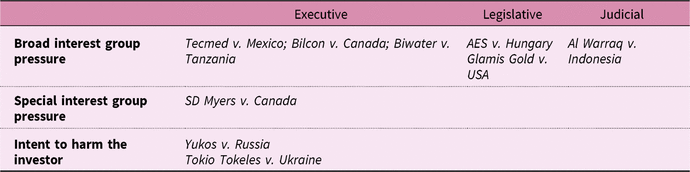
Combining our analysis of the source of the measure that is the subject of the dispute and the type of influence over government decision-making, we can map arbitral discussion on two axes. The following diagram locates each of the cases discussed in this section.Footnote 64
A framework for distinguishing varieties of ‘politically’ motivated state conduct, populated with well-known cases

Our framework is a simplification for heuristic purposes. The boundaries between different types of motivation are not always clear. Moreover, the diagram is unable to represent visually that many cases concern the conduct of multiple branches of government (some cases may also involve multiple types of motivation). Nevertheless, our framework makes two important contributions to the literature on investment treaties. First, it illustrates the wide variety of scenarios in which tribunals have grappled with politically motivated conduct. Second, it facilitates a more fine-grained analysis of tribunals’ approaches to cases raising similar issues. The following section illustrates the latter, through an analysis of cases that fall within the top left-hand corner of our framework.
3. Tribunal responses to politically motivated conduct
In this section we examine the way in which arbitral tribunals have assessed conduct of the executive branch that a foreign investor alleges was motivated by the influence of broad interest groups. From the outset, it is important to note that no investment treaty explicitly sanctions state conduct that is motivated by the influence of interest groups – whether broad or narrow – over government decision-making. Nor does any investment treaty explicitly excuse conduct that is politically motivated from liability. The issue of how to approach political motivations is one that arises in the course of tribunals’ interpretation and application of common substantive provisions of investment treaties, particularly the fair and equitable treatment standard.
We argue that arbitral responses to allegations of politically motivated state conduct can be divided into three categories:
1. The tribunal finds a breach of the investment treaty due to the interest groups’ influence over the conduct at issue;
2. The tribunal finds that the political nature of the measure is not relevant in determining whether the treaty has been breached; or
3. The tribunal avoids engaging with the claimant’s contentions that host state conduct was politically motivated.
In principle, a fourth possible response is also available to tribunals. Tribunals could conclude that a state’s responsiveness to pressure from broad interest groups justifies the impugned conduct, and thus did not amount to a treaty breach.
We illustrate the first three of these categories with relevant cases below, all of which relate to executive action that is influenced by popular opinion and/or popular protest and/or electoral considerations. For the purposes of this section, we further narrow our analysis to cases where such conduct of the executive branch was specific to the foreign investor in question. By holding the source, the type of political pressure and the specificity of the measure constant, we demonstrate that variation in tribunal response is not wholly a function of these three dimensions of variation. To illustrate that a fourth approach is, in principle, open to tribunals we include a short discussion of cases concerning conduct of the legislative branch where tribunals have held that it is legitimate for government decision-making to respond to public opinion. The fact that we are unable to identify any case relating to the conduct of the executive branch that falls into this category is, in itself, an interesting finding of our study.Footnote 65
3.1 Politically motivated conduct breaches an investment treaty
In several cases, tribunals have concluded that executive conduct that is influenced by pressure or advocacy from broad interest groups amounts to a breach of an investment treaty. Of the four approaches identified in this section, our research suggests this is the approach most commonly adopted by tribunals.Footnote 66 In such cases, the tribunal often juxtaposes politically motivated decision-making to an ideal of rational, technocratic decision-making.Footnote 67
This framing is perhaps clearest in Tecmed v. Mexico. The tribunal assessed Mexico’s conduct through the lens of the legal doctrine of proportionality. It accepted that the investor had breached some of the conditions attached to its operating permit but held that this was not sufficient to justify the authority’s conduct. Instead, it focused on the motivations behind the decision. The tribunal held that the authority’s decision not to renew the permit was, in part, influenced by community opposition to the facility:
[T]here were factors other than compliance or non-compliance by [the claimant] with the Permit’s conditions or the Mexican environmental protection laws and that such factors had a decisive effect in the decision to deny the Permit’s renewal. These factors included “political circumstances”.Footnote 68
While the tribunal acknowledged that other factors may have played some role, it concluded that the significant influence of community opposition on the agency’s decision meant that the decision was not proportionate.Footnote 69 It therefore amounted to a breach of the investment treaty.
Bilcon v. Canada is somewhat different, in that the politically motivated actor was an independent panel of experts, the JRP, appointed by the executive branch of government to assess the claimants’ proposed project. We follow the arbitral tribunal in that case as treating the JRP as an extension of the executive branch because it was ‘empowered to exercise elements of Canada’s governmental authority’. Notwithstanding the distinct political dynamics, the tribunal’s reasoning in Bilcon is similar to that in Temced. It juxtaposed the JRP’s sensitivity to community concerns to a rational and technical assessment of the proposed project. Specifically, the tribunal held that the JRP failed to adhere to the statutory framework for environmental assessment by placing too much weight on the local ‘community’s own expression of its interests and values’ and by failing to consider possible mitigation measures that might allow the project to go ahead.Footnote 70
3.2 Political motivations irrelevant to the question of whether treaty was breached
In other cases, a tribunal acknowledges that conduct of the executive branch at issue in the dispute may have been influenced by broad interest groups, but finds such political motivations irrelevant in determining whether the treaty was breached. Bear Creek v. Peru is representative of this approach. The claim related to a mining concession held by a foreign investor. The investor had obtained presidential authorization to own the concession within 50 kilometres of the Peru-Bolivia border. The project was met with significant opposition from local communities, which organized at times violent protests across the region. In 2011, newly-elected President Humala enacted Supreme Decree 032, repealing the previously-granted authorization allowing the claimants to hold the concession. Peru justified this measure in part on the grounds that the investor did not conduct sufficient community engagement to gain a ‘social licence to operate’ – i.e., the support of the local community – and that the social unrest surrounding the project was ‘a direct consequence of the Claimant’s conduct’.Footnote 71 Bear Creek contended, and the tribunal ultimately agreed, that this amounted to an illegal indirect expropriation of their investment under the Canada-Peru FTA.
In assessing Peru’s conduct, the tribunal acknowledged that Decree 032 was likely made for political reasons – namely to deal with the violent protest in the region.Footnote 72 However, this motivation was not relevant to the tribunal’s analysis. Instead, the tribunal based its conclusions on ‘whether Respondent can claim that such further outreach [to affected communities] was legally required and its absence caused or contributed to the social unrest, so as to justify Supreme Decree 032’.Footnote 73 The tribunal concluded that Peru could not legally require the claimant to conduct further outreach, given its ‘approval, support and endorsement’ of Bear Creek’s outreach activities in the years preceding Decree 032.Footnote 74
3.3 Tribunal avoids assessment of politically motivated conduct
A third approach adopted by some tribunals is to avoid engaging with allegations that executive conduct was motivated by the influence of broad interest groups, even though such allegations are central to the way the foreign investor has framed its claim. This approach may reflect the tribunal’s implicit judgment that the state’s alleged political motivations are not relevant to the outcome of the dispute. Alternatively, a tribunal’s decision not to address such allegations may be a strategic choice. In such cases, a tribunal’s decision could be influenced by the political context in which the impugned conduct occurred, but the tribunal’s stated reasons may be crafted with an eye to maintaining the perceived legitimacy of the investment treaty regime.Footnote 75 The possibility that strategic considerations or disagreement among tribunal members is behind a tribunal’s decision to avoid the issue makes it important to distinguish this approach from the approach adopted by tribunals like Bear Creek.Footnote 76
An example of this approach is the decision in Impregilo v. Argentina. The case concerned a water supply concession in Buenos Aires owned by the investor. From the outset, the investor struggled with low payment rates from water users.Footnote 77 In 2001, the investor sought permission from the Provincial Government to increase water tariffs to make up for its shortfall in expected revenue. The Province refused. The investor characterized the Province’s refusal to adjust tariffs as motivated by elected officials’ ‘political and populist desire to prevent any increases in water and sewage bills’.Footnote 78 In January 2002, the profitability of the investment was further affected by the Argentine financial crisis and new national legislation that unpegged the value of the Argentine Peso from the value of the US Dollar and removed the right of all concessionaires to calculate tariffs in US Dollars. The investor argued that the Province’s failure to renegotiate the financial terms of the concession following these fundamental macroeconomic ruptures was also motivated by a ‘political desire to retake control of the water and sewerage sector’.Footnote 79
Although the way the investor presented its claims squarely raised the issue of political motivations, the tribunal’s reasoning makes only an oblique reference to the context of the dispute.Footnote 80 Instead, the tribunal found that the Province was under a contractual obligation to maintain the economic equilibrium of the concession. This entailed an obligation to renegotiate the terms of the contract in the investor’s favour, following the measures taken in response to the financial crisis.Footnote 81
3.4 Politically motivated conduct not a breach of an investment treaty
In principle, tribunals could adopt a fourth approach. They might find that the executive branch’s responsiveness to pressure from broad interest groups justifies the state conduct at issue. Because the interests and views of other constituencies constitute a reason for the state’s action, this could, in principle, be relevant to the evaluation of whether the state’s conduct is reasonable or rational or proportionate – three mediate legal doctrines that tribunals regularly rely on to determine whether the provisions of an investment treaty have been breached.Footnote 82 However, we are not aware of any case concerning conduct of the executive branch that has adopted this approach. As such, we illustrate the possibility of this fourth approach using an example of a conduct of the legislative branch, where the tribunal held that it was appropriate and justified for a state to be influenced by public opinion.
Electrabel v. Hungary (along with AES v. Hungary which is based on largely the same facts) arose from various changes made to the regulation of electricity distributors enacted in the early 2000s. The measures challenged by the investor included the reintroduction of administrative pricing which reduced the price at which the investor could sell electricity, and eventually the cancellation of long-term power purchase agreements that had been concluded with Electrabel in the 1990s. Hungary argued that it had enacted these changes to bring its domestic regulatory framework into compliance with EU law.Footnote 83 The investor alleged that legislation that reintroduced administrative pricing for electricity generators was adopted for ‘inappropriate political reasons’, in that the parliament was responding to public opposition to high electricity prices.Footnote 84 The tribunal agreed that the Hungarian parliament was influenced by public opinion.Footnote 85 However, it held that the politicized nature of decision did not breach the relevant investment treaty. On the contrary, it suggested that the state’s responsiveness to the interests of constituencies other than foreign investors was both normal and justified:
politics is what democratic governments necessarily address; and it is not, ipso facto, evidence of irrational or arbitrary conduct for a government to take into account political or even populist controversies in a democracy subject to the rule of law.Footnote 86
3.5 Summary
Our analysis in this section leads to two main conclusions. First, tribunals have taken very different approaches to evaluating investor-specific conduct of the executive branch that is motivated by pressure from broad interest groups. Second, notwithstanding this variety of approaches, many tribunals seem to regard such political influences over government decision-making as inherently illegitimate.
4. Evaluating tribunals’ approaches
The foregoing section focused on how arbitral tribunals have assessed conduct of the executive branch that the investor alleges is motivated by the influence of broad interest groups. We identify four possible approaches. In this section, we evaluate the first two approaches, which embody markedly different understandings of the relationship between domestic political contestation and the investment treaty regime. We do not evaluate the third approach, as any evaluation of this approach presupposes an account of why tribunals decline to engage with allegations of political influence over government decision-making. We have not developed such an account in this article. We do not evaluate the fourth approach, as we have no examples of tribunals adopting this approach in assessing the conduct of the executive branch.
To evaluate the first two approaches, we draw on both public and private law theory. We invoke two influential theories of public law. The first, which has its origins in the UK common law tradition, is the view that the executive power should be constrained within the parameters set by law. The second, which has its origins in German administrative law, is the view that executive power should be exercised proportionately. We then turn to private law theory. This turn reflects our interest in testing whether the first approach is tenable within normative frameworks that are presumptively sympathetic to investors’ interests. In particular, influential theories of private law privilege individual autonomy, so one might assume that they provide some justification for protecting investors from the vagaries of political contestation. We also consider theories of private law based on consent and libertarianism. Finally, we consider the implications of a law and economics approach, which is a variant of utilitarianism.
4.1 The goals of public law I: Ultra vires and legality
Insofar as it relates to legal control of the executive branch, public law in the United Kingdom has traditionally been justified by the principle of ‘ultra vires’ or ‘legality’.Footnote 87 This principle has its roots in Dicey’s conception of parliamentary sovereignty.Footnote 88 On this view, the role of public law is to prevent the arbitrary exercise of executive power by ensuring that power is exercised within the parameters defined by the laws of parliament. This view has been criticized, not least on the basis that the precise scope of executive power conferred by any particular piece of legislation will often be unclear.Footnote 89 Nevertheless, legality remains a central normative commitment underpinning judicial review of executive action in many countries within the English common law tradition,Footnote 90 particularly those in which the executive is not directly elected.
The goal of ensuring the legality of executive action, in its simplest form, favours the second approach to assessing politically motivated conduct. The relevant question is whether the executive has acted within the scope of power conferred by the legislature.Footnote 91 Answering this question may be difficult. But the answer turns on an analysis of the scope of power that was conferred, not on an inquiry into the factors that motivated executive action.
The situation becomes more complex when one considers statutory conferrals of power on executive actors to be exercised for specified purposes. An example is an environmental agency that is granted the power to cancel an investor’s operating permit if the investor fails to comply with specified environmental conditions. Courts in common law countries have elaborated doctrines to protect agencies’ scope for discretionary action consistent with their statutory purpose, while limiting the ability of such agencies to exercise powers for other purposes. These include doctrines precluding executive actors from exercising power for an ‘improper purpose’ and from taking ‘irrelevant considerations’ into account in their decision-making.Footnote 92 A detailed review of these doctrines is beyond the scope of this article, which vary between jurisdictions in any case. (For example, when analysing questions of improper purpose, courts in some jurisdictions will inquire into the subjective motivations behind executive action,Footnote 93 whereas others are concerned primarily with the policy goal thereby pursued.Footnote 94 ) For present purposes, these doctrines are relevant in that they work through some of the implications of a normative commitment to the legality of executive action.
These doctrines do not support the view that executive conduct that was influenced by pressure from broad interest groups is illegitimate per se. On the contrary, many statutory schemes require decision-makers within the executive branch to consider diverse interests, consult widely and maintain public confidence in the functioning of their agency.Footnote 95 The principle of legality could, however, support the conclusion that it is illegitimate for executive decision-makers to respond to pressure from broad interest groups in certain situations. For example, it may be illegitimate for a domestic competition authority to initiate a price-fixing inquiry against a foreign investor in response to protests about the investor’s environmental impacts. Such a conclusion would need to be carefully justified through an analysis of the scope of authority of the executive actor in question, and the type of pressure to which it is responding.
Tecmed v. Mexico is an example of a decision where the careful analysis required by the principle of legality was not carried out. The tribunal suggested that community opposition to the waste facility was an irrelevant consideration that the Mexican environmental agency should not have taken into account.Footnote 96 This conclusion was not based on any analysis of the factors that the environmental agency was entitled to take into account in deciding whether to renew the investor’s operating permit (bearing in mind that the local community’s opposition arose from the investment’s environmental impacts). Nor was it based on analysis of the conditions attached to the operating permit. On the contrary, the claimant conceded that it had breached the conditions of the operating permit,Footnote 97 and, insofar as the tribunal considered the issue, it seems to have accepted that the Mexican environmental agency had acted lawfully in making its decision.Footnote 98
4.2 The goals of public law II: Proportionality and justification
The principle of proportionality is arguably the most influential theory of public law today.Footnote 99 While often associated with the protection of constitutional rights from legislative interference,Footnote 100 its antecedents can be traced to German administrative law.Footnote 101 Proportionality analysis has now been adopted to varying extents in administrative law across many jurisdictions.Footnote 102 Our engagement with proportionality analysis reflects its influence as a framework for evaluating conduct of the executive branch that affects private interests. At the most basic level, proportionality analysis reflects the view that state interference with individuals’ rights must be justified in some substantive sense.Footnote 103 Proportionality analysis provides a structure of inquiry through which judges can assess questions of justification.
Structured proportionality analysis requires a four-stage inquiry. In the first stage, the judge asks whether state conduct that infringes an individual’s rights serves a proper purpose; in the second stage, the judge asks whether there is any rational connection between the conduct and its purpose; in the third stage, the judge asks whether the measure was necessary to achieve its purpose; and, only in the final stage, whether the conduct is proportionate to the infringement of the individual’s rights.Footnote 104 All four questions must be answered affirmatively for the state’s conduct to be justified. But, for present purposes, it is the first stage that is especially relevant.
When proportionality theorists ask whether state conduct has a proper purpose, they normally understand ‘purpose’ in an objective sense:
courts do not normally inquire into the states of minds of the relevant decision-makers, and rightly so. What matters is whether the policy or decision is objectively justifiable, not whether the persons who made it had the right considerations on their minds.Footnote 105
Even theorists who argue that the intention of government decision-makers should be taken into account limit that inquiry into the purpose the measure was intended to achieve, as opposed to the reasons why the measure was adopted.Footnote 106 On either view, if widespread public protest motivated a state to adopt new regulations limiting air pollution, reduction of air pollution would be regarded as the purpose of the regulation. Consistently with these views, discussion about ‘illegitimate’ purposes in judicial reasoning and academic commentary has focused not on the influences on government decision-making, but whether the impugned conduct pursues a purpose inconsistent with a pluralist society – for example, mandating observance of a particular religion.Footnote 107 In practice, government action rarely fails at this stage.Footnote 108
On this basis, proportionality as a theory of public law strongly favours the second approach to assessing politically motivated conduct to the first approach.Footnote 109 Proportionality analysis provides a way to test whether the state’s conduct – i.e., the outcome of a state’s decision-making process – is justified. The analysis focuses on the conduct, rather than the political context from which the conduct emerges.
4.3 The goals of private law I: Autonomy and corrective justice
The principle of individual autonomy is central to many theories of the private law.Footnote 110 To give greater content to this principle, we consider Weinrib’s influential account in The Idea of Private Law. In this book, Weinrib seeks to specify the situations in which law should require one actor to compensate another for harm that the former has done to the latter. Drawing on Kant, he argues that such rules of corrective justice should embody an equal commitment to the autonomy of individuals according to rules that apply equally to all: ‘the free choice of the one must be capable of coexisting with the freedom of the other’.Footnote 111
There may be many different legal rules that are compatible with the principle of autonomy stated at this level of abstraction. What is relevant, for present purposes, is that the motivations or influences behind an actor’s conduct are irrelevant in such an autonomy-based account.Footnote 112 This is because, in Weinrib’s view, the demands of correlativity require that the duties of one party and the entitlements of the other mirror each other.Footnote 113 In a general scheme of this sort, the entitlements of one individual cannot be dependent on duties that are defined by the other individual’s feelings, needs or motivations.Footnote 114 The principle of individual autonomy, and the Kantian principle of right derived from it, is equally opposed to liability based on subjective standards:
[c]onduct cannot be criticized under the principle of right either because of the actor’s internal state of mind; or because the actor did not fulfil another’s wishes or needs … The principle of right judges people according to their external interactions.Footnote 115
Indeed, the autonomy-based account emphasizes the importance of preserving an actor’s ability to act for its own reasons to the greatest extent possible.Footnote 116
On this basis, autonomy-based theories of private law strongly favour the second approach to assessing politically motivated conduct to the first approach. Such theories suggest the motivations behind state conduct – whether political or otherwise – should not be relevant in determining whether the host state is required to pay compensation for harm it has caused to a foreign investor.
4.4 The goals of private law II: Promise and consent
Theorists of contract law emphasize values of promise and consent.Footnote 117 While closely related, there are subtle differences between these theories. In promise-based theories, contracts ought to be observed because they reflect the intention of parties to incur obligations.Footnote 118 As such, they seem to invite an inquiry into subjective motivations, at least insofar as the creation of contractual obligations is concerned. (Fried has since rowed back from this implication of his theory.Footnote 119 ) In contrast, theories that are grounded in consent, or in a commitment to protecting the reliance interest of the promisee, reject the view that the creation and content of contractual obligations should depend on the promisor’s state of mind.Footnote 120 We focus specifically on promise-based theories, as these theories are the most open to considering subjective motivations.
Fried’s Contract as Promise is the seminal promise-based account of contract law. In his account, the goal of promise-keeping invites a focus on what each party has promised to the other. According to this theory, understanding the content of the original promise depends on the parties’ intentions. But determining whether the contract is subsequently breached does not depend on the motivations behind the impugned conduct.Footnote 121 In Fried’s words, this theory demands ‘only loyalty to the promise itself – the faithful carrying out of the mutual promises that the parties, having come to understand their separate purposes, chose to exchange’.Footnote 122 It does not entail a wider duty on one party to act in the interests of the other party, or a duty of one party to ignore the interests of third parties when deciding how to act.
Promise-based theories of contract law also strongly favour the second approach to assessing politically motivated conduct to the first approach. Such theories suggest the motivations behind state conduct – whether political or otherwise – should not be relevant in determining whether a state has breached an investment treaty. Rather they suggest a tribunal should limit itself to the question of whether the state’s conduct was consistent with the promises it had exchanged with an investor. In the context of investment treaty disputes, this implies that an arbitral tribunal should privilege specific contractual rights and obligations established by agreement between the investor and the host state.Footnote 123
4.5 The goals of private law III: Protecting legitimately acquired property rights
A third influential theory of private law, libertarian theory, argues that a fundamental goal of the state should be to protect existing, validly acquired, property rights.Footnote 124 This theory has its roots in the Lockean natural rights tradition. Epstein has done more than any other scholar to explore the implications of libertarian principles for normative debate about legal rules. He argues that the law should protect property rights, and that state interference with property rights should only be permitted provided that no affected individual is left worse off.Footnote 125 In other words, any interference with an individual’s property rights requires compensation.
The goal of protecting legitimately acquired property rights is similar to the goal of ensuring promises are kept, in that both provide a theory that justifies the protection of certain interests. However, the interests that are the focus of the two theories are distinct. A commitment to libertarian goals implies respect for investors’ rights of ownership – their legal entitlements relating to the possession, use and disposition of the property in question.Footnote 126 Applied to the investment treaty context, libertarian theory suggests that an arbitral tribunal should ascertain the precise contours of the investor’s proprietary rights under the applicable law (normally, the law of the host state) and then determine the extent to which the state’s subsequent conduct infringed those rights.Footnote 127 This exercise has nothing to do with the motives for the interference. For this reason, libertarianism also strongly favours the second approach to assessing politically motivated conduct to the first approach.
4.6 Instrumental theories of law
Instrumental theories of law adopt a consequentialist methodology and seek to evaluate legal rules according to their effects in practice.Footnote 128 These theories often imply that different parts of a legal system should be understood as pursuing similar goals, such as the maximization of social welfare. In this sense, it makes more sense to speak of instrumental theories of law generally, even though instrumental theories are more commonly deployed in the analysis of private law. This section focuses particularly on law and economics approach, arguably the most influential instrumental theory of law.
Scholars in the field of law and economics generally agree that law should be evaluated primarily according to its impact on efficiency.Footnote 129 Efficiency is a utilitarian principle. It refers to the net social welfare – the greatest good for the greatest number. Within the field of law and economics, scholars disagree about what efficiency requires in any particular context. One important result is that, under common simplifying assumptions, efficiency can be maximized by requiring one actor to pay compensation for harm done to another actor only if the conduct in question is, itself inefficient – i.e., only if the value of the harm exceeds the total value of the benefits (or harm-avoided) by the conduct. This principle has been applied across the private law fields of tort and contract, as well as to public law questions, including the state’s power to regulate the use of private property.Footnote 130 We use this principle to illustrate the implications of a law and economics theoretical framework for tribunals’ scrutiny of politically motivated conduct. Our conclusion would be the same if we applied other principles that have been discussed in the law and economics literature, such as the principle that efficiency can be achieved by pairing strict liability for harm with liquidated damages.Footnote 131
The principle that a state should be liable for loss caused to a foreign investor only if state’s conduct is inefficient clearly favours the second approach to assessing politically motivated conduct over the first approach. Indeed, if anything, this principle suggests that the executive branch’s responsiveness to pressure from broad interest groups is a factor that should weigh against state liability. This follows from scholarship that suggests that concentrated economic interests tend to have greater influence over regulatory decision-making than the diffuse interests represented by broad interest groups.Footnote 132 Although concentrated interests tend to have greater influence over regulators than diffuse interests, when these are in tension, the sum of the interests of the many is likely to outweigh whatever loss might be suffered by the few. In these circumstances, state responsiveness to broad interest groups is likely to increase net social welfare and, therefore, compensation should not be required.Footnote 133
4.7 In summary
In this section, we have evaluated two markedly different approaches adopted by investment treaty tribunals in assessing conduct of the executive branch that was influenced by pressure from broad interest groups. To do so, we applied six diverse and influential theories of public and private law. These theoretical frameworks have at least some relevance to investment treaties in that they speak to broadly analogous issues, such as the justifications for a legal system constraining the exercise of public power, or for imposing liability for harm or for breach of a promise. We do not claim that these six theories constitute an exhaustive application of every possible theory of law. But they constitute a broad selection and allow us to evaluate tribunals’ approaches from diverse perspectives.
None of the six theories that we consider justifies the view that it is inherently illegitimate for the executive branch to be influenced by pressure from broad interest groups. Notably, the three private law theories we considered regard questions of subjective motivation as irrelevant to the determination of liability, and the utilitarian approach suggest that executive responsiveness to broad interest groups should, if anything, weigh against a finding of liability. The only potential support for the first approach comes from the public law principle of legality, but this is limited to narrow circumstances in which pressure from broad interest groups leads an executive actor to exercise its powers for purposes that are not those for which the power was conferred. Overall, our analysis suggests that many arbitral tribunals demonstrate a reflexive distrust of political contestation that is not tenable, even on its own terms.
5. Conclusion
In framing investment treaty claims against host states, foreign investors routinely assert that the state’s conduct was ‘political’ in some sense. Investment treaty tribunals must then grapple with these allegations. Yet, tribunals lack both a coherent conception of what constitutes politically motivated conduct and a consistent understanding of the relevance, if any, of such motivations for the disposition of a foreign investors’ legal claims. We propose a new framework for mapping the variety of state conduct that tribunals characterize as politically motivated. Our framework illustrates that tribunals’ vague references to political motivations behind state conduct collapse important distinctions between disparate influences over different branches of government.
In Section 3, we show that our framework provides a useful way to organize academic inquiry into tribunals’ conceptions of legitimate and illegitimate political influence over government decision-making. We focus on cases in which the claimant alleges that investor-specific conduct of the executive branch was motivated by the influence of broad interest groups. We demonstrate that tribunals hold different views about the relevance of such political motivations. Our focus on the executive branch of government speaks to debates about justifications for international legal constraints on executive decision-making. Some scholars have suggested that investment treaties do not reduce space for democratic policy-making because most investment treaty disputes concern the conduct of the executive branch.Footnote 134 While we have not sought to develop a theory of democracy,Footnote 135 our factual analysis of disputes involving the executive branch raises serious doubts about the premise that underpins this argument. Several of the cases we discuss arise from the election of new officer-holders within the executive branch – for example, the election of Peru’s new President in Bear Creek and the election of a new municipal government in Tecmed. Others, such as Bilcon, arise from an executive agency’s exercise of powers that are conferred by laws adopted by democratically elected legislatures. Our analysis shows that constraints on executive conduct clearly do have implications for democratic processes and policy-making.
Our engagement with both public and private law theory in Section 4 is relevant to ongoing debates about how the investment treaty regime should be conceptualized. In the academic literature, public and private law conceptions of the regime are often assumed to be in tension with one another.Footnote 136 Our article raises questions about whether this is necessarily the case. We show that tribunals’ distrust of politically motivated conduct is difficult to justify from either a public law or a private law perspective. This points to the possibility that agreement on at least some of the contentious issues in the investment treaty regime does not require resolution of underlying theoretical debates. It also raises further sociological questions, which we have not sought to answer, about the persistence of normative assumptions within the arbitral community that are difficult to justify from any perspective.
Our conclusions also speak to wider debates about investment treaties. There is a vast body of literature in the discipline of political science on the way that different groups seek to advance their goals and interests by influencing policy-making. Legal constraints that limit or exclude the possibility of such influence have clear distributive implications. When tribunals hold states liable for responding to pressure from broad interest groups, foreign investors benefit at the expense of the host state or the interest group in question (or, perhaps, both).Footnote 137 Arbitral jurisprudence about the legitimate scope for political influence over state conduct may well have a wider impact on the way that states resolve potential investment disputes that never reach arbitration.Footnote 138
Finally, this article also helps define a new research agenda on the way that the investment treaty regime relates to domestic political contestation, raising further empirical and normative questions. Further research might usefully probe the reasons why tribunals assess different types of politically motivated conduct in different ways. Are tribunals themselves sensitive to pressure from actors aside from the immediate parties to the dispute, or to concerns regarding the perceived legitimacy of the investment regime? Broader empirical work could also draw on sources beyond the legal submissions before arbitral tribunals to understand the interaction between domestic political contestation and the investment treaty regime – for example, whether disputes in certain states or industries are likely to engage different patterns of third-party interests. Finally, there are the implications of these dynamics for constituencies other than investors and states themselves. One concern is that arbitral tribunals’ distrust of politics may discourage host states from responding to domestic constituents’ demands. All in all, there is much more at stake in these debates than investors’ casual allegations of ‘politically’ motivated conduct in arbitral proceedings would suggest.