

1 Introduction
According to the Mexican Census Bureau (the Instituto Nacional de Estadística y Geografía, INEGI), labor force participation for males aged 60–64 has decreased from 94.6% in 1960 to 65.2% in 2010. A similar shift in early retirement is evident in other Latin American countries (CISS, 2005; Alvarez et al., Reference Alvarez, Da Silva, Forteza and Rossi2009). Previous literature indicates that these trends are similar to those experienced in developed countries, which have also seen a sharp decline in labor force participation among men of retirement age from the 1960s through the late 1980s (cf. e.g., Mitchell and Fields, Reference Mitchell and Fields1982; Costa, Reference Costa1998; Blöndal and Scarpetta, Reference Blöndal and Scarpetta1999; Gruber and Wise, Reference Gruber and Wise1999).
One of the causes for the sustained decline in male labor force participation has been incentives for early retirement in the design of social security systems and employer-provided retirement plans (Hurd, Reference Hurd1990; Ruhm, Reference Ruhm1995; Rust and Phelan, Reference Rust and Phelan1997; Lumsdaine and Mitchell, Reference Lumsdaine, Mitchell, Ashenfelter and Card1999; Gruber and Wise, Reference Gruber and Wise1999, Reference Gruber and Wise2004; French, Reference French2005). Gruber and Wise (Reference Coile, Gruber, Gruber and Wise2004) in particular, note that social security systems have contributed to the decline in male labor force participation around retirement age in the USAFootnote 1, the UK, Belgium, Canada, Denmark, France, Germany, Italy, the Netherlands, Spain, Sweden, and Japan.
This paper examines how the social security system affects retirement behavior in Mexico. We use data from the Mexican Health and Aging Study (MHAS), a survey of Mexicans at least 50 years of age and equivalent to the US Health and Retirement Study (HRS). In particular, we analyze the retirement behavior of men aged 50–69 who work in the formal sector and are enrolled in the Mexican Social Security Institute (IMSS). We assess transitions to retirement using MHAS panel data from 2000 to 2003 to understand whether incentives of the social security system affect retirement decisions.
IMSS undertook a major pension reform in 1997, switching the pay-as-you-go (PAYG) system to a fully funded system with personal retirement accounts (PRAs). Individuals 50 years old or above in the MHAS who retired between 2000 and 2003 only contributed between 3 and 6 years to the PRA system and prefer to claim PAYG benefits. We analyze the effects of the PAYG social security system on retirement decisions and simulate the impact of a pension reform to a PRA system on retirement behavior, assuming that individuals had contributed to such a system throughout their working life. The MHAS data allow us to construct social security wealth (SSW) and retirement incentive measures for individual respondents. We estimate single-year accrual, peak-value (Coile and Gruber, Reference Coile and Gruber2007), and option-value (Stock and Wise, Reference Stock and Wise1990) retirement-incentive measures. We use these to compare the opportunity cost of retiring today with that of retiring in the future for each individual.
The few studies on this topic for Latin American countries include Miranda-Muñoz (Reference Miranda-Muñoz2004), Cerda (Reference Cerda2005), Lanza Queiroz (Reference Lanza Queiroz2007), Alvarez et al. (Reference Alvarez, Da Silva, Forteza and Rossi2010), Miranda-Muñoz (Reference Miranda-Muñoz2011), and Sauré and Zoabi (Reference Sauré and Zoabi2011). Miranda-Muñoz (Reference Miranda-Muñoz2011) used 1991–2000 data from Mexico's cross-sectional National Employment Survey (ENE) to construct a pseudo-panel using cohort techniques. She found that the youngest cohorts have the fewest incentives to delay retirement. She attributed this decline in incentives to the decrease in real wages and SSW resulting from economic downturns in Mexico during the 1990s. SSW is linked to wages prior to retirement in the PAYG system. Hence, changes to real wages affect retirement decisions. Sauré and Zoabi (Reference Sauré and Zoabi2011) find that for the OECD countries, occupation also influences retirement behavior. They do not find such evidence for the Mexican case.
Our analysis indicates that the Mexican social security system induces early retirement. This is in part because of a replacement rate, that is, the proportion of pre-retirement income that the social security benefits replaces, which is effectively fixed higher for lower-income individuals not yet 65. This is the minimum pension guarantee (MPG) of the system, equal to the minimum wage in Mexico City. As soon as a worker's retirement benefits are above the MPG, the replacement rate increases as long as the worker contributes to the system. As a result, higher-income individuals may have an incentive to work longer.
We find that a worker's SSW increases his probability of retiring, but that incentive measures can encourage delaying retirement. These results are consistent with the findings in Gruber and Wise (Reference Coile, Gruber, Gruber and Wise2004). Our simulations of changes in retirement behavior resulting from the 1997 reform in Mexico also indicate that the PRA system provides incentives to retire early as individuals become eligible at age 60 to claim the MPG. Overall, we expect the PRA system to reduce the average retirement age only slightly. And, indeed, we find that the average retirement age changes from 62 in PAYG to 60 in the PRA system.
Analyzing retirement patterns is essential to understanding early retirement trends affecting the financial sustainability of social security systems, especially in countries where populations are aging and living longer. The older population in Mexico is expected to increase 232% by 2040 – a higher rate of growth than that expected in ten other Latin American countries, including Brazil, Peru, and Guatemala. The number of persons aged 65 or older to those 15–64 years of age, that is, the old-age dependency ratio, is also expected to increase from 8% in 2000 to 30% in 2050, a level that would approach that year's projected US ratio of 34%. This is in large part because a large cohort born in Mexico between 1980 and 2005 will begin to retire by 2040 (Aguila et al., Reference Aguila, Diaz, Manqing Fu, Kapteyn and Pierson2011). Our results suggest that the reform of the PAYG system to a PRA system will also induce many individuals of those large cohorts enrolled in the social security system to retire early.
In the next section of this paper, we describe the Mexican labor market and explain in detail the design and eligibility plans of the social security system. In Section 3, we provide an overview of the data used in this study. In Section 4, we describe how we estimated retirement incentives for each year after a worker becomes age-eligible. In Section 5, we present the results of a Probit regression model, which includes SSW and the estimates of the incentives to retire as its explanatory variables for assessing the effects of the PAYG system rules and incentives on retirement decisions in Mexico. In Section 6, we present simulations of changes in retirement behavior due to the 1997 shift from a PAYG to a PRA system. In Section 7, we present our conclusions.
2 Mexico's labor market and institutional context
2.1 Overview
Most Mexican workers – 58% – work in the ‘informal’ employment sector (Perry et al., Reference Perry, Maloney, Arias, Fajnzylber, Mason and Saavedra-Chanduvi2007) and do not make mandatory contributions to a social security system. They work part time, or independently, or for non-compliant private-sector firms – more often in rural areas and in small firms with one to five employees. Government-paid non-contributory pension programs were introduced in 2001 for the growing segment of the population that reaches retirement without social security coverage. The government non-contributory pension is much smaller than the social security benefits received by workers in the formal sector. In 2001, about one-third of the income for people in their 70 s and nearly one-fifth for those 80 or older still came from wages, bonuses, or business income – a possible consequence of the social security system not being mandatory for the self-employed (Aguila et al., Reference Aguila, Diaz, Manqing Fu, Kapteyn and Pierson2011).
In contrast, 42% of Mexican workers in the ‘formal’ sector are private-sector and government workers who contribute to social security and receive social security and health care benefits when they retire. Private-sector workers contribute to the IMSS, which covered 32.9% of all Mexican workers in 2011 (IMSS, 2012; INEGI, 2012). Government and other public-sector workers contribute to the Social Security and Services Institute for State Workers (ISSSTE). The ISSSTE covered 5.8% of all Mexican workers in 2011 (ISSSTE, 2012). Other institutions in Mexico, such as the army, navy, state governments, and municipalities, provide their own social security services but enroll smaller numbers of workers. There is no portability of retirement and health care benefits across social security institutions.
In 1997, the IMSS reformed the PAYG plan and replaced it with a fully funded system of PRAs. The ‘new-generation’ of workers who entered the labor market after the reform can only claim social security benefits under the PRA rules. The ‘transition-generation’ of workers who contributed previously to the PAYG system and then to the new PRA system has a choice. When they retire, they can choose to receive social security benefits under either the PAYG or the PRA rules;Footnote 2 individuals choose the plan that pays the highest benefits. Those individuals that do not satisfy the PRA requirements for 25 years of contribution but do satisfy the 10-year contribution requirement for the PAYG system may only choose social security benefits under the PAYG rules.
Aguila (Reference Aguila2011) finds that transition-generation individuals choose to retire under PRA rules only when they have made contributions for at least 22 years to the PRA (and thus 3 years to the PAYG to satisfy the PRA's minimum contribution requirement). Those with fewer than 22 years of contributions in the PRA but at least 25 years of contribution to both systems combined choose to retire under the PAYG rules because the PAYG system has higher benefits. The cohorts of workers we analyzed in this study were born between 1931 and 1951 and have contributed most of their working life to the PAYG system and only 3 to 6 years to the PRA system. The rules setting retirement incentives for these cohorts are those of the PAYG system. We will describe the rules of the IMSS PAYG system that affect the retirement behavior for men.Footnote 3
2.2 Normal and early retirement under the PAYG system
The PAYG system is a well defined-benefit system and the benefits can be claimed through ‘normal’ or ‘early’ retirement. Normal retirement age in Mexico is 65. The IMSS requires at least 10 years of contributions to retire under PAYG rules. Social security benefits are computed as a proportion of the average wage in the 5 years before retirement, and benefits increase for each year of contribution beyond the required 10 years. Under the PAYG rules, the MPG, that is the minimum social security benefits individuals can receive or social security benefit is equal to the minimum wage in Mexico City.
For transitions to and from the formal sector during working life, the IMSS recognizes previous contributions to the PAYG system.Footnote 4 Retirement is ‘early’ if taken from age 60 to 64. Under the PAYG rules, benefits are reduced by 5% for each year below the normal retirement age. For example, an individual who retires at age 60 will receive 75% of the normal retirement social security benefits.
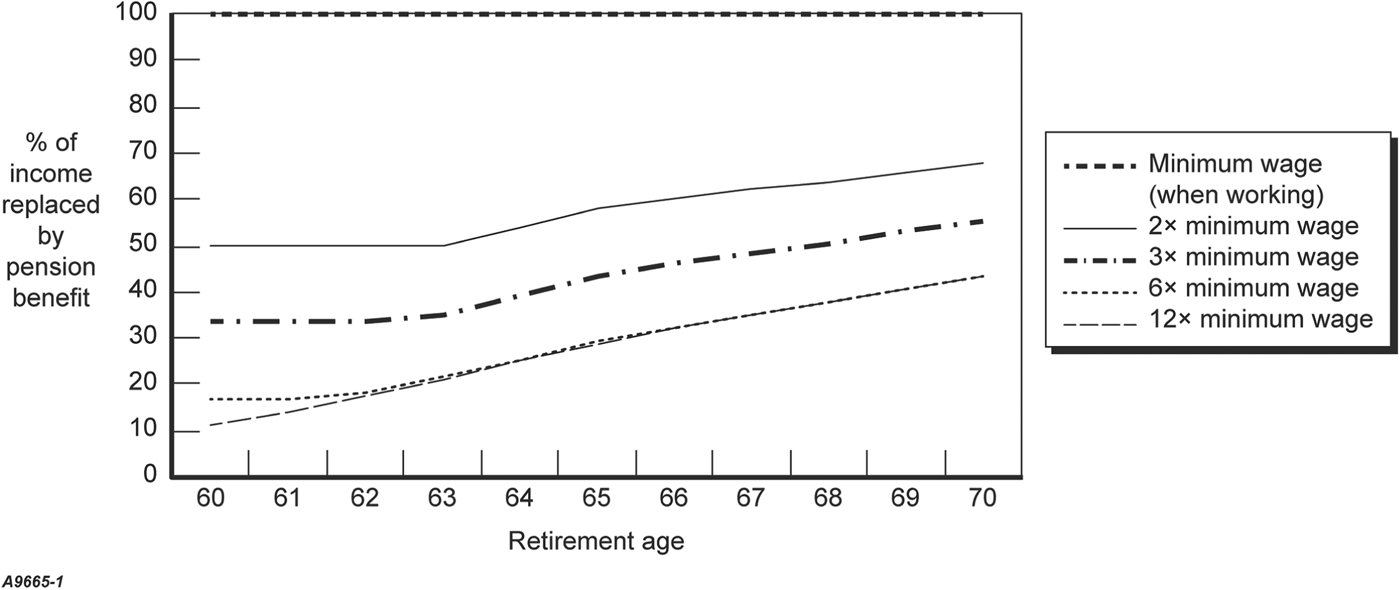
We present in Figure 1 the old-age pension replacement rate, i.e., the pension or social security benefits as a proportion of the wage previous to retirement, from ages 60 to 70 for various levels of labor income expressed as a multiple of the minimum wage. The old-age pension replacement rate measure shows the effectiveness of the social security system at replacing pre-retirement wages with retirement income. The pension replacement rate is computed assuming 10 years of contributions at age 60 and one additional year of contribution for each additional year in the labor force.
PAYG replacement rate by selected levels of labor income.

The replacement rate is 100% for individuals earning the minimum wage, as they receive the MPG. The replacement rate is flat before age 65 for lower-income workers claiming the MPG. Higher-income individuals do not claim the MPG and the replacement rate increases the longer they stay in the system. Higher-income individuals have fewer incentives for retiring early because the replacement rate increases the longer they stay in the system in comparison to lower-income workers that claim the MPG.Footnote 5
The penalty for retiring below the normal retirement age is actuarially equivalent to retiring at 65, because the present value of the early retirement social security benefits is equal to the social security benefits at age 65 except for those that claim the MPG. After age 65, the social security benefits increase with additional years of contribution; Mexico has no mandatory retirement age.
2.3 Other retirement benefits and eligibility criteria
In the USA and the UK, dependent benefits induce couples to retire jointly. In Mexico, retiring male workers, including those that claim the MPG, obtain additional benefits equivalent to 15% of their social security benefits. However, the male worker receives these benefits whether or not he has a wife and independent of whether the wife is still working or receives social security benefits. The bottomline: every male retiree receives an extra benefit in the amount of 15% of his social security benefits.Footnote 6
In the Mexican system, survivor benefits are paid to the wife if a male worker dies while working or drawing retirement benefits. These benefits are paid independent of whether the male worker retired early or at normal retirement age. There are no survivor benefits for a husband unless he was financially dependent on his wife's income.Footnote 7
Also, when a formal-sector transition-generation worker retires and claims benefits under the PAYG rules, and then begins working again, he continues to receive his benefits. There is no earnings test in Mexico. If he takes a job in the informal sector after claiming benefits, he will not contribute to a social security system and the job in the informal sector will not affect his PAYG benefits. If he takes a job in the government, he will contribute to the public-sector social security system (ISSSTE) and receive benefits later if he qualifies, without regard to the PAYG benefits, because the two social security systems are unconnected.
Fewer than 10% of private firms in Mexico offer an optional pension benefit in addition to the IMSS social security system (Hewitt Associates, 2005). There is, however, no official information on the number of workers enrolled in private pensions, which have been introduced only in recent decades.
3 Data overview
In this study, we use data from the MHAS, a two-wave panel obtained in 2001 (the first wave) and 2003 (the second wave) for men and women born in 1951 or earlier. The data set is nationally representative and has information on demographic and employment characteristics, health status, access to health-care services, receipt of family transfers (cash or other support from family members), and wealth for respondents in 9,862 households. Spouses of age-eligible individuals were also interviewed, even if they themselves were not age-eligible.
In the first wave, individuals were interviewed between May and August of 2001, with a response rate of 89.7%. MHAS (2004) shows that the 2001 sample's demographic and socioeconomic characteristics are similar to nationally representative surveys from the 2000 Mexican Census, the 2000 Mexican National Employment Survey (ENE)Footnote 8, the 2000 Mexican National Health Survey, and the Mexican National Income and Expenditure Survey 2000, suggesting that the non-response does not introduce sample selection problems. In the second wave, individuals were interviewed from June to September 2003, with a response rate of 94.2% (MHAS, 2004; Wong and Espinoza, Reference Wong and Espinoza2004).
To extend our analysis back to 2000 and include other information on employment characteristics, we merged the MHAS data with the ENE 2000 data for the same individuals.Footnote 9 We also reconstructed 2002 information from retrospective questions of the MHAS 2003 questionnaire. Altogether, we identified a sample of 802 males working and contributing to the IMSS who were 50–69 years old in 2000. We checked for any potential issues in terms of attrition in the panel. We compared the characteristics of individuals in the 2001 MHAS wave from the panel to the 2001 characteristics of those that died, refused or were not contacted in the 2003 wave. We found that the differences between these groups are not statistically significant. The latter may indicate no sample selection problems due to attrition. In our sample, only 45 individuals attrited from the MHAS between the two waves.
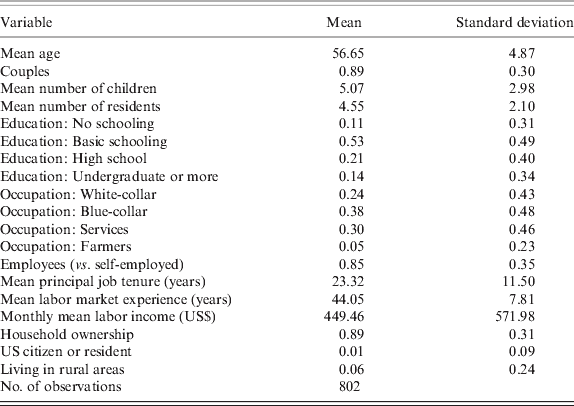
Our sample yielded 3,208 person–year observations from 2000 to 2003. The number of retirement-age individuals who stopped working during this time is 215, of whom 45 later re-entered the labor market.Footnote 10 The remaining 587 individuals continued working through the observed span, so these observations are right censored; i.e., we do not observe their age of retirement. Table 1 shows the main characteristics of our sample of male workers 50–69 years of age who contributed to the IMSS.
Summary statistics of the sample: 50–69 year old male workers at IMSS
Notes: The categories of the education variable are: no schooling (0 years of education), basic schooling (up to 6 years of education), high school (between 7 and 12 years of education), and undergraduate or more (more than 12 years of education).
Source: Author's calculations using the 2000 Mexican National Employment Survey (ENE).
The mean age of the sample is 56.65 and 89% of the individuals have a spouse. The number of residents per household is 4.55, indicating that older adults cohabit with other family members. Fifty three percent of the sample has basic schooling and 11% has no schooling. Most males live in urban areas. Nearly all are blue-collar, service, or white-collar workers. Their monthly mean earnings are $449.46 and have an average tenure on their principal job of 23.32 years. Most live in urban areas.
To analyze and compute the social security benefits, we use MHAS information about years of contribution to the IMSS and current earnings. The MHAS does not include earnings histories, so we built earning profiles using data from the employment surveys we describe below.
3.1 Earnings profiles
We constructed cohort earnings profiles using the National Urban Employment Survey (ENEU) from 1988 to 2003. The cohort cells only include individuals working and contributing to the IMSS.Footnote 11 We estimated the earnings history with the equation (see Blundell et al., Reference Blundell, Meghir, Smith, Gruber and Wise2004):
 $$Y_{igt} \equals \theta _{i} Y_{gt} .$$
θi is an individual-fixed effect that is estimated as θi=Yig 2000/Yg 2000 in order to adjust for differences among individuals in the same cohort and education group (g). We use the labor income information from 2000 reported in the ENE from the exact same individuals who were also interviewed in the MHAS to adjust the past earnings history for each individual.Footnote 12
Five percent of our sample had missing observations for the 2000 wage variable. We imputed the missing data using Ordinary least squares (OLS), controlling for age, gender, education, number of children, total household residents, marital status, household ownership, occupation, number of working hours, self-employed/employed status, and job tenure.Footnote 13 We estimated the future earnings from 2001 onwards by assuming a constant increase in real wages of 1.0%.Footnote 14
As noted, social security benefits are computed from the average wage in the 5 years prior to retirement. The earliest date earnings are required in order to compute the social security benefits for 1995. Another issue to consider is the high proportion of individuals working in the informal sector and the number of workers moving between the formal and informal sectors in Mexico during working age (see, e.g., Maloney, Reference Maloney2002; Maloney, Reference Maloney2004; Cox-Edwards and Rodríguez-Oreggia, Reference Cox-Edwards and Rodríguez-Oreggia2006; Perry et al., Reference Perry, Maloney, Arias, Fajnzylber, Mason and Saavedra-Chanduvi2007). In this analysis, we assume that individuals contribute to the IMSS in each of the 5 years prior to retirement, so that previous movements between the formal and informal sectors do not affect our estimations. We consider this plausible because individuals have fewer incentives to stop contributing to the IMSS in the 5 years before retirement.
4 Construction of retirement incentive measures
We use the option value, peak value, and 1-year accrual retirement incentive measures (see Stock and Wise, Reference Stock and Wise1990; Coile and Gruber, Reference Coile and Gruber2007; Gruber and Wise, Reference Coile, Gruber, Gruber and Wise2004) to understand the incentives for individuals who have to retire in every year as soon as they reach eligibility. These retirement incentive measures include accrued individual SSW equal to the present discounted value of accrued social security benefits.
The option value method focuses on the opportunity cost of retiring. It compares the value of retiring today (as measured by the estimates of the accrued social security benefits) with that of retiring in the future. The individual continues to work when the expected present value of doing so is greater than that of immediate retirement. The model is forward looking at a point in time and allows expectations about future events to be updated as the individual ages. Thus, the retirement decision is evaluated again every period with the new information available. The value function considers a utility from working that depends on the after-tax wage (y) from year s until retirement (R). It also includes a utility of retirement that is a function of retirement SSW received until death. β is the discount rate and prs /t is the probability of being alive at time s conditional on surviving at time t. The term prs /t is multiplicative assuming independence with earnings and retirement social security wealth.
 $$V_{t} \lpar R\rpar \equals \mathop {\sum}\limits_{s \equals t}^{R \minus \setnum{1}} {pr_{s \sol t} \ast \beta ^{\lpar s \minus t\rpar } } \ast U_{w} \lpar y_{s} \rpar \plus \mathop {\sum}\limits_{s \equals R}^{T} {pr_{s \sol t} \ast \beta ^{\lpar s \minus t\rpar } \ast U_{R} \lpar SSW_{s} \lpar R\rpar \rpar .$$
The value function depends on retirement age (R), which determines the retirement benefits and the date until earnings are received. The individual compares the expected value function of retiring in the first period possible with the highest expected value function of retiring in the future: OVt(R)=EtVt(R)−EtVt(t). When EtVt(R)>EtVt(t) and therefore OVt(R)>0, the individual continues working, as the value of retiring is higher in the future. On the contrary, if OVt(R)⩽0, the individual retires because the value of retiring in the future is lower. The value function is evaluated up to T−1 as there is no mandatory retirement age in Mexico.
Uw(ys)=ys γ and UR(SSWs(R))=(k*SSWs(R))γ, where γ is the risk aversion parameter with an underlying utility function of constant relative risk aversion, and k accounts for the disutility of labor (k⩾1). SSWs(R) is the present discounted value of retirement social security benefits and ys is the present discounted value of after-tax labor income.Footnote 15
The peak value compares the expected discounted present value of a worker's SSW if the worker retired today and the maximum wealth in all future periods. Comparing the option value with the findings using the peak value can help isolate more clearly the effect of social security on retirement behavior. Labor earnings in the option value could capture differences across individuals in preferences about leisure and the estimated effect of retirement incentives on the probability of retirement may not be identified. The peak value not including labor earnings could provide a more accurate estimate of the effect of retirement incentives on the probability of retirement (Coile and Gruber, Reference Coile and Gruber2007). A single-year accrual compares the value of retiring in period t and t+1 (SSWt +1−SSWt). Coile and Gruber (Reference Coile and Gruber2007) find that retirement decisions are more sensitive to the peak value than to the single-year accrual, showing that forward-looking retirement incentive measures are more accurate to model retirement behavior. The peak value and option value take into account the age profile of possible benefits in the future. In the next section, we explain how to calculate SSW for the PAYG system in Mexico.
4.1 SSW of the PAYG system
SSW is the present value of an individual worker's social security benefits. Once we know the SSW of every worker, we can compute the retirement incentives measures.
We estimate the present value of the social security benefits as follows:
 $$SSW_{t}^{} \lpar R\rpar \equals \mathop {\sum}\limits_{s \equals R}^{T} {{{\lsqb pr_{\left. s \right\vertt} ^{} \ast rb_{R} ^{} \rsqb } \over {\lpar 1 \plus d\rpar ^{s \minus t} }}} \comma$$
SSWt is the present discounted value of the rbR which are the PAYG retirement social security benefits.Footnote 16T=101 is the maximum number of years a worker has been alive according to the Mexican National Population Council mortality tables for 2000. d is the discount rate, and R is the date of retirement.
We computed the survival probabilities (prs |t) from the Mexican life tables in 2000 for men published by the National Population Council (CONAPO, 2000). ps |t is estimated as  $p_{\left. s \right\vertt} \equals \prod _{t}^{s \minus \setnum{1}} \lpar 1 \minus \lambda _{t} \rpar $. λt is the hazard function. The hazard function is estimated as λt=dt/St where dt are the number of persons dying in period t and St are the survivors at time t.Footnote 17
Retirement benefits are computed as follows according to the IMSS PAYG rules:
 $$rb_{R} \equals \lpar 1 \minus \mu _{R} \rpar \ast \lsqb \psi \lpar \bar{Y}\rpar \ast \bar{Y} \plus \varphi \ast \lpar \omega \minus 10\rpar \ast \lambda \lpar \bar{Y}\rpar \ast \bar{Y}\rsqb .$$
ɸ indicates if the individual has contributed more than 10 years to the social security institute.  $\bar{Y}$ is the average wage of the previous 5 years to retirement.
 $\psi \lpar \bar{Y}\rpar $ is the replacement rate which is a decreasing function of $\bar{Y}$.
 $\lambda \lpar \bar{Y}\rpar $ is the replacement rate for every year of contribution beyond ten and is an increasing function of $\bar{Y}$. ω are years of contribution to the IMSS. μR is the penalty for early retirement.
We calculate the average wage in the 5 years prior to retirement as
 $$\mathop Y\limits^{ \minus } \equals {1 \over 5}\mathop {\sum}\limits_{s \equals R \minus \setnum{5}}^{R \minus \setnum{1}} {Y_{s} \ast \lpar 1 \plus Y_{lb} \rpar } \comma $$
Ys is the nominal wage before taxes. Ylb are labor benefits provided by the employer such as meals, uniforms, and commissions. Ys is top-coded to a maximum of 25 times the minimum wage, the maximum a worker can contribute to the system. For higher-income workers that receive a salary greater than the maximum, the social security retirement benefit is computed as 25 times the minimum wage. After-tax labor income for the workers enrolled in IMSS is:
 $$y_{s} \equals Y_{mw} \ast Y_{s} \ast \lsqb 1 \minus \tau _{IT} \lpar Y_{s} \rpar \rsqb \plus \lsqb 1 \minus Y_{mw} \rsqb \ast Y_{s} \ast \lcub 1 \minus \tau _{IT} \lpar Y_{s} \rpar \minus \tau _{SS} \lpar Y_{s} \rpar \ast \lpar 1 \plus Y_{lb} \rpar \rcub .$$
τIT is the income tax, which is an increasing function of Ys. τSS is the social security contribution. Ymw has a value of one when the worker earns no more than the minimum wage and a value of zero if making more than the minimum wage. Workers earning the minimum wage are exempt from paying the income tax and receive a redistributive subsidy by the government called a salary loan. In addition, the employers cover social security contributions for workers making the minimum wage. In these cases, before-tax labor income is lower than after-tax wage due to the government subsidy.Footnote 18
The MHAS provides information on after-tax income (ys). In order to compute social security benefits, before-tax labor income (Ys) is required. The income tax (τIT) and social security tax (τSS) are deducted from the gross labor income to obtain the after-tax wage. The income tax is a function of before-tax labor income but the social security tax is a function of before-tax labor income plus labor benefits (Ylb). After rearranging the terms in Equation (6), we obtain before-tax labor income. We approximated the before-tax wage with an iterative procedure. According to the labor regulations in Mexico, the minimum labor benefits (Ylb) provided by the employer must represent 4.52% of a worker's before-tax wage. We obtained income tax brackets (τIT) from 1995 to 2003. Labor benefits vary by firm but we assume that all workers receive the minimum Ylb according to the regulatory framework, as there are no studies that indicate a difference in benefits by firm size or industry. Moreover, the Ylb proportion has not changed in the regulatory framework since the 1970s. τSS was estimated by taking into account the employee social security contributions to all IMSS services described in Aguila (Reference Aguila2011). For workers earning the minimum wage, the employer pays τSS.Footnote 19 We used the Mexican National Consumer Price Index to deflate retirement benefits and after-tax labor income since 2002.
4.2 SSW and retirement incentives estimates
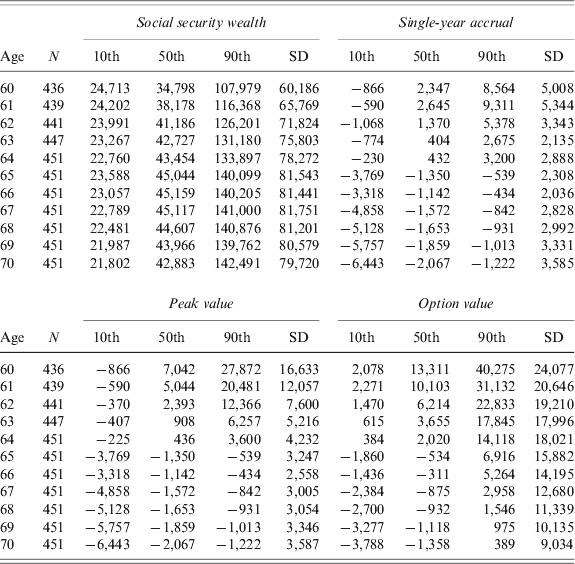
Table 2 shows workers' SSW computations. It also presents our estimated retirement incentive measures. The single-year accrual and peak value measures for SSW are in US dollars. The estimates of the option value are measured in utility units so they are not comparable in magnitude to the peak value or single-year accrual.
Social security wealth, single-year accrual, peak value, and option value percentiles by age (US$)
Notes: N is the number of observations by age. SD is the standard deviation.
Source: Author's calculation using the 2001 and 2003 Mexican Health and Aging Study (MHAS) and the 2000 Mexican National Employment Survey (ENE).
Table 2 also presents the percentiles of the distribution of SSW and each incentive measure. It shows the percentile values for each age of those individuals that were working in the year 2000 and had not exited the formal sector. Each age is affected by sample selection. Given that the MHAS does not have past earnings histories, we cannot check whether the typical individuals in these percentiles have patterns of SSW accumulation or decumulation that are similar to those of the percentile values in Table 2.
A median worker's SSW is US$34,798 at age 60. This increases but at a decreasing rate to age 65 when it is US$45,044. The accrual rate declines from age 60 to 65 but is positive. After age 65, the SSW increases slightly and then decreases by 0.8–1.7% each year.
For workers at the 10th percentile, SSW is highest at age 60 and decreases most years after that, indicating that lower-income workers would be better off retiring as soon as they fulfill the requirements to obtain social security benefits. This is largely because workers in the 10th percentile would claim the MPG and SSW declines the longer they stay in the labor market because they receive the same monthly benefits for a shorter period of time.
In contrast, workers in the 90th percentile have a positive accrual rate up to age 65. After age 65, the accrual rate is negative. SSW at age 60 is US$24,713 for those in the 10th percentile at age 60, and US$107,979 for those in the 90th percentile. Workers in the 10th percentile receive, on average, 23% of the SSW that workers in the 90th percentile obtain at age 60. The standard deviation shows high variation in SSW.
The results of single-year accrual and peak value follow the same tendency. The incentive measures are computed from age 60, the earliest possible age to retire. The single-year accruals in Table 2 show that individuals in the 10th percentile have incentives to choose the early retirement option. In contrast, individuals in the 90th percentile and the median would have incentives to work until age 65.
Table 2 shows the results for the peak value. The peak value predicts that individuals in the 10th percentile would choose to retire as soon as they reach the minimum requirements. Individuals in the 90th percentile face different retirement incentives; the peak value shows that they have more incentives to delay retirement until age 65. It is worth highlighting that the single-year accrual and peak value are very similar for the 10th percentile. This is consistent with the SSW for the 10th percentile in Table 2, which indicates that the highest amount is always in the current period when compared to all possible future periods.
The option value shows positive values for the 10th and 50th percentiles up to age 64 in Table 3. After 64 years of age, the option value is negative. In the 10th percentile, the positive option values up to age 64 are very small. Workers in the 90th percentile have positive option values at all possible retirement ages but the estimate shows a decreasing trend. The single-year accrual, peak value, and option value provide similar results for the 50th percentile. The correlation between the peak and option values is 0.82, the correlation between the peak value and the single-year accrual is 0.93, and the correlation between the single-year accrual and the option value is 0.74.
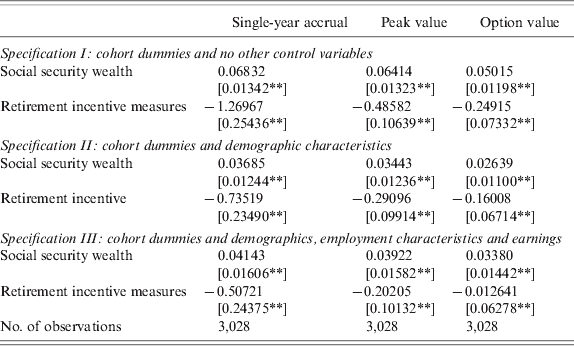
Marginal effect of the probability of retirement: single-year accrual, peak value, and option value
Notes: Demographic variables included in the regression are: cohort dummies, marital status, US citizenship or permanent residency, total number of household residents, years of schooling, residence in a urban or rural area, and household ownership. Employment characteristics and earnings variables included in the regression are: occupation (white-collar, blue-collar, services, and farmer), type of job (employed or self-employed), tenure at firm, tenure at firm squared, labor market experience, labor market experience squared, labor income, and labor income squared. Cohorts are defined as born between 1931–1935, 1936–1940, 1941–1945, and 1946–1950. The benchmark categories for the dummy variables are: cohort born between 1946 and 1950, year 2000, and white-collar occupation. Social security wealth, labor income variables, and the retirement incentive measures amounts are in US$100,000. **Estimates are significant at 5% level of confidence. *Estimates are significant at 10% level of confidence. Standard errors were corrected with the Huber–White robust method for heteroskedasticity.
Source: Author's calculation using the 2001 and 2003 Mexican Health and Aging Study (MHAS) and the 2000 Mexican National Employment Survey (ENE).
In sum, SSW for lower-income employees is higher the earlier they retire. In contrast, higher-income workers are better off delaying retirement. The incentive measures, particularly the single-year accrual and the peak value, indicate that workers in the 10th percentile should retire at age 60 while those in the 50th and 90th percentiles should retire at age 65. The option value predicts normal retirement for workers in the 10th and 50th percentiles but later retirement for those in the 90th percentile.
5 Retirement behavior
5.1 Empirical model
This section presents the estimates of the regression models for retirement decisions. The benchmark model is:
 $$P\lpar R_{it} \equals 1\rpar \equals G\lpar \alpha _{\setnum{0}} \plus \alpha _{\setnum{1}} RI_{it} \plus \alpha _{\setnum{2}} SSW_{it} \plus a_{\setnum{3}} X_{it} \rpar .$$
Rit equals one in the year when the individual transitions from working to not working and zero otherwise. Thus, in period t the individual was not working and in period t−1 the individual was working. This is a conditional probability model where G is the cumulative distribution function. G is assumed to have a standard normal distribution, so we estimate the model with a Probit equation. We pool information for each individual from 2000 to 2003, yielding four periods of data for each individual around retirement age.
Rit is the retirement incentive measures estimated in the previous section, single-year accrual, peak value, and option value. SSWit is social security wealth. Xit is a matrix of demographic characteristics that include age, marital status, number of household residents, education, residence in an urban or rural area, and household ownership. We also include year dummies to capture macro shocks. The variable total number of residents reflects cohabitation arrangements of different generations in a household.
Employment characteristics and earnings variables we included in the regression were occupation (white collar, blue-collar, services, and farmers), type of job (employed or self-employed), tenure at firm in years and years squared, labor market experience in years and years squared, and labor income in dollars and dollars squared.Footnote 20 We define labor-market experience as age minus 6 years and minus the number of years in school (see Coile and Gruber, Reference Coile, Gruber, Gruber and Wise2004).
Other sources of income during retirement are private pensions and US social security benefits. We do not include private pensions in our model because only 1 % of the individuals interviewed in MHAS 2001 had one. To control for US social security retirement benefits, we included a dummy variable indicating US permanent residency or citizenship.
To capture differences in wealth, we included a variable on household ownership. This variable indicates whether individuals own, rent, or borrow the house where they currently live. The MHAS provides other measures of wealth but unfortunately we could not reconstruct these variables for 2000 and 2002.
Health can also affect retirement decisions. The MHAS has rich information about health status and health conditions, but the retrospective questions are not suitable to reconstruct these health variables for 2000 and 2002. We therefore did not include health variables in our analysis.
5.2 Results
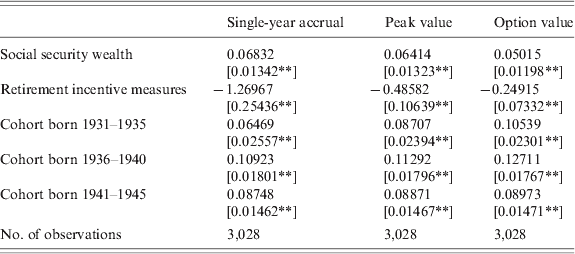
This section describes the results of the retirement-probability models for each incentive measure. Table 3 summarizes the estimated specifications. The coefficients are the marginal effects of the Probit regressions.Footnote 21 We report the average of the marginal effects computed for each individual and then average all of the computed effects.
The first set of results includes no control variables (Specification I). The second set includes demographic characteristics (Specification II). The third set includes demographic and employment characteristics and earnings. Employment and earnings variables are as noted earlier (Specification III). The social security wealth, incentive measures, and earnings variables are in hundred thousands of US dollars.
We use employment and earnings variables to compute the SSW and incentive measures. Including them in the retirement probability model may cause identification problems in the coefficients. Coile and Gruber (Reference Coile and Gruber2007) argue against excluding earning and tenure variables from the specification of the model because it could introduce an omitted variable bias. Earnings and tenure variables may capture the omitted determinants of labor supply; therefore, it would be inaccurate to exclude them from the model. We are interested in separating the effects of the omitted determinants of the labor supply from the effects of the SSW and retirement incentive measures as discussed in Coile and Gruber (Reference Coile and Gruber2007).
Table 3 shows the main results including the incentive measures: single-year accrual, peak value, and option value. SSW and the retirement incentive measures are statistically significant at the 5% level in all of the specifications. As expected, the coefficients of SSW are positive and the coefficients of the retirement incentive measures are negative. We can observe in Table 2 a rather large standard deviation of SSW and the retirement incentive measures indicating that using the Probit model by assuming a normal distribution might not be accurate. For robustness, we conducted the same analysis using a transformation for SSW, labor income variables, and the retirement incentive measures but the results were very similar.Footnote 22
An increase in US$10,000 of the single-year accrual implies a decline in the probability to retire by 12.6% for the effect estimated in Specification I with no control variables. An increase in US$10,000 of the peak value implies a decline in the probability to retire by 4.8 %. For the option value, a rise in 10,000 units decreases the probability to retire by 2.4%. The Appendix shows the results of the entire specifications.
In order to compare and interpret these effects, we compute the changes in the predicted probability by an increase in one standard deviation of the retirement incentive measures. In Specification I, an increase by one standard deviation of the single-year accrual decreases the predicted likelihood of retirement by 3.6 %. An increase by one standard deviation of the peak value decreases the predicted likelihood of retirement by 3.5%, while a one standard deviation increase in the option value declines by 2.8 %. In Specification II, an increase by one standard deviation of the single-year accrual decreases the predicted likelihood of retirement by 2.1 %, for the peak value we find a decline by 2.0 %, and for the option value by 1.8 %. In Specification III, an increase by one standard deviation of the single-year accrual, peak value, and option value decreases the predicted likelihood of retirement by 1.4 %.
In sum, the SSW and incentive measures coefficients are as expected. SSW always has a positive influence, implying a higher probability to retire as the social security benefits increase. This shows an income effect in the retirement decision. The incentive measures coefficients are negative, indicating that higher social security retirement benefits in the future decrease the probability of retiring in the current period. A substitution effect is present in the retirement decision. The coefficients of the single-year accrual, peak value, and option value are smaller when employment characteristics and earnings are included.
6 Simulating the effect of a reform from a PAYG system to PRAs
In this section, we present the simulation results of the effect on retirement behavior of a reform from a PAYG to a PRA system. To estimate the effect of the reform from a PAYG to a PRA system on retirement behavior, we assume that transition-generation individuals in this analysis contribute all of their working life to the PRA system. We assume that the cohorts that retired at the beginning of the 2000s in our data contributed during all of their working life to the PRA system. Ideally, we would observe responses to retirement incentives that will be in place from the 2020s onwards, when the new-generation will start retiring under the PRA system. In this analysis, we provide an indication of the changes in retirement behavior in Mexico as a result of the replacement of the PAYG system with a PRA system. Our data are for individuals who faced a different labor market and economic environment when working between the 1950s and the 2000s. Unfortunately, we cannot estimate directly the effects of the PRA system on retirement decisions: there are 20 individuals from the new-generation in our sample, not a sufficient number to analyze the retirement decisions as we did above.
We compute the SSW and retirement incentives according to the PRA system and obtain the hazard rates of the probability of retirement under the PRA system. We compare the retirement hazard rates under the PRA system with the hazard rates under the PAYG system. In the next section, we show how we estimated SSW under the reform scenario and then present the results of the simulation analysis.
6.1 SSW of the PRA system
Private retirement funds administrators (Administradoras de Fondos para el Retiro, or AFORES) manage the PRA system. The longer workers contribute, the higher their benefits, so early retirement is penalized. This system does allow early retirement from age 60 as long as the worker can obtain benefits of at least 130 % of the MPG with the PRA funds. As in the PAYG system, in the PRA there is an MPG equivalent to the minimum wage of Mexico City, indexed to inflation. The IMSS computes the PAYG benefits and the AFORE presents the PRA options of annuitization or scheduled withdrawals provided by insurance companies. Insurance companies sell different types of annuities and workers can choose among those available (Aguila, Reference Aguila2011).
The PRA benefits are computed from the balance in the individual account, which depend on the employee contribution rate (τe), the employer contribution rate (τem), and the government contribution rate (τg), which is a percentage of the worker's monthly wage w. The employee and employer contributions did not change after the pension reform, remaining at 6.275 % of a worker's wage.
The government contribution also includes a redistributive component called the social quota that is a fixed amount (csq) equivalent to 5.5 R of the minimum wage in Mexico City. These contributions are calculated monthly but deducted from the worker's wage and are deposited in the AFORES bimonthly. The balance of the PRA account also depends on the fees charged by the AFORES. Since its beginning, the PRA system has had up to three types of management fees: load factor (flf), accrued interest, (fr), and balance fee (fb). Accrued-interest fees were discontinued in 2003 and load-factor fees in 2008. The load-factor fee was a percentage of the total wage on which the worker paid a contribution to the PRA system. It was also charged bimonthly, but the balance and the interest fees were charged monthly. PRA performance also depends on the monthly rate of return r and the bimonthly periods of contribution to the system M. The contributions are deposited bimonthly, but the balance and the interest fees are charged monthly, therefore, the PRA retirement benefits with management fees are computed as follows:
 $$rb^{DC} \equals \mathop {\sum}\limits_{k \equals \setnum{3}}^{\setnum{2}M} {\lsqb rb_{k}^{DC} \plus rb_{k \plus \setnum{1}}^{DC} \rsqb } \comma $$
 $$rb_{k}^{DC} \equals \langle \lcub \lsqb \lpar Y_{k \minus \setnum{1}} \plus Y_{k \minus \setnum{2}} \rpar \ast \lpar \tau _{e} \plus \tau _{em} \plus \tau _{g} \rpar \rsqb \minus f_{lf} \plus c_{sq} \ast 2\rcub \ast \lsqb 1 \plus r\lpar 1 \minus f_{r} \rpar \rsqb \rangle \ast \lpar 1 \minus f_{b} \rpar \comma $$
where
 $$rb_{k \plus \setnum{1}}^{DC} \equals \left\{ {rb_{k}^{DC} \ast \lsqb 1 \plus r\lpar 1 \minus f_{r} \rpar \rsqb } \right\}\ast \lpar 1 \minus f_{b} \rpar \comma $$
 $$k \equals \lpar 2\ast i\rpar \plus 1\quad i \equals 1\comma \hskip-1pt\ldots\comma M \minus 1.$$
The present value of the social security benefits of the PRA system is computed using Equation (3) in Section 4.1.Footnote 23Footnote 24 We include the fees of the representative AFORE from 1997 to 2008 as in Aguila et al. (Reference Aguila, Hurd and Rohwedder2012). The fees structure we mentioned above changed in 2008 to include only balance fees, but according to the analysis in Aguila et al. (Reference Aguila, Hurd and Rohwedder2012), the loss in SSW improves only 2 % with respect to the previous scheme with balance, accrued interest, and load factor.Footnote 25 We use the historic time series of the annual rate of return of commercial banks; for the years after 2001, we assume an annual rate of return of retirement funds of 5.0 %, which is a standard rate used to compute the social security benefits (Aguila et al., Reference Aguila, Hurd and Rohwedder2012). We simulate the earnings history of these individuals over their working life because the MHAS does not contain earning histories. We simulate the earnings profiles with a simple version of the Mincer (Reference Mincer1974) model of earnings.Footnote 26 We employ the National Urban Employment Survey (ENEU) from 1988 to 2003; our sample is individuals working and contributing to the IMSS by education group. With the simulation results, for each individual, we estimated his average annual rate of growth of labor income (Δit) from 1950 to 2000. We estimated the earnings history for every period from t to t−51 in order to include the first possible entry into the labor market for the individuals in our sample as follows: Yit −1=ΔitYit. We estimated the future earnings from 2001 onwards by assuming a constant increase in real wages of 1.0 %.
6.2 Effects of the PRA reform on retirement behavior
We estimated the SSW of the PRA system and retirement incentives. We find that the SSW is much lower in the PRA than in the PAYG system (results not shown).Footnote 27 The low levels of SSW accumulation are due in part to the volatility of the Mexican economy between 1970 and 2000. Economic cycles severely affect SSW accumulation.
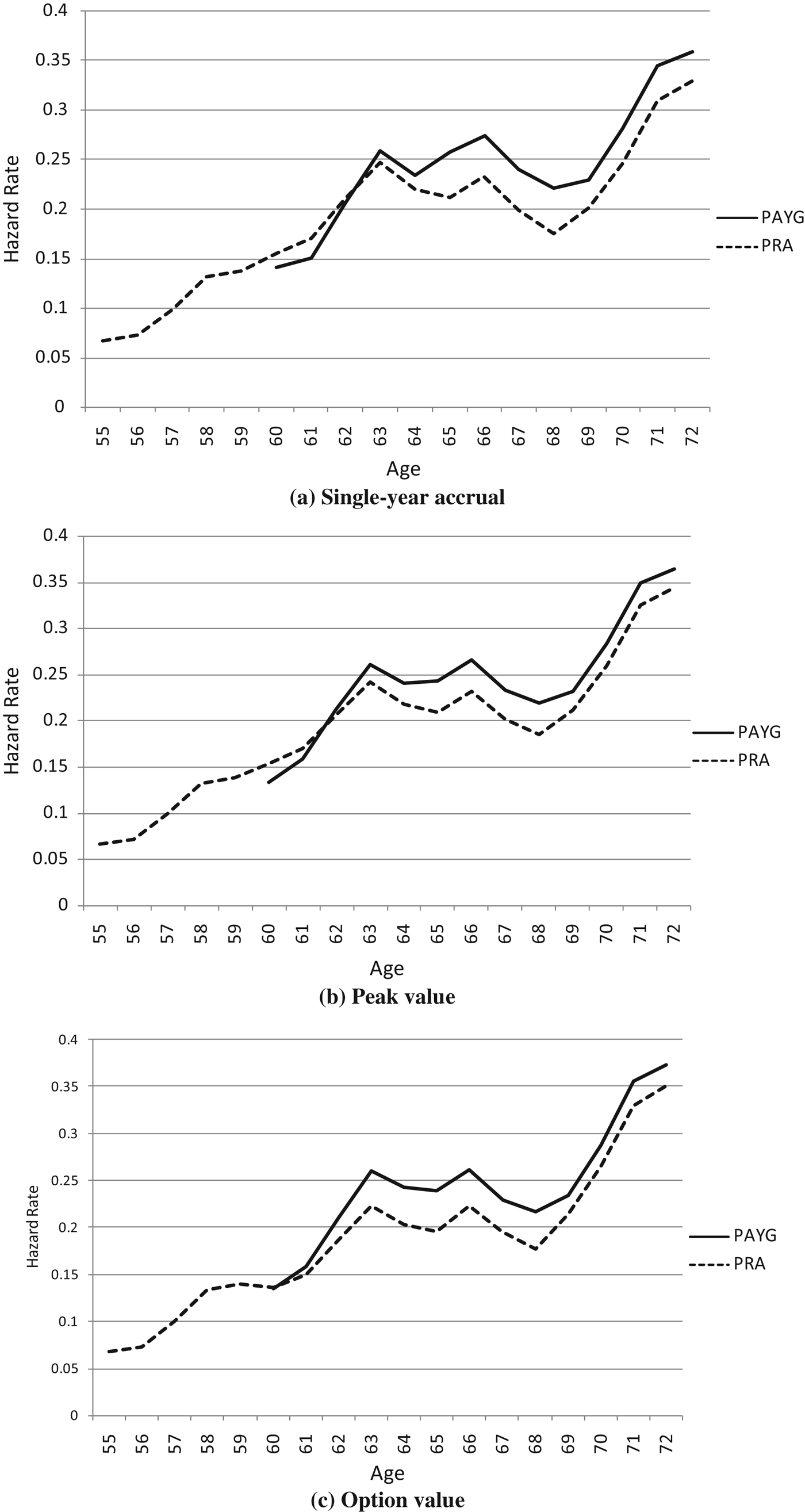
The retirement incentive measures show that individuals in the PRA system have incentives to retire as soon as they can with the MPG because working more years does not provide them with a higher retirement wealth. The MPG distorts the incentives to work for longer in the PRA system and offsets the wealth effect of the system.Footnote 28 In Figure 2, we show the hazard rates of retirement for the PAYG system and the PRA reform scenario. We observe that individuals are more likely to choose the early retirement option as soon as they reach eligibility. While the worker's entire wage history and real rate of return of the AFORE determine retirement benefits of the PRA, retirement benefits of the PAYG system only depend on the wage history of the 5 years prior to retirement. In our simulations, retirement benefits under the PRA system are more sensitive to the performance of the Mexican economy during the period of analysis than retirement benefits of the PAYG system. During the period of analysis, Mexico experienced several economic crises resulting in periods with negative real interest rates and negative real rate of growth of wages. In the reform scenario shown in Figure 2, we assume that individuals make consecutive contributions for the years they reported working in their principal job. The average retirement age in the reform scenario is 60 for the PRA, while the average retirement age for the PAYG system is 62.
Hazard rates by age in the PAYG and PRA systems. (a) Single-year accrual. (b) Peak value. (c) Option value. Notes: Individuals in the PAYG system can only start claiming benefits at age 60.
6.3 Sensitivity analysis
We conducted several sensitivity analyses in order to test the robustness of the results. First, we performed the same analysis as in Section 6.2 but assumed that all individuals at age 60 have 25 years of contribution. The results did not change: individuals prefer to retire as early as possible. Second, we conducted a sensitivity analysis for the changes in the real rate of return but the results are very similar. The impact of the economic crises on wages, during the period of analysis, causes increases in the interest rate by up to 10% in real terms, and has a very small effect on retirement wealth accumulation. Even with an increase of 10% in the real interest rate, more than 95% of individuals at age 60 have accumulated retirement wealth below the MPG. These individuals have incentives to claim the MPG and retire as soon as they are eligible.
Finally, we conducted a sensitivity analysis by constructing earnings profiles with different scenarios of transitions into and out of the formal sector. We designed six different scenarios of plausible earnings trajectories that each individual might have followed in the past.Footnote 29 We find that individuals who move out of the formal sector in the middle and at the end of their working life accumulate lower social security wealth. This may indicate that individuals who move between the formal and informal sectors in the middle and end of their working life obtain lower levels of social security wealth. Individuals who can only claim the MPG prefer to retire as soon as they comply with the eligibility criteria. Given low levels of accumulation of social security wealth, individuals prefer to retire as soon as they reach the eligibility criteria.
7 Concluding remarks
Mexico and other Latin American nations have seen a decrease in labor force participation in early retirement ages similar to that seen in the USA before the 1990s. We find that the incentives for retirement built into the social security system have probably contributed to such retirement decisions.
According to the incentive measures we estimated, lower-income workers would always choose the early retirement option. Higher-income individuals delay retirement in order to claim normal retirement age social security benefits. The accrual rate is in most cases negative, implying that the social security system is not actuarially fair. We find a higher probability to retire when workers have higher social security wealth. The incentive measures indicate that there is a lower probability to retire today when the social security benefits are higher in future periods. These results are as expected and similar to the findings in Gruber and Wise (Reference Coile, Gruber, Gruber and Wise2004).
Mexico reformed its old PAYG system to a system with personal retirement accounts. The results of simulating the impact of the PRA system on retirement behavior show that individuals’ SSW is lower in the PRA than in the PAYG system. We also find that the PRA provides incentives to retire early. This may indicate further analysis is required to understand the consequences for the financial sustainability of the social security system and income security at older ages in Mexico.
Appendix
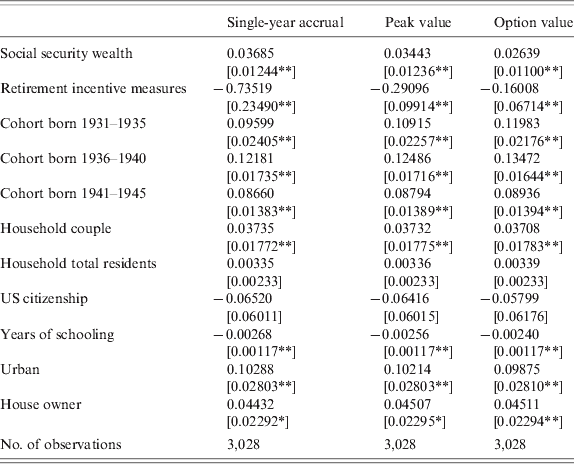
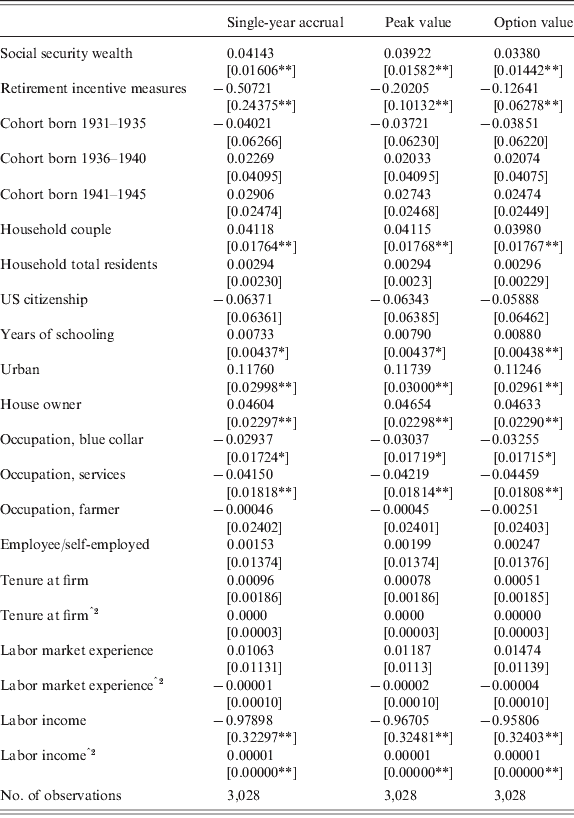
The following tables show the coefficients for the different specifications in Table 3 including only cohort dummies (Table A.1), adding other demographic variables (Table A.2), and employment characteristics and earnings (Table A.3). The probability to retire is higher for households with couples and a larger number of household residents in comparison to households with singles. Table A.2 shows that males with more years of schooling have a higher probability to retire. Table A.3 shows the coefficient of years of schooling becomes very small after including occupation characteristics. This may indicate that occupation could be correlated to years of schooling and is capturing part of the effect. We find a higher probability to retire for individuals that live in urban rather than rural areas. This could be explained by a higher access to social security in urban areas.
Probability of retirement including cohort dummies: single-year accrual, peak value, and option value
Probability of retirement including demographics: single-year accrual, peak value, and option value
Probability of retirement including demographics, employment characteristics and earnings: single-year accrual, peak value, and option value
The available variable to capture differences in wealth is home ownership. The coefficient is significant in all of the specifications and is positive. Wealthier individuals are more likely to retire. Males in blue collar jobs or in service occupations are less likely to retire than those in white-collar jobs. The coefficients of job tenure and labor market experience are not significant.