Introduction
In Southeast Asia poultry and people may be exposed to and infected with avian influenza virus through a complex chain of social and economic activities related to raising, buying and selling of poultry and their products. In order to understand the dynamics of disease spread and to formulate effective and efficient measures to prevent and control outbreaks, it has become increasingly important to understand the structure of the poultry sector and the relationships between the many people and institutions involved. Mapping of value chains is one tool that can assist.
Value chain mapping is a tool used in economics and business/managerial science to study the structure of an industry or a firm by focusing on how actors are connected through various forms of contracts and other coordination mechanisms (or governance) (Kaplinsky Reference KAPLINSKY2004; Reardon Reference REARDON2006). The application of the approach to food safety and animal health regulations in livestock markets has been proposed (Humphrey and Napier Reference HUMPHREY and NAPIER2005; Riviere-Cinnamond et al., Reference RIVIERE-CINNAMOND, PASCHALI and WELLS2005). Kobayashi (Reference KOBAYASHI2006) confirmed the usefulness of value chain mapping in addressing HPAI policy issues and described a four step process: (1) drawing the first maps and identifying risk factors (2) collecting data (3) describing the industry structure and refining and completing the maps and (4) conducting analyses (Kobayashi Reference KOBAYASHI2006).
FAO has supported the development of poultry value chain maps in Vietnam, Indonesia, Myanmar, Egypt and China. The objective of the studies in Indonesia is to develop a better understanding of poultry value chains in different regions of the country and use this information to develop and strengthen effective HPAI prevention and control policies and interventions. This paper describes one such study, undertaken in the province of North Sumatra, Indonesia, and suggests ways in which the information from the maps can be used to assist policymakers to learn where disease risk lies in the poultry sector, who must be involved in risk reduction measures, and what the impact will be on their income and livelihoods options.
Identifying aspects within the value chain
During a participatory workshop in North Sumatra, government livestock authorities and representatives of the poultry industry were asked to identify key ‘actors’ in the local industry, key ‘routes’ of product flows, geographical distribution of poultry activities, and sketch value chain maps for the industry.
Consultants from the University of North Sumatra were contracted to verify and elaborate the value chain maps. 13 districts or municipalities were purposively selected as the locations of the survey in consultation with the provincial Livestock Services office. The districts and municipalities were selected because they represent the major poultry production centres in North Sumatra and most are major routes for international and inter-provincial poultry product movements.
Structured questionnaires were used to collect data on poultry production and distribution, and on knowledge of HPAI, primary sources of information, biosecurity practices and waste disposal from a random sample of respondents from breeding farms, poultry associations, farmers, poultry shops, poultry slaughterhouses, and pet bird markets. A total of 474 respondents participated in the study. Traditional, small-scale and large-scale commercial producers were included. After data analysis, the value chain maps were revised and validated in focus group discussions with key stakeholder groups and a qualitative epidemiological risk assessment was also conducted.
Constructing value chains for poultry production
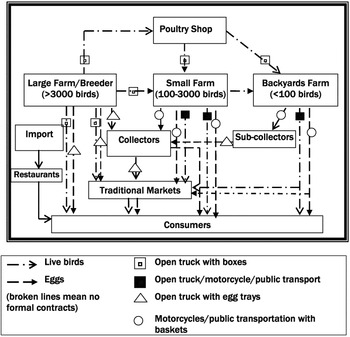
The poultry industry in North Sumatra is economically significant, accounting for up to 5% of North Sumatra's USD 10 billion Gross Regional Domestic Product. Value chain maps were produced for broilers, layers (including ‘male layers’ raised for meat), ducks, native (Kampung) chickens, quail, pet birds, and the feed and poultry manure trade. Each map showed the major actors in the industry, the flow of product, the volume and value of product and the relationship between the various actors. Many actors are involved in the poultry industry and many people rely on the industry for their livelihood; for instance, the on-farm broiler industry alone employs over 35,000 people. The poultry value chains are complicated, involving several production systems. Figure 1 shows the duck value chain.
Duck value chain in Northern Sumatra.

This is one of the simpler chains, but nevertheless it suggests several points of interest. The connection between industrial and smallholder systems, through the supply of young ducks, suggests that breeders could be an important intervention point to provide ‘safe’ young birds for the whole industry. Because of the informal nature of the relationships between most actors (indicated by the depiction of the product flows as dashed rather than solid lines) this would not be an easy system to regulate, and provision of information at critical points on the chain would be important. Traders (‘collectors’) and market stallholders could be very important here as they have a connecting role between farmers and consumers. There are many different types of transport and most of them are open, which suggests a biosecurity risk. Traditional markets, where live birds are sold, are regarded by many people as risky and it is sometimes suggested that they should be closed down, but this map shows that there are currently no alternatives for duck sellers in North Sumatra.
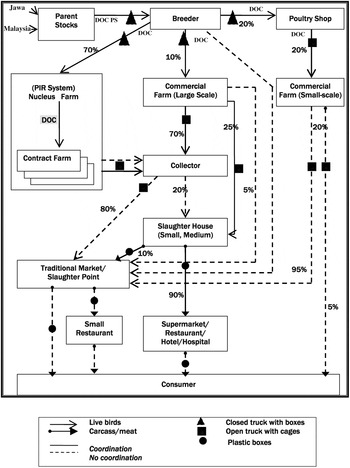
Broiler chicken value chain in Northern Sumatra.

Slaughterhouses are more prominent in the broiler market chain shown in Figure 2, but they still only absorb less than 25% of birds produced from large scale farms (approx 13.6 million out of a total 60.2 million) and none from small scale commercial farms. This chain shows more formal co-ordination than the duck one, particularly between breeders, large scale commercial farmers and contract farmers, but collectors still handle the bulk of transport.
Knowledge of the clinical signs of HPAI in poultry varied among the respondents with only 18% of collectors and 39% of workers at slaughter points able to describe the clinical signs of HPAI. The results are shown in Table 1.
Knowledge of clinical signs of HPAI by respondent.

Results in Table 2 show that 63% of respondents did not apply any significant biosecurity measures. The application of measures was lowest among non-commercial or backyard poultry producers and collectors with only 20% and 35% applying any measures.
Distribution of respondents based on biosecurity application.

Although there are eight major slaughterhouses in North Sumatra, each processing 1,000 to 4,000 birds per day, slaughter points located in traditional markets are the more common place to slaughter live birds. There are around 3,000 slaughter points in North Sumatra, most slaughtering 100 – 500 birds per day. Each slaughter point employs two to three workers, including the owner. Only 37.1% of respondent workers at slaughter points admitted to practicing simple biosecurity, usually using soap and warm water only. 44.8% ‘sterilised’ utilities such as knives while 58.1% respondents answered that they ‘sterilised’ their slaughter point (Table 3).
Biosecurity practices at slaughter points.

Several potentially high risk points for HPAI transmission between birds were identified: the trade in day old chicks between Java, Malaysia and North Sumatra, the more than 52 million birds that pass between nucleus and contract farms, and bird collectors in all poultry chains. Bird collectors are a critical market hub and each collector may have physical contact with many different producers and markets. In terms of animal to human transmission, the estimated 3,000 slaughter points that practice relatively low levels of biosecurity and the trading of unprocessed manure were identified as potentially high risk points.
Discussion
The value chain map is a convenient and efficient framework in which interdisciplinary expertise can be brought together to plan and examine policy implications of HPAI prevention and control options. The maps serve as a useful communication tool among experts and stakeholders with various backgrounds and interests.
The scale of the industry in North Sumatra highlights vulnerability in terms of the actual and potential adverse impact of HPAI on livelihoods and the local economy, and this provides a starting point for policy dialogue with government officials. A major obstacle in implementing control measures is the low level of HPAI awareness among stakeholders along the value chain. The low level of HPAI awareness among collectors, their low levels of biosecurity and their widespread contact with producers and markets make them a priority group for future HPAI awareness and extension activities.
There is a need to identify and disseminate low or zero cost biosecurity control measures, which will probably work best when combined with market incentives that reward safe poultry production and measures to encourage or reward disease reporting. Anecdotal evidence suggests that backyard and small-scale commercial producers sell live or culled birds at the first sign of illness within the flock. The many small scale slaughter points in traditional markets with very low levels of biosecurity are a significant risk point for animal to human transmission. Building of well-managed larger slaughterhouses is one option for addressing this risk, but the concept of slaughtering poultry away from the point of sale may be problematic for consumers who prefer to purchase live birds and have them slaughtered in front of them.
The study highlighted the potential for increased engagement of the private sector in HPAI prevention and control measures. Examples include the building and managing of slaughterhouses and manure processing.
In order to promote the recommendations from value chain analysis and related work, FAO is focusing on advocacy at the provincial and national levels and through working with ‘policy champions’. At the national level a key entry point for advocating recommendations will be the revision of the Government of Indonesia's National Strategic Plan for HPAI Control and Pandemic Preparedness 2006-2008 due to take place in mid-2008. In addition, a joint United Nations presentation to the Parliamentary Committee on Agriculture, Fisheries and Forestry is also being explored as a means to encourage high level commitment in Government to prevent and control HPAI.