The World Health Organization (WHO) and the Centers for Disease Control and Prevention (CDC) recognize the week of November 13–19, 2017, as “Antibiotic Awareness Week.” Antimicrobial resistance (AMR) was presented as a global health and economic threat in May 2017 at the 70th World Health Assembly and the 43rd G7 Summit, and at the 2017 Hamburg Summit in July 2017, as well as at the World Economic Forum in January 2017.
1
,
2
It is estimated that, by 2050, millions of lives will be lost and the cumulative economic cost directly attributable to AMR will reach US$100 trillion.
2
Globalization of trade and ease of travel have facilitated dissemination of multidrug-resistant (MDR) pathogens around the globe. Multidrug-resistant pathogens, predominantly gram-negative rods (GNRs), have been recognized as a global priority for research and development of antibiotics.
3
However, few antibacterial drugs under development are targeting these deadly pathogens, and the clinical efficacy of these new antibacterial agents against life-threatening bacterial infections remains to be seen.Reference Srinivasan, Stundick, Sun, Theuretzbacher, Wallace and Wise
4
Antimicrobial resistance is a global challenge issue for all nations. Low- and middle-income countries (LMICs) have large reservoirs of patients suffering from difficult-to-treat infections. In contrast, while patients in resource-rich countries survive longer due to advances in health care, including organ transplantation and chemotherapy, they are at risk for infection from MDR pathogens due to prolonged exposure in healthcare settings. Likewise, the prevention of AMR requires judicious use of antibiotics, improvement in surveillance, implementation of infection prevention and control (IPC) efforts, and effective national hygiene and sanitation initiatives.
Antimicrobial resistance is a global threat requiring a multipronged global response. Such a response will necessarily include a point prevalence survey (PPS) to assess antibiotic usage at the patient level.
5
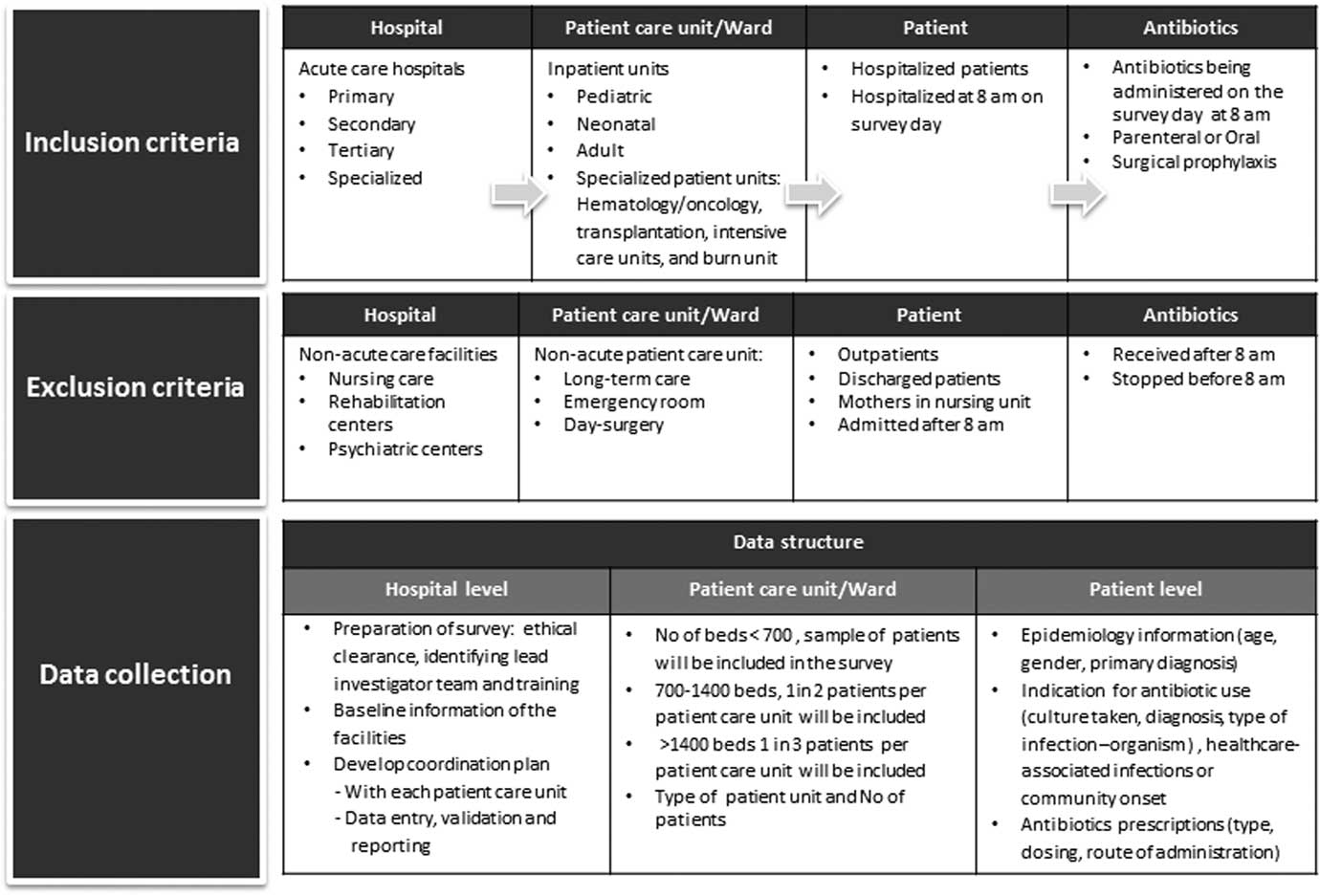
Frontline healthcare and public health professionals will play a pivotal role in measuring the use of antibiotics and determining the indications for their use in managing infectious diseases. The WHO Hospital Antimicrobial Use Point Prevalence Survey (WHO HAMU PPS) is a standardized tool for estimating the prevalence of antimicrobial use in hospitals (Figure 1). While the methodology is designed for worldwide implementation, it has been developed to meet the need and resources requirement in LMICs. By collecting data at a specific point in time, the WHO HAMU PPS allows key data to be collected in a standardized manner, requiring less time and resources than longitudinal surveys. The WHO HAMU PPS, contrary to the global PPS, collects information on all inpatients with or without antibiotics, which also makes it a useful tool for IPC activities. The WHO HAMU PPS will be implemented to support the Global Action Plan on AMR and to facilitate the monitoring of the National Action Plans. In addition, countries will receive technical support to facilitate the participation of LMICs. Hospitals settings have high patient concentrations and high rates of MDR bacterial infections, which are mostly caused by a high selection pressure due to the use of broad-spectrum antibiotics and an inadvertent breech in IPC practices in particular. In a recent meta-analysis, antimicrobial stewardship was associated with a significant decrease in the incidence of infections and colonization with AMR pathogens in hospitalized patients.Reference Baur, Gladstone and Burkert
6
The WHO HAMU-PPS study will assess antimicrobial use at a global level and will raise the overall awareness of rational use of antibiotics. These efforts will generate policy recommendations that will ultimately allow data to be compared at district, country, and regional levels over time.
FIGURE 1
WHO hospital antimicrobial use point prevalence survey protocol.
Pilot sites for the WHO HAMU PPS study will be launched in 33 countries in Latin America and the Caribbean (LAC); 26 of these countries (79%) are LMICs.
7
According to the United Nations Development Programme (UNDP), 8 countries (20%) have a low or medium human development index (average, 0.73; range, 0.493–0.847).
8
Since 1996, a regional laboratory-based AMR surveillance program, Red Latinoamericana de Vigilancia de las Resistencias Antimicrobianas (ReLAVRA), has been reporting AMR data on 21 pathogens (11 community-acquired pathogens and 10 hospital-acquired pathogens) from a total of 21 national reference laboratories from 18 countries.
9
The quality of data is ensured by an external quality assurance program, and the regional trends of resistance have been monitored. However, without measuring the usage of antimicrobials in hospital facilities and at patient levels, a correlation between resistance trends and antimicrobial use cannot be established. Moreover, only very limited data are available and only a few studies have been published regarding antimicrobial use at the patient level in this region. Therefore, it is important to carry out WHO HAMU PPS in this region to collect comparable data and provide guidance for policy decisions.
Meanwhile, IPC initiatives remain critical to preventing person-to-person transmission of AMR pathogens, and sometimes these initiatives are the only option available in resource-constrained settings. The IPC measures enhance the effect of an antimicrobial stewardship program in reducing prevalence of MDR-GNR.Reference Baur, Gladstone and Burkert
6
IPC guidelines formulated to prevent the spread of MDR pathogens, carbapenem-resistant Enterobacteriaceae, Acinetobacter baumannii, and Pseudomonas aeruginosa have been formulated by the WHO and the CDC.
10
,
11
In addition, other public–private partnership projects have been established to support the research and development of new antibiotics. They are funded by Biomedical Advanced Research and Development Authority (BARDA) in the United States and by the Combating Antibiotic Bacteria Biopharmaceutical Accelerator (CARB-X, funded by BARDA, the Wellcome Trust and the US National Institutes of Health). Furthermore, numerous stakeholders, including the Drive-AB project by the Innovative Medicines Initiative, have also focused their discussion on economic models that incentivize the development of new antibiotics while ensuring their value for ongoing use in patients.
12
However, the road to discovery of newer modalities is long and fraught with many obstacles. While we await the success of these initiatives, many LMICs should continue to invest in basic infrastructure for a clean water supply, sanitation, and disinfection, and local facilities should invest in hand hygiene gels and other strategies that address long-term care and rehabilitation of patients infected with MDR pathogens. Multisectorial efforts, international collaboration, public–private partnership, implementation of new economic models to support the research and development of new and effective antibacterial agents, as well as robust surveillance programs, are necessary to address the global challenge of AMR. We are at a crossroad with several significant initiatives. Either these efforts can be made more effective with focused and synergistic efforts or their momentum will dissipate due to the lack of a coherent and effective approach, which will result in serious consequences for us all.





 You have
Access
The World Health Organization (WHO) and the Centers for Disease Control and Prevention (CDC) recognize the week of November 13–19, 2017, as “Antibiotic Awareness Week.” Antimicrobial resistance (AMR) was presented as a global health and economic threat in May 2017 at the 70th World Health Assembly and the 43rd G7 Summit, and at the 2017 Hamburg Summit in July 2017, as well as at the World Economic Forum in January 2017. 1 , 2 It is estimated that, by 2050, millions of lives will be lost and the cumulative economic cost directly attributable to AMR will reach US$100 trillion. 2 Globalization of trade and ease of travel have facilitated dissemination of multidrug-resistant (MDR) pathogens around the globe. Multidrug-resistant pathogens, predominantly gram-negative rods (GNRs), have been recognized as a global priority for research and development of antibiotics. 3 However, few antibacterial drugs under development are targeting these deadly pathogens, and the clinical efficacy of these new antibacterial agents against life-threatening bacterial infections remains to be seen.Reference Srinivasan, Stundick, Sun, Theuretzbacher, Wallace and Wise 4
Antimicrobial resistance is a global challenge issue for all nations. Low- and middle-income countries (LMICs) have large reservoirs of patients suffering from difficult-to-treat infections. In contrast, while patients in resource-rich countries survive longer due to advances in health care, including organ transplantation and chemotherapy, they are at risk for infection from MDR pathogens due to prolonged exposure in healthcare settings. Likewise, the prevention of AMR requires judicious use of antibiotics, improvement in surveillance, implementation of infection prevention and control (IPC) efforts, and effective national hygiene and sanitation initiatives.
Antimicrobial resistance is a global threat requiring a multipronged global response. Such a response will necessarily include a point prevalence survey (PPS) to assess antibiotic usage at the patient level. 5 Frontline healthcare and public health professionals will play a pivotal role in measuring the use of antibiotics and determining the indications for their use in managing infectious diseases. The WHO Hospital Antimicrobial Use Point Prevalence Survey (WHO HAMU PPS) is a standardized tool for estimating the prevalence of antimicrobial use in hospitals (Figure 1). While the methodology is designed for worldwide implementation, it has been developed to meet the need and resources requirement in LMICs. By collecting data at a specific point in time, the WHO HAMU PPS allows key data to be collected in a standardized manner, requiring less time and resources than longitudinal surveys. The WHO HAMU PPS, contrary to the global PPS, collects information on all inpatients with or without antibiotics, which also makes it a useful tool for IPC activities. The WHO HAMU PPS will be implemented to support the Global Action Plan on AMR and to facilitate the monitoring of the National Action Plans. In addition, countries will receive technical support to facilitate the participation of LMICs. Hospitals settings have high patient concentrations and high rates of MDR bacterial infections, which are mostly caused by a high selection pressure due to the use of broad-spectrum antibiotics and an inadvertent breech in IPC practices in particular. In a recent meta-analysis, antimicrobial stewardship was associated with a significant decrease in the incidence of infections and colonization with AMR pathogens in hospitalized patients.Reference Baur, Gladstone and Burkert 6 The WHO HAMU-PPS study will assess antimicrobial use at a global level and will raise the overall awareness of rational use of antibiotics. These efforts will generate policy recommendations that will ultimately allow data to be compared at district, country, and regional levels over time.
WHO hospital antimicrobial use point prevalence survey protocol.
Pilot sites for the WHO HAMU PPS study will be launched in 33 countries in Latin America and the Caribbean (LAC); 26 of these countries (79%) are LMICs. 7 According to the United Nations Development Programme (UNDP), 8 countries (20%) have a low or medium human development index (average, 0.73; range, 0.493–0.847). 8 Since 1996, a regional laboratory-based AMR surveillance program, Red Latinoamericana de Vigilancia de las Resistencias Antimicrobianas (ReLAVRA), has been reporting AMR data on 21 pathogens (11 community-acquired pathogens and 10 hospital-acquired pathogens) from a total of 21 national reference laboratories from 18 countries. 9 The quality of data is ensured by an external quality assurance program, and the regional trends of resistance have been monitored. However, without measuring the usage of antimicrobials in hospital facilities and at patient levels, a correlation between resistance trends and antimicrobial use cannot be established. Moreover, only very limited data are available and only a few studies have been published regarding antimicrobial use at the patient level in this region. Therefore, it is important to carry out WHO HAMU PPS in this region to collect comparable data and provide guidance for policy decisions.
Meanwhile, IPC initiatives remain critical to preventing person-to-person transmission of AMR pathogens, and sometimes these initiatives are the only option available in resource-constrained settings. The IPC measures enhance the effect of an antimicrobial stewardship program in reducing prevalence of MDR-GNR.Reference Baur, Gladstone and Burkert 6 IPC guidelines formulated to prevent the spread of MDR pathogens, carbapenem-resistant Enterobacteriaceae, Acinetobacter baumannii, and Pseudomonas aeruginosa have been formulated by the WHO and the CDC. 10 , 11 In addition, other public–private partnership projects have been established to support the research and development of new antibiotics. They are funded by Biomedical Advanced Research and Development Authority (BARDA) in the United States and by the Combating Antibiotic Bacteria Biopharmaceutical Accelerator (CARB-X, funded by BARDA, the Wellcome Trust and the US National Institutes of Health). Furthermore, numerous stakeholders, including the Drive-AB project by the Innovative Medicines Initiative, have also focused their discussion on economic models that incentivize the development of new antibiotics while ensuring their value for ongoing use in patients. 12 However, the road to discovery of newer modalities is long and fraught with many obstacles. While we await the success of these initiatives, many LMICs should continue to invest in basic infrastructure for a clean water supply, sanitation, and disinfection, and local facilities should invest in hand hygiene gels and other strategies that address long-term care and rehabilitation of patients infected with MDR pathogens. Multisectorial efforts, international collaboration, public–private partnership, implementation of new economic models to support the research and development of new and effective antibacterial agents, as well as robust surveillance programs, are necessary to address the global challenge of AMR. We are at a crossroad with several significant initiatives. Either these efforts can be made more effective with focused and synergistic efforts or their momentum will dissipate due to the lack of a coherent and effective approach, which will result in serious consequences for us all.
ACKNOWLEDGMENTS
The authors appreciate help of Chen-Ling Hsieh of PAHO’s AMR team and Dr Christopher Houchens of BARDA for helpful suggestions.
Financial support: No financial support was provided relevant to this article.
Potential conflicts of interest: All authors report no conflicts of interest relevant to this article.