Implications
The feedstuffs available for poultry nutrition are limited, forming a main problem confronting the poultry production worldwide. Such problem has become even worse by the tendency of using grains in the production of biofuels and the subsequent increase in the prices of feedstuffs. The results of this experiment indicated that whole inedible date could be included in the broiler diets for up to 150 g/kg feed, during the period from 15 to 42 days of age without adverse effects on growth performance and meat quality. This would increase the availability of feed resources, especially in the regions where the supply of feedstuffs is limited.
Introduction
Dates (Phoenix dactylifera L.) are considered a main crop in the arid and semi-arid regions that are mostly located within the latitudes of 10°N, and 39°N (Food and Agriculture Organization of the United Nations, 1999). Date crop plays a central role in the economy and social life in these regions; it is considered an important food source for human being (Hmeidan et al., Reference Hmeidan, Al-Yousef and Al-Turki1993; Hussein et al., Reference Hussein, Alhadrami and Khalil1998; Al-Homidan, Reference Al-Homidan2003). Egypt, Saudi Arabia, Iran, Iraq, UAE, Algeria and Pakistan are seven leading countries that produce more than 90% of the world’s date supply (Daghir, Reference Daghir2008). Dates are also used for the production of molasses, alcohol, vinegar, yeast and several other products, and the date by-products are used in animal feeding (Daghir, Reference Daghir2008). About 20% of dates are inedible for human (Hmeidan et al., Reference Hmeidan, Al-Yousef and Al-Turki1993; Al-Homidan, Reference Al-Homidan2003). Afzal et al. (Reference Afzal, Nafemipou and Riasi2006) studied the effect of using rations containing different levels of whole dates on the growth performance of broiler chicks during the period of 20 to 49 days of age. No significant differences were detected in feed intake, live weight and feed conversion ratio (FCR), when whole dates were used for up to 300 g/kg.
Feedstuffs for economical animal production are considerably limited in many regions of the world, where the feedstuff importation becomes necessary. This is becoming even worse due to the use of different crops such as maize in biofuel production and the subsequent increase in the price of energy sources in animal rations (Farrell, Reference Farrell2005; Lumpkins and Batal, Reference Lumpkins and Batal2005; Światkiewicz and Korleski, Reference Światkiewicz and Korleski2008).
Several attempts have been practiced to replace maize with date wastes in broiler diets, but no much consideration was given to the utilization of the whole inedible dates (WID). Date waste containing considerable amounts of nutrients, ranging 24.2 to 40.0 g/kg for crude protein (CP), 11.1 to 39.5 g/kg for ether extract (EE), 24.1 to 160.0 g/kg for crude fibre (CF), 745.5 to 765.3 g/kg for nitrogen-free extract (NFE) that is rich in monosaccharide of which 440 g/kg is glucose and 500 g/kg fructose and some sucrose (Sawaya et al., Reference Sawaya, Khalil, Khatchadourian, Safi and Mashadi1983), 2321 to 3050 kcal/kg for metabolizable energy (ME), 0.7 to 1.2 g/kg for methionine and cystine, 0.4 to 1.2 g/kg for lysine (Vandepopuliere et al., Reference Vandepopuliere, Al-Yousef and Lyons1995; Hussein et al., Reference Hussein, Alhadrami and Khalil1998; Al-Homidan, Reference Al-Homidan2003). Kamel et al. (Reference Kamel, Diab, Ilian and Salman1981) showed that using whole dates by 50, 100 and 300 g/kg diet to replace the same levels of corn have promoted growth and feed utilization of broilers. Hmeidan et al. (Reference Hmeidan, Al-Yousef and Al-Turki1993) showed that including date wastes by 180, 233 and 278 g/kg of broiler diets improved growth performance and concluded that the use of date wastes by 180 g/kg diet resulted in the highest growth performance of broilers. Vandepopuliere et al. (Reference Vandepopuliere, Al-Yousef and Lyons1995) reported that whole dates and date fruits have supported growth and FCR comparable to or better than those of the control diet. Along the same line, Hussein et al. (Reference Hussein, Alhadrami and Khalil1998) concluded that using dates by 100 g/kg in broiler starter rations had no adverse effect on growth and FCR of growing chicks. Hmeidan et al. (Reference Hmeidan, Al-Yousef and Al-Turki1993) and Al-Homidan (Reference Al-Homidan2003) indicated that WID contains sufficient amount of nutrients, suggesting that these wastes could be an alternative source of feedstuffs.
Although, the above-mentioned studies indicated the usefulness of WID as feedstuffs in broiler diets, the recommended level has not been clearly determined under the present circumstance of using cereals in biofuel production. Thus, this study aims to investigate the effect of different levels of WID in broiler diets during the growing–finishing period (15 to 42 days of age) on growth performance, digestibility of nutrients, carcass characteristics and meat quality measurements.
Material and methods
Birds, management and treatments
Mature WID were collected from different varieties (Zahdi date, El-daf date, Sukarry date and Khudri date) grown in Saudi Arabia. WID used in this study were whole dates, which consisted of date fruits (∼850 g/kg) and date pits (∼150 g/kg; stones). The WID were oven dried at ∼55°C for 24 h, and crushed to about 1 mm3 as a maximum size using a heavy-duty high-rotation hammer mills. A representative sample of WID was collected for proximate chemical analyses for measuring dry matter (DM), CP, EE, crude fibre (CF), ash, NFE, according to Association of Official Analytical Chemists (AOAC; 1990), and methionine, cystine and lysine of date were determined at the BASF AG, Germany, using amino acid analyser (model Biochrom 20, Amershan Pharmcia, Cambridge, UK).
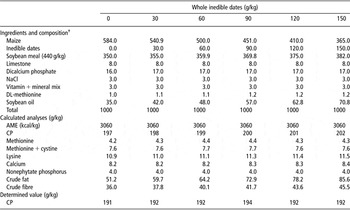
The broiler trial was conducted at the King Abdulaziz University, Faculty of Meteorology Environmental and Arid land Agriculture. Unsexed Lohman straight-run broiler chicks were raised under summer conditions with an average temperature of 38 ± 4°C. Chicks were fed a commercial mash starter diet (220 g/kg CP and 3100 kcal ME/kg diet) during 1 to 14 days of age. During the growing–finishing period (15 to 42 days of age), chicks were subjected to the experimental dietary treatments in which WID were included by 0, 30, 60, 90, 120 and 150 g/kg in isocaloric (∼3060 kcal ME/kg) and isonitrogenous (∼192 g/kg CP) diets. Dietary treatments (Table 1) were based on maize and soybean meal. The diets were formulated to meet the nutrient requirements of broiler chicks (National Research Council (NRC), 1994). The nutrient values of WID used in feed formulation were shown in Table 2.
Composition of the grower–finisher broiler diets fed during 15 to 42 days of age

AME = apparent metabolisable energy.
†Vitamin and mineral mixture provided per kilogram of diet: vitamin A (all-trans-retinyl acetate) 12 000 IU, vitamin E (all rac-α-tocopheryl acetate) 10 IU, K3 3 mg, Vitamin D3 2200 ICU, riboflavin 10 mg, Ca pantothenate10 mg, niacin 20 mg, choline chloride 500 mg, vitamin B12 10 μg, vitamin B6 1.5 mg, thiamine (as thiamine mononitrate) 2.2 mg, folic acid 1 mg, D-biotin, 50 μg. Trace mineral (mg/kg of diet): Mn 55, Zn 50, Fe 30, Cu 10, Se 0.1 and ethoxyquin. In addition, anticoccidial drug (Uccma pedomix produced by United Company for Chemical and Medical Preparations (UCCMA), The Industrial Area, El-Salam City, Cairo, Egypt) at 1 kg/ton was supplemented, which contained 125 g of clopidol.
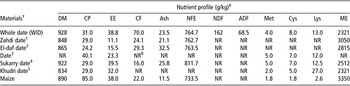
Chemical compositions (g/kg), some essential amino acids (g/kg) and ME value (kcal/kg) of the whole inedible date compared to some literature values

†DM = dry matter; EE = ether extract; CF = crude fibre; NFE = nitrogen-free extract; Met = methionine; Cys = cystine; Lys = lysine; ME = metabolizable (kcal/kg) energy value calculated according to Carpenter and Clegg (Reference Carpenter and Clegg1956); NR = not reported.
‡1Kamel et al. (Reference Kamel, Diab, Ilian and Salman1981); 2Hmeidan et al. (Reference Hmeidan, Al-Yousef and Al-Turki1993); 3Hussein et al. (Reference Hussein, Alhadrami and Khalil1998); 4Al-Homidan (Reference Al-Homidan2003); 5Vandepopuliere et al. (Reference Vandepopuliere, Al-Yousef and Lyons1995); Maize nutrient profile according to NRC (1994), respectively.
Three hundred chicks were randomly distributed to six dietary treatments, each contained five replicates of ten chicks each (approximately equal initial of 15 days of age and 236 ± 15.6 g live body weight (BW)). The average live BW of 1-day-old chicks was 42.1 ± 4.3 g. Each replicate was housed in floor pens (1 × 1 m each), furnished with shaving wood. Chicks were kept under similar managerial and hygienic conditions. Mash ration and water were offered ad libitum from tube feeders and automatic nipple drinkers. A 23-h lighting programme was provided in the house.
Data collections
Chicks were weighed at 15, 21, 28, 35 and 42 days of age. Feed intake was also measured weekly and FCR was calculated. At day 42 of age, five male broilers were selected randomly from each treatment (one bird per replicate) to determine carcass characteristics and weights of internal organs. Birds were fasted overnight and slaughtered, bled, plucked and eviscerated. Each carcass was then weighed (dressed weight), and internal organs and abdominal fat were separated and weighed. The dressed weight and internal organs were expressed as percentages to live BW. A sample of skinless and boneless meat of breast and thigh (1 : 1) were chemically analysed for DM, CP, EE and ash according to AOAC (1990).
The physical characteristics of meat, targeting tenderness and water-holding capacity (WHC) were measured according to Volovinskaia and Kelman (Reference Volovinskaia and Kelman1962), where 0.3 g minced meat tissues were put under an ash-less filter paper and pressed for 10 min using 1 kg weight. On the filter paper, two zones (inner and outer) were formed, where their surface areas were measured by the Planimeter (Gebrüder HAFF GmbH, Germany). WHC was calculated by subtracting the inner zone from the outer zone. The inner zone is due to the meat pressing only indicating the tenderness. Colour intensity and pH value were measured according to the methods of Husani et al. (Reference Husani, Deatherage and Kunlkle1950) and Aitken et al. (Reference Aitken, Casey, Penny and Volys1962), respectively. For the measurement of colour intensity, meat samples (10 g/each) were shaked in 50 ml distilled water in a dark room for 10 min, filtered and the colour intensity (absorbency) was measured using a photometer at 543 nm. For measuring pH value, a 10.0 g of prepared samples from meat and drip were blended with 50 ml of distilled water for 10 min, and the pH value was measured.
Digestibility of nutrients of the total gut was determined using five males per treatment (one male per replicate). At 42 days of age, birds were fasted for 24 h, followed by feeding their corresponding experimental diets for 72 h, so that the feed intake and excreta were accurately determined. The excreta samples were collected for each replicate, cleaned from feathers and feed, weighed, dried in a forced air oven at 70°C for 36 h. They were finally ground and placed in screw-top glass jars until analysed. The procedure described by Jakobson et al. (Reference Jakobsen, Gertov and Nilsen1960) was applied to excreta samples to separate faecal nitrogen and urine nitrogen. CP, EE and CF of the excrement as well as those of feed were determined according to AOAC (1990), and expressed on a DM basis. The digestibility of CP, EE, CF, ash and organic matter (OM) was calculated by dividing the daily amount retained (g/day) by the amount of intake (g/day).
Statistical analysis
Data were analysed using one way ANOVA of GLM procedure of Statistical Analysis Systems Institute (1990). The model was: Yik = μ + Di + eik, where Y is a single observation, μ is the general mean, D is the effect of the treatment (i = A, B, C, D, E, F) and eik is the random error. Before analysis, all percentages were subjected to logarithmic transformation (log10 x + 1) to approximate normal distribution. Student Newman–Keuls test was used for mean differences at P < 0.05.
Results
Nutrient composition of WIP
Table 2 shows the chemical analyses of the present sample of WID. The CP, methionine, methionine and cystine and lysine were 31, 0.4, 1.2 and 1.3 g/kg, respectively. There were apparent differences in chemical composition, ME value and amino acid profiles among different laboratories, as well as in biological variation due to different varieties of WID. On the other hand, when WID was compared with maize, the CP and ME values presented 36.5% and 69.3%, respectively. In addition, the amino acids of maize were higher than those of WID.
Growth performance
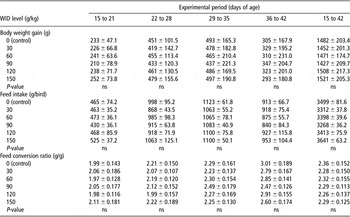
Table 3 shows the effect of different levels of WID on growth performance of broiler chicks. There were no differences due to inclusion of WID for up to 150 g/kg diet on growth, feed intake and FCR.
Growth, feed intake and feed conversion ratio of broiler chicks by whole inedible date level (mean ± s.d.)

ns = not significant.
Digestibility of nutrients
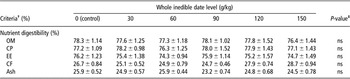
Table 4 shows the effect of different levels of WID on digestibility of nutrients. The digestibility of OM, CP, EE, CF and apparent retention of ash were not significantly affected by WID for up to 150 g/kg diet.
Nutrient digestibilities of broiler chicks as affected by the level of whole inedible date (mean ± s.d.)

†OM = organic matter; DM = dry matter; EE = ether extract; CF = crude fibre; WHC = water-holding capacity; pH.
‡ns = not significant.
Carcass characteristics and internal organs
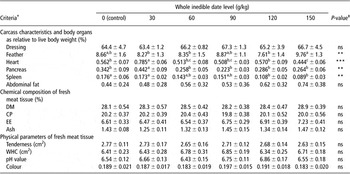
Table 5 shows the effects of different levels of WID on dressed carcass percentage and internal organs of broiler chicks. WID had no adverse effect on dressing percentage. However, it should be mentioned that the inclusion of WID above 30 g/kg in broiler diets insignificantly improved dressing percentage by 2.8% to 3.6%.
Relative weight of dressed carcass and inner organs as relative to live body weight, chemical composition and physical parameters of meat of broiler chicks as affected by the level of whole inedible date (mean ± s.d.)

†OM = organic matter; DM = dry matter; EE = ether extract; WHC = water-holding capacity; pH.
‡ns = not significant.
a,b,cMeans within the same row not having similar superscripts are significantly different (P < 0.05).
**P ⩽ 0.01; ***P ⩽ 0.001.
Feather percentage was significantly increased due to increasing WID to 150 g compared to feeding 30, 60 and 120 g WID. Furthermore, heart percentages of chicks fed 120 and 150 g/kg WID were significantly lower than those fed 30 g/kg. WID at 150 g/kg resulted in lower heart percentage than that of chicks fed diet containing 120 g/kg WID and the control diet. Pancreas hypertrophy (P ⩽ 0.01) was observed in the group fed 30 g/kg WID and this was diminished with increasing WID level. Inclusion of WID above 90 g/kg significantly decreased spleen percentage compared with the control group or those fed 30 g/kg WID.
Meat quality measurements
Table 5 shows the effect of different levels of WID on nutrient profile of meat quality. WID for up to 150 g/kg diet had no significant effects on DM, CP, EE and ash of breast and thigh meat mixture. On the other hand, there were no significant effects of dietary WID for up to 150 g/kg on the physical parameters of meat such as tenderness, WHC, colour intensity and pH of meat.
Discussion
A considerable change in the market price of maize was shown after using it for the production of biofuel (Farrell, Reference Farrell2005; Lumpkins and Batal, Reference Lumpkins and Batal2005; Światkiewicz and Korleski, Reference Światkiewicz and Korleski2008). Thus, there is a renewed interest in the use of agro-industrial by-products such as WID that found in sizeable amounts at reasonable price in the arid and semi-arid regions to overcome the shortage of grains facing animal nutrition. WID contain considerable amounts of nutrients (764.7 g/kg soluble carbohydrate that is rich in monosaccharide, 500 g/kg glucose and fructose and some sucrose (Sawaya et al., Reference Sawaya, Khalil, Khatchadourian, Safi and Mashadi1983) and 2321 kcal ME/kg diet); however, WID are limited in protein and amino acids (Table 2). Similarly, Vandepopuliere et al. (Reference Vandepopuliere, Al-Yousef and Lyons1995) observed that dates contain 2, 5 and 27 g/kg methionine, cystine and lysine, respectively. Al-Homidan (Reference Al-Homidan2003) reported that dates contain 5, 7 and 12.5 g/kg methionine, cystine and lysine, respectively. The differences in chemical and amino acid profile of dates illustrated in Table 2 could be attributed to the tested varieties and the maturation stage of the fruits and/or agronomic condition.
The lack of significance in growth performance of broiler chicks fed different levels of WID for up to 150 g/kg could be partly attributed to high standard deviation as well as low growth rate of broiler chicks raised in the tropic regions (38 ± 4°C) during the experimental course. High ambient temperature in the tropic and subtropic areas adversely influences the growth of chicks (Attia et al., Reference Attia, Böhmer Barbara and Roth-Maier Dora2006). Furthermore, the lack of negative effect of WID on the digestibility of nutrients confirmed the absence of significance in growth performance of broilers during the period of 15 to 42 days of age.
Similar to the present results, Kamel et al. (Reference Kamel, Diab, Ilian and Salman1981), Vandepopuliere et al. (Reference Vandepopuliere, Al-Yousef and Lyons1995), Hmeidan et al. (Reference Hmeidan, Al-Yousef and Al-Turki1993), Hussein et al. (Reference Hussein, Alhadrami and Khalil1998), Al-Homidan (Reference Al-Homidan2003) and Afzal et al. (Reference Afzal, Nafemipou and Riasi2006) reported that WID for up to 240 g/kg in the starter and finisher diets did not significantly affect BW gain (BWG), FCR and feed intake of 49-day-old broiler chicks. This may be due to the high levels of glucose and fructose as available carbohydrate in WID (500 g/kg) and some sucrose (Sawaya et al., Reference Sawaya, Khalil, Khatchadourian, Safi and Mashadi1983).
There was an increased level of oil supplementation to equalize energy level and this could contribute to the improvement in BWG and FCR observed at the highest inclusion levels of WID (Table 3). Furthermore, Kamel et al. (Reference Kamel, Diab, Ilian and Salman1981), Vandepopuliere et al. (Reference Vandepopuliere, Al-Yousef and Lyons1995), Hussein et al. (Reference Hussein, Alhadrami and Khalil1998) and Al-Homidan (Reference Al-Homidan2003) were not able to distinguish between the response of birds to fat (when added to make the diet isocaloric) and to WID, due to the lower apparent metabolisable energy of WID than maize. However, the effect of fats or oils on the improvement of feed utilization was apparent (Summers, Reference Summers1984; Aggoor et al., Reference Aggoor, Attia and Qota2000).
In harmony with the present results, Kamel et al. (Reference Kamel, Diab, Ilian and Salman1981), Hmeidan et al. (Reference Hmeidan, Al-Yousef and Al-Turki1993) and Al-Homidan (Reference Al-Homidan2003) concluded that WID had no adverse effects on dressing percentage with or without giblets and internal organs. The absence of significance effects of WID on the nutrient contents (CP and EE) and physical characteristics of meat tissues (tenderness, WHC and pH) confirmed that the experimental diets containing WID for up to 150 g/kg have met the broiler requirements during 15 to 42 days of age (Table 1). Similarly, Hmeidan et al. (Reference Hmeidan, Al-Yousef and Al-Turki1993) and Al-Homidan (Reference Al-Homidan2003) observed that WID did not significantly affect carcass quality of broilers.
Conclusion
It is possible to include WID for up to 150 g/kg in broiler diets from 15 to 42 days of age without adverse effects on growth performance and meat quality.