INTRODUCTION
Validation of the Word Accentuation Test of Premorbid Intelligence (WAT) among Older, Spanish-Speaking Immigrants in the United States
The identification of dementia in older individuals requires that some standard of prior cognitive ability level be available for comparison with screening or neuropsychological test measures. One method that has been used to estimate premorbid intelligence is the use of reading tests. This method is based on three assumptions: (1) scores on tests of reading ability and general intelligence are highly correlated among normals (Nelson & McKenna, 1975); (2) the ability to pronounce words, without necessarily being able to define them, is preserved in early stages of dementia (Christensen et al., 1991; Cummings et al., 1986; O'Carroll, 1995; Patterson et al., 1994; Storandt et al., 1995); and (3) familiarity with low-frequency words is an indicator of prior education or higher levels of crystallized intelligence (Spreen & Strauss, 1991). This is the logic behind the National Adult Reading Test (NART; Nelson, 1982) and its various adaptations (e.g., Blair & Spreen, 1989; Grober & Sliwinski, 1991; Nelson, 1982) in which an individual reads aloud a list of rarely encountered English words. Scores on these tests are then used in regression equations predicting scores on the Wechsler Adult Intelligence Scales (WAIS; for review, see Crawford, 1992).
The adaptation of tests similar to the NART in languages other than English presents particular challenges. In general, on any NART-like test, word items are selected that meet two requirements. First, they must be sufficiently rare in the corpus so that the ability to read them reflects more advanced reading knowledge. Second, they must not follow the usual grapheme-to-phoneme mapping rules in the language. This ensures that individuals can only pronounce the words because they have prior familiarity with them and not by applying pronunciation rules. This is how English words were chosen for the various British versions of the NART (Crawford, 1990, 1992; Nelson, 1982; Nelson & O'Connell, 1978) and the versions adapted for Canada and the United States (Blair & Spreen, 1989; Grober & Sliwinski, 1991, Schwartz & Saffran, 1987). The same procedure must be followed in languages other than English. That is, the NART cannot be translated, but new word lists must be confected for each language, again targeting words that are both rare and that do not follow common grapheme-to-phoneme mappings in that language. Thus, for example, reading tests have been developed in Italian (Test di Intelligenza Breve or TIB; Colombo et al., 2000), in French (the fNART by Bovet on a French-speaking Swiss sample; see Mackinnon & Mulligan, 2005), and in Spanish for Spain (Del Ser et al., 1997) and Argentina (Burin et al., 2000).
A second issue in developing NART-like reading tests in other languages is choosing an appropriate IQ battery against which to establish the criterion validity of the instrument. The English versions were validated against the WAIS. In the case of languages other than English, either a properly adapted version of the WAIS or a similarly normed cognitive battery must be used. For certain languages, versions of the WAIS have been adapted, both linguistically and culturally, and re-standardized on the population of the relevant language group. Thus for instance, versions of the French WAIS (Wechsler, 1989, 2000) were normed on French speakers in France, the Italian WAIS (Wechsler, 1974, 1997) was normed in Italy, and the Spanish WAIS was normed on Spanish speakers in Spain (Wechsler, 1958[1982], 1997) and in Argentina (Wechsler, 1984). Where no version of the WAIS has been adapted and normed, another standardized instrument must be used.
Both of these issues shape the parameters for adapting the existing Spanish versions of the NART for Spanish speakers in the United States, where according to Census 2000 there are almost 8 million Spanish-speakers who speak English either “not at all” or “not well.” First, the words used as test items must be appropriate for speakers of many “Spanishes” because the Spanish-speaking population of the United States has its origins in both Spain and Latin America. Second, the target list must be validated against a cognitive battery that was itself standardized on speakers of Spanish from Spain, Latin America, and the United States.
The first Spanish version of the NART, the Word Accentuation Test (WAT), was developed in Spain by Del Ser and colleagues (1997). Because Spanish has highly regular rules of pronunciation, rare accented words were selected as test items and then shorn of their accents (Table 1). That is, Spanish “represents phonemes in an almost straightforward letter-to-sound mapping” (Signorini, 1997; p. 323). Nevertheless, there are exceptions to this rule, and these are words whose lexical stress requires explicit marking by means of accent. Thus, to pronounce written words a Spanish speaker must possess both knowledge of the rules plus word-specific knowledge. It is this latter that is tested in the WAT. In the Del Ser et al. study (1997), performance by 81 cognitively healthy elders on a 30-item word list correlated significantly with Vocabulary (r = .842) and Picture Completion (r = .722) subtests of the Spanish (Spain) version of the WAIS (Wechsler, 1982). Internal validity (r = .91), test–retest reliability after 30 days (r = .97), and inter-rater reliability (r = .93) were all high. In a cross-validation with 40 controls and 20 patients with NINCDS-ADRDA diagnoses of dementia, matched on sex, age, and education, no statistical difference in WAT scores was obtained between groups, indicating that the WAT is resistant to mental deterioration.
List of 30 words in the WAT (Del Ser et al., 1997) and their correctly accented forms

An adaptation of the WAT for Buenos Aires (the WAT-BA) was subsequently developed by Burin and colleagues (2000). A new word list, sensitive to Argentine Spanish, was confected and validated against the Argentine version of the WAIS (Wechsler, 1984). The WAT-BA accounted for 85% of the variance on the Vocabulary subtest in a sample of 74 cognitively healthy older adults.
The research reported here follows the logic of both the Del Ser et al. (1997) and Burin et al. (2000) studies and has three aims: (1) to test the feasibility of the original WAT word list and add new items, if necessary; (2) to validate the WAT on a sample of older, cognitively healthy Latin American immigrants; and (3) to develop regression equations predicting intelligence scores from WAT scores.
As noted above, one particular difficulty in this regard is that Spanish versions of the WAIS have been normed in only a few Spanish-speaking countries, and no existing version attempts to take into account variations in the Spanish spoken by immigrants to the United States. Thus, for this research, the WAT was validated against the Batería Woodcock-Muñoz (BWM-R; Woodcock & Muñoz-Sandoval, 1996a). The BWM-R is the Spanish version of the Woodcock-Johnson Psychoeducational Battery–Revised (WJ-R; Woodcock & Johnson, 1989, 1990) which was normed on 6,359 English-speakers, and subsequently re-calibrated on 2,000 Spanish-speakers in six countries and five U.S. states.
Adaptation of the BWM-R took place as follows. Norms on the BWM-R were “equated” with the WJ-R on the basis of item response theory (for a description of this process, see Woodcock & Muñoz-Sandoval, 1993). That is, where subtest items had identical and nonverbal content (e.g., Visual Matching, Calculation), norms were used from the WJ-R. Where subtests used verbal prompts and required verbal responses, items were translated from English into Spanish by native Spanish speakers from various countries who followed an iterative process of crosschecking until consensus was reached. Importantly, new items in Spanish were generated and integrated into the item difficulty rankings of the existing English items.
All of these items (those translated from English plus the new Spanish items) were then re-calibrated on a Spanish-speaking sample of 2000 individuals from Mexico, Puerto Rico, Costa Rica, Spain, Argentina, Peru, and Arizona, California, Florida, New York, and Texas. Items that showed some regional bias were then eliminated so that regional varieties of Spanish would not affect participant performance.
As with the English Woodcock-Johnson, the BWM-R comprises two batteries: cognitive and achievement. The achievement battery measures formal academic achievement: reading and writing skills, quantitative skills, science, social studies, and humanities (Woodcock & Muñoz-Sandoval, 1996b). The cognitive battery (Woodcock & Muñoz-Sandoval, 1996a) is based on the Horn-Catell theory of intelligence (g) and measures the following domains of general intelligence by means of seven standard and seven supplemental subtests: fluid reasoning (Gf), comprehensive knowledge (Gc), visual processing (Gv), auditory processing (Ga), processing speed (Gs), long-term retrieval (Glr), and short-term retrieval (Gsm). Standard scores are generated with M = 100 (SD = 15). In a sample of 17-year-olds, the English Woodcock-Johnson Psychoeducational Battery–Cognitive tests correlated significantly with the WAIS-R Full-Scale IQ (r = .64; Woodcock & Mather, 1989, Table 7.9). However, because no Spanish version of the WAIS normed is available in the United States, it is not possible to establish a similar correlation for Spanish.
Thus, the major strength of the BWM-R for the purposes of this research is that it is the most comprehensive, properly validated and normed intelligence test available for use with Spanish-speaking immigrants, across the variety of “Spanishes” of Latin America and the United States. (For a review of the strengths and weaknesses of the BWM-R for use with older adults, see Schrauf & Navarro, 2005).
Two separate studies were conducted with the WAT. In the first, the WAT and additional test items were tested for feasibility and identification of the most predictive items. On the basis of the results of that study, the original WAT was validated against the BWM-R and the Raven's Colored Matrices.
METHODS
Feasibility Study of The Word Accentuation Test and Additional Test Items
The goals of the feasibility study were to ensure that cognitively healthy Spanish speakers could read out loud the printed versions of the unaccented words (without necessarily pronouncing them correctly), that words would be generally unfamiliar but normally distributed across the group, and that the test administrator could discriminate correct from incorrect pronunciation.
Materials and procedures
To test for the advisability of modifying the original WAT word list, 55 new words were generated and added to the 30 items of the original WAT. As noted above, words in NART-like tests must not follow rule-governed grapheme-to-phoneme mappings in the language in question. Hence, Spanish words were chosen that were both rare in the corpus and accented. Two Spanish linguists confected a list of 100 rare, polysyllabic, accented words in Spanish, with particular attention to Latin American usage. Of these, 55 words with a frequency below 36/2,000,000 (Alameda & Cuetos, 1995) were selected and combined with the 30 original words of the Del Ser et al. (1997) version of the WAT for a final list of 85 words. Participants in the feasibility study were asked to read each word out loud and to rate its pronunciability (“Pronouncing this word is: 1 = very difficult, 5 = very easy) and to rate their familiarity with the word (I have encountered this word: 1 = never, 5 = constantly).
Participants
Twenty (20) older, healthy, community-dwelling Spanish-speaking immigrants from Puerto Rico, Mexico, Cuba, El Salvador, Honduras, and Guatemala participated in the feasibility study. The participants in both this study as well as the validation study reported next were recruited from newspaper advertisements and senior centers. All signed informed consent forms were approved by the Institutional Review Board of Northwestern University, and the study was conducted in accord with the Helsinki Declaration.
RESULTS
Pronunciability indicated simply that participants could read the word (whether correctly pronounced or not). The mean pronunciability score across the list was 3.93 (SD = .28) where a score of 4 was “easy” to pronounce. Familiarity indicated a subjective sense of having encountered the word before. Mean familiarity across the list was 2.48 (SD = .62), where 2 indicated “rarely” and 3 indicated “sometimes.” Kolmogorov-Smirnov tests showed a normal distribution for both ratings. These results indicate that participants could read the words out loud but generally found them unfamiliar.
Validation of the Word Accentuation Test
Participants
The desired sample size was determined by a power analysis using r2 values between the WAT and intelligence batteries in the Spanish samples in Spain (Del Ser et al., 1997) and in Argentina (Burin et al., 2000). This analysis suggested that 80 individuals would provide more than sufficient power. Thus, the combined 85 word list was validated on a sample of 80 older, community-dwelling, Spanish-speaking immigrants (41 female).
Participants had a mean age of 69.44 (SD = 5.24) and had immigrated to the United States between the ages of 13 and 80 (M = 38.91, SD = 17.71) from Colombia (9%), Cuba (5%), Dominican Republic (3%), Ecuador (3%), El Salvador (1%), Guatemala (5%), Mexico (51%), Peru (6%), Puerto Rico (16%), and Uruguay (1%). These proportions roughly mirror the distribution of Hispanics by country of origin in the U.S. Census 2000 (Summary File 4): Mexican (59%), Central and South American (9%), Puerto Rican (10%), and Cuban (3.5%). All participants were asked to list all of the languages they knew, rank them by relative dominance, and report age-at-first-exposure. All 80 participants indicated that Spanish was their dominant language and provided self-reports of proficiency on 7-point scales (1 = none, 7 = like a native speaker) for understanding Spanish (M = 6.89, SD = 0.36), speaking Spanish (M = 6.83, SD = 0.50), reading Spanish (M = 6.40, SD = 0.88), and writing Spanish (M = 6.15, SD = 1.17). . Seventy-four participants indicated that English was their second language, with six participants listing English as a third language (after Kek'chi, Quechua, Tarasco, and Lithuanian). They rated their abilities in English as “more or less” and “functional” across all four modalities: understanding (M = 3.27, SD = 1.64), speaking (M = 3.07, SD = 1.46), reading (M = 3.21, SD = 1.73), and writing (M = 2.66, SD = 1.65).
Inclusion criteria required that all formal education be completed in the (Hispanic) country of origin, and mean years of education was 8.54 (SD = 4.20). All participants were screened for dementia by means of the Mini-Mental State Examination (MMSE; Folstein & McHugh, 1975), adapted for Spanish-speaking individuals (Sano et al., 1997). A Spanish–English bilingual researcher (E.N.) with 6 years experience in dementia-related projects administered the MMSE in Spanish, and only participants scoring 25 or higher were admitted to the study (M = 27.83, SD = 1.40). All participants denied any previous mental illness, psychiatric treatment, alcoholism, or head injury. All were screened for vision using the MIS Pocket Vision Guide, and those with vision problems wore corrective lenses during testing.
Participants completed the following instruments:
Word Accentuation Test (WAT; Del Ser et al., 1997) Plus Additional Items. As described above, the 30-item WAT was supplemented with an additional 55 new items. Words were printed, without accent marks, on a black and white page in 16-point type. Participants were asked to read each word aloud without attending to whether they knew what the word meant or not. The total score is the number of words read correctly.
Ravens Colored Progressive Matrices (RCPM; Raven et al., 2000). Sets A and Ab were administered to each participant. The RCPM is a test of nonverbal intelligence and comes in several versions. The colored progressive matrices were chosen because they are more suitable than the other forms for individuals with lower levels of formal education.
Folstein Mini-Mental Examination (MMSE; Folstein et al., 1975). Participants completed a Spanish translation (Sano et al., 1997) in which the serial-sevens item was replaced by spelling the word “mundo” (“world”) backward (Marshall et al., 1997) and “no ifs, ands, or buts” was replaced by “más vale tarde que nunca” (“better late than never”; Mulgrew et al., 1999).
Batería Woodcock-Muñoz–Pruebas de Habilidad Cognitiva Revisada (BWM-R; Woodcock & Muñoz-Sandoval, 1996a; for reviews, see Kaufman, 1990; Lezak, 1995). Participants completed seven standard and seven supplemental subtests of the BWM-R, which combine in pairs to measure various subcomponents of intelligence. Because the intent in assessing premorbid intelligence is to assess crystallized versus fluid intelligence, Comprehensive Knowledge was chosen as the most appropriate measure against which to validate the WAT. Comprehensive Knowledge in the BWM-R is a composite score resulting from two subtests: Picture Vocabulary and Oral Vocabulary. Picture Vocabulary measures the ability to name familiar and unfamiliar pictured objects. Oral Vocabulary measures knowledge of the meaning of words by requiring testees to generate synonyms and antonyms of words. The choice of Comprehensive Knowledge is consistent with the prior validations of the WAT developed in Spain (using Vocabulary and Picture Completion Subtests of the WAIS; Del Ser et al., 1997) and in Argentina (using the Vocabulary subtest of the WAIS; Burin et al., 2000).
All of the instruments were administered in Spanish by a bilingual research assistant. Participant performance on the Word Accentuation Test, Ravens Matrices, and subtests of the Batería Woodcock-Muñoz was audiotaped, scored by the bilingual research assistant, and reviewed in conference. (A detailed account of these procedures are found in Schrauf & Navarro, 2005.)
RESULTS
Item analyses were conducted for the combined 85-item list. Items were accepted into the final list if their item–total tetrachoric correlation was greater than .40 and they correlated significantly (p < .01) with both the Comprehensive Knowledge subscale of the BWM-R and Ravens Matrices. This created a final new list of 31 items, 12 of which were shared with the original WAT list. These 31 items accounted for 73% of the Comprehensive Knowledge subscale variance (r2 = .73, adjusted r2 = .56, S.E. = 5.95, p < .001) and 58% of the Ravens Matrices variance (r2 = .58, adjusted r2 = .30, S.E. = 3.30, p < .01). On the other hand, the 30 items of the original WAT accounted for 77% of the Comprehensive Knowledge subscale variance (r2 = .77, adjusted r2 = .64, S.E. = 5.40, p < .001) and 58% of the Ravens Matrices variance (r2 = .58, adjusted r2 = .32, S.E. = 3.27, p < .01).
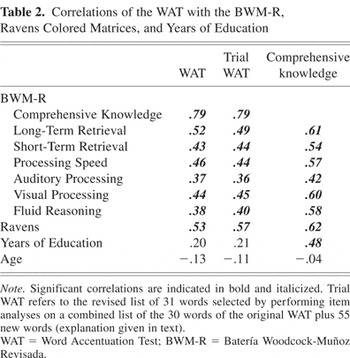
Construct and convergent validity were established by means of Pearson correlations between the original WAT word list of 30 words, the revised WAT word list of 31 words constructed for this research, Ravens Matrices, and the subtests of the BWM-R (Table 2). First, all other subcomponents of intelligence correlated significantly with the measure of crystallized intelligence (Comprehensive Knowledge). Second, the WAT and the revised WAT word list correlated highly with Comprehensive Knowledge, which in turn is based on Picture Vocabulary (confrontation naming) and Oral Vocabulary (synonyms and antonyms) subtests of the BWM-R. Third, the WAT and revised list correlated equivalently with the BWM-R; therefore, a new or revised list is not necessary. All subsequent analyses concern only the original WAT.
Correlations of the WAT with the BWM-R, Ravens Colored Matrices, and Years of Education

No significant gender effects were found. A comparison of WAT scores of men and women showed no significant difference between the groups (t(78) = 1.12). Age was not significantly correlated with WAT scores (−.13), perhaps reflecting that the WAT score is an indicator of crystallized intelligence, which typically (in the aggregate) is fairly stable through the eighth decade of life (Park, 2000). Consistent with this, the correlation between age and Comprehensive Knowledge (−.04) was not significant either. Education and scores on the WAT were not significantly correlated (.20). This finding may reflect the restricted education range in the sample (M = 8.54, SD = 4.20).
Bilingual status did not affect performance on any of the measures. As indicated above, 74 of 80 participants indicated that English was their second language, and the remaining 6 listed English as their third language. Hence, to test for the effects of bilingualism on the intelligence measures (Comprehensive Knowledge, Ravens Matrices, and the WAT), we created low and high English proficiency groups. Because the median of self-reported ability to speak English (median = 3) was also the mode (21), we chose not to perform a median split by ability to speak English, but rather by age-at-first exposure (median = 20). This strategy effectively created a “higher” proficiency group whose mean self-reported ability to speak English was 3.49 (SD = 1.55) and a “lower” proficiency group whose mean was 2.68 (SD = 1.27). Subsequent t tests comparing these groups on Comprehensive Knowledge (t(78) = 1.25), Ravens Matrices (t(78) = 1.17), and the WAT (t =.59) showed no significant differences between proficiency groups. Finally, an analysis of the effect of country-of-origin on the WAT suggests little influence, although only Mexico and Puerto Rico provide enough numbers in this sample (41 and 14, respectively) to test for these effects. A t test shows no significant differences between these two countries on WAT performance (t(52) = .31).
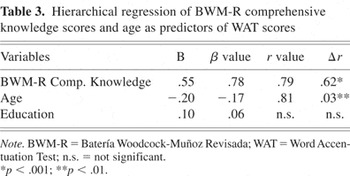
As an additional indication of validity, a hierarchical regression was performed entering BWM-R Comprehensive Knowledge scores, years of education, and age as predictors of WAT scores (Table 3; adjusted r2 = .64, F(2,77) = 71.37, p < .001). Comprehensive Knowledge was a strong predictor of WAT scores (β = .78, p < .001), whereas age emerged as a weak predictor WAT scores (β = −.17, p < .001), accounting for only an additional 3% of the variance in the WAT scores. Education did not enter as a significant predictor. This finding provides additional evidence that relying on years of education alone as an indicator of premorbid intelligence can be problematic (Manly et al., 2003).
Hierarchical regression of BWM-R comprehensive knowledge scores and age as predictors of WAT scores

Linear regression equations were constructed to predict both BWM-R Comprehensive Knowledge scores and scores on Ravens Matrices as follows:

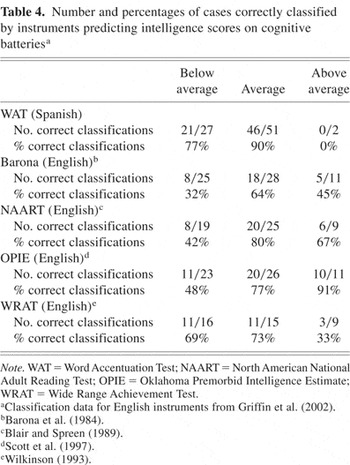
It is important to note that regression equations based on reading tests typically show regression-to-the-mean effects. That is, deviations between predicted and observed scores are greatest for individuals with below-average and above-average scores (Basso et al., 2000; Graves et al., 1999; Griffin et al., 2002; Veiel & Koopman, 2001). To test for these effects, the standardized Comprehensive Knowledge scores (M = 100, SD = 15) were used to classify individuals into three ability groups: below average (89 and below), average (90–109), and above average (110 and over). Table 4 (first row) shows the number of subjects, means, standard deviations, and ranges for the Comprehensive Knowledge and WAT scores for each group. Agreement between the WAT predicted scores and the BWM-R scores was obtained in 67 of 80 cases (84%). Within groups, cases were correctly classified as follows: below average, 21 of 27 (77%); average, 46 of 51 (90%); and above average, 0 of 2 (0%).
Number and percentages of cases correctly classified by instruments predicting intelligence scores on cognitive batteriesa

DISCUSSION
The Alzheimer's Association estimates that the prevalence of dementia among U.S. Hispanics could increase sixfold by the year 2050 (Alzheimer's Association, 2004). Given that many Hispanics have limited English proficiency, neurocognitive assessment must rely increasingly on instruments carefully adapted and normed for a Spanish-speaking population (Artioli I Fortuny et al., 2005). As discussed above, the existing Spanish versions of the WAT (Del Ser et al., 1997; Burin et al., 2000) are based on versions of the WAIS normed in Spain and Argentina. However, Spanish speakers in the United States come from many different Spanish-speaking countries and/or have lived in Spanish speaking regions of the United States for many generations. Hence, an appropriate revalidation of the WAT for use in the United States should rely for criterion validity on a cognitive battery whose norming sample reflects this diversity. For these reasons, we chose the Batería Woodcock-Muñoz-Revisada (BWM-R), which was normed in six Spanish-speaking countries and five U.S. states where Spanish is more commonly spoken.
In adapting the WAT to the U.S. context, we took the further step of having Spanish phonologists generate an additional 55 rare, accented words to combine with the 30 words of the original WAT. This was done to provide alternatives to the original list in case any of those words (selected for Spain) provided insufficient discriminatory power for a WAT adapted for Spanish-speakers in the United States. However, analyses indicated that these additional items did not improve the correlations of the original list with subtests of the Woodcock-Muñoz or Ravens Matrices, and were, therefore, unnecessary. Thus, the original list of 30 words accounts for 77% of the variance in Comprehensive Knowledge scores from the Batería Woodcock-Muñoz and 58% of the variance on Ravens Colored Progressive Matrices. Regression equations are provided that predict both scores from performance on the WAT.
These results are comparable, perhaps superior, to similar results among English speakers for tests of premorbid intelligence predicting scores on the WAIS. Griffin et al. (2002) examined correct classifications of 64 cases using the Barona demographic equations (Barona et al., 1984), the North American National Adult Reading Test (NAART; Blair & Spreen, 1989), the Oklahoma Premorbid Intelligence Estimate (OPIE; Scott et al., 1997), and Wide Range Achievement Test (WRAT; Wilkinson, 1993). Table 4 compares these classifications with those made using the WAT to predict scores on the BWM-R. In sum, the WAT is similar to other reading tests in successfully predicting scores in average ranges on cognitive batteries but tends to underestimate higher than average scores and over-estimate lower than average scores (Johnstone et al., 1996). The WAT appears weaker at predicting above average scores, although a sample with more numerous, highly educated participants would be necessary to confirm this result.
That the available methods for assessing premoribid intelligence generally show regression-to-the-mean effects is problematic for clinical practice and poses additional challenges for psychometric research. Obviously, clinicians must interpret the results in the context of other available data, both from other instruments used in neuropsychological assessment as well as patient background and history. For the existing English instruments, other steps have been proposed. For instance, based on the data shown in Table 4, Griffin et al. (2002) have suggested that different instruments show better predictive ability for different ranges of intelligence. Specifically, the OPIE which combines demographic equations predicting WAIS scores with current performance on certain WAIS subtests, may be a more precise indicator of premorbid intelligence for individuals in the above average range. The WRAT-3, a reading test, is more precise for individuals in the below average range, whereas all three (OPIE, WRAT-3, and NAART) work well for individuals in the average range. Again, this advice is limited to patients who can be tested in English, but it suggests future avenues for instrument development in Spanish. For instance, demographic equations (similar to the English versions predicting scores on the WAIS; e.g., Barona et al., 1984) could be formulated based on information from the BWM-R standardization sample and then combined with BWM-R subtest performance to create an OPIE-like instrument. Another possible response to regression-to-the-mean effects has been made by Veiel and Koopman (2001) who propose statistical corrections for regression equations predicting WAIS scores (Barona et al., 1984; Blair & Spreen, 1989; Krull et al., 1995). Whether or not these equations are effective with WAT scores validated on the BWM-R is a topic of future investigation.
While a principal virtue of this study is that it takes advantage of the cultural and linguistic diversity available in the BWM-R standardization sample, a limitation of the study is the smaller numbers of individuals in our validation sample from South and Central American countries other than Mexico and Puerto Rico. Although no significant differences were found on WAT performance by Puerto Ricans and Mexicans, additional data are necessary to test this relation for the other countries-of-origin in the sample.
Finally, in work with clinical populations, we are initiating a cross-validation of the WAT on Spanish-speaking controls and cognitively impaired individuals. As with the validation of the WAT in Spain (Del Ser et al., 1997), we expect to see significant differences between controls and early to mid-stage dementia patients in performance on cognitive measures (e.g., BWM-R Picture Vocabulary and Ravens Matrices) but no differences on the WAT.
In summary, this study demonstrates the logic and practice of adapting a NART-like reading test for the assessment of premorbid intelligence to the Spanish context of the United States. Specifically, the study demonstrates the concurrent validity of the existing Spanish Word Accentuation Test (WAT; Del Ser et al., 1997) against the Batería Woodcock-Muñoz-Revisada (Woodcock & Muñoz-Sandoval, 1996a). For clinicians working with Spanish-speaking populations in the United States, the WAT provides an indicator of premorbid intelligence as part of more comprehensive neuropsychological assessment and patient history.
ACKNOWLEDGMENTS
This research was supported by grants from the Alzheimer's Association (NIRG 02-3674) and, in part, from the National Institute on Aging (NIA P30 AG13854) to the Cognitive Neurology–Alzheimer's Disease Center of Northwestern University.