Introduction
High fidelity medical simulators (HFMS) are accepted tools for educating and evaluating medical students and physicians without risk to patients. The use of medical manikins has also been well received by other health care workers such as nurses and prehospital professionals.Reference Bond, Kostenbader and McCarthy1 Studies have evaluated the processes but not the contribution of HFMS to the overall training results for trauma life support courses.Reference Barsuk, Ziv and Lin2 Other studies have examined health care worker attitudes toward the use of HFMS in training but have not examined changes in attitude in relation to the amount of trainee clinical experience.Reference Bond, Kostenbader and McCarthy1
This paper is the first to report the use of HFMS in an International Trauma Life Support (ITLS) course. Course participants had varying degrees of clinical experience, and included paramedics, nurses, and physicians. The objective of this observational study was to assess variations in learner responses to HFMS in ITLS instruction, as well as any effect HFMS may have had on course examination scores. In an effort to measure the students’ response to the use of HFMS, pre- and post-course evaluations were administered to collect self-reported attitudes regarding simulators in ITLS training. A secondary observation involved comparing test scores between learners who took the course examination before the simulator session and those who took the examination after the simulator session.
Methods
In December 2009, a tertiary care academic medical center approved as an ITLS provider held a two-day course which included the use of HFMS. No patients were involved in this study and the course evaluation forms were confidential. Full institutional review board (IRB) examination was waived for the study.
The course format was didactic sessions for a day and a half, followed by trauma-assessment training and testing scenarios in the latter part of day two, and ending with a written, multiple choice course examination. In the past, members of each student team would take turns serving as the “victim” undergoing treatment for the trauma-assessment training and testing components of the course. The HFMS simulation replaced the student role-playing in the trauma-assessment portion of the course. One adult manikin and one pediatric manikin, high fidelity medical simulators HAL and Pediatric HAL (Gaumard Scientific, Miami, FL, USA), were used in two separate suites of immersive environments that included sound effects, vital signs monitors (Lifepak CPR, Physio-Control, Redmond, WA, USA) and actual medical equipment. Scenarios included blunt or penetrating trauma, traumatic amputations, and burns.
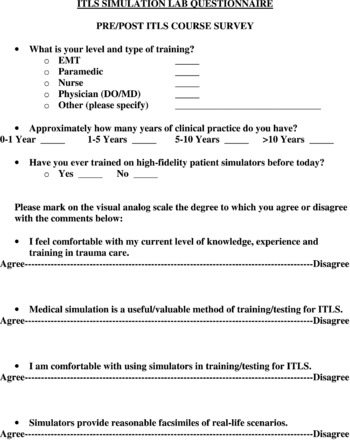
The students reported their attitudes towards HFMS through pre- and post-course surveys. The surveys included demographic data, level and type of training, the number of years in clinical practice, prior experience with HFMS, four visual analog scales (VAS) measuring confidence level regarding trauma care, and attitudes towards the utility of HFMS in trauma education (Figure 1). These questionnaires were derived from Wright, et al., which examined emergency medicine residents’ attitudes toward the use of HFMS in air ambulance training.Reference Wright, Lindsell and Hinckley3 Two questions measuring participants’ subjective responses to HFMS were added. Each student was randomly assigned to one of two groups: one took the post-course examination prior to the HFMS encounter, and the other took the test afterwards. Because this observational study was primarily concerned with attitudes toward simulation, all students underwent HFMS trauma-assessment training, and none engaged in the play-acting involved in previous ITLS courses.
Survey instrument

A paired samples two-tailed t-test was conducted to compare pre- and post-course questionnaire responses. Statistics were calculated using PASW Statistics, Version 18.0.0 (SPSS, Inc., 2009, Chicago, Illinois, USA.
Results
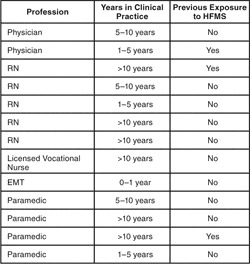
The total number of course participants was 13, representing a variety of health care professionals, years of clinical practice, and previous experience with HFMS (Table 1). All 13 course participants completed pre-simulation surveys, 10 completed post-simulation surveys, and all 13 completed the course examination. This ITLS course represented the first encounter with HFMS for eight out of 10 of the participants completing the post-simulation survey.
Course participants’ professions, experience and previous exposure to high fidelity medical simulators (HFMS)

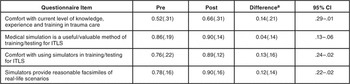
All post-experience responses indicated improvement after simulation completion, with statistically significant increases in comfort with current knowledge, experience and training in trauma care (t9 = 2.18, p < 0.05), comfort with using simulators (t9 = 2.59, p < 0.05), and attitudes regarding simulators providing reasonable realism (t9 = 2.79, p < 0.05). Results are reported in Table 2.
Comparison of pre- and post-examination responses to high fidelity medical simulators (HFMS) (aPaired t9, p < 0.05, n = 10; data are given as mean (SD))

The course participants had positive experiences with HFMS; although six out of 10 indicated positive attitudes towards HFMS prior to their session with the simulators, their post-simulation assessment of the utility of HFMS increased by five percent. Comfort level with simulation training increased by 17% after the simulator sessions, although for 80% of participants, this was their first exposure to HFMS. Course participants’ perceptions of the realism of HFMS increased by 15% after their simulator sessions. The course participants’ reported self-confidence in their knowledge, experience and training in trauma care increased by 27% after their HFMS sessions. Attitudes assessed by VAS improved after the course participant encounters with HFMS.
The most important finding was the improvement in scores on the course-end written examinations. The students were randomly assigned to one of two groups. The first group took the ITLS written course examination prior to their HFMS sessions, and achieved a 50% pass rate (three out of six students passed). The second group took the examination after their HFMS sessions with an 86% pass rate (six out of seven students passed).
Discussion
Previous studies have demonstrated acceptance of HFMS as a means of instruction appropriate for different groups of health care professionals.Reference Bond, Kostenbader and McCarthy1 This study supports that finding, with increased positive attitudes reported by the EMT, paramedics, nurses and physicians who participated in the course. The course participants’ sense of the realism of immersive HFMS increased after their encounters with the simulators; this suggests they could learn to treat high-risk, high-stress conditions such as trauma from the simulation.
The most striking observation of our study is the difference in the written course examination scores between the pre-HFMS and post-HFMS groups. The effect of HFMS on testing was not controlled for, because the primary objective of the study was to survey attitudes about simulation. Test scores are not surrogates for real-world clinical outcomes; however, they indicate retention and comprehension of the material being taught, and in that respect HFMS appears to have improved recall and grasp of the didactic instruction given during this course. Similar to the way in which many health care professionals remember particular patients in the course of their training, rather than diseases taught in isolation of reality through textbooks, HFMS may offer a more memorable, enhanced experience than didactic sessions.
Limitations
The primary limitation of this observational study is the small sample size. Although the course participants represented a diverse background of health care professionals, the total number was drawn from only one ITLS course. In order to confirm these results, the study needs to be repeated with larger numbers of participants.
Although the questionnaire used to survey the students had not been previously validated, it was based on a similar study by Wright, et al. Reference Wright, Lindsell and Hinckley3 The additions made to the survey involved self-reported subjective attitudes to HFMS.
A further limitation of this study is in the correlation of pre-simulation and post-simulation test groups. This was an observational study surveying attitudes towards HFMS. Both sets of students underwent HFMS, and neither group served as a control by undergoing typical ITLS training with students playing the role of patients as has been done in the past. Future trials designed to assess the utility of HFMS in trauma education should include non-HFMS control groups.
The expense of HFMS presents a natural barrier to the broad use of immersive simulation in ITLS instruction. However, if future studies validate improvement in testing and clinical outcomes, failing to incorporate HFMS in trauma and other health care instruction on the basis of cost will become less acceptable.
Conclusion
In this study, HFMS for ITLS instruction was accepted by healthcare professionals of varying backgrounds and degrees of clinical experience. The course participants’ perceptions of the utility of HFMS improved after their encounters with medical manikins. The use of immersive simulation improved self-confidence in knowledge and training in trauma care. Although this study was not controlled, the improvement in test scores suggests that HFMS may aid comprehension and retention of course materials. Further study is needed to validate the findings of this small pilot sample. Comparative studies with non-HFMS control groups are necessary to confirm improved test scores as a result of HFMS.
Abbreviations:
HFMS = High fidelity medical simulators
ITLS = International Trauma Life Support
VAS = visual analog scale