In the wake of the September 11, 2001, attacks and the response to Hurricane Katrina, significant investment was made into emergency preparedness. More recent events, including the Boston Marathon bombing and concerns over the nation’s capacity to care for serious infectious diseases, maintain the nation’s attention on this issue.Reference Lurie, Margolis and Rising 1 To emergently respond to disasters and public health emergencies, hospitals must mobilize physical and human resources as they “surge” to meet a heightened patient demand. Hospital surge capacity—or the maximum potential delivery of required resources through augmentation or modification of resource management and allocation—depends upon daily operational efficiency in both the emergency department (ED) and the hospital.Reference Kelen and McCarthy 2 – Reference Bayram, Sauer and Catlett 4 The immediate bed availability target of the Hospital Preparedness Program in the US Department of Health and Human Services is for 20% of all staffed beds within a health care coalition (a collaborative network of health care and public health agencies serving a local region) to be made available within 4 hours of a disaster-related surge request. 5 Limited inpatient bed availability and inefficient hospital discharge practices leading to holding admitted patients in the ED (ED boarding) impedes operational efficiency and the hospital’s ability to meet these surge requests.Reference Kelen and McCarthy 2 , Reference Bayram, Sauer and Catlett 4 , Reference Soremekun, Terwiesch and Pines 6
ED boarding time, or time spent in the ED after a decision to admit a patient to the hospital but before the patient leaves for an inpatient room, has been highlighted as a benchmark for ED quality and is measured and publicly reported by the Centers for Medicare and Medicaid Services (CMS). 7 The boarding of ED patients that have been admitted to the hospital is a leading cause of ED crowding,Reference Beniuk, Boyle and Clarkson 8 , Reference Hwang, McCarthy and Aronsky 9 reflecting an imbalance in daily surge (demand) and capacity (supply) of limited hospital resources.Reference Beniuk, Boyle and Clarkson 8 , Reference McCarthy, Aronsky and Kelen 10 The adverse effects of ED crowding on patient outcomes during ordinary times have been well described.Reference Pines and Hollander 11 - Reference Bernstein, Aronsky and Duseja 14 Crowding is associated with increased mortality,Reference Sun, Hsia and Weiss 12 , Reference Chalfin, Trzeciak and Likourezos 15 increased hospital length of stay,Reference Sun, Hsia and Weiss 12 , Reference Bernstein, Aronsky and Duseja 14 , Reference Liew, Liew and Kennedy 16 and increased hospital costs. ED crowding is also associated with delays to care including administration of antibioticsReference Pines and Hollander 11 and pain medication.Reference Pines and Hollander 11 , Reference Mills, Shofer and Chen 17 Periods of ED crowding have been linked to increased ambulance transport times for chest pain patients as the result of ambulance diversion, which may increase the risk of death due to delays in care.Reference Schull, Morrison and Vermeulen 18 , Reference Shen and Hsia 19
Boarding admitted patients in the ED has also been proposed as a barrier to disaster preparedness because these practices hinder baseline health resource delivery and emergent resource scaling. 5 , 7 In 2012, The National Quality Forum highlighted the link between hospital crowding, ED boarding, and regional preparedness and emphasized the need for regional measures so that “hospitals and health systems engage in an environment that not only fosters cooperation but also competition.” 5 , 7 More recently, poor performance on ED benchmarks for boarding times was cited as a potential cause for the delayed diagnosis in the first diagnosed Ebola case during the 2014 US outbreak. 20 In the present study, we describe regional variation in patient boarding times across the United States and assess the degree to which areas at risk for disasters or public health emergencies have high ED boarding times and thus are potentially less able to rapidly surge to optimally manage an emergency response.
METHODS
Hospital Study Population and Data Linkage
We performed a retrospective cross-sectional analysis using data from the 2012 CMS Hospital Compare database and the 2012 American Hospital Association (AHA) Annual Survey Database. CMS Hospital Compare is a national database of inpatient and outpatient quality measures from US hospitals. 21 All hospitals receiving reimbursement through the Inpatient Prospective Payment System (IPPS) and Outpatient Prospective Payment System (OPPS) publicly report data through this system; other hospitals may report the data but limit public availability. We identified hospitals reporting median ED boarding time to CMS in 2012. ED boarding time is defined by CMS as time spent in the ED after the decision to admit but before leaving for an inpatient room. Hospitals identified from the CMS database were linked to the AHA Annual Survey by using a unique hospital identifier. The AHA Annual Survey provided ED annual visit data, which we used to develop a regional weighted average ED boarding time (see outcome measure below).
Outcome Measure
The primary outcome was regional weighted average ED boarding time, which we calculated per hospital referral region (HRR). Created by the Dartmouth Atlas of Healthcare, an HRR is a designated geographic area representing a regional health care market for tertiary medical careReference Wennberg and Cooper 22 and is among the most widely used geographic units to describe regional variation in health care delivery.Reference Wennberg and Cooper 22
A regional weighted average ED boarding time was calculated for each HRR, based on reported median ED boarding times per hospital in the HRR, and weighted by the proportion of total ED visits in the HRR that were attributed to that hospital (Equation 1). To weight median boarding times, ED visits per hospital were used as an indicator of relative hospital size. The regional weighted average ED boarding time was calculated as:
 $$\eqalignno{ {\rm Eq. }\ 1. \ Weighted \;Average_{j} \cr={{\mathop{\sum}\nolimits_{i=1}^n {ED \;Boarding \;Time_{{hosptial \, i}} {\times} ED \;Visits_{{hospital \, i}} } } \over {Total \;ED \;Visits_{{HRR \, j}} }}$$
where for HRR j, weighted average j equals the median boarding time for each hospital i, multiplied by the number of ED visits to hospital i, which is then summed and divided by the total number of ED visits to all hospitals in HRR j.
Statistical and Geospatial Analysis
Geospatial analysis was performed to detect geographically concentrated clusters of high or low regional ED boarding times, using both global (Moran’s I) and local (Local Indicators of Spatial Association [LISA]) tests for spatial autocorrelation,Reference Anselin 23 a test for whether there is correlation between data points that are geographically close to one another. We used Moran’s I to test for spatial clustering (nonrandom distribution) of HRR boarding time values across the country. The LISA statistics were used to identify which HRRs neighbor other HRRs with similar or different boarding times. Neighbors are determined by geographic proximity and use an inverse distance method to weight values on the basis of location (further distances are weighted lower than nearer distances).
LISA identifies both the statistical significance of the spatial patterns and the classification of the relationship. We used this method to identify 4 patterns of interest: (1) hot spots, which are clusters of regions (ie, HRRs) with high boarding times; (2) cool spots, which are clusters of regions with low boarding times; (3) high outlier, which is a region with a high boarding time surrounded by regions with low boarding times; and (4) low outlier, which is a region with a low boarding time surrounded by regions with high boarding times. A nonsignificant observation indicates that boarding time in the location is not correlated with times in locations nearby (ie, that boarding times vary at random). ArcGIS 10.1 (ESRI, Redlands, CA), STATA12 (StataCorp, College Station, TX), and OpenGeoDa 1.2 (Center for Spatially Integrated Social Science, Tempe, AZ) were used for statistical and geographic analysis.
Regional Subanalysis
To identify regions at increased risk for terrorist attacks, we identified areas in the Department of Homeland Security Urban Areas Security Initiative (UASI). 24 , 25 The UASI “provides nearly $559 million to enhance regional preparedness and capabilities in 25 high-threat, high-density areas.” 24 Metropolitan regions were linked to their respective HRR boarding times by manually matching UASI names to HRR names.
To identify areas at risk for natural disasters, we identified the top 25 Metropolitan Statistical Areas (MSAs) with the greatest number of Federal Emergency Management Agency (FEMA) declarations from 1964 to 2013. Four types of disasters were included: coastal flooding, severe storms, hurricanes, and tornadoes. 26 These 4 disasters were selected because they occur with the greatest frequency and affect large populations. The total number of FEMA declarations was calculated for each MSA; MSAs were linked to their respective HRR boarding times by manually matching MSA names to HRR names.
RESULTS
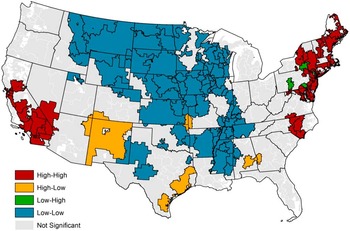
Our analysis was limited to 3317 of 4671 (71%) general medical and surgical hospitals reporting ED boarding time to CMS and ED visit data to the AHA database in 2012. These hospitals were located in all 306 HRRs (100%). The median number of hospitals per HRR was 7 (range, 1-63). Across all HRRs, the median ED patient boarding time was 101.3 minutes (25th percentile: 80.1; 75th percentile: 126.2). The Moran’s I value was 0.17 (z-score: 25.1, P<0.01), indicating clustering of high and low boarding times. The results of the hot spot analysis conducted on ED boarding times in HRRs in the United States are shown in Figure 1. Forty-five high-boarding-time HRRs (in red) clustered in the Northeast and California, with the 5 longest boarding times located in (1) San Bernardino, California; (2) Bronx, New York; (3) East Long Island, New York; (4) New York, New York; and (5) Columbus, Georgia. Sixty-seven HRRs with shorter boarding times (in blue) clustered along the Mississippi River and across the Midwest and Northern Plains regions.
Clustering of ED Boarding Times Across US HRRs. Abbreviations: ED, emergency department; HRR, hospital referral region. The figure shows a spatial autocorrelation map of ED boarding times for HRRs. The map highlights regions with high and low average ED boarding times. The red areas are those with high ED boarding times that are surrounded by similarly high ED boarding times; these are hot spot clusters. Areas of low ED boarding times surrounded by other areas of low boarding times are indicated in blue (cool spot clusters). Areas in green have low ED boarding times but neighbor regions with high ED boarding times (low outliers). The inverse, areas with high ED boarding times surrounded by areas with low ED boarding times, are noted in orange (high outliers). Gray areas had values that were not statistically significant; the values were randomly distributed (ie, not clustered or spatially correlated with their neighbors).

Analysis revealed 7 high-outlier HRRs (in orange) in the Midwest, Southeast, and Southwest had significantly longer boarding times than did their neighboring low-boarding-time HRRs. Four low-outlier HRRs (in green) in the Northeast had significantly shorter boarding times than did their neighboring high-boarding-time HRRs.
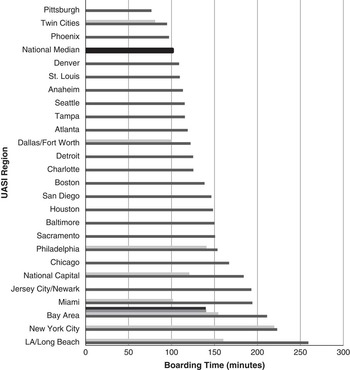
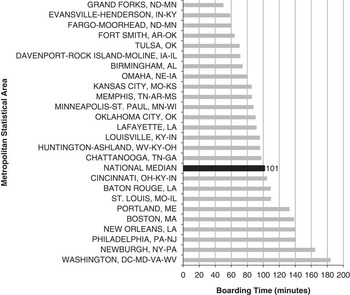
Figure 2 shows boarding times for UASI regions (Figure 2A) and regions identified as high-risk for select natural disasters (Figure 2B). For UASI regions (35 HRRs), boarding times in these regions ranged from 76.7 minutes (Pittsburgh, PA) to 259.3 minutes (San Bernardino, CA). A total of 86% of UASI HRRs had boarding times greater than or equal to the national median (95% confidence interval [CI]: 137.0-166.4), and 2 population-dense UASI regions had boarding times twice the national median: LA/Long Beach, California, and New York City, New York. The median weighted average boarding time for the 35 UASI HRRs (139.9; 95% CI: 113.3-160.3) was higher than the 271 non-UASI HRRs (97.1; 95% CI: 78.4-124.5; P<0.001).
ED Boarding Times for UASI Terrorist-Threatened Regions. Abbreviations: ED, emergency department; HRR, hospital referral region; UASI, Department of Homeland Security Urban Areas Security Initiative. Graph of ED boarding times for 25 terrorist-threatened regions as identified by the UASI. Gray bars identify ED boarding times for the 25 UASI regions. The wide black bar identifies the national median boarding time for an HRR (101 minutes). For some UASI regions, multiple data points are included because some UASI areas include multiple HRRs (ie, Bay Area includes Alameda County, San Francisco, San Jose, and San Mateo County).

ED Boarding Times for High-Risk Natural Disaster Metropolitan Statistical Areas. Abbreviations: ED, emergency department; HRR, hospital referral region. Graph of ED boarding times for the 25 metropolitan regions with the most natural disasters as identified by the Federal Emergency Management Agency. Gray bars identify ED boarding times for the 25 metropolitan regions. The black bar identifies the national median boarding time for an HRR (101 minutes).

For HRRs with a high frequency of weather-related disasters, boarding times ranged from 50.4 minutes (Grand Forks, MI) to 184.1 minutes (Washington, DC). Of these HRRs, only 36% had boarding times greater than or equal to the national median. HRRs with both high frequency of natural disasters and prolonged boarding times were located in major urban coastal areas, including New Orleans, Louisiana; Portland, Maine; and Washington, DC.
DISCUSSION
More than 80% of US urban regions at highest risk of a terrorist attack have prolonged ED boarding times, suggesting an inability to efficiently meet the daily demand for acute care and calling into question the ability of these regions to mount a surge response following a large-scale public health emergency. 5 , 7 Several of these high-boarding regions are clustered together as hot spots, imposing additional limits on surge capacity. If ED crowding during periods of routine hospital demand highlights resource-constrained health care regions and negatively impacts health outcomes,Reference Kelen and McCarthy 2 , Reference Barbisch and Koenig 3 , Reference Beniuk, Boyle and Clarkson 8 , Reference Sun, Hsia and Weiss 12 significant limitations of ED capacity and patient care may also occur during unpredictable, large-scale heath emergencies. EDs are the primary access point for injured patients following a health emergency,Reference Stratton and Tyler 27 and hospital crowding and ED boarding may thus compromise a region’s catastrophic surge capacity.Reference Kaji and Lewis 28
Our novel results identified the relation between US regions threatened by 2 types of public health emergencies and their regional ED boarding times. Weather-related disasters threaten surge capacity for fewer HRRs compared to terrorist-related disasters. More weather-threatened HRRs localized to Western and Plains regions where less hospital crowding and ED boarding was observed. However, almost all terrorist-threatened regions had boarding times greater than the national median.
Some suggest that disasters, particularly weather-related events, may not impede surge capacity because patient injuries may be managed in the ambulatory setting.Reference Stratton and Tyler 27 Indeed, historic weather-related events, such as Superstorm Sandy or the Joplin tornado, damaged a small proportion of the region’s hospital resources, and neighboring hospitals surged to meet patient care demands. The ability of the health care resources within a region to respond when confronted with a more severe weather event that damages multiple regional hospitals in a single geographic area is less clear.
We also note that the majority of terrorist-threatened regions had prolonged boarding times. This finding is particularly concerning, given that the injury profile for patients harmed during a terrorist event will require more intensive critical care resources and hospital admission. Hospital crowding may lead to delays in care and degradation in quality of care and may negatively impact patient outcomes following a large-scale, man-made event.
Catastrophic surge capacity occurs in 2 phases following large-scale public health emergencies. The primary surge response manages acute injuries and illness associated with an event.Reference Mokdad, Mensah and Posner 29 , Reference Runkle, Brock-Martin and Karmaus 30 A secondary surge response occurs as a result of the exacerbation of chronic disease in the setting of limited health care and environmental resources.Reference Mokdad, Mensah and Posner 29 , Reference Runkle, Brock-Martin and Karmaus 30 Following Hurricane Katrina’s widespread flooding and power outages, the incidence of renal-associated hospital admissions for dialysis patients was 2.53 times the incidence before the hurricane, and approximately 3% of dialysis patients in the affected region were hospitalized.Reference Howard, Zhang and Huang 31 Given the extensive burden of chronic disease across the United States requiring complicated medical care and medical devices, secondary surge may present a tremendous patient and resource burden for hospitals in crowded regions.
Surge capabilities are even more in question for many urban, coastal regions vulnerable to both types of public health emergencies. We identified several high-risk regions that may be challenged to adequately surge when necessary, including population-dense cities such as New York, Los Angeles, and Newark, and coastal areas, such as Portland, Maine. In some areas, including Philadelphia, Boston, and Washington, DC, the threat to surge capacity is magnified, because these regions are at risk for both terrorist and weather-related events. Hospitals within these high-boarding-time HRRs may not be able to rely on neighboring hospitals or neighboring HRRs during a catastrophic surge owing to their equally strained systems. As described, the Hospital Preparedness Program has supported the creation of health care coalitions that facilitate regional cooperation and immediate bed availability to help absorb the influx of patients from the event as well as from coalition partners (other health care facilities). 5 Ideally, this would be achieved through a regional, cooperative approach coordinated across multiple health care facilities. Better synergy between population-based quality measurement and coalition-level assessment of boarding might augment preparedness efforts as our data show that health care coalitions in hot spot regions would be severely limited in surge capacity given clustering of crowded hospitals.
Our findings inform national efforts to enhance both daily and disaster-related emergency care. The National Quality Forum has suggested that regional boarding time might be used as a proxy for preparedness to better align health system and emergency management priorities. 7 Just as prevention quality indicators have been used to provide insight into the quality of preventative care services in a community, regional boarding times could be used as a window into emergency care system readiness within a community or a health care coalition. Incentives could be developed to encourage inter-facility coordination and population-based planning approaches that reflect hospitals’ collective responsibility to meet a community’s emergency care needs. Regional simulation events that engage the public health, health care, and emergency preparedness communities may also aid in preparedness efforts by breaking down barriers between traditional domains of the preparedness landscape. Regional planning efforts allow hospitals to take inventory of their surge capacity and work cooperatively with neighboring hospital coordinators in a controlled setting to identify limitations in regional response to emergencies. New measures of real-time inter- and intra-coalition capacity, such as regional dashboards reporting ED and inpatient capacity, may subsequently emerge, which would ensure more coordinated responses to disasters at both regional and national levels. The disaster focus of health care coalitions could be broadened so that regional partnerships focus on improving emergency care of all manner including burn, trauma, critical illness, and disaster care. 5 , Reference Pole, Marcozzi and Hunt 32
Limitations
There were several limitations to our study. First, ED boarding time is only one measure of hospital crowding. Other crowding measures include ambulance diversion hours, number of patients who leave without being seen, number of waiting room patients, ED length of stay, and ED occupancy rate.Reference Hwang, McCarthy and Aronsky 9 , 33 We also recognize that the typical demand for routine health care may not be present during a disaster because elective procedures may be postponed and individuals may individually decrease demand for discretionary health care consumption. However, boarding time is a well-correlated proxy for hospital crowdingReference Hwang, McCarthy and Aronsky 9 and likely more correlated to catastrophic surge capacity of an individual hospital compared to other measures focused on ED operations.
Some small community hospitals may be excluded from our analysis because the CMS database excludes hospitals outside the IPPS and OPPS systems. These hospitals are not mandated to report quality measure data to CMS, and even participating hospitals may opt out of public data reporting. However, because our calculation for regional ED boarding time per HRR was weighted by ED visits to adjust for hospital volume variations, we do not expect that loss of smaller hospitals would influence these calculations. While these hospitals would provide space to assist with surge response capability, estimates of HRR boarding times are a relatively accurate reflection of daily surge capacity limitations.
We recognize that additional selection bias exists in our data, because only general medical and surgical hospitals with ED visits were included in the sample. Health care coalitions are careful to include many facility types (long-term care, EMS, home health, etc) because lower-acuity patients may be transferred from hospitals to other care settings to create acute care beds. Finally, HRRs are not designed to reflect emergency care utilization; self-identified health care coalitions or empirically derived catchment areas based on patient utilization patterns might be an improved unit of geographic analysis for future studies.
Annual ED visits were selected as a measure of relative hospital size to weight boarding time calculations. Annual ED visits is a single measure of hospital size; other measures include total hospital admissions, number of inpatient beds, and yearly hospital visits. However, given that a significant proportion of hospital admissions are made through the ED, annual ED visits is an appropriate measure of hospital size and may in fact overestimate hospital size. Because the AHA survey does not require complete data reporting, several of these other measures were not available in the dataset.
CONCLUSIONS
Urban and coastal HRRs have prolonged boarding times and are clustered among HRRs with similarly long boarding times, raising concern for the ability of a region to adequately surge in the event of a disaster or public health emergency. Inability to manage regional daily surges in hospitals may suggest limitations in the ability of a region to respond to a large-scale event. Regional strategies, including population-based quality measurement, could be used to improve the emergency and disaster care system in the United States.
Acknowledgments
Funding support for this study was provided by the Agency for Healthcare Research and Quality (R01HS23614) and National Heart, Lung, and Blood Institute (K12HL109009).