Background
Caring for a family member with cancer can be challenging physically, psychologically, and financially (Kent et al., Reference Kent, Rowland and Northouse2016). Caregivers provide informal, unpaid aid to family members often to the detriment of their own well-being. Their quality of life is impacted as they struggle to balance the patient's needs with their own needs for self-care and support (Kim and Given, Reference Kim and Given2008). As the daily demands of informal cancer caregiving are increasing (Levit et al., Reference Levit, Balogh and Nass2013), there is a growing need for support interventions for caregivers (Kim and Given, Reference Kim and Given2008; McLean et al., Reference McLean, Gomes and Higginson2017).
Caregivers’ needs may differ based on the patient's place in the cancer continuum (Kim and Given, Reference Kim and Given2008). As cancer patients progress across their disease trajectory from diagnosis to survivorship, each stage requires caregivers to complete new tasks (Kent et al., Reference Kent, Rowland and Northouse2016). Diagnosis is a notable crisis period for patients and caregivers, as many struggle to receive adequate psychosocial, emotional, and informational support (Levit et al., Reference Levit, Balogh and Nass2013; Fletcher et al., Reference Fletcher, Flight and Chapman2017). The caregiver's experience during diagnosis is important because it sets the stage for the caregiving process.
In addition, the caregiving experience is shaped by the caregiver's place in the lifespan. Cancer caregiving in midlife often requires the caregiver to manage the health of both younger and older generations, while juggling professional, romantic, and personal responsibilities (Fingerman et al., Reference Fingerman, Nussbaum, Birditt and Vangelisti2003; Litzelman, Reference Litzelman and Applebaum2019; Zarit et al., Reference Zarit, Polenick and DePasquale2019). Studies of middle-aged familial cancer caregivers have prioritized spousal and parental caregivers, giving less attention to adult children caring for a parent (Litzelman, Reference Litzelman and Applebaum2019). There is little research on how midlife caregivers’ experiences diverge in different types of caregiving relationships.
The primary aim of this study was to describe the unique needs of midlife caregivers of blood cancer patients during the diagnosis adjustment period (which could include initial treatment). We also sought to understand whether the needs of parent caregivers (caring for a diagnosed child) and adult-child caregivers (caring for a diagnosed parent) differ, and if so, how.
Methods
Participants
Participant inclusion criteria were being between 30 and 65 years old and being a self-identified caregiver for one's living child or parent who was diagnosed with acute myeloid leukemia (AML), acute lymphoblastic leukemia (ALL), or lymphoma. The patient must have completed primary blood cancer treatment or maintenance therapy within the past 1–18 months. These cancers were chosen because the treatments are time-bound and affect all age groups.
Procedure
Following University of Florida IRB approval, caregivers were recruited via email through the Leukemia & Lymphoma Society's (LLS) constituent database and using a recruitment posting to the LLS Community, an online community where patients and caregivers can connect to each other, educational information, and research opportunities. Interested caregivers could click a link that led to preliminary online screening based on eligibility criteria. Eligible participants read a waiver of informed consent and could provide contact information. We contacted interested caregivers to confirm eligibility and schedule the phone interviews. Using a semi-structured interview script with 24 questions, we conducted 41 interviews over 2 months, which were audio-recorded and transcribed. Three of these questions pertained specifically to the diagnosis adjustment period (e.g., What led up to the patient's diagnosis?). Two participants were removed from analysis because the patient they were caring for had died, making the final sample 39 caregivers. Interview duration ranged from 18 to 145 min, with a median interview time of 43 min. Participants received a $50 Amazon gift card.
Analysis
Data were managed using ATLAS.ti software and thematically analyzed using the constant comparative method (Glaser and Strauss, Reference Glaser and Strauss1967). Separate analyses were conducted for each caregiver group. Data were segmented to identify text specific to the diagnosis adjustment period, which includes the three questions regarding diagnosis and references participants made to this period throughout the transcript. We reviewed the segmented data multiple times and discussed patterns relevant to the aim. We followed Strauss and Corbin's analytical steps (Strauss and Corbin, Reference Strauss and Corbin1998). We open coded to identify concepts and assign conceptual labels (i.e., code). When possible, and to maintain rigor, labels were generated in vivo (using participants’ words). Codes representing similar phenomena were collapsed into categories (i.e., themes). Thematic salience was determined by Owen's criteria (repetition, reoccurrence, and forcefulness) (Owen, Reference Owen1984). Axial coding was conducted to identify thematic characteristics (i.e., properties) and relationships among themes. Two authors reviewed the analysis at each stage. Once analysis was complete, two additional authors verified findings by analyzing different subsets of the data using the codebook.
Results
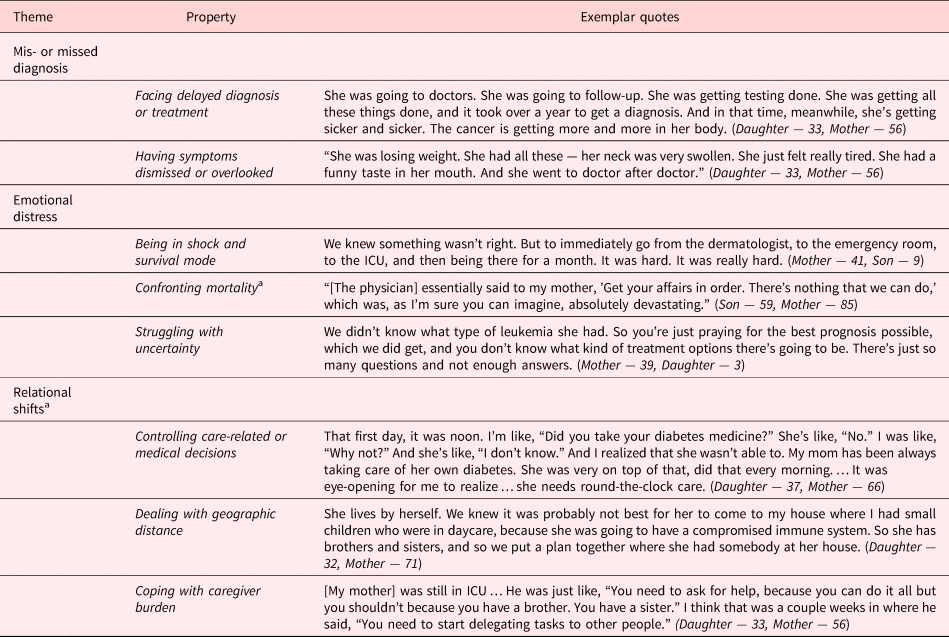
Interviews with n = 20 parent caregivers and n = 19 adult-child caregivers were included in the analysis. See Table 1 for patients’ and caregivers’ demographics. Our analysis identified three major themes: mis- or missed diagnosis and emotional distress, which were described by both caregiver types, and relational shifts, which was described only by adult-child caregivers. Both caregiver types described similar experiences during the diagnosis adjustment period, but these manifested differently in each group. Thematic properties are italicized below (Table 2). Caregiver–patient dyads are identified by the patient's age at diagnosis, the caregiver's age, and their relationship to the patient.
Participant demographics

a ns indicates nonsignificant findings.
Themes, properties, and exemplar quotes

a Only reported by adult-child caregivers.
Mis- or missed diagnosis
Mis- or missed diagnosis was experienced by both caregiver types and was defined by two features: (1) facing delayed diagnosis or treatment and (2) having symptoms dismissed or overlooked. The following results reveal how experiences differed between the two types of caregivers.
Facing delayed diagnosis or treatment
Both parent and adult-child caregivers described challenges with delayed diagnoses or treatment. However, this experience was more prevalent for parent caregivers. All parent caregivers reported a delay (ranging from weeks to years) between onset of symptoms and cancer diagnosis. Participants reported taking their child to see several doctors before leukemia or lymphoma was even considered. One caregiver described how her 17-year-old daughter was mistakenly treated for mononucleosis, a sinus infection, a virus, and asthma before being diagnosed with lymphoma. Caregivers expressed frustration and disappointment, as this mother shared: “[The doctor] missed it. She missed a lot of signs. And I thought, this doctor should have taken blood tests or something.” (Mother — 53, Daughter — 17)
Adult-child caregivers described how misdiagnoses caused treatment delays, which some believed allowed cancer to progress. A caregiver explained:
She was going to doctors. She was going to follow-up. She was getting testing done. She was getting all these things done, and it took over a year to get a diagnosis. And in that time, meanwhile, she's getting sicker and sicker. The cancer is getting more and more in her body. (Daughter — 33, Mother — 56)
Adult-child caregivers reported that their parents also experienced treatment complications as a result of these delays, having to wait until the parent was healthy enough to undergo surgery or chemotherapy. One son shared how this affected his father, who contracted an infection after biopsy:
They wanted him to heal before they started any kind of treatment because the likelihood of dying from a post-operative infection and introducing R-CHOP, which is going to reduce his ability to fight anything off. We waited for about, I guess, it was six months. (Daughter — 47, Father — 64)
Having symptoms dismissed or overlooked
Both caregiver types shared how mis- or missed diagnoses were tied to symptoms being dismissed or overlooked by providers. For instance, parent caregivers recalled persistent cold and flu symptoms or changes in appetite and energy levels. Adult-child caregivers recalled parents having vague symptoms not uncommon in aging adults (e.g., sudden weight loss or prolonged fatigue). As this caregiver shared about her mother: “She was losing weight. She had all these — her neck was very swollen. She just felt really tired. She had a funny taste in her mouth. And she went to doctor after doctor.” (Daughter — 33, Mother — 56)
Parent caregivers also recalled more uncommon symptoms. For example, a mother spent years helping her young-adult daughter search for an explanation for persistent itching, all while facing speculation from physicians and family members who questioned if her daughter's pain was real:
She did not have swollen lymph nodes. Her main symptoms were itching, and her skin was itching terribly every night. It was awful. It was a nightmare. … It was almost as hard as the treatment … just not knowing what she had and the fact that she was so sick, and nobody could figure out what she had. And so they'd tell us to go to the psychiatrist. (Mother — 57, Daughter — 27)
Emotional distress
Both parent and adult-child caregivers recalled significant emotional distress. However, the nature of distress was distinct between the two types. Parent caregivers stressed being in shock and survival mode after diagnosis while adult-children caregivers struggled with confronting mortality. Both types of caregivers described struggling with uncertainty, which was tied to their unique experiences with emotional distress.
Being in shock and survival mode
Parent caregivers recalled being in a state of shock followed by functioning in “survival mode,” meaning just getting by, upon diagnosis. Their shock was exacerbated by the aggressive treatment protocol for pediatric blood cancer, which was often both immediate and inpatient. After experiencing delayed diagnoses, children were admitted to the hospital for inpatient treatment the same day they were diagnosed. They described how this traumatic life change marked the beginning of a weeks- or months-long hospital stay, as this mother shared:
We knew something wasn't right. But to immediately go from the dermatologist, to the emergency room, to the ICU, and then being there for a month. It was hard. It was really hard. (Mother — 41, Son — 9)
Parents were forced to process their child's cancer diagnosis and simultaneously learn how to support them during treatment. Parent caregivers described shifting into “survival mode,” as this mother explained: “It was as if time stopped, but we had to keep going because each day was a different chemo, a different procedure, lab work. It was just — it was a lot of information.” (Mother — 33, Daughter — 1) These caregivers described how survival mode meant prioritizing cancer over everything else, including personal health, career, and even other children: “Nothing else was as important as that. It was just getting her better, getting her comfortable. That's all I cared about.” (Mother — 50, Daughter — 14) They described living “minute-by-minute” and compartmentalizing fears and frustrations to get through the initial weeks of treatment:
I just was numb to everything. I didn't feel the extremes. So I wasn't super sad or super angry. Because at first, I was terrified and angry and a lot of these feelings, and then it just came to nothing. (Mother — 42, Son — 10)
Confronting mortality
Adult-child caregivers highlighted emotional distress related to facing their parent's mortality. Some recalled being told at diagnosis that their parent only had a few weeks or months to live, as one son shared: “[The physician] essentially said to my mother, 'Get your affairs in order. There's nothing that we can do,' which was, as I'm sure you can imagine, absolutely devastating.” (Son — 59, Mother — 85) Even when caregivers were not given a terminal prognosis, the diagnosis propelled them to confront their parent's mortality and its impact on the family:
The most challenging thing for me is I know she doesn't have a whole lot of time to live. … I think the end is near. And what's hard for me with that is my daughters are 20 and 21. They're just graduating from college. One of them is engaged, and what's going through my mind is she's going to miss the wedding. (Daughter — 49, Mother — 69)
Mortality-related distress was compounded when parents had comorbidities, which made treatment challenging and heightened caregivers’ fears about their parent's survival. One daughter discussed how her mother's cancer led to a lung infection and partial heart failure. She was distressed about the physicians’ resistance to start chemotherapy:
Finally I just said, “Listen, she's going to die if we don't start chemo.” [They said] “Well, chemo might kill her.” I said, “Well, she might die anyways, so we got to do something because this isn't working. She's not getting better … It's better to take that chance, doing chemotherapy in a weakened state, than just letting her die like this!” (Daughter — 33, Mother — 56)
Struggling with uncertainty
Both caregiver types experienced uncertainty-related distress but from different sources. Parent caregivers stressed information-related uncertainty. They worried about how little they knew about blood cancer or treatment. Upon diagnosis, parents described waiting in the hospital for days without information regarding the disease or treatment plan, as more tests were run to confirm what type of leukemia or lymphoma their child had. These caregivers mentioned that some doctors recommended starting general chemotherapy even before knowing the test results, as one mother stated:
We didn't know what type of leukemia she had. So you're just praying for the best prognosis possible, which we did get, and you don't know what kind of treatment options there's going to be. There's just so many questions and not enough answers. (Mother — 39, Daughter — 3)
Adult-child caregivers highlighted uncertainty related to caregiving demands, which was tied to mortality distress. They described being uncertain about how they would manage caregiving with their other life demands:
The first thing of course was that you're hysterical about it, that you think they're dying in the next five minutes and you're losing them. … [then] trying to figure out how the hell you're going to do this — because I work full-time, I have three kids, and my husband. I'm already needed enough by them. So, “How do I do this?” and “Do I have to leave work?” and “Do I have to give up my job?” and “What will this look like to my family, and will everybody be able to cope through this?” (Daughter — 47, Mother — 71)
Adult children described uncertainty about the impact on both their parent's life and their own, as this daughter expressed: “What does this all mean? What does this mean for his lifestyle? And his ability to take care of himself? And what is this going to mean for me?” (Daughter — 47, Father — 64)
Relational shifts
Unlike parent caregivers of children, adult children encountered relational shifts in their roles in order to provide care to their parents upon diagnosis. Relational shifts required difficult changes in family structure and as well as new responsibilities or experiences in three areas: (1) controlling care-related or medical decisions, (2) dealing with geographic distance, and (3) coping with caregiver burden.
Controlling care-related or medical decisions
Some adult-child caregivers had to assume control of their parent's medical decision making for the first time, including decisions related to activities of daily living and maintaining care plans at home. As one daughter described:
That first day, it was noon. I'm like, “Did you take your diabetes medicine?” She's like, “No.” I was like, “Why not?” And she's like, “I don't know.” And I realized that she wasn't able to. My mom has been always taking care of her own diabetes. She was very on top of that, did that every morning. … It was eye-opening for me to realize … she needs round-the-clock care. (Daughter — 37, Mother — 66)
In some cases, assuming control of a parent's care meant overruling their wishes. One son had to force his father to seek medical attention: “I said, 'I'm going to take you to the hospital.' … And he turned to me and says, 'No, you're not,' and I said, 'Yes. I'm taking you to the hospital.'” (Son — 37, Father — 71) He was later told by a physician that if they had waited even a week longer, his father would not have survived.
At times, assuming control of medical care meant making life or death decisions, including where their parent would receive treatment, whether to enroll them in clinical trials, and what quality of life their parent would find acceptable. The weight of this responsibility was evident in one daughter's description of how she and her mother discussed treatment options: “I really don't want to say, 'If you don't do this, you're not going to live long,' but I think she goes, 'Well, I'll trust you to make the right decisions for me.'” (Daughter — 64, Mother — 86)
Dealing with geographic distance
Unlike parent caregivers, these adult-children caregivers rarely lived with their parent, with many living states or countries away. Adult children described how, after diagnosis, they had to decide whether they would move home to care for their parents. One daughter shared how she quit her job, gave up her apartment, and moved in with her mother during 9 months of treatment. Another daughter described the difficulties of leaving her young children in America for 3 months to care for her father in China: “My second child, she was only six, seven, eight months old. So I was still breastfeeding, so it was very tough.” (Daughter — 36, Father — 61)
Some participants spoke about how they found ways to coordinate care from their current homes, either by traveling back and forth or by organizing help from loved ones in the area. A daughter who lived in a different area than her mother shared this experience:
She lives by herself. We knew it was probably not best for her to come to my house where I had small children who were in daycare, because she was going to have a compromised immune system. So she has brothers and sisters, and so we put a plan together where she had somebody at her house. (Daughter — 32, Mother — 71)
Coping with caregiver burden
Adult-child caregivers shared that they struggled with caregiver burden. To cope, sometimes caregivers delegated caregiving tasks when other family members were available. One daughter described her husband encouraged her to do this:
[My mother] was still in ICU … He was just like, “You need to ask for help, because you can do it all but you shouldn't because you have a brother. You have a sister.” I think that was a couple weeks in where he said, “You need to start delegating tasks to other people.” (Daughter — 33, Mother — 56)
Geographic proximity, career flexibility, and dependent children impacted the distribution of responsibilities, however. Some caregivers sought long-distance support, as this woman shared:
[My brother] has been a little bit of a support system for me, especially in the beginning. … I'd call him and let him know like, “Okay, here's now what is going on … ” [He] just kind of providing strengths, I guess, to me over a phone call or something like that. (Daughter — 30, Mother — 60)
Not all caregivers were able to share the burden. Some described anger and frustration at being the primary caregiver, having to ask siblings for help, or when they refused to help. A son shared such an experience soon after his mother's diagnosis:
My brother doesn't really want to process all of it. My brother decided he was going to keep his plan to go to [travel] for six months, seven months. And so he went ahead and left. (Son — 46, Mother — 67)
Discussion
Our findings highlight the diagnosis experiences of caregivers in midlife who are caring for a family member with a blood cancer, with a special focus on the distinct challenges of parent caregivers caring for a diagnosed child and adult-child caregivers caring for a diagnosed parent. Caregivers shared common experiences of mis- or missed diagnosis, symptoms being overlooked, treatment delays, uncertainty, and emotional distress. However, their challenges were also tied to their relational role. Particularly for parent caregivers, themes emerged that depicted a state of shock and survival mode as well as informational uncertainty, which were tied to coping with a diagnosis early in the lifespan. Particularly for adult-child caregivers, themes reflected coping with family relational shifts, confronting mortality, and managing cancer in the context of comorbidities and geographic considerations.
Although caregivers of both types reported experiencing mis- or missed diagnoses, almost all parent caregivers received at least one misdiagnosis before cancer was discovered. Misdiagnosis among pediatric patients with leukemia and lymphoma is very common, often diagnosed as infection (Chen and Mullen, Reference Chen and Mullen2017). Cancer is more likely to develop later in the lifespan and, thus, less likely to be overlooked in older adults. Still, older adult patients in this study did report experiencing mis- or missed diagnoses too. This further complicated their ability to receive treatment and contributed to increased emotional distress and caregiving burden. Better systems level and patient-provider communication about time frame expectations and updates may help caregivers cope with informational uncertainty.
Consistent with previous research, emotional distress is a profound part of the caregiving experience, although different caregiver types reported varying experiences of distress. In comparison to adult-child caregivers, parent caregivers highlighted their extreme shock, as facing a life-threatening disease in childhood is far less normative than in old age. From a lifespan developmental lens, confronting mortality in later life, such as is the experience of adult-child caregivers of aging parents, is more expected or normative. Yet, not all adult children will assume the role of caregiver for their parent. It involves a relational shift that requires the adult child to transition into a new family role (Phillips, Reference Phillips1957). These relational shifts or role changes for adult children can exacerbate the already stressful caregiving experience, requiring adult children to reevaluate both their personal identity and their parental relationship (Germino and Funk, Reference Germino and Funk1993). This can be especially true in families where parental caregiving has not been part of the family's norm, perhaps due to cultural factors, ages of its members, or preexisting dynamics (Dilworth-Anderson et al., Reference Dilworth-Anderson, Brummett and Goodwin2005; Anngela-Cole and Hilton, Reference Anngela-Cole and Hilton2009).
Collectively, these findings suggest that a caregiver's needs vary by caregiver relationship to the patient. Caregivers’ psychological processes and concerns during the diagnosis period present differently depending on age of the patient, and caregiving interventions targeting middle-aged caregivers should be tailored based on the intergenerational relationship with the patient.
Clinical and practical implications
Caregiving in midlife for a blood cancer patient is challenging, and caregiving experiences vary based on lifespan factors such as intergenerational dynamics and roles, patient and caregiver age, and the patient's place in the lifespan. Clinicians, psycho-oncology professionals, and researchers can incorporate a lifespan lens to better understand caregivers’ unique needs during the diagnosis adjustment period. For clinicians working with older patients, it is important to address the complex multi-generational responsibilities facing midlife caregivers and the family conflicts that the distribution of caregiving duties can create. Enhanced logistical and psychological support resources are needed to assist adult caregivers through family role and dynamic changes and to better accommodate geographically distal caregivers. The findings of this paper can be used to inform the development of support interventions that address the unique needs of each caregiver group at the diagnosis stage of the cancer continuum.
Study limitations
Participants in the study described aspects of their experience specifically related to the diagnosis and treatment of a blood cancer. Generalizations about the differences between caregiving for this cancer type and others cannot be made from these findings alone. Additionally, only one member of the caregiver–patient dyad was interviewed. Both relational perspectives of a dyad are important, as well as that of the provider. Finally, participants in this study were mostly of White race and female, meaning these findings may not reflect racial, ethnic, and cultural diversity of caregiving experiences.
Conclusion
This qualitative study found that family members in midlife who are caring for a patient with a blood cancer commonly experienced mis- or missed diagnosis, treatment delays, emotional distress, and uncertainty. Parent caregivers described a state of shock and informational uncertainty. Adult-child caregivers described coping with family role reversals, confronting mortality, managing cancer despite comorbidities, distributing the caregiving burden among family members, and geographic considerations. The findings of this study stress that intergenerational roles, relationship type, and age impact caregivers’ experiences and, ultimately, their needs. More work should be done to understand how these findings vary in different ethnic and racial groups. Scholars should also investigate interventions, system-level efforts, and process changes that contribute to the psychological toll of cancer diagnosis on the family unit.
Funding
Funding for this project came from the Carolan Research Institute and the Leukemia & Lymphoma Society. No grant number.
Conflict of interest
There are no conflicts of interest.
Data availability statement
The data that support the findings of this study are available from the corresponding author upon reasonable request.