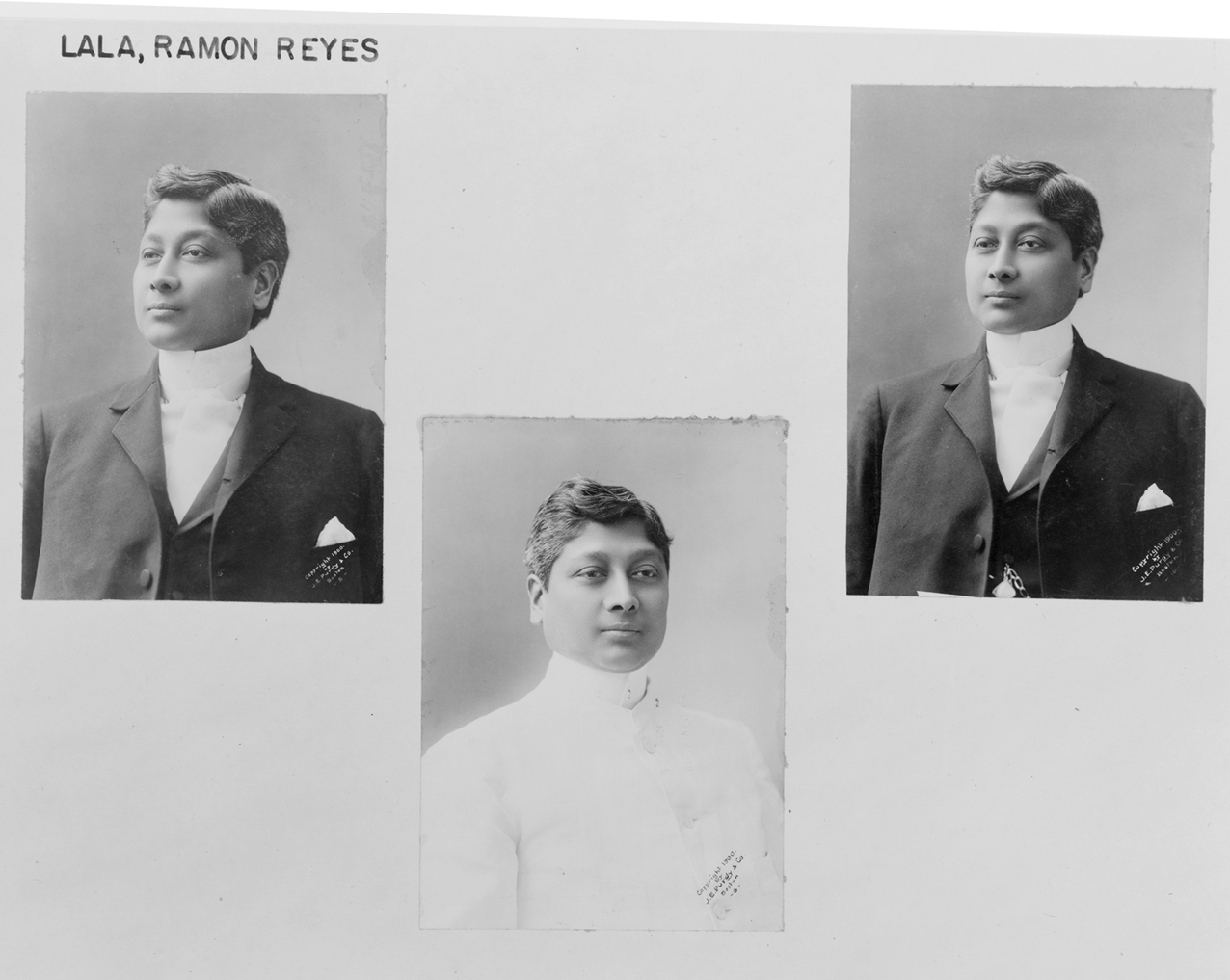
When the American navy defeated Spanish ships in Manila Bay in 1898, U.S. ignorance about the Philippines was deep and widely acknowledged. President William McKinley could not locate the seven-thousand-island archipelago on a map. Finley Peter Dunne's Mr. Dooley asked if the Philippines were islands or canned goods. But great ignorance presented Ramon Reyes Lala with an equally great opportunity (figure 1). Lala was born in Manila in 1857 and immigrated to the United States in 1887. He became a naturalized citizen in 1896 and was living in New York City when, just two years later, Americans suddenly became desperate for knowledge about his native land. Lala left his middling job as a clerk and fashioned himself into an authority on the history, economy, and environment of the potential new U.S. possession. In multiple articles with titles as unvarying as “A Filipino View of Filipinos” and “A Prominent Filipino's Views,” Lala offered an insider's perspective that shaped and confirmed what Americans thought they knew about Spain, its colonies, and more generally about tropical landscapes and people. Lala's Philippines were rich in natural resources that remained untapped due to what he called the “effete rule of Spain.” He pleaded for the United States to send “the scientist, engineer, and practical economist” to discover “what the Philippines have to add to the useful productions of the world.” In short, Lala announced to rapt audiences in 1898, the Philippines were open for business. His invitation to investors earned him the praise of the American press, the patronage of the Republican Party, and a nearly decade-long public speaking career in the United States.Footnote 1
Lala included the above images in his letters to American politicians, alerting them to the publication of his book, The Philippine Islands. Ca. 1900. Photograph. https://www.loc.gov/item/99403755/

Lala's success in the middle-class economy of print and public speaking depended on his deft maneuvering between modalities of power hardening in terms of race. That is, over the course of his American career, Lala became a legal and social anomaly. He was a Philippine nationalist who rejected the sovereignty of the First Philippine Republic; an outspoken advocate of annexation and Philippine statehood at a time when the U.S. public, for a variety of reasons, was uncertain of the war and rejected statehood. While many attending his talks imagined Filipinos to be half-clad primitives, Lala donned a suit, spoke lightly accented English, and claimed to hold degrees from Britain and Switzerland. He was also a naturalized citizen just as the U.S. Congress and Supreme Court ruled naturalized citizenship impossible for Philippine colonial subjects. Citizenship was Lala's most valuable possession. As a legal right, it allowed him to traverse the lecture circuit without fear of deportation; as cultural capital, it enabled him to speak to audiences as a political equal. Lala offered himself as proof of the present Filipino capacity for U.S. citizenship. But in fashioning himself into a representative “Filipino,” Lala hid a South Asian background and an alleged short stay in the Philippines. He also fabricated his British degree. Nonetheless, Lala cultivated a Republican Party patronage network eager to present him as a counter to tours by Filipino nationalists sponsored by the Anti-Imperialist League and the traveling expositions of Cordilleran peoples. Republicans offered Lala, neither nationalist nor savage, as evidence of U.S. benevolence and Philippine civilizational potential shorn of citizenship. Lala's embodied contradictions, then, extended to his position as a producer of colonial knowledge, a racialized commodity, and a representative Filipino in the United States when many in the archipelago would not recognize him as such.
This essay reconstructs Lala's career as a booster of American Empire in order to illuminate the role of commerce in colonial knowledge production and the possibilities for Philippine American citizenship embedded within. I eschew assigning a fixed identity to Lala and instead view him as a deracinated migrant who traversed the Spanish, British, and U.S. Empires before reinventing himself in the United States as the “first Filipino American.” His success reflected an understanding of the United States born from diasporic merchant communities in an age of imperial trade barriers and Philippine nationalism.Footnote 2 Lala—equal parts intellectual, huckster, and insult comic—does not necessarily illuminate the elite tensions that contributed to the construction of a colonial state.Footnote 3 Rather, he offers a view into how non-elites harnessed U.S. expansion while managing its dehumanization. Here I am following lines of inquiry opened by Michael Salman and Adrian De Leon, both of whom center commerce as a medium of colonial knowledge production. Salman locates the idea of a draconian pre-Spanish Philippines in the archival afterlife of works by the professional forger José E. Marco, whose wares assured private American collectors of their own benevolence.Footnote 4 De Leon's recovery of the Cordilleran subjects of American ethnographic photography reads beyond images of abjection for evidence of their negotiations for “fair wages, good working conditions, and individual and collective dignity in visual representation.”Footnote 5 Lala, too, legitimated American Empire in pursuit of personal ambition. He contrasted the imperial rule of the United States with that of Spain, thus flattering U.S. sensibilities. But he also made a case for Philippine comparability to the United States. In demanding recognition of his U.S. citizenship, Lala blurred the boundaries between the imperial and the domestic that ultimately limited his use as a Republican token of native support for empire. This led Lala to pursue public speaking on the fictive travel circuit, wherein he made a case for Philippine American citizenship by contrasting Filipinos with other foreign-born and non-white Americans.
Lala's career thereby brings Filipinx diasporic history into conversation with the histories of blackness and indigeneity. U.S. historians have grappled with the ideological, military, and economic relationship between American settler colonialism and overseas expansion but are just beginning to ask how Philippine-identified people made sense of the United States with respect to indigenous, immigrant, and African American peoples.Footnote 6 Lala's engagement, I argue, was ambivalent. Like the African American trickster, Lala “deployed the quintessential weapons of the weak—charisma, deflection, improvisation”—to advance his standing in a United States hostile to Filipino American citizenship.Footnote 7 Like early twentieth-century indigenous intellectuals, Lala understood his self-fashioning as inextricable from his representation of Filipinos as a whole. His “urge to play” Filipino, to paraphrase Kiara Vigil on the networks of indigenous authors and performers, was part of a “strategy to intervene” in the emerging U.S. discourses around Filipino-ness.Footnote 8 But shorn of ties in the Philippines and larger Filipino communities in the United States, Lala remained dependent on white middle-class audiences. Lala increasingly countered his racialization by emphasizing the primitiveness of non-white and immigrant Americans. Filipino inclusion, he intuited, depended on the exclusion of others, suggesting the limits to inter-imperial solidarities with the U.S. Empire.Footnote 9
Indian and Pacific Ocean Worlds
After twelve seemingly quiet years in the United States, Ramon Reyes Lala went public. Spurred by the sudden interest in the Philippines generated by the War of 1898, Lala introduced himself to American media consumers as a wealthy, urbane, and highly educated Philippine businessman. What we know of this biography comes from Lala himself: that he was born in mid-century Manila; left for Britain and enrolled in St. John's College, London, in 1878 before relocating to Switzerland; and that his encounter with European ignorance about the Philippines left him determined to write “a history of my own fatherland.” Lala returned to Manila at some point in the 1880s, determined to write a natural and political history of the archipelago. But, “because of my sympathy with the rising cause of the insurgents, Spanish tyrants banished me from my country and my kindred.” Lala left Manila with “all the manuscripts I had already written, resolved to finish the task I had set before me amid a more congenial environment.”Footnote 10 He found that congeniality in New York.
Extant archival records do not quite bear out Lala's claims. Though Lala never named his family ties, the revolutionary nationalist Apolinario Mabini did. In response to a 1900 inquiry about the rising U.S.-based speaker, Mabini wrote he did “not personally know Mr. Ramon Reyes Lala, for his residence in the Philippines has been very short; but I know his father who is a native of Indian Empire (sic).”Footnote 11 Mabini was referring to Lala-Ary, proprietor of the Fonda Francesa de Lala Ary—Lala Ary's French Hotel—located in Manila's Binondo district. Additional evidence for Mabini's assertion is hidden in Lala's name. “Lala,” unusual even in the linguistically diverse Philippines, is a Hindi honorific for bankers, merchants, tradesmen, and clerks.Footnote 12 Over time, the father's honorific became the son's last name. There is also no evidence that Lala graduated from St. John's College, London. Indeed, there was no such school. The promotional material for his 1902–1904 lecture tour corrected the error and identified Lala as a graduate of St. John's College, Oxford. That institution does not have a record of Lala on its roll of attendees.Footnote 13 The more pertinent question to ask then is how Lala's transformation from the son of an Indian Ocean hotelier to prominent Filipino American mirrors the Philippines’ transition from a Spanish to American colony.
The elder Lala-Ary followed Indian Ocean trade routes, the British Empire, and Spanish liberal reforms to mid-century Manila. He had previously managed Singapore's Hotel de l'Europe before purchasing the Fonda Francesca building from the American-based Russell and Sturgis trading firm in 1875. His move from Singapore to Manila was characteristic of what William G. Clarence-Smith calls a hidden history of South Asians in the Spanish Philippines.Footnote 14 Hindi and Muslim merchants from Gujarat, later followed by Hindi merchants from Sindh, added Manila to extant business in British ports as Spain gradually opened its Pacific colony to foreign trade in the wake of its American losses. South Asians joined a cast of British, American, French, and German merchants, as well as Chinese merchants and Christian and Druze Arab merchants from Ottoman Syria. By one account, Lala-Ary spoke Hindi, Malay, Spanish, English, German, and French.Footnote 15 His multilingualism allowed him to cater to these merchant communities. As an 1894 Hong Kong directory advertised, “English, American, and all European visitors will find [the Fonda Francesa] the most comfortable hotel in the Philippines.”Footnote 16 Ramon Reyes Lala's young life, then, was marked by brief encounters with a cast of cosmopolitan merchants and travelers, giving him access to global networks. Syrian diasporic ties were so broad that ship manifests indicate that Syrians in New York traveled to Manila by way of Marseilles and the Suez Canal well before 1898.Footnote 17
Spanish authorities intended for freer trade to make its Pacific colony more profitable in the wake of its American losses but imposed restrictions on foreigners in an effort to prevent more loss. The combination instead unmoored Spanish authority. Richard Chu has shown how Chinese merchants evaded restrictions on their mobility by marrying indios and converting to Catholicism.Footnote 18 The sons of this mestizo merchant elite contributed to an emergent Philippine nationhood. Educated abroad, they embraced the title ilustrado—the enlightened—and expected their literary, artistic, and scientific achievements to bring greater political rights within the Spanish Empire. When it did not, ilustrados rejected Spanish classificatory systems and “began to identify as indio or naturales.” Their cultural productions shifted from defining their place within Spain toward establishing an ilustrado right to govern an independent Filipino nation.Footnote 19 South Asians, by contrast, dealt with Spanish restrictions by appealing to British Consuls. British imperial status effectively allowed South Asians to remain a class apart and outside the fold of Philippine nationhood.Footnote 20 Nonetheless, Lala-Ary's Fonda Francesa became a gathering place for ilustrado nationalists. José Rizal, by far the hotel's best-known ilustrado guest, had the protagonist of his two incendiary anti-Spanish novels lodge at the Fonda Francesca. The hotel, if not Lala-Ary, became immortalized in nationalist folklore.Footnote 21
Ramon Reyes Lala was in New York when Spanish authorities executed Rizal, an event credited with sparking the Philippine Revolution in 1896. But he appears to have imbibed the excitement of Philippine nationalism from afar, extending its flexible citizenship to himself. Lala framed his 1887 move to the United States as an exile, however unlikely. While Spanish authorities did punish nationalists with expulsion, none went to the United States. Rizal was imprisoned in Mindanao. Others took refuge in Hong Kong and Singapore, facilitating the ilustrado conception of Britain as more liberal than Spain and political ties to other Asian nationalists.Footnote 22 It is possible that Lala followed Syrian merchant networks to New York. But in a telling mark of just how little formal emigration tied the Philippines to the United States, Lala or a clerk altered his 1896 citizenship application. Rather than renounce his fidelity to the typeset “Emperor of Germany,” someone crossed it out and wrote “King of Spain.”Footnote 23
This is not to say that the United States did not cast a large shadow over the Spanish Empire. The economic collapse of the 1870s that had led the Russell and Sturgis firm to sell its building to Lala-Ary saw Britain, France, and Germany reorganize into closed imperial trading blocs. Colonies gained access to these markets in exchange for political subordination. The United States, too, erected protective barriers to commodities such as sugar. Landed and commercial elites in the Spanish Caribbean debated how to accommodate protectionism.Footnote 24 Cuban and Puerto Rican nationalists divided between those who sought complete separation from Spain, assimilationists seeking representation in the Cortes, and groups Lillian Guerra calls “pro-imperial nationalists” who proposed that annexation to the United States offered access to markets and constitutional rights.Footnote 25
The strategic benefits of U.S. statehood and citizenship in a world of empire reverberated within the United States and across the Pacific as well. Indigenous North American intellectuals like Charles Eastman understood citizenship to mean political equality put toward the exercise of self-determination.Footnote 26 The Hawaiian nationalist Joseph Moku‘ohai Poepoe, writes Noenoe K. Silva, hoped federal citizenship and suffrage rights would counter the power of the American-descended oligarchy.Footnote 27Ilustrados likewise imagined possible engagements with the United States. Rizal traveled from San Francisco to New York by train in 1888, impressed by U.S. technological prowess but wary of its territorial ambitions.Footnote 28 The Visayan planter Juan Araneta, by contrast, was so inspired by American agriculture that he rechristened two haciendas “California” and “Louisiana”—the states he believed offered a model of federal, scientific, and landowner cooperation.Footnote 29
Filipinos would not consider annexation to the United States until the War of 1898. Exiled in Hong Kong since 1896, Emilio Aguinaldo urged Filipinos not to take up arms against the United States if Spain called upon them to fight.Footnote 30 But whereas Aguinaldo envisioned U.S. intervention as a step toward independence, others proposed the Philippines become a suzerainty or protectorate of the United States. This pragmatic option, the ilustrado Trinidad Pardo de Tavera argued from within the Partido Federalista after 1900, offered Filipinos control over internal affairs while freeing them from the costs of foreign engagement with hostile imperial powers.Footnote 31 Lala lobbied for a similar position from within the United States though he did so with no sustained contact with the Partido Federal. He did so as just one participant in a new and burgeoning American marketplace for Philippine knowledge. In this marketplace, books, articles, and connections could overcome loose ties to the archipelago and bring political appointments and personal advancement.
Lala's Expert Performance in the United States
The War of 1898 generated a traffic in information about Spain's largest colonial holding in the Pacific. Though the yellow press had familiarized U.S. readers with accounts of Spanish barbarity in Cuba, there had been very little coverage of the concurrent Philippine Revolution. The Philippines, lamented the American artist Frank D. Millet in 1899, “remained outside the Kodak zone.”Footnote 32 U.S.-based publishers rushed to fill the void, extending book contracts to anyone with a bare knowledge of the archipelago, a deft pen, and reproducible half-tone photographs. Journalists and naturalists most readily fit the bill. Guidebooks by the war correspondents Murat Halstead and Trumbull White bundled the Philippines with Cuba, Puerto Rico, and Hawaii as barely distinguished “new possessions.”Footnote 33 The Macmillan Press courted naturalists for a series of books on colonial governance. The retired University of Michigan collector Joseph Beale Steere declined to turn notes from his two mid-nineteenth-century expeditions to the islands into one printed volume, but his protégé, Dean Conant Worcester, seized the opportunity. Macmillan also repackaged the British naturalist Benjamin Kidd's London Times articles as The Control of the Tropics (1898) and Alleyne Ireland's twelve years of travel writing on British Asia and Africa into the more formal textbook, Tropical Colonization: An Introduction to the Study of the Subject (1899). The Arthur Clark Company, meanwhile, funded an elaborate archival collecting expedition for what would become the fifty-five volume The Philippine Islands, 1493–1803.
These books netted their authors lucrative careers in colonial administration. Kidd resigned from his post as a clerk in favor of an all-expenses-paid speaking tour throughout the United States and a meeting with McKinley.Footnote 34 University of Chicago President William Rainey Harper appointed Ireland “Professional Lecturer and Special Commissioner for the Study of Colonial Affairs,” a position that Jessica Blatt argues reflects American political science's entanglement with colonial race science.Footnote 35 Worcester parlayed his book into a post on the Schurman Commission investigating conditions in the Philippines (1899) and a long career as the Philippine Commission's director of the Interior Bureau. From this perch, he oversaw the Bureaus of Ethnography, Agriculture, and Science, all of which aided his investments in gold mining, coconut plantations, and cattle grazing.Footnote 36 James Robertson, one-half of the duo behind The Philippine Islands, 1493–1803, followed Worcester's course from collector to administrator when he became director of the Philippine National Library in 1910.
Worcester and Robertson protected their careers by shaping a narrative about Philippine incapacity for independence. Worcester's ethnographies extended Spanish and ilustrado framings of upland people as tribal but cast U.S. governance as essential to the protection of these childlike savages from more advanced but vicious Tagalog lowlanders.Footnote 37 As Gloria Cano and Salman have each shown, Robertson rejected material challenging American claims to public education as its signature reform and was easily goaded into paying exorbitant sums for fraudulent material affirming U.S. benevolence. This included Marco's forged Code of Raja Kalantiaw, “a supposed precolonial legal code of uncharacteristic harshness.”Footnote 38 The Chicago industrialist Edward E. Ayer purchased Robertson's material on behalf of the Newberry Library. Paired with Alleyne Ireland's tenure at the University of Chicago and Worcester's ties to Michigan, the rush for Philippine knowledge positioned the upper Midwest as an institutional center for Philippine Studies in North America for most of the twentieth century.
Lala aspired to make the same leap from author to administrator. He lacked the patronage of a figure like Ayers, the prestige of a land grant university such as Michigan, and the cachet of speaking as a representative of the British Empire. But Lala did possess a set of valuable commodities he had brought from the Philippines: photographs. He offered use of these photographs to New York's Continental Publishing Co. in exchange for a contract to publish his history of the Philippines. While he wrote, the Continental Publishing Co. sold the images to other press outlets. An unnamed representative alerted an editor at The Century, “we have the only first-class photographs of scenes in the Philippine Islands, in this country. They are of recent date and most excellent subjects and were taken by a native who is now in the United States.” The fee was negotiable, and the publisher could “also supply an article, if desired.”Footnote 39 The Continental Publishing Co. did not bother to identify Lala by name, allowing “native” to lend authenticity.
Lala's New York anonymity allowed him to reinvent himself as an ilustrado—born into landed wealth, educated abroad, and exiled for his nationalism. He became a guest of the Fonda Francesa rather than the son of the proprietor. It was a distinguished background that further distinguished Lala from competing authors, thus offering insight into the making and marketing of an ostensibly “native” author. In tone, content, and title, Lala's The Philippine Islands differed little from Worcester's. Both began Philippine history at the moment of Spanish contact and jumped to the eighteenth-century British occupation. Yet only Lala penned a dedication thanking Dewey, “whose recent great victory over the Spanish-fleet has begun a new era of freedom and prosperity for my country,” and McKinley, “in whose hand lies the destiny of eight millions of Filipinos.” Like the concurrent promotion of Eastman's works, Lala's racialization as Filipino enabled him to appeal to white authors and authorities for support.Footnote 40 But in a U.S. environment in which the Philippines figured as a source of future revenue rather than an imagined past, Lala's marketing as native sought to establish that he possessed a more intimate knowledge of the archipelago than the passerby. Lala also modified the ilustrado biography to suit American audiences. He tapped into the public's deference to British authority in imperial matters—and the attendant imagining of white middle-class Americans as “Anglo-Saxon”—by fabricating a British degree from the fictional St. John's College, London.Footnote 41
The book's impending publication allowed Lala to cultivate ties with American political figures, who in turn cemented his presentation as a native informant. The publisher solicited a blurb from Minnesota Senator Cushman K. Davis, chair of the Senate Foreign Relations Committee and soon-to-be negotiating member of the Paris Peace Commission. Davis instead wrote an introduction praising Lala's knowledge.
Everybody knows, in a general way, that the Philippine Islands produce sugar, rice, hemp, tobacco, coffee, and many other agricultural staples, and that they are rich in minerals and valuable woods. But heretofore it has been very difficult to obtain specific information upon these subjects. Mr. Lala has given this information.Footnote 42
Davis also affirmed more bluntly what Lala intended his British degree to imply. Lala, Davis wrote, came to the United States already “instructed in European thought, tendencies, and methods.”Footnote 43 Filipino by birth, British by education, and American by citizenship, Lala was an ideal broker for the United States’ newest territorial possession.
Lala sent copies of his book, an author photograph, and requests for letters of recommendation and an appointment on the Philippine Commission to a slew of Republican officials between 1899 and 1900. The materials are a testament to how he inserted himself into what Vigil calls an “epistolary culture” of patronage and colonial knowledge production. He endeavored to visually represent himself as both Filipino and American. The three shots composing the author photo include two depictions of Lala in a black tuxedo jacket; just one in the white jacket deemed more characteristic of the tropics (figure 1 again). The responses reveal a party officialdom eager to anoint Lala a “representative Filipino” who could speak on their behalf as McKinley's reelection centered on the war of occupation. Francis V. Greene, commander of the Second Philippine Expeditionary Forces, recommended Lala be put on a list of regular speakers for Republican candidates. Greene introduced Lala to General Daniel Butterfield, who was arranging a celebration in honor of Dewey. Lala, wrote Greene, would make an excellent speaker at the celebration. He was “the only Filipino residing in this country; at all events, he is the only one of education, refinement and position” and a “firm friend of the US, as I think most Filipinos are also, in spite of the present troubles; and I think he is well qualified to speak on behalf of his own people.”Footnote 44
Lala's campaign talks bore a superficial resemblance to Republican stances on annexation. Echoing McKinley's talk to Methodist ministers, he cast Philippine retention as the only honorable option available to the United States. Lala implored an audience at New York's Wellesley Club, “Of you, Americans, I, a Filipino, therefore, beg, to not leave my countrymen as you found them! You cannot, in humanity, give them back into Spanish bondage. You cannot, in justice, sell them to some European or Asiatic Power, to become subject, most likely to another tyranny.”Footnote 45 But whereas McKinley paternalistically framed the United States as duty bound to “uplift and Christianize” childlike Filipinos, Lala's Filipinos were adults. Filipinos, he continued, “feel that they have fought for, and won, their own freedom, though acknowledging that you have facilitated it. They would, therefore, oppose such disposition to the bitter death. And a Filipino knows how to die! Let a thousand martyrs attest!”Footnote 46
By casting Filipinos as adults, Lala chose not to assuage anti-annexationist fears of interracial sex and unregulated Asian immigration with appeals to paternalistic duty and the civilizing mission. He instead offered his possession of U.S. citizenship as evidence of the Philippine capacity for citizenship through annexation more generally, defusing any discomfort with the subversive potential of his message with humor. Annexation, he joked, was an already consequence free fait accompli: “I have been asked to say a few words about the much-discussed and little-known Filipinos, of which long-suffering and much-maligned race I am, I believe, the only one that is also an American citizen … I am already annexed!” Yet his insistence that Filipino American citizenship was non-threatening came at the cost of distancing Filipinos from Yellow Peril caricature without necessarily dismissing the assumptions of racist depictions. “The Filipinos,” he argued to the tony Wellesley audience, “are not a race of irrepressible savages, a noisy horde of Asiatic cut-throats, unversed in the ways of the Occident, demanding the boon of American citizenship.” Filipinos were just like him: “We have our own lawyers and doctors, and other professional men by the hundreds, educated, as I was, abroad in Europe, or in America, or in the universities of Manila. We have our poets, artists, musicians, who have awakened the wonders of travelers, the admiration of Europe. We have our merchant-princes and our large planters. We have our native customs, our large cities, our own architecture; in brief, our own civilization.”Footnote 47
Lala further defused anti-annexationist contentions that the Philippines were hostile to white settlement—an argument advanced in Kidd's Control of the Tropics—by reworking common geographical tropes. While many annexationists naturalized the Philippine occupation as part of the westward march of civilization over indigenous savagery, Lala framed Pacific expansion as part of the American triumph over Spain. The Spanish had failed to develop the Philippines not because they had degenerated under the heat of the tropical sun but because, in his words, “the [Spaniard] looks upon nature with a lazy eye, troubling himself little about anything that cannot be put to some immediate use.”Footnote 48 Just as the United States had made the West productive, so too would Americans unleash latent Philippine wealth. In an article alluringly titled, “Gold in the Philippines,” Lala set aside the inconvenient history of Mexican independence and instead proposed, “that wherever the United States plants its foot gold appears … For some three centuries Spain held the [Californian] soil, and its golden treasure lay hidden and undreamed of; but no sooner had the United States gained the land than gold seemed almost to sprout up under every bush.” The same, he promised, waited abroad. “For gold has long been known in the Philippines, and vast deposits of it may await the hand of the conqueror, as they did in California and Alaska.”Footnote 49 His portrayal of the California soil withholding its riches from Spain but opening to the United States imbued the Philippine land with its own agency but one that would bend to the American will.
By faulting Spain for failing to harness Philippine wealth, Lala also neutralized discussions about the so-called unfitness of tropical people for free labor. In accord with the tenets of tropicality, Lala did not deny that the heat and humidity produced great agricultural wealth and impeded the indigenous will to labor. He would tell the readers of Everybody's Magazine that “The Filipino is a philosopher. He works when necessary to live, but he has a remarkable capacity for resting. His wants are few; the warm sun and fertile soil render the task of living cheap and easy.”Footnote 50 Lala, however, argued this trait was mutable. Like Rizal before him, he rooted the supposed disinclination to work in Spanish misrule.Footnote 51 “The rule of the Spaniard,” Lala wrote, “was not calculated to bring out the best element in their [Filipino] nature, and under different management they may prove far more tractable and industrious. Indolent as the climate makes them, they can work steadily enough when fairly paid and justly treated.”Footnote 52 But whereas Rizal believed that national independence was a precondition of productivity, Lala emphasized that better “management” was key to making tropical labor efficient. In this, Lala contributed to the concurrent transnational racialization of agricultural labor throughout the global and American South. In their aggressive pursuit of outside capital, U.S. Northeastern-railroad and banana entrepreneurs in the Caribbean, along with new South boosters, recast black labor as docile and trainable.Footnote 53
Lala developed a repertoire of metaphors that made the Philippines legible to Americans by likening it to the United States. Yet these metaphors could sometimes destabilize and subvert U.S. conventions. Lala, for instance, rejected cartoonish depictions of Aguinaldo as an obstinate and undisciplined child, arguing instead that the Philippine recourse to guerilla warfare was rational in light of the American Civil War and Reconstruction. Well-versed in the romance of Reconciliation, Lala explained that Filipinos responded to the U.S. presence as they did because, “The methods of the American carpet-bagger and the exploitations of the American machine politician, are not unknown to the educated Filipinos, and they would be sure that they will not exchange medieval tyranny for a nineteenth century despotism.”Footnote 54 He attributed the participation of rural and uneducated Filipinos in the insurgency with recourse to Spanish misdeeds. Recounting the indiscriminate imprisonment of suspected revolutionaries and public executions, Lala asked if it was a surprise that Filipinos would resist U.S. authority. Without yet knowing Americans, unlike himself, Lala insisted Filipinos, “look upon all the white race as alike, and have had such bitter experience with one nation of whites that they do not propose, if they can in any way avoid it, to fall again under the dominion of what they consider a faithless and cruel race of oppressors.”Footnote 55 All peoples, Lala argued, had the capacity for violence. In what may have been a veiled reference to the massacre of black North Carolinians in Wilmington, Lala asked, “surely a few acts of violence among the Filipinos should not surprise you, when, even in one of your most civilized Christian communities—only a few days ago occurred a series of public crimes that have shocked the whole world.”Footnote 56
Whether it was because he was an effective campaigner or because he collapsed too many boundaries, Republican officials did not appoint Lala to the Philippine Commission. Henry Cabot Lodge wrote to Roosevelt that Lala “seems to me exceptionally fitted to do good work for the United States in the Philippines.” Yet, in a frank admission how little was known about Lala, Lodge added the following caveat, “I feel sure that unless there are circumstances in regard to him of which I have no knowledge he could render us very valuable service.”Footnote 57 “Roosevelt,” Lodge informed Lala, “replied that he knew about you and was anxious to avail himself of your services, but he did not know in what direction this could be done; that he would like, however, to have your application, together with such letters and endorsements as you cared to put with it, and he would forward it to Governor Taft and suggest that some suitable position be given to you in the Islands.”Footnote 58 Taft redirected Lala's application back to the United States. Lala received a response from the office of the Secretary of War nearly a year later, indicating that he would have to apply directly to Taft for a post.Footnote 59 Taft, however, deemed Lala more useful as textual evidence for his many reports on conditions in the Philippines. Writing to the Secretary of War in 1901 about alleged Philippine character traits, Taft cited Lala who, “ought by ties of consanguinity to be able to understand them, however, kaleidoscope-like they may be.”Footnote 60
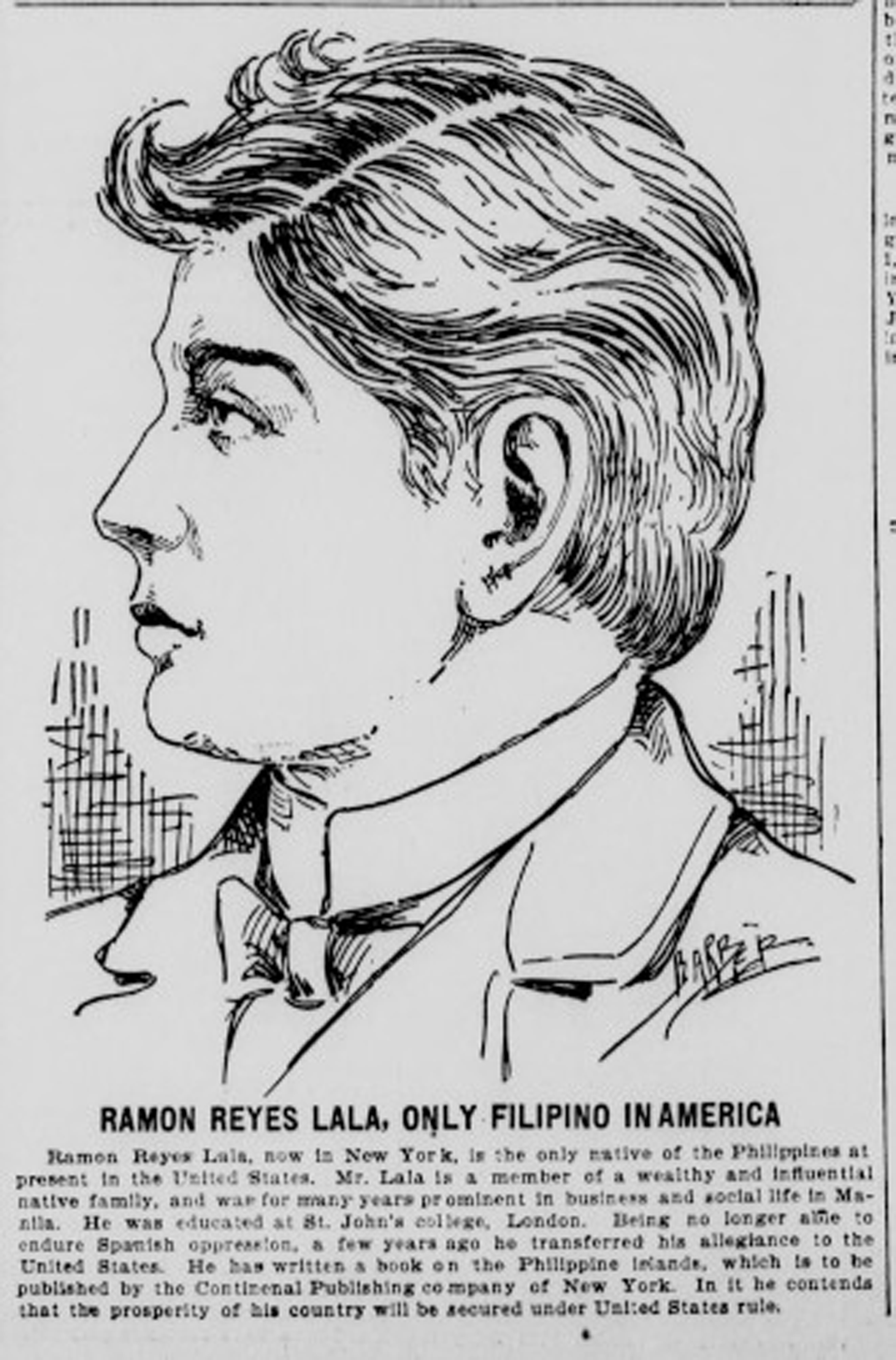
Lala forged a speaking and writing career independent of Republican political campaigning once a government post proved elusive. His success was dependent on cultivating and maintaining favorable relations with what could be a fickle press that struggled to make sense of Lala. He was initially rewarded for providing what Davis called “specific information” on the Philippines with a warm U.S. press reception. The Los Angeles Herald bestowed on Lala the title, “the only Filipino in America,” and ran an accompanying sketch Europeanizing his features (figure 2).Footnote 61 More often he was identified as “a Filipino of that mingled Malaysian and Caucasian blood that produces the most intelligent, cultured, energetic people in the Philippines.”Footnote 62 Lala, wrote another, was “tall, handsome, animated, and speaks English fluently … [he] is in demand as an authentic and interesting lecturer and writer on the Philippine Islands … He presents the Filipino as he really is and discusses the commercial possibilities of the ‘Key to the Orient.’”Footnote 63 Another paper clung tightly to Lala's brown skin and marveled over his fluency in English, issuing what can only be described a most backhanded compliment: “Mr. Lala speaks English fluently, and barring the color of his skin, would not be taken for a native of the Philippines.”Footnote 64 Though Roosevelt and civic nationalists used the category “English speaking people” as a way of assimilating European immigrants into the American body politic, Lala's English did not necessarily grant him access to whiteness.Footnote 65 An AAAPS review of Lala's The Philippine Islands dismissed the book's value solely because “the native hue of his narrative is clumsily covered … with a veneer of western civilization. In charity to our new subjects, therefore, we will refrain from further comment upon this native contribution to the literature of the country.”Footnote 66 The New York Times, on the other hand, judged the information he could provide worthy of trust out of expediency: “While we are not particularly informed as to his past, or the authority to which his views are entitled, it is so rare to have the testimony of an educated native, necessarily familiar with the facts in the islands and obviously a temperate and sensible writer, that it cannot fail to have peculiar interest.”Footnote 67
The Los Angeles Herald's short feature on Lala identified him as “the only Filipino in America.” Despite the whitened features, the piece did not identify Lala as a U.S. citizen. September 11, 1898, p. 4. California Digital Newspaper Collection, Center for Bibliographic Studies and Research, University of California, Riverside, http://cdnc.ucr.edu

In light of such gatekeeping, Lala projected wealth as a testament to his trustworthiness. The appearance of wealth, writes T. Jackson Lears, acquired a “heavy cultural weight” in the highly “mobile, anonymous society” of the Gilded Age.Footnote 68 The stock market beckoned investors to entrust their money to strangers, while coal-fired rail and steam-powered ships made it easier for those strangers to abscond when investments did not pan out.Footnote 69 But Lala's projection of wealth involved refashioning stereotypes of the tropical. In this respect, Lala's performance resembled that of another deracinated shape shifter, William Henry Ellis. Born enslaved in Virginia and forcibly relocated to East Texas, Ellis manipulated the white-black color line by laying claim to the many identities and shades in the periphery of the expanding United States. As in Lala's case, bilingualism was key. Ellis leveraged his Spanish fluency into a claim of Mexican citizenship, building a career brokering U.S.-Mexican trade.Footnote 70 Both men mastered the anti-Spanish fervor of the 1890s. In New York at the same time as Lala, Ellis planted a story in the press that identified him as a Cuban insurrecto of Mexican descent and a “Captain in the insurgent army.”Footnote 71Everybody's Magazine, meanwhile, published a fantastically dramatic and unsubstantiated account of Lala's exile. He had been, “involved in one of the many fruitless revolts against Spanish authority. Orders for his arrest were issued, but he succeeded in escaping to the mountains of the interior, and after a month of hardship, was smuggled aboard a sailing vessel, in which he came to New York.”Footnote 72
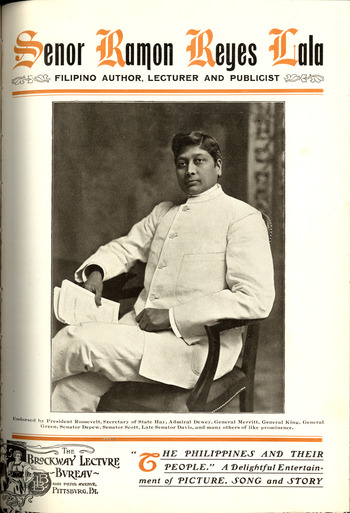
Caricatures of an imagined tropical elite flattened what white middle-class Americans thought of as former Spanish colonies. Lala traded the black suit he wore in 1899 for a public wardrobe made exclusively of white linens (figure 3). A Cleveland paper deemed Lala, “in a white suit and white canvas shoes … an interesting and picturesque figure, typical of the land through which, with the aid of a darkened hall, beautifully tinted stereopticon views and remarkable powers of description, he managed to guide his hearers.”Footnote 73 Lala played “Sobre Las Olas” (Over the Waves) composed by the Mexican American Juventino Rosas in 1888 as part of his stock Chautauqua talk after 1904.Footnote 74 A Boston Globe review reflexively referred to Lala's piano rendition as a “Filipino” song.Footnote 75 Inasmuch as Lala aimed to define Filipino American citizenship, he more often contributed to a vision of a decontextualized tropical elite by playing to the audience.
Lala photographed in the white linens he wore during his American lecture tour. Redpath Chautauqua Collection, Special Collections, University of Iowa.

Lala's ability to craft a Filipino ethnicity based on a stereotyped Latin elite was challenged on multiple fronts. He found himself competing with images traveling back to the United States from the warfront and with newly arrived Filipinos. The Anti-Imperialist League arranged for the nationalist Sixto Lopez to travel to Boston. Lopez had been an intimate of Rizal and narrowly escaped execution in 1896 only to find himself exiled by U.S. forces in 1899. From Boston, Lopez embarked on a nationwide speaking tour against the occupation in which he admonished the conduct of the war and called for immediate independence. According to Michael Patrick Cullinane, the league also reproduced over a dozen broadsides and pamphlets by Lopez, a complement to the more than one hundred essays Lopez published in local and regional papers.Footnote 76 While Lala framed Philippine resistance to American rule as understandable in light of the violence of the recent Civil War and Reconstruction, Lopez cast it as natural as any war of national independence, reminding Americans of their own revolt against British rule. “In this respect, the Filipinos do not differ from the Americans. They have at least a right to the same sentiment, and they are just as ready to refuse to submit to the loss of that which, to them, is dearer than anything America can provide.”Footnote 77 While Lala donned a white suit, charmed audiences with folk songs, and praised Taft, Lopez can be seen wearing black, insisting that full independence was a matter of upholding the universal ideals of justice and liberty.
At the other end of the imperial visual spectrum, Lala competed with depictions of tribal savagery. The St. Louis world's fair included an “Igorot Village” among the Philippine display. Though the upland performers had negotiated their wages and working conditions, Philippine-based elites well understood that displays of loincloth-clad men in front of thatched huts suggested that the archipelago was not capable of independence.Footnote 78 Lala read these displays as an assault on his U.S. citizenship. By framing the Philippines as a domestic possession as yet foreign to the United States, Igorot Villages mirrored the emerging legal relationship of Filipinos to the American federal state. Filipinos, the Supreme Court ruled in the body of law known as the Insular Cases, were to be colonial subjects of the American nation—potential migrants and military labor for the United States undeserving of the right to naturalize in the United States.Footnote 79 Lala understood that the decisions, when paired with imperial spectacle, rendered him, quite literally, the only Filipino American citizen. His later lectures therefore positioned the Philippines as an already integral part of a geographically dispersed and ethnically composite United States. His venue for this message was not the world's fairs and populist Midway spectacles open to indigenous performers. It was the fictive travel movement.
Lala entered into a contract with the Brockway Lecture Bureau of Pittsburgh in 1903. The bureau arranged a tour on the Chautauqua circuit and published his promotional materials. A typewritten text of his talk at the Smithsonian's Natural History Museum indicates that he most often spoke to fictive travel clubs, which, as Kristen Hoganson writes, taught largely white female middle-class members to view the world as a place already disciplined for their enjoyment.Footnote 80 Lala's tourist audiences came ready to embark on an excursion to the tropics. Lala obliged— but only to a degree. An attractive four-page pamphlet featuring a large photograph of Lala typically attired in a white linen suit highlighted his endorsements by noted Republican annexationists, including Roosevelt. The pamphlet stressed that Lala spoke “cultured English without a trace of foreign accent,” his voice capable of filling the largest venue. He delivered the “exotic” in familiar notes tailored to the comfort of largely Midwestern middle-class audiences. The pamphlet also promised over two hundred photographs.
Though the photographs are now gone, Lala's transcript gives us an idea of what he displayed to U.S. audiences. He broke his written text into numbered paragraphs, each indicating the introduction of a new illustrative image. Much like his book and standard travel guides, Lala opened with Magellan's “discovery,” imagining that the “brown-skinned natives” “watched their strange white visitors, believing them angels of light.” He smoothed over his nod to difference with a presentation of maps that explained the size and shape of the archipelago with reference to American states. Luzon, he shared, was as large as all the mid-Atlantic states and well-positioned for trade. “For commercial purposes no country in the World is better situated.” Lala then brought his audiences deep into its interior, described in luxuriant and sexualized tones of tropicality. “Luscious fruits, in rich clusters hang from the pendant of boughs of myriad trees, inviting the passers-by to a feast. The Philippines are a veritable Eden: a paradise of beauty—an El Dorado of hidden wealth.”Footnote 81
But he quickly moved to framing the tropical exotic familiar and domestic. In this, his tour functioned as a counter-ethnography. Aware of the dangers of appealing too exclusively to the tropics of imagination, particularly that which associated them with disease, Lala emphasized health and cleanliness. The island of Corregidor, situated off Manila Bay, was “the sanitarium of the Philippines, and one of the healthiest spots on the globe.”Footnote 82 Moving to an image of people bathing in the Pasig River, Lala questioned “whether any people in the world are cleaner than the Filipinos. Nearer Manila or Cavite, it is not an unusual sight to see hundreds of them disporting in the surf, and where water is not accessible, a native will carry a jar of water many a mile, that he or she, may bathe with it.”Footnote 83
Lala domesticated the Philippines by rendering the United States foreign. When discussing two stereopticon slides of Binondo—the neighborhood of the Lala-Ary Hotel—he softened the presence of Chinese merchants and shops by likening the neighborhood to New York's Lower East Side: “In each of the small stores, on a little counter, sits a Chinaman, casting accounts by means of the ancient abacus. Another stands behind the counter, and acts as a salesman; a third is in the front, drumming up custom, very much after the manner of Moses Cohen, of Baxter Street, New York.” Chinese traders, he bluntly stated, “are the Jews of the Orient.” Seeking a big laugh that we can only imagine the audience returned, Lala speculated that New York's “Moses Cohen would starve in the Rosario.”Footnote 84 He declined to share that Binondo was also home to his father's Lala-Ary Hotel. Nor did he let on that the ilustrados he posed as would have once been considered Filipino Chinese mestizos.
Belonging to and thereby favoring none, Lala laid out the strengths and limits of Filipino groups while drawing on stereotyped metaphors that his audience could understand. He wielded causal racism as evidence of his own cosmopolitanism and a deflection of his racialization. The laundry women of Sampaloc, he shared, “don't do it in the good old Irish style; but they do it nonetheless.” The “thousands of Chinamen in Manila,” he further shared, were not in the laundry business until the American occupation.”Footnote 85 Bucking the reports of U.S. soldiers and moral reformers, Lala offered that Manila cockfights were not “accompanied by one tenth of the disorder and brutality that attends our American prize-fights. They know nothing of the solar plexus for they have no Bob Fitzsimmons. That type of man we shall not attain till we are civilized.”Footnote 86 He waited until his 140th image to introduce “Negritos,” the Aeta of Luzon's Pampanga province. Before flicking to the image, he spit at the audience, “But probably you have wondered where the uncivilized Filipinos are, the types you have expected to see, rather than such I have shown you. Well, here are some of them.”Footnote 87 Lala then raced through a description that seethed with resentment, referring to the Aeta as “puny, stupid, and ugly, of a low order of intellect and deficient in judgement, and aggressiveness.”Footnote 88 Unable to distance himself from tribal Filipinos without recourse to a joke at the expense of African Americans, Lala concluded his brief segment on tribal Filipinos with an analogy. The Aeta, he joked to presumably receptive white audiences, “are as partial to hen-roosts, and as fond of chicken as is the proverbial colored person of America.”Footnote 89
While Lala's racist humor presented the United States as foreign, his domesticating metaphors likened the rest of the Philippines to the United States. The Nipa dwellings that Americans erroneously read as shacks were, in his translation, the “Home Sweet Home, as the Filipino of the middle-class knows it.”Footnote 90 He emphasized the nipa home's architectural suitability to the tropical climate. By elevating the home six feet above ground with the support of bamboo stilts, air could “circulate freely beneath” and “snakes and insects” could not enter. “It is as you see, in every way built in a style conducive to both health and comfort … the rooms and passageways are conveniently arranged, and the design of the whole domicile aims at coolness and cleanliness, both essentials in this hot, moist climate.”Footnote 91 He also softened difference with ample reliance on humor. Not all was lost, for instance, if a snake did make its way into a home as “he is the house-cat of the Islands, and is a first-class rat-catcher.”Footnote 92 Upending the boundaries between foreign and domestic, animal and human, home and pest, Lala concluded his series of housing images: “Mosquitos, rats, snakes, bats, and Americans are things one must get used to in Manila.”Footnote 93
Lala ended his fictive tour with a ride on the Manila-Dagupan Railway—a symbol of a progressive future. He acknowledged that the American rider might find the MDR “primitive and slow, too slow for the American taste,” but assured his audience it “will only enable you to see the country better.”Footnote 94 Smiling villagers run out to the train to express their thanks and “shout a kind Adios” before returning to the work of cultivation.Footnote 95 While his fictive tourists may have preferred to linger in the rural idyllic, Lala called for the lights to come on and shared his vision for the future. “Towns will be laid out, factories will be built, and work will call for hands that are both willing and able; then shall civilization lead my nation to that freedom, and that prosperity which is now the envied privilege of the American people.”Footnote 96 He reminded his audience that they were directly implicated in the Philippine future. Lala still did not give up hope that this future included citizenship. His last words to his audience were that they make “manhood, not being, the criterion of American citizenship.”Footnote 97
Conclusion
Lala disappeared from the archival record just as suddenly as he appeared. He did not campaign for Taft in the 1908 election nor did he advocate for or against Woodrow Wilson's policy of Filipinization. His failure to earn a position in the colonial government of the Philippines may be a mark of his success in the United States and the extent to which he fell victim to it. In 1898, the immigrant clerk living in New York leveraged his proximity to that city's publishing industry to forge a career as a public intellectual. This was a career he may have sought as a young man in Manila, as did many ilustrado nationalists. Lala, however, seems to have been peripheral to the figures on which he fashioned himself in the United States. Though the American press at times expressed some doubt toward his claims, it nonetheless embraced Lala as an authentic Philippine voice in support of American annexation and colonialism. Lala published widely in American periodicals and became a sought-after Republican speaker and fictive travel lecturer. He contributed to an emerging understanding not just about the Philippines but about the place of the United States in the world. As the intervention against Spain gave way to a bloody and protracted colonial conquest, Lala assured his audiences that the United States was a benevolent power and that the loss of life—American and Philippine—would be returned in riches. To judge from the newspaper endorsements of his Chautauqua circuit talk, Lala's audiences left absolved of guilt for the war and occupation. Lala's lecture, wrote one paper, focused on the “condition of the people in the Islands under Spanish and American rule” rather than “the bloody scenes of carnage in the Philippine wars.” His was “an educational treat, and his listeners went away feeling that if the Filipinos are of the splendid type of men that Senor Lala is, the Islands and their people were well worth fighting for and paying $20,000,000 in terms of settlement.”Footnote 98 Lala, wrote another, affirmed that the American attitude toward the Philippines was “not of greed and gain, but love and fidelity, as America has ever followed the steps of God.”Footnote 99 His use to the American officials on whom his speaking career depended may have faded as debates over war and annexation eased after 1902.
While white audiences may have left assured of the righteousness of American rule, Lala's words—especially his reluctance and resentment toward picturing so-called tribal savages—reveal a certain ambivalence toward the American imperial project. Annexation, he quickly understood, did not guarantee Philippine statehood. The colonial status of the Philippines therefore threatened the American citizenship he attained in 1896. Lala's representational politics revolved around securing statehood and American political citizenship for the Philippines. His strategies for doing so—letter writing, network building, and consistent writing and public speaking —are reminiscent of other indigenous intellectuals who also sought U.S. citizenship as a way to build rather than diminish rights for their communities. Lala made this case, however, by emphasizing the alleged primitiveness of African Americans and Jewish immigrants. He did not challenge the racialized hierarchy that measured diverse cultures according to a scale of civilization so much as he tried to position himself higher up on that scale. His was a politics forged around his singularity. Lala was, in many respects, “the only Filipino in America.” This singularity may also account for his disappearance from the U.S. press and politics. He died in New York in 1921, his occupation unknown.
Within the state archive of American Empire in the Philippines, Lala now comes to us as a footnote. U.S. officials did not reward him with an appointment, but colonial administrators, including Taft, gladly drew on his writing in support of their positions in the expanding American Empire. In reconstructing his brief public career, this essay illuminated his ambivalent and sometimes subversive representational politics contained within his archival contribution. He advocated for an American Empire in which Filipino American citizenship—and hence political equality however limited and constrained —was an immediate right rather than a promised but distant future.
Acknowledgments
I would like to thank my 2017 OAH panelists, especially Tore Olsson for his comment; Adrian De Leon for extensive and invaluable feedback on an earlier draft; William Gervais Clarence-Smith and Megha Sharma Sehdev for a genealogy of Lala's name; the anonymous reviewers for their insights; and Rachel Berger, Sarah Ghabrial, Katherine Lemons, Virginia McCormick, Elena Razlogova, and Yumna Siddiqi for reading many drafts.